Original | Odaily Planet Daily(@OdailyChina)
Author | Asher(@Asher_ 0210)

In the current crypto market landscape, if there's one altcoin that can still excite the market, it's probably HYPE.
Market data shows that the HYPE/BTC and HYPE/BNB exchange rates have continued to hit new all-time highs, with HYPE/BTC currently at 0.0006249 and HYPE/BNB at 0.075. This indicates that HYPE's strength is not merely following the market rebound but consistently outperforming mainstream crypto assets like BTC and BNB.
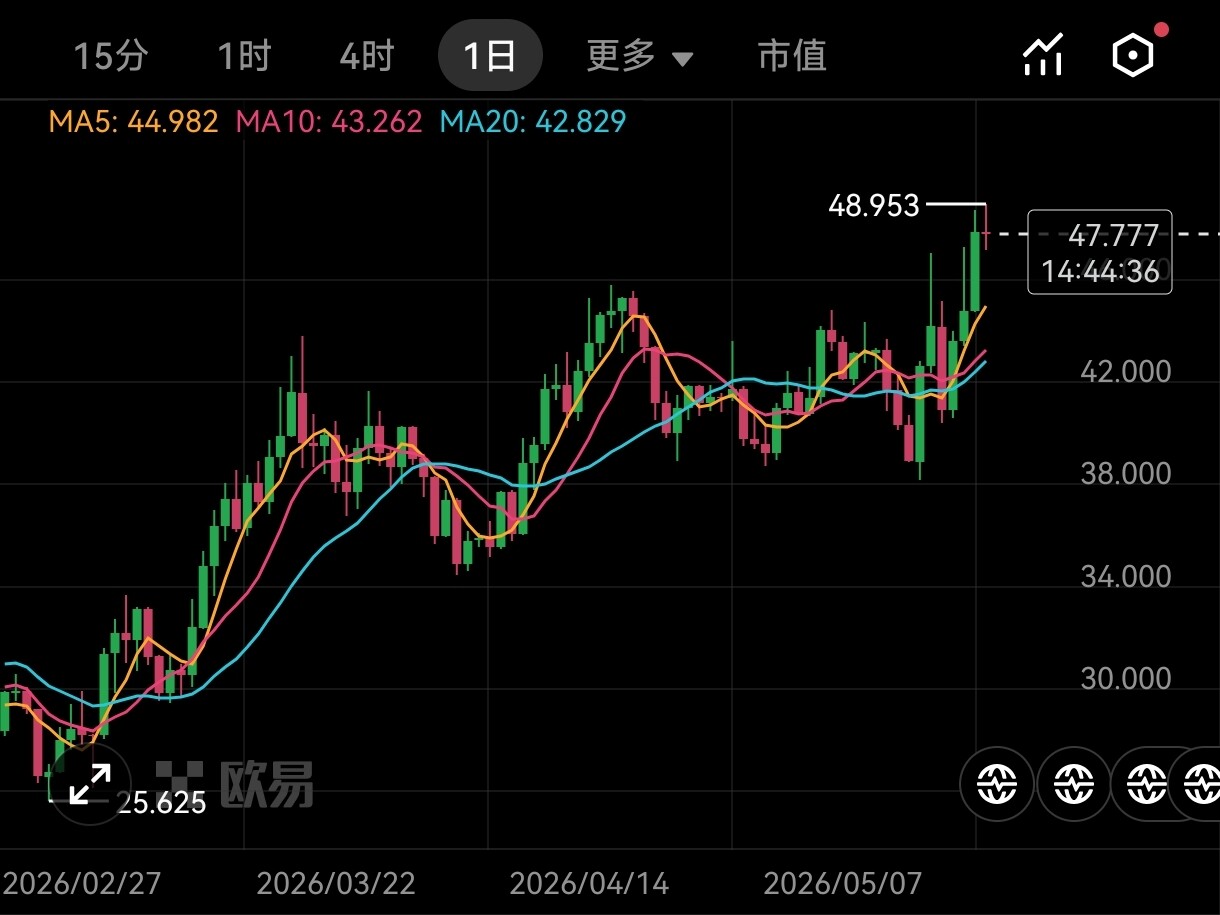
Previously, the public understanding of Hyperliquid was more limited to being a high-performance Perp DEX. However, capital is clearly no longer just buying a decentralized exchange platform token; it's betting that Hyperliquid can integrate more asset types, more liquidity, and more trading scenarios into the same on-chain trading system.
HYPE's price performance reflects the market reevaluating Hyperliquid's value.
In this article, Odaily Planet Daily will dissect the logic behind its rise through several key changes.
From THYP to BHYP: Compliant Buying Channels for HYPE Are Opening Up
The first external catalyst for HYPE's recent surge is the opening of ETF channels.
Currently, two asset management institutions have begun launching ETF products centered around Hyperliquid. On May 12, 21Shares listed the Hyperliquid ETF under the ticker THYP; on May 15, Bitwise listed the Hyperliquid ETF under the ticker BHYP. Data shows that as of May 18 EST, the total historical net inflow for 21Shares Hyperliquid ETF THYP reached $12.901 million; the total historical net inflow for Bitwise Hyperliquid ETF BHYP reached $2.0446 million.
More crucially, Bitwise did not stop at just issuing the ETF. Yesterday, Bitwise announced that it would use 10% of the management fee income from its BHYP Hyperliquid ETF to hold HYPE on its corporate balance sheet, and the related HYPE holdings will also be staked.
This transforms the ETF narrative from a mere product launch into a potential source of sustained buying pressure. The larger the ETF's scale and the higher its management fee income, the greater the theoretical amount Bitwise would allocate for acquiring HYPE. In the short term, this capital may not immediately dictate the price; but in the long run, it links ETF growth, the asset manager's income, and HYPE holdings together.
In other words, ETFs don't just bring HYPE one-time hype; they open a new funding channel. HYPE is starting to transition from a crypto-native asset into an on-chain trading platform token that traditional capital can also price.
USDC Returns to Hyperliquid: HYPE Gains Potential Daily Buying Pressure Exceeding $400k
The second reason for HYPE's recent rise is that with the return of USDC to Hyperliquid, the market has begun to recalculate the protocol's future stable revenue and whether this revenue can continue to flow towards HYPE buybacks.
According to an official Hyperliquid announcement, Coinbase will act as the fund deployer, Circle will be responsible for CCTP and native cross-chain infrastructure deployment, and both have committed to staking HYPE to activate AQAv2. This means the USDC return is not just a simple stablecoin integration, but a new mechanism established by Coinbase, Circle, and Hyperliquid around native USDC, cross-chain liquidity, and reserve yield distribution.
The key is that Coinbase will subsequently share the majority of USDC reserve yields with the Hyperliquid protocol. While the exact revenue split has not been officially disclosed, if referencing the previous USDH yield distribution mechanism, Hyperliquid could potentially receive about 90% of the reserve yields. Therefore, the market also interprets AQAv2 as a protocol revenue-sharing mechanism Hyperliquid established for USDC reserve yields.
Based on community calculations, assuming a $4.7 billion scale with a 3.8% annualized yield, USDC reserve yields correspond to approximately $160 million in annualized revenue, translating to potential daily HYPE buyback pressure of about $440,000. Once the AQAv2 interface is perfected and officially operational, Hyperliquid will no longer rely solely on trading fees for HYPE buybacks but may gain an additional, relatively stable source of cash flow.
This is where the USDC return truly impacts HYPE's pricing. Previously, the intensity of HYPE buybacks depended primarily on trading volume; the more active the trading, the higher the protocol revenue and buyback capacity. However, with the addition of USDC reserve yield buybacks, the source of buying pressure for HYPE is no longer solely dependent on trading fees but also on the amount of stablecoin liquidity Hyperliquid can attract and retain. In other words, trading fee buybacks represent platform trading activity, while USDC reserve yield buybacks represent the platform's ability to attract and retain capital. The market's repricing of HYPE may be precisely because it observes that HYPE's buyback story no longer relies solely on trading heat.
Hyperliquid Integrates HIP-4, Entering the Prediction Market Arena
Beyond RWA, Hyperliquid is also reaching into this year's hottest crypto sector—prediction markets.
On May 2, Hyperliquid launched HIP-4 Outcome Markets on its mainnet, initially offering intraday binary outcome contracts for BTC. Simply put, users can trade on whether the BTC price will be above a specified price at a certain point in time. Contract prices fluctuate between 0.001 and 0.999, reflecting the market's pricing of the event's probability; upon settlement, the contract pays out 1 if the event occurs and 0 if it does not.
Predictefy data shows that on the first day of HIP-4's launch, the trading volume for BTC price-related event contracts reached $6.15 million, placing Hyperliquid's volume in this specific market far ahead of competitors like Kalshi, Polymarket, and other prediction markets offering similar instruments.
For HYPE, the significance of HIP-4 is not just adding another product feature but connecting prediction markets to HYPE's staking, fee, and buyback mechanisms. According to the design, in the future, when deploying prediction events permissionlessly, market creators will need to stake 1 million HYPE, which is higher than the 500,000 HYPE required for deploying perpetual markets under HIP-3. Each staking slot can support rolling and periodic markets and can be reused after settlement. If issues like oracle manipulation, abnormal market states, or prolonged downtime occur, staked assets may be slashed.
Therefore, HIP-4 brings HYPE not just a simple prediction market concept boost but a more direct value-capture path. More permissionless deployment of prediction events means greater demand for HYPE staking, and more trading volume means more fee revenue, which ultimately feeds back into Hyperliquid's existing buyback logic.
RWA Open Interest Hits New Highs: Hyperliquid's Ceiling Isn't Just a Perp DEX
Beyond ETFs and USDC yield flows, RWA is pushing Hyperliquid's trading boundaries even further.
Data shows that the open interest size for RWA trading on the Hyperliquid platform has risen to $2.6 billion, setting a new all-time high and doubling compared to two months ago. This data indicates that Hyperliquid is no longer merely catering to trading demand for crypto assets like BTC, ETH, and SOL; real-world assets are also gaining scale within its on-chain trading system.
This is crucial for HYPE's valuation. If Hyperliquid were just a Perp DEX, its valuation anchors would primarily be the crypto cycle, trading volume, and fee revenue. But RWA opens up a different dimension: stocks, commodities, precious metals, Pre-IPO assets, etc., could all become subjects of 24/7 on-chain trading.
The significance of RWA for Hyperliquid isn't adding a few more trading pairs; it's pulling the platform out of the internal competition within the crypto market. Perp DEXs compete over who can capture more crypto trading volume, but RWA competition is about who can bring off-chain asset trading demand on-chain. If Hyperliquid can continue growing this market segment, HYPE's pricing will no longer just follow the crypto trading cycle but will begin to be tied to the much larger demand for real-world asset trading.
US SEC Plans to Propose Tokenized Stock Exemption, Adding Fuel to RWA Narrative
Potential US SEC regulatory easing for tokenized stocks is further raising Hyperliquid's long-term ceiling. According to reports, the US SEC is preparing to propose an innovation exemption for tokenized stock trading, allowing tokens tied to publicly traded company stocks to be traded on crypto platforms. Under certain circumstances, relevant platforms might not need full broker-dealer or exchange registration, and third-party-issued tokenized stocks might not even require consent from the listed company.
For Hyperliquid, this isn't about starting tokenized stock trading from scratch, but it adds a regulatory angle to the RWA direction it's already pursuing. On the Hyperliquid platform, trading for real-world assets like stocks and Pre-IPO assets is already gaining scale, and RWA open interest has also hit new highs. If US regulation genuinely opens an experimental window for tokenized stocks, this type of on-chain trading demand could be further amplified.
For Hyperliquid, the clearer the regulatory boundaries, the lower the resistance for real-world asset on-chain trading might become. Those best positioned to capture this incremental demand often aren't individual asset issuers but platforms capable of hosting order books, liquidity, and settlement. If tokenized stocks transition from a grey-area experiment to a compliant growth area, Hyperliquid's already-operating RWA business wouldn't just be an early attempt but could become the main battlefield in the next round of on-chain trading competition.
Fundamentals Continue to Strengthen, But Short-Term Enters a Bull-Bear Confrontation Zone
The logic behind HYPE's rise is becoming clearer. ETFs open channels for compliant capital, the USDC return brings potential incremental buyback pressure, and RWA, prediction markets, and tokenized stocks continue to expand Hyperliquid's trading boundaries. These changes all point in the same direction—Hyperliquid is no longer just a Perp DEX but is expanding into a larger on-chain trading system.
However, the validity of long-term logic doesn't guarantee a one-way short-term price rally. According to on-chain data, HYPE is currently witnessing a large-scale standoff between major whale long and short positions, with the TOP1 and TOP2 whales positioned as direct counterparties, with a total size exceeding $60 million. Bulls are betting on Hyperliquid's future growth potential, while bears are wagering on the pullback pressure after rapid short-term gains. As whale position sizes increase, HYPE's short-term price may no longer be determined solely by fundamentals but will also be influenced by factors like leverage liquidations, funding rates, and market sentiment.
Therefore, HYPE's short-term price movement is not easy to predict and will likely depend on which side of the whale confrontation is forced to exit first. However, when viewed over a longer horizon, HYPE's fundamentals remain compelling. Hyperliquid continues to expand tradable assets, capital entry points, and revenue streams, with HYPE playing an increasingly central role as a value carrier within the buyback, staking, and fee capture mechanisms.
Related Content
First-Day Trading Volume Crushes Polymarket: Hyperliquid Enters Prediction Markets with BTC Binary Options
Behind Coinbase's Acquisition of USDH: Hyperliquid's Strategic Choice