After semiconductors lead the gains, are funds buying into AI orders or a macroeconomic rebound?

marsbitPubblicato 2026-06-19Pubblicato ultima volta 2026-06-19

Introduzione

After US-Iran talks led to a temporary ceasefire and framework for reopening the strategic Strait of Hormuz, U.S. stocks rose on June 18, with the Nasdaq gaining 1.9%. The semiconductor and AI hardware sectors outperformed. This rally stemmed primarily from reduced geopolitical risk, which lowered oil prices and inflation expectations, easing discount rate pressure on high-valuation growth stocks like tech. The key question is not whether tech rebounded, but the nature of the rebound. The market appears to be selectively repricing AI infrastructure plays rather than broadly chasing AI narratives. Gains were concentrated in chips, optical interconnects, memory, and domestic manufacturing—segments tied to tangible data center build-outs and capital expenditure. Intel's ~10% surge, fueled by a Trump statement about potential Apple collaboration, exemplifies this mixed dynamic. It reflects policy catalysts and domestic manufacturing sentiment more than confirmed fundamentals. Meanwhile, strong earnings from companies like Astera Labs (revenue up 93% YoY) provided concrete evidence of AI-driven demand in hardware. In essence, the rally represents a risk-premium recalibration. Lower Middle East tensions opened a valuation repair window, and capital flowed first into AI infrastructure segments with visible near-term revenue streams. The sustainability of this move hinges on upcoming Q2 earnings, specifically continued strength in cloud provider capex, AI server orders, and hardwa...

TL;DR

According to reports from AP and Axios, following the framework arrangement reached between the U.S. and Iran regarding the ceasefire extension and the passage of oil tankers through the Strait of Hormuz, U.S. stocks rose on June 18, with the Nasdaq gaining 1.9%. The semiconductor and AI hardware supply chain performed even stronger.

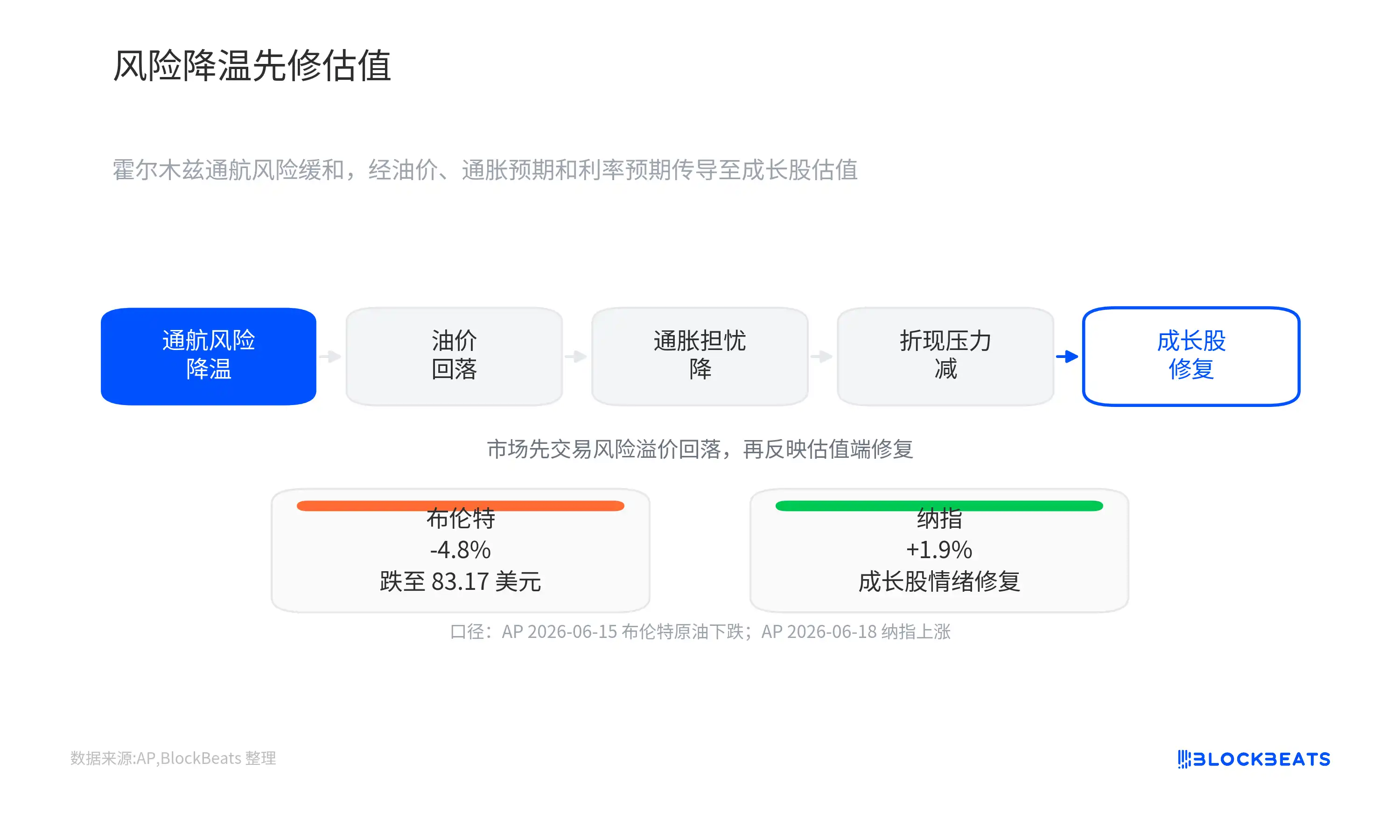
Such geopolitical news impacts technology stocks primarily through oil prices and interest rate expectations. The Strait of Hormuz is a crucial global artery for oil transportation; any disruption can quickly drive up oil prices and inflation expectations. Conversely, if the market trades on 'resumed passage and de-escalating conflict,' the discounting pressure on high-valuation growth stocks will ease.

Easing Middle East risks does not equate to a sudden improvement in AI fundamentals. What it opens up first is a window for valuation repair. What's truly worth watching is which directions funds choose after this window opens. The gains on June 18 were more concentrated not in broad technology stocks, but in chips, optical interconnects, memory, and some domestic manufacturing targets.

Intel was one of the most conspicuous trades that day. According to a Reuters report, Trump stated that Apple would collaborate with Intel to design and manufacture chips in the U.S. Influenced by this, Intel's stock price surged approximately 10%-11%. However, no formal disclosures regarding contract scale, product categories, or mass production timelines have been seen from Apple or Intel yet. This resembles more of an elasticity release driven by policy catalysts and the domestic manufacturing narrative.

Therefore, the core question of this rally is not 'whether tech stocks have rebounded,' but the nature of the rebound. Is the market buying back into AI infrastructure orders, or is it conducting a selective valuation repair by leveraging the de-escalation of geopolitical risks?

Declining Energy Risks First Repair Growth Stock Valuations

For general investors, the Strait of Hormuz can be understood as the 'chokepoint' for global oil transport. Any risk of blockade in this passage can drive up oil prices, pushing inflation expectations higher, and also affecting the Federal Reserve's path and corporate costs. High-valuation technology stocks are particularly sensitive to this chain because their valuations rely more heavily on cash flows many years into the future.

According to an AP report on June 15, Brent crude oil fell 4.8% to $83.17, returning to early March levels. Kiplinger mentioned the same day that WTI crude fell 4.9% to $80.75, its lowest settlement price since early March. Falling oil prices do not mean inflation pressure has been eliminated, but they are enough to reduce market tail-end concerns about energy shocks.

This explains why the Nasdaq and semiconductors gained greater elasticity after the news. They did not rise because of sudden profit changes at individual companies, but were prioritized for rebalancing by funds after the decline in risk premiums.

However, this chain cannot be simply described as 'Hormuz eases, therefore semiconductors rise.' A more accurate statement is that the de-escalation of geopolitical risks provided the external conditions for a rebound in growth assets. Which segments within the tech sector are favored by funds still depends on whether their fundamentals can be verified.
Ranking Within Tech Favors the Hardware Chain

This rally more resembles a re-ranking within technology stocks.

Semiconductors leading the gains indicate the market is not just buying a single leader, but is re-pricing the AI infrastructure chain. However, if one only sees 'chips are up,' it's easy to misjudge it as a full-fledged return of AI trading. More importantly, fund preferences are more concentrated in chip manufacturing, optical interconnects, memory, equipment, and domestic manufacturing.

The underlying change is that AI trading has moved from the early stage of 'the bigger the model, the better; the more GPUs, the better' to a more selective phase. Investors are now asking not whether AI has imagination space, but who can capture real revenue from data center construction.

The attention on optical interconnects and memory is also related to this stage. Large AI clusters cannot run on GPUs alone. Tens of thousands of chips require high-speed data transfer between them; optical interconnects (high-speed transmission in data centers) are akin to building highways for AI clusters. As training and inference demands expand, memory bandwidth, storage capacity, and data movement efficiency will also become bottlenecks.

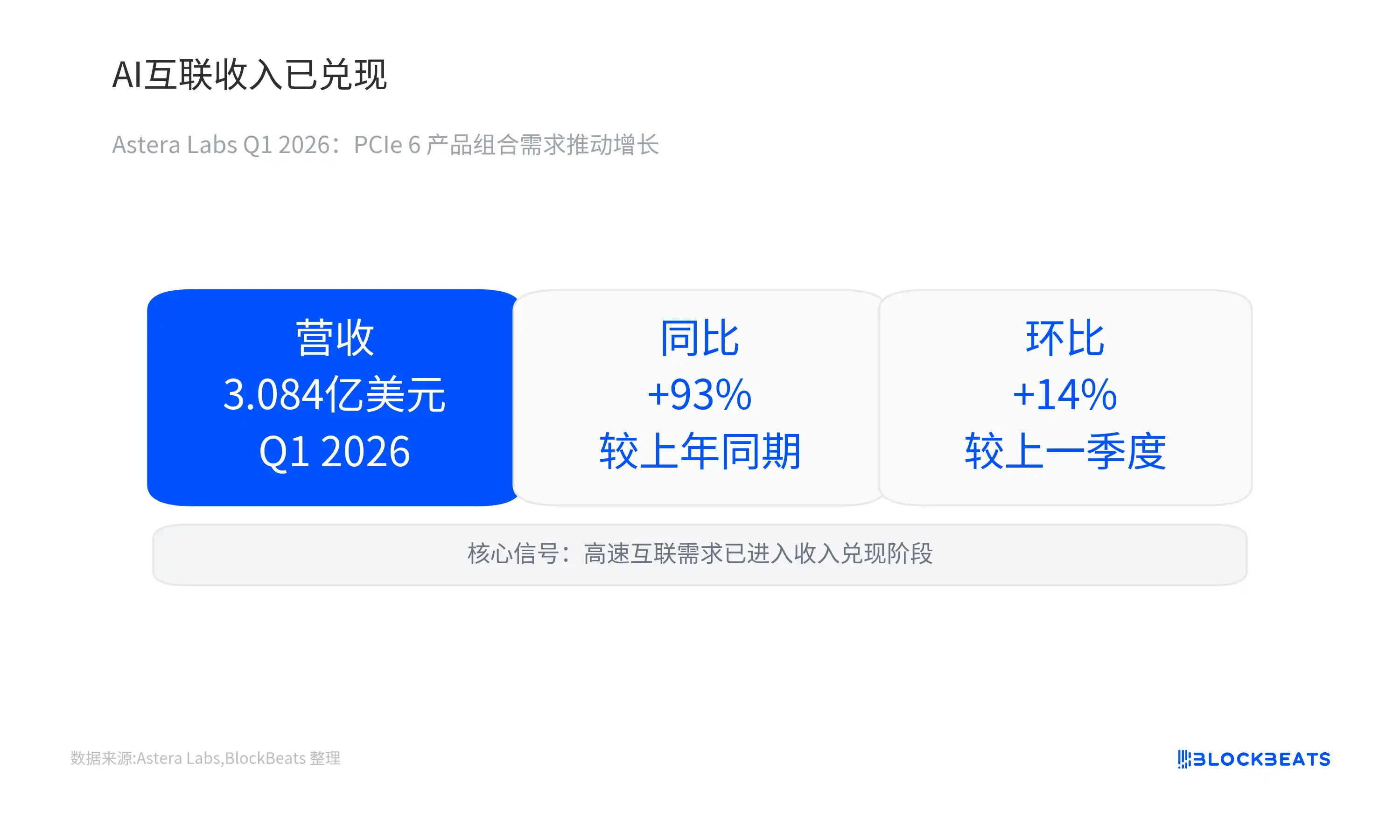
Astera Labs' earnings report provided the market with a more concrete anchor. The company's Q1 2026 revenue was $308.4 million, up 93% year-over-year and 14% quarter-over-quarter. The company stated that growth was driven by demand for its PCIe 6 product portfolio and AI interconnect-related products. Such data makes it easier for investors to believe that the AI hardware chain is not just about long-term narratives but is already translating into orders and revenue from data center construction.
This is also the difference between this round of trading and purely forward-looking tech stories. Public market performance can support chips and tech-related directions leading the gains, but 'which segments funds prioritize buying' remains a market generalization that requires a nuanced understanding. At least from the market action, the recovery in risk appetite has not turned into indiscriminate chasing of all high-valuation assets. Funds seem more inclined to first buy segments that can be verified by earnings reports and capital expenditure.

The Intel Trade Mixes Policy and Fundamental Imagination

Intel's surge is the most prone to misinterpretation.

According to Reuters, Trump stated that Apple would collaborate with Intel to design and manufacture chips in the U.S. This statement directly placed Intel into the narrative of domestic chip manufacturing. For the market, it is not an ordinary customer partnership news but a convergence point of supply chain security, manufacturing reshoring, and U.S. chip policy.

However, this does not mean Intel's fundamentals have already been turned around by the Apple partnership. A more prudent understanding currently is that Trump's remarks provided a policy catalyst which, combined with the recovery in semiconductor risk appetite, amplified the elasticity of Intel as a domestic manufacturing target. How much revenue this collaboration can bring, whether it enters advanced node mass production, the timeline, and gross margin improvements all require clearer information from Apple, Intel, or subsequent financial reports.

This precisely illustrates the divergence in this round of AI hardware revaluation. Policy catalysts can boost attention, orders and revenue can support valuation, and capital expenditure can verify cycle strength. When all three appear simultaneously, stock price elasticity is greatest. However, if there is only policy rhetoric without contract scale and financial contribution, the trade is more easily re-priced as short-term sentiment.

Intel, optical interconnects, and memory correspond to three verification paths respectively. Intel needs to see if policy and customer cooperation can translate into genuine foundry revenue. Optical interconnects depend on whether the scaling of AI clusters continues to push bandwidth demand higher. Memory and storage rely on whether AI server orders continue to drive prices and shipments.
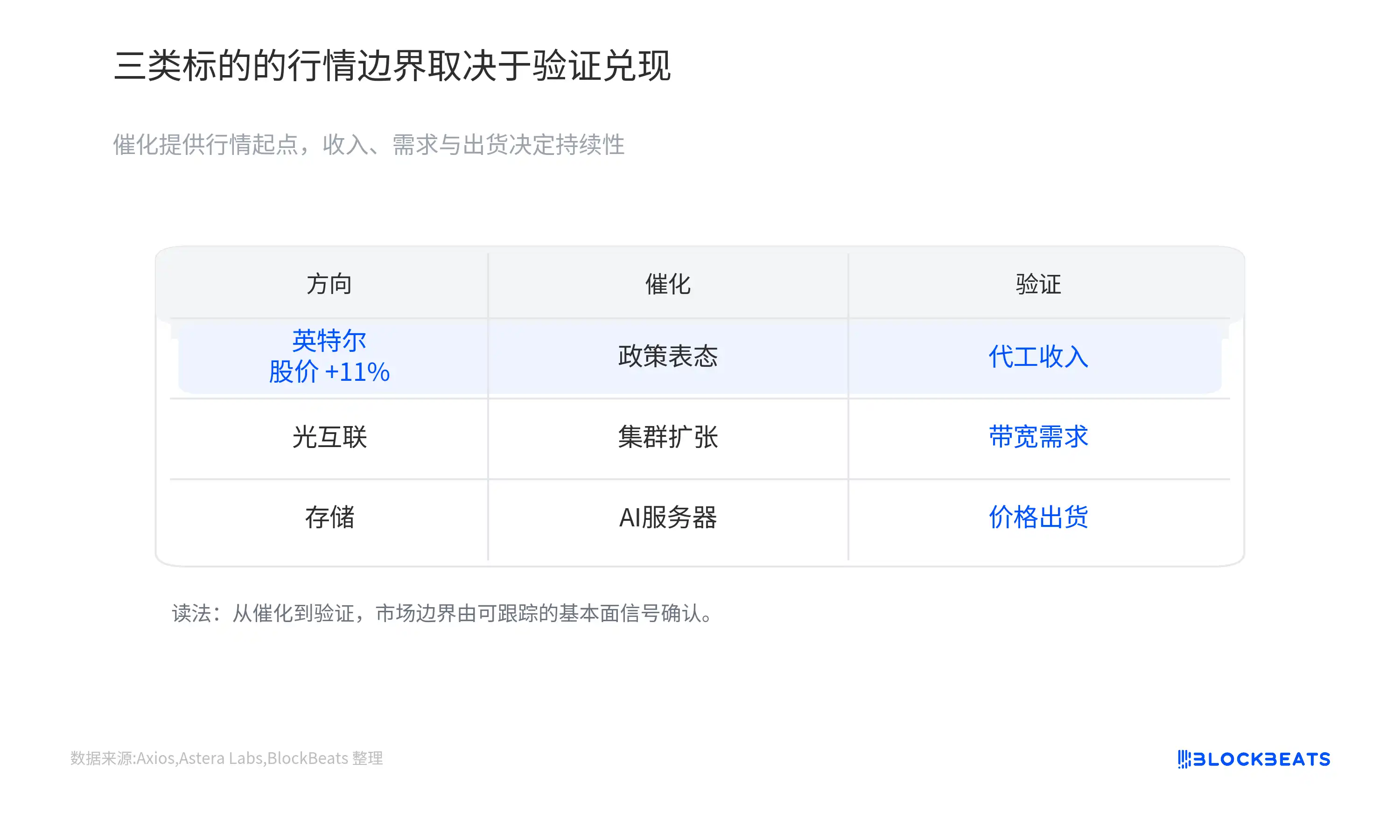
If Q2 earnings reports continue to show robust cloud provider capital expenditure, AI server orders remain high, and revenue guidance from optical interconnect and memory companies continues to grow, this rally will more closely resemble a continuation of the AI infrastructure cycle. If data falls short of expectations, the market may redefine it as a valuation repair following the easing of geopolitical risks.

Orders and Negotiation Progress Determine the Rally's Limits

The biggest misjudgment to avoid now is prematurely writing a short-term window as confirmation of a long-term trend.

The U.S.-Iran framework is still in the preliminary arrangement stage. According to Axios, both sides agreed to a 60-day ceasefire extension framework and may reopen the Strait of Hormuz. The market can trade on risk easing, but this does not mean the Hormuz risk has disappeared. Whether the ceasefire can be sustained, whether passage arrangements are stable, and whether sanctions and nuclear issues disrupt negotiations again will all impact oil prices and risk appetite.

The verification for the AI hardware chain is also straightforward. In the upcoming Q2 earnings reports, investors need to see whether large cloud providers continue to revise capital expenditure upwards, whether AI server order intensity is maintained, and whether revenue guidance from optical interconnect and memory companies continues to show growth. Once capital expenditure begins to be questioned, the elasticity of high-valuation hardware chains will conversely become a source of volatility.

Intel has an additional layer of verification. Trump's remarks are sufficient to trigger trading, but what truly affects valuation is contract scale, product categories, mass production timelines, and profit margins, not the 'Made in America' narrative itself. Policy can provide a pricing window but cannot substitute for financial realization.

This rally is better understood as a selective recovery in risk appetite: the easing of macro risks opened a window, and funds prioritized buying back the AI hardware chain. It weakens the extreme judgment that 'AI trading is over,' but it is not yet sufficient to prove that the AI infrastructure cycle is re-accelerating. The answer is not in a single day's gains but in whether capital expenditure, orders, and profit margins can continue to keep up.


Domande pertinenti

QAccording to the article, what is the core issue behind the rise of semiconductor and AI hardware stocks on June 18th?

AThe core issue is not whether tech stocks rebounded, but the nature of the rebound. The key question is whether the market is buying back into actual AI infrastructure orders or is merely performing a selective valuation repair based on cooling geopolitical risks.

QWhy does a de-escalation of tensions in the Middle East, specifically regarding the Strait of Hormuz, benefit high-valuation growth stocks like semiconductors?

AThe Strait of Hormuz is a critical choke point for global oil transport. Reduced risk there lowers oil prices and inflation expectations, which in turn reduces the discounting pressure on high-valuation growth stocks whose valuations rely heavily on future cash flows. This provides an external condition for a rebound in growth assets.

QWhat specific shift in AI investment focus does the article highlight as occurring in the market?

AThe focus has shifted from the early stage of 'bigger models and more GPUs are better' to a more selective phase. Investors are now asking who can actually generate real revenue from data center construction for AI, leading to increased attention on specific hardware chains like chip manufacturing, optical interconnects, memory, storage, and equipment.

QWhat are the three verification paths mentioned for the re-rating of AI hardware stocks, as illustrated by Intel, optical interconnects, and memory/storage?

A1. Intel: Verification depends on whether policy catalysts and customer cooperation translate into real foundry revenue. 2. Optical Interconnects: Verification depends on whether the scaling of AI clusters continues to drive higher bandwidth demand. 3. Memory/Storage: Verification depends on whether AI server orders continue to drive prices and shipments.

QWhat key information does the article suggest investors should look for in upcoming Q2 earnings to determine if the recent rally is sustainable?

AInvestors should look for whether large cloud providers continue to raise their capital expenditure guidance, whether AI server order strength is maintained, and whether revenue guidance from optical interconnect and memory companies continues to show growth. Capital expenditure trends, orders, and profit margins are crucial for sustainability.

Letture associate

Conversation with Investor Zheng Di: MicroStrategy's Coin Sale Experiment, AI Economy, and Opportunities in US Stocks

Frontier tech investor Zheng "Didier" Di discusses the recent Bitcoin price drop, the financial strategy shift at MicroStrategy, the AI-driven surge in U.S. stocks, and the evolving role of crypto exchanges. Didier posits that the recent BTC decline stems less from macro factors or ETF outflows, and more from market repricing due to MicroStrategy's new financial structure. Following a wave of preferred stock and debt issuance (STRC, STRZ, etc.), MicroStrategy must now manage cash flow to pay dividends, potentially leading to a market expectation of sustained, small-scale BTC sales to maintain its "per-share bitcoin neutral" principle. Didier views this as a financial "experiment" testing market capacity for such recurring sell pressure, which, while creating near-term structural headwinds, likely avoids a true "death spiral" absent major new external shocks. Shifting to AI, Didier argues that tokens are becoming the new form of labor, with AI models and compute (tokenized inputs) increasingly replacing human roles in execution and middle-management. This drives enterprise efficiency and higher margins, fueling the sustained rally in U.S. semiconductor, data center, and infrastructure stocks. He foresees an emerging "machine economy" where automated agents transact and collaborate on-chain. Regarding crypto exchanges offering U.S. equities, Didier sees this as a natural evolution. With few crypto-native assets generating lasting value, exchanges are pivoting towards real-world assets (RWAs) like stocks and bonds. This doesn't necessarily cannibalize crypto but reflects a maturing industry focusing on blockchain's core utilities: decentralized choice and efficient settlement. He notes that trading logic for crypto natives doesn't need to drastically change, as meme-driven and fundamentalist strategies find analogs in U.S. markets. The "1011 event" (likely referring to a major market crash) severely damaged crypto market liquidity, marking a probable end to the altcoin speculative cycle, with capital flowing towards the deeper liquidity of U.S. markets. For the macro outlook, Didier is cautious about near-term market pressure from potential mega-IPOs (e.g., SpaceX) and the U.S. midterm elections, which could bring more regulatory scrutiny. Long-term, he remains bullish on AI's productivity gains and its convergence with blockchain/Web3, predicting a shift from speculative frenzy to a more institutionalized, industrial phase for the crypto sector.

marsbit26 min fa

Conversation with Investor Zheng Di: MicroStrategy's Coin Sale Experiment, AI Economy, and Opportunities in US Stocks

marsbit26 min fa

Playnance’s $GCOIN Lists on KoinBX Amid Rapid Growth in India

Playnance's native token, $GCOIN, has been listed on the cryptocurrency exchange KoinBX as of June 18. This move aims to enhance accessibility for its rapidly growing community, particularly in India, where the blockchain-powered Web3 iGaming ecosystem has gained significant traction. Over 130 partners in Playnance's "Be the Boss" program have built communities engaging thousands of active players in the region. The "Be the Boss" model allows participants to create and manage their own gaming communities, earning rewards tied to community activity. CEO Pini Peter noted India's high engagement, with community leaders successfully building player networks. One partner, Dr. Nicolas, reported earning over $57,000 through the program in recent months, highlighting both the financial rewards and the opportunity to grow an engaged community. $GCOIN serves as the ecosystem's core utility token, incentivizing participation and aligning the interests of players and community leaders ("Bosses"). The listing on KoinBX is part of Playnance's strategy to expand globally, increasing the token's utility and accessibility by combining community ownership, gamified engagement, and blockchain-based incentives. Founded in 2020, Playnance is a Web3 iGaming infrastructure company focused on creating live, non-custodial, on-chain products to onboard mainstream users. It currently processes approximately one million transactions daily, aiming to simplify the user experience while maintaining full on-chain transparency.

TheNewsCrypto1 h fa

Playnance’s $GCOIN Lists on KoinBX Amid Rapid Growth in India

TheNewsCrypto1 h fa

STRC Hits Historic Low, Saylor's Perpetual Motion Machine Grinds to a Halt

STRC, the perpetual preferred stock issued by MicroStrategy to fund its Bitcoin purchases, hit a historic low of $85.32, a 17% discount to its $100 par value. Designed as a "digital credit engine" to trade stably near par and enable continuous share issuance for buying Bitcoin, its plunge signals a breakdown in this model. Three key factors drove the decline: 1. Bitcoin's price fell over 50% from its peak, trading around $63,000 amid hawkish Fed signals. 2. MicroStrategy's cash reserves were depleted after a $1.5 billion convertible note repayment, slashing the dividend coverage for STRC's 11.5% yield to ~7 months. The company then sold 32 BTC to cover dividends—Michael Saylor's first Bitcoin sale since 2022—damaging the "never sell" narrative. 3. A competing Bitcoin-backed preferred stock, Strive's SATA, offers a higher yield (~13%) and daily dividends, drawing investors away from STRC. The drop triggers a negative cycle: STRC below par halts ATM share issuances, cutting off a key funding source for Bitcoin buys and potentially forcing more BTC sales for dividends, further eroding confidence. While Saylor argues the model is mathematically sound—needing only 2.3% annual Bitcoin growth to sustain itself—the market is testing the resilience of the leveraged Bitcoin treasury strategy in a bear market. The STRC price now reflects rising skepticism about this financial machinery's durability during downturns.

marsbit1 h fa

STRC Hits Historic Low, Saylor's Perpetual Motion Machine Grinds to a Halt

marsbit1 h fa

A Guide to Grayscale’s ‘Bottom Fishing’: Using Cash Flow to Assess Cryptocurrency Value

**Title:** Grayscale's Guide to Bottom-Fishing: Valuing Cryptoassets Using Cash Flows **Summary:** This report by Grayscale Research presents a fundamental valuation framework for cryptocurrency assets, moving beyond pure speculation to analyze those with underlying cash flows. It distinguishes between "commodity-like" assets (e.g., Bitcoin) and "cash-flow" assets, primarily within DeFi. Using the leading decentralized lending protocol Aave as a case study, the analysis applies traditional financial methodologies like Discounted Cash Flow (DCF) and Price-to-Earnings (P/E) multiples. Key findings indicate that AAVE tokens are currently undervalued. Despite recent challenges, the protocol's strong revenue growth, ~50% net profit margin, and diversified treasury support a fundamental valuation range of $80-$100 per token (compared to a ~$75 market price at the time of writing). In a base-case scenario driven by stablecoin adoption and regulatory clarity, the fair value could rise to around $175 within a year. The report emphasizes that protocol success does not automatically translate to token value. It critically examines the "value capture" mechanisms—such as buybacks, burns, and staking rewards—that channel protocol profits to token holders. Furthermore, it addresses the legal and governance complexities of Decentralized Autonomous Organizations (DAOs), noting their difference from traditional corporate equity but highlighting how robust, transparent governance can align protocol economics with holder interests. The conclusion is that the crypto market is maturing, with capital increasingly flowing towards projects with demonstrable fundamentals, real adoption, and disciplined capital allocation, creating opportunities for value-based investors.

marsbit2 h fa

A Guide to Grayscale’s ‘Bottom Fishing’: Using Cash Flow to Assess Cryptocurrency Value

marsbit2 h fa

Trading

Spot
Futures
活动图片