Tron – Why TRX’s $1.96T stablecoin boom still faces ONE challenge

ambcryptoPubblicato 2026-06-30Pubblicato ultima volta 2026-06-30

Introduzione

Tron achieved $1.96 trillion in stablecoin settlements in Q1 2026, driven by its role as a fast, low-cost network for real-world dollar transfers and remittances. Daily active users grew 16% recently to 4.4 million, reflecting strong engagement. However, new user growth and broader DeFi adoption remain challenges. While stablecoin liquidity supports network activity and capital retention, with TVL at $4.4 billion, usage in lending and smart contracts is limited. Tron's future growth depends on expanding beyond payments into a more diversified on-chain ecosystem.

TRON’s [TRX] stablecoin settlement growth reflects more than rising transaction volumes. This is because it increasingly serves as the preferred network for real-world dollar transfers.

Low fees, fast settlement, and deep Tether [USDT] liquidity continue attracting remittances, peer-to-peer payments, and cross-border transactions that require speed over complex DeFi functionality.
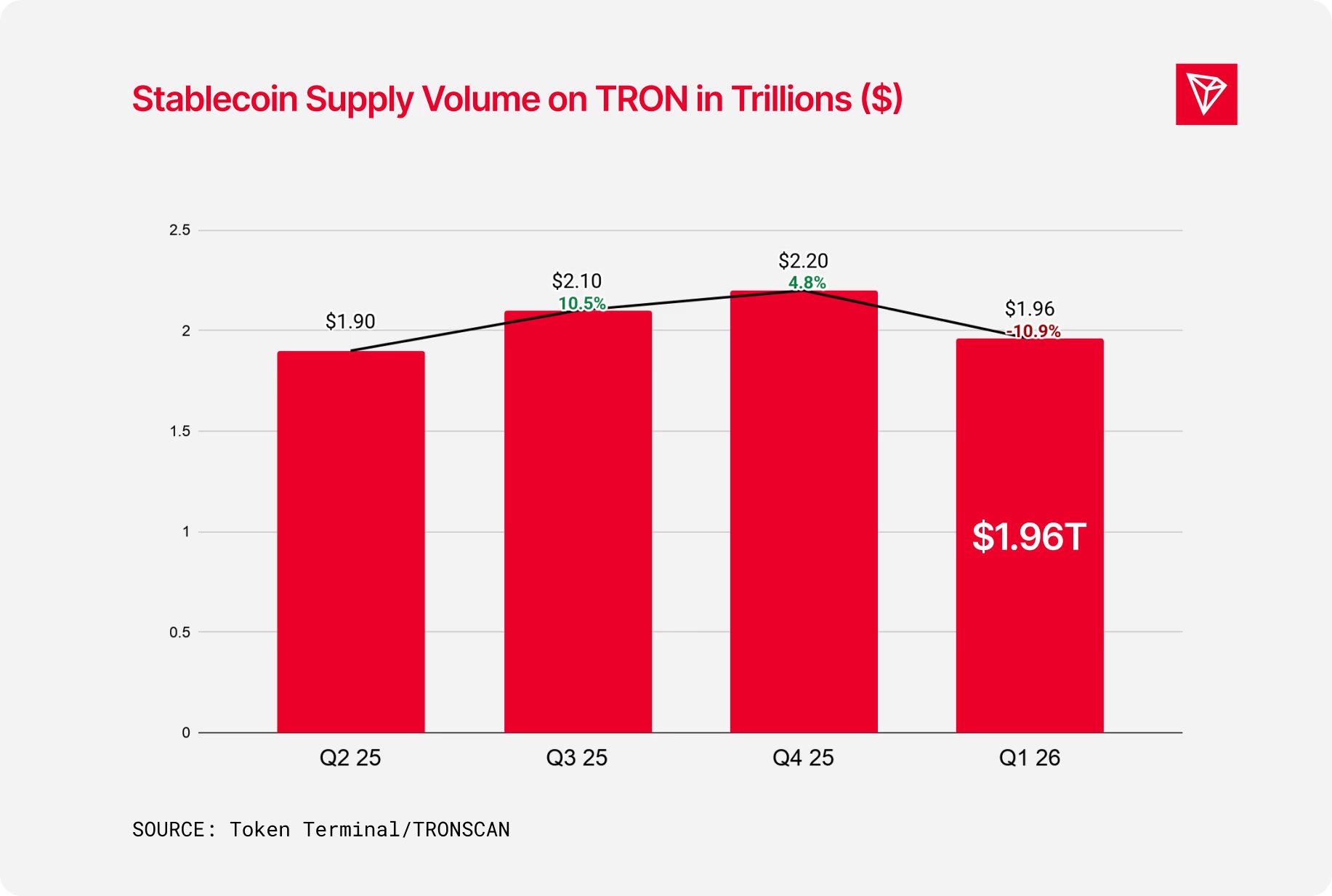
Source: TRONSCAN

This trend was helpful for processing $1.96 trillion in stablecoin settlements for the first quarter of 2026 on TRON. Meanwhile, TRON also hosts approximately $85-86 billion in USDT. Much of this usage stems from users’ need for recurring payments.

As such, there is strong evidence to support that the usage patterns are providing a foundation for structural value in the network.

If the flow of payment dollars into the system continues to grow at the same rate or possibly increases and if USDT issuance continues to expand, then TRON will solidify itself as a leader in stablecoin settlement. Otherwise, faster competitors could erode its edge.

User activity reflects payment growth

TRON’s growing use of stablecoins for transaction settlement has boosted network activity. However, adoption trends show both positive and negative signals.

Daily active users rose 16% over the past thirty days to roughly 4.4 million, exceeding the Q1 average of 3.2 million and indicating stronger engagement from existing participants.
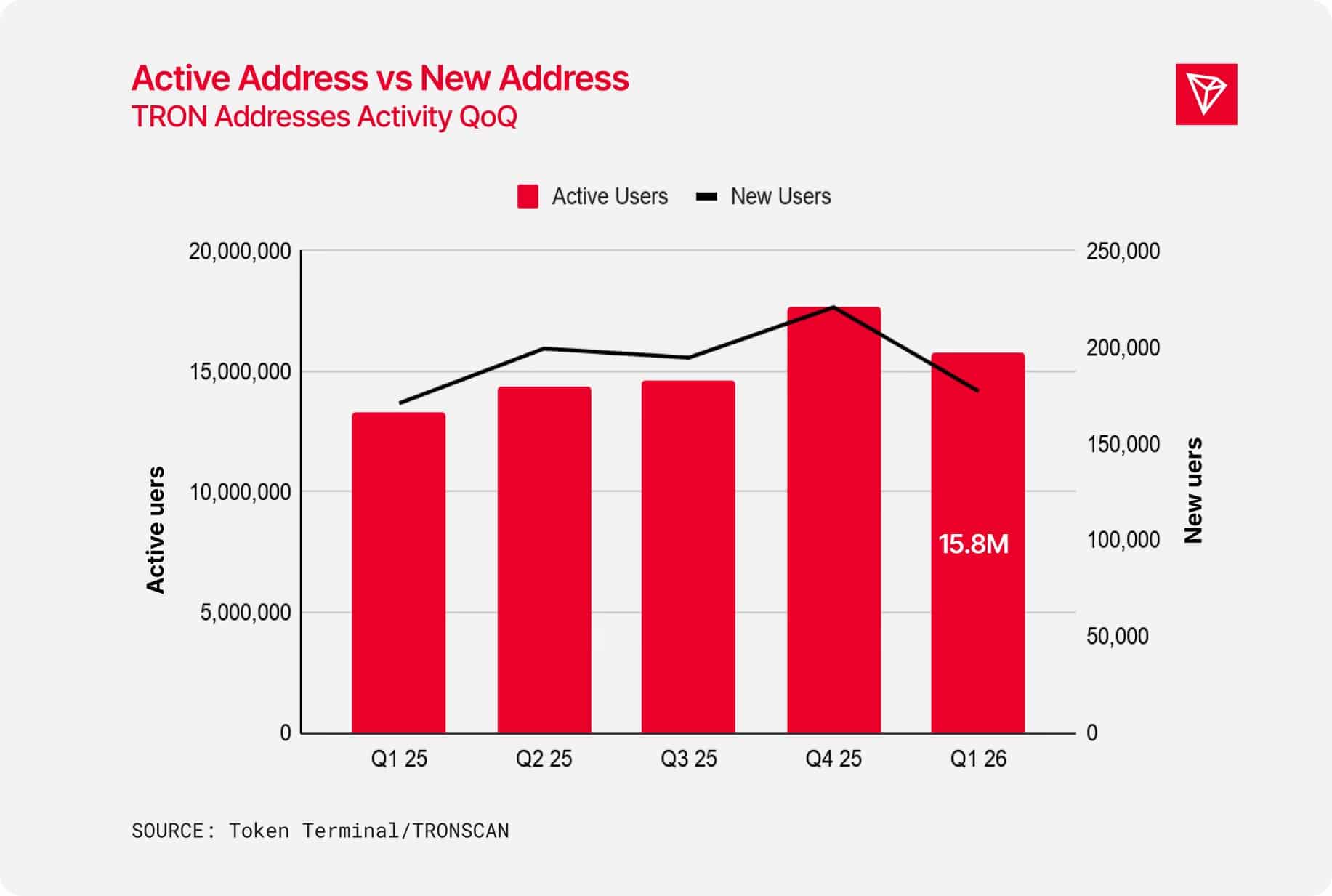
Source: TRONSCAN

However, quarterly data shows active addresses eased to 15.8 million from the Q4 2025 peak, while new address creation also declined. Thus, it appears that despite the decline in the number of new users being added, there continues to be strong activity due to the ability of users to pay using the network’s stablecoins.

Long-term growth of the network will likely depend upon additional new users entering the ecosystem in addition to sustained payments through the stablecoins. If existing users continue driving transaction growth, network activity could remain elevated. Moreover, sustaining long-term expansion will likely require stronger new-user onboarding alongside continued stablecoin payment demand.

Capital retention supports network growth

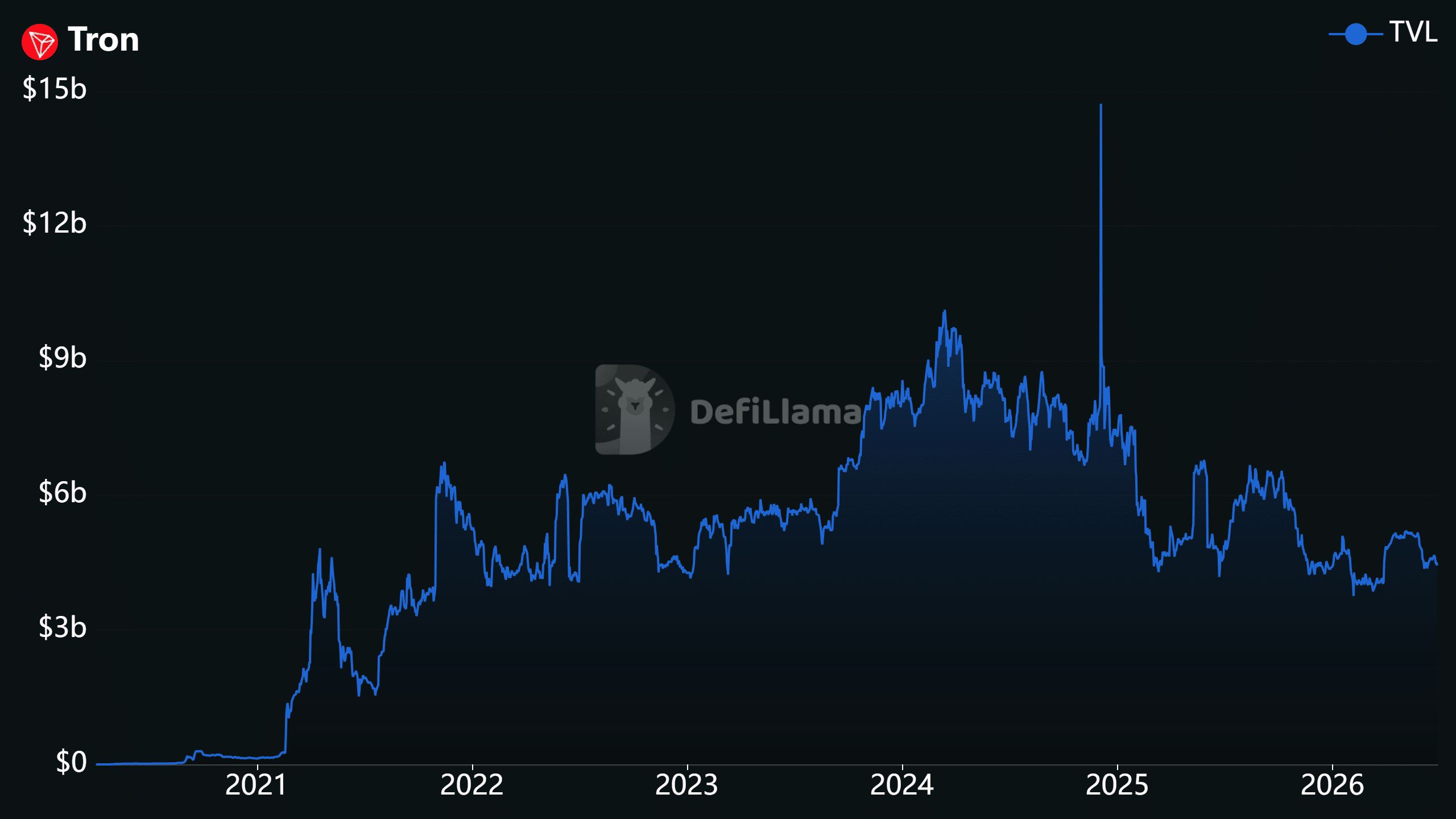
TRON’s expanding payment network is retaining capital on-chain, but growth remains concentrated in stablecoin settlements rather than broader DeFi activity. At press time, TVL has grown to roughly $4.4 billion and is supported mainly by stablecoins anchoring liquidity on the network.
Source: DeFiLlama

Rather than exiting immediately after settlement, much of that capital circulates among transfers, which sustains transaction volume and network revenue. Efficiency also supports recurring TRX burns and validator rewards without significantly raising user costs.

However, dominance in payments has not translated into strong adoption of DeFi. Lending, decentralized exchanges, and smart contract activity remain relatively smaller contributors to usage.

If retained liquidity gradually expands into these sectors, TRON can strengthen its broader ecosystem. Otherwise, it will likely continue leading payments, relying less on growth driven by DeFi.


Final Summary

  • TRON’s payment growth remained strong, but broader ecosystem expansion still depends on DeFi adoption.
  • TRX retained payment liquidity, though sustained growth requires stronger on-chain utility beyond settlements.


Crypto di tendenza

Domande pertinenti

QWhat key challenge does TRON still face despite its massive stablecoin settlement growth in early 2026?

ADespite processing $1.96 trillion in stablecoin settlements in Q1 2026 and growing its daily active users, TRON's broader ecosystem expansion still depends on stronger DeFi adoption (like lending and decentralized exchanges). Its growth remains concentrated in payments rather than diverse on-chain utility.

QWhat are the primary factors driving TRON's popularity for stablecoin transactions, according to the article?

AThe primary factors are its low fees, fast settlement times, and deep Tether (USDT) liquidity. These make it the preferred network for real-world dollar transfers like remittances, peer-to-peer payments, and cross-border transactions that prioritize speed over complex DeFi functionality.

QHow did TRON's user activity metrics show both positive and negative signals recently?

APositively, daily active users rose 16% to roughly 4.4 million, exceeding the Q1 average. Negatively, quarterly active addresses eased from the Q4 2025 peak, and new address creation declined, indicating a slowdown in onboarding new users despite strong activity from existing ones.

QHow is the capital from stablecoin settlements contributing to TRON's network growth?

ACapital from settlements is largely retained on-chain, circulating among transfers instead of exiting immediately. This sustains transaction volume, network revenue, TRX burns, and validator rewards. However, this retained liquidity has not significantly expanded into broader DeFi sectors like lending or DEXs.

QWhat two conditions does the article state are necessary for TRON to solidify itself as a leader in stablecoin settlement?

AFirst, the flow of payment dollars into the system must continue to grow at the same rate or increase. Second, USDT issuance on the network must continue to expand. If these conditions are not met, faster competitors could erode TRON's edge.

Letture associate

Opinion: AI Bubble Bursts, Bitcoin and Other Risky Assets Are the First to Be Impacted

BIS Warns AI Investment Boom Could Trigger Market Stress, Impacting Bitcoin First The Bank for International Settlements (BIS) warns that a potential bursting of the "AI bubble" could tighten liquidity and severely impact risk assets like Bitcoin in the near term. Major tech firms are projected to spend over $1 trillion on AI infrastructure in 2025-2026. The BIS cautions that if returns fail to meet expectations, a sudden withdrawal of financing could turn this investment boom into a prolonged bust, creating ripple effects across financial markets. While AI holds long-term economic promise, the current scale and speed of investment, coupled with intense competition and physical bottlenecks (e.g., semiconductors, power grids), mirror historical bubbles. The report highlights that the AI funding web—spanning corporate debt, private credit, and complex vendor agreements—makes systemic risks harder to see. A disappointment in AI adoption could transmit stress through this chain, widening credit spreads and pressuring weaker borrowers. For Bitcoin, the initial reaction to such a market shock would likely be defensive. As liquidity tightens, investors typically sell liquid assets first, and Bitcoin often trades in line with other risk assets during portfolio de-risking. Recent correlations, like Bitcoin's drop following a sharp decline in South Korea's stock market, support this view. However, the longer-term outcome for Bitcoin depends on the policy response. If an AI-driven credit crunch forces central banks to inject liquidity and ease policy eventually, it could reignite Bitcoin's narrative as a hedge against monetary debasement. Yet, traders betting on this outcome may first have to endure significant market volatility and potential price declines.

marsbit41 min fa

Opinion: AI Bubble Bursts, Bitcoin and Other Risky Assets Are the First to Be Impacted

marsbit41 min fa

South Korea Reaps Riches, America Turns Hostile

The US has filed a collective antitrust lawsuit in California against Samsung, SK Hynix, and US-based Micron, alleging they colluded to create a "RAMpocalypse" by slashing traditional DRAM production and raising prices 700% over four years amid the AI boom. This lawsuit targets the heart of the AI supply chain: High Bandwidth Memory (HBM), critical for Nvidia's GPUs. Currently, SK Hynix (57%), Samsung (22%), and Micron (21%) dominate global HBM production. The case highlights a deeper US concern: in the AI era, South Korea, through its HBM dominance, is capturing an estimated 35% of global AI profits, second only to the US (49%). SK Hynix's operating profit margin recently hit a record 72%. In response to the lawsuit, South Korea announced a massive $800 trillion won investment to build four new chip plants, doubling down on its strategic position. Analysts see the lawsuit not merely as a consumer price issue but as strategic pressure. It aims to support Micron's US manufacturing expansion (subsidized by the CHIPS Act) and secure America's share of AI profits by bringing more HBM production onshore. However, South Korea's rapid execution and massive cash flow from current HBM sales give it a significant speed advantage over US build-out timelines. The conflict underscores a fundamental shift: AI infrastructure like GPUs and HBM is becoming a new form of strategic national resource, akin to oil. While Nvidia and Korean memory giants are interdependent, the struggle over profit distribution and industrial sovereignty in this new landscape is just beginning. This lawsuit may be the first major skirmish in the AI resource wars.

marsbit54 min fa

South Korea Reaps Riches, America Turns Hostile

marsbit54 min fa

Trading

Spot

Articoli Popolari

Come comprare TRX

Benvenuto in HTX.com! Abbiamo reso l'acquisto di TRON (TRX) semplice e conveniente. Segui la nostra guida passo passo per intraprendere il tuo viaggio nel mondo delle criptovalute.Step 1: Crea il tuo Account HTXUsa la tua email o numero di telefono per registrarti il tuo account gratuito su HTX. Vivi un'esperienza facile e sblocca tutte le funzionalità,Crea il mio accountStep 2: Vai in Acquista crypto e seleziona il tuo metodo di pagamentoCarta di credito/debito: utilizza la tua Visa o Mastercard per acquistare immediatamente TRONTRX.Bilancio: Usa i fondi dal bilancio del tuo account HTX per fare trading senza problemi.Terze parti: abbiamo aggiunto metodi di pagamento molto utilizzati come Google Pay e Apple Pay per maggiore comodità.P2P: Fai trading direttamente con altri utenti HTX.Over-the-Counter (OTC): Offriamo servizi su misura e tassi di cambio competitivi per i trader.Step 3: Conserva TRON (TRX)Dopo aver acquistato TRON (TRX), conserva nel tuo account HTX. In alternativa, puoi inviare tramite trasferimento blockchain o scambiare per altre criptovalute.Step 4: Scambia TRON (TRX)Scambia facilmente TRON (TRX) nel mercato spot di HTX. Accedi al tuo account, seleziona la tua coppia di trading, esegui le tue operazioni e monitora in tempo reale. Offriamo un'esperienza user-friendly sia per chi ha appena iniziato che per i trader più esperti.

1.6k Totale visualizzazioniPubblicato il 2024.12.10Aggiornato il 2026.06.02

Come comprare TRX

Discussioni

Benvenuto nella Community HTX. Qui puoi rimanere informato sugli ultimi sviluppi della piattaforma e accedere ad approfondimenti esperti sul mercato. Le opinioni degli utenti sul prezzo di TRX TRX sono presentate come di seguito.

活动图片