Farewell to Traditional Bull and Bear Markets, Deciphering the Logic of Today's Bubble Rotation

Foresight NewsPubblicato 2026-06-08Pubblicato ultima volta 2026-06-08

Introduzione

"Farewell to Traditional Bulls and Bears: Understanding Today's Market Logic of Bubble Rotation" The article draws a parallel between modern financial markets and a meteorological chain of thunderstorms, contrasting it with the past's slower-moving, more predictable 'layered cloud' systems of long bull/bear cycles and gradual sector rotations. The author argues that today's market has undergone a permanent structural shift, creating an environment where discrete, intense thematic bubbles (e.g., AI, GLP-1 drugs, crypto, robotics, quantum tech) sequentially form, swell, and burst. These 'storm cells' are triggered when capital fleeing a dying bubble acts like a meteorological 'cold air wedge,' forcing the warm, moist capital of latent interest in a new sector to rapidly rise and condense into the next speculative frenzy. This new 'convective' market regime is driven by eight fundamental changes: 1. Democratization of speculation via zero-commission trading, gamified apps, and heavy retail participation in instruments like 0DTE options. 2. Permanent, price-insensitive buying pressure from defined-contribution retirement plans (e.g., 401(k)s). 3. Passive investing creating inelastic market participants that amplify momentum, especially into mega-cap stocks. 4. The dominance of multi-strategy funds and high-frequency trading (HFT), weakening price discovery and creating fragile microstructure prone to synchronized sell-offs. 5. Artificially suppressed volatility that eventually...


Author: Smac, Partner at Compound VC

Translation: Saoirse, Foresight News


Editor's Note: Market hotspots are emerging one after another, with the AI frenzy sweeping across the board, while some question whether it will repeat the bubble of the metaverse. Amidst the clamor, people are often swept up by current trends, unable to see the long-term picture. To make rational judgments, one must learn to elevate their perspective. Smac, a partner at Compound, uses a meteorological analogy to dissect the market logic behind the rotating bubbles.


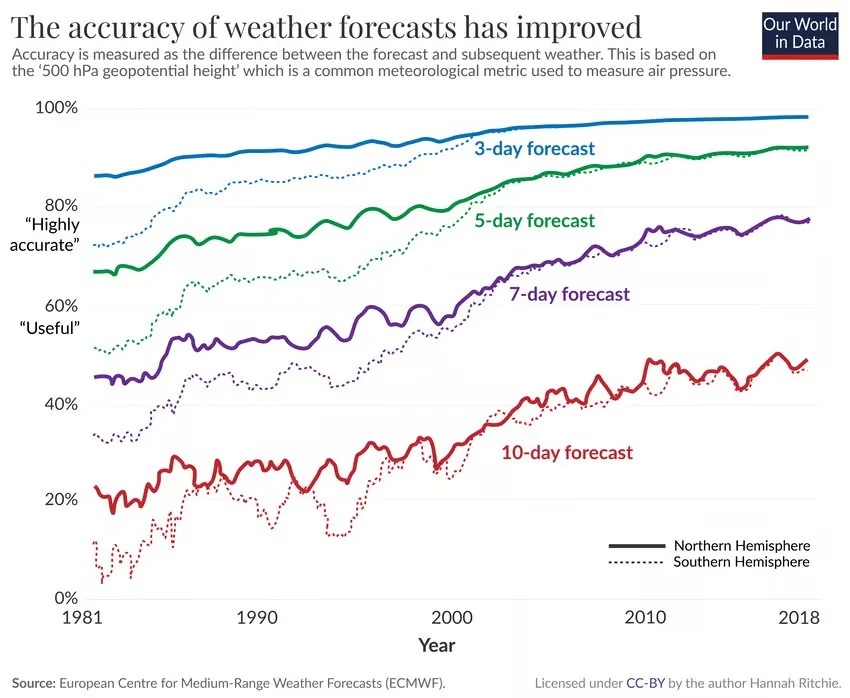
Meteorology is a fascinating field. Over the past fifty years, various forecasting tools have evolved, increasing the accuracy of weather predictions. Today's five-day forecast is as reliable as the single-day forecast from thirty years ago.


To most people, weather is a coherent, moving system: clouds roll in, rain falls, it stops, and it clears. Imagine a winter front arriving; the image that likely comes to mind is a vast, grey cloud cover stretching hundreds of miles, dumping heavy snow. Meteorologists call this stratiform weather, essentially like a layered cake, where the same weather experience unfolds across the covered area.


But weather isn't limited to this single form. If you've seen a summer thunderstorm in the plains, you'll notice it operates differently. First, an individual convective cell forms: warm, moist air near the ground rises, meets cold air aloft, condenses, and forms a towering, localized cumulonimbus cloud. Within an hour, hail, lightning, and torrential rain follow, visibility dropping to under a hundred meters.


Once the cell reaches its peak and releases its energy, it gradually dissipates. The storm's downdraft of cold air spreads outward at speeds up to 40 miles per hour. When this cold air collides with surrounding warm, moist air that hasn't yet formed a storm, it acts like a wedge, pushing the warm air upward again.


As long as sufficient atmospheric instability exists, this "cold air wedge" can trigger a new convective cell ten or more miles away from the original storm.
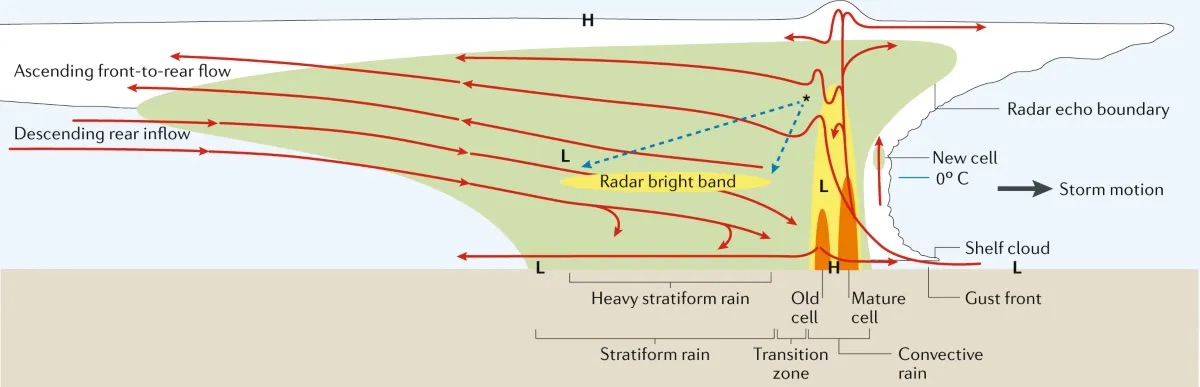


The new cell couldn't have formed on its own; the energy was already present in the atmosphere, lacking only a trigger, which the dying storm provided. Then, the new cell repeats the evolution of the previous storm.


When multiple convective cells form in sequence, they constitute a Mesoscale Convective System. From the ground, one only encounters each storm individually; each one feels like the entire weather system. On one side, all is calm, with people unaware of the coming storm; on the other side, the rain has already passed. But from a satellite's eye view, you see a series of separate cells linked in a line, each at a different stage of development, moving forward until it exhausts the warm, moist air along its path.


Supercell storm cloud near Amistad, New Mexico, at sunset


This sequential storm system requires vastly different atmospheric conditions than a single frontal system:

  • Warm, moist air near the surface acts as the storm's "fuel."
  • Dry, cold air aloft encourages the warm air to rise, creating atmospheric instability.
  • Winds varying with altitude cause the storm to rotate and move laterally, known as wind shear.


When these three conditions align, a parade of storms unfolds.


After all this meteorology, back to the point: the financial markets today operate almost exactly like this meteorological phenomenon.


The markets of the past were like stratiform weather systems: a multi-year bull market, followed by a multi-year bear market, with slow rotations of sector leadership. The 1982-2000 long bull market, followed by the internet bubble, then the 2003-2007 real estate and credit cycle. These cycles were long and clear. Even if investors' timing was off by years, understanding the major trend still led to profits.


But today's market is nothing like that. We are in a convective storm chain market: one hot sector after another hits like sequential storms. To those inside, each surge feels unstoppable and all-encompassing.


Capital flows out of fading narratives and ignites new frenzies in adjacent areas. The pace of leadership rotation has dramatically accelerated—AI infrastructure, GLP-1s (a class of diabetes drugs popular for weight loss, now a hot investment theme), stablecoins, quantum technology, nuclear energy, decentralized autonomous tech, robotics, space... Each undergoes a complete hype cycle, with its own cohort of true believers, a full narrative arc, and inevitably, a correction. The "cold air" from the dying bubble spreads out, igniting the next hotspot in a new area.


Refusing to acknowledge this fundamental market shift is self-delusion. People love to mock the phrase "this time is different," but ignoring permanent changes in the financial environment is either intellectual laziness or stubborn nostalgia for a market that no longer exists.


A Market Landscape Transformed


For a long time after WWII, financial markets moved at the pace of slow-moving weather systems. A bull market could last ten, fifteen, even twenty years, with rotations still anchored to long-term secular trends.
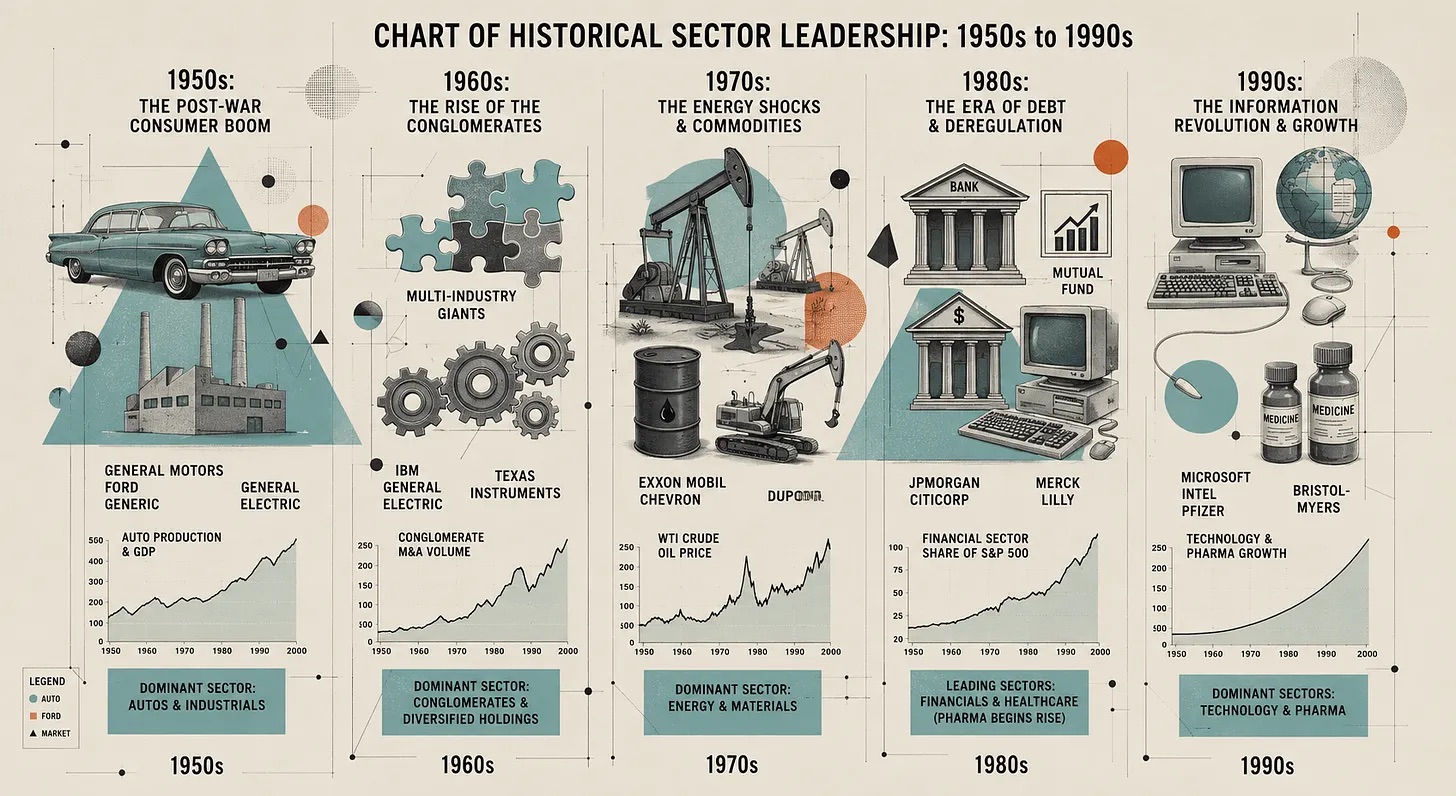

Approximate timeline of thematic sectors and leading market segments


Back then, sector rotations occurred within a unified macro backdrop. Only at major inflection points—the breakdown of Bretton Woods, Volcker's anti-inflation push, the peak of the dot-com bubble, the Global Financial Crisis—did the grand market regime truly shift.


This structure arose from many factors: high transaction costs, minimal retail participation forcing a long-term holding mindset, pension funds as the primary retirement vehicle. The S&P 500 was dominated by manufacturing, energy, banking, and retail—companies whose earnings grew roughly in line with the economy, stable and predictable. Information also moved slowly; an annual report might take weeks to be digested by most investors.


Volatility was also more symmetrical. Deep corrections followed bull markets, with leverage unwinding slowly over long periods. Rallies in bear markets were similarly gradual. The market lingered in different emotional states for long stretches, with regime changes measured in quarters or years.


In the weather analogy, the old market had: moderate fuel, high atmospheric stability, weak wind shear. Long, smooth waves. Investors could plan accordingly. Today, all environmental conditions have changed, some reversed, leading to a structural transformation.


Where Did the Change Come From?


Numerous shifts intertwine and amplify each other, each alone powerful enough to reshape markets. In summary, there are eight core transformations:


  1. The Democratization of Speculation
  2. The Formation of Perpetual Buyers
  3. Passive Investing Creates Inelastic Counterparties
  4. The Rise of Multi-Strategy & HFT, The Disappearance of the Middle
  5. Volatility Suppression
  6. A Complete Shift in Index Composition
  7. The End of Information Latency
  8. Fiscal & Monetary Regime Change


1. The Democratization of Speculation


The participant base has visibly changed. In the 1990s, retail trading accounted for only ~10% of US equity volume. High commissions meant retail mostly bought and held stocks, with little active speculation.


Robinhood pioneered zero-commission trades and payment for order flow. In Fall 2019, Schwab eliminated commissions, followed by Fidelity, TD Ameritrade, E*Trade—rewriting the rulebook.


Covid accelerated this: stimulus checks, idle time at home, gamified mobile trading apps. Retail's share of volume surged to ~25% in 2020-2021. Many thought it was temporary, but elevated retail participation persists. On April 29, 2025, amid market gyrations from tariff news, JPMorgan data showed retail order flow hitting a record 48% of volume. On normal days, it's over double pre-Covid levels; during big moves, it can reach 35%.


The deeper change is in *what* retail trades. Single-stock options dominate, with zero-day-to-expiration options exploding. The new cohort is younger, highly concentrated, trades narratives. Critically, they often use leverage not captured in margin data, and trade more on price action than fundamentals, heavily influenced by social signals.


In weather terms: the market's "warm, moist air" near the surface is more abundant than ever, with immense latent energy potential.


2. The Formation of Perpetual Buyers


I've written about this before. In short, the US retirement system shifted from Defined Benefit pensions to Defined Contribution plans. Individuals now must manage their own retirement savings. This translates to a massive, price-insensitive, passive flow of capital into equities every pay period—an automated, perpetual bid.


Traditional pensions operated differently: DB plans had to manage duration risk against liabilities. Managers made active judgments on valuation; if stocks were expensive, they could tilt towards bonds. Even if slow-moving, this was far more active than today's purely passive perpetual bid.


This is crucial: the marginal trading dollar today has far more price impact than before.


3. Passive Investing Creates Inelastic Counterparties


Passive index investing, by definition, buys and sells irrespective of price, purely based on index weight. The higher a stock's market cap, the more passive money flows in, and vice versa. This inherently embeds momentum into the market's plumbing. The Magnificent Seven's dominance is partly fueled by this.


Countless articles have detailed index concentration. Yes, these companies are exceptionally profitable and growing. But the core issue: there is no natural "sell" switch for passive flows.


4. The Rise of Multi-Strategy & HFT, The Disappearance of the Middle


While perpetual passive buyers formed, the active trading landscape also transformed. The hallmark is the rise of multi-strategy pod shops: Citadel, Millennium, Point72, Balyasny—housing hundreds of independent PMs running specific strategies under strict risk controls. AUM for these firms exploded, concentration mirroring index concentration.


Simultaneously, High-Frequency Trading now accounts for 50-60% of US equity volume, ~75% in futures. This combination creates a fragile market microstructure: funds trade against each other, weakening price discovery. Much of the volume is just capital churning within the system.


In normal times, bid-ask spreads are razor-thin—a good thing. But when a narrative breaks, positioning becomes extreme, or multiple firms' risk limits are breached, the microstructure fails. PMs' risk exposures are highly correlated, stop-loss rules similar. One firm's forced selling triggers others'. Think Feb 2018, Aug 2019, Mar 2020, Aug 2024. The structure enabling these events is now entrenched and will repeat.


Traditional fundamental long/short hedge funds are being squeezed out. These funds ran 20-40 stock books based on deep research, with investment horizons of quarters. Now, they're absorbed into larger platforms, move to private markets, family offices, or single-strategy funds. I believe there's still significant alpha in understanding narrative rotation and patience amidst short-term flows.


5. Volatility Suppression


Combining the above four points, today's volatility regime makes sense. Since 1990, the VIX has closed below 20 on about two-thirds of trading days. Volatility exhibits ~85% day-to-day correlation, meaning today's vol level heavily depends on yesterday's.


But regime shifts are extreme and asymmetrical. Numerous studies show suppressed volatility eventually breaks out violently over a few days, but decays back slowly over weeks.


The reasons are structural: a massive "short vol" industry exists. The rise of 0DTE options means market makers' hedging further suppresses intraday vol. Markets simmer at low volatility, risk builds, and when tail risks emerge, everyone rushes for the exits simultaneously.


Simply put, volatility distribution is now more pathological: long periods of compression lead to more violent decompressions.


6. A Complete Shift in Index Composition


The sixth change is the composition of the indices themselves. In 1980, the S&P 500 was dominated by manufacturers: Industrials, Materials, Energy, Financials, Staples. Their earnings grew roughly with GDP, stable, with valuation multiples mean-reverting. Forecasting P&G's earnings five years out wasn't wildly off.


Today is different. Information Technology, Communication Services, plus tech-heavy names in Consumer Discretionary like Amazon and Tesla, comprise over 40% of the S&P 500. These companies' earnings aren't linear. Software has near-zero marginal distribution costs. AI is profoundly uncertain—will AI labs become the core infrastructure for the next half-century, or money-losing science projects? Opinions diverge wildly.


For such companies, forecasting near-term earnings is hard; long-term value is highly speculative, leading to massive valuation swings. Valuation relies less on financial statements, more on narrative. For investors who can anticipate technological frontiers, competitive moats, and nascent markets, this creates massive alpha opportunities.


Traditional manufacturers expand capacity gradually, DCF models are stable, multiples mean-revert. Now, valuation often hinges on the market's belief in a story. This isn't to say traditional valuation is dead; it's the reality for these new asset types.


Today's major indices are packed with these long-duration, narrative-driven assets. The steeper the temperature gradient in the atmosphere, the more potential energy. Similarly, more of these assets mean more potential market energy, leading to more violent moves when triggered.


7. The End of Information Latency


Everyone feels this intuitively, but its impact is underrated. For most of financial history, market-relevant information traveled with the speed of its distribution medium. Now, information is virtually latency-free.


Especially positioning information travels faster than ever. Investors see real-time reactions of known figures. More people publicize their positions. A torrent of real-time info fuels FOMO. Gain screenshots abound, stories of turning $1k into millions go viral. The fear of missing out is perpetual.


8. Fiscal & Monetary Regime Change


This needs little elaboration. The summary:

  • Persistently accommodative US monetary policy, low real rates.
  • Quantitative Easing expanding the Fed's balance sheet.
  • Low discount rates elevating prices of all long-duration assets.
  • Activist fiscal policy—stimulus checks, industrial policy bills.
  • Full employment alongside wartime-sized deficits.
  • A K-shaped economy, decoupling financial markets from Main Street.


How the Storms Form


Combine all the above, and rotating market bubbles become an inevitable outcome.



The lifecycle is multi-stage and logical:

  • Dormancy: Sectors fall out of favor, ignored. But work continues in obscurity.
  • Catalyst: A genuine breakthrough—technical, regulatory, earnings—noticed first by deep sector specialists.
  • Narrative Formation: A cohesive market narrative emerges, dramatically lowering the cognitive barrier to entry. Purists may hate the simplification, but simple stories enable mass participation.
  • Divergence of Opinion: Clear polarization occurs. Beyond true believers, the pool of potential marginal buyers shrinks. The gap between bulls' and bears' valuation estimates widens.
  • Break: In hindsight, the peak is always clear. Today's participants are eager to call tops, a natural outcome of the attention economy. Once the narrative cracks, concerted selling begins. Capital seeks a new home.
  • New Hotspot Emerges: The outflowing capital—the "cold air wedge"—triggers the next bubble in a new area.


Looking Ahead


The implications of this new regime are profound. We can predict the *shape* of the storm chain, but not the exact *location* of each cell.


Post-Covid, many believed market aberrations were temporary or unique to ZIRP. Some of that was true, but it's now clear the structural shift is permanent. None of the eight drivers are reversing:


  • Commissions aren't coming back.
  • Passive AUM isn't shrinking.
  • Traditional DB pensions are gone for good.
  • Social media and information speed will only increase.
  • Multi-strategy shops may evolve but, given their scale/profitability, aren't disappearing soon.
  • Information latency isn't getting longer.


This environment is the new "climate." Expecting a return to the slow, stratified markets of the 80s/90s is refusing to face reality.


Some argue the duration of each bubble will compress indefinitely. That's hard to say, as it becomes a game of anticipating others' anticipation. But one thing is certain: each cycle educates participants, potentially accelerating the next. Crypto traders now play by traditional market rules. However, narrative-driven cycles have a natural minimum duration; they can't accelerate infinitely.


This rotating bubble market primarily benefits two types of investors. First, **deep sector specialists** who understand the underlying tech, regulation, supply chains, unit economics, and can judge if the narrative can become reality. AI tools will make many think they belong here—a dangerous trap. Second, **regime observers**. Most investors fall here, tasked with identifying what the dominant sophisticated cohort is doing.


And the pipeline of future narratives is rich: AI infrastructure & apps, robotics, embodied AI, precision medicine, crypto, materials science, fusion & advanced fission, grid storage, space, brain-computer interfaces, quantum. Even within a megatrend, different segments (upstream/downstream, layers of the tech stack) will bubble sequentially.


Retail has innate advantages in this market: time flexibility, no investment committee meetings, no quarterly redemption pressures. The effective "buy the dip" strategy of recent years provided a baseline. With proper risk management, retail can thrive here.


Rising Above the Storm


Explaining the structure might sound like I'm making a value judgment. I have my opinions. In venture, we can choose not to fund projects with negative social externalities. But in public markets, the most common error is predicting the market you *wish* existed, not the one that does.


It's a human emotional bug; even Newton fell victim to it.


Emotion is the enemy of returns. Constantly, you see asset managers on TV calling for a crash, a recession. They are perma-bears, rarely right.


The market isn't going back. Is this storm-chain regime more pathological than the old one? I can't say. Objectively, many changes enabling it are positive: lower investment barriers, automated retirement savings, accessible passive vehicles, real-time information—democratizing finance.


On the ground, each storm feels all-encompassing, vision limited to the immediate squall. That's the experience inside each sector bubble: a gravitational pull absorbing all market attention. To see the full chain—one bubble dying, the next igniting—you must actively elevate your perspective. Participants in each cycle are lost in their own mania or despair.


Markets are fascinating because they constantly evolve, yet price discovery remains a human endeavor. Humans are emotional and repeat mistakes. This tension creates what we see: seeming chaos up close, but from a higher vantage, just a rolling sequence of bubbles.


The core intent here is to encourage stepping out of the immediate storm, observing from a higher plane, seeing where the chain is headed, and avoiding being swept away by the emotions of any single bubble.


Simple in theory, demanding immense discipline in practice. Easier said than done.

Domande pertinenti

QWhat core analogy does the author use to describe the modern financial market, and what are its key characteristics?

AThe author uses the meteorological analogy of a 'convective storm chain' or 'mesoscale convective system' to describe the modern market. Its key characteristics are the rapid, sequential formation of individual speculative 'bubbles' or 'storms' in different sectors (like AI, GLP-1s, crypto). Each storm feeds off market energy (capital/enthusiasm), reaches a peak, and then dissipates. The outflow from a fading bubble acts as a 'cold air wedge' that triggers the next bubble in an adjacent sector, creating a continuous chain of rolling speculation rather than a single, long-lasting 'front' of a traditional bull market.

QWhat are the three atmospheric conditions necessary for a convective storm chain, and how do they correspond to the author's view of the current market structure?

A1. Warm, moist air near the surface (Fuel) -> Corresponds to a massive, retail-driven speculative base using leverage and options. 2. Dry, cold air aloft (Instability) -> Corresponds to a market index full of long-duration, narrative-driven companies (like tech/AI) with high valuation uncertainty, creating potential energy. 3. Wind shear (directional wind change with altitude) -> Corresponds to the specific triggering mechanisms (e.g., a tech breakthrough, policy change) that force the warm speculative capital upward to initiate a new bubble, and the fast flow of information/capital that propels it sideways.

QList three of the eight fundamental market shifts the author identifies as creating the 'convective' environment.

A1. Democratization of Speculation: Zero-commission trading, gamified apps, and high retail participation (especially in options) have created a massive, energetic 'fuel' layer. 2. The Rise of Passive Perpetual Buying: The shift from defined-benefit pensions to defined-contribution plans (like 401(k)s) creates constant, price-insensitive inflows into the market, providing a persistent bid. 3. The Dominance of Multi-Strategy Funds and HFT: These actors, with correlated risk models, provide liquidity in calm times but can cause microstructural breakdowns during stress, as they all rush for exits simultaneously, amplifying volatility.

QAccording to the author, which two types of investors are best positioned to benefit in this new market regime?

A1. Deep Fundamental Analysts: Those who can truly understand the technology, regulatory landscape, supply chains, and unit economics behind a narrative to judge if expectations are realistic. 2. Flow/Trend Observers: Those who focus on identifying and following the momentum and actions of the dominant professional players and capital flows, rather than fighting the prevailing trend.

QWhy does the author believe the shift to this 'chain of rolling bubbles' market structure is permanent, not a temporary anomaly?

AThe author argues the eight underlying drivers are structural and unlikely to reverse: trading commissions won't go back up; passive investing will not shrink; defined-benefit pensions are gone for good; information flow will only get faster; large multi-strategy firms are entrenched; and low interest rates/fiscal deficits have become a persistent feature. Therefore, this new 'climate' is the enduring baseline for markets, not a transient weather pattern.

Letture associate

Bitcoin Monthly Chart Adjustment Structure Established, HYPE Entry Opportunity Emerges | Exclusive Analysis

Bitcoin Monthly Correction Structure Confirmed, HYPE Entry Opportunity Emerges | Guest Analysis Last week's analysis correctly identified that the $60,000 level for Bitcoin was an intermediate point, not the bottom of the current correction. This was validated on June 5th when the price broke below this key support, dropping to around $59,100. The monthly-level a-b-c three-wave corrective structure from the October 2025 high of $126,200 is now fully established, with the market currently in the c-wave decline phase. The cumulative adjustment time is less than 35 days, indicating the structure is far from complete. This week's focus will be tracking the rebound's strength and resistance performance. The two key resistance zones of $65,000 and $69,500~$70,500 will be crucial observation points for determining the subsequent trend. For HYPE, last week's top warning signal was also validated, with the price falling up to 27% from its $75.87 high. The token has now entered a support zone, presenting a potential short-term entry opportunity. From a strategic standpoint, the medium-term outlook remains bearish, awaiting optimal timing to add short positions upon a rebound. **Key Trading Views Summary:** * **BTC:** The analysis maintains a bearish medium-term bias. Strategy involves building short positions on rebounds towards $65,000 or the $69,500~$70,500 resistance area. A break below the $59,000-$60,000 support could trigger additional short entries. Short-term trading (30% capital) focuses on range-bound opportunities. * **HYPE:** Following a confirmed correction from the $75.87 high, the short-term strategy shifts to "buying on dips." Consider light long positions (under 30%仓位) if the price finds support and shows stabilization signals in the $55-$57 or deeper $47-$49 support zones, contingent on confirming technical signals. The key resistance to watch is the $62.5-$64.57 area. **Risk Management Reminder:** Always set an initial stop-loss immediately upon opening a position. Move the stop-loss to breakeven upon achieving 1% profit, and subsequently trail it to lock in gains. Market conditions change rapidly; this analysis is for informational purposes only and not investment advice.

marsbit41 min fa

Bitcoin Monthly Chart Adjustment Structure Established, HYPE Entry Opportunity Emerges | Exclusive Analysis

marsbit41 min fa

Trading

Spot
Futures

Articoli Popolari

Cosa è $S$

Comprendere SPERO: Una Panoramica Completa Introduzione a SPERO Mentre il panorama dell'innovazione continua a evolversi, l'emergere delle tecnologie web3 e dei progetti di criptovaluta gioca un ruolo fondamentale nel plasmare il futuro digitale. Un progetto che ha attirato l'attenzione in questo campo dinamico è SPERO, denotato come SPERO,$$s$. Questo articolo mira a raccogliere e presentare informazioni dettagliate su SPERO, per aiutare gli appassionati e gli investitori a comprendere le sue basi, obiettivi e innovazioni nei domini web3 e crypto. Che cos'è SPERO,$$s$? SPERO,$$s$ è un progetto unico all'interno dello spazio crypto che cerca di sfruttare i principi della decentralizzazione e della tecnologia blockchain per creare un ecosistema che promuove l'impegno, l'utilità e l'inclusione finanziaria. Il progetto è progettato per facilitare interazioni peer-to-peer in modi nuovi, fornendo agli utenti soluzioni e servizi finanziari innovativi. Al suo interno, SPERO,$$s$ mira a responsabilizzare gli individui fornendo strumenti e piattaforme che migliorano l'esperienza dell'utente nello spazio delle criptovalute. Questo include la possibilità di metodi di transazione più flessibili, la promozione di iniziative guidate dalla comunità e la creazione di percorsi per opportunità finanziarie attraverso applicazioni decentralizzate (dApps). La visione sottostante di SPERO,$$s$ ruota attorno all'inclusività, cercando di colmare le lacune all'interno della finanza tradizionale mentre sfrutta i vantaggi della tecnologia blockchain. Chi è il Creatore di SPERO,$$s$? L'identità del creatore di SPERO,$$s$ rimane piuttosto oscura, poiché ci sono risorse pubblicamente disponibili limitate che forniscono informazioni dettagliate sul suo fondatore o fondatori. Questa mancanza di trasparenza può derivare dall'impegno del progetto per la decentralizzazione—un ethos che molti progetti web3 condividono, dando priorità ai contributi collettivi rispetto al riconoscimento individuale. Centrando le discussioni attorno alla comunità e ai suoi obiettivi collettivi, SPERO,$$s$ incarna l'essenza dell'empowerment senza mettere in evidenza individui specifici. Pertanto, comprendere l'etica e la missione di SPERO rimane più importante che identificare un creatore singolo. Chi sono gli Investitori di SPERO,$$s$? SPERO,$$s$ è supportato da una varietà di investitori che vanno dai capitalisti di rischio agli investitori angelici dedicati a promuovere l'innovazione nel settore crypto. Il focus di questi investitori generalmente si allinea con la missione di SPERO—dando priorità a progetti che promettono avanzamenti tecnologici sociali, inclusività finanziaria e governance decentralizzata. Queste fondazioni di investitori sono tipicamente interessate a progetti che non solo offrono prodotti innovativi, ma contribuiscono anche positivamente alla comunità blockchain e ai suoi ecosistemi. Il supporto di questi investitori rafforza SPERO,$$s$ come un concorrente degno di nota nel dominio in rapida evoluzione dei progetti crypto. Come Funziona SPERO,$$s$? SPERO,$$s$ impiega un framework multifunzionale che lo distingue dai progetti di criptovaluta convenzionali. Ecco alcune delle caratteristiche chiave che sottolineano la sua unicità e innovazione: Governance Decentralizzata: SPERO,$$s$ integra modelli di governance decentralizzati, responsabilizzando gli utenti a partecipare attivamente ai processi decisionali riguardanti il futuro del progetto. Questo approccio favorisce un senso di proprietà e responsabilità tra i membri della comunità. Utilità del Token: SPERO,$$s$ utilizza il proprio token di criptovaluta, progettato per servire varie funzioni all'interno dell'ecosistema. Questi token abilitano transazioni, premi e la facilitazione dei servizi offerti sulla piattaforma, migliorando l'impegno e l'utilità complessivi. Architettura Stratificata: L'architettura tecnica di SPERO,$$s$ supporta la modularità e la scalabilità, consentendo un'integrazione fluida di funzionalità e applicazioni aggiuntive man mano che il progetto evolve. Questa adattabilità è fondamentale per mantenere la rilevanza nel panorama crypto in continua evoluzione. Coinvolgimento della Comunità: Il progetto enfatizza iniziative guidate dalla comunità, impiegando meccanismi che incentivano la collaborazione e il feedback. Nutrendo una comunità forte, SPERO,$$s$ può affrontare meglio le esigenze degli utenti e adattarsi alle tendenze di mercato. Focus sull'Inclusione: Offrendo basse commissioni di transazione e interfacce user-friendly, SPERO,$$s$ mira ad attrarre una base utenti diversificata, inclusi individui che potrebbero non aver precedentemente interagito nello spazio crypto. Questo impegno per l'inclusione si allinea con la sua missione generale di empowerment attraverso l'accessibilità. Cronologia di SPERO,$$s$ Comprendere la storia di un progetto fornisce preziose intuizioni sulla sua traiettoria di sviluppo e sui traguardi. Di seguito è riportata una cronologia suggerita che mappa eventi significativi nell'evoluzione di SPERO,$$s$: Fase di Concettualizzazione e Ideazione: Le idee iniziali che formano la base di SPERO,$$s$ sono state concepite, allineandosi strettamente con i principi di decentralizzazione e focus sulla comunità all'interno dell'industria blockchain. Lancio del Whitepaper del Progetto: Dopo la fase concettuale, è stato rilasciato un whitepaper completo che dettaglia la visione, gli obiettivi e l'infrastruttura tecnologica di SPERO,$$s$ per suscitare interesse e feedback dalla comunità. Costruzione della Comunità e Prime Interazioni: Sono stati effettuati sforzi attivi di outreach per costruire una comunità di early adopters e potenziali investitori, facilitando discussioni attorno agli obiettivi del progetto e ottenendo supporto. Evento di Generazione del Token: SPERO,$$s$ ha condotto un evento di generazione del token (TGE) per distribuire i propri token nativi ai primi sostenitori e stabilire una liquidità iniziale all'interno dell'ecosistema. Lancio della Prima dApp: La prima applicazione decentralizzata (dApp) associata a SPERO,$$s$ è stata attivata, consentendo agli utenti di interagire con le funzionalità principali della piattaforma. Sviluppo Continuo e Partnership: Aggiornamenti e miglioramenti continui alle offerte del progetto, inclusi partnership strategiche con altri attori nello spazio blockchain, hanno plasmato SPERO,$$s$ in un concorrente competitivo e in evoluzione nel mercato crypto. Conclusione SPERO,$$s$ rappresenta una testimonianza del potenziale del web3 e delle criptovalute di rivoluzionare i sistemi finanziari e responsabilizzare gli individui. Con un impegno per la governance decentralizzata, il coinvolgimento della comunità e funzionalità progettate in modo innovativo, apre la strada verso un panorama finanziario più inclusivo. Come per qualsiasi investimento nello spazio crypto in rapida evoluzione, si incoraggiano potenziali investitori e utenti a ricercare approfonditamente e a impegnarsi in modo riflessivo con gli sviluppi in corso all'interno di SPERO,$$s$. Il progetto mostra lo spirito innovativo dell'industria crypto, invitando a ulteriori esplorazioni delle sue innumerevoli possibilità. Mentre il percorso di SPERO,$$s$ è ancora in fase di sviluppo, i suoi principi fondamentali potrebbero effettivamente influenzare il futuro di come interagiamo con la tecnologia, la finanza e tra di noi in ecosistemi digitali interconnessi.

75 Totale visualizzazioniPubblicato il 2024.12.17Aggiornato il 2024.12.17

Cosa è $S$

Cosa è AGENT S

Agent S: Il Futuro dell'Interazione Autonoma in Web3 Introduzione Nel panorama in continua evoluzione di Web3 e criptovalute, le innovazioni stanno costantemente ridefinendo il modo in cui gli individui interagiscono con le piattaforme digitali. Uno di questi progetti pionieristici, Agent S, promette di rivoluzionare l'interazione uomo-computer attraverso il suo framework agentico aperto. Aprendo la strada a interazioni autonome, Agent S mira a semplificare compiti complessi, offrendo applicazioni trasformative nell'intelligenza artificiale (AI). Questa esplorazione dettagliata approfondirà le complessità del progetto, le sue caratteristiche uniche e le implicazioni per il dominio delle criptovalute. Cos'è Agent S? Agent S si presenta come un innovativo framework agentico aperto, progettato specificamente per affrontare tre sfide fondamentali nell'automazione dei compiti informatici: Acquisizione di Conoscenze Specifiche del Dominio: Il framework apprende in modo intelligente da varie fonti di conoscenza esterne ed esperienze interne. Questo approccio duale gli consente di costruire un ricco repository di conoscenze specifiche del dominio, migliorando le sue prestazioni nell'esecuzione dei compiti. Pianificazione su Lungo Orizzonte di Compiti: Agent S impiega una pianificazione gerarchica potenziata dall'esperienza, un approccio strategico che facilita la suddivisione e l'esecuzione efficiente di compiti complessi. Questa caratteristica migliora significativamente la sua capacità di gestire più sottocompiti in modo efficiente ed efficace. Gestione di Interfacce Dinamiche e Non Uniformi: Il progetto introduce l'Interfaccia Agente-Computer (ACI), una soluzione innovativa che migliora l'interazione tra agenti e utenti. Utilizzando Modelli Linguistici Multimodali di Grandi Dimensioni (MLLM), Agent S può navigare e manipolare senza sforzo diverse interfacce grafiche utente. Attraverso queste caratteristiche pionieristiche, Agent S fornisce un framework robusto che affronta le complessità coinvolte nell'automazione dell'interazione umana con le macchine, preparando il terreno per innumerevoli applicazioni nell'AI e oltre. Chi è il Creatore di Agent S? Sebbene il concetto di Agent S sia fondamentalmente innovativo, informazioni specifiche sul suo creatore rimangono elusive. Il creatore è attualmente sconosciuto, il che evidenzia sia la fase embrionale del progetto sia la scelta strategica di mantenere i membri fondatori sotto anonimato. Indipendentemente dall'anonimato, l'attenzione rimane sulle capacità e sul potenziale del framework. Chi sono gli Investitori di Agent S? Poiché Agent S è relativamente nuovo nell'ecosistema crittografico, informazioni dettagliate riguardanti i suoi investitori e sostenitori finanziari non sono documentate esplicitamente. La mancanza di approfondimenti pubblicamente disponibili sulle fondazioni di investimento o sulle organizzazioni che supportano il progetto solleva interrogativi sulla sua struttura di finanziamento e sulla roadmap di sviluppo. Comprendere il supporto è cruciale per valutare la sostenibilità del progetto e il suo potenziale impatto sul mercato. Come Funziona Agent S? Al centro di Agent S si trova una tecnologia all'avanguardia che gli consente di funzionare efficacemente in contesti diversi. Il suo modello operativo è costruito attorno a diverse caratteristiche chiave: Interazione Uomo-Computer Simile a Quella Umana: Il framework offre una pianificazione AI avanzata, cercando di rendere le interazioni con i computer più intuitive. Mimando il comportamento umano nell'esecuzione dei compiti, promette di elevare le esperienze degli utenti. Memoria Narrativa: Utilizzata per sfruttare esperienze di alto livello, Agent S utilizza la memoria narrativa per tenere traccia delle storie dei compiti, migliorando così i suoi processi decisionali. Memoria Episodica: Questa caratteristica fornisce agli utenti una guida passo-passo, consentendo al framework di offrire supporto contestuale mentre i compiti si sviluppano. Supporto per OpenACI: Con la capacità di funzionare localmente, Agent S consente agli utenti di mantenere il controllo sulle proprie interazioni e flussi di lavoro, allineandosi con l'etica decentralizzata di Web3. Facile Integrazione con API Esterne: La sua versatilità e compatibilità con varie piattaforme AI garantiscono che Agent S possa adattarsi senza problemi agli ecosistemi tecnologici esistenti, rendendolo una scelta attraente per sviluppatori e organizzazioni. Queste funzionalità contribuiscono collettivamente alla posizione unica di Agent S all'interno dello spazio crittografico, poiché automatizza compiti complessi e multi-fase con un intervento umano minimo. Man mano che il progetto evolve, le sue potenziali applicazioni in Web3 potrebbero ridefinire il modo in cui si svolgono le interazioni digitali. Cronologia di Agent S Lo sviluppo e le tappe di Agent S possono essere riassunti in una cronologia che evidenzia i suoi eventi significativi: 27 Settembre 2024: Il concetto di Agent S è stato lanciato in un documento di ricerca completo intitolato “Un Framework Agentico Aperto che Usa i Computer Come un Umano”, mostrando le basi per il progetto. 10 Ottobre 2024: Il documento di ricerca è stato reso pubblicamente disponibile su arXiv, offrendo un'esplorazione approfondita del framework e della sua valutazione delle prestazioni basata sul benchmark OSWorld. 12 Ottobre 2024: È stata rilasciata una presentazione video, fornendo un'idea visiva delle capacità e delle caratteristiche di Agent S, coinvolgendo ulteriormente potenziali utenti e investitori. Questi indicatori nella cronologia non solo illustrano i progressi di Agent S, ma indicano anche il suo impegno per la trasparenza e il coinvolgimento della comunità. Punti Chiave su Agent S Man mano che il framework Agent S continua a evolversi, diversi attributi chiave si distinguono, sottolineando la sua natura innovativa e il potenziale: Framework Innovativo: Progettato per fornire un uso intuitivo dei computer simile all'interazione umana, Agent S porta un approccio nuovo all'automazione dei compiti. Interazione Autonoma: La capacità di interagire autonomamente con i computer attraverso GUI segna un passo avanti verso soluzioni informatiche più intelligenti ed efficienti. Automazione di Compiti Complessi: Con la sua metodologia robusta, può automatizzare compiti complessi e multi-fase, rendendo i processi più veloci e meno soggetti a errori. Miglioramento Continuo: I meccanismi di apprendimento consentono ad Agent S di migliorare dalle esperienze passate, migliorando continuamente le sue prestazioni e la sua efficacia. Versatilità: La sua adattabilità attraverso diversi ambienti operativi come OSWorld e WindowsAgentArena garantisce che possa servire un'ampia gamma di applicazioni. Man mano che Agent S si posiziona nel panorama di Web3 e delle criptovalute, il suo potenziale per migliorare le capacità di interazione e automatizzare i processi segna un significativo avanzamento nelle tecnologie AI. Attraverso il suo framework innovativo, Agent S esemplifica il futuro delle interazioni digitali, promettendo un'esperienza più fluida ed efficiente per gli utenti in vari settori. Conclusione Agent S rappresenta un audace passo avanti nell'unione tra AI e Web3, con la capacità di ridefinire il modo in cui interagiamo con la tecnologia. Sebbene sia ancora nelle sue fasi iniziali, le possibilità per la sua applicazione sono vaste e coinvolgenti. Attraverso il suo framework completo che affronta sfide critiche, Agent S mira a portare le interazioni autonome al centro dell'esperienza digitale. Man mano che ci addentriamo nei regni delle criptovalute e della decentralizzazione, progetti come Agent S giocheranno senza dubbio un ruolo cruciale nel plasmare il futuro della tecnologia e della collaborazione uomo-computer.

536 Totale visualizzazioniPubblicato il 2025.01.14Aggiornato il 2025.01.14

Cosa è AGENT S

Come comprare S

Benvenuto in HTX.com! Abbiamo reso l'acquisto di Sonic (S) semplice e conveniente. Segui la nostra guida passo passo per intraprendere il tuo viaggio nel mondo delle criptovalute.Step 1: Crea il tuo Account HTXUsa la tua email o numero di telefono per registrarti il tuo account gratuito su HTX. Vivi un'esperienza facile e sblocca tutte le funzionalità,Crea il mio accountStep 2: Vai in Acquista crypto e seleziona il tuo metodo di pagamentoCarta di credito/debito: utilizza la tua Visa o Mastercard per acquistare immediatamente SonicS.Bilancio: Usa i fondi dal bilancio del tuo account HTX per fare trading senza problemi.Terze parti: abbiamo aggiunto metodi di pagamento molto utilizzati come Google Pay e Apple Pay per maggiore comodità.P2P: Fai trading direttamente con altri utenti HTX.Over-the-Counter (OTC): Offriamo servizi su misura e tassi di cambio competitivi per i trader.Step 3: Conserva Sonic (S)Dopo aver acquistato Sonic (S), conserva nel tuo account HTX. In alternativa, puoi inviare tramite trasferimento blockchain o scambiare per altre criptovalute.Step 4: Scambia Sonic (S)Scambia facilmente Sonic (S) nel mercato spot di HTX. Accedi al tuo account, seleziona la tua coppia di trading, esegui le tue operazioni e monitora in tempo reale. Offriamo un'esperienza user-friendly sia per chi ha appena iniziato che per i trader più esperti.

1.1k Totale visualizzazioniPubblicato il 2025.01.15Aggiornato il 2026.06.02

Come comprare S

Discussioni

Benvenuto nella Community HTX. Qui puoi rimanere informato sugli ultimi sviluppi della piattaforma e accedere ad approfondimenti esperti sul mercato. Le opinioni degli utenti sul prezzo di S S sono presentate come di seguito.

活动图片