Original author: Oluwapelumi Adejumo
Original compilation: Saoirse, Foresight News
Morgan Stanley's newly launched Ethereum and Solana exchange-traded products saw a combined trading volume of $38 million on their debut day. This Wall Street institution has swiftly established a foothold in two major cryptocurrency fund tracks previously dominated by early entrants.
Morgan Stanley Ethereum Trust (MSSE) traded 933,715 shares on Tuesday, attracting a net inflow of $5.15 million; Morgan Stanley Solana Trust (MSOL) traded 951,216 shares with a volume of approximately $19 million, but did not see an increase in outstanding shares. Both products are listed on the NYSE Arca exchange, with an opening price of around $20 per share.
Data from market intelligence firm SoSoValue shows that total inflows into U.S. Ethereum-related funds that day were approximately $14.5 million, with MSSE accounting for over one-third of that inflow. BlackRock's staking-enabled ETHB saw an inflow of $5.9 million, while BlackRock's larger spot Ethereum fund ETHA added $3.5 million.
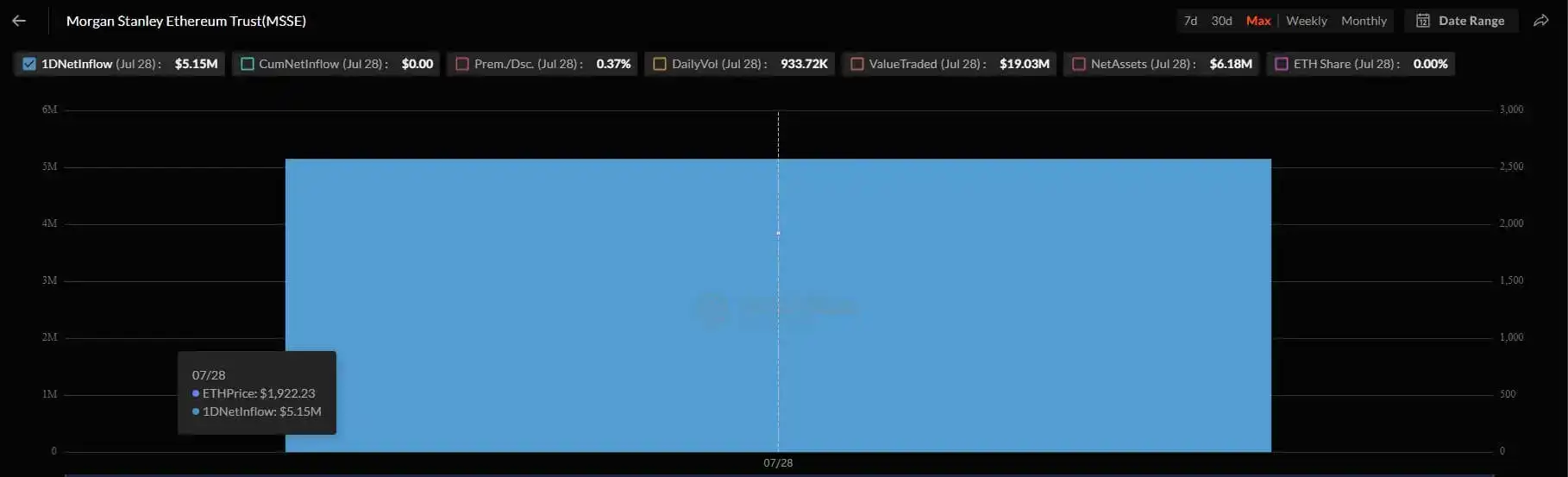
Performance of Morgan Stanley Ethereum Fund on its first day (Source: SoSoValue)
The situation was the opposite for the Solana track. Investors heavily redeemed the BSOL fund from Bitwise, with mainstream Solana funds experiencing a net outflow of $18.1 million overall.
The contrasting debut performances of the two products serve as an early test of how much market share the latecomer Morgan Stanley can capture. Most secondary market trading of MSSE ultimately translated into new assets under management; while MSOL saw comparable trading activity in the secondary market, it failed to attract new capital inflows in an environment where the broader Solana fund category faced widespread outflows.
Morgan Stanley Investment Management launched these two products on July 28th, expanding its cryptocurrency product line. The firm had already launched the Morgan Stanley Bitcoin Trust (MSBT) in April of this year. Despite the Bitcoin ETF track being led by BlackRock and Fidelity, MSBT's assets under management had surpassed $400 million by the time of this report.
These new products go beyond simple spot cryptocurrency asset allocation, with both supporting staking of the underlying assets. Morgan Stanley has officially entered the increasingly competitive fray among fund issuers vying over how much staking yield they can pass on to investors.
Morgan Stanley Wages Price War with Comprehensive Fee Rates Lower Than Competitors
In both the Ethereum and Solana tracks, Morgan Stanley's combined cost of management fees plus staking revenue share is among the lowest in the industry, positioning it competitively.
MSSE and MSOL charge an annual product management fee of 0.14%; Morgan Stanley itself does not take any share of the staking rewards, with the custodian and staking service provider collectively taking only 5% of the total staking rewards. All remaining rewards, before deductions for other fees and distributions, are retained in the trust accounts. This fee structure provides a significant advantage over a host of established competitors.
Solana ETF Industry Fee Comparison
Bitwise's BSOL has a management fee of 0.20%, with a service provider share of staking rewards at 6%; Grayscale's GSOL has a management fee of 0.19% and a service provider share of 7%; Franklin Templeton's SOEZ takes an 8% share of staking rewards; 21Shares has the lowest staking share at 10%, while Fidelity takes 15%, and VanEck and Farside Investors take as high as 25%.

Management and Staking Fees of Solana Exchange-Traded Funds (Source: Farside Investors)
Ethereum ETF Industry Fee Comparison
The disparity in industry fees is equally evident: Grayscale's low-cost Ethereum product charges a management fee of 0.15% and a staking share of 6%; BlackRock's ETHB has a regular management fee of 0.25% and a staking share of 10%; 21Shares' TETH takes a 25% staking share, while Grayscale's flagship Ethereum Trust ETHE takes a 23% staking share.

Custody and Staking Fees of Ethereum ETFs (Source: Farside Investors)
BlackRock has introduced a limited-time promotion: for the first $2.5 billion in assets under management over a 12-month period starting in March, the management fee is reduced to 0.12%, superficially lower than Morgan Stanley's rate in the short term, but the product's regular fee remains at 0.25%.
Therefore, Morgan Stanley's competition extends beyond simple ETF management fee comparisons. For crypto funds that support staking, the final yield investors receive also depends on two key factors: the proportion of the fund's assets participating in network staking, and how much of the staking rewards are retained by various intermediary institutions.
MSSE Rules: Under normal market conditions, 50% to 80% of the Ethereum holdings will be used for staking, with the prospectus setting an 80% upper limit. The staking ratio can be flexibly adjusted based on redemption demand, on-chain unlocking periods, and market liquidity. MSOL employs a more aggressive staking strategy: the trust can stake up to 100% of its Solana tokens; to meet daily redemptions and ensure liquidity, a portion of tokens will be held un-staked.
Net staking rewards for both funds will be distributed monthly in cash, with a minimum guaranteed distribution on a quarterly basis. Rewards are first accumulated in Ethereum or Solana tokens, then the trust sells an equivalent amount of cryptocurrency for cash to distribute to fund shareholders.
This model allows ordinary investors to earn staking rewards through a traditional brokerage account, without needing to custody crypto tokens themselves or directly interface with blockchain validator nodes.
Channel Distribution Tests the First-Mover Advantages of Established Products
Despite having a clear fee advantage, Morgan Stanley still needs to catch up with the scale and liquidity that established funds have accumulated over months or even years; the gap remains significant. Bitwise BSOL has accumulated net inflows of $892 million, contributing the vast majority to the total $1.12 billion across all Solana ETFs tracked by Farside; BlackRock's spot Ethereum ETHA has attracted $11.4 billion, and its staking-enabled ETHB has also accumulated $529 million.
Established funds possess longer trading histories and stable investor bases. Fee advantages cannot immediately erase these first-mover benefits. However, Morgan Stanley holds its own unique channel barriers.
Bloomberg Intelligence analyst Eric Balchunas commented that, leveraging Morgan Stanley's scale and reach, these two new products represent the most significant new supply since the launch of Ethereum and Solana ETFs. The company has nearly 16,000 financial advisors managing a combined $2.6 trillion in client assets; by the end of 2025, Morgan Stanley Wealth Management's total client assets reached $7.4 trillion, serving over 20 million clients.
Morgan Stanley has clearly identified cryptocurrencies and asset tokenization as key expansion areas, facilitating client access to crypto products across multiple channels like the ETRADE securities platform, corporate employee wealth management, and financial advisors. Supporting infrastructure is being rolled out continuously: ETRADE fully launched spot trading for Bitcoin, Ethereum, and Solana this month; Morgan Stanley has also partnered with Galaxy Digital, allowing qualified high-net-worth clients to exchange their crypto holdings for shares of spot crypto ETFs.
Leveraging this vast offline wealth management network, MSSE and MSOL can reach ordinary wealth management clients, not just native investors deeply entrenched in the crypto space — which constituted the early client base for most competitors.