The Era Where 'Bitcoin Determines Everything' Is Coming to an End

marsbitPubblicato 2026-06-02Pubblicato ultima volta 2026-06-02

Introduzione

The article argues that the era where "Bitcoin decides everything" in the crypto market is ending. It posits a new dichotomy: **endogenous assets**, whose value is tied to crypto market cycles (like Bitcoin and traditional altcoins), and **exogenous assets**, which nominally belong to crypto but derive their value from independent, real-world demand and business fundamentals. Examples of exogenous assets include: * **Hyperliquid**: A hybrid, with growing activity in non-crypto perpetual contracts (HIP-3) and prediction markets (HIP-4). * **Venice**: An AI inference service using tokens primarily as a marketing tool; its revenue comes from user payments, not crypto speculation. * **Figure**: A fintech firm using blockchain to streamline lending; its core value is its credit business. The rise of exogenous assets is significant because it enables true fundamental investing, based on quantifiable demand, sustainable revenue (e.g., Venice's subscriptions, stablecoin company acquisitions), and improved token value accrual mechanisms—factors absent in past cycles. Consequently, analyzing exogenous assets requires traditional business due diligence (assessing user base, unit economics, moats) rather than just tracking Bitcoin's price. The market driver is shifting from a single factor (BTC) to multiple factors. Promising exogenous sectors highlighted include: on-chain exchanges/brokers, tokenization infrastructure, crypto+AI, privacy-focused digital banks, lending (institu...

Written by: Charlie

Compiled by: Luffy, Foresight News

For a long time, the entire crypto market's trends have revolved around Bitcoin. Now, such an era is coming to an end.

The crypto economy is now splitting into two major camps: endogenous assets and exogenous assets.

So-called endogenous assets are the traditional crypto categories familiar to the public: the value of these tokens and projects is entirely dependent on the overall rise and fall of crypto asset prices. Exogenous assets, on the other hand, nominally belong to the crypto track, but their value trends are increasingly independent of the crypto market.
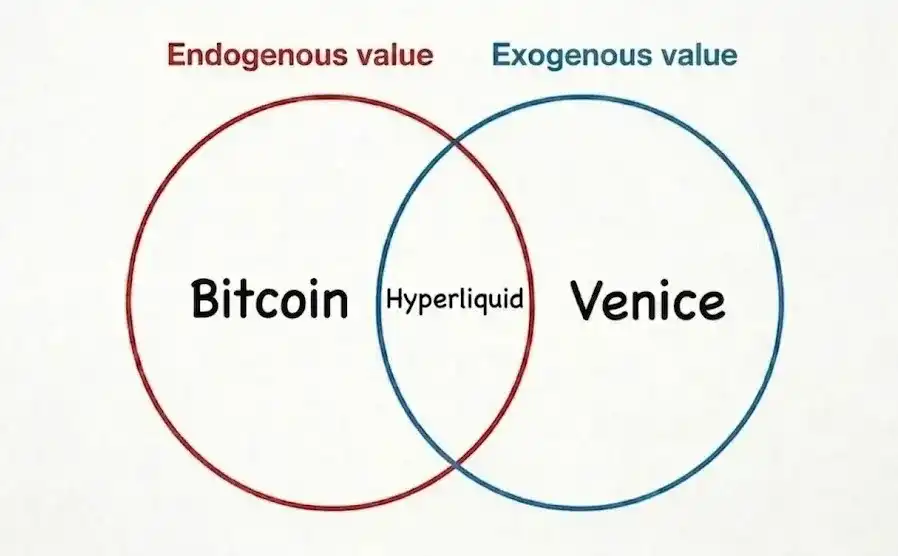
Bitcoin's value stems from its own attributes and is reflected in its price. Price increases further strengthen the market's perception of its value attributes. At the peak of a bull market, Bitcoin is revered as an "interstellar currency," the most scarce digital circulating asset in human hands; at the trough of a bear market, it is denigrated as a digital collectible with no cash flow support.

Hyperliquid falls between these two camps. Most of its business still relies on crypto market trends, but both supply and demand sides are continuously broadening. Many on-chain financial infrastructures fall into this category, with underlying assets gradually shifting towards real-world asset tokenization.
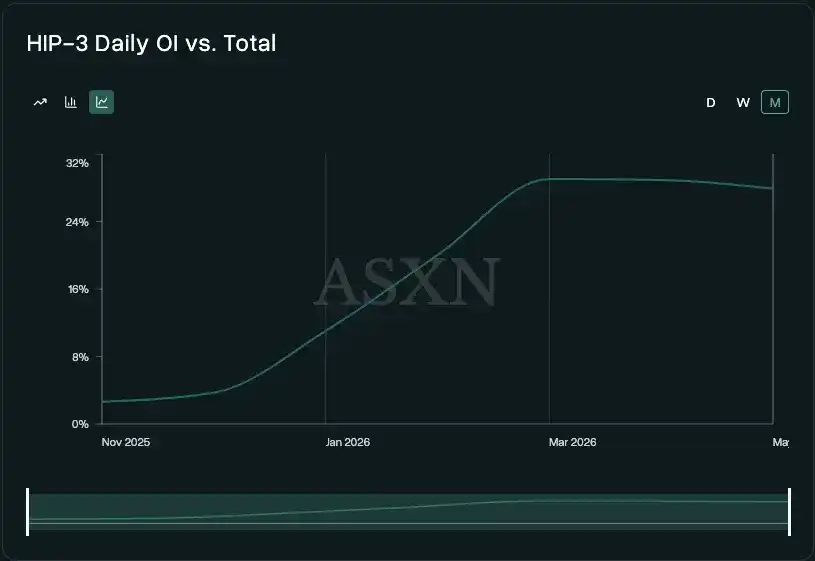
HIP-3 open interest can roughly reflect the activity of non-crypto trades. Currently, HIP-3 contracts account for about 30% of Hyperliquid's total open interest, whereas in November 2025, this proportion was only 4%. The upcoming HIP-4 prediction market will further drive growth, bringing new trading users and trading pairs.

Projects like Venice completely belong to the exogenous camp, with their development logic completely detached from the crypto market. Although there is some user overlap, its business model leans more towards consumer-grade artificial intelligence, rather than native crypto products like Uniswap. Uniswap's core business is still users trading various endogenous assets, so its performance naturally fluctuates with asset prices; Venice packages private multimodal inference services, adopting a "pay-per-use + subscription" fee model.

Venice's only connection to the crypto field is using tokens as a value carrier, and the fact that some of its computing power suppliers have backgrounds in the crypto industry. Project lead Erik Voorhees, a veteran in the crypto industry, believes that when used effectively, tokens can be excellent marketing tools.

Publicly listed company Figure is also a typical case. This fintech lending company developed its own blockchain, reducing the approval time for home equity loans to under 5 minutes. For Figure, blockchain is merely a supporting technology; its core value lies in the credit business itself.

The large-scale rise of exogenous tracks, whether in the token market or the listed company sector, has profound significance. In the past, as most business models were deeply tied to crypto asset prices, purely bottom-up fundamental investing was difficult to implement. The crypto industry has not been without narratives emphasizing "blockchain over Bitcoin," but previous cycles eventually returned to Bitcoin's performance. The reason was that these tracks failed to form stable demand and generate continuous revenue; even with revenue, it couldn't be transmitted to token value. Once token prices stopped rising, projects lost support.

This cycle is fundamentally different. Now we can clearly see paying user groups and payment logic. Demand in most tracks is quantifiable, no longer relying solely on sentiment-driven hype. Simultaneously, the mechanisms for tokens as value carriers are continuously improving. Venice's revenue comes from users genuinely paying for AI inference services. Even if the overall crypto market declines, its business wouldn't be significantly impacted because it doesn't rely on coin price movements. This cycle possesses two core advantages absent in previous ones: sustainable real-world usage demand, and investors starting to invest based on fundamentals rather than pure market narratives.

The stablecoin track in the private market is also like this. In March 2026, Mastercard announced it would acquire BVNK for up to $1.8 billion; this company had a valuation of only $750 million when it completed its Series B round 15 months prior. Another stablecoin-related company, Bridge, was acquired by Stripe for $1.1 billion in February 2025. According to Stripe's annual report, Bridge's current annual business growth is fourfold. The development of these companies is entirely decoupled from the crypto industry's bull and bear cycles.

This is not to say we are bearish on endogenous assets. Just as gold and even small gold mining companies always have their place in an investment portfolio, Bitcoin and a host of endogenous crypto assets also have their raison d'être. However, the performance drivers and market correlations of the two asset classes have fundamentally diverged, a fact confirmed by data.
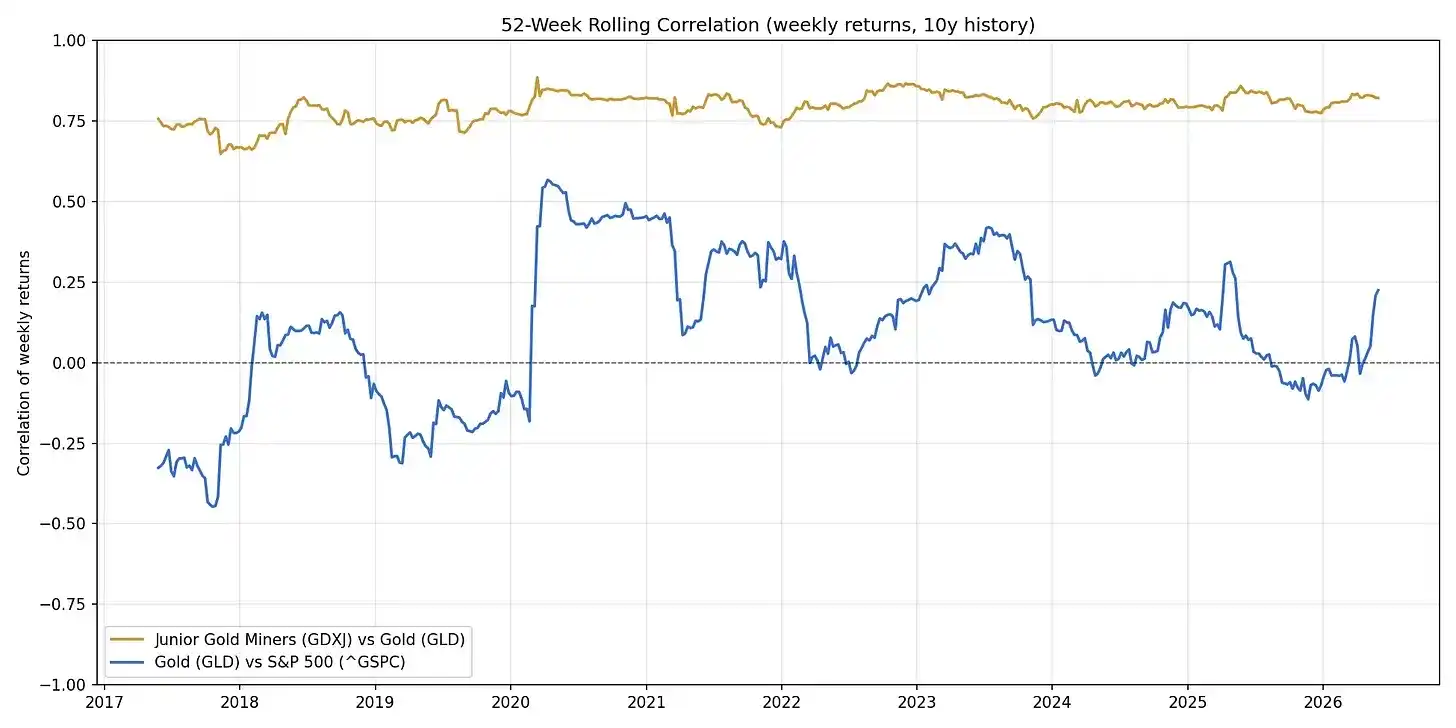
This analogy can be visualized: The correlation coefficient between small gold mining stocks and gold prices consistently remains around 0.75. This is precisely the current state of the traditional crypto market—various crypto assets are like small gold mines, with Bitcoin corresponding to gold; the entire sector represents leveraged investments relative to Bitcoin. The blue curve in the chart represents another relationship: Gold and the S&P 500 Index may show weak联动 due to macroeconomic influences, but each operates on its own independent logic. This is also the future direction for exogenous assets. In the long run, these assets will gradually decouple from the trend of "following Bitcoin's rise and fall."
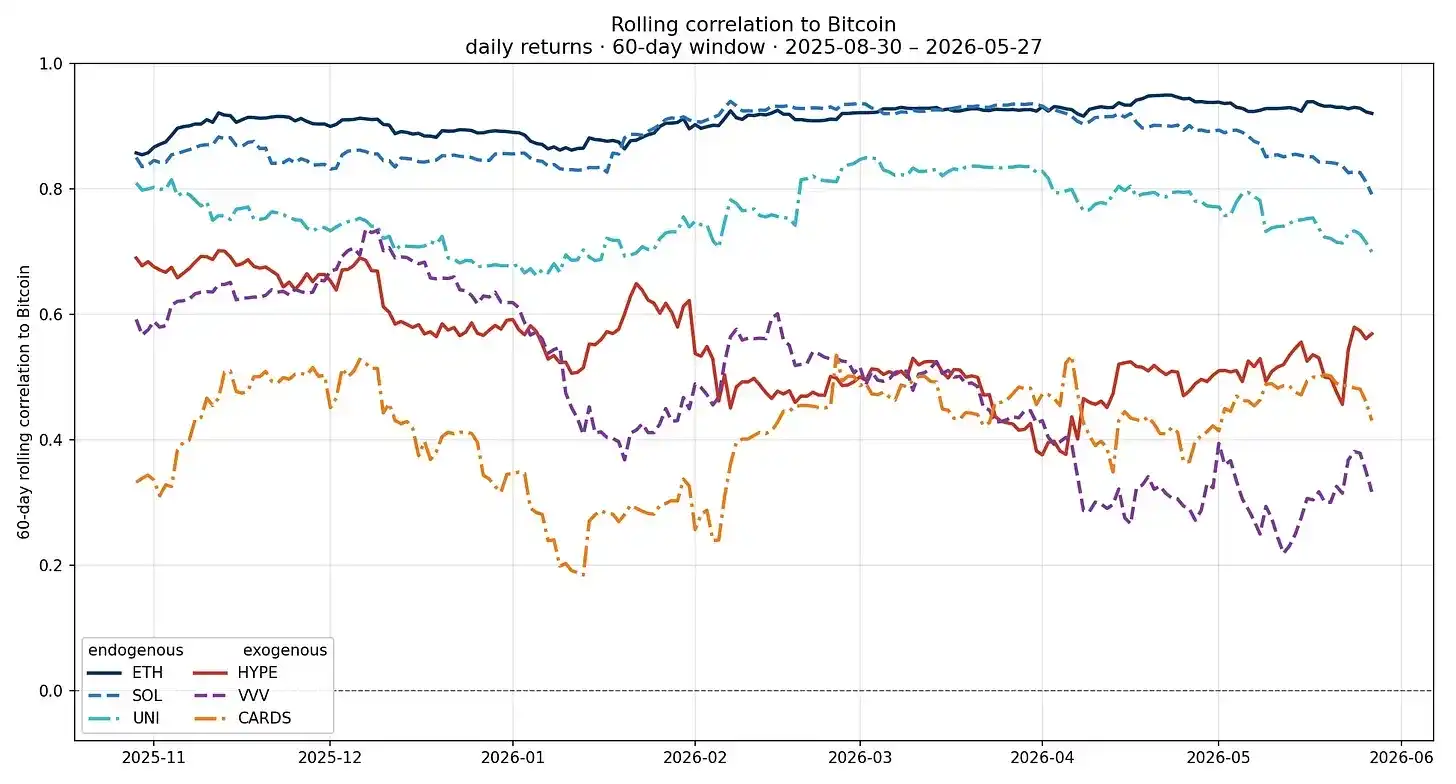
It should be noted that many exogenous assets themselves also issue tokens. This phenomenon both confirms the above trend and represents a special circumstance.

Currently, the vast majority of endogenous assets remain highly synchronized with Bitcoin's price movements. A few exogenous assets show reduced correlation, but due to their short development cycles, they do not yet provide strong reference points. Industry规律 has always been fundamentals first, followed by changes in market correlation.

This change has also completely rewritten industry analysis logic. Researching exogenous assets requires fundamental due diligence like analyzing traditional companies:梳理付费用户群体, measuring unit economics, and assessing industry moats. Bitcoin price is no longer the primary参考指标. Analyzing such projects is more akin to fintech investors making judgments, with the added special环节 of asset custody.

Here are the currently promising exogenous tracks:

  • On-chain exchanges and brokerage service providers
  • Clearing and redemption solutions for long-tail asset tokenization
  • Deep convergence tracks of crypto + AI (private inference, distributed open-source model training like Nous Research's Psyche, etc.)
  • New digital banks (Payy and Raycash, focusing on privacy protection,值得关注; Aztec and Zama providing programmable privacy infrastructure also have potential)
  • Lending track (Morpho has become a mainstream choice for institutional repo markets; smaller projects like Valinor and 3jane focus on private credit细分领域)
  • Stablecoin issuers, real-world asset tokenization service providers
  • Payment channels (in general payments, Stripe and Tempo are industry benchmarks; in agent payments, currently led by Coinbase)
  • Non-financial crypto consumer products (represented by Venice, Collector Crypt; these projects赋予实体业务价值 to tokens, driving product adoption and enabling marketing empowerment)
  • Agent economy (core opportunities lie in the agent接入层, service provider and creator协同生态, where substitutability is low. Cloudflare leads in布局, but whether it will charge traffic fees or merely provide basic services remains unclear)

At this stage, investing in equity of relevant companies remains the safest way to gain exposure to the above tracks, with优质代币标的 being rare exceptions. Only as the value-carrying mechanisms for tokens continue to optimize will their role be further enhanced. This requires joint推进 from regulators and the entire industry. Current work is underway: on the regulatory front, the 《CLARITY Act》 is稳步推进; on the industry front, institutions like Blockworks are推动市场信息透明化. Token mechanisms still have a long optimization journey ahead.

But none of these details change one core trend: the driving force of the crypto market is shifting from a single factor to multiple factors. The focus of industry research is also shifting from interpreting Bitcoin price charts to delving into corporate fundamentals. In the next decade, there will be no need to wonder why the "crypto market" no longer rises and falls in unison, because the industry landscape has been completely transformed.

Domande pertinenti

QAccording to the article, what are the two major camps that the crypto economy is now divided into, and what is their main difference?

AThe crypto economy is now divided into endogenous assets and exogenous assets. Endogenous assets are traditional crypto categories whose value is completely dependent on the overall crypto market trends. Exogenous assets nominally belong to the crypto track, but their value trajectory is increasingly independent of the crypto market.

QWhat examples of exogenous assets are mentioned in the article, and how do their business models differ from traditional crypto projects like Uniswap?

AExamples of exogenous assets mentioned are Venice and Figure. Venice operates more like a consumer-grade AI service, using a 'pay-per-use + subscription' model, with its core value not tied to crypto asset prices. Figure uses blockchain as a supporting technology to streamline its core lending business. Unlike Uniswap, whose core business is trading endogenous assets and thus fluctuates with their prices, these exogenous projects have business models independent of crypto market cycles.

QWhat two core advantages does the current market cycle possess that previous ones lacked, according to the author?

AThe current cycle possesses two core advantages: sustainable real usage demand and investors beginning to invest based on fundamentals rather than solely on market narratives.

QWhat is the key difference in how one should analyze exogenous assets compared to endogenous assets, as described in the article?

AAnalyzing exogenous assets requires fundamental due diligence similar to analyzing traditional companies. This includes examining the paying user base, calculating unit economics, and evaluating industry moats. The price of Bitcoin is no longer the primary reference indicator. The analysis is more akin to what a fintech investor would do, with the additional consideration of asset custody.

QWhat is the core trend identified by the article regarding the driving forces of the crypto market and the focus of industry research?

AThe core trend is that the driving force of the crypto market is shifting from a single factor to multiple factors. Consequently, the focus of industry research is changing from interpreting Bitcoin price charts to delving into corporate fundamentals.

Letture associate

a16z Crypto's Latest Article: Why Do We Need Prediction Markets?

Prediction markets allow people to trade on the outcome of future events. They function as markets that aggregate dispersed information into a price signal, which represents the collective probability of an event occurring. By creating assets that pay out only if a specific outcome happens, these markets enable participants to bet based on their knowledge and beliefs. These markets have historical precedents, like 16th-century papal selection bets, and modern foundations in economics and market design. They offer advantages over traditional forecasting tools like polls: they provide direct probability estimates, update in real-time, and incentivize participants with real financial stakes to contribute accurate information. This can lead to more informed predictions, even for highly specific questions—such as which AI model performs best on certain tasks—that aren't covered by traditional commodity or stock markets. However, prediction markets face challenges. Infrastructure is needed to verify outcomes and ensure transparent, auditable operations. Market design must encourage participation from diverse, informed individuals while mitigating issues like insider trading or manipulation attempts aimed at distorting public perception. Despite these hurdles, with proper design focusing on transparency and participation management, prediction markets have significant potential as a core tool for forecasting the future.

marsbit1 h fa

a16z Crypto's Latest Article: Why Do We Need Prediction Markets?

marsbit1 h fa

Trading

Spot
Futures

Articoli Popolari

Cosa è BITCOIN

Comprendere HarryPotterObamaSonic10Inu (ERC-20) e la sua posizione nel mondo delle criptovalute Negli ultimi anni, il mercato delle criptovalute ha assistito a un aumento della popolarità delle meme coin, catturando l'interesse non solo dei trader, ma anche di coloro che cercano coinvolgimento comunitario e valore di intrattenimento. Tra questi token unici c'è HarryPotterObamaSonic10Inu (ERC-20), un progetto intrigante che mescola riferimenti culturali nel tessuto delle criptovalute. Questo articolo esplora gli aspetti chiave di HarryPotterObamaSonic10Inu, analizzando i suoi meccanismi, l'etica guidata dalla comunità e il suo coinvolgimento con il panorama crittografico più ampio. Che cos'è HarryPotterObamaSonic10Inu (ERC-20)? Come suggerisce il suo nome, HarryPotterObamaSonic10Inu è una meme coin costruita sulla blockchain di Ethereum, classificata secondo lo standard ERC-20. A differenza delle criptovalute tradizionali che possono enfatizzare l'utilità pratica o il potenziale investimento, questo token prospera grazie al valore di intrattenimento e alla forza della sua comunità. Il progetto mira a creare un ambiente in cui gli utenti coinvolti possono riunirsi, condividere idee e partecipare ad attività ispirate a diversi fenomeni culturali. Una caratteristica notevole di HarryPotterObamaSonic10Inu è la zero tassa sulle transazioni. Questo elemento allettante tende a incoraggiare il trading e il coinvolgimento della comunità, privo di costi aggiuntivi che possono scoraggiare i trader di piccole dimensioni. L'offerta totale della moneta è fissata a un miliardo di token, un numero che segna la sua intenzione di mantenere una circolazione sostanziale all'interno della comunità. Creatore di HarryPotterObamaSonic10Inu (ERC-20) Le origini di HarryPotterObamaSonic10Inu sono avvolte in un certo mistero; i dettagli sul creatore rimangono sconosciuti. Lo sviluppo di questo token non presenta un team identificabile o un piano esplicito, cosa non rara nel settore delle meme coin. Invece, il progetto è emerso organicamente, con il suo progresso fortemente dipendente dall'entusiasmo e dalla partecipazione della sua comunità. Investitori di HarryPotterObamaSonic10Inu (ERC-20) Per quanto riguarda investimenti esterni e finanziamenti, HarryPotterObamaSonic10Inu rimane ambiguo. Il token non elenca alcuna fondazione di investimento conosciuta o un sostegno organizzativo significativo. Invece, la linfa vitale del progetto è la sua comunità di base, che informa la sua crescita e sostenibilità attraverso azioni collettive e coinvolgimento nello spazio crittografico. Come funziona HarryPotterObamaSonic10Inu (ERC-20)? In quanto meme coin, HarryPotterObamaSonic10Inu opera principalmente al di fuori delle strutture tradizionali che governano spesso il valore degli asset. Ci sono diversi aspetti distintivi che definiscono il funzionamento del progetto: Transazioni senza tasse: Senza costi fiscali sulle transazioni, gli utenti possono comprare e vendere liberamente il token senza preoccuparsi di costi nascosti. Coinvolgimento della comunità: Il progetto prospera sull'interazione della comunità, sfruttando le piattaforme social per creare entusiasmo e facilitare il coinvolgimento. Discussioni, condivisione di contenuti e coinvolgimento sono elementi cruciali che aiutano ad espandere la sua portata e a favorire la lealtà tra i sostenitori. Nessuna utilità pratica: Va notato che HarryPotterObamaSonic10Inu non offre un'utilità concreta all'interno dell'ecosistema finanziario. Piuttosto, è classificato come un token principalmente per attività di intrattenimento e comunitarie. Riferimento culturale: Il token incorpora astutamente elementi della cultura pop per attirare interesse, collegandosi a appassionati di meme e seguaci delle criptovalute. HarryPotterObamaSonic10Inu esemplifica come le meme coin operino in modo diverso rispetto ai progetti di criptovalute più tradizionali, entrando nel mercato come costrutti sociali innovativi piuttosto che come asset utilitari. Cronologia di HarryPotterObamaSonic10Inu (ERC-20) La storia di HarryPotterObamaSonic10Inu è segnata da diversi traguardi notevoli: Creazione: Il token è emerso da un meme virale, catturando l'immaginazione di molti appassionati di criptovalute. Le date di creazione specifiche non sono disponibili, sottolineando la sua crescita organica. Inserimento negli scambi: HarryPotterObamaSonic10Inu ha fatto il suo ingresso in vari scambi, consentendo un accesso e un trading più facili da parte della comunità. Iniziative di coinvolgimento della comunità: Attività in corso volte a migliorare l'interazione della comunità, comprese gare, campagne sui social media e generazione di contenuti da parte di fan e sostenitori. Piani di espansione futura: La tabella di marcia del progetto include il lancio di una collezione NFT, merchandising e un sito di eCommerce relativo ai suoi temi culturali, coinvolgendo ulteriormente la comunità e cercando di aggiungere più dimensioni al suo ecosistema. Punti chiave su HarryPotterObamaSonic10Inu (ERC-20) Natura guidata dalla comunità: Il progetto dà priorità al contributo collettivo e alla creatività, garantendo che il coinvolgimento degli utenti sia al centro del suo sviluppo. Classificazione come meme coin: Rappresenta l'epitome delle criptovalute basate sull'intrattenimento, distinguendosi dai veicoli d'investimento tradizionali. Nessuna affiliazione diretta con Bitcoin: Nonostante la somiglianza nel nome del ticker, HarryPotterObamaSonic10Inu è distintivo e non ha alcuna relazione con Bitcoin o altre criptovalute consolidate. Focus sulla collaborazione: HarryPotterObamaSonic10Inu è progettato per creare uno spazio per la collaborazione e la condivisione di storie tra i suoi detentori, fornendo un canale per la creatività e il legame comunitario. Prospettive future: L'ambizione di espandersi oltre il suo presupposto iniziale verso NFT e merchandising delinea un percorso per il progetto per potenzialmente entrare in strade più mainstream all'interno della cultura digitale. Poiché le meme coin continuano a catturare l'immaginazione della comunità crittografica, HarryPotterObamaSonic10Inu (ERC-20) si distingue per i suoi legami culturali e il suo approccio centrato sulla comunità. Anche se potrebbe non adattarsi al modello tipico di un token orientato all'utilità, la sua essenza risiede nella gioia e nella camaraderia coltivate tra i suoi sostenitori, evidenziando la natura in evoluzione delle criptovalute in un'epoca sempre più digitale. Con la continuazione dello sviluppo del progetto, sarà importante osservare come le dinamiche della comunità influenzano la sua traiettoria nel panorama in continuo cambiamento della tecnologia blockchain.

1.5k Totale visualizzazioniPubblicato il 2024.04.01Aggiornato il 2024.12.03

Cosa è BITCOIN

Come comprare BTC

Benvenuto in HTX.com! Abbiamo reso l'acquisto di Bitcoin (BTC) semplice e conveniente. Segui la nostra guida passo passo per intraprendere il tuo viaggio nel mondo delle criptovalute.Step 1: Crea il tuo Account HTXUsa la tua email o numero di telefono per registrarti il tuo account gratuito su HTX. Vivi un'esperienza facile e sblocca tutte le funzionalità,Crea il mio accountStep 2: Vai in Acquista crypto e seleziona il tuo metodo di pagamentoCarta di credito/debito: utilizza la tua Visa o Mastercard per acquistare immediatamente BitcoinBTC.Bilancio: Usa i fondi dal bilancio del tuo account HTX per fare trading senza problemi.Terze parti: abbiamo aggiunto metodi di pagamento molto utilizzati come Google Pay e Apple Pay per maggiore comodità.P2P: Fai trading direttamente con altri utenti HTX.Over-the-Counter (OTC): Offriamo servizi su misura e tassi di cambio competitivi per i trader.Step 3: Conserva Bitcoin (BTC)Dopo aver acquistato Bitcoin (BTC), conserva nel tuo account HTX. In alternativa, puoi inviare tramite trasferimento blockchain o scambiare per altre criptovalute.Step 4: Scambia Bitcoin (BTC)Scambia facilmente Bitcoin (BTC) nel mercato spot di HTX. Accedi al tuo account, seleziona la tua coppia di trading, esegui le tue operazioni e monitora in tempo reale. Offriamo un'esperienza user-friendly sia per chi ha appena iniziato che per i trader più esperti.

3.9k Totale visualizzazioniPubblicato il 2024.12.12Aggiornato il 2026.06.02

Come comprare BTC

Cosa è $BITCOIN

ORO DIGITALE ($BITCOIN): Un'Analisi Completa Introduzione all'ORO DIGITALE ($BITCOIN) L'ORO DIGITALE ($BITCOIN) è un progetto basato su blockchain che opera sulla rete Solana, con l'obiettivo di combinare le caratteristiche dei metalli preziosi tradizionali con l'innovazione delle tecnologie decentralizzate. Sebbene condivida un nome con Bitcoin, spesso definito “oro digitale” a causa della sua percezione come riserva di valore, l'ORO DIGITALE è un token separato progettato per creare un ecosistema unico all'interno del panorama Web3. Il suo obiettivo è posizionarsi come un asset digitale alternativo valido, anche se i dettagli riguardanti le sue applicazioni e funzionalità sono ancora in fase di sviluppo. Cos'è l'ORO DIGITALE ($BITCOIN)? L'ORO DIGITALE ($BITCOIN) è un token di criptovaluta esplicitamente progettato per l'uso sulla blockchain di Solana. A differenza di Bitcoin, che fornisce un ruolo di stoccaggio di valore ampiamente riconosciuto, questo token sembra concentrarsi su applicazioni e caratteristiche più ampie. Aspetti notevoli includono: Infrastruttura Blockchain: Il token è costruito sulla blockchain di Solana, nota per la sua capacità di gestire transazioni ad alta velocità e a basso costo. Dinamiche di Offerta: L'ORO DIGITALE ha un'offerta massima fissata a 100 quadrilioni di token (100P $BITCOIN), sebbene i dettagli riguardanti la sua offerta circolante siano attualmente non divulgati. Utilità: Sebbene le funzionalità precise non siano esplicitamente delineate, ci sono indicazioni che il token potrebbe essere utilizzato per varie applicazioni, potenzialmente coinvolgendo applicazioni decentralizzate (dApp) o strategie di tokenizzazione degli asset. Chi è il Creatore dell'ORO DIGITALE ($BITCOIN)? Attualmente, l'identità dei creatori e del team di sviluppo dietro l'ORO DIGITALE ($BITCOIN) rimane sconosciuta. Questa situazione è tipica tra molti progetti innovativi nel settore blockchain, in particolare quelli allineati con la finanza decentralizzata e i fenomeni delle meme coin. Sebbene tale anonimato possa favorire una cultura guidata dalla comunità, intensifica le preoccupazioni riguardo alla governance e alla responsabilità. Chi sono gli Investitori dell'ORO DIGITALE ($BITCOIN)? Le informazioni disponibili indicano che l'ORO DIGITALE ($BITCOIN) non ha alcun sostenitore istituzionale noto o investimenti di venture capital prominenti. Il progetto sembra operare su un modello peer-to-peer incentrato sul supporto e sull'adozione della comunità piuttosto che su percorsi di finanziamento tradizionali. La sua attività e liquidità si trovano principalmente su exchange decentralizzati (DEX), come PumpSwap, piuttosto che su piattaforme di trading centralizzate consolidate, evidenziando ulteriormente il suo approccio di base. Come Funziona l'ORO DIGITALE ($BITCOIN) Le meccaniche operative dell'ORO DIGITALE ($BITCOIN) possono essere elaborate in base al suo design blockchain e alle caratteristiche della rete: Meccanismo di Consenso: Sfruttando il proof-of-history (PoH) unico di Solana combinato con un modello di proof-of-stake (PoS), il progetto garantisce una validazione efficiente delle transazioni contribuendo all'alta performance della rete. Tokenomics: Sebbene meccanismi deflazionistici specifici non siano stati dettagliati ampiamente, l'ampia offerta massima di token implica che potrebbe soddisfare microtransazioni o casi d'uso di nicchia che devono ancora essere definiti. Interoperabilità: Esiste il potenziale per l'integrazione con l'ecosistema più ampio di Solana, inclusi vari piattaforme di finanza decentralizzata (DeFi). Tuttavia, i dettagli riguardanti integrazioni specifiche rimangono non specificati. Cronologia degli Eventi Chiave Ecco una cronologia che evidenzia traguardi significativi riguardanti l'ORO DIGITALE ($BITCOIN): 2023: Il dispiegamento iniziale del token avviene sulla blockchain di Solana, contrassegnato dal suo indirizzo di contratto. 2024: L'ORO DIGITALE guadagna visibilità poiché diventa disponibile per il trading su exchange decentralizzati come PumpSwap, consentendo agli utenti di scambiarlo contro SOL. 2025: Il progetto assiste a un'attività di trading sporadica e a un potenziale interesse per impegni guidati dalla comunità, sebbene non siano state documentate partnership significative o avanzamenti tecnici fino ad ora. Analisi Critica Punti di Forza Scalabilità: L'infrastruttura sottostante di Solana supporta alti volumi di transazioni, il che potrebbe migliorare l'utilità di $BITCOIN in vari scenari di transazione. Accessibilità: Il potenziale basso prezzo di trading per token potrebbe attrarre investitori al dettaglio, facilitando una partecipazione più ampia grazie a opportunità di proprietà frazionata. Rischi Mancanza di Trasparenza: L'assenza di sostenitori, sviluppatori o di un processo di audit pubblicamente noti potrebbe generare scetticismo riguardo alla sostenibilità e all'affidabilità del progetto. Volatilità del Mercato: L'attività di trading è fortemente dipendente dal comportamento speculativo, il che può comportare una significativa volatilità dei prezzi e incertezze per gli investitori. Conclusione L'ORO DIGITALE ($BITCOIN) emerge come un progetto intrigante ma ambiguo all'interno dell'evolvente ecosistema di Solana. Sebbene tenti di sfruttare la narrativa dell'“oro digitale”, la sua partenza dal ruolo consolidato di Bitcoin come riserva di valore sottolinea la necessità di una chiara differenziazione della sua utilità e struttura di governance. L'accettazione e l'adozione future dipenderanno probabilmente dall'affrontare l'attuale opacità e dalla definizione più esplicita delle sue strategie operative ed economiche. Nota: Questo rapporto comprende informazioni sintetizzate disponibili a ottobre 2023, e potrebbero essersi verificati sviluppi oltre il periodo di ricerca.

99 Totale visualizzazioniPubblicato il 2025.05.13Aggiornato il 2025.05.13

Cosa è $BITCOIN

Discussioni

Benvenuto nella Community HTX. Qui puoi rimanere informato sugli ultimi sviluppi della piattaforma e accedere ad approfondimenti esperti sul mercato. Le opinioni degli utenti sul prezzo di BTC BTC sono presentate come di seguito.

活动图片