Pump and Dump? Bitcoin and Ethereum Long-Short Squeeze, Direction to Be Decided Tonight! Best Time to Layout Altcoins: ZEC, FARTCOIN, TON Back to $8?

金色财经Pubblicato 2025-12-09Pubblicato ultima volta 2025-12-09

Introduzione

The cryptocurrency market is currently experiencing high volatility with significant liquidations, as Bitcoin and Ethereum remain in key consolidation zones. Over $204 million was liquidated in 24 hours, affecting over 87,000 traders. Bitcoin has been trading sideways since November 21st around $80,600, with a tightening Bollinger Band suggesting an imminent breakout. A move above $92,600 could signal a rally toward $94,185 and $96,012, while a drop below $87,600 may lead to a decline below $80,600. Post-Fed rate decision volatility is expected, and a "sell the news" scenario is possible. Ethereum continues to trade within a large range between $4,146 and $3,011. Key resistance lies at $3,138 and $3,260, while support levels are $3,050, $2,980, and $2,900. A bounce from $3,050–$3,020 could present a buying opportunity. The article emphasizes that fundamentals drive long-term trends, while technicals reflect market sentiment. Messaging and news only cause short-term fluctuations. Examples like SUI and HYPE show steady growth, whereas TON struggles despite positive news due to underlying issues. Several risky tokens have recently been listed, often a sign of low liquidity and potential market manipulation. Traders should be cautious. Two altcoins are highlighted: ZEC, which saw a 20% pump and is now above $400—consider taking partial gains; and FARTCOIN, which presents a buying opportunity in the $0.36–0.38 range with a stop loss at $0.342, targeting $0.55 upon breaking $0...

Once-in-a-lifetime window for high-risk, high-reward bets? This year's market has been lackluster, with a 1:1 risk-reward ratio considered decent, but recently it's been a classic 'pump and dump' script: 'profits like a chick pecking rice, losses like an elephant taking a dump.' U.S. stocks plummet, the crypto market is stagnant, trading volume halved compared to March, and the market keeps painting doors, long-short squeezing. The quieter it is, the more likely it is the calm before the storm. The real reversal often hides in this dead silence.

In the past 24 hours, 87,150 people were liquidated across the network, with liquidation totaling $204 million. Long positions liquidated $99.4939 million, short positions liquidated $105 million.
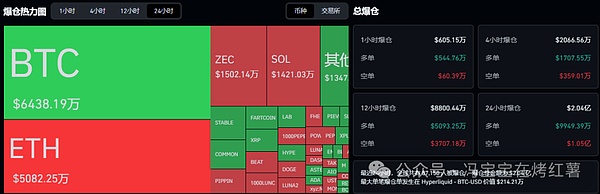
BTC

Bitcoin has been oscillating for 17 days since falling to 80,600 on November 21st. The time is sufficient, and the direction will be decided in the coming days. The price is still fluctuating within the 12-hour Bollinger Bands but is gradually narrowing to the 4-hour Bollinger Bands, compressing to the extreme. Expect increased short-term volatility; please be aware of the risks.
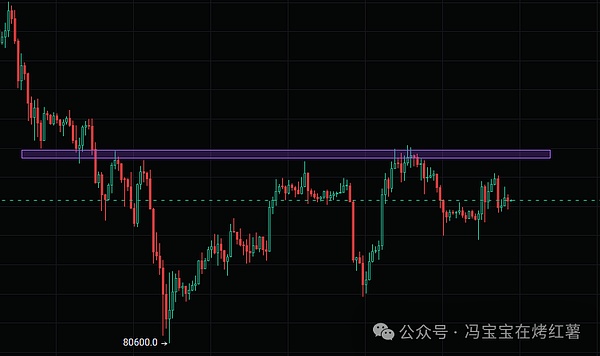
Trading suggestion: If it breaks above 92,600, the rebound could continue, challenging the 94,185 and 96,012 levels. If it breaks below 87,600, the rebound ends, possibly falling back below 80,600.

The market may experience剧烈震荡 after Wednesday's rate cut, although it has been priced in提前. The probability of another rate cut in January is only 27%. Good news being realized can easily trigger a sell-off. If there are signs of a bull trap, consider布局空单提前.

ETH

Ethereum is still operating within the large box range of 4146-3011. As long as the upper boundary isn't broken and the lower boundary isn't breached, continue to buy low and sell high within the box for oscillation. Currently, the price is again consolidating around 3100.
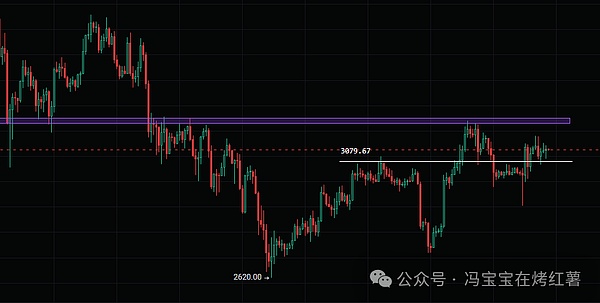
Trading suggestion: Key resistance above is at the 3138 and 3260 levels. As long as it cannot break through, this is just an ordinary rebound, a short-term gap fill, not something to fear. For intraday shorts, support below focuses on 3050, 2980, and 2900. If it falls to 3050-3020 and holds, you can boldly go long.

Altcoins

In trading, many people discuss fundamentals, news, and technicals separately. But in my view, fundamentals and technicals are more like: two sides of the same coin!

Good projects: The fundamentals are truly strong, the product is delivered, and the technical chart will honestly reflect it. The long-term moving average keeps going up, and the price oscillates and rises around the moving average. This is called the value being gradually understood by the market. For example, $SUI and $HYPE in this bull market have been honestly moving up like this.

Bad projects: No matter how much they paint the technical chart, it's just a facade. The long-term moving average can't rise, and the entire trend looks messy.

News? It's the short-term jumps on the K-line. Positive news can temporarily push the price further from the moving average, negative news closer, but it can never change the direction of the long-term moving average because the moving average is pushed by fundamentals. $TON is a classic example. News is everywhere, plenty of positive news, but it just can't lift. Either there are fundamental flaws, or the moving average adjustment isn't finished. As long as the long-term moving average hasn't turned upward, no amount of news hype will help.
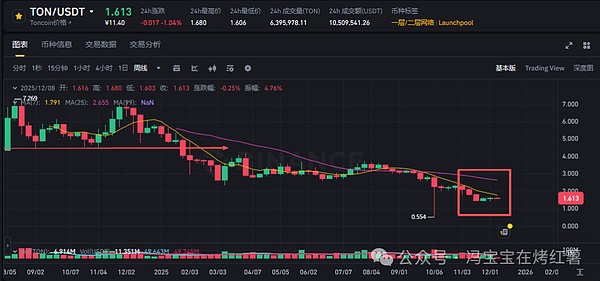
So just remember two sentences: First, fundamentals determine whether this coin can have a bull market long term. Second, the long-term moving average tells you which step it's at now.

News just amplifies the sound a bit; it doesn't change the major trend. Don't just FOMO when you see a coin suddenly has good news. It might pump short-term, but long-term, it still depends on the moving average.

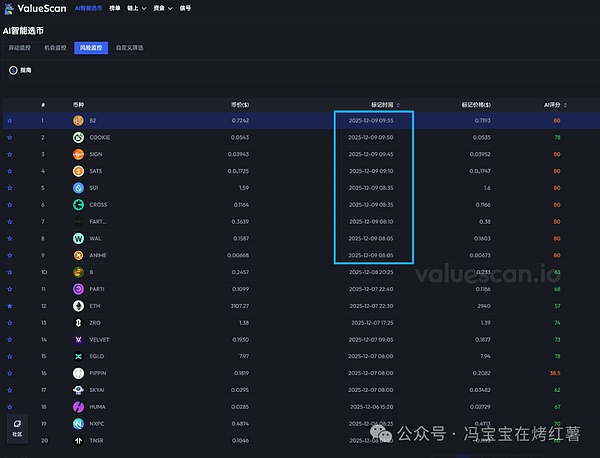
Found 9 risk tokens listed this morning!

Not many, but not few either. Usually, such shitcoins are only listed in batches when liquidity is very poor and there's no popularity. The fact that it appears near the反弹高点 of altcoins today requires caution. It's highly likely that market makers are exiting first, preparing to dump, and mainstream coins will follow with a correction later.
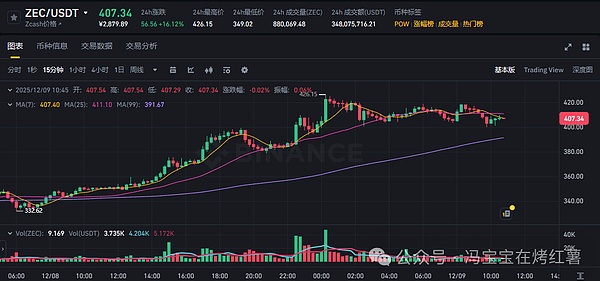
$ZEC

ZEC:注意分批落袋 (Pay attention to taking profits in batches). It rallied against the market, up nearly 20% at the highest, still up 13% now. The price has stabilized above $400. For the remainder,建议用小仓位继续格局 (suggest continuing to hold with small positions). If the 4-hour K-line can break and hold above the neckline, it should still be bullish short-term.
$FARTCOIN

fartcoin: Go long if it falls to the 0.38-0.36 range, stop loss at 0.342. Or wait for a breakout above 0.42 to enter long on the right side. Target above is 0.55.


Domande pertinenti

QWhat is the current market situation described in the article regarding Bitcoin and Ethereum?

AThe market is described as stagnant with low volatility, experiencing 'chopping and double liquidation of long and short positions.' Bitcoin has been consolidating for 17 days after dropping to $80,600, while Ethereum is trading within a large range between $4,146 and $3,011.

QWhat are the key price levels to watch for Bitcoin's potential breakout according to the article?

AFor an upward breakout, watch for a move above $92,600, which could lead to a challenge of $94,185 and $96,012. For a downward breakout, a break below $87,600 could end the rebound and potentially lead to a return below $80,600.

QHow does the article differentiate between a 'good project' and a 'bad project' in the crypto market?

AA good project has strong fundamentals, which are reflected in its technical chart with long-term moving averages consistently trending upward. A bad project's technical chart appears messy, and its long-term moving averages fail to rise, regardless of positive news or hype.

QWhat trading advice is given for the altcoin FARTCOIN?

AThe advice is to go long (buy) in the range of $0.38 to $0.36 with a stop loss at $0.342. Alternatively, one can wait for a breakout above $0.42 to enter a long position, targeting an upside of $0.55.

QWhat warning does the article give based on the listing of 9 'risk tokens'?

AThe article warns that a batch listing of such low-liquidity, low-popularity 'junk coins' near a rebound high for altcoins is often a sign that market makers are preparing to sell off, which could be followed by a correction in mainstream cryptocurrencies.

Letture associate

Warsh's First Day in Office, Markets Deliver a 'Wake-up Call': Rate Hike Expected This Year

On his first day in office, newly inaugurated Federal Reserve Chairman Warsh received a stark market warning, with expectations now fully pricing in a 25-basis-point interest rate hike this year. The shift was triggered by hawkish remarks from Fed Governor Waller, who stated that inflation is now the key policy "driver" and that the odds of a hike or cut are evenly split. This sent short-term Treasury yields higher. Waller signaled a significant pivot in his stance, citing disappointing inflation and labor data. He suggested removing "easing bias" language from Fed statements and did not rule out future rate increases if inflation fails to recede, though he noted immediate action isn't warranted without signs of unanchored inflation expectations. Chairman Warsh faces immediate pressure at his first FOMC meeting in June. With the preferred inflation gauge at a three-year high, analysts warn that failing to hike could be interpreted as an implicit easing of policy. The geopolitical situation in the Middle East is adding to existing price pressures. The market's expectation for a hike contrasts sharply with earlier forecasts for multiple cuts. While long-term Treasury yields have been contained by lower energy prices recently, analysts note they remain under structural upward pressure. Warsh's swearing-in at the White House highlights political scrutiny over Fed independence. However, the market has made it clear that inflation is the most urgent challenge, leaving the new chairman little time to settle in.

marsbit3 h fa

Warsh's First Day in Office, Markets Deliver a 'Wake-up Call': Rate Hike Expected This Year

marsbit3 h fa

Has Microsoft Lost Its Way in the AI Race, and Can Copilot Bring It Back on Track?

Microsoft, once seen as an early AI frontrunner due to its investment in OpenAI, is navigating a strategic shift amid increased competition. Its initial reliance on OpenAI’s GPT models has been complicated by OpenAI’s growing ambitions as a direct competitor, rapid advancements from rivals like Claude and Gemini, and the disruptive rise of AI agents, which challenge its traditional SaaS business model. These factors contributed to stock declines and slower-than-expected adoption of its flagship Copilot products. In response, CEO Satya Nadella has taken a hands-on role in product development, signaling the urgency of change. Microsoft is pivoting from a model-centric strategy to a "model-agnostic" enterprise platform approach. It aims to become the foundational layer connecting various AI models—from OpenAI, Anthropic, or its own new "Superintelligence" team—with enterprise workflows, data, security, and cloud services. Recent organizational changes merged consumer and enterprise Copilot teams to accelerate innovation, exemplified by new products like Copilot Tasks and Copilot Cowork. However, this transformation comes at a high cost. Microsoft faces massive capital expenditures, potentially reaching ~$190 billion by 2026, to support AI infrastructure. While its platform strategy shows early signs of traction with growing Azure AI revenue, it must balance startup-like agility with the reliability expected by enterprise clients. The core challenge is no longer being the sole AI winner but defending its position as the essential enterprise software entry point amidst rapid technological commoditization and the shift towards always-on AI agents.

marsbit4 h fa

Has Microsoft Lost Its Way in the AI Race, and Can Copilot Bring It Back on Track?

marsbit4 h fa

Why Haven't Forex Stablecoins Taken Off?

Why FX Stablecoins Never Took Off: A Path Forward via Synthetic FX Despite the explosive growth of stablecoin-powered digital banking, which has seen ~$6B in VC investment and a 24x surge in crypto card spending in under a year, a major limitation persists: these banks are essentially dollar-only accounts. This leaves 95-99% of global accounts, which are denominated in non-USD currencies, underserved. Attempts to create native foreign currency (FX) stablecoins (like EURC) have largely failed, with total FX stablecoin TVL at ~$600M compared to $400B for USD stablecoins—a 700x gap. These FX tokens face critical challenges: fragile pegs due to low liquidity, limited exchange/FinTech acceptance, poor on/off-ramps, complex regional compliance, and a chicken-and-egg adoption problem. The article argues that the solution lies not in competing with entrenched USD stablecoin networks (USDT/USDC), but in adopting a synthetic FX model inspired by traditional finance. Specifically, it advocates for Mark-to-Market Non-Deliverable Forwards (NDFs)—cash-settled FX derivatives that allow users to maintain underlying USD stablecoin holdings while having their account balance and P&L denominated in a foreign currency. This approach offers key advantages: strong oracle-based pegs, retention of deep USD stablecoin liquidity and yield, superior on/off-ramps, scalability to any currency with a reliable feed, and capital efficiency. It mirrors how modern institutional FX markets operate. Primary use cases for on-chain NDFs include: 1. **Digital Banks/Wallets:** Enabling multi-currency accounts for international users without leaving the USD stablecoin ecosystem, boosting deposits and retention. 2. **FX Carry Trade Vaults:** Offering access to sovereign interest rate differentials (e.g., earning yield on BRL) in a more stable and scalable format than crypto-native products like Ethena. 3. **Global Enterprise Payments:** Allowing merchants to receive payments in local currency equivalents while settling in USD stablecoins, similar to services offered by Stripe for fiat. The conclusion is that synthetic FX, not native FX stablecoins, is the viable path to integrating foreign exchange into the growing stablecoin digital banking landscape, potentially unlocking the next phase of institutional DeFi and multi-trillion-dollar global adoption.

链捕手4 h fa

Why Haven't Forex Stablecoins Taken Off?

链捕手4 h fa

Trading

Spot
Futures

Articoli Popolari

Come comprare TON

Benvenuto in HTX.com! Abbiamo reso l'acquisto di The Open Network (TON) semplice e conveniente. Segui la nostra guida passo passo per intraprendere il tuo viaggio nel mondo delle criptovalute.Step 1: Crea il tuo Account HTXUsa la tua email o numero di telefono per registrarti il tuo account gratuito su HTX. Vivi un'esperienza facile e sblocca tutte le funzionalità,Crea il mio accountStep 2: Vai in Acquista crypto e seleziona il tuo metodo di pagamentoCarta di credito/debito: utilizza la tua Visa o Mastercard per acquistare immediatamente The Open NetworkTON.Bilancio: Usa i fondi dal bilancio del tuo account HTX per fare trading senza problemi.Terze parti: abbiamo aggiunto metodi di pagamento molto utilizzati come Google Pay e Apple Pay per maggiore comodità.P2P: Fai trading direttamente con altri utenti HTX.Over-the-Counter (OTC): Offriamo servizi su misura e tassi di cambio competitivi per i trader.Step 3: Conserva The Open Network (TON)Dopo aver acquistato The Open Network (TON), conserva nel tuo account HTX. In alternativa, puoi inviare tramite trasferimento blockchain o scambiare per altre criptovalute.Step 4: Scambia The Open Network (TON)Scambia facilmente The Open Network (TON) nel mercato spot di HTX. Accedi al tuo account, seleziona la tua coppia di trading, esegui le tue operazioni e monitora in tempo reale. Offriamo un'esperienza user-friendly sia per chi ha appena iniziato che per i trader più esperti.

1.7k Totale visualizzazioniPubblicato il 2024.12.10Aggiornato il 2025.03.21

Come comprare TON

Discussioni

Benvenuto nella Community HTX. Qui puoi rimanere informato sugli ultimi sviluppi della piattaforma e accedere ad approfondimenti esperti sul mercato. Le opinioni degli utenti sul prezzo di TON TON sono presentate come di seguito.

活动图片