XRP’s Long-Term Path Gains Clarity After Major DAS Research Revelation – Here’s Where It’s Headed

bitcoinistPubblicato 2025-12-10Pubblicato ultima volta 2025-12-10

Introduzione

A fresh crypto research report from Digital Asset Solutions (DAS), highlighted by expert Stern Drew, provides a clear, data-driven outlook for XRP and Ripple. According to the analysis, XRP is no longer competing primarily within the crypto space but is instead evolving into a global payment infrastructure focused on serving banks, fintech companies, and cross-border networks. The research identifies three key factors shaping this trajectory: XRP's structural advantages (fast settlement, low cost, neutral bridge asset), Ripple's strategic integration of stablecoins like its own RLUSD (with XRP acting as the liquidity bridge), and forming catalysts such as RippleNet expansion, new RLUSD corridors, and institutional custody solutions. The report concludes that XRP is cementing its role as foundational financial infrastructure rather than a speculative asset, aiming to compete with traditional payment systems.

A fresh update from a crypto expert has emerged regarding XRP and Ripple’s next trajectory, sparking a debate in the community. In recent years, this update has turned out to be one of the most accurate in determining the future of the leading altcoin, reinforcing the significance of the update.

New Research Outlines XRP’s Direction

In a post on the X platform shared by Stern Drew, a crypto expert, Digital Asset Solutions (DAS) Research has delivered what many XRP watchers have been waiting for and finding difficult to determine. The Research seems to have offered insights and provided a clear data-driven signal that breaks through months of conjecture and market noise.

According to the expert, DAS Research just presented the most convincing evidence so far of where XRP is headed. While their analysis offers a clear view of the future direction, it shows that the altcoin and Ripple, an American-based payment firm, are no longer competing in crypto.

Ripple and XRP are shifting into a global payment infrastructure, one that is used by banks, Fintechs, and cross-border networks that seek speed, scale, and settlement transparency. Looking at the Research, there are 3 core realities that are likely to shape the next trajectory of the asset and the payment firm.
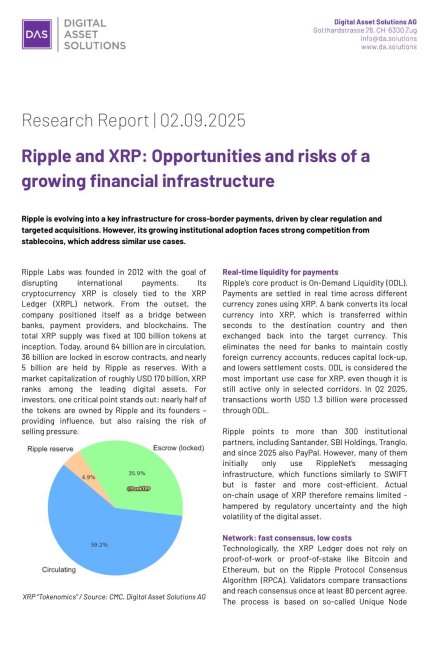
Source: Chart from Stern Drew on X

The first scenario is that XRP boosts the structural advantage, which includes fast settlement, low cost, neutral bridge asset, globally distributed ledger, and institutional-grade reliability. Drew stated that this is the reason adoption is growing in the midst of enterprises that seek predictable value transfer, and not speculation.

Secondly, the Research highlights the transformation of stablecoins, as these coins are becoming strategic assets, not competitive ones. Instead of opposing them, Ripple is absorbing stablecoins, which are becoming a key part of the crypto and financial landscape.

Ripple’s integration of stablecoins is evidenced by its RLUSD, a dollar-pegged token acting as the fiat anchor. Meanwhile, XRP serves as the liquidity and bridge asset that ties everything together. In the current landscape, this connection is precisely how scaled settlement ecosystems develop.

Catalysts To Drive The Next Future

With key updates and achievements of Ripple, the Research noted that the catalysts to spur the next phase are already forming. Some of these catalysts include RippleNet’s partnership expansion, RLUSD corridors opening, and institutional custody maturing. Even Exchange-Traded Fund (ETF) structures are entering the conversation.

Each of these catalysts raises the likelihood that regulated financial plumbing will incorporate XRP. Meanwhile, direct bank-level chain utilization is the only sector that is currently lagging behind. However, this is exactly what worldwide licensing pushes, ZK-enabled identity layers, Ripple Prime, and RLUSD are meant to open.

Drew believes that DAS is creating awareness of what investors are unable to see. Behind the scenes, XRP is cementing its position as infrastructure, not a trade, and the competition is not other tokens, but the existing payment system, which is starting to shift.

XRP trading at $2.08 on the 1D chart | Source: XRPUSDT on Tradingview.com

Letture associate

Bitcoin's Creator Has Not Appeared Publicly for Exactly 15 Years. Where Did Satoshi Disappear To?

Bitcoin's creator, Satoshi Nakamoto, has been absent from the public eye for exactly 15 years, with his last known communication dating back to April 26, 2011. His final public forum post on December 12, 2010, addressed a DoS attack on the Bitcoin network. Shortly before disappearing, he privately corresponded with early developers, informing them he had "moved on to other things" and that Bitcoin was in good hands, specifically naming Gavin Andresen as the lead developer. His withdrawal is speculated to be linked to Andresen's planned talk about Bitcoin at the CIA headquarters. Satoshi's true identity remains one of cryptocurrency's greatest mysteries. Numerous theories exist, ranging from him being an individual to a group, or even a project by the CIA. Several individuals, including cryptographers Hal Finney and Nick Szabo, have been proposed as candidates, but all have either denied it or remained silent. Some speculate he may be deceased. The mystery is fueled further by the immense wealth potentially held by Satoshi. Research based on a unique mining pattern, dubbed "Patoshi," suggests he may have mined approximately 1.1 million BTC, worth over $100 billion at current prices. This was possible due to minimal mining competition and a high coin emission rate in Bitcoin's early days, when it could be mined on a regular laptop. The network's computational power has since grown by over 10 billion times.

RBK-crypto2 min fa

Bitcoin's Creator Has Not Appeared Publicly for Exactly 15 Years. Where Did Satoshi Disappear To?

RBK-crypto2 min fa

How Does x402 V2 Enable Autonomous Payments for AI Agents?

The x402 protocol, initially developed by Coinbase, leverages the HTTP 402 status code to embed payment logic directly into web requests. The newly released V2 upgrade introduces significant improvements to address limitations in cross-chain support, scalability, identity authentication, and repeated payments experienced in V1. Key enhancements include: - **Wallet Identity and Reusable Sessions**: Supports wallet-based authentication (e.g., Sign-In-With-X via CAIP-122), allowing reusable sessions after initial payment. This reduces latency and costs for high-frequency use cases like AI agent tasks and LLM inference. - **Unified Payment Interface**: Enables multi-chain payments (e.g., Base, Solana) and compatibility with traditional systems (ACH, SEPA, credit cards) via Facilitators. Dynamic payTo routing allows context-aware pricing and complex market structures. - **Modular Architecture**: A plugin-driven SDK simplifies integration, supporting easy expansion to new chains and payment methods without core changes. Multi-Facilitator support automates optimal payment path selection based on preferences. - **Automatic Discovery**: Services can expose metadata for automatic synchronization, ensuring real-time pricing and availability updates without manual intervention. For end-users, V2 enables seamless, subscription-like access with reduced friction. Developers benefit from flexible, low-maintenance payment integration and dynamic pricing models. AI agents gain autonomy to make economic decisions, such as purchasing API calls or compute resources independently using allocated budgets. x402 V2 evolves from a pay-per-use tool into a versatile economic layer, though challenges like ecosystem adoption, modular risks, and regulatory uncertainty remain.

比推22 min fa

How Does x402 V2 Enable Autonomous Payments for AI Agents?

比推22 min fa

Bitcoin (BTC) Price Trend and Investor Sentiment Suggest a Bullish December

Bitcoin (BTC) is showing signs of a potential bullish December, challenging a decade-old bearish seasonal pattern where November losses typically extend into year-end declines. Key factors supporting this shift include reduced leverage, with open interest dropping from $94 billion to $60 billion, and Bitcoin’s price reclaiming its monthly volume-weighted average price (rVWAP), indicating controlled distribution. Liquidity dynamics have also shifted, with deep liquidity clusters moving upward, and around $3 billion in short positions set to liquidate near $96,000. Market structure diverges from historical cycles due to spot ETF inflows, introducing constant structural demand and accelerating price discovery. Analysts note that Bitcoin’s four-year cycle, while not obsolete, is no longer time-aligned, resembling extended accumulation phases like mid-2016 or late-2019. Macro liquidity (M2) growth has plateaued, creating a late-cycle environment where risk assets rally despite underlying economic softening. Supporting indicators, such as CNY/USD and ETH/BTC correlations, along with improving PMI data and gold’s relative strength, suggest continued risk-on momentum rather than cycle fatigue. While buy-sell ratios show urgency, analysts caution this may reflect positioning squeeze rather than sustainable accumulation. Overall, December’s performance may depend more on structural forces—ETF flows, liquidity rotation, and shifting macro correlations—than traditional halving-driven周期 patterns.

cointelegraph_中文38 min fa

Bitcoin (BTC) Price Trend and Investor Sentiment Suggest a Bullish December

cointelegraph_中文38 min fa

Trading

Spot
Futures
活动图片