Vibe Coding Accidentally Burns $550,000 Worth of Tokens, Then Turns Mockery into $700 Million Profit

marsbitPubblicato 2026-07-06Pubblicato ultima volta 2026-07-06

Introduzione

An employee at the American fintech company Slash, encouraged by his company to experiment with AI "vibe coding," created a simple pixel-style FPS browser game called "Brainrot Shooter." He initially shocked the online community by posting a fake screenshot showing an exorbitant $81,267 (550,000 RMB) AI token bill for developing the game. The story quickly went viral, with many expecting him to be fired for the massive "expense incident." However, the narrative took a dramatic turn. The game attracted significant attention, garnering thousands of players and hundreds of hours of playtime within 48 hours, and even drew interest from brands for advertising partnerships. Slash reframed the project as a successful "strategic initiative." The employee later announced that the viral game had indirectly brought in approximately $100 million in new Assets Under Management (AUM) for Slash's platform—a claimed 1200x return. Finally, the employee revealed the truth: the original $81k bill was fabricated using browser developer tools; the actual development cost was less than $200. The entire episode, from the fake bill to the viral success and massive business impact, was an elaborate and highly effective marketing stunt.

An employee, heeding the company's call, dove headfirst into the world of Vibe Coding and diligently crafted a pixel-style brainrot FPS game.

Before he could even finish feeling pleased with himself, he glanced over inadvertently.

Holy crap, this thing cost me 81,267 dollars in tokens (equivalent to 550,000 RMB)???

Didn't I just cause a colos!sal! dis!aster!

(At this point, one must loudly emit the voice of Madam Wang from *The Story of Minglan*.mp3)

The boss only encouraged everyone to do Vibe Coding, he didn't tell me to Spend Money in huge handfuls!

The company was also speechless, and could only tearfully share it, hoping everyone passing by would come play this little game, treating the $80,000 bill as marketing expenses for people to get to know our company through the game.
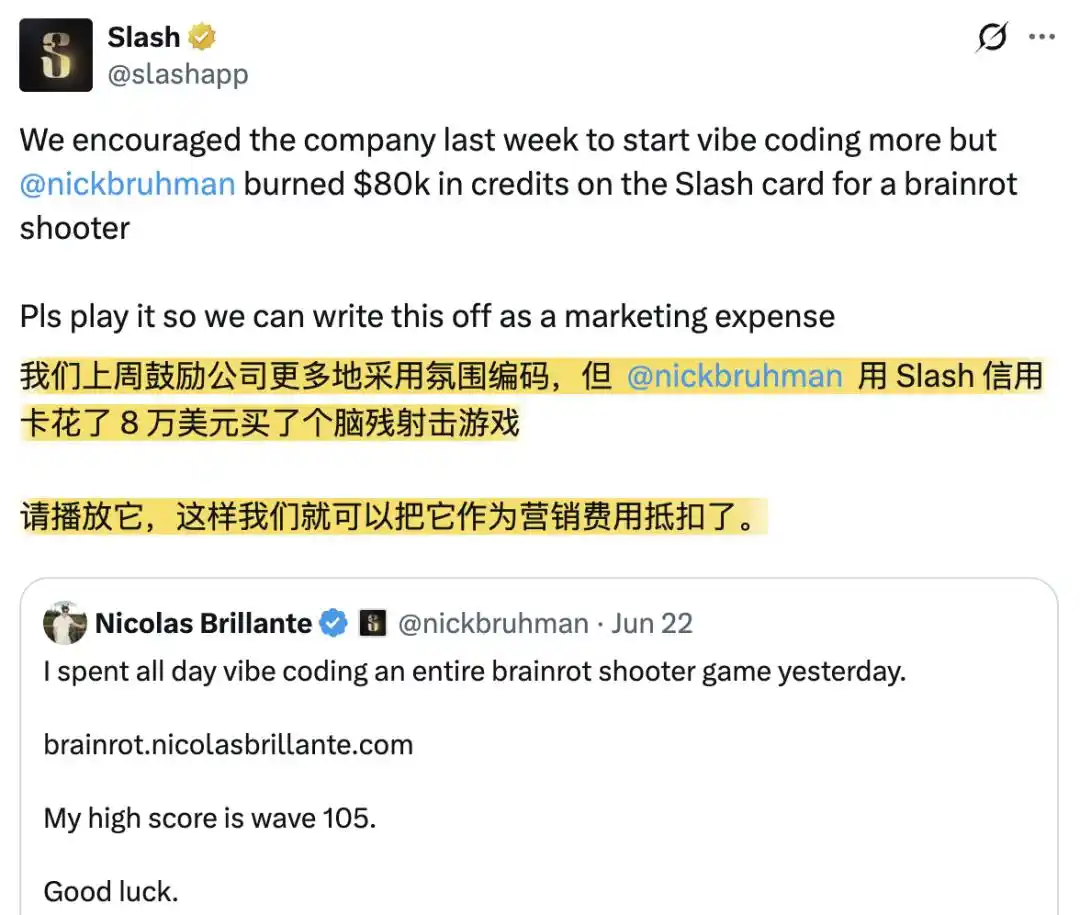
Things having come to this...

Hey, how is there still a plot twist?

Within 48 hours of launch, the game attracted 6,912 players, with a cumulative playtime of 8,986 hours, and 3 brands proactively inquired about advertising cooperation.

The original "expense incident" was quickly rebranded by the company as a "strategic project."

Did you think the story ended here?

There's something even more exciting.

The employee later announced happily on X, this brainrot mini-game that burned $80,000 has already brought the company $100 million in new AUM (Assets Under Management).

Approximately 700 million RMB.

Calculating it this way, that initial AI bill enough to get someone fired on the spot actually had a return rate exceeding 1200 times.

This is a case of "a blessing in disguise," where in the end the lost horse not only came trotting back by itself but brought a whole team of horses behind it.

$80,000, Just to Vibe Out a Brainrot Mini-Game

The name of this American company is Slash, a corporate financial services firm primarily offering commercial bank accounts, corporate cards, capital management, and other services to businesses.

Shortly before the incident, Slash had just announced that assets under management on its platform surpassed $1 billion.

Simultaneously, the company was also actively promoting AI use internally among employees, especially encouraging everyone to try out Vibe Coding, which is currently taking the global programmer community by storm.

Vibe Coding is all about "you don't need to know how to code, but you must dare to make demands."

So, Slash's Head of Strategic Operations, Nicolas Brilliante (affectionately called Nick here), was eager to try and Vibe out a small game.

The game was ultimately named *Brainrot Shooter*.
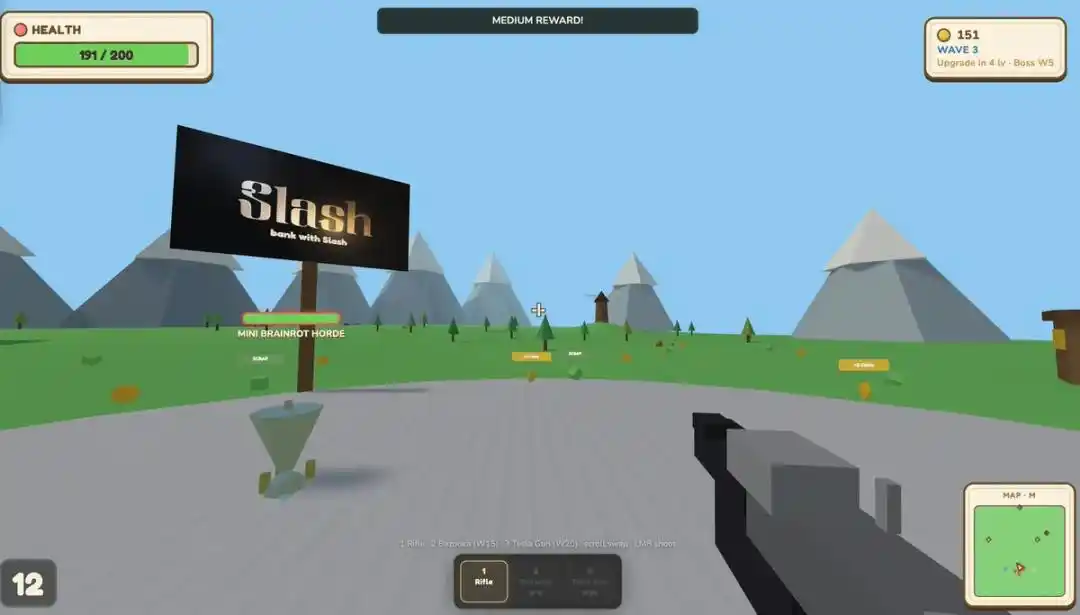
It uses a first-person shooter gameplay style, with maps made of pixel blocks, slightly reminiscent of *Minecraft*. Players run around the map with a weapon, chasing and shooting at internet brainrot characters like Skibidi Toilet, Tung Tung Tung Sahur, etc.

How should I put this... From graphics, gameplay to development scale, it's closer to a quickly assembled web demo.

Put it in a game store, and it's probably the level where players can guess the entire gameplay just by reading the name.

But Nick, with tears in his voice, said this thing caused him to inexplicably spend $81,267 in AI Credits in a week, like running water.

He also joked self-deprecatingly to the onlooking netizens that it was indeed an accident; he had underestimated his own abilities.
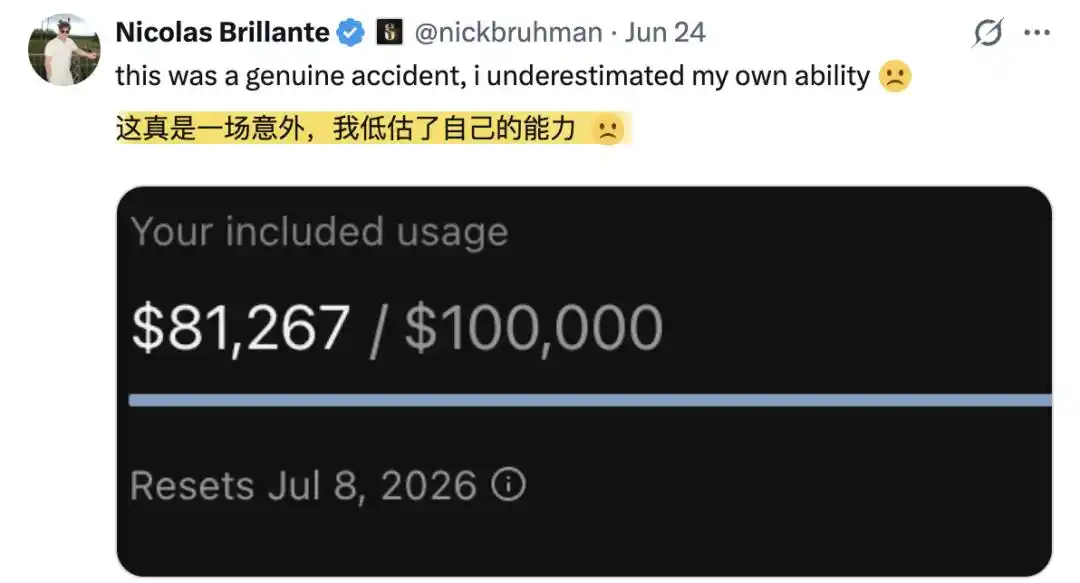
Not the ability to develop games, mind you, but the ability to burn tokens.

Oh, what a thrill~

The news quickly spread. Onlookers commented that they had made much more complex games, so how could it possibly cost $80,000.

Some serious bystanders even calculated for Slash, believing that even if the employee used the most expensive models entirely, having AI work non-stop for a week could hardly explain such an exaggerated expense.

Besides concerned citizens, the prediction market Polymarket also came to watch, suggesting Slash might reconsider its internal AI programming strategy because of this incident.

What to do? What could be done??
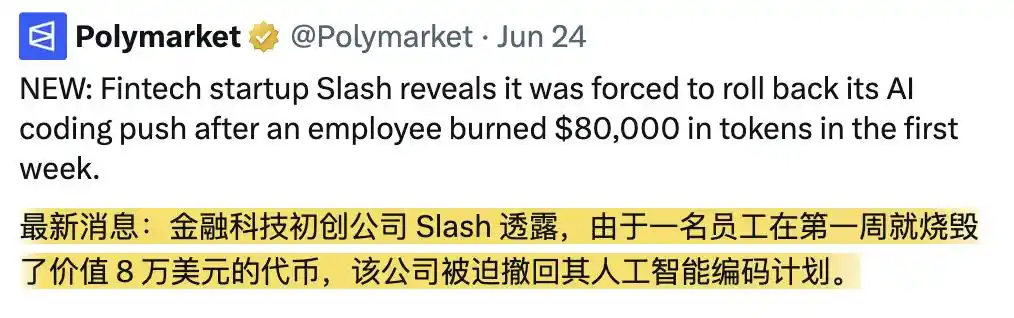
This world is just so absurd.

This kind of disaster, the people/companies that cause it aren't actually that rare.

In December last year, Uber pushed AI coding tools like Claude Code and Cursor to all its engineers, encouraging Vibe Coding, and ended up burning through the annual budget in 4 months.

Other companies are also gradually catching on.

On July 1st, UBS analysts wrote in a report: "Based on conversations with over a dozen corporate IT executives over the past few weeks, 60% of enterprises are now, in some way, limiting AI spending by setting up certain guardrails."

A Sudden Twist, Accident Transforms into a Success Story

At that time, many spectators had just one question: Nick, when exactly are you getting fired? Waiting online, quite eagerly.

Nick was out of options; he had to salvage whatever he could.

Slash's official account stated on X that since things had come to this, please, please come play our Vibe Coding masterpiece.

Better make the finance department believe this $80,000 counts as marketing expenses.

However, before the firing notice arrived, the game went viral first.

Slash subsequently released the game's 48-hour performance stats.

  • A total of 6,912 players entered the game
  • Cumulative playtime reached 8,986 hours
  • Peak concurrent players: 437
  • Average playtime per player: ~1.3 hours

That's not even the main point.

The main point is that 3 brands proactively reached out inquiring about ad partnerships!

The Slash finance department's attitude then did a complete 180-degree turn.

The definition of this mini-game within the company was formally upgraded from an "expense incident" to a "strategic initiative."

Look at this ╮(╯▽╰)╭

When no one was playing it was an incident; with traffic, it starts talking about strategic value. To put it nicely, companies really know how to go with the flow.

Nick also immediately regained his vigor, stating that while the $80,000 couldn't be recovered, the game could continue to be iterated until it was truly worth millions.

Nick and the company started iterating on the game while recouping some costs by accepting in-game small ads.

The first batch of advertising partners soon made a dazzling appearance.

Capitalizing on the traffic, Slash quickly brought AI companies like Melius and Bland into the game.
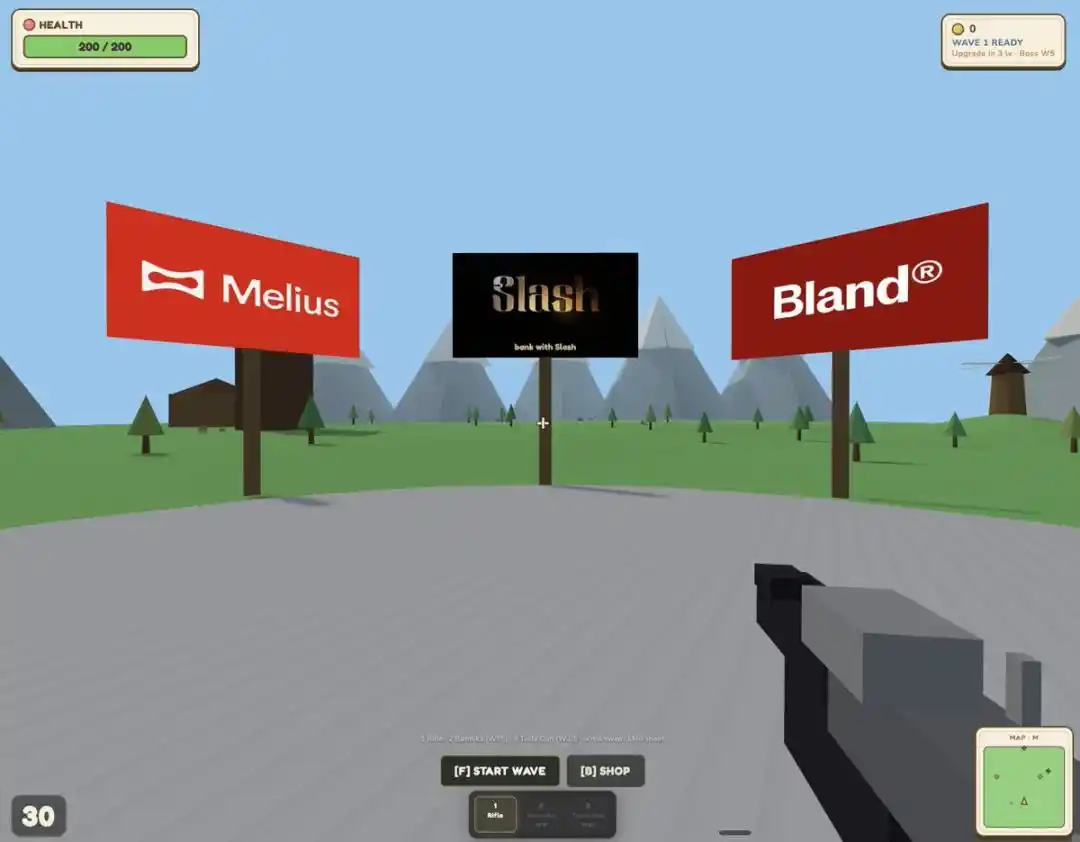
A corporate financial services company, because an employee used AI to make a brainrot shooting game, unexpectedly acquired a new media advertising slot.

How thrilling?

As long as the traffic is big enough, causing trouble can also be packaged as innovation.

Brought in $100 Million in AUM

Chinese people all know, after Tang Monk and his three disciples retrieved the true scriptures from the Great Thunderclap Monastery, the story of *Journey to the West* wasn't over.

Because they forgot to ask Buddha when the old turtle of Tongtian River could cultivate into human form. The great turtle became furious, shook its body, and threw the master, disciples, horse, and scriptures all into the river.

Nick's story turning from tragedy to joy should already count as a Happy Ending, right?

No, this matter isn't over.

Not long after, Nick appeared again to post, this time even more radiant—

Remember everyone mocking me for burning $80,000 in AI Credits before? Now, this mini-game made through Vibe Coding has already brought Slash $100 million in AUM.

To his knowledge, no one had ever reached this level before with a Vibe Coding game.

AUM stands for Assets Under Management, usually translated as such, referring to the total amount of client funds managed by a platform.

This means the brainrot game didn't directly bring the company much revenue, but after the game went viral, approximately $100 million in new funds entered its platform.

Slash did not further disclose how many clients the funds came from, the statistical period, or specifically how to prove these new AUM were brought by the game.

Therefore, this $100 million currently remains self-reported data from the company and the individual involved, lacking third-party verification.

However, even if not all the new AUM is attributed to the game, the communication effect brought by *Brainrot Shooter* is still quite impressive.

Remarkable, a fintech company originally primarily serving corporate clients has, through a rough-looking mini-game, entered the public eye more widely.

Originally, I wanted to express my afterthoughts with phrases like "What you lose on the swings you gain on the roundabouts," or "A loss may turn out to be a gain."

A few days later, Nick smiled smugly:

Don't rush, there's a second level.

One More Thing

Thinking the dust had settled, another thunderbolt struck out of the blue.

After the story of "employee spends $80,000 making a game, accidentally brings company $100 million AUM" had completely spread, Nick finally revealed the ultimate answer.

That $81,267 AI bill was FAKE!

He admitted that the amount in the screenshot was manually altered using the browser's Inspect Element.

The real AI cost for the first version of *Brainrot Shooter* was only about $80. After continuing to fix bugs and add content, the cumulative cost still didn't exceed $200.

That earlier token-burning bill that made onlookers' hearts go "OMG how could this be - LOL this guy's gonna get fired right? - Hmm the company's being somewhat humane - Wow they actually made money, respect respect" was a hoax from start to finish.

Wow, my left brain says, speechless, it was a marketing stunt?

My right brain says, to be fair, that's a pretty successful marketing stunt!

Now, let's rewrite the complete synopsis for this "Vibe Coding pixel brainrot mini-game astronomical bill incident":

Nick and the company used less than $200 to Vibe Code a brainrot mini-game, and then casually Vibe Marketed a global news story.

References:

[1]https://x.com/nickbruhman/status/2070558467010580877?s=20

[2]https://www.businessinsider.com/ubs-enterprises-ai-spending-tokens-2026-7?utm_source=chatgpt.com

[3]https://x.com/nickbruhman/status/2072703116667916307

This article is from the WeChat public account "QbitAI," author: Heng Yu

Crypto di tendenza

Domande pertinenti

QWhat was the initial major 'mistake' the employee made while using Vibe Coding?

AThe employee (Nicolas Brilliante) initially claimed to have accidentally spent $81,267 worth of AI tokens (credits), equivalent to 550,000 RMB, while creating a small pixelated 'Brainrot Shooter' game using Vibe Coding.

QHow did the company's perception of the 'Brainrot Shooter' game change after its release?

AThe company's perception changed dramatically from viewing it as an 'expense incident' to officially categorizing it as a 'strategic initiative' or 'strategic project' after the game attracted significant player traffic and inquiries from brands for advertising partnerships.

QWhat was the reported business benefit the 'Brainrot Shooter' game ultimately brought to Slash, according to the employee's later update?

AAccording to the employee's later update, the 'Brainrot Shooter' game reportedly brought in $100 million in new Assets Under Management (AUM) to the company Slash.

QWhat was the final revelation about the initial $81,267 token bill?

AThe final revelation was that the initial $81,267 token bill was fake. The employee admitted to using the browser's 'Inspect Element' tool to manually alter the screenshot. The actual cost for the first version of the game was only about $80, with the total cumulative cost never exceeding $200.

QWhat does the article suggest is the true nature of the entire 'Vibe Coding bill incident'?

AThe article suggests that the entire 'Vibe Coding bill incident' was an elaborate and successful marketing campaign (Vibe Marketing). For less than $200, the employee and the company created both a small game and generated a global news story around it.

Letture associate

End of Correction or Continuation of Trend: Technical Structure Review of BTC and HYPE | Guest Analysis

**Weekly Technical Analysis: BTC & HYPE Structure Review** This analysis covers the multi-timeframe technical structure for Bitcoin (BTC) and HYPE. **Bitcoin (BTC) Analysis:** BTC's correction from its May 6 high has formed a clear four-segment pattern on the daily chart. The market is currently in a (3-4) rebound phase. The key determinant for the short-term trend is the endpoint of this rebound ("Endpoint 4"): * **Path 1 (Preferred Scenario):** If the rebound surpasses the $65,700 resistance, subsequent pullbacks are less likely to break the key support at $57,820 (July 1 low). This would suggest a transition into a consolidating range, building energy for a potential bullish reversal. * **Path 2:** Failure to reach $65,700, or even $64,500, increases the probability of a breakdown below $57,820, continuing the downtrend. The 4-hour chart shows a completed five-wave decline from June 15, culminating in a momentum divergence at the low, which supported the recent bounce. **BTC Weekly Outlook & Strategy (Jul 6-12):** * **Core View:** Focus on the high point of the daily rebound from $57,820. * **Key Levels:** * Resistance: $64,500-$65,700; $67,300; $69,500-$71,000. * Support: $60,950-$62,300; $57,820; $55,000. * **Strategy:** * **Mid-term:** Maintain ~20% short position. Consider increasing shorts to <50% if price stalls in the $65,700-$67,300 zone with confirming model signals. * **Short-term:** Use 30% capital for swing trades between support/resistance. * **Plans:** * **Plan A (Short):** Enter shorts (~30%) if price is rejected at $65,700-$67,300. * **Plan B (Long):** Enter longs (~15%) only if price breaks above $65,700 first, then pulls back and finds support near $57,820. **HYPE Analysis:** The rebound from the June 25 low has developed a seven-segment structure on the 4-hour chart. Price is approaching the historical high zone near $76.94. Internal models have triggered top warnings, suggesting caution against chasing the rally and highlighting near-term pullback risks. **HYPE Weekly Outlook & Strategy:** * **Core View:** Observe price action in the $75-$76.94 resistance area. * **Key Levels:** * Resistance: $75-$76.94; $80. * Support: $68; $65.5; $60.5-$61.5. * **Strategy:** Prioritize profit-taking and risk management. If holding longs, consider moving stop-loss to ~$68 to protect gains. Close positions promptly on signs of a downturn. **Trade Recap:** A recent short-term long trade in HYPE, entered at $64 based on model buy signals and exited at ~$70.55 on sell signals, yielded a profit of approximately 10.23%. **General Risk Management:** Always set an initial stop-loss. Move stop-loss to breakeven at +1% profit, and trail it upwards by 1% for every subsequent 1% gain to lock in profits. *Disclaimer: Market conditions change rapidly. All analysis, models, and strategies presented are for educational/log purposes only and do not constitute investment advice. Trade at your own risk.*

Odaily星球日报2 min fa

End of Correction or Continuation of Trend: Technical Structure Review of BTC and HYPE | Guest Analysis

Odaily星球日报2 min fa

Is Anyone Still Buying in the Crypto Market? Unpacking 3 Common Watch-and-Wait Mentalities Today

Is Anyone Still Buying in the Crypto Market? Unpacking 3 Common Wait-and-See Mindsets This article analyzes the current cautious sentiment in the crypto market, distilled from conversations with sophisticated investors. The author identifies three dominant investor mindsets: 1. **Satisfied with Current Holdings:** Many retain a long-term belief in digital assets but see no immediate catalyst for significant price appreciation. They hold positions to avoid missing a future surge but allocate minimal new capital or attention. A shift requires a new, observable catalyst or a rotation from other portfolio areas. 2. **Waiting for Lower Prices:** This reflects not just short-term timing but a belief about crypto's total addressable market and upside potential. It could change if key perceived cycle bottoms pass without a crash, a major bullish event occurs (e.g., sovereign adoption), or price rebounds trigger FOMO-driven buying. 3. **High Opportunity Cost of Allocation:** The core question is comparative growth. With AI-related equities appearing to offer relentless, high-speed growth, justifying marginal investment into assets without similar perceived momentum is difficult. A slowdown in the AI trade could potentially mark a bottom and trigger capital reallocation into crypto. In conclusion, while long-term conviction persists for many, near-term marginal capital flows are constrained by these beliefs. The author suggests the market may be closer to a bottom than a top, but the current climate is defined by this wait-and-see approach, awaiting a catalyst to reignite broader investor commitment.

marsbit1 h fa

Is Anyone Still Buying in the Crypto Market? Unpacking 3 Common Watch-and-Wait Mentalities Today

marsbit1 h fa

China Added 67 New Unicorns in Half a Year, with AI and Robotics Accounting for Over Half

China added 67 new unicorn companies in the first half of 2026, reaching a total of 517 unicorns with a combined valuation of approximately $2.39 trillion. This surge marks a significant rebound after a post-2022 slowdown and sets a new semi-annual record. The growth is primarily driven by Artificial Intelligence (AI) and Robotics, which together account for over 53% of the new entrants. Specifically, 19 new unicorns are in robotics and 17 in AI. Notable companies include DeepSeek ($615.38B) and Kling AI ($18B). The trend indicates a decisive shift from internet consumer models to hard tech innovation. Geographically, new unicorns are highly concentrated in four cities: Beijing (19), Shanghai (18), Shenzhen (9), and Hangzhou (5), which together host 76.1% of the new companies. Hangzhou's overall valuation is boosted significantly by DeepSeek. Valuation distribution among new unicorns is pyramidal: 77.6% are valued between $1B and $2B, indicating early-stage status, while only two exceed $10B. There is a notable "speed divide": many AI/robotics startups achieved unicorn status in under three years, often via corporate spin-offs or led by star founders, while hard tech companies in semiconductors or biotech typically took over eight years. The report concludes that this wave reflects China's accelerating transition into an AI and robotics-powered innovation cycle, characterized by faster company formation, heightened geographic concentration, and a clear focus on foundational technologies.

marsbit1 h fa

China Added 67 New Unicorns in Half a Year, with AI and Robotics Accounting for Over Half

marsbit1 h fa

Trading

Spot

Articoli Popolari

Cosa è $S$

Comprendere SPERO: Una Panoramica Completa Introduzione a SPERO Mentre il panorama dell'innovazione continua a evolversi, l'emergere delle tecnologie web3 e dei progetti di criptovaluta gioca un ruolo fondamentale nel plasmare il futuro digitale. Un progetto che ha attirato l'attenzione in questo campo dinamico è SPERO, denotato come SPERO,$$s$. Questo articolo mira a raccogliere e presentare informazioni dettagliate su SPERO, per aiutare gli appassionati e gli investitori a comprendere le sue basi, obiettivi e innovazioni nei domini web3 e crypto. Che cos'è SPERO,$$s$? SPERO,$$s$ è un progetto unico all'interno dello spazio crypto che cerca di sfruttare i principi della decentralizzazione e della tecnologia blockchain per creare un ecosistema che promuove l'impegno, l'utilità e l'inclusione finanziaria. Il progetto è progettato per facilitare interazioni peer-to-peer in modi nuovi, fornendo agli utenti soluzioni e servizi finanziari innovativi. Al suo interno, SPERO,$$s$ mira a responsabilizzare gli individui fornendo strumenti e piattaforme che migliorano l'esperienza dell'utente nello spazio delle criptovalute. Questo include la possibilità di metodi di transazione più flessibili, la promozione di iniziative guidate dalla comunità e la creazione di percorsi per opportunità finanziarie attraverso applicazioni decentralizzate (dApps). La visione sottostante di SPERO,$$s$ ruota attorno all'inclusività, cercando di colmare le lacune all'interno della finanza tradizionale mentre sfrutta i vantaggi della tecnologia blockchain. Chi è il Creatore di SPERO,$$s$? L'identità del creatore di SPERO,$$s$ rimane piuttosto oscura, poiché ci sono risorse pubblicamente disponibili limitate che forniscono informazioni dettagliate sul suo fondatore o fondatori. Questa mancanza di trasparenza può derivare dall'impegno del progetto per la decentralizzazione—un ethos che molti progetti web3 condividono, dando priorità ai contributi collettivi rispetto al riconoscimento individuale. Centrando le discussioni attorno alla comunità e ai suoi obiettivi collettivi, SPERO,$$s$ incarna l'essenza dell'empowerment senza mettere in evidenza individui specifici. Pertanto, comprendere l'etica e la missione di SPERO rimane più importante che identificare un creatore singolo. Chi sono gli Investitori di SPERO,$$s$? SPERO,$$s$ è supportato da una varietà di investitori che vanno dai capitalisti di rischio agli investitori angelici dedicati a promuovere l'innovazione nel settore crypto. Il focus di questi investitori generalmente si allinea con la missione di SPERO—dando priorità a progetti che promettono avanzamenti tecnologici sociali, inclusività finanziaria e governance decentralizzata. Queste fondazioni di investitori sono tipicamente interessate a progetti che non solo offrono prodotti innovativi, ma contribuiscono anche positivamente alla comunità blockchain e ai suoi ecosistemi. Il supporto di questi investitori rafforza SPERO,$$s$ come un concorrente degno di nota nel dominio in rapida evoluzione dei progetti crypto. Come Funziona SPERO,$$s$? SPERO,$$s$ impiega un framework multifunzionale che lo distingue dai progetti di criptovaluta convenzionali. Ecco alcune delle caratteristiche chiave che sottolineano la sua unicità e innovazione: Governance Decentralizzata: SPERO,$$s$ integra modelli di governance decentralizzati, responsabilizzando gli utenti a partecipare attivamente ai processi decisionali riguardanti il futuro del progetto. Questo approccio favorisce un senso di proprietà e responsabilità tra i membri della comunità. Utilità del Token: SPERO,$$s$ utilizza il proprio token di criptovaluta, progettato per servire varie funzioni all'interno dell'ecosistema. Questi token abilitano transazioni, premi e la facilitazione dei servizi offerti sulla piattaforma, migliorando l'impegno e l'utilità complessivi. Architettura Stratificata: L'architettura tecnica di SPERO,$$s$ supporta la modularità e la scalabilità, consentendo un'integrazione fluida di funzionalità e applicazioni aggiuntive man mano che il progetto evolve. Questa adattabilità è fondamentale per mantenere la rilevanza nel panorama crypto in continua evoluzione. Coinvolgimento della Comunità: Il progetto enfatizza iniziative guidate dalla comunità, impiegando meccanismi che incentivano la collaborazione e il feedback. Nutrendo una comunità forte, SPERO,$$s$ può affrontare meglio le esigenze degli utenti e adattarsi alle tendenze di mercato. Focus sull'Inclusione: Offrendo basse commissioni di transazione e interfacce user-friendly, SPERO,$$s$ mira ad attrarre una base utenti diversificata, inclusi individui che potrebbero non aver precedentemente interagito nello spazio crypto. Questo impegno per l'inclusione si allinea con la sua missione generale di empowerment attraverso l'accessibilità. Cronologia di SPERO,$$s$ Comprendere la storia di un progetto fornisce preziose intuizioni sulla sua traiettoria di sviluppo e sui traguardi. Di seguito è riportata una cronologia suggerita che mappa eventi significativi nell'evoluzione di SPERO,$$s$: Fase di Concettualizzazione e Ideazione: Le idee iniziali che formano la base di SPERO,$$s$ sono state concepite, allineandosi strettamente con i principi di decentralizzazione e focus sulla comunità all'interno dell'industria blockchain. Lancio del Whitepaper del Progetto: Dopo la fase concettuale, è stato rilasciato un whitepaper completo che dettaglia la visione, gli obiettivi e l'infrastruttura tecnologica di SPERO,$$s$ per suscitare interesse e feedback dalla comunità. Costruzione della Comunità e Prime Interazioni: Sono stati effettuati sforzi attivi di outreach per costruire una comunità di early adopters e potenziali investitori, facilitando discussioni attorno agli obiettivi del progetto e ottenendo supporto. Evento di Generazione del Token: SPERO,$$s$ ha condotto un evento di generazione del token (TGE) per distribuire i propri token nativi ai primi sostenitori e stabilire una liquidità iniziale all'interno dell'ecosistema. Lancio della Prima dApp: La prima applicazione decentralizzata (dApp) associata a SPERO,$$s$ è stata attivata, consentendo agli utenti di interagire con le funzionalità principali della piattaforma. Sviluppo Continuo e Partnership: Aggiornamenti e miglioramenti continui alle offerte del progetto, inclusi partnership strategiche con altri attori nello spazio blockchain, hanno plasmato SPERO,$$s$ in un concorrente competitivo e in evoluzione nel mercato crypto. Conclusione SPERO,$$s$ rappresenta una testimonianza del potenziale del web3 e delle criptovalute di rivoluzionare i sistemi finanziari e responsabilizzare gli individui. Con un impegno per la governance decentralizzata, il coinvolgimento della comunità e funzionalità progettate in modo innovativo, apre la strada verso un panorama finanziario più inclusivo. Come per qualsiasi investimento nello spazio crypto in rapida evoluzione, si incoraggiano potenziali investitori e utenti a ricercare approfonditamente e a impegnarsi in modo riflessivo con gli sviluppi in corso all'interno di SPERO,$$s$. Il progetto mostra lo spirito innovativo dell'industria crypto, invitando a ulteriori esplorazioni delle sue innumerevoli possibilità. Mentre il percorso di SPERO,$$s$ è ancora in fase di sviluppo, i suoi principi fondamentali potrebbero effettivamente influenzare il futuro di come interagiamo con la tecnologia, la finanza e tra di noi in ecosistemi digitali interconnessi.

110 Totale visualizzazioniPubblicato il 2024.12.17Aggiornato il 2024.12.17

Cosa è $S$

Cosa è AGENT S

Agent S: Il Futuro dell'Interazione Autonoma in Web3 Introduzione Nel panorama in continua evoluzione di Web3 e criptovalute, le innovazioni stanno costantemente ridefinendo il modo in cui gli individui interagiscono con le piattaforme digitali. Uno di questi progetti pionieristici, Agent S, promette di rivoluzionare l'interazione uomo-computer attraverso il suo framework agentico aperto. Aprendo la strada a interazioni autonome, Agent S mira a semplificare compiti complessi, offrendo applicazioni trasformative nell'intelligenza artificiale (AI). Questa esplorazione dettagliata approfondirà le complessità del progetto, le sue caratteristiche uniche e le implicazioni per il dominio delle criptovalute. Cos'è Agent S? Agent S si presenta come un innovativo framework agentico aperto, progettato specificamente per affrontare tre sfide fondamentali nell'automazione dei compiti informatici: Acquisizione di Conoscenze Specifiche del Dominio: Il framework apprende in modo intelligente da varie fonti di conoscenza esterne ed esperienze interne. Questo approccio duale gli consente di costruire un ricco repository di conoscenze specifiche del dominio, migliorando le sue prestazioni nell'esecuzione dei compiti. Pianificazione su Lungo Orizzonte di Compiti: Agent S impiega una pianificazione gerarchica potenziata dall'esperienza, un approccio strategico che facilita la suddivisione e l'esecuzione efficiente di compiti complessi. Questa caratteristica migliora significativamente la sua capacità di gestire più sottocompiti in modo efficiente ed efficace. Gestione di Interfacce Dinamiche e Non Uniformi: Il progetto introduce l'Interfaccia Agente-Computer (ACI), una soluzione innovativa che migliora l'interazione tra agenti e utenti. Utilizzando Modelli Linguistici Multimodali di Grandi Dimensioni (MLLM), Agent S può navigare e manipolare senza sforzo diverse interfacce grafiche utente. Attraverso queste caratteristiche pionieristiche, Agent S fornisce un framework robusto che affronta le complessità coinvolte nell'automazione dell'interazione umana con le macchine, preparando il terreno per innumerevoli applicazioni nell'AI e oltre. Chi è il Creatore di Agent S? Sebbene il concetto di Agent S sia fondamentalmente innovativo, informazioni specifiche sul suo creatore rimangono elusive. Il creatore è attualmente sconosciuto, il che evidenzia sia la fase embrionale del progetto sia la scelta strategica di mantenere i membri fondatori sotto anonimato. Indipendentemente dall'anonimato, l'attenzione rimane sulle capacità e sul potenziale del framework. Chi sono gli Investitori di Agent S? Poiché Agent S è relativamente nuovo nell'ecosistema crittografico, informazioni dettagliate riguardanti i suoi investitori e sostenitori finanziari non sono documentate esplicitamente. La mancanza di approfondimenti pubblicamente disponibili sulle fondazioni di investimento o sulle organizzazioni che supportano il progetto solleva interrogativi sulla sua struttura di finanziamento e sulla roadmap di sviluppo. Comprendere il supporto è cruciale per valutare la sostenibilità del progetto e il suo potenziale impatto sul mercato. Come Funziona Agent S? Al centro di Agent S si trova una tecnologia all'avanguardia che gli consente di funzionare efficacemente in contesti diversi. Il suo modello operativo è costruito attorno a diverse caratteristiche chiave: Interazione Uomo-Computer Simile a Quella Umana: Il framework offre una pianificazione AI avanzata, cercando di rendere le interazioni con i computer più intuitive. Mimando il comportamento umano nell'esecuzione dei compiti, promette di elevare le esperienze degli utenti. Memoria Narrativa: Utilizzata per sfruttare esperienze di alto livello, Agent S utilizza la memoria narrativa per tenere traccia delle storie dei compiti, migliorando così i suoi processi decisionali. Memoria Episodica: Questa caratteristica fornisce agli utenti una guida passo-passo, consentendo al framework di offrire supporto contestuale mentre i compiti si sviluppano. Supporto per OpenACI: Con la capacità di funzionare localmente, Agent S consente agli utenti di mantenere il controllo sulle proprie interazioni e flussi di lavoro, allineandosi con l'etica decentralizzata di Web3. Facile Integrazione con API Esterne: La sua versatilità e compatibilità con varie piattaforme AI garantiscono che Agent S possa adattarsi senza problemi agli ecosistemi tecnologici esistenti, rendendolo una scelta attraente per sviluppatori e organizzazioni. Queste funzionalità contribuiscono collettivamente alla posizione unica di Agent S all'interno dello spazio crittografico, poiché automatizza compiti complessi e multi-fase con un intervento umano minimo. Man mano che il progetto evolve, le sue potenziali applicazioni in Web3 potrebbero ridefinire il modo in cui si svolgono le interazioni digitali. Cronologia di Agent S Lo sviluppo e le tappe di Agent S possono essere riassunti in una cronologia che evidenzia i suoi eventi significativi: 27 Settembre 2024: Il concetto di Agent S è stato lanciato in un documento di ricerca completo intitolato “Un Framework Agentico Aperto che Usa i Computer Come un Umano”, mostrando le basi per il progetto. 10 Ottobre 2024: Il documento di ricerca è stato reso pubblicamente disponibile su arXiv, offrendo un'esplorazione approfondita del framework e della sua valutazione delle prestazioni basata sul benchmark OSWorld. 12 Ottobre 2024: È stata rilasciata una presentazione video, fornendo un'idea visiva delle capacità e delle caratteristiche di Agent S, coinvolgendo ulteriormente potenziali utenti e investitori. Questi indicatori nella cronologia non solo illustrano i progressi di Agent S, ma indicano anche il suo impegno per la trasparenza e il coinvolgimento della comunità. Punti Chiave su Agent S Man mano che il framework Agent S continua a evolversi, diversi attributi chiave si distinguono, sottolineando la sua natura innovativa e il potenziale: Framework Innovativo: Progettato per fornire un uso intuitivo dei computer simile all'interazione umana, Agent S porta un approccio nuovo all'automazione dei compiti. Interazione Autonoma: La capacità di interagire autonomamente con i computer attraverso GUI segna un passo avanti verso soluzioni informatiche più intelligenti ed efficienti. Automazione di Compiti Complessi: Con la sua metodologia robusta, può automatizzare compiti complessi e multi-fase, rendendo i processi più veloci e meno soggetti a errori. Miglioramento Continuo: I meccanismi di apprendimento consentono ad Agent S di migliorare dalle esperienze passate, migliorando continuamente le sue prestazioni e la sua efficacia. Versatilità: La sua adattabilità attraverso diversi ambienti operativi come OSWorld e WindowsAgentArena garantisce che possa servire un'ampia gamma di applicazioni. Man mano che Agent S si posiziona nel panorama di Web3 e delle criptovalute, il suo potenziale per migliorare le capacità di interazione e automatizzare i processi segna un significativo avanzamento nelle tecnologie AI. Attraverso il suo framework innovativo, Agent S esemplifica il futuro delle interazioni digitali, promettendo un'esperienza più fluida ed efficiente per gli utenti in vari settori. Conclusione Agent S rappresenta un audace passo avanti nell'unione tra AI e Web3, con la capacità di ridefinire il modo in cui interagiamo con la tecnologia. Sebbene sia ancora nelle sue fasi iniziali, le possibilità per la sua applicazione sono vaste e coinvolgenti. Attraverso il suo framework completo che affronta sfide critiche, Agent S mira a portare le interazioni autonome al centro dell'esperienza digitale. Man mano che ci addentriamo nei regni delle criptovalute e della decentralizzazione, progetti come Agent S giocheranno senza dubbio un ruolo cruciale nel plasmare il futuro della tecnologia e della collaborazione uomo-computer.

568 Totale visualizzazioniPubblicato il 2025.01.14Aggiornato il 2025.01.14

Cosa è AGENT S

Come comprare S

Benvenuto in HTX.com! Abbiamo reso l'acquisto di Sonic (S) semplice e conveniente. Segui la nostra guida passo passo per intraprendere il tuo viaggio nel mondo delle criptovalute.Step 1: Crea il tuo Account HTXUsa la tua email o numero di telefono per registrarti il tuo account gratuito su HTX. Vivi un'esperienza facile e sblocca tutte le funzionalità,Crea il mio accountStep 2: Vai in Acquista crypto e seleziona il tuo metodo di pagamentoCarta di credito/debito: utilizza la tua Visa o Mastercard per acquistare immediatamente SonicS.Bilancio: Usa i fondi dal bilancio del tuo account HTX per fare trading senza problemi.Terze parti: abbiamo aggiunto metodi di pagamento molto utilizzati come Google Pay e Apple Pay per maggiore comodità.P2P: Fai trading direttamente con altri utenti HTX.Over-the-Counter (OTC): Offriamo servizi su misura e tassi di cambio competitivi per i trader.Step 3: Conserva Sonic (S)Dopo aver acquistato Sonic (S), conserva nel tuo account HTX. In alternativa, puoi inviare tramite trasferimento blockchain o scambiare per altre criptovalute.Step 4: Scambia Sonic (S)Scambia facilmente Sonic (S) nel mercato spot di HTX. Accedi al tuo account, seleziona la tua coppia di trading, esegui le tue operazioni e monitora in tempo reale. Offriamo un'esperienza user-friendly sia per chi ha appena iniziato che per i trader più esperti.

1.1k Totale visualizzazioniPubblicato il 2025.01.15Aggiornato il 2026.06.02

Come comprare S

Discussioni

Benvenuto nella Community HTX. Qui puoi rimanere informato sugli ultimi sviluppi della piattaforma e accedere ad approfondimenti esperti sul mercato. Le opinioni degli utenti sul prezzo di S S sono presentate come di seguito.

活动图片