BofA's Hartnett: Brace for the 'June Storm', US CPI to 'Burst the Bubble'

marsbitPubblicato 2026-06-08Pubblicato ultima volta 2026-06-08

Introduzione

Bank of America strategist Hartnett warns of a potential "June storm" for markets, with an unexpectedly high US CPI print set to be the key catalyst. Historical data shows that when CPI surpasses 4%, the S&P 500 has historically fallen by an average of 4% over the next 3 months and 7% over 6 months. A confluence of risks threatens to puncture the tech asset bubble. Global central banks, notably the Fed under Chair Warsh, are tilting hawkish to combat inflation, risking a sharp rise in long-term bond yields. Market sentiment is at an extreme, with BofA's internal indicators flashing a strong "sell signal." Further pressure comes from record liquidity drainage due to mega IPOs like SpaceX, alongside key non-economic events. Hartnett concludes that risk assets are in an extremely fragile position, facing a severe test from macro events, policy shifts, and tightening liquidity in June.

BofA strategist Hartnett issued a warning: if upcoming inflation data exceeds expectations, it will directly trigger a sell-off in risk assets. Historical data shows that over the past 100 years, once CPI breaks above 4%, the S&P 500 index has fallen by an average of 4% over the next 3 months and 7% over 6 months.
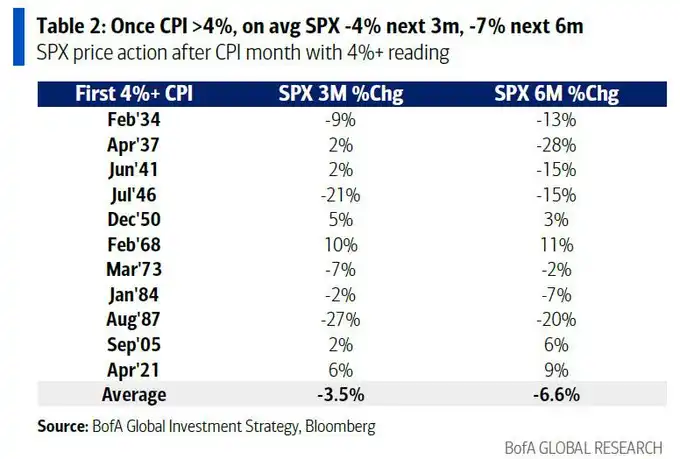
Furthermore, market "sell signals" are strengthening, with mega IPOs like SpaceX set to drain record liquidity, combined with risks of a hawkish pivot by global central banks, leaving the tech bubble in an extremely fragile moment.

U.S. stocks face a severe stress test in June. Bank of America strategist Michael Hartnett warns that a series of concentrated macro event risks and a sharp withdrawal of market liquidity could drive global bond yields significantly higher, thereby bursting the current technology asset bubble.

According to Flow Trading Desk, Hartnett stated in his latest research report that the upcoming U.S. CPI data is the core catalyst for this "June storm". If the latest inflation data exceeds expectations, it will directly trigger the mechanism for selling risk assets. Historical data shows that when inflation breaks through key warning levels, it often triggers a deep correction in U.S. benchmark stock indices in the following months.

Simultaneously, intensive resolutions and statements from global central banks are steering the market's direction. Particularly, the Federal Open Market Committee (FOMC) meeting led by the new Fed Chair Wash is a key event. Its policy stance, whether hawkish or dovish, will determine the fate of U.S. stocks and long-term bond yields. Any unexpectedly tight signal will hit investors hard.

Against a backdrop of extremely euphoric bullish sentiment, Bank of America's internal sentiment indicators have issued a strong "sell signal." Coupled with the unprecedented liquidity drain from imminent mega tech IPOs, current risk assets are in an extremely vulnerable position.

Key Inflation Data Approaches, U.S. Stocks Face Historic Pullback Risk

The U.S. CPI data to be released on June 10th is the first major test for the market.

Over the past three months, this data has averaged a month-on-month increase of 0.6%; over the past six months, the average is 0.4%. If May's CPI month-on-month growth exceeds 0.4% (the current market expectation is 0.5%), it means the U.S. CPI year-on-year growth rate will break above 4% and could head towards 5% before the U.S. midterm elections. This trend would make risk assets extremely uneasy.

Historical data shows that over the past 100 years, once CPI breaks above 4%, the S&P 500 index has fallen by an average of 4% over the next 3 months and 7% over 6 months.

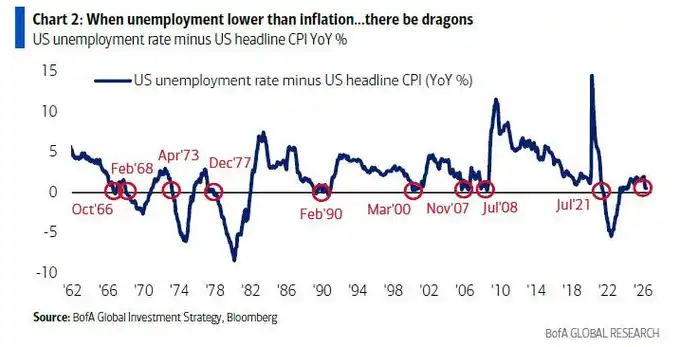
Another inflation indicator that cannot be ignored is the crossover between the unemployment rate and CPI.

In May, there is a "small probability but high-impact possibility" that the U.S. unemployment rate (consensus expectation 4.3%) could equal or fall below the inflation rate (consensus expectation 4.2%). This would be only the 7th occurrence since 1960. In years when inflation is close to or higher than unemployment (such as 1966, 1973, 2008, and 2021), the Federal Reserve typically resorts to interest rate hikes, and Wall Street's memories of these years are often painful.
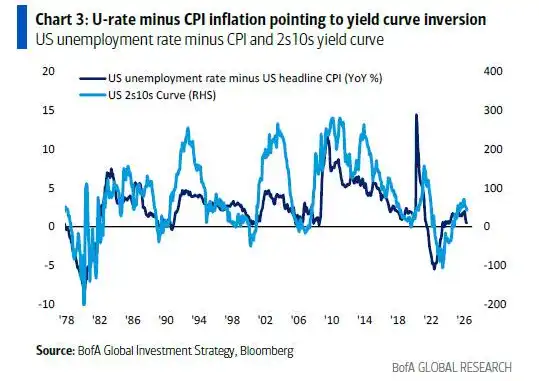
Furthermore, the spread between the unemployment rate and CPI is highly correlated with the U.S. yield curve and is currently pointing towards a near-term curve inversion, which is another signal with negative implications for risk assets.
Global Central Bank Meetings Dense, Bond Yields May End the Boom

"Booms and bubbles are ultimately ended by bonds," Michael Hartnett reiterated this logic in the report.

He warns that a series of events in June could push the UK 30-year bond yield above 6%, the U.S. above 5%, and Japan above 4%. With the market saturated with bullish positions and optimistic earnings expectations, a surge in yields would undoubtedly be negative for risk assets.

Global central banks are currently significantly lagging behind the inflation curve. Among 68 global central banks, 46 currently have inflation levels exceeding their target or the absolute median of their target range. Against this backdrop, the European Central Bank (ECB) has a 98% probability of raising rates by 25 basis points, while the probability of the Bank of Japan (BoJ) raising rates by 25 basis points also reaches 83%, with the latter urgently needing this to prevent the yen from breaking below the "Maginot Line" of 160 per dollar.

The June 17th FOMC meeting led by Wash is seen as one of the two most important events this month.

The market currently faces a policy dilemma: if Wash is too dovish, long-term yields will head towards 6%; if too hawkish, the S&P 500 risks a correction towards the 7000-point zone; while a "Goldilocks"-style moderate stance could propel the NYSE Composite Index (NYA) to break above the all-time high of 24000 points.

As Wash stated back in 2024, global central banks seem complacent with inflation nearing 3%, and the 2% inflation target is no longer taken seriously. This compromise is extremely dangerous.

Wealth Effect Fuels Inflation, Extreme Sentiment Triggers "Sell Signal"

From a macroeconomic perspective, the U.S. is experiencing a K-shaped recovery driven by a "wealth-stock market virtuous cycle."

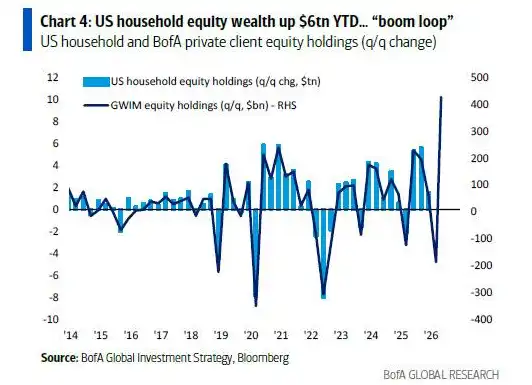
U.S. household stock wealth has increased by $6 trillion year-to-date. This "wealth-price spiral" directly exacerbates inflationary pressures. Despite economic prosperity, voters' perceptions are not uniform. Currently, Trump's approval rating on inflation is already lower than Biden's lowest levels.
In terms of fund flows, investors have recently shown an extreme tendency to chase the tech bubble. Last week's data showed a massive $122 billion flowing into cash, $39 billion into bonds (a record high), and $23.1 billion into equities. Meanwhile, cryptocurrencies saw outflows of $2 billion and gold outflows of $3.1 billion, indicating investors are selling other assets to chase technology and semiconductor sectors.

The extreme fund flows have caused Bank of America's Bull/Bear indicator to rise further from 8.5 to 8.7, making the "sell signal" triggered two weeks ago even stronger.
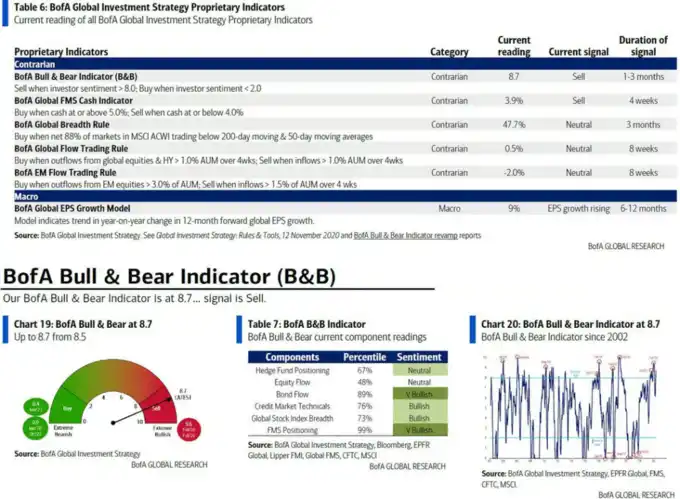
Historical data shows that among the 17 "sell signals" since 2002, global stocks have lost an average of 2% to 3% over the subsequent 2 to 3 months, with maximum drawdowns reaching 15% to 20%. Additionally, global breadth indicators show that 48% of global stocks are in overbought territory.

Mega IPOs Drain Liquidity, Non-Economic Events Intensify Market Turmoil

Beyond macroeconomic data, the biggest non-economic event risk in June comes from massive capital market supply.

SpaceX's initial public offering (IPO) is set to start trading next Friday. Along with Anthropic and OpenAI's offerings and the end of related lock-up periods, this will drain record liquidity from the market. The impact of this scale of liquidity tightening as a market catalyst may even surpass the decisions of central banks.

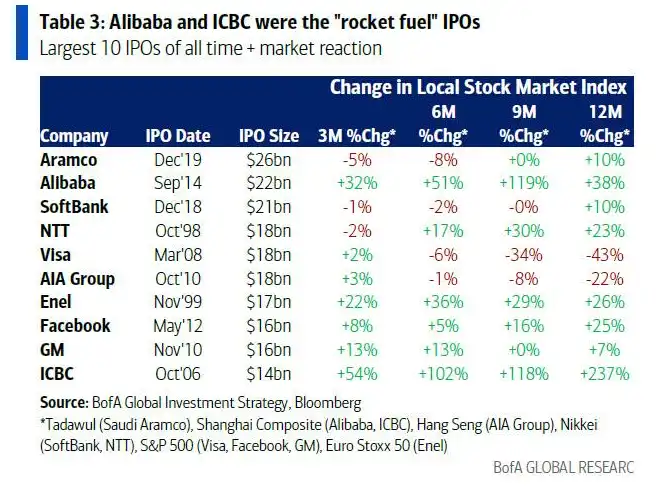
The impact of historical mega IPOs on the market is mixed.

While IPOs like Alibaba and ICBC once acted as market boosters, the listings of Visa and AIA marked market "tops," with the S&P 500 and the Hang Seng Index declining significantly within 9 to 12 months after these IPOs.
Hartnett believes that this political shift is the core reason why Latin American bond yields and spreads are at historic lows (falling to 217 basis points, the lowest since November 2007). A similar trend of political rightward shift is also evident in Europe.

For investors, this means a profound, substantive reassessment of global economic policy preferences is underway in the near term.


Domande pertinenti

QAccording to Michael Hartnett of Bank of America, what is the potential impact on the S&P 500 if the upcoming CPI data exceeds expectations?

AAccording to Michael Hartnett, if the upcoming CPI data exceeds expectations, it could directly trigger a sell-off in risk assets. Historical data shows that once CPI surpasses 4%, the S&P 500 index has historically fallen an average of 4% over the subsequent three months and 7% over six months.

QWhat is Hartnett's view on the relationship between bond yields and the end of market booms or bubbles?

AHartnett reiterates the logic that 'booms and bubbles are ultimately ended by bonds.' He warns that events in June could cause yields on UK 30-year gilts to break above 6%, US yields above 5%, and Japanese yields above 4%, which would be bearish for risk assets.

QWhat does the Bank of America's internal sentiment indicator currently signal, and what is its historical implication?

ABank of America's internal sentiment indicator, the Bull/Bear indicator, has triggered a strong 'sell signal,' rising further from 8.5 to 8.7. Historically, since 2002, following the 17 previous 'sell signals,' global equities have lost an average of 2% to 3% over the subsequent two to three months, with maximum drawdowns reaching 15% to 20%.

QAside from macro data, what significant non-economic event risk does Hartnett identify for June, and what is its potential market impact?

AHartnett identifies the massive capital market supply from mega IPOs, specifically mentioning SpaceX's upcoming IPO launch, as a significant non-economic event risk for June. He states it could drain record liquidity from the market, with its catalytic power potentially even exceeding central bank decisions.

QWhat specific policy dilemma does Hartnett outline for the June FOMC meeting chaired by the new Fed Chair, and what are the potential market outcomes for each scenario?

AHartnett outlines a policy dilemma for the FOMC meeting: if the new Chair is too dovish, long-term yields could head towards 6%; if too hawkish, the S&P 500 risks a correction towards the 7000-point area; a 'Goldilocks' or just-right stance could push the NYSE Composite Index to a new all-time high above 24,000 points.

Letture associate

Tech Stocks in the Midst of Deleveraging: Rather Than Rushing to Buy the Dip, Wait for the Macro Environment to Stabilize First

"Technology Stocks in Deleveraging Phase: Wait for Macro Stability Before Buying the Dip" The current sell-off in tech/AI stocks is primarily driven by macro headwinds, not a breakdown in AI fundamentals. After a parabolic rise, the market faced a perfect storm: an overcrowded trade, a massive SpaceX IPO draining liquidity, pre-CPI/PPI/FOMC hedging, and strong jobs data renewing "higher-for-longer" rate fears. This triggered a concentrated deleveraging in hot tech names. Key historical context: Unlike the December 2023 sell-off focused on AI capex returns, the current correction centers on the "denominator" – rising concerns over rates, inflation, the Fed, geopolitics, and liquidity. Leading memory stocks like Micron have seen ~20% pullbacks, significant but not yet at panic levels seen in March. The intense selling wave may be largely over, but a quick V-shaped recovery is unlikely. The market will likely churn in high volatility, awaiting clarity. The immediate catalyst needed for a sustainable reversal is a "stop-bleeding" signal from macro conditions. This doesn't require a major positive shock (like the April Iran ceasefire), but simply a halt to further deterioration: CPI not surprising hotter, Treasury yields stabilizing, the Fed not turning more hawkish, and post-SpaceX IPO liquidity easing. Once macro pressure plateaus, the intact AI investment thesis – centered on persistent compute/memory shortages and accelerating commercialization – can quickly regain market focus. The strategy is clear: prioritize monitoring macro stabilization over rushing to bottom-fish individual AI stories. Patience is key.

marsbit8 min fa

Tech Stocks in the Midst of Deleveraging: Rather Than Rushing to Buy the Dip, Wait for the Macro Environment to Stabilize First

marsbit8 min fa

South Korean Stocks Plunge, Global Funds Liquidate: Has the Semiconductor Fundamentals Really Changed?

South Korean stocks experienced their sharpest decline of the year, with the KOSPI index plunging nearly 9% on Monday, triggering a market circuit breaker. Leading semiconductor firms Samsung Electronics and SK Hynix were heavily sold off, raising questions about whether the AI-driven bull market has reached an inflection point. This sell-off was largely triggered by a significant drop in the U.S. semiconductor sector late last week. Concurrently, NVIDIA CEO Jensen Huang visited Seoul over the weekend, meeting with top executives from SK Group, Samsung, LG, and NAVER. He announced a new multi-year partnership with SK Hynix to co-develop next-generation memory products for AI data centers. Huang emphasized that AI infrastructure build-out remains in its early stages, creating a stark contrast between market panic and ongoing, strengthened industry collaboration. The article argues that South Korea has become one of the most sensitive markets for global AI-related capital flows, functioning like a large AI memory ETF due to the heavy weighting of its chipmakers. The current market turmoil reflects a shift in investor focus: from simply betting on overall AI growth to scrutinizing which companies will actually capture the profits from that growth. This "profit pool reassessment" phase is causing high volatility based on supply chain news and earnings guidance. Ultimately, the direction of the Korean market will be determined by external factors—NVIDIA's orders, HBM supply-demand dynamics, and capital expenditures from cloud service providers—rather than domestic conditions. The disconnect between sharp price corrections and continued strong signals from the industry core leaves the market at a crossroads, awaiting clearer data on the durability of AI infrastructure demand.

marsbit46 min fa

South Korean Stocks Plunge, Global Funds Liquidate: Has the Semiconductor Fundamentals Really Changed?

marsbit46 min fa

Trump in Talks with AI Companies Over Profit Sharing, A Narrative Pressure of Industrial Revolution Scale Begins

In recent AI market discussions, a new dimension beyond growth and profits has emerged: the question of how the immense wealth potentially generated by AI should be shared with the wider public. Triggered by reports of White House officials discussing "voluntary equity transfers" with top AI firms, similar to models like Alaska's Permanent Fund, the conversation focuses on public wealth funds. OpenAI's own whitepaper proposes such funds, allowing households without direct tech stock ownership to benefit from AI gains. More radical proposals, like Bernie Sanders' call for high public equity stakes and board seats, represent an extreme end of the spectrum. Currently, these are early-stage policy probes, not enacted laws. OpenAI's initiative is seen as an attempt to secure "social license" for its future expansion, mitigating risks of public backlash, stricter regulation, or anti-trust actions as AI's economic impact grows. The core market implication is the introduction of a "policy discount" to AI valuations, particularly for private model companies like OpenAI, Anthropic, and xAI. Investors must now consider not just future earnings but also what portion might be allocated to public mechanisms. The impact varies greatly based on the mechanism. A small, voluntary transfer of non-voting economic rights (e.g., 5%) acts as a quantifiable long-term cost. Government acquisition of economic rights via warrants tied to support differs from direct equity with governance power. The most disruptive scenario would be forced high-percentage public ownership affecting control and innovation incentives. Key signals to watch include whether other AI companies follow suit, if the White House formalizes proposals, related disclosures in future IPO documents, and any market price reactions. For now, this represents a shift from pricing pure AI growth to pricing its potential distribution. A manageable, voluntary economic share is akin to an insurance cost for societal acceptance, while a forced shift toward control and governance would fundamentally alter valuation logic.

marsbit49 min fa

Trump in Talks with AI Companies Over Profit Sharing, A Narrative Pressure of Industrial Revolution Scale Begins

marsbit49 min fa

From Record Highs to a Two-Week Low: Why Did AI Concept Stocks Suddenly Pull Back?

From Record Highs to Two-Week Lows: Why Did AI Stocks Suddenly Pull Back? U.S. stock indices, led by the tech-heavy Nasdaq 100, fell sharply to two-week lows. This marked a reversal from earlier in the week when AI infrastructure and semiconductor stocks had propelled major indices to record highs. Investors are rotating out of these previously high-flying tech sectors into other areas. The sell-off was driven by profit-taking and concerns that the AI rally had become overextended, exacerbated by chipmaker Broadcom's sales outlook falling short of lofty market expectations. The decline accelerated following a stronger-than-expected U.S. May nonfarm payrolls report, which showed 172,000 jobs added versus an estimated 88,000. This data sparked a jump in bond yields, with the 10-year Treasury yield rising to 4.553%, as it reinforced market speculation that the Federal Reserve's next move could be a rate hike rather than a cut. Globally, equities also declined, with European and Asian markets falling. Within the U.S. market, chip and AI-related stocks like Super Micro Computer and Arm Holdings led the losses, dropping over 7%. Cryptocurrency-linked stocks and mining shares also fell sharply amid drops in Bitcoin and commodity prices. While the overall Q1 earnings season remained solid, with 83% of S&P 500 companies beating estimates, the weakness was concentrated in tech. Excluding the tech sector, Q1 earnings growth was around 3%, the weakest in two years.

marsbit50 min fa

From Record Highs to a Two-Week Low: Why Did AI Concept Stocks Suddenly Pull Back?

marsbit50 min fa

Trading

Spot
Futures

Articoli Popolari

Cosa è $S$

Comprendere SPERO: Una Panoramica Completa Introduzione a SPERO Mentre il panorama dell'innovazione continua a evolversi, l'emergere delle tecnologie web3 e dei progetti di criptovaluta gioca un ruolo fondamentale nel plasmare il futuro digitale. Un progetto che ha attirato l'attenzione in questo campo dinamico è SPERO, denotato come SPERO,$$s$. Questo articolo mira a raccogliere e presentare informazioni dettagliate su SPERO, per aiutare gli appassionati e gli investitori a comprendere le sue basi, obiettivi e innovazioni nei domini web3 e crypto. Che cos'è SPERO,$$s$? SPERO,$$s$ è un progetto unico all'interno dello spazio crypto che cerca di sfruttare i principi della decentralizzazione e della tecnologia blockchain per creare un ecosistema che promuove l'impegno, l'utilità e l'inclusione finanziaria. Il progetto è progettato per facilitare interazioni peer-to-peer in modi nuovi, fornendo agli utenti soluzioni e servizi finanziari innovativi. Al suo interno, SPERO,$$s$ mira a responsabilizzare gli individui fornendo strumenti e piattaforme che migliorano l'esperienza dell'utente nello spazio delle criptovalute. Questo include la possibilità di metodi di transazione più flessibili, la promozione di iniziative guidate dalla comunità e la creazione di percorsi per opportunità finanziarie attraverso applicazioni decentralizzate (dApps). La visione sottostante di SPERO,$$s$ ruota attorno all'inclusività, cercando di colmare le lacune all'interno della finanza tradizionale mentre sfrutta i vantaggi della tecnologia blockchain. Chi è il Creatore di SPERO,$$s$? L'identità del creatore di SPERO,$$s$ rimane piuttosto oscura, poiché ci sono risorse pubblicamente disponibili limitate che forniscono informazioni dettagliate sul suo fondatore o fondatori. Questa mancanza di trasparenza può derivare dall'impegno del progetto per la decentralizzazione—un ethos che molti progetti web3 condividono, dando priorità ai contributi collettivi rispetto al riconoscimento individuale. Centrando le discussioni attorno alla comunità e ai suoi obiettivi collettivi, SPERO,$$s$ incarna l'essenza dell'empowerment senza mettere in evidenza individui specifici. Pertanto, comprendere l'etica e la missione di SPERO rimane più importante che identificare un creatore singolo. Chi sono gli Investitori di SPERO,$$s$? SPERO,$$s$ è supportato da una varietà di investitori che vanno dai capitalisti di rischio agli investitori angelici dedicati a promuovere l'innovazione nel settore crypto. Il focus di questi investitori generalmente si allinea con la missione di SPERO—dando priorità a progetti che promettono avanzamenti tecnologici sociali, inclusività finanziaria e governance decentralizzata. Queste fondazioni di investitori sono tipicamente interessate a progetti che non solo offrono prodotti innovativi, ma contribuiscono anche positivamente alla comunità blockchain e ai suoi ecosistemi. Il supporto di questi investitori rafforza SPERO,$$s$ come un concorrente degno di nota nel dominio in rapida evoluzione dei progetti crypto. Come Funziona SPERO,$$s$? SPERO,$$s$ impiega un framework multifunzionale che lo distingue dai progetti di criptovaluta convenzionali. Ecco alcune delle caratteristiche chiave che sottolineano la sua unicità e innovazione: Governance Decentralizzata: SPERO,$$s$ integra modelli di governance decentralizzati, responsabilizzando gli utenti a partecipare attivamente ai processi decisionali riguardanti il futuro del progetto. Questo approccio favorisce un senso di proprietà e responsabilità tra i membri della comunità. Utilità del Token: SPERO,$$s$ utilizza il proprio token di criptovaluta, progettato per servire varie funzioni all'interno dell'ecosistema. Questi token abilitano transazioni, premi e la facilitazione dei servizi offerti sulla piattaforma, migliorando l'impegno e l'utilità complessivi. Architettura Stratificata: L'architettura tecnica di SPERO,$$s$ supporta la modularità e la scalabilità, consentendo un'integrazione fluida di funzionalità e applicazioni aggiuntive man mano che il progetto evolve. Questa adattabilità è fondamentale per mantenere la rilevanza nel panorama crypto in continua evoluzione. Coinvolgimento della Comunità: Il progetto enfatizza iniziative guidate dalla comunità, impiegando meccanismi che incentivano la collaborazione e il feedback. Nutrendo una comunità forte, SPERO,$$s$ può affrontare meglio le esigenze degli utenti e adattarsi alle tendenze di mercato. Focus sull'Inclusione: Offrendo basse commissioni di transazione e interfacce user-friendly, SPERO,$$s$ mira ad attrarre una base utenti diversificata, inclusi individui che potrebbero non aver precedentemente interagito nello spazio crypto. Questo impegno per l'inclusione si allinea con la sua missione generale di empowerment attraverso l'accessibilità. Cronologia di SPERO,$$s$ Comprendere la storia di un progetto fornisce preziose intuizioni sulla sua traiettoria di sviluppo e sui traguardi. Di seguito è riportata una cronologia suggerita che mappa eventi significativi nell'evoluzione di SPERO,$$s$: Fase di Concettualizzazione e Ideazione: Le idee iniziali che formano la base di SPERO,$$s$ sono state concepite, allineandosi strettamente con i principi di decentralizzazione e focus sulla comunità all'interno dell'industria blockchain. Lancio del Whitepaper del Progetto: Dopo la fase concettuale, è stato rilasciato un whitepaper completo che dettaglia la visione, gli obiettivi e l'infrastruttura tecnologica di SPERO,$$s$ per suscitare interesse e feedback dalla comunità. Costruzione della Comunità e Prime Interazioni: Sono stati effettuati sforzi attivi di outreach per costruire una comunità di early adopters e potenziali investitori, facilitando discussioni attorno agli obiettivi del progetto e ottenendo supporto. Evento di Generazione del Token: SPERO,$$s$ ha condotto un evento di generazione del token (TGE) per distribuire i propri token nativi ai primi sostenitori e stabilire una liquidità iniziale all'interno dell'ecosistema. Lancio della Prima dApp: La prima applicazione decentralizzata (dApp) associata a SPERO,$$s$ è stata attivata, consentendo agli utenti di interagire con le funzionalità principali della piattaforma. Sviluppo Continuo e Partnership: Aggiornamenti e miglioramenti continui alle offerte del progetto, inclusi partnership strategiche con altri attori nello spazio blockchain, hanno plasmato SPERO,$$s$ in un concorrente competitivo e in evoluzione nel mercato crypto. Conclusione SPERO,$$s$ rappresenta una testimonianza del potenziale del web3 e delle criptovalute di rivoluzionare i sistemi finanziari e responsabilizzare gli individui. Con un impegno per la governance decentralizzata, il coinvolgimento della comunità e funzionalità progettate in modo innovativo, apre la strada verso un panorama finanziario più inclusivo. Come per qualsiasi investimento nello spazio crypto in rapida evoluzione, si incoraggiano potenziali investitori e utenti a ricercare approfonditamente e a impegnarsi in modo riflessivo con gli sviluppi in corso all'interno di SPERO,$$s$. Il progetto mostra lo spirito innovativo dell'industria crypto, invitando a ulteriori esplorazioni delle sue innumerevoli possibilità. Mentre il percorso di SPERO,$$s$ è ancora in fase di sviluppo, i suoi principi fondamentali potrebbero effettivamente influenzare il futuro di come interagiamo con la tecnologia, la finanza e tra di noi in ecosistemi digitali interconnessi.

75 Totale visualizzazioniPubblicato il 2024.12.17Aggiornato il 2024.12.17

Cosa è $S$

Cosa è AGENT S

Agent S: Il Futuro dell'Interazione Autonoma in Web3 Introduzione Nel panorama in continua evoluzione di Web3 e criptovalute, le innovazioni stanno costantemente ridefinendo il modo in cui gli individui interagiscono con le piattaforme digitali. Uno di questi progetti pionieristici, Agent S, promette di rivoluzionare l'interazione uomo-computer attraverso il suo framework agentico aperto. Aprendo la strada a interazioni autonome, Agent S mira a semplificare compiti complessi, offrendo applicazioni trasformative nell'intelligenza artificiale (AI). Questa esplorazione dettagliata approfondirà le complessità del progetto, le sue caratteristiche uniche e le implicazioni per il dominio delle criptovalute. Cos'è Agent S? Agent S si presenta come un innovativo framework agentico aperto, progettato specificamente per affrontare tre sfide fondamentali nell'automazione dei compiti informatici: Acquisizione di Conoscenze Specifiche del Dominio: Il framework apprende in modo intelligente da varie fonti di conoscenza esterne ed esperienze interne. Questo approccio duale gli consente di costruire un ricco repository di conoscenze specifiche del dominio, migliorando le sue prestazioni nell'esecuzione dei compiti. Pianificazione su Lungo Orizzonte di Compiti: Agent S impiega una pianificazione gerarchica potenziata dall'esperienza, un approccio strategico che facilita la suddivisione e l'esecuzione efficiente di compiti complessi. Questa caratteristica migliora significativamente la sua capacità di gestire più sottocompiti in modo efficiente ed efficace. Gestione di Interfacce Dinamiche e Non Uniformi: Il progetto introduce l'Interfaccia Agente-Computer (ACI), una soluzione innovativa che migliora l'interazione tra agenti e utenti. Utilizzando Modelli Linguistici Multimodali di Grandi Dimensioni (MLLM), Agent S può navigare e manipolare senza sforzo diverse interfacce grafiche utente. Attraverso queste caratteristiche pionieristiche, Agent S fornisce un framework robusto che affronta le complessità coinvolte nell'automazione dell'interazione umana con le macchine, preparando il terreno per innumerevoli applicazioni nell'AI e oltre. Chi è il Creatore di Agent S? Sebbene il concetto di Agent S sia fondamentalmente innovativo, informazioni specifiche sul suo creatore rimangono elusive. Il creatore è attualmente sconosciuto, il che evidenzia sia la fase embrionale del progetto sia la scelta strategica di mantenere i membri fondatori sotto anonimato. Indipendentemente dall'anonimato, l'attenzione rimane sulle capacità e sul potenziale del framework. Chi sono gli Investitori di Agent S? Poiché Agent S è relativamente nuovo nell'ecosistema crittografico, informazioni dettagliate riguardanti i suoi investitori e sostenitori finanziari non sono documentate esplicitamente. La mancanza di approfondimenti pubblicamente disponibili sulle fondazioni di investimento o sulle organizzazioni che supportano il progetto solleva interrogativi sulla sua struttura di finanziamento e sulla roadmap di sviluppo. Comprendere il supporto è cruciale per valutare la sostenibilità del progetto e il suo potenziale impatto sul mercato. Come Funziona Agent S? Al centro di Agent S si trova una tecnologia all'avanguardia che gli consente di funzionare efficacemente in contesti diversi. Il suo modello operativo è costruito attorno a diverse caratteristiche chiave: Interazione Uomo-Computer Simile a Quella Umana: Il framework offre una pianificazione AI avanzata, cercando di rendere le interazioni con i computer più intuitive. Mimando il comportamento umano nell'esecuzione dei compiti, promette di elevare le esperienze degli utenti. Memoria Narrativa: Utilizzata per sfruttare esperienze di alto livello, Agent S utilizza la memoria narrativa per tenere traccia delle storie dei compiti, migliorando così i suoi processi decisionali. Memoria Episodica: Questa caratteristica fornisce agli utenti una guida passo-passo, consentendo al framework di offrire supporto contestuale mentre i compiti si sviluppano. Supporto per OpenACI: Con la capacità di funzionare localmente, Agent S consente agli utenti di mantenere il controllo sulle proprie interazioni e flussi di lavoro, allineandosi con l'etica decentralizzata di Web3. Facile Integrazione con API Esterne: La sua versatilità e compatibilità con varie piattaforme AI garantiscono che Agent S possa adattarsi senza problemi agli ecosistemi tecnologici esistenti, rendendolo una scelta attraente per sviluppatori e organizzazioni. Queste funzionalità contribuiscono collettivamente alla posizione unica di Agent S all'interno dello spazio crittografico, poiché automatizza compiti complessi e multi-fase con un intervento umano minimo. Man mano che il progetto evolve, le sue potenziali applicazioni in Web3 potrebbero ridefinire il modo in cui si svolgono le interazioni digitali. Cronologia di Agent S Lo sviluppo e le tappe di Agent S possono essere riassunti in una cronologia che evidenzia i suoi eventi significativi: 27 Settembre 2024: Il concetto di Agent S è stato lanciato in un documento di ricerca completo intitolato “Un Framework Agentico Aperto che Usa i Computer Come un Umano”, mostrando le basi per il progetto. 10 Ottobre 2024: Il documento di ricerca è stato reso pubblicamente disponibile su arXiv, offrendo un'esplorazione approfondita del framework e della sua valutazione delle prestazioni basata sul benchmark OSWorld. 12 Ottobre 2024: È stata rilasciata una presentazione video, fornendo un'idea visiva delle capacità e delle caratteristiche di Agent S, coinvolgendo ulteriormente potenziali utenti e investitori. Questi indicatori nella cronologia non solo illustrano i progressi di Agent S, ma indicano anche il suo impegno per la trasparenza e il coinvolgimento della comunità. Punti Chiave su Agent S Man mano che il framework Agent S continua a evolversi, diversi attributi chiave si distinguono, sottolineando la sua natura innovativa e il potenziale: Framework Innovativo: Progettato per fornire un uso intuitivo dei computer simile all'interazione umana, Agent S porta un approccio nuovo all'automazione dei compiti. Interazione Autonoma: La capacità di interagire autonomamente con i computer attraverso GUI segna un passo avanti verso soluzioni informatiche più intelligenti ed efficienti. Automazione di Compiti Complessi: Con la sua metodologia robusta, può automatizzare compiti complessi e multi-fase, rendendo i processi più veloci e meno soggetti a errori. Miglioramento Continuo: I meccanismi di apprendimento consentono ad Agent S di migliorare dalle esperienze passate, migliorando continuamente le sue prestazioni e la sua efficacia. Versatilità: La sua adattabilità attraverso diversi ambienti operativi come OSWorld e WindowsAgentArena garantisce che possa servire un'ampia gamma di applicazioni. Man mano che Agent S si posiziona nel panorama di Web3 e delle criptovalute, il suo potenziale per migliorare le capacità di interazione e automatizzare i processi segna un significativo avanzamento nelle tecnologie AI. Attraverso il suo framework innovativo, Agent S esemplifica il futuro delle interazioni digitali, promettendo un'esperienza più fluida ed efficiente per gli utenti in vari settori. Conclusione Agent S rappresenta un audace passo avanti nell'unione tra AI e Web3, con la capacità di ridefinire il modo in cui interagiamo con la tecnologia. Sebbene sia ancora nelle sue fasi iniziali, le possibilità per la sua applicazione sono vaste e coinvolgenti. Attraverso il suo framework completo che affronta sfide critiche, Agent S mira a portare le interazioni autonome al centro dell'esperienza digitale. Man mano che ci addentriamo nei regni delle criptovalute e della decentralizzazione, progetti come Agent S giocheranno senza dubbio un ruolo cruciale nel plasmare il futuro della tecnologia e della collaborazione uomo-computer.

536 Totale visualizzazioniPubblicato il 2025.01.14Aggiornato il 2025.01.14

Cosa è AGENT S

Come comprare S

Benvenuto in HTX.com! Abbiamo reso l'acquisto di Sonic (S) semplice e conveniente. Segui la nostra guida passo passo per intraprendere il tuo viaggio nel mondo delle criptovalute.Step 1: Crea il tuo Account HTXUsa la tua email o numero di telefono per registrarti il tuo account gratuito su HTX. Vivi un'esperienza facile e sblocca tutte le funzionalità,Crea il mio accountStep 2: Vai in Acquista crypto e seleziona il tuo metodo di pagamentoCarta di credito/debito: utilizza la tua Visa o Mastercard per acquistare immediatamente SonicS.Bilancio: Usa i fondi dal bilancio del tuo account HTX per fare trading senza problemi.Terze parti: abbiamo aggiunto metodi di pagamento molto utilizzati come Google Pay e Apple Pay per maggiore comodità.P2P: Fai trading direttamente con altri utenti HTX.Over-the-Counter (OTC): Offriamo servizi su misura e tassi di cambio competitivi per i trader.Step 3: Conserva Sonic (S)Dopo aver acquistato Sonic (S), conserva nel tuo account HTX. In alternativa, puoi inviare tramite trasferimento blockchain o scambiare per altre criptovalute.Step 4: Scambia Sonic (S)Scambia facilmente Sonic (S) nel mercato spot di HTX. Accedi al tuo account, seleziona la tua coppia di trading, esegui le tue operazioni e monitora in tempo reale. Offriamo un'esperienza user-friendly sia per chi ha appena iniziato che per i trader più esperti.

1.1k Totale visualizzazioniPubblicato il 2025.01.15Aggiornato il 2026.06.02

Come comprare S

Discussioni

Benvenuto nella Community HTX. Qui puoi rimanere informato sugli ultimi sviluppi della piattaforma e accedere ad approfondimenti esperti sul mercato. Le opinioni degli utenti sul prezzo di S S sono presentate come di seguito.

活动图片