Optical Modules Soar, Why Is NOK the Second Leader After MRVL?

marsbitPubblicato 2026-06-03Pubblicato ultima volta 2026-06-03

Introduzione

Nokia's stock has surged nearly 170% to around $16.8 since Nvidia's $1 billion investment and AI-RAN partnership in October 2025, reflecting a market re-rating from a cyclical telecom equipment provider to an AI infrastructure player. This rise, adding roughly $60 billion in market cap, is driven by AI capex expansion into telecom edge, RAN, and optical networks. The company's Q1 2026 results showed strong momentum, with AI & Cloud net sales up 49% and 10 billion euros in new orders, prompting Nokia to raise its AI & Cloud market growth forecast to a 27% CAGR (2025-2028). Optical network growth of 20% further strengthens its position in connecting AI data centers. Recent tests with operators like T-Mobile and the opening of an AI Networking Innovation Lab demonstrate progress from concept to early commercial deployment. Nokia's strategy integrates Nvidia GPUs into its network hardware, enabling concurrent AI processing and RAN tasks for real-time optimization and new edge services. However, with a trailing P/E nearing 100x and consensus price targets lagging the current stock price, significant future growth is already priced in. The key constraint now is the pace and scale of large-scale operator deployments. While execution signals remain positive and the company's position in AI edge infrastructure is established, high valuation leaves limited room for error, making tangible commercial contracts the critical factor for further stock performance.

Nokia's share price is currently around $16.8, having accumulated an increase of nearly 170% since Nvidia's subscription to new shares at $6.01 in October 2025. Its market capitalization has increased by approximately $60 billion, reaching a 16-year high. The market no longer views it merely as a cyclical telecom equipment supplier but is rapidly re-rating it as an AI network and edge infrastructure player. Nvidia's equity investment and technical collaboration have been the most direct catalyst.

Behind this is the major trend of AI capital expenditure shifting from core data centers to the telecom edge, wireless access networks, and optical networks. The question is, how far has this re-rating progressed, and how much support can future actual implementation provide for the stock price?

Nokia's Stock Price Has Completed the AI Infrastructure Re-rating

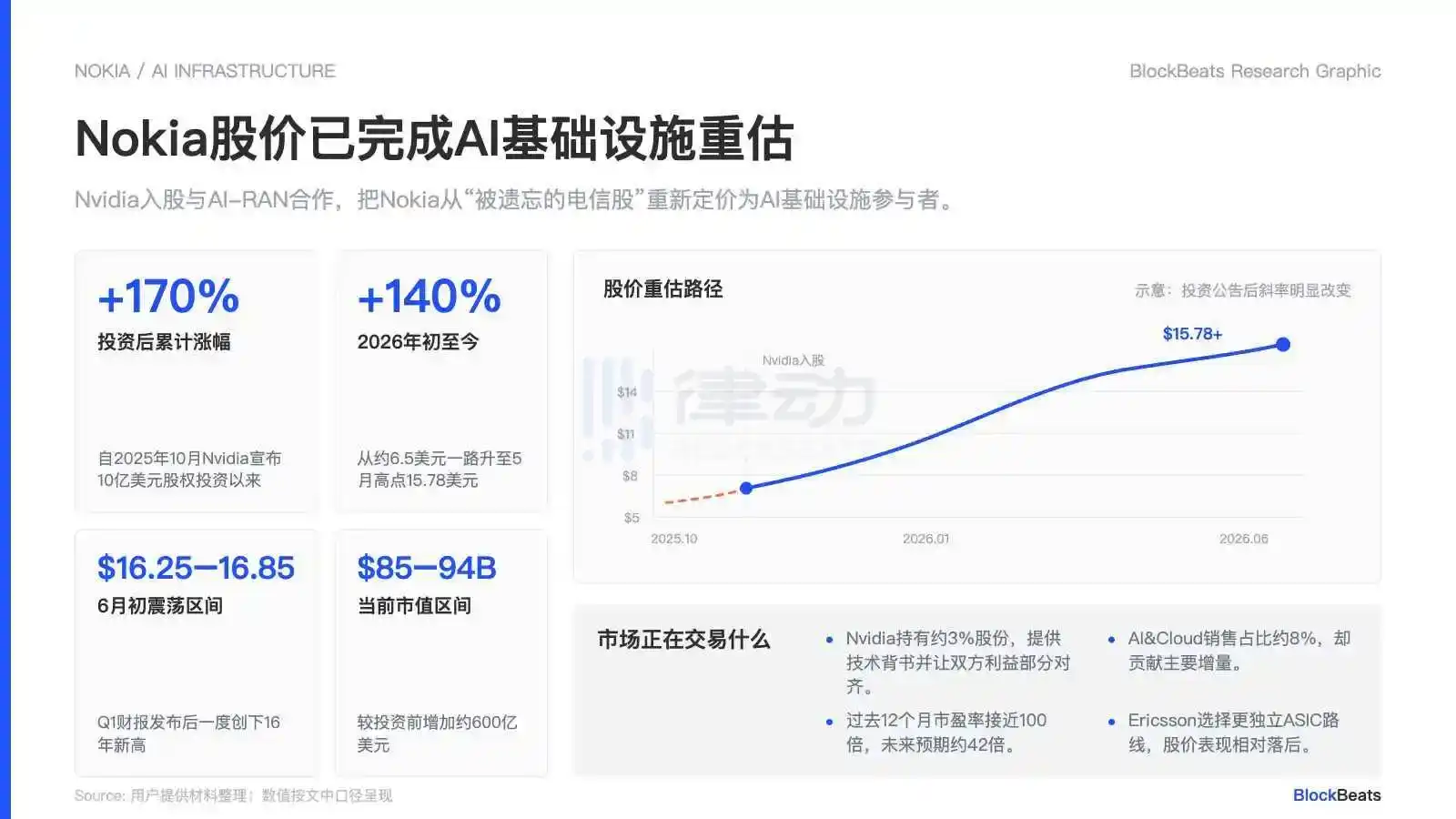
Since Nvidia announced a $1 billion equity investment and reached an AI-RAN strategic cooperation agreement in October 2025, Nokia's share price has accumulated gains of nearly 170%. Year-to-date in 2026, the increase exceeds 140%, rising from around $6.5 to a peak of $15.78 in May, and fluctuating in the $16.25-$16.85 range in early June. Following the Q1 earnings release, it once hit a 16-year high.

The current market capitalization is approximately $85-94 billion, an increase of about $60 billion from pre-investment. The AI&Cloud business accounts for about 8% of group sales but contributes the majority of the incremental value. The trailing twelve-month P/E ratio is close to 100 times, while the forward P/E ratio is about 42 times, significantly higher than traditional telecom peers but still lower than pure-play AI infrastructure companies. In contrast, Ericsson's share price performance lags due to its choice of a more independent ASIC chip strategy.

These changes indicate that the market is already trading on Nokia's transformation from a "forgotten telecom stock" to an AI infrastructure participant. Nvidia holds approximately 3% of the shares, providing both technical endorsement and partially aligning interests. Coupled with the narrative of the U.S. pushing to regain leadership in the telecom field, this has collectively accelerated this round of re-rating.

However, after significantly outperforming, what actual business progress is the market truly trading on?
Q1 Orders and Guidance Raise Validate Accelerated Transformation

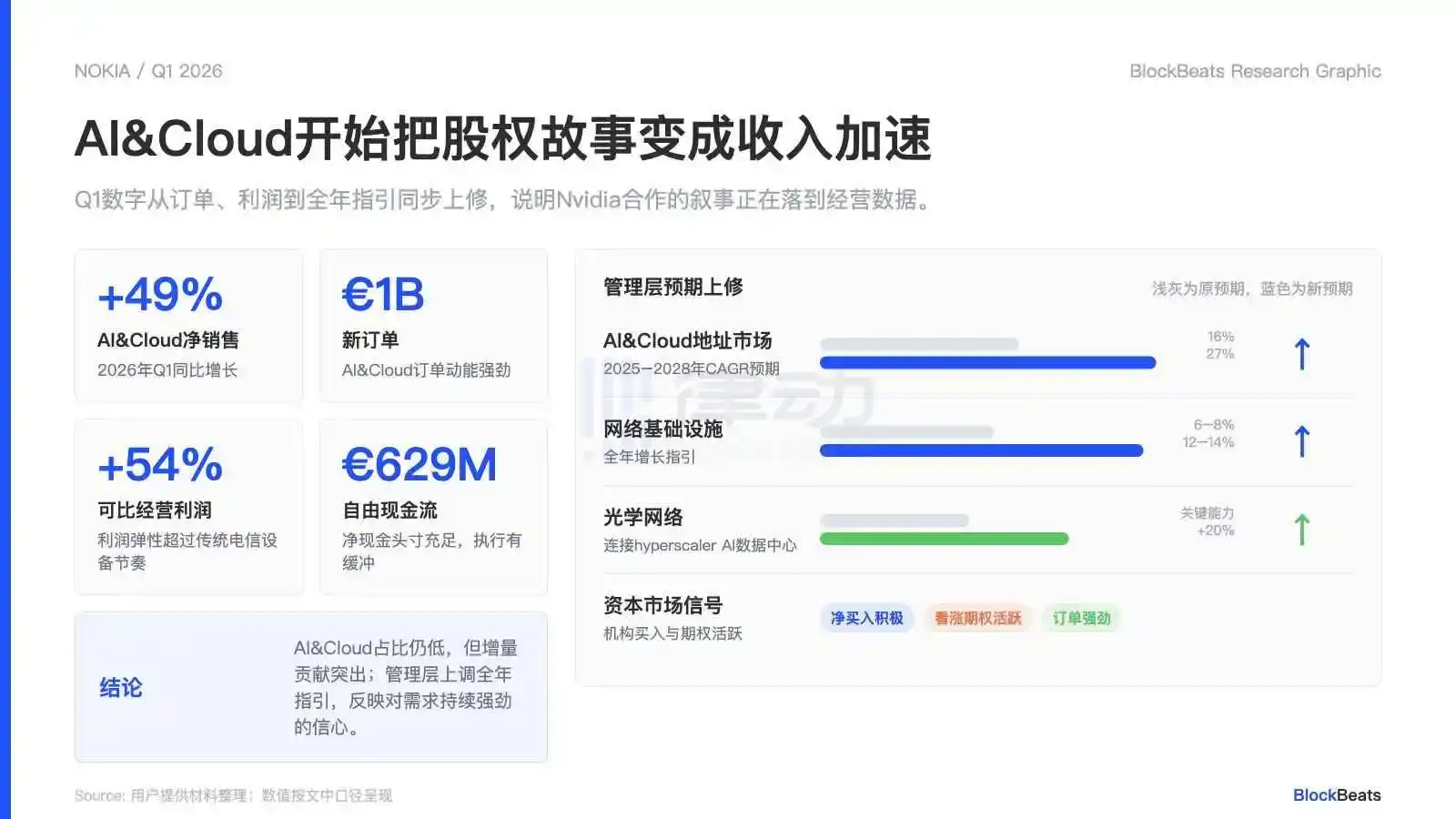
In the Q1 2026 earnings report, Nokia's AI&Cloud net sales increased by 49% year-over-year, securing €1 billion in new orders, with comparable operating profit surging by 54%. Consequently, the company raised its expected annual compound growth rate for the AI&Cloud addressable market from 16% to 27% for 2025-2028, and its full-year growth guidance for network infrastructure from 6-8% to 12-14%.

Optical network business grew by 20% during the same period, becoming a key part of connecting hyperscaler AI data centers. This capability was further strengthened following the acquisition of Infinera. New order intake is strong, free cash flow reached €629 million, and the net cash position is ample, providing a buffer for future execution.

These figures indicate that the cooperation with Nvidia is shifting from an equity story to visible revenue acceleration. Although AI&Cloud still represents a low proportion, its incremental contribution is prominent. The company's raised full-year guidance reflects management's confidence in sustained strong demand. Institutions have been net buyers over the past 12 months, and call option activity is higher than normal levels, further supporting this assessment.
MWC Tests and Innovation Lab Confirm Early Commercial Pathway

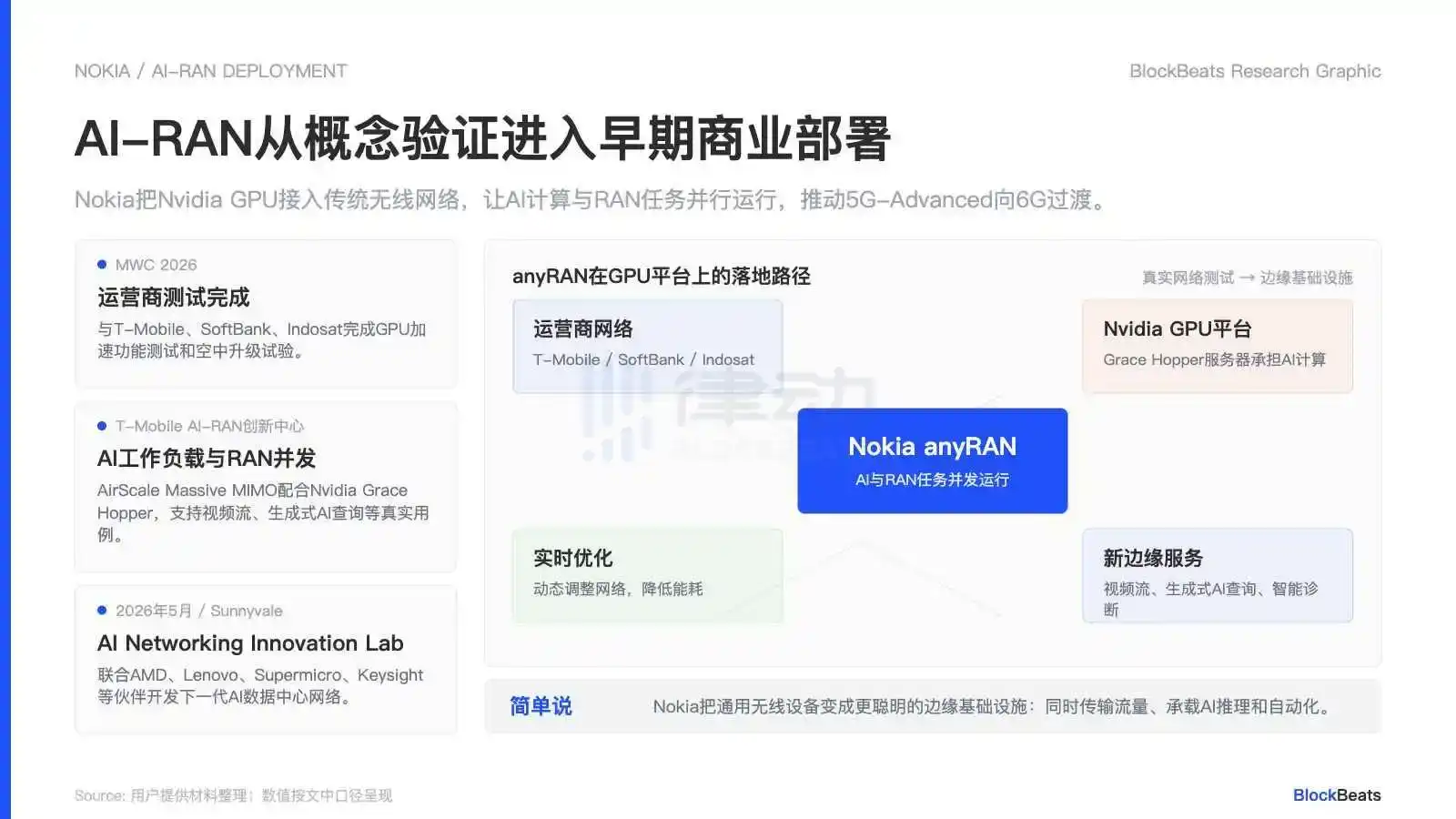
During MWC 2026, Nokia completed functional tests and over-the-air upgrade trials with operators like T-Mobile, SoftBank, and Indosat. At T-Mobile's AI-RAN Innovation Center, they used Nokia's AirScale Massive MIMO radio equipment alongside Nvidia Grace Hopper servers, successfully running AI workloads concurrently with RAN (Radio Access Network) tasks, supporting practical use cases like video streaming and generative AI queries.

In May 2026, Nokia opened the AI Networking Innovation Lab in Sunnyvale, California, collaborating with partners like AMD, Lenovo, Supermicro, and Keysight to develop next-generation AI data center networks. Concurrently, it introduced AI agent features for fixed broadband products, helping operators diagnose problems automatically, reduce costs, and accelerate fiber deployment.

These developments show that the acceleration path for Nokia's anyRAN software on Nvidia GPU platforms is now implementable. AI-RAN (using AI to optimize wireless access networks) is no longer just a concept but can deliver real-time optimization, reduce energy consumption, and generate new edge services within actual operator networks, providing a viable path for the transition from 5G-Advanced to 6G. Nokia CEO Justin Hotard stated that the cooperation is moving from validation to early commercial deployment.

Simply put, Nokia is applying Nvidia GPUs to traditional wireless network hardware, enabling AI computing and network transmission tasks to run in parallel. This allows for real-time network adjustments, saves power, and facilitates the development of new services. This approach turns general-purpose equipment into smarter edge infrastructure.
Deployment Scale Becomes the Biggest Constraint Under High Valuation

Although Q1 data, test results, and ecosystem partner expansion are relatively positive, the current P/E ratio is close to 100 times. Analyst consensus target prices are around €9.4-€12 (some investment banks have raised to around €12-€14), significantly lagging the current stock price. This indicates that the market has already priced in considerable optimism for long-term AI-RAN penetration and the 27% growth expectation, leaving a significantly compressed margin for error.

Over the next 12-24 months, the conversion speed of actual deployment contracts from major operators, the overall pace of AI capital expenditure, and differences in approach compared to Ericsson (which insists on independent ASICs, avoiding deep ties to a single GPU supplier) will become the core variables. If subsequent orders fall short of expectations or AI spending slows, the risk of a pullback will significantly increase.

Institutional net buying and bullish option preferences currently still support share price momentum, but these ultimately need to be validated by execution. Nokia's position as a representative AI edge infrastructure player has gained recognition, and the combination of optical networks with wireless access networks expands the overall market opportunity. However, there is a noticeable distance from current early orders to truly commercial deployment at hyperscaler scale.

It is still in the early acceleration phase, with overall execution signals being positive. However, the high valuation has already tightened the margin for error considerably. Investors should focus next on actual large-scale deployment progress rather than new demonstrations to gauge how much further this trend of AI expanding to the telecom edge can go.


Domande pertinenti

QAccording to the article, why has Nokia's stock price experienced a significant revaluation recently?

ANokia's stock price has been revalued because the market is no longer viewing it just as a cyclical telecom equipment vendor, but as an AI network and edge infrastructure player. This shift was catalyzed by a strategic investment and AI-RAN collaboration with Nvidia, aligning with the trend of AI capital expenditure moving from core data centers into telecom edges and optical networks.

QWhat were the key performance highlights for Nokia's AI & Cloud business in Q1 2026?

AIn Q1 2026, Nokia's AI & Cloud business saw net sales grow by 49% year-over-year, secured 1 billion euros in new orders, and comparable operating profit increased by 54%. Due to this strong performance, the company raised its growth expectations for the AI & Cloud addressable market.

QWhat practical demonstrations at MWC 2026 validated Nokia's AI-RAN path?

AAt MWC 2026, Nokia conducted functional tests and over-the-air upgrade trials with operators like T-Mobile, SoftBank, and Indosat. A key test at T-Mobile's AI-RAN Innovation Center successfully ran AI workloads concurrently with RAN tasks using Nokia's AirScale Massive MIMO hardware and Nvidia Grace Hopper servers, supporting real use cases like video streaming and generative AI queries.

QWhat is a major constraint for Nokia's stock mentioned in the article, given its current valuation?

AA major constraint is the high valuation, with a trailing P/E close to 100x. This high valuation reflects significant market optimism upfront, leaving little room for error. The key variable now is the conversion speed of large-scale operator deployment contracts and the overall pace of AI capital expenditure over the next 12-24 months.

QHow does Nokia's strategic approach differ from its competitor Ericsson's according to the article?

ANokia's strategy involves a deep technical collaboration and equity investment from Nvidia, integrating Nvidia's GPU technology into its telecom hardware. In contrast, Ericsson is pursuing a more independent ASIC chip route, avoiding deep binding to a single GPU vendor like Nvidia.

Letture associate

ETH Bull and Bear Views Compilation: Can Ethereum's Value Flow Back to ETH?

Titled "ETH Bull and Bear Views: Can Ethereum's Value Flow Back to ETH?", this article synthesizes the current heated debate around Ethereum's native token, ETH, following Bankless co-founder David Hoffman's decision to sell his entire ETH holdings. The **bullish case**, represented by figures like Tom Lee (BitMine CEO) and Raoul Pal, argues that ETH's core thesis remains intact. They contend Ethereum is the essential, secure, and neutral foundational layer for future finance—encompassing stablecoins, RWA, DeFi, L2s, and Agentic AI. Bulls bet on ETH's long-term revaluation as institutional adoption of on-chain finance grows, with significant buying activity from entities like BitMine and Consensys cited as evidence. Conversely, the **bearish perspective**, led by Hoffman and analysts like Markus Thielen, questions ETH's value capture mechanism. They acknowledge Ethereum's network success but argue that the value created by L2s, DeFi, and applications does not sufficiently accrue to the ETH token itself. Bears point to ETH's prolonged underperformance versus the broader crypto market, lack of traditional cash flows, weakening "ultrasound money" narrative, and apparent institutional retreat (e.g., Harvard Management Company exiting its ETH ETF position) as key concerns. The debate highlights a pivotal shift: ETH is no longer just a community belief asset. The central question is whether ETH can transition from being a "**used infrastructure**" to a "**continuously bought and held core asset**" as more value enters the Ethereum ecosystem. The market is now critically examining the direct link between network growth and ETH's value.

marsbit33 min fa

ETH Bull and Bear Views Compilation: Can Ethereum's Value Flow Back to ETH?

marsbit33 min fa

Crypto is dead, Perps are forever

The crypto industry is shifting from a focus on creating native assets (like altcoins and protocol tokens) to becoming a "global asset pipeline." Native cryptocurrencies, except for Bitcoin, are seen as failing in their value storage and utility promises, with demand driven largely by speculation. Attention and liquidity are now moving toward real-world assets (RWAs) like U.S. stocks, bonds, gold, and oil traded on-chain via perpetual contracts (Perps). Stablecoins like USDT and USDC set the precedent, proving blockchain's core strength is efficient global settlement and transfer, not inventing new monetary systems. Meanwhile, assets like Ethereum and many DeFi tokens struggle as their narratives weaken against tangible traditional assets and the rapid real-world progress of AI. Perpetual contracts have emerged as a pivotal innovation. They simplify trading by offering pure price exposure to any asset, bypassing complexities of ownership, custody, and traditional market hours. Projects like Hyperliquid gained traction by combining CEX-like efficiency with on-chain transparency, capitalizing on post-FTX distrust, macroeconomic volatility, and the surge in demand for 24/7 stock trading. In conclusion, while the era of speculative native "crypto assets" may be over, perpetual contracts persist as the industry's most potent financial instrument—transforming all assets into globally accessible, constantly tradable instruments centered on price speculation.

marsbit38 min fa

Crypto is dead, Perps are forever

marsbit38 min fa

Tencent, Alibaba, ByteDance in a Battle for the Skill Store

Skill is becoming a key concept in the AI field, essentially serving as a structured "instruction manual" for AI Agents that specifies tool calls, decision logic, and output standards. This allows Agents to execute predefined tasks. As the number of Skills grows, distribution platforms have emerged. Major tech companies are swiftly entering this space. In March, Tencent, Alibaba, and ByteDance launched Skill stores within their respective Agent platforms. Subsequently, players like Zhipu AI, Meituan, and Xiaohongshu joined the fray. This competition for the "Skill store" is fundamentally a battle for the AI-era user entry point; whoever controls distribution controls the users. While ByteDance's Coze has experimented with paid Skills, most platforms offer them for free. The real value lies not in the stores themselves but in using them to attract and retain users within an ecosystem, driving revenue from services like cloud computing, model calls, or advertising. The landscape features three main player types: 1) **Internet giants** (e.g., Alibaba, ByteDance, Tencent, Meituan), leveraging Skills to drive traffic and monetize through their broader ecosystems (cloud services, transactions, ads). 2) **Large model companies** (e.g., Zhipu AI, Moonshot AI), using Skill stores to increase user engagement and monetize model API calls. 3) **Content platforms** (e.g., Xiaohongshu), treating Skills as a new content format to generate traffic and ad revenue. However, transforming Skill stores into a sustainable business faces significant hurdles. Key challenges include: the **difficulty in pricing Skills** due to inconsistent outputs across different models and contexts; **lack of cost transparency** (varying token consumption); **security risks** like Skill poisoning; and the **absence of standardized protocols** for development and evaluation. Unlike standardized mobile apps, Skills are often personalized workflows resistant to uniformity, which hinders the establishment of a reliable review and monetization system akin to the App Store. While there is genuine user demand for paid Skills—particularly in enterprise (e.g., contract review) and certain personal productivity scenarios—current platforms offer developers limited and unpredictable distribution. The future of Skill stores depends on overcoming these standardization, evaluation, and safety challenges to make acquiring a Skill as straightforward as downloading an app. For now, the stores function more as display shelves than robust marketplaces.

marsbit38 min fa

Tencent, Alibaba, ByteDance in a Battle for the Skill Store

marsbit38 min fa

The Crypto Scene Is Dead, Perpetual Swaps Are Eternal

The crypto industry is undergoing a fundamental shift. The era defined by minting novel, native digital assets (altcoins) is fading. These assets, lacking real-world cash flows or clear value, are losing relevance as attention and capital flow elsewhere. Two powerful external forces are reshaping the space. First, traditional assets like U.S. stocks, bonds, gold, and oil are being tokenized and traded on-chain. Second, the explosive growth of AI, with its tangible products, has overshadowed crypto's once-dominant "future narrative." This marks a critical pivot: crypto is transitioning from being a "factory for new assets" to becoming a "global conduit for existing assets." Its validated utility is not complex financial reinvention but efficient global settlement, transfer, and trading—the original promise of blockchain. Stablecoins like USDT and USDC exemplify this, offering faster dollar movement rather than replacing it. Consequently, native ecosystems like Ethereum face profound challenges. While still crucial infrastructure, ETH struggles to capture value as users interact with Layer 2s or trade traditional assets without needing to hold it. DeFi's grand narrative of rebuilding finance has narrowed to core needs like cheap transfers and deep liquidity. The true breakout innovation is the perpetual contract (Perp). It brilliantly bypasses the complexities of direct asset ownership (custody, compliance, dividends) by creating pure price exposure. Users can speculate on the price movement of *any* asset—NVIDIA, gold, oil—24/7, globally, and with leverage. This "price casino" model, while risky and ethically fraught, delivers unmatched liquidity and accessibility. Projects like Hyperliquid succeeded not by inventing new mechanics but by perfecting the timing and execution of this model. Key drivers included making on-chain Perps feel like centralized exchanges, post-FTX trust migration towards transparency, and rising demand to trade macro assets and equities round-the-clock. In conclusion, the crypto world's most enduring successes are the dollar (via stablecoins), Bitcoin, and trading. Its new frontier is not creating alternative assets but providing a seamless, perpetual trading layer—a new API—for the world's existing financial system. The age of native altcoins is over; the age of perpetual synthetic exposure has begun.

Odaily星球日报47 min fa

The Crypto Scene Is Dead, Perpetual Swaps Are Eternal

Odaily星球日报47 min fa

Trading

Spot
Futures
活动图片