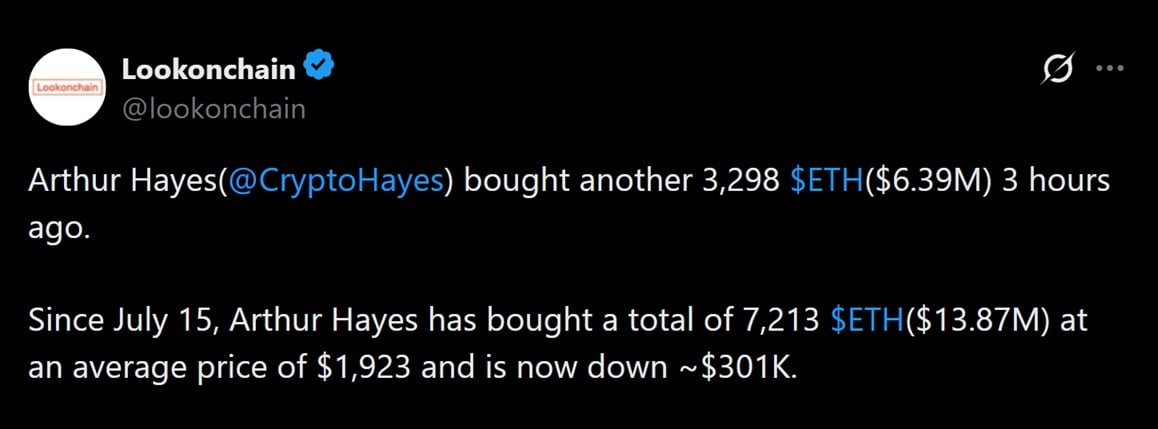
Lookonchain noted the latest purchase within hours of its execution, tracing it to a wallet associated with Hayes—the co-founder of BitMEX who currently serves as the Chief Investment Officer of the family office Maelstrom. Including this purchase, Hayes's total purchases since July 15 amount to 7,213 $ETH worth $13.87 million, with an average entry price of $1,923.
Hayes is best known as the co-founder of the derivatives exchange BitMEX, from whose CEO position he stepped down in 2021; since then, he has built a reputation as an active commentator on macroeconomic issues, alternating between calls for aggressive cryptocurrency accumulation and defensive selling recommendations in response to changing liquidity conditions. His trades are closely watched on-chain, as Maelstrom discloses little information about its official positions, making wallet-tracking services like Lookonchain a primary source of information about his activities.
From a $606,000 Loss to a Reversal
This wave of buying marks a sharp reversal compared to Hayes's stance in June, when a wallet linked to him sold 6,000 $ETH for approximately $10.14 million at an average price of around $1,690. This sale realized an estimated loss of $606,000 on the $ETH he had accumulated several weeks earlier at an average entry price of about $1,793, deviating from his typical strategy of buying on dips and selling on rallies.
This is not the first time Hayes has sharply reversed course—switching from selling to buying—within a short timeframe. In August 2025, a wallet associated with him sold $13.35 million worth of cryptocurrencies, including 2,373 $ETH, citing concerns over a proposed US tariff bill, even as he argued that Bitcoin would ultimately test $100,000 and Ether $3,000.
This core conviction has remained consistent for several months, as in an April note Hayes argued that wartime inflation, regulatory changes freeing up bank balance sheets, and coordination between the Treasury and the Federal Reserve would collectively result in more than $4 trillion in total credit creation, concluding: "That's why I believe Bitcoin will rise."
He has since extended this liquidity argument to Ether, viewing corrections like the one in June as entry points rather than reasons to retreat.
Ether's Recovery Meets Institutional Demand
Hayes's purchases coincide with a broader recovery in Ether, which traded around $1,900 on July 28, showing a roughly 20% gain over the month, though the token's value remains about 49% lower compared to the previous year. The recovery has aligned with a renewed interest from institutional investors: according to Bitcoin.com News data, Ether exchange-traded funds (ETFs) alone attracted $103.90 million in net inflows during the week of July 20-24, roughly three times the $33.79 million attracted by Bitcoin funds over the same period.
This inflow gap indicates institutional investors are pivoting towards Ether, even as individual traders like Hayes engage with the asset, displaying significantly more volatility in their positions. Whether this demand persists will likely determine if Hayes's latest bet can cover his $301,000 paper loss or compound it.
end-content