How To Play The Bitcoin 4-Year Cycle For The Most Gains In The Bull Market

bitcoinistPubblicato 2026-05-25Pubblicato ultima volta 2026-05-25

Introduzione

A crypto analyst argues that Bitcoin's four-year cycle is still active, despite recent market debates suggesting it may be over. By examining past cycles from 2011-2014, 2015-2018, and 2019-2022, the analyst identifies a consistent pattern: a "Buy" year with declining prices, a "Hold" year of rising prices, a "Sell" year near the peak, and a final "Bear" year of market crash. The analyst applies this model to the current cycle, positioning 2023 as the Buy phase, 2024 as Hold, 2025 as Sell, and 2026 as the ongoing Bear phase, explaining Bitcoin's recent sideways and declining price action. Looking ahead, the analyst predicts the 2027-2030 cycle will follow the same pattern, with the next major accumulation opportunity potentially arriving in 2027. The conclusion is that the four-year cycle structure remains intact and is playing out as expected.

A crypto analyst is raising questions over whether the famous four-year cycle theory that has governed Bitcoin’s (BTC) market trajectory in the past is now dead. The expert has shared BTC’s price movements and investor trends to prove that the cycle theory is still very much alive and playing out in the current market cycle.

Analyst Says Bitcoin’s 4-Year Cycle Is Still Active

In an X post on May 23, Mags, a crypto analyst, has raised concerns about whether “the 4-year cycle is over” for Bitcoin. This debate has been spreading across the market for months now, with some experts, such as Strategy CEO Michael Saylor, stating that the four-year cycle has ended, while others believe it is still active.

Many crypto community members, in response to Mags’ post, also compared this cycle to past ones. They noted that the current BTC market is markedly different from previous cycles, due to the emergence of Spot ETFs, increased institutional flows, and broader adoption.

However, after examining and comparing these cycles himself, Mags noted that each one corresponds almost perfectly to the next. The analyst pointed to the 2011-2014 four-year cycle on his accompanying chart, highlighting how the market moved through distinct stages of investor activity and price movement during that period.
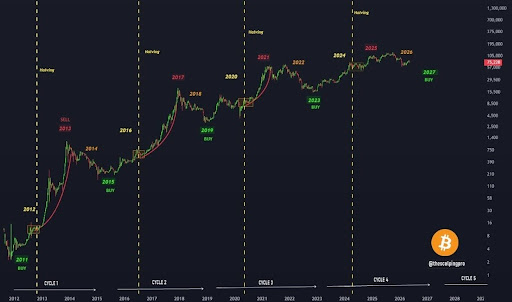
Source: Chart from Mags on X

In 2011, Bitcoin prices were declining, presenting a buying opportunity for investors. In the second year, Bitcoin began to rise, and investors simply held onto their tokens to allow them to grow. By 2013, prices had climbed to near peak levels, which the analyst noted was when most investors began selling their BTC. The fourth and final year of that cycle saw the market crash, and prices fall sharply. Mags described this as the bear market stage, marking the final stage before a fresh bull cycle began.

Notably, the same four-stage yearly trend was observed during the 2015-2018 and 2019-2022 cycles. Mags also stated that the cyclical theory is actively running in the current cycle, noting that Bitcoin has already moved through its Buy stage in 2023, Hold in 2024, and Sell phase in 2025. Based on this, Mags said that BTC is now in its bear market phase, coinciding with the cryptocurrency’s recent sideways movements and ongoing price declines.

What The Theory Says About The 2027-2030 Cycle

In his analysis, Mags went further to predict what the next cycle could look like after the current one ends. He suggested that the 2027-2030 cycle could follow a similar pattern, with Bitcoin potentially experiencing the same Buy, Hold, Sell, Bear market phases across each year.

He noted that if this structure holds, the next major accumulation window for investors and traders would arrive in 2027, a year ahead of the next anticipated bull run. Mags has pushed back against the speculation that the four-year cycle is dead, declaring that the structure “is still on track and everything is playing out perfectly.”

BTC trading at $77,435 on the 1D chart | Source: BTCUSDT on Tradingview.com

Domande pertinenti

QIs Bitcoin's 4-year cycle theory still active according to the crypto analyst Mags?

AYes, Mags states that the 4-year cycle theory is still active and is playing out perfectly in the current market cycle.

QWhat are the four distinct yearly stages described in the analyst's interpretation of the Bitcoin cycle?

AThe four distinct yearly stages are: Buy (Year 1 - price decline/buying opportunity), Hold (Year 2 - price rise/accumulation), Sell (Year 3 - near peak levels/most investors sell), and Bear Market (Year 4 - market crash/price decline).

QAccording to Mags' analysis, what phase is Bitcoin currently in within the 2023-2026 cycle?

AAccording to Mags, Bitcoin is currently in its Bear Market phase for the 2023-2026 cycle, coinciding with recent sideways movements and price declines.

QWhen does Mags predict the next major accumulation window for Bitcoin investors will occur?

AMags predicts the next major accumulation window for investors and traders will arrive in 2027.

QWhy are some in the crypto community debating if the 4-year cycle is over for Bitcoin?

ASome believe the current Bitcoin market is markedly different from past cycles due to factors like the emergence of Spot ETFs, increased institutional flows, and broader adoption, leading to the debate about the cycle's validity.

Letture associate

IOSG: DeFi at Its Most Critical Moment, The Real Vulnerability Lies Not in the Code

In April 2026, a series of major DeFi exploits—targeting Drift Protocol ($285M), KelpDAO ($292M via bridge), and Wasabi Protocol ($4.5M)—revealed a fundamental security crisis. None involved smart contract code vulnerabilities. Instead, losses stemmed from compromised operational foundations: social engineering of multi-signature signers, a single-point-of-failure bridge validator, and stolen admin private keys. This month, where over $625M was stolen across ~30 incidents, marked the collapse of DeFi's core security premise: that rigorous code audits alone ensure safety. The real vulnerabilities lay in trusted operational components—admin keys, governance councils, and bridge configurations—areas audits typically ignore. The KelpDAO incident triggered an asymmetric domino effect: its $2.92B unsupported token mint caused ~$8.5B in outflows from Aave and a $13.2B total DeFi TVL drop in 48 hours, showcasing how one protocol's operational failure can cascade through composable systems. The article argues that most so-called "DeFi" is actually "OpenFi": permissionless and transparent on-chain, but critically reliant on trusted third parties for key operations. This inherent trade-off between decentralization and operational feasibility is often obscured by marketing. The industry's path forward requires honest disclosure of trust assumptions (like L2Beat's framework), treating operational security as a first-class discipline alongside code audits, and designing systems whose risks can be clearly assessed and insured. The April events were not a code security failure but a breakdown in the mental model surrounding it.

marsbit6 min fa

IOSG: DeFi at Its Most Critical Moment, The Real Vulnerability Lies Not in the Code

marsbit6 min fa

The 'Stock Call King' Serenity: 3840% Annual Return, Beating Institutions to the Punch

This article profiles the mysterious stock trader and analyst known as Serenity, who has gained significant influence on social media platform X as a "stock call king." Serenity claims extraordinary annual returns of 3840% for the current year and 2256% over the past two years, primarily by focusing on overlooked companies within the AI and semiconductor supply chains. Operating anonymously, Serenity describes himself as a former Reddit WallStreetBets trader, an AI/semiconductor supply chain analyst, and a former AI research scientist. His core investment strategy, termed the "Chokepoint" theory, involves identifying small, critical bottleneck companies in the AI infrastructure ecosystem—such as those in photonics, substrates, and materials—that are essential yet undervalued. He argues these "invisible champions" become crucial as demand for AI hardware surges, creating significant investment opportunities before large institutions take notice. A frequently cited example is stock AXTI, which he has recommended for over two years and claims has yielded over 10,000% returns. The article notes that while Serenity's free, public posts on X have garnered a large following, his identity and exact portfolio size remain unverified, leading to some skepticism. Critics question if his reported returns are fabricated or if he might be manipulating prices of low-market-cap stocks. Serenity counters that he shares research freely to democratize information, allowing retail investors to benefit before institutional buy-ins, and that percentage returns are more meaningful than disclosing specific dollar amounts. Ultimately, the article presents Serenity as a polarizing figure—either a visionary analyst with a superior research framework or a potentially sophisticated market player. It concludes that the truth of his claims and legacy will only be determined by time.

Odaily星球日报14 min fa

The 'Stock Call King' Serenity: 3840% Annual Return, Beating Institutions to the Punch

Odaily星球日报14 min fa

Will Ethereum's Native Privacy Proposal EIP-8182 Absorb Liquidity from Other Privacy Coins?

The article discusses Ethereum Improvement Proposal (EIP) 8182, titled "Private ETH and ERC-20 Transfers," a draft proposal to integrate native privacy directly into the Ethereum protocol layer (L1). Currently, Ethereum transactions are fully transparent, and existing privacy solutions like Tornado Cash are third-party dApps with limitations: small anonymity sets (mixing pools), lack of interoperability, and regulatory vulnerability. EIP-8182 aims to create a large, unified "shared shielded pool" and zero-knowledge proof (ZK) precompiles within the core protocol. Key features include a massive, shared anonymity pool for all users and dApps, significantly enhancing privacy strength; native support for private transfers of ETH and any ERC-20 token; a decentralized system contract architecture without admin controls or fees; and the use of ZK proofs to validate transactions without revealing specific details. If implemented, this upgrade could position Ethereum as the world's largest privacy-focused blockchain. By offering a built-in, highly private environment with a vast user base and liquidity, it might attract institutional and individual users, potentially drawing liquidity away from dedicated privacy coins like Zcash and Monero, or even users seeking privacy on Bitcoin. The integration could transform Ethereum from a transparent public ledger into a dominant privacy-centric platform, with potential future enhancements like fully homomorphic encryption (FHE) for compliance capabilities.

marsbit18 min fa

Will Ethereum's Native Privacy Proposal EIP-8182 Absorb Liquidity from Other Privacy Coins?

marsbit18 min fa

Investors Frantically Snap Up AI Firms with 'No Profits': A High-Stakes Gamble on 'the Right to Define the Future'

"Investors are pouring billions into Chinese AI startups with no profits, betting on the future of the industry. A state-backed fund is reportedly in talks to lead DeepSeek's funding at a $45B valuation, just weeks after it was valued at $10B. Along with companies like Zhipu AI, MiniMax, and Kimi (backed by Meituan and Alibaba), their combined valuation exceeds $140B. This isn't a typical venture capital play. Investors are paying for 'future definition rights'—a chance to set the standards for the next tech era. Morgan Stanley notes a 6-12 month window for this scarcity premium before more AI companies go public. Despite massive losses, these companies show strong growth. Zhipu AI's API revenue grew 60x, Kimi's annual recurring revenue doubled to $200M in a month, and MiniMax turned its gross margin positive, with over 70% of revenue from overseas. Their valuations vastly exceed profitable firms like iFlytek. Crucially, technical progress underpins this growth. DeepSeek's latest model boasts costs just 1% of a leading competitor's, while Zhipu AI has raised API prices due to high demand. However, gaps with top global models remain. Tech giants like Tencent and Alibaba, investing heavily while describing their own AI efforts as 'leaky boats,' are also investing in these startups as a hedge. Key risks loom: the closing scarcity window, computing power bottlenecks limiting growth, and the sustainability of DeepSeek's cost-advantage model. With state capital now a major player, the success of these companies has become a strategic national concern. The next year will test if their soaring valuations can be justified by future profits."

marsbit1 h fa

Investors Frantically Snap Up AI Firms with 'No Profits': A High-Stakes Gamble on 'the Right to Define the Future'

marsbit1 h fa

Trading

Spot
Futures

Articoli Popolari

Come comprare 4

Benvenuto in HTX.com! Abbiamo reso l'acquisto di 4 (4) semplice e conveniente. Segui la nostra guida passo passo per intraprendere il tuo viaggio nel mondo delle criptovalute.Step 1: Crea il tuo Account HTXUsa la tua email o numero di telefono per registrarti il tuo account gratuito su HTX. Vivi un'esperienza facile e sblocca tutte le funzionalità,Crea il mio accountStep 2: Vai in Acquista crypto e seleziona il tuo metodo di pagamentoCarta di credito/debito: utilizza la tua Visa o Mastercard per acquistare immediatamente 44.Bilancio: Usa i fondi dal bilancio del tuo account HTX per fare trading senza problemi.Terze parti: abbiamo aggiunto metodi di pagamento molto utilizzati come Google Pay e Apple Pay per maggiore comodità.P2P: Fai trading direttamente con altri utenti HTX.Over-the-Counter (OTC): Offriamo servizi su misura e tassi di cambio competitivi per i trader.Step 3: Conserva 4 (4)Dopo aver acquistato 4 (4), conserva nel tuo account HTX. In alternativa, puoi inviare tramite trasferimento blockchain o scambiare per altre criptovalute.Step 4: Scambia 4 (4)Scambia facilmente 4 (4) nel mercato spot di HTX. Accedi al tuo account, seleziona la tua coppia di trading, esegui le tue operazioni e monitora in tempo reale. Offriamo un'esperienza user-friendly sia per chi ha appena iniziato che per i trader più esperti.

340 Totale visualizzazioniPubblicato il 2025.10.20Aggiornato il 2025.10.20

Come comprare 4

Discussioni

Benvenuto nella Community HTX. Qui puoi rimanere informato sugli ultimi sviluppi della piattaforma e accedere ad approfondimenti esperti sul mercato. Le opinioni degli utenti sul prezzo di 4 4 sono presentate come di seguito.

活动图片