Elon Musk: In 5 Years, People on the Internet Will Become a Statistical Error — Only Bots Will Remain

cryptonews.ruPubblicato 2026-08-11Pubblicato ultima volta 2026-08-11

Introduzione

Elon Musk commented on social media X, agreeing with a Cloudflare forecast that AI agent traffic will "significantly exceed" human traffic. Cloudflare predicts that within five years, bot traffic could be 1,000 times greater than human traffic. The company's CEO, Matthew Prince, noted that bot traffic first surpassed human traffic in May 2026, earlier than their original forecast of late 2027. Cloudflare's CFO, Thomas Seifert, stated that at current growth rates, humans risk becoming a "statistical margin of error" online, not due to declining human activity, but due to the explosive growth of AI agent activity. The company tracks this ratio via its Cloudflare Radar dashboard, which measures bot versus human traffic based on HTTP requests for HTML content. However, methodologies for measuring bot traffic vary. Another report from Thales/Imperva recorded automated traffic at 53% of global internet traffic in 2025, differing from Cloudflare's figures due to different sampling and criteria. This lack of a unified measurement standard poses a challenge for regulators and infrastructure developers seeking a clear picture of online activity.

Elon Musk wrote on social network X that the traffic of AI agents will "definitely significantly exceed" human traffic, citing a forecast by Cloudflare. The entrepreneur's comment referred to the company's assessment that in five years, bot traffic will exceed human traffic by 1,000 times.

The traffic of AI agents will clearly and significantly exceed human traffic, there is no question about it. The Cloudflare forecast is accurate.

Cloudflare has been developing the idea that automated systems are surpassing humans in terms of internet activity volume for several months. Back on June 3, 2026, the company's CEO, Matthew Prince, announced that bot traffic had for the first time in internet history surpassed human traffic. According to him, the company expected this event closer to the end of 2027, then shifted the forecast to early 2027, but AI agent traffic grew so rapidly that the tipping point was recorded in May 2026.

Humans as a 'Statistical Error'

At the conference on the results of the second quarter of 2026, held on August 6, Cloudflare's CFO, Thomas Seifert, stated that if the current trend continues, in five years, bot traffic will exceed human traffic by 1,000 times. Seifert clarified that the company's previous forecasts on this topic had been incorrect — but not in the usual direction: reality consistently outpaced expectations. In his words, humans risk becoming a "statistical error" on the internet — not due to a decrease in human activity, but due to the rate of growth in agent activity.
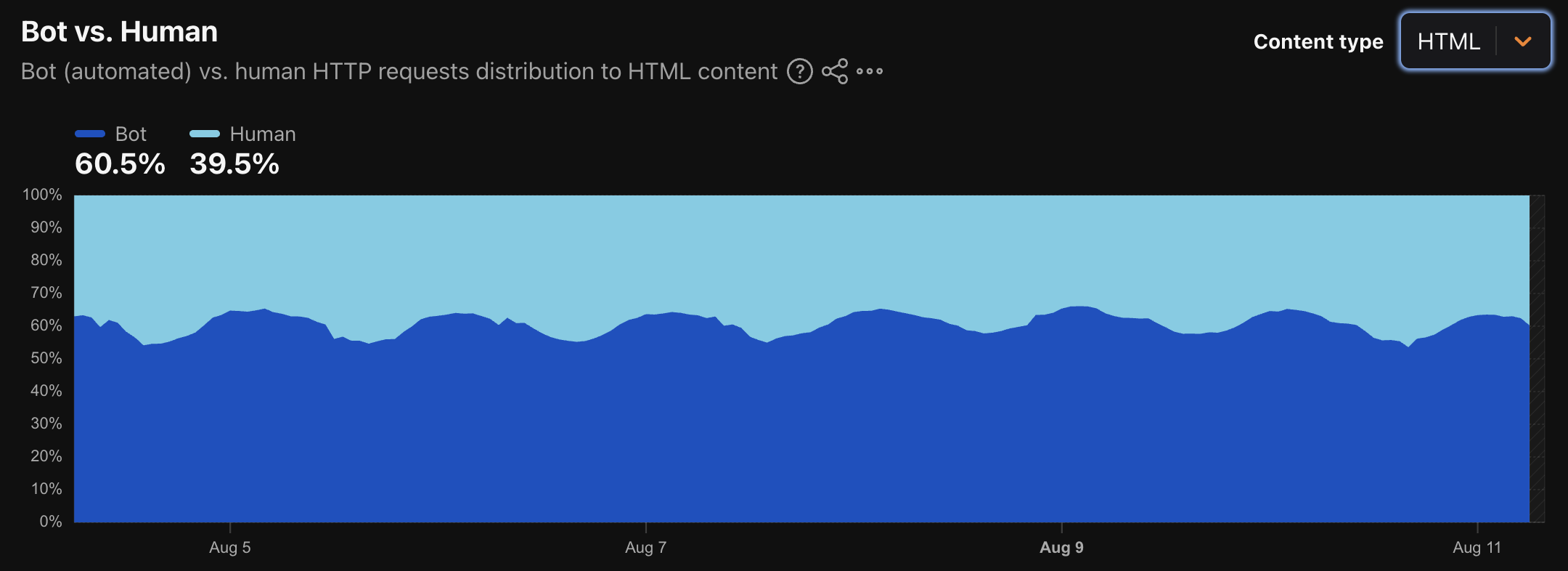
Ratio of bot traffic to human traffic based on HTTP requests for HTML content. Source: Cloudflare

The data referenced by Prince and Seifert is updated daily on the Cloudflare Radar dashboard, which tracks the ratio of bot traffic to human traffic. It was this section that Prince linked to in his June post, and a month later, Musk drew attention to it while commenting on Cloudflare's conclusions.

AI's Opinion

From a methodological standpoint, comparing different sources of telemetry opens an interesting perspective. Cloudflare Radar measures the share of bots based on HTTP requests for HTML content on the company's servers, whereas Thales/Imperva recorded a different figure in its annual report: in 2025, the share of automated traffic across the entire global network reached 53%, compared to 51% the previous year. The discrepancy in numbers between providers is explained by different domain samples and different criteria for classifying a request as a "bot" — a unified measurement standard does not yet exist.

A historical parallel can be drawn with early disputes about internet provider coverage in the 1990s, when each company used its own methodology for counting users. The technical risk that remains off-screen: the more vendor metrics diverge, the harder it becomes for regulators and infrastructure developers to rely on a unified picture of what's happening. Will the market be left without a common standard for accounting for agent traffic?

end-content

Crypto di tendenza

Domande pertinenti

QWhat did Elon Musk claim about the future of internet traffic, according to the article?

AElon Musk claimed that the traffic of AI agents will "clearly and significantly exceed" human traffic. He agreed with a Cloudflare forecast stating that within five years, bot traffic would exceed human traffic by 1,000 times, making people a "statistical error."

QWhat key milestone regarding bot traffic did Cloudflare report occurring in mid-2026?

AIn mid-2026, specifically in May 2026, Cloudflare reported that bot traffic surpassed human internet traffic for the first time in history. This event occurred earlier than the company's previous forecasts, which had predicted it for late 2027 or early 2027.

QWhat was the financial director of Cloudflare's prediction about the future ratio of bot-to-human traffic?

AThomas Seifert, the CFO of Cloudflare, predicted that if current trends continue, bot traffic would exceed human traffic by 1,000 times within five years. He clarified that past forecasts on this topic were not incorrect but were too conservative, as reality consistently outpaced expectations.

QWhy do different cybersecurity companies report different figures for bot traffic, as mentioned in the article?

ADifferent companies report different figures due to differing methodologies. For example, Cloudflare Radar measures bot share based on HTTP requests to HTML content on its servers, while others like Thales/Imperva use different samples of domains and criteria for classifying a request as a "bot." There is currently no unified standard for measurement.

QWhat potential problem does the article suggest could arise from the lack of a unified standard for measuring agent traffic?

AThe article suggests that the greater the divergence in metrics between different vendors, the harder it becomes for regulators and infrastructure developers to rely on a single, coherent picture of what is happening on the internet. This creates a technical risk and raises the question of whether the market will remain without a common standard for accounting for agent traffic.

Letture associate

Google and Meta Called Out for Benchmark Gaming

Recently, analysis firm SemiAnalysis accused tech giants Google and Meta of "benchmark gaming" with their AI models Gemini 3.8 Flash and Muse Spark 1.3. The accusation stems from a dramatic performance drop between two versions of the Terminal-Bench evaluation for AI agents. On the older, public Terminal-Bench 2.1, Gemini 3.8 Flash scored 89.4, ranking second and beating GPT-6 Astra, while Muse Spark 1.3 scored 88.8. However, on the newly released, more secure Terminal-Bench 4.0, their scores plummeted to 19.1 and approximately 33.3 respectively, far behind competitors. SemiAnalysis argues this indicates "benchmark contamination," where companies train models not on the public test questions themselves, but on expensive, privately purchased training data specifically designed to mimic the benchmark's style. This has evolved into a lucrative industry, with specialized firms selling tailored training tasks for thousands to hundreds of thousands of dollars. The article specifically points to Datacurve, a company that both sells expert coding data and runs its own benchmark (DeepSWE), where the accused models also performed well. Meta's Chief AI Officer, Alexandr Wang, dismissed the claims as a "silly argument," pointing out similar performance drops for other models like GPT-5.6 Sol. He stated Meta never claimed Muse Spark 1.3 was as powerful as top-tier models, only that it offered better value. The report concludes that this is the inevitable fate of all high-quality public benchmarks—they become "gamed" over time. The proposed solution of private, high-quality benchmarks comes with a significant downside: it would erode public transparency, turning open rankings into marketing tools and leaving developers without a common, fair measure to compare AI models.

marsbit2 h fa

Google and Meta Called Out for Benchmark Gaming

marsbit2 h fa

Crypto's Nouveau Riche Strikes Gold in the Real World: Coinbase Co-founder's Venezuelan Oil Field Adventure

Coinbase co-founder Fred Ehrsam is venturing into the oil fields of Venezuela, a surprising shift for a prominent figure in the digital asset space. Through his company Primavera Infinita, he recently secured a production contract for the Budare-Elotes block with Venezuela's state oil firm PDVSA. This move into a politically volatile, sanction-scarred country highlights a bet on high returns from its reopening under new leadership and shifting U.S. foreign policy. Ehrsam’s investment reflects a venture capital-style appetite for risk, targeting assets deeply discounted by political uncertainty. He is not alone; smaller, politically connected U.S. firms like Aspect Holdings and Hunt Oil are also entering, while established giants like ExxonMobil remain cautious due to past expropriations. To manage the complex, capital-intensive nature of oil, Ehrsam is assembling a professional team. This trend extends beyond Ehrsam. Other crypto wealth, like BitMEX's Arthur Hayes and Tether, is diversifying into traditional hard assets—energy, metals, and agriculture—seeking physical scarcity as a long-term anchor. Tether, for instance, took a controlling stake in agricultural giant Adecoagro. These moves signify crypto capital's evolving interest: not just tokenizing real-world assets (RWA), but directly acquiring and operating them. Ultimately, Ehrsam's gamble is less on oil geology and more on the duration of Venezuela's current political window. It underscores a broader narrative where digital-era wealth seeks stability and scale in the physical world's most traditional, immovable resources.

marsbit2 h fa

Crypto's Nouveau Riche Strikes Gold in the Real World: Coinbase Co-founder's Venezuelan Oil Field Adventure

marsbit2 h fa

Refuting the Ethereum 'Abandoning' ETH Narrative: What Does It Really Mean to Pay Gas Without ETH?

Title: Refuting the "Ethereum Abandoning ETH" Argument: What Does Paying Gas Without ETH Really Mean? The debate sparked by Vitalik Buterin's discussion of EIP-8141 (Frame Transactions), which suggests users could pay transaction fees without holding ETH, has led to extreme claims that ETH will lose its value. However, this perspective misunderstands the proposal. Currently, an Ethereum user initiating a transaction must also pay the network's Gas fee in ETH. EIP-8141 aims to decouple these actions. It allows a transaction to be split into separate "frames." A user could sign a transaction to, for example, send USDC, while a separate Paymaster account pays the required ETH Gas fee on their behalf. The user would then settle the cost with the Paymaster using USDC or another token. From the user's perspective, they pay in a stablecoin without interacting with ETH. Crucially, from the Ethereum protocol's perspective, the Gas is still paid in ETH; only the settlement layer between the user and Paymaster changes. This concept isn't entirely new; ERC-4337's Account Abstraction already allows similar Gas sponsorship. EIP-8141 seeks to integrate this capability more natively. The core goal is to drastically improve user experience by abstracting away the complexity of Gas, similar to how one pays with a credit card abroad without handling the local currency. It also enables atomic operations, like bundling token approval with a swap, which would revert together if the swap fails. Regarding ETH's value, the argument that "no ETH is needed" is incorrect. While users may not hold ETH, Paymasters and services must still acquire and spend ETH to pay network fees on the backend. The demand for ETH shifts from being distributed across millions of user wallets to being concentrated in the balances of these service providers. The key variable is whether this improved usability attracts significant new users and increases overall network activity. If it does, total ETH burned in fees could rise substantially. If it doesn't, the change merely reshuffles who holds the ETH needed for Gas. In summary, EIP-8141 aims to lower the entry barrier by hiding Gas complexity, betting that this will drive broader adoption and increase the fundamental utility—and thus demand—for the Ethereum network and ETH itself.

marsbit2 h fa

Refuting the Ethereum 'Abandoning' ETH Narrative: What Does It Really Mean to Pay Gas Without ETH?

marsbit2 h fa

Trading

Spot

Articoli Popolari

Come comprare ELON

Benvenuto in HTX.com! Abbiamo reso l'acquisto di Dogelon Mars (ELON) semplice e conveniente. Segui la nostra guida passo passo per intraprendere il tuo viaggio nel mondo delle criptovalute.Step 1: Crea il tuo Account HTXUsa la tua email o numero di telefono per registrarti il tuo account gratuito su HTX. Vivi un'esperienza facile e sblocca tutte le funzionalità,Crea il mio accountStep 2: Vai in Acquista crypto e seleziona il tuo metodo di pagamentoCarta di credito/debito: utilizza la tua Visa o Mastercard per acquistare immediatamente Dogelon MarsELON.Bilancio: Usa i fondi dal bilancio del tuo account HTX per fare trading senza problemi.Terze parti: abbiamo aggiunto metodi di pagamento molto utilizzati come Google Pay e Apple Pay per maggiore comodità.P2P: Fai trading direttamente con altri utenti HTX.Over-the-Counter (OTC): Offriamo servizi su misura e tassi di cambio competitivi per i trader.Step 3: Conserva Dogelon Mars (ELON)Dopo aver acquistato Dogelon Mars (ELON), conserva nel tuo account HTX. In alternativa, puoi inviare tramite trasferimento blockchain o scambiare per altre criptovalute.Step 4: Scambia Dogelon Mars (ELON)Scambia facilmente Dogelon Mars (ELON) nel mercato spot di HTX. Accedi al tuo account, seleziona la tua coppia di trading, esegui le tue operazioni e monitora in tempo reale. Offriamo un'esperienza user-friendly sia per chi ha appena iniziato che per i trader più esperti.

388 Totale visualizzazioniPubblicato il 2024.12.12Aggiornato il 2025.03.21

Come comprare ELON

Discussioni

Benvenuto nella Community HTX. Qui puoi rimanere informato sugli ultimi sviluppi della piattaforma e accedere ad approfondimenti esperti sul mercato. Le opinioni degli utenti sul prezzo di ELON ELON sono presentate come di seguito.

活动图片