Chip Stocks Lead U.S. Market Decline: Is AI Trading Being Hit by Both Interest Rates and Returns?

marsbitPubblicato 2026-06-24Pubblicato ultima volta 2026-06-24

Introduzione

Chip stocks led a broad decline in US markets, with the Nasdaq dropping 2.2% and the S&P 500 falling 1.4%. This selloff reflects a dual challenge for the once-high-flying AI hardware trade: rising interest rate expectations and growing investor impatience for clear returns from massive AI capital expenditures. The pressure was most acute on hardware leaders. Nvidia fell about 4%, dipping below a $5 trillion market cap, while Micron plunged 13.2% ahead of its earnings report. Declines across memory, storage, AI, and mobile chips indicated a sector-wide retreat. The selloff spread globally, with South Korea's KOSPI index dropping nearly 10% as key suppliers SK Hynix and Samsung recorded double-digit losses. Investors appeared to be taking profits from the most crowded trades first. Macro headwinds intensified as market expectations shifted toward a more aggressive Federal Reserve. Forecasts for multiple rate hikes in 2026 pressured high-valuation tech stocks, which rely on long-term growth projections that become less attractive as discount rates rise. Concurrently, investors are scrutinizing the profit potential of the immense AI spending by cloud giants like Alphabet, Amazon, and Meta. While these expenditures drive demand for chips and hardware, the market is now questioning whether AI services will generate sufficient returns to justify the ongoing costs. This adjustment is not necessarily a bubble burst but a recalibration. AI demand fundamentals remain, but the narrati...

According to an AP report, on June 23rd, U.S. tech stocks and the AI supply chain collectively fell, with the Nasdaq closing down 2.2% and the S&P 500 dropping 1.4%. This pullback was not due to an isolated problem at a single chip company, but rather the simultaneous pressure on two fronts affecting the most crowded AI hardware trades of the past year. The first is a sudden intensification of expectations for Federal Reserve rate hikes, and the second is investors beginning to question when the sustained increase in AI capital expenditures by cloud providers will translate into sufficiently clear profits.
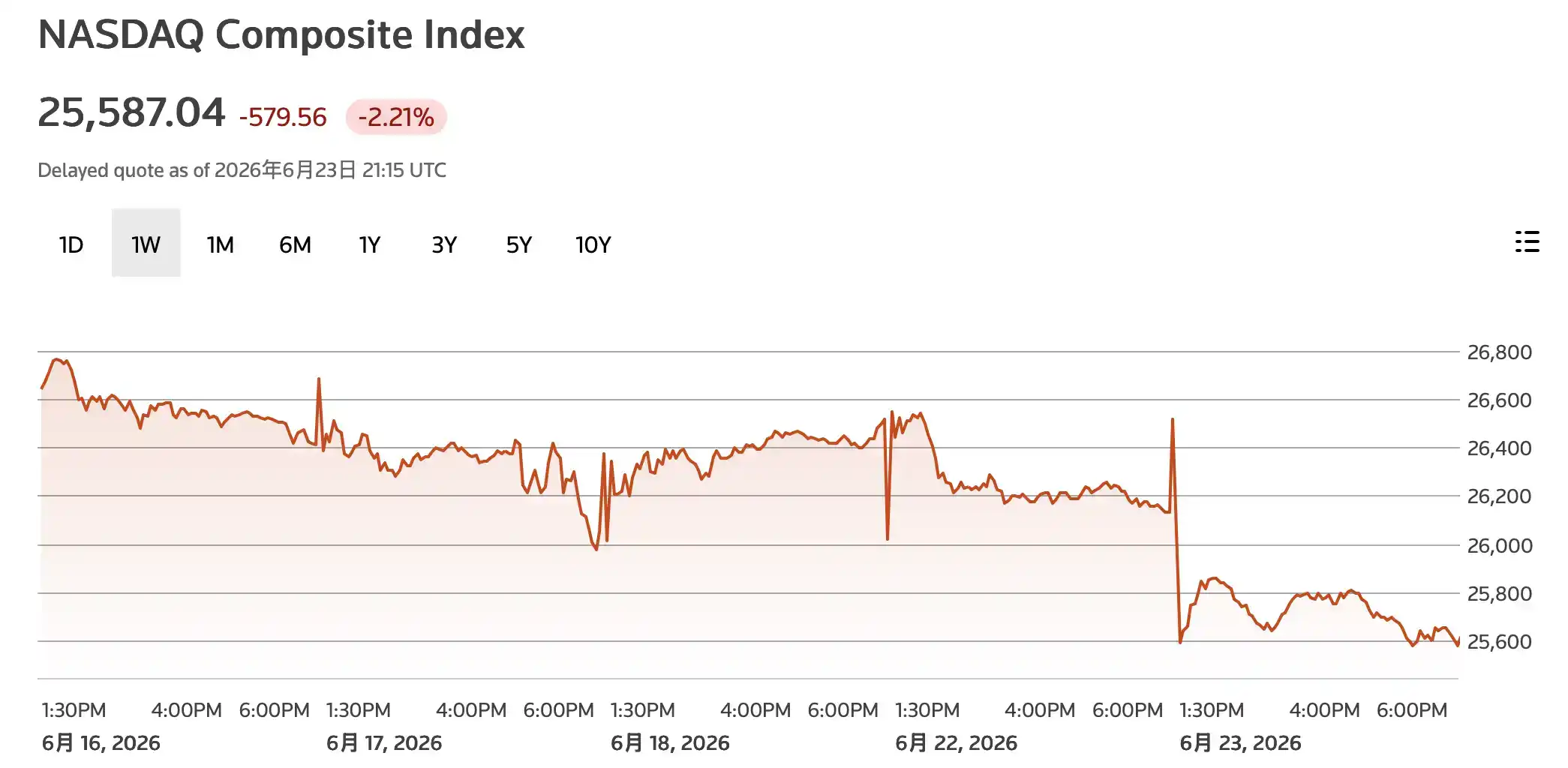
The most direct pressure fell on the hardware supply chain. Market data showed that NVIDIA (NVDA) fell about 4% on Tuesday, with its market cap dropping below $5 trillion. Micron plummeted 13.2%, Qualcomm fell about 8%, and SanDisk and Western Digital also saw significant declines. Weakness in memory, storage, AI chips, and mobile chips together indicates the selling was not confined to a specific subsector.

Asian markets also faced simultaneous pressure. South Korea's KOSPI index fell nearly 10% on June 23rd, with SK Hynix and Samsung Electronics both recording double-digit percentage drops. In recent months, tight supply of HBM and memory chips had been supporting Korean tech stocks, but this time, the market chose to cash in profits first.

AI Hardware Chain Was the First to Be Sold

The sequence of this decline is significant. Investors did not retreat first from software or internet platforms but instead sold off the chip and memory stocks that had benefited most from the AI capital expenditure boom in the past.

NVIDIA remains the core stock of the AI boom. Its GPUs have almost defined this data center expansion cycle and have also become the most concentrated outlet for market risk appetite. Falling below a $5 trillion market cap itself does not change the company's industry position, but from a trading perspective, it is a conspicuous price signal. When both the interest rate and return cycles are being questioned simultaneously, assets with the largest gains and most crowded holdings are often sold first.

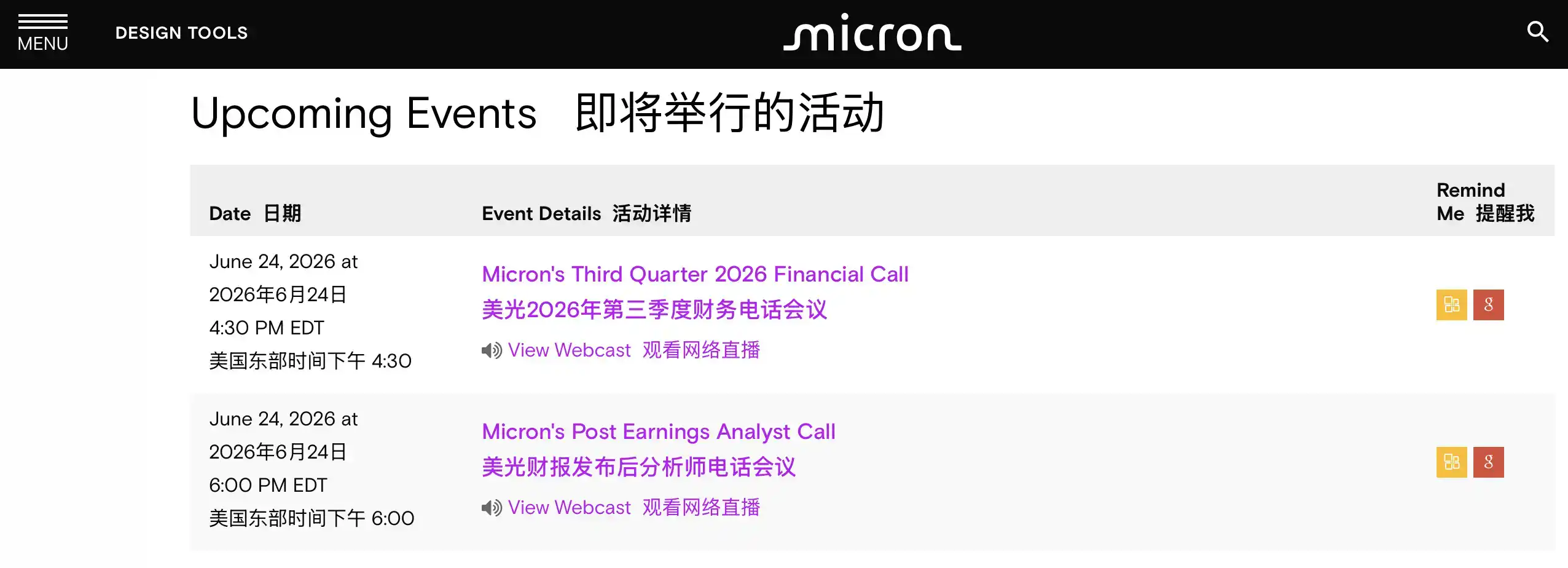
Micron's sharper decline is partly due to its approaching earnings report. The company announced it will report its fiscal 2026 third-quarter results and hold an earnings call on June 24th. The market had previously bet on continued tight demand for high-bandwidth memory driven by AI servers. If the guidance is not strong enough, investors worry the earlier gains lack new earnings catalysts; even if the guidance is strong, it needs to prove that high memory prices and AI demand are not just short-term stockpiling.
The reaction in the South Korean market further amplified these concerns. SK Hynix and Samsung are key companies in the global memory and HBM supply chain. Their double-digit declines indicate this adjustment has spread from U.S. market leaders to the global AI hardware supply chain.

Previously, Broadcom's AI revenue guidance failing to meet the most optimistic expectations had already triggered a round of selling in chip stocks. Tuesday's action was more like a concentrated release of such worries. AI demand still exists, but the market is no longer willing to pay increasingly high prices just for a "huge future."

Turning Hawkish on Rate Hike Expectations, High-Valuation Tech Stocks Under Pressure

The macro trigger came from a shift in Federal Reserve policy expectations.

The Federal Reserve announced that Kevin Warsh was sworn in as its new Chairman on May 22nd. Reuters cited Bank of America forecasts suggesting the Fed could raise rates by 25 basis points each in September, October, and December of 2026, for a cumulative 75 basis points for the year. The reasoning includes labor market resilience and inflation pressures not fully subsiding.

This is particularly unfriendly to tech stocks. Valuations of AI leaders rely on long-term growth expectations. Rising interest rates increase the discounting pressure on future cash flows and make lower-risk assets like U.S. Treasuries attractive again. Recent high U.S. Treasury yields and a noticeable increase in futures market bets on rate hikes this year indicate the market is quickly adjusting its expectations for the policy path.

The market is not suddenly doubting the existence of AI, but is recalculating a more realistic question: If the cost of capital is higher and future profit realization is farther away, what price is one willing to pay for AI assets now?

This is also why the adjustment in chips, memory, and high-growth tech stocks has been so synchronized. They previously benefited together from the combination of "sustained explosion in AI demand" and "interest rates eventually falling." Once one of these pillars loosens, the parts with the biggest gains and highest valuations come under pressure first.

Cloud Providers Are Still Spending, Investors Start Questioning Returns

The other pressure comes from AI capital expenditure itself.

Hyperscale cloud and AI investors like Alphabet, Amazon, and Meta are still maintaining high-intensity data center construction. Over the past year, such spending has been seen by the market as a guarantee of demand for NVIDIA, memory chips, power equipment, and data center assets. As long as cloud providers kept spending, the hardware chain had revenue.

But now the question has become: Can this money ultimately be earned back?

AI model training and inference require massive computing power, electricity, and server investment. Cloud providers can monetize through enterprise customers, advertising tools, developer platforms, and consumer subscriptions, but whether service pricing can cover capital expenditures has not been fully proven. The market is beginning to scrutinize AI product pricing, customer usage intensity, and whether enterprises are willing to pay high fees for generative AI long-term with a more critical eye.

This is also why the "sell the heavy spenders" trade is starting to gain traction. Investors are not just selling chip stocks; they are also becoming more cautious about internet and cloud computing giants that keep increasing their AI budgets. The more aggressive the spending was before, the more likely they are to be questioned about profit margins and free cash flow.

Volatility in high-valuation assets is also amplifying this sentiment. According to an Axios report, SpaceX fell over 16% on Monday after its IPO, losing about $400 billion in market value. It is not the main cause of this chip stock decline, but it shows that strong-narrative, high-valuation assets are facing stricter market scrutiny.

Too Early to Talk About a Bubble Burst, Micron and Inflation Data to Provide Answers

A more accurate description of this adjustment is that after substantial gains, the AI trade is experiencing a concentrated pullback, not that a bubble has definitively burst.

AI hardware demand still exists, and cloud provider capital expenditures have not stopped. The fundamentals of companies like NVIDIA, Micron, and SK Hynix are still closely tied to data center construction, HBM supply, and AI server shipments. The real question is whether current stock prices have already priced in too much good news.

The first validation point is Micron's earnings report. The market will watch three things: whether memory demand driven by AI servers remains strong, whether price increases can be sustained, and whether management's guidance for subsequent quarters is sufficient to support the prior gains. If the report is strong, the chip chain may get a breather; if guidance falls short, selling could continue to spread to more AI supply chain companies.

The second validation point is interest rates. Whether the Fed under Warsh's leadership actually starts hiking in September will depend on inflation, employment, and energy prices. If inflation pressures remain stubborn, growth stock valuations will continue to face pressure; if data cools, the market may again bet on a policy pivot, giving tech stocks room to recover.

The current market divergence is whether this is just a normal profit-taking episode within an AI bull market or the beginning of a shift from "just buy growth" to "must see returns." At the very least, Tuesday's decline shows that while the AI narrative remains powerful, it can no longer alone offset the pressure brought by higher interest rates and a longer profit realization horizon.


Crypto di tendenza

Domande pertinenti

QAccording to the article, what were the two main pressures that caused the recent decline in US AI hardware stocks?

AThe two main pressures were: 1) A sudden rise in expectations for Federal Reserve interest rate hikes, and 2) Investors beginning to question when the substantial AI capital expenditures by cloud providers will translate into clear and sufficient profits.

QWhy did Micron's stock experience a particularly sharp drop of 13.2%, as mentioned in the article?

AMicron's sharp drop was attributed to its upcoming Q3 FY2026 earnings report scheduled for June 24th. The market was anxious, fearing that if the guidance wasn't strong enough, it would lack a new catalyst for its previous gains. Even with strong guidance, there was concern about proving that high memory prices and AI demand weren't just short-term stocking.

QHow did the market behavior in South Korea on June 23rd relate to the broader AI hardware sell-off?

AThe South Korean market mirrored and amplified the sell-off. The KOSPI index fell nearly 10%, with key AI hardware supply chain companies like SK Hynix and Samsung Electronics both seeing double-digit percentage drops. This indicated the sell-off had spread from US leaders to the global AI hardware supply chain, as investors chose to take profits on stocks previously supported by tight HBM and memory chip supply.

QWhat change in investor focus does the article suggest is putting pressure on cloud and internet giants investing heavily in AI?

AThe article suggests investors are shifting focus from just buying growth to demanding visible returns. They are becoming more cautious about companies with aggressive AI budgets, scrutinizing their profit margins and free cash flow, and questioning whether AI service pricing can ultimately cover the massive capital expenditures on compute, power, and servers.

QWhat are the two key upcoming events or data points the article identifies as critical for determining the next direction for AI-related stocks?

AThe two key upcoming events are: 1) Micron's earnings report, which will provide signals about the strength and sustainability of AI-driven memory demand and pricing. 2) Inflation data and the subsequent Federal Reserve policy decisions under Chairman Kevin Warsh, which will determine the path of interest rates and their pressure on growth stock valuations.

Letture associate

Stablecoin Salaries: Why Are They Becoming the First Choice for Cross-Border Workers?

Stablecoin Salaries: Why They're Becoming the Top Choice for Global Remote Workers The traditional global salary system carries hidden exchange rate risks for freelancers in countries like India, Argentina, and Turkey who earn in USD but spend in local currencies. When salaries are instantly converted to local currency, workers lose purchasing power if that currency depreciates against the dollar. For instance, an Indian designer converting a $2000 monthly salary to rupees lost over 10% in purchasing power last year due to the rupee's decline. Holding even a portion of income in USD or USD-pegged stablecoins can preserve value. Stablecoins offer a solution by breaking down barriers to holding dollars. Opening foreign USD bank accounts is difficult, and international wire transfers incur high fees (averaging 6.5%) and delays. In contrast, stablecoin transfers are fast and low-cost. Furthermore, many countries with high inflation and depreciating currencies restrict citizens' access to foreign currency. Self-custody stablecoin wallets enable workers to hold dollar-equivalent assets without needing bank approval, bypassing these limits. These wallets integrate multiple functions: they allow users to convert only what's needed for daily expenses into local currency, keep the remainder in stablecoins, connect to on-chain lending or yield products, and even link to payment cards for direct spending. While challenges remain—such as the lack of deposit insurance and evolving regulatory frameworks—the trend is clear. Reports indicate a growing preference for USD or stablecoin payments among freelancers in high-inflation countries. This shift represents a fundamental restructuring of salary functions: payment currency, asset storage, yield generation, spending, and cross-border flow. It offers the freedom and flexibility that are core to money's purpose, signaling a profound change in the global financial landscape.

Foresight News4 min fa

Stablecoin Salaries: Why Are They Becoming the First Choice for Cross-Border Workers?

Foresight News4 min fa

Don't Just Focus on Layoffs, The New Structure of the Ethereum Foundation is More Worthy of Appreciation

The Ethereum Foundation (EF) has undergone a significant organizational restructuring, with the most notable change being a strategic refocusing of its priorities rather than just a 20% staff reduction (approximately 54 people). The new structure clearly prioritizes the Protocol and Access layers, which now comprise the largest teams (57 and 34 people, respectively). This signals EF's intent to concentrate its core resources on fundamental, hard-to-outsource aspects of Ethereum: protocol evolution, security, privacy, client development, and the foundational access layer. Key areas within the Protocol layer, led by an architecture group including Vitalik Buterin and Justin Drake, receive heightened emphasis. These include post-quantum security, zkEVM, formal verification, and long-term roadmap development ("Strawmap"). This reflects a shift towards tackling complex, interdependent challenges like scalability, privacy, and future-proofing the protocol, potentially moving from a pure "redundant security" multi-client model towards more specialized clients aided by AI-assisted formal verification. Financially, EF's budget is being reduced by approximately 40%. The goal is to transition from spending about 15% of its remaining funds annually to a more sustainable 5% rate, akin to a long-term endowment, ensuring its longevity. Concurrently, the restructuring involves pushing certain responsibilities—such as application development, adoption, and ecosystem coordination—to external organizations like EthLabs, the Ethereum Apps Guild, and others. This "multi-node" model aims to increase ecosystem resilience by decentralizing functions beyond the EF, though it introduces new coordination challenges. In essence, the reorganization represents EF consciously narrowing its scope to focus on the hardest, most critical protocol-level problems while fostering a more distributed and sustainable ecosystem structure for Ethereum's future growth.

Foresight News32 min fa

Don't Just Focus on Layoffs, The New Structure of the Ethereum Foundation is More Worthy of Appreciation

Foresight News32 min fa

Report Analysis: What Is Coherent Planning as CPO Booms?

Title: Report Interpretation: What Moves Is Coherent Making Amid the CPO Boom? Summary: JP Morgan analyst Samik Chatterjee reiterates an Overweight rating on Coherent (COHR), citing undervalued growth potential across three core areas: data center optical transceivers, co-packaged optics (CPO) chips, and industrial lasers/thermal management. COHR's 1.6T data center transceivers are in high demand, with pricing remaining firm. The rise of CPO is seen not as a threat but as a catalyst, creating higher demand for sophisticated optical components, an area where COHR holds a competitive edge with its comprehensive portfolio (lasers, isolators, VCSELs, thermoelectric coolers). Each CPO chip offers significantly greater revenue potential than traditional transceivers. Furthermore, its Optical Circuit Switch (OCS) technology targets a potential $4B market with reliability and power advantages. The company is expanding its InP (Indium Phosphide) device capacity fourfold within two years, securing substrate supply and transitioning to more cost-effective 6-inch wafers. As one of only two major suppliers of high-quality pump lasers—currently in severe shortage—COHR can now move up the value chain from components to complete line cards/systems, boosting ASP over tenfold. Gross margin targets (>42%) may be revised upward due to high-end product premiums, cost improvements from the wafer transition, and contributions from new high-margin products like CPO and OCS. Its efficient thermadite thermal material also offers long-term growth. Industrial segment revenue grows at a steady 5-10%, supported by semiconductor equipment orders. Changes in Apple's Face ID protocol present a re-competition opportunity for 3D sensing. Overall, Coherent is positioned as a key infrastructure provider, with AI-driven compute demand fueling the need for high-speed optical interconnectivity. Growth from CPO/OCS, stable industrial performance, and margin improvement support the bullish thesis. *Disclaimer: This summary interprets a third-party analyst report from JP Morgan. It does not constitute investment advice.*

marsbit55 min fa

Report Analysis: What Is Coherent Planning as CPO Booms?

marsbit55 min fa

After Laying Off 20% of Staff, What Are the Key Points of EF's New Structure?

Following the completion of a months-long organizational restructuring, the Ethereum Foundation (EF) announced a 20% workforce reduction (approximately 54 employees) on June 23rd. It reorganized its teams into five new core clusters: Protocol, Access, User, Community, and Institutional (plus Operations/Management support units). Officially, this move implements the EF's 2026 Mandate and 2025 Treasury Management Policy, aiming to create a more focused and "self-sovereign" organization. The restructuring prioritizes the CROPS principles—Censorship Resistance, Openness & Freedom, Privacy, and Security—as foundational organizational tenets. The Protocol cluster will focus on core protocol R&D, including MEV reduction and zkEVM. The Access cluster emphasizes preserving user "zero option" for non-custodial, permissionless interaction. The User, Community, and Institutional clusters will manage external engagement, with the latter handling institutional and regulatory matters. While offering enhanced severance and transition support for affected employees, the EF did not disclose budget allocations or specific KPIs for the new clusters. This has led to market uncertainty about the impact on project funding and development priorities. Analysts note the announcement's positive tone of mission focus contrasts with a backdrop of recent EF leadership changes and broader ecosystem pressures. The true impact—whether this signifies strategic realignment or reactive contraction—will become clearer as the new structure's resource allocation and project prioritization are revealed in the coming months.

marsbit1 h fa

After Laying Off 20% of Staff, What Are the Key Points of EF's New Structure?

marsbit1 h fa

Trading

Spot
Futures

Articoli Popolari

Come comprare CHIP

Benvenuto in HTX.com! Abbiamo reso l'acquisto di USD.AI (CHIP) semplice e conveniente. Segui la nostra guida passo passo per intraprendere il tuo viaggio nel mondo delle criptovalute.Step 1: Crea il tuo Account HTXUsa la tua email o numero di telefono per registrarti il tuo account gratuito su HTX. Vivi un'esperienza facile e sblocca tutte le funzionalità,Crea il mio accountStep 2: Vai in Acquista crypto e seleziona il tuo metodo di pagamentoCarta di credito/debito: utilizza la tua Visa o Mastercard per acquistare immediatamente USD.AICHIP.Bilancio: Usa i fondi dal bilancio del tuo account HTX per fare trading senza problemi.Terze parti: abbiamo aggiunto metodi di pagamento molto utilizzati come Google Pay e Apple Pay per maggiore comodità.P2P: Fai trading direttamente con altri utenti HTX.Over-the-Counter (OTC): Offriamo servizi su misura e tassi di cambio competitivi per i trader.Step 3: Conserva USD.AI (CHIP)Dopo aver acquistato USD.AI (CHIP), conserva nel tuo account HTX. In alternativa, puoi inviare tramite trasferimento blockchain o scambiare per altre criptovalute.Step 4: Scambia USD.AI (CHIP)Scambia facilmente USD.AI (CHIP) nel mercato spot di HTX. Accedi al tuo account, seleziona la tua coppia di trading, esegui le tue operazioni e monitora in tempo reale. Offriamo un'esperienza user-friendly sia per chi ha appena iniziato che per i trader più esperti.

293 Totale visualizzazioniPubblicato il 2026.04.21Aggiornato il 2026.06.02

Come comprare CHIP

Discussioni

Benvenuto nella Community HTX. Qui puoi rimanere informato sugli ultimi sviluppi della piattaforma e accedere ad approfondimenti esperti sul mercato. Le opinioni degli utenti sul prezzo di CHIP CHIP sono presentate come di seguito.

活动图片