TRUMP holds $1.50 – Breakout setup or another Q3 bull trap?

ambcryptoPubblicato 2026-07-20Pubblicato ultima volta 2026-07-20

Introduzione

The TRUMP memecoin is consolidating around $1.50 with rising Open Interest (OI), hinting at a potential breakout setup as bulls buy the dip. However, the broader context is bearish. TRUMP is down over 5.3% in Q3, underperforming Bitcoin and continuing a streak of quarterly losses. Bullish catalysts are fading, including declining odds for the pro-crypto CLARITY Act. With the wider memecoin sector struggling and speculative demand cooling, TRUMP's recent bounce may be a short-term rotation rather than a reversal. A break below $1.50 support could confirm a bull trap, leading to a deeper Q3 breakdown.

With bullish catalysts fading, is TRUMP’s bearish Q3 trend only just beginning?

Zooming in, the setup looks less straightforward. The Official Trump memecoin has been holding a tight consolidation range around the $1.5 level, with nearly two weeks of steady upside, hinting that a potential accumulation zone could be forming as bulls continue to buy the dip.

TRUMP’s rising Open Interest (OI) is adding another bullish angle. As the chart below shows, Open Interest has climbed back toward early July levels, approaching the $100 million mark.

Interestingly, nearly $10 million in OI has been added this week alone, matching the token’s tight range consolidation.
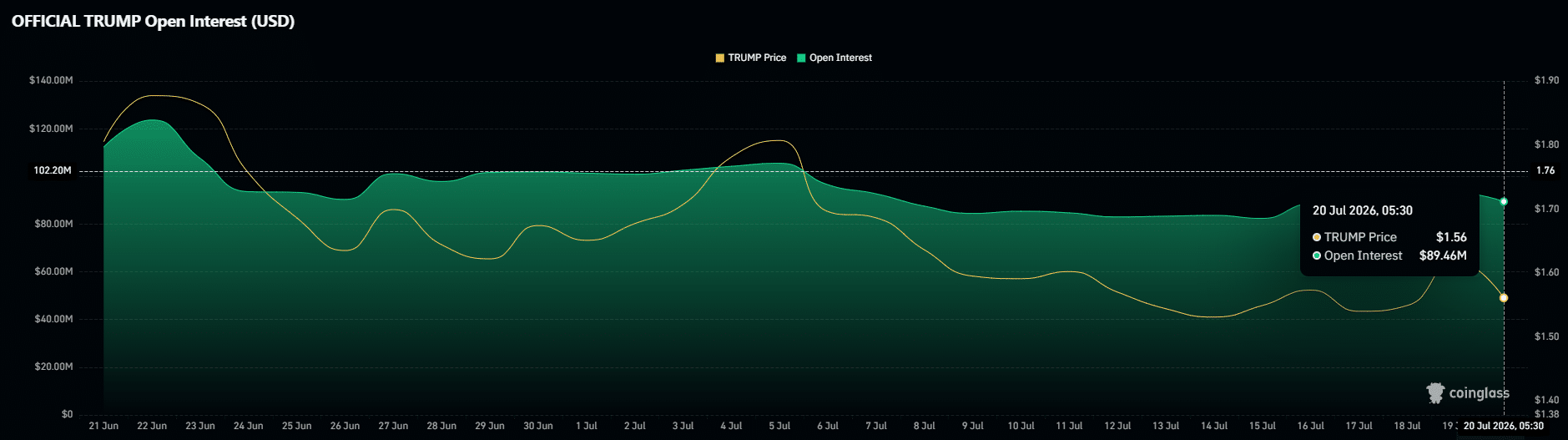
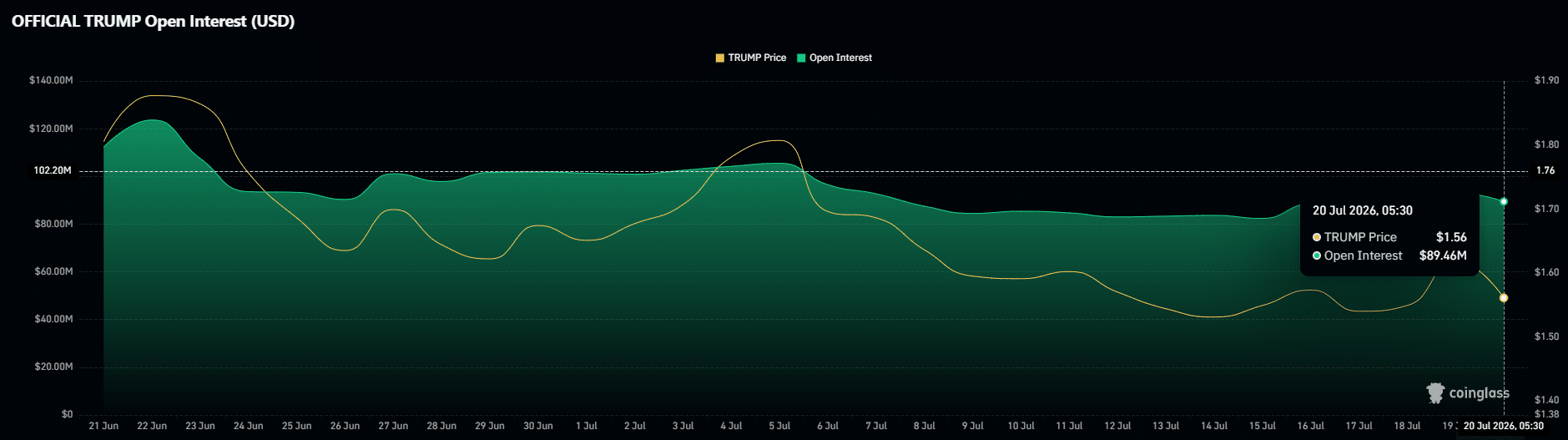
Source: CoinGlass

Technically, rising OI when the price is compressed often signals that traders are positioning for a big move.

Zooming out, though, the broader setup starts to look weaker. TRUMP is currently down over 5.3% in Q3, which may seem minor at first glance.

But compared with Bitcoin’s nearly 10% during the same period and TRUMP’s streak of six straight quarterly losses, the risk of another Q3 breakdown cannot be ignored.

This is especially notable as one of Official Trump’s [TRUMP] major bullish catalysts begins to lose momentum. So, with sentiment shifting, is the current 5% decline just the start of a larger Q3 breakdown?

TRUMP breakout hopes meet fading catalysts

TRUMP’s technical weakness is becoming a bearish outliner.

Looking across the memecoin sector, the overall setup looks weak, with total market cap down over 15% in the past 30 days. This shows that despite the broader macro FUD, investor appetite for speculative assets continues to cool.

However, a few names are still bucking the trend and attracting fresh capital.

Take Pepe [PEPE], for example, which has gained over 20% in Q3, showing that selective demand still exists even as the broader memecoin market struggles. Unfortunately for TRUMP, it has yet to join that group of outperformers.
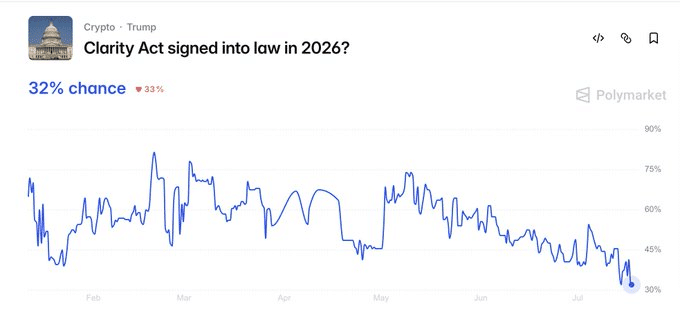
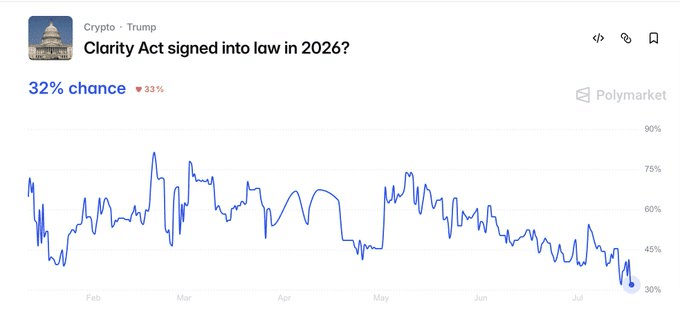
Source: Polymarket

Adding to the pressure, recent Polymarket odds show the chances of the CLARITY Act becoming law by the end of 2026 have fallen to a record low of 32%, weakening a major bullish catalyst.

Against this backdrop, TRUMP’s quarterly weakness looks like a broader trend issue.

With the broader memecoin sector struggling, momentum around the CLARITY Act fading, and speculative demand becoming more selective, TRUMP is failing to attract consistent capital inflows.

This makes the recent bounce look more like a short-term rotation rather than a confirmed reversal, putting the rising OI under the microscope.

If this setup holds and TRUMP breaks below the $1.5 support level, the recent recovery could be a bull trap, raising the risk of a deeper Q3 breakdown.


Final Summary

  • TRUMP is holding near $1.50, with rising Open Interest suggesting traders are preparing for a bigger move.
  • With memecoin demand cooling and CLARITY Act hopes fading, TRUMP’s recent bounce could turn into a bull trap.


Domande pertinenti

QWhat are the two main possibilities for TRUMP's price action suggested by the article's title?

AThe article's title suggests TRUMP's price holding at $1.50 could either be a breakout setup or a Q3 bull trap.

QWhat are the two conflicting signals mentioned regarding TRUMP's current price setup?

AThe conflicting signals are: 1) A tight consolidation range and rising Open Interest hinting at a potential accumulation/breakout. 2) Broader market weakness, fading catalysts, and the token's poor quarterly performance suggesting a potential breakdown.

QAccording to the article, what is the primary bullish catalyst for TRUMP that is losing momentum?

AThe primary bullish catalyst losing momentum is the CLARITY Act, as Polymarket odds for it becoming law by end-2026 have fallen to a record low of 32%.

QHow does TRUMP's Q3 performance compare to Bitcoin's and the broader memecoin sector?

ATRUMP is down over 5.3% in Q3, underperforming Bitcoin's nearly 10% gain in the same period. It also contrasts with the broader memecoin sector's ~15% drop and specific outperformers like PEPE, which gained over 20% in Q3.

QWhat does the rising Open Interest (OI) combined with a compressed price range typically signal, according to the article?

ATechnically, rising Open Interest when the price is compressed often signals that traders are positioning for a big move.

Letture associate

L2 'Recalibration': When L1 Becomes Its Own Rollup, What Is Ethereum's Endgame?

The article discusses the evolving relationship between Ethereum's Layer 1 (L1) and Layer 2 (L2) solutions, moving beyond the initial "L2 for scaling" model. As Ethereum L1 itself scales (increasing Gas Limit, statelessness, zkEVM), the unique value proposition of L2s shifts from merely providing cheap execution to offering differentiated features like application-specific optimization, privacy, and flexible governance. The piece explores three key themes: 1. **L2's New Role:** L2s are transitioning from a pure scaling technology to a spectrum of execution environments with varying degrees of security inheritance from Ethereum L1. 2. **Interoperability as State Trust:** Solving L2 fragmentation is less about cross-chain bridges and more about enabling faster, trust-minimized state verification between environments. This involves initiatives like faster L1 finality, intent-based architectures (Open Intents Framework), and native account abstraction. 3. **Blurring Layers:** With the potential integration of zk-proofs into L1 validation (making L1 akin to its own "Rollup") and the concept of "Native Rollups," the rigid boundary between L1 and L2 may fade. The future could be a unified system with multiple execution domains (for DeFi, gaming, privacy, etc.) sharing a common security, settlement, and state framework. In conclusion, Ethereum's goal is not to abandon L2s or re-centralize everything on L1, but to re-integrate the fragmented user experience—liquidity, accounts, applications—while preserving the scaling benefits of a multi-environment ecosystem. The endgame is a cohesive "one chain" feeling for users, powered by diverse but securely interconnected execution layers.

marsbit8 min fa

L2 'Recalibration': When L1 Becomes Its Own Rollup, What Is Ethereum's Endgame?

marsbit8 min fa

The Encryption Bill Clarity's Challenge: A Thorny Path of Bipartisan Compromise in the U.S.

U.S. lawmakers are attempting to advance the Clarity Act, a significant crypto market structure bill, but its path is fraught with partisan hurdles. The process has been rocky since January, when a prior bipartisan deal in the Senate Banking Committee was upended. A key compromise in May on "yield" issues allowed the bill to move forward in committee, but only with the conditional support of two Democratic senators, Angela Alsobrooks and Ruben Gallego. They emphasized that their final vote depends on reaching an agreement on ethics provisions for elected officials. Ultimately, the Senate Agriculture Committee passed its version along party lines without Democratic support. As Republicans push for a full Senate vote in July, the demand for strong ethics language has expanded beyond Democrats. Additional controversies surround provisions related to yields (aligning some Republicans with large banks) and developer protections (opposed by enforcement agencies). Core concerns about illicit finance and consumer protection remain central to the debate. Despite consensus on the need for legislation, achieving the necessary bipartisan compromise is proving difficult. While momentum exists—including recent meetings between senators and White House officials—a reconciled bill text faces skepticism. Senator Gallego has stated that without ethics terms acceptable to Democrats, they will not provide the needed votes. The immediate goals for the crypto community in Congress are unclear: a symbolic Senate vote before the August recess, eventual passage into law by 2026, or forging a final compromise framework. The arduous, vote-by-vote effort to build bipartisan support continues, mirroring the traditional legislative grind the industry must now navigate.

Foresight News59 min fa

The Encryption Bill Clarity's Challenge: A Thorny Path of Bipartisan Compromise in the U.S.

Foresight News59 min fa

Trading

Spot
活动图片