Survey finds 6 in 10 of Asia’s rich plan to ramp up crypto buying in 2026

cointelegraphPubblicato 2025-12-11Pubblicato ultima volta 2025-12-11

Introduzione

A new survey by Sygnum reveals that over 60% of high-net-worth individuals (HNWIs) in Asia plan to increase their cryptocurrency investments in 2026, reflecting a strong bullish outlook for digital assets over the next two to five years. The study, which surveyed 270 HNWIs and professional investors across ten APAC countries, found that 87% already hold crypto, with an average portfolio allocation of around 17%. Notably, 90% view digital assets as important for long-term wealth preservation rather than pure speculation. The shift underscores growing institutional acceptance, with most investors expecting traditional wealth managers to offer regulated crypto services. Key motivations include portfolio diversification and intergenerational wealth planning.

High-net-worth individuals in the Asia Pacific region are becoming increasingly bullish on crypto assets, with more than half planning to increase their portfolio exposure, according to a new survey.

It found that 6 in 10 of the surveyed Asian high-net-worth individuals (HNWIs) are prepared to increase their crypto allocations based on a strong two- to five-year outlook, according to Sygnum’s APAC HNWI Report 2025.

The results of the survey, released on Thursday, revealed that Asian private wealth has “moved decisively into digital assets,” and is now expecting traditional wealth managers to catch up.

The findings also revealed that an overwhelming 90% of surveyed HNWIs view digital assets as “important for long-term wealth preservation and legacy planning, not purely speculation.”

“Digital assets are now firmly embedded within APAC’s private wealth ecosystem,” said Gerald Goh, Sygnum co-founder and APAC CEO.

“Despite near-term macro uncertainty, we continue to see accelerating adoption driven by strategic portfolio diversification, intergenerational wealth planning, and demand for institutional-grade products.”

This represents a fundamental shift from crypto as a speculative asset to an institutional wealth management product.

More than half of portfolios hold over 10% crypto

The survey revealed that 87% of Asian HNWIs already hold crypto, and around half have an allocation of more than 10%. The average portfolio allocation is around 17%.

87% of investors also said they would ask their private bank or adviser to add crypto services if offered through regulated partners.

Meanwhile, 80% of those actively investing reported holdings in blockchain protocol tokens, such as Bitcoin (BTC), Ether (ETH) and Solana (SOL). The most common reason for investing, according to 56% of respondents, was portfolio diversification.
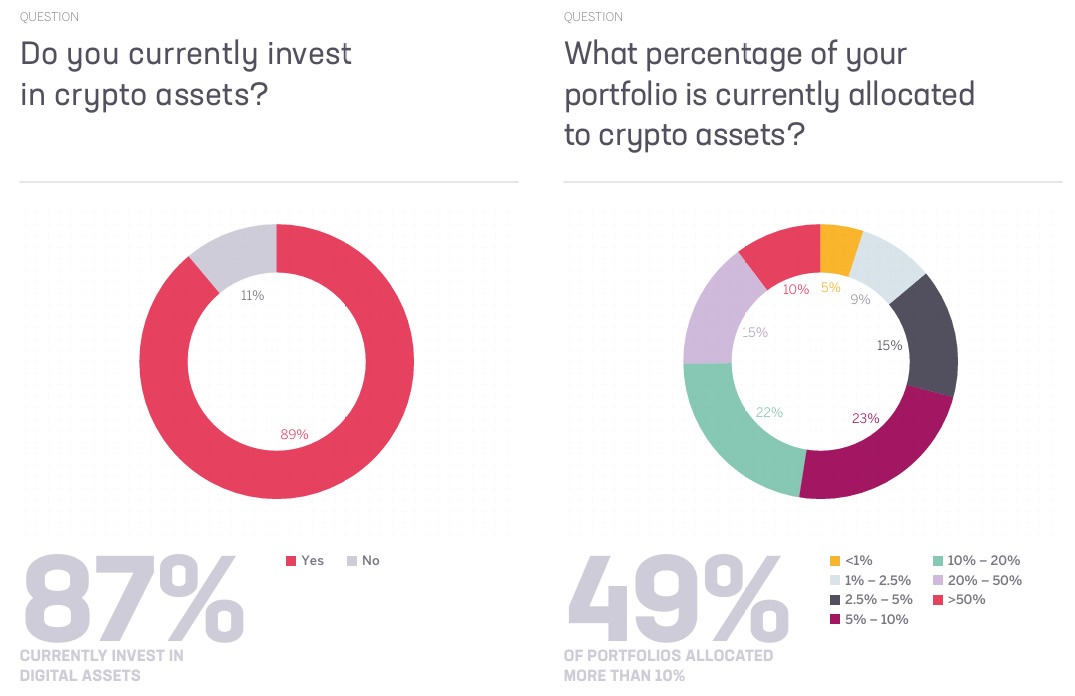
Nearly half of the portfolios hold more than 10% in crypto. Source: Sygnum


“APAC is rapidly becoming one of the world’s fastest-growing and most important digital asset gateways, and we expect this momentum to strengthen further into 2026,” Goh said.

Related: Ripple’s big Singapore win: What the expanded license allows now

The survey polled 270 HNWIs with more than $1 million in investable assets and professional investors with over ten years of experience across ten APAC countries, mostly in Singapore, but including Hong Kong, Indonesia, South Korea and Thailand.

Magazine: XRP’s ‘now or never’ moment, Kalshi taps Solana: Hodler’s Digest

Letture associate

Bitcoin Price Surpasses Open Interest Following FOMC

Following Bitcoin Price Surpasses Open Interest After FOMC Following the FOMC announcement, Bitcoin's price demonstrated the instability of leverage in the current market cycle, fluctuating between $92,000 and $89,500. This volatility liquidated billions in open positions on major derivatives markets. Despite the extreme swings, capital continued flowing into high-conviction crypto projects like Bitcoin Hyper ($HYPER), a Bitcoin Layer-2 solution combining Solana-level transaction speeds with Bitcoin's security. U.S. traders added over $38 million in new Bitcoin exposure ahead of key macroeconomic data. The sentiment remains cautiously optimistic, with analysts viewing the $90,000 level as a critical psychological and structural support. A sustained break above $92,000 could open a path toward the $100,000–$110,000 resistance range. Post-FOMC, the market saw a healthy reset with open interest dropping and funding rates normalizing. U.S. institutional flows via ETFs remained strong, indicating long-term investor confidence. Analysts from Bernstein project a potential long-term move to $200,000, while others like Matrixport forecast a mid-cycle consolidation around $120,000–$150,000. Concurrently, Bitcoin Hyper is gaining attention as an ambitious L2 project, having raised over $29 million in its presale. It aims to solve Bitcoin's scalability issues by enabling seamless cross-chain movement with instant, low-fee transactions. Its architecture and staking rewards position it as a high-beta play on Bitcoin's adoption, attracting capital shifting from speculative altcoins to core infrastructure projects.

bitcoinist9 min fa

Bitcoin Price Surpasses Open Interest Following FOMC

bitcoinist9 min fa

Trading

Spot
Futures
活动图片