Hands-on with Hunyuan Hy3 Preview: Tencent's AI, Finally Competitive?

marsbitPubblicato 2026-04-26Pubblicato ultima volta 2026-04-26

Introduzione

Tencent's Hunyuan AI team has released its latest language model, Hy3 preview, marking a significant step forward for the company's AI capabilities. With 295B total parameters and support for 256K context length, the model employs a mixture-of-experts architecture. It shows improvements in complex logic, instruction following, contextual learning, code generation, and agent task execution. In testing, Hy3 preview demonstrated strong performance in multi-step logical reasoning but showed occasional instability in identifying traps in trick questions. It performed well in extracting key information from disordered meeting transcripts and accurately followed new linguistic rules. As an AI agent, it successfully built functional applications like a Snake game and generated data analysis dashboards, though it sometimes fell short in fully completing complex open-ended tasks. In natural language use, it produced coherent and stylistically appropriate narratives with reduced “AI-like” tone. Priced competitively, Hy3 preview is already integrated into Tencent’s key products, including Tencent Cloud and WorkBuddy. While not leading in every benchmark, it represents a solid, practical model that signals Tencent’s renewed momentum in AI development.

By AIX Finance, Author: Lei Jing, Editor: Jin Yufan

The AI circle has been active recently, and Tencent's Hunyuan Hy3 preview has also officially debuted.

On April 23, Tencent Hunyuan officially released and open-sourced the new generation language model Hy3 preview. According to the official website introduction, this model adopts a mixture-of-experts architecture that integrates fast and slow thinking, with a total of 295B parameters, 21B activated parameters, and supports a maximum context length of 256K. This is hailed by the official as the most intelligent Hunyuan model to date.

Three months ago, Yao Shunyu joined Tencent with experience in the ReAct framework and实战经验 from OpenAI, leading the reconstruction of the pre-training and reinforcement learning infrastructure. Hy3 preview is the first report card after this rebuild. The official stated that the model has achieved significant improvements in complex reasoning, instruction following, in-context learning, code generation, and agent capabilities.

Judging from the data and evaluation results disclosed by the official, Hy3 preview demonstrates impressive strength in multiple basic tests. Although it may not reach the industry's top level in all dimensions, it is sufficient to meet practical needs in most scenarios.

In terms of actual operational efficiency and stability, Hy3 preview has also made breakthroughs. Official data shows that this model reduces first token latency by 54% and end-to-end duration by 47%, significantly improving response speed. At the same time, task success rates have also improved, and it can now stably drive complex Agent workflows, covering various business scenarios such as document processing and data analysis.

Furthermore, its inference cost has decreased. On Tencent Cloud API, input costs are as low as 1.2 RMB per million Tokens, and personal packages start at 28 RMB per month, placing it in the lowest price tier among models of similar size. Currently, Hy3 preview has been launched in core Tencent products such as Tencent Cloud, Yuanbao, and WorkBuddy.

Next, we will test the performance of the Hunyuan large model in practical applications based on the four directions mentioned by the official.

Reasoning Ability: Can Decompose Complex Logic, But Trap Identification Needs Strengthening

We first tested the model's reasoning ability. Logic reasoning questions are a type netizens love to use to test a model's "IQ". In this segment, we first tested with the classic "car wash problem" within Yuanbao.

In this classic trick question, Hy3 preview initially did not answer correctly. It provided a clear and logical reasoning to suggest walking, overlooking the key point which was "washing the car". Only after being reminded again about the need to wash the car did it give the correct answer.

It is worth noting that in tests by other netizens, Hy3 preview has been able to answer correctly directly, indicating that its trap identification ability lacks stability.

Let's try another brain teaser. In this problem, one needs to understand the real-world logic that the eggs that were broken, fried, and eaten are the same batch. But Hy3 preview did not realize this; it thought the fried eggs still existed and could be eaten.

Subsequently, we increased the difficulty and tested it with a logic problem that has a more complex derivation process. The difficulty of this question lies in the lack of direct positioning information; one must rely on implicit conditions to eliminate possibilities, making it easy to miss key information.
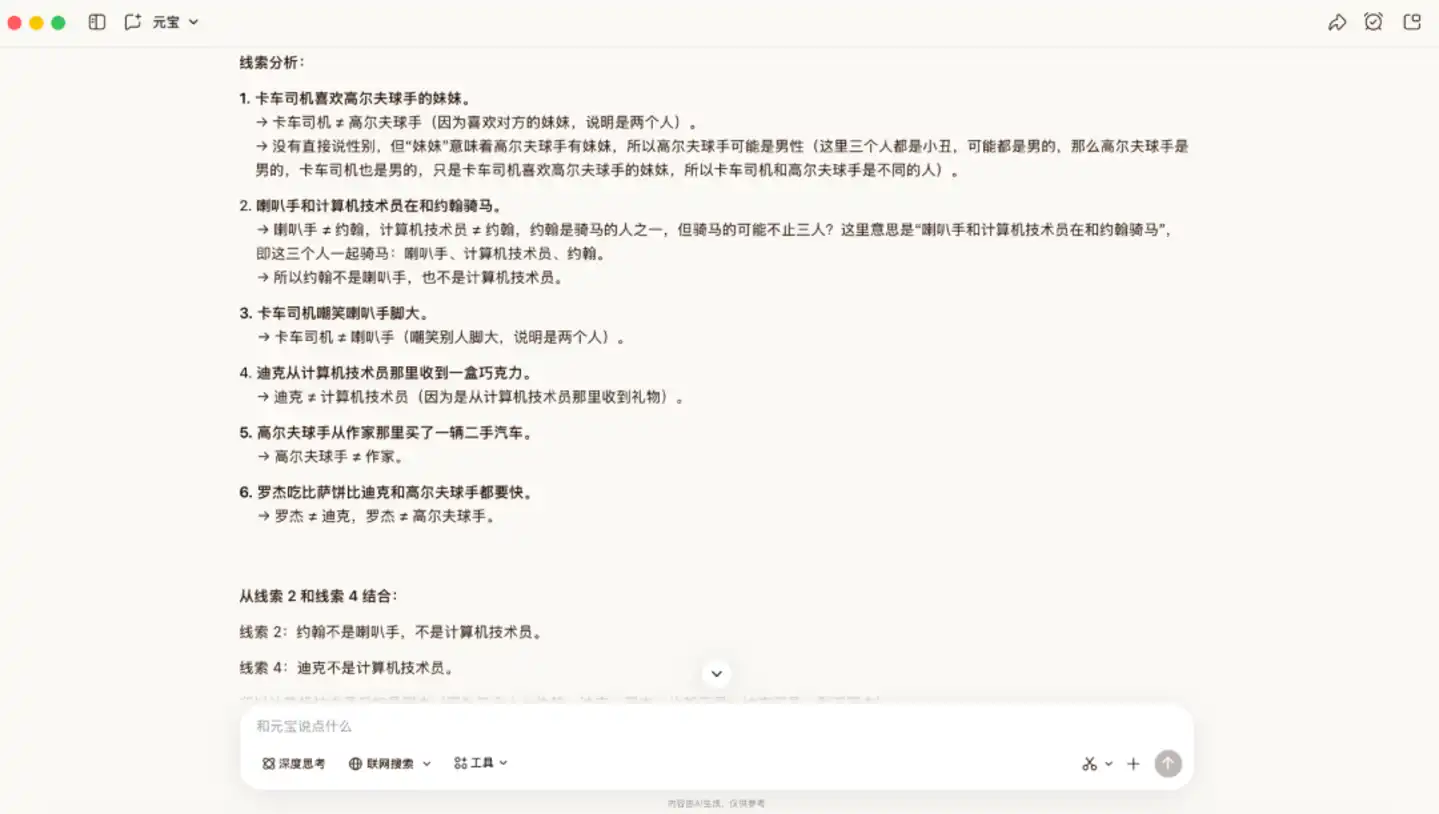
In this scenario, Hy3 preview provided the correct answer. It first broke down the clues one by one, extracted the mutually exclusive relationships between people and professions, and then locked identities through elimination. Next, it sequentially determined the归属 of some positions and then gradually filled in the rest结合 the rules.

Overall, Hy3 preview has strong conventional rational logic deduction abilities, but its reverse thinking, trap identification, and flexible thinking in life scenarios are still insufficient. When facing tricky brain teasers, it tends to be limited by literal conventional logic,忽略 the traps in the questions and real-world scenarios, performing poorly. However, when facing complex logic reasoning problems with hidden conditions and繁琐 derivations, it can拆解 clues and reason step by step, demonstrating solid logical analysis and step-by-step deduction capabilities.

In-Context Learning and Instruction Following: Extracting Information, Stable Performance Under Interference Scenarios

This segment tests two basic skills of the model: whether it can grasp the true instruction, and whether it can quickly understand the instruction.

Tencent provided five scenarios in its official blog, including project planning, travel summaries, and reading notes. We selected two scenarios for practical testing.

Scenario 1: Information extraction from messy meeting minutes

We provided a混乱 transcript of a meeting recording,混杂 with interruptions, digressions, repeated corrections, etc., and asked it to extract three types of information.
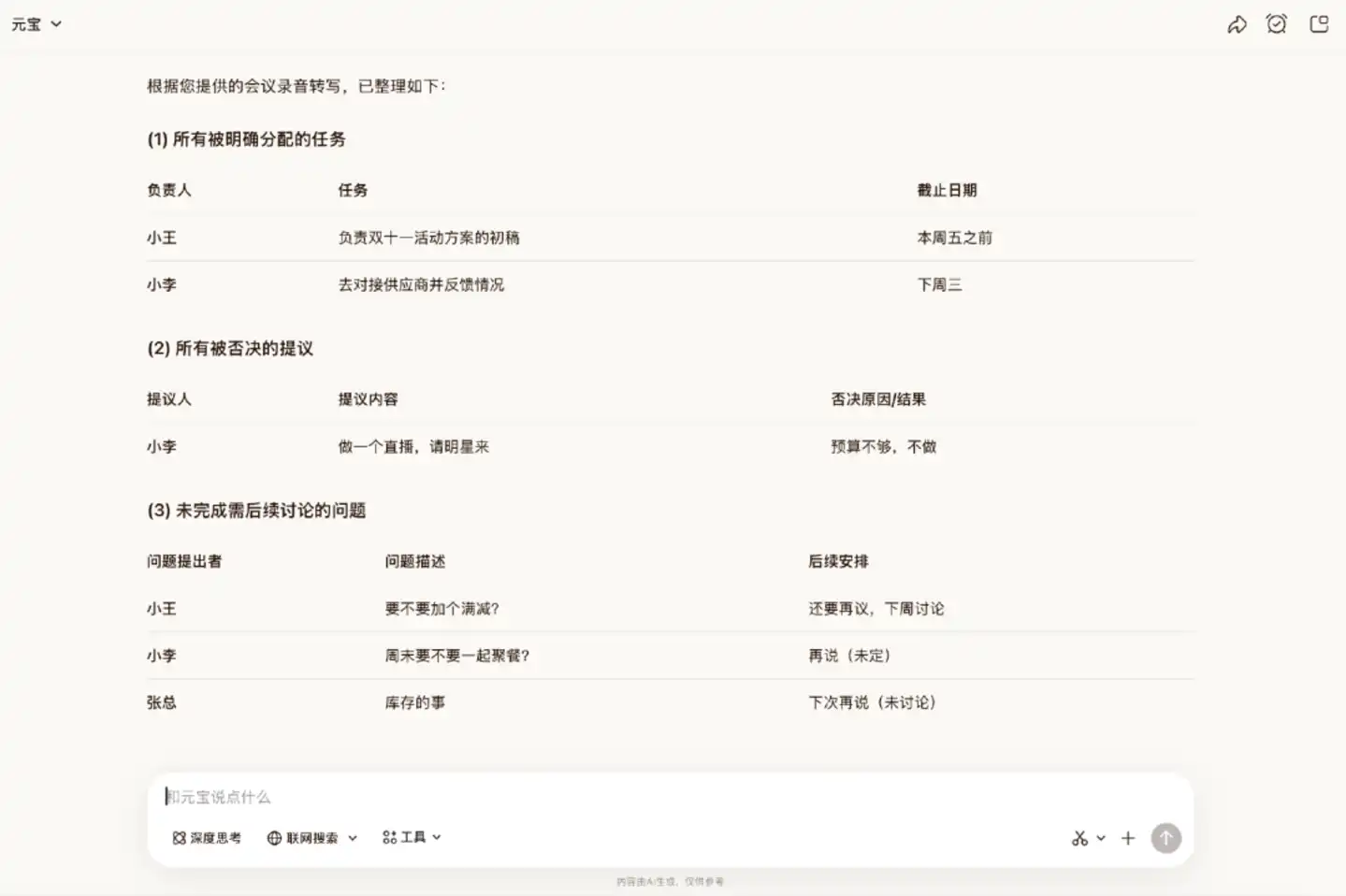
The answer given by Hy3 preview accurately listed these three types of information, demonstrating good information extraction capabilities.

Scenario 2: Understanding and following new language rules

We created a simple language, demonstrated the rules to it through examples, and gave it three new sentences to translate.
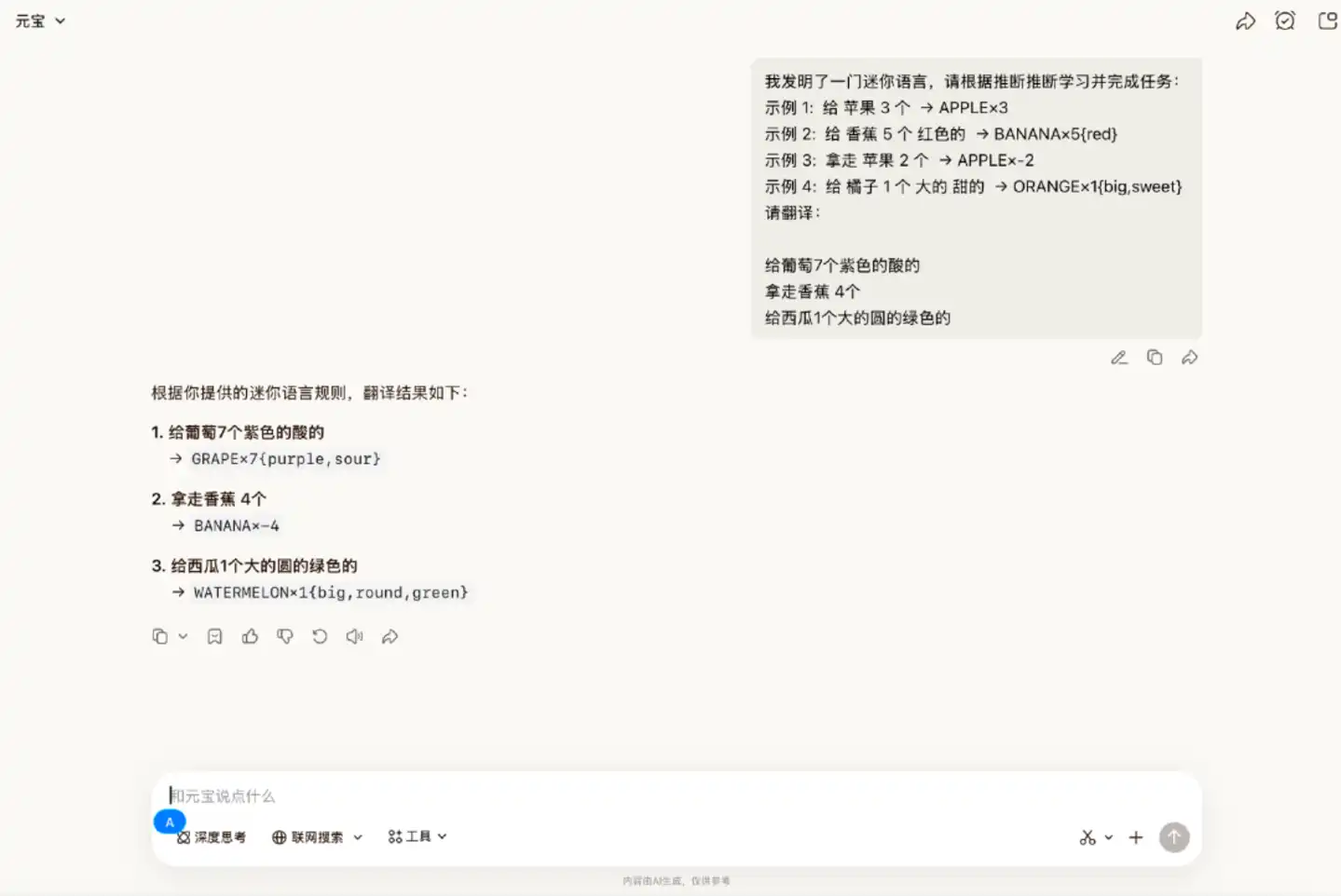
In this round, Hy3 preview was able to accurately complete the relevant requirements, executing every detail according to the rules.

Overall, Hy3 preview can understand instruction requirements and effectively排除干扰信息, making it suitable for practical scenarios with繁杂 information interference and information extraction.

Code and Agent: Tool Calling is Relatively Mature, Task Delivery Completeness is Lacking

Code ability and agent ability are important dimensions for evaluating whether an AI assistant is useful. This tests both the model's depth of understanding of user needs and the Agent's ability to plan, call tools, and close the loop in multi-step tasks. In this segment, we designed three tasks for WorkBuddy (Tencent's AI assistant).

For the first task, we asked WorkBuddy to crawl the air quality data of five cities from the past year and generate an analysis report based on this data.
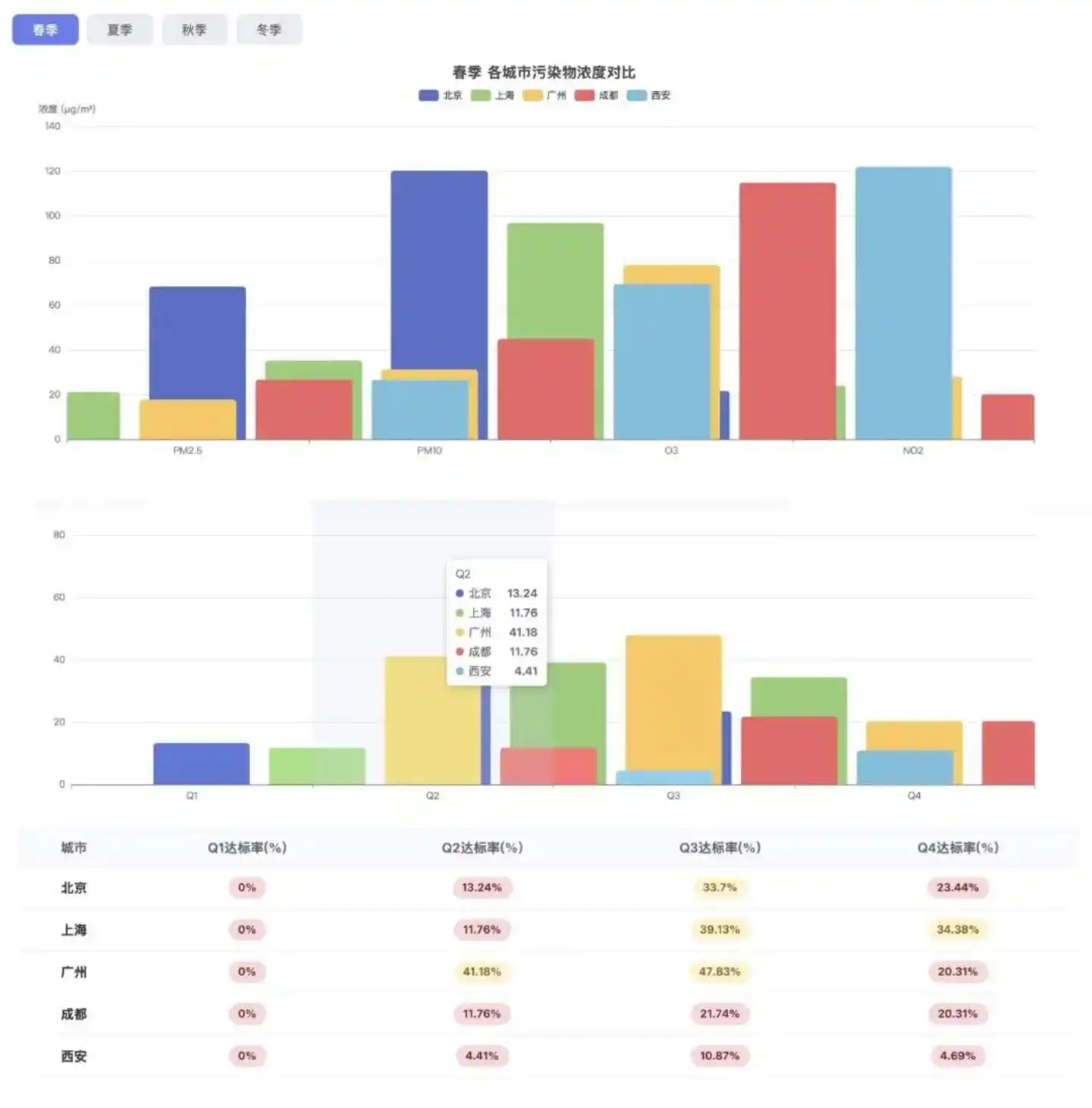
Judging from the page presentation, the finished product is合格. The structure of sections like season switching, radar charts, trend charts, and correlation heatmaps is complete, the visual presentation is orderly, and the charts also have basic interactive functions. This indicates that its execution capability at the front-end presentation level meets the standard.

However, there are two main problems: first, due to obstacles in the data acquisition phase, Hy3 preview only obtained 224 days of valid data, a large gap which affected the credibility of subsequent charts; second, the prompt clearly requested a paragraph of analysis conclusion. Although Hy3 preview reserved the area for the corresponding section on the page, the actual content was blank. This means it has task closure awareness, but its final delivery capability is still insufficient.

For the second task, we asked it to build a small贪吃蛇 (Snake) game.

The final result was relatively mature, with exquisite graphics, complete logic, and it could run normally. However, it should be noted that贪吃蛇 belongs to a closed-rule task with clear requirements and no need to call external data. The evaluation criteria are relatively clear, making it a scenario where agents are more proficient. WorkBuddy's performance in this task can only reflect its capabilities within its comfort zone, verifying that it has certain practical value.
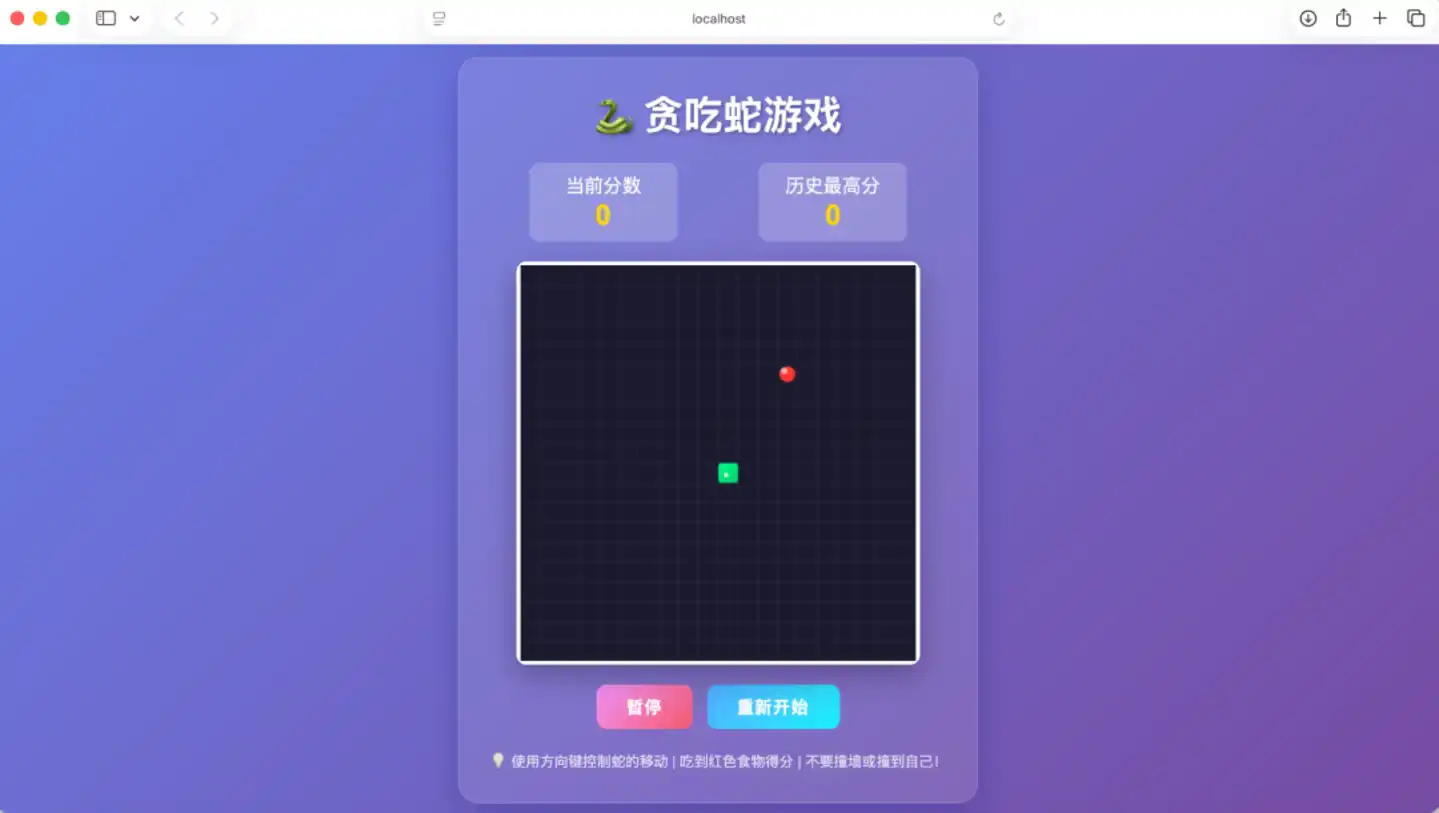
For the third task, we increased the difficulty and asked it to analyze an open-ended complex task: analyze the business model evolution of the AI Coding industry, review the development history from 2023 to the present, and identify key turning points and core driving factors in the industry.

This is an open-ended complex task with no single standard answer. The quality of the result depends on the Agent's judgment, information screening ability, and expression ability.

At the execution level, WorkBuddy was able to automatically call multiple tools, first revising the execution plan and then落地推进 the plan. The entire process took about half an hour.
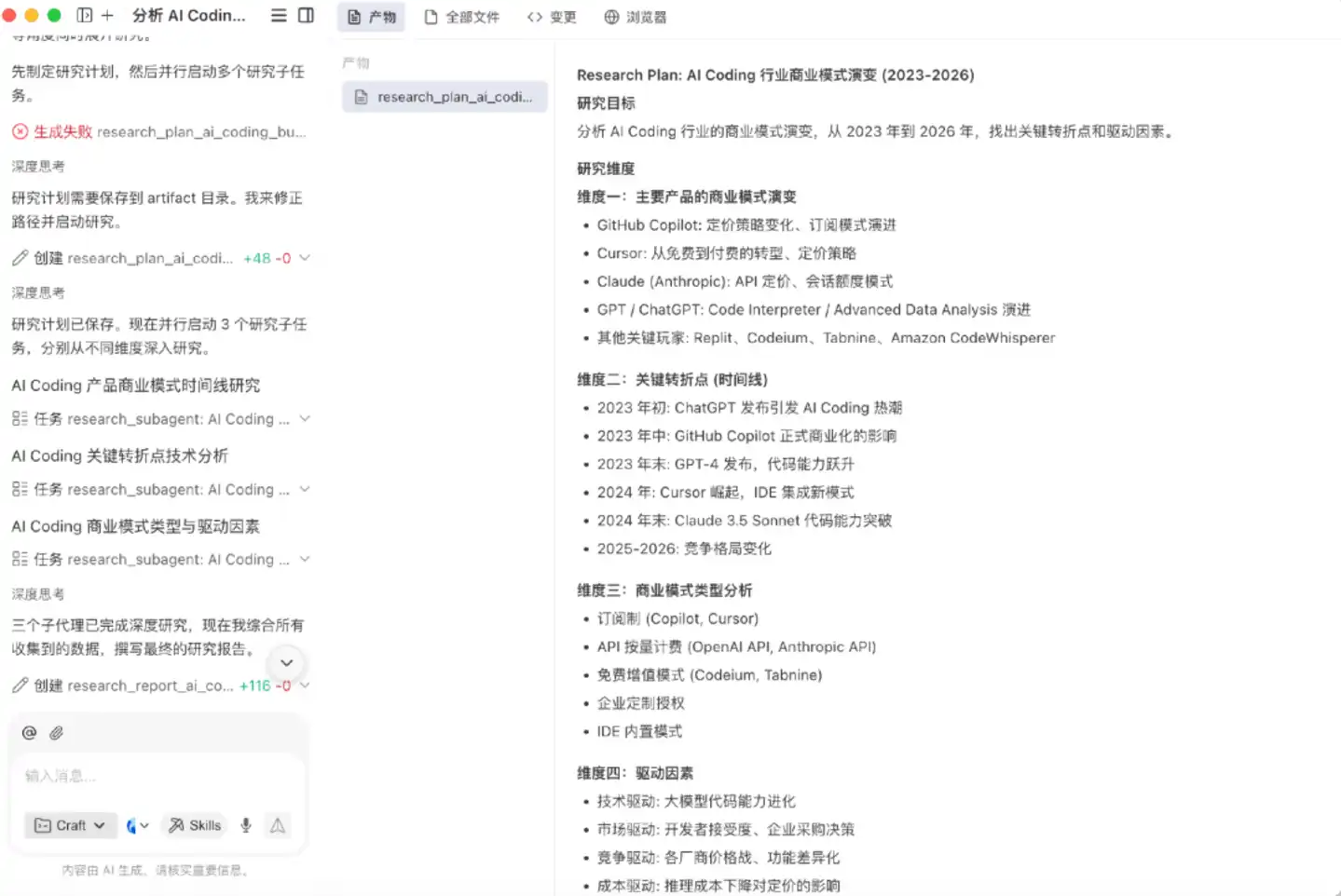
However, the final result was not impressive; it only built a basic framework, and the actual content was not substantial enough. It can be seen that although it掌握了 the method of decomposing research problems, it does not know how to further refine these dimensions into valuable research arguments.

In summary, WorkBuddy already possesses the capabilities expected of a daily coding assistant, but there is still room for improvement in the deep execution and final delivery of complex tasks.

Natural Conversation: AI Flavor Significantly Reduced

Finally, let's see if Yuanbao has "human flavor". This round tests through two scenarios: casual chat and creative writing.

Scenario 1: Casual Chat

The official documentation mentions that Hy3 preview can better understand users'倾诉 intentions,承接 user emotions, and avoid preachy, templated replies.
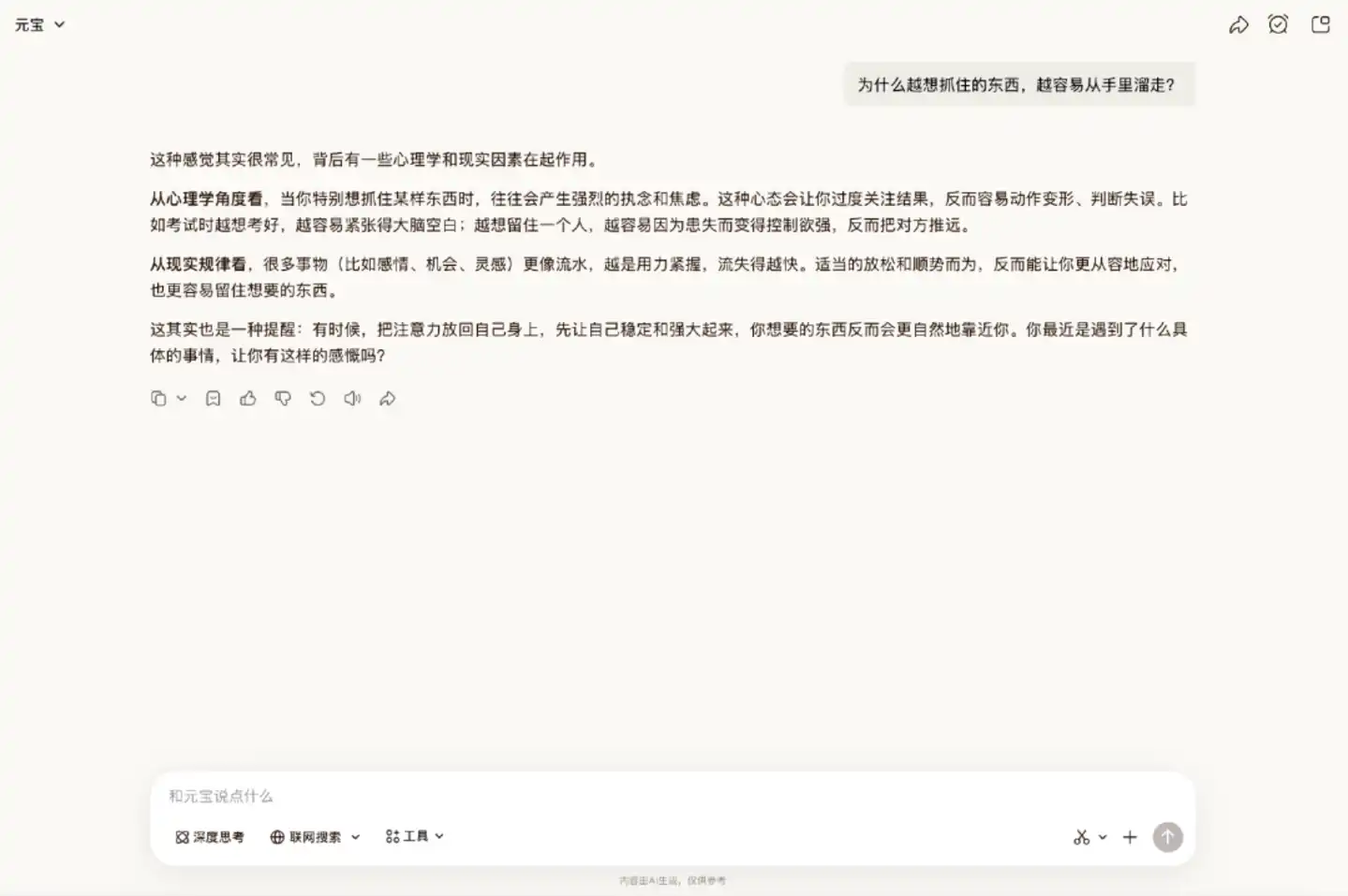
In actual testing, Hy3 preview's performance确实 aligns with this positioning. It did not start by listing a bunch of suggestions but first objectively analyzed the possible reasons behind it, then asked if something had happened. The overall tone was温和, quite measured, and had a natural feel suitable for casual chat scenarios.

Scenario 2: Creative Writing

In this segment, we designed two tasks to test its narrative and expressive abilities.

We first asked it to write a story where the protagonist never appears on stage, but readers can clearly understand who he is, what he experienced, and why he is important after reading.
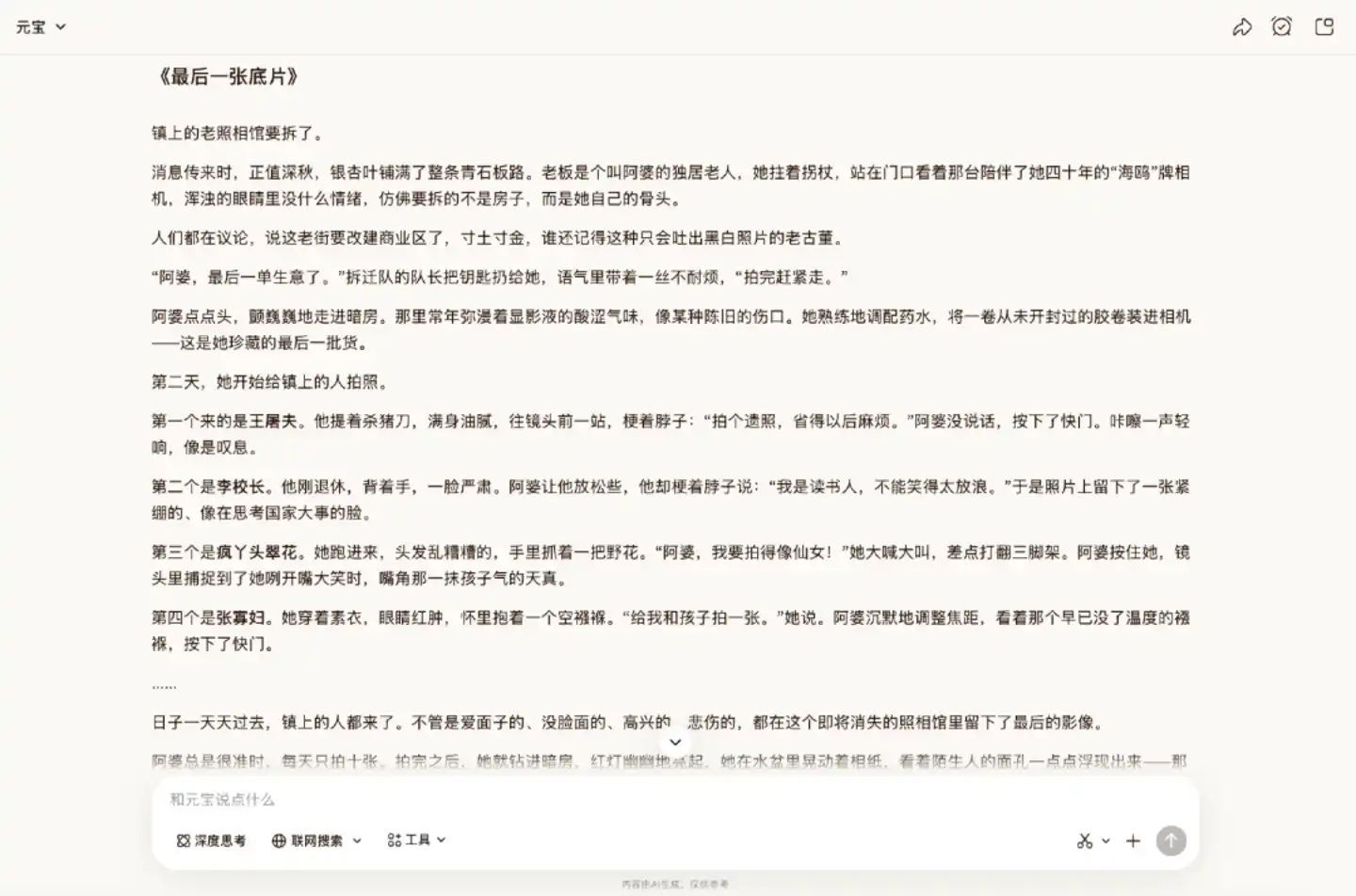
The finished product submitted by Yuanbao had self-consistent logic, smooth narrative, and relatively high completion, almost devoid of the套路感 common in AI writing.

Next, we asked it to imitate the writing style of "Those Things in the Ming Dynasty" (《明朝那些事儿》) to write a historical story about figures from another dynasty.

AI writing often manifests style replication as rigid imitation, merely copying the writing framework without grasping the article's style. But judging from the generated result, Hy3 preview's style replication ability is strong, meeting the requirements overall. It captured the style of the original book's popular history telling and presented the entire story quite well.
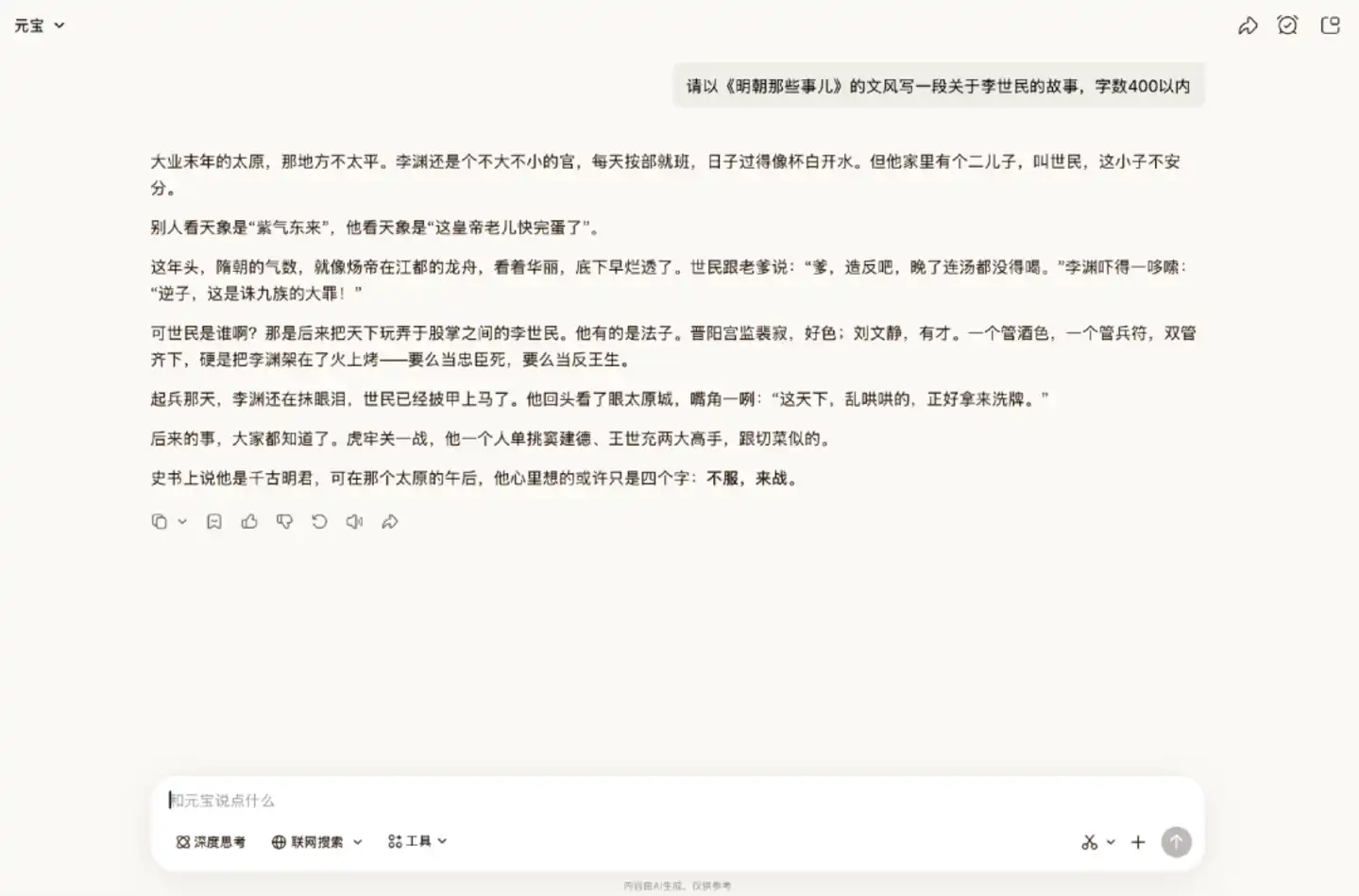
This round of evaluation was the most surprising. Overall, in natural language expression, Hy3 preview has already shed the套路腔 that is correct but flavorless, and can write texts with high readability.

Conclusion

After testing the four dimensions, Hy3 preview gives the impression of being "steady but not stunning".

It did not deliver a crushing performance in any single item, but it also has almost no obvious shortcomings. Placed within the entire ranking of domestic large models, it may not be the most stunning one, but it meets the standard of a practical model that can get work done.

Pulling the perspective back a bit, the real significance of Hy3 preview might not lie in the model itself.

Over the past two years, Tencent has been relatively passive on the large model battlefield. At the end of January this year, Ma Huateng publicly admitted at the annual meeting that Tencent's AI actions were slow. The relatively slow technical pace and the lack of a benchmark model that the outside world could remember were the two major problems Tencent faced. The release of Hy3 preview marks a turning point in Tencent's AI story and gives Tencent an AI model that can be used across its entire ecosystem.

Currently, Hy3 preview is only a preview version. Feedback from the open-source community is still being collected, and the actual calling experience in products like Yuanbao, QQ, and Tencent Docs still needs time to检验. According to official disclosures, larger parameter-scale models will be released后续.

But at least, Tencent AI has begun to撕掉 the "passive" label of the past two years.

Domande pertinenti

QWhat are the key features and specifications of Tencent's Hunyuan Hy3 preview model as mentioned in the article?

AThe Hunyuan Hy3 preview model uses a hybrid expert architecture with fast and slow thinking fusion, has a total of 295B parameters and 21B activated parameters, and supports a maximum context length of 256K. It also features a 54% reduction in first-token latency and a 47% reduction in end-to-end time, with lower inference costs.

QHow did the Hy3 preview model perform in logical reasoning tests according to the article?

AThe Hy3 preview model showed strong capabilities in conventional logical reasoning and complex step-by-step deduction but was less effective at identifying traps in trick questions and demonstrated instability in handling脑筋急转弯 (brain teasers) and real-world scenario adaptations.

QWhat were the findings regarding Hy3 preview's context learning and instruction following abilities?

AThe model effectively understood instructions, extracted key information from cluttered inputs like messy meeting transcripts, and correctly followed new language rules in tests, showing stability in干扰场景 (interference scenarios).

QHow did the WorkBuddy AI assistant, powered by Hy3 preview, perform in code and agent task tests?

AWorkBuddy demonstrated mature tool invocation and could handle closed-rule tasks like building a Snake game well. However, it struggled with data acquisition and task completion in complex, open-ended assignments, such as generating a reliable data analysis report or深度执行 (deep execution) of industry analysis.

QWhat improvements in natural language and creative writing did the article note for the Hy3 preview model?

AThe model showed reduced 'AI flavor,' with more natural and empathetic conversational tones. It also produced coherent, high-readability creative writing, successfully mimicking specific styles like '明style' (Ming style) in historical storytelling without falling into clichés.

Letture associate

How Many Tokens Away Is Yang Zhilin from the 'Moon Chasing the Light'?

The article explores the intense competition between two leading Chinese AI companies, DeepSeek and Kimi (Moon Dark Side), and the mounting pressure on Yang Zhilin, the founder of Kimi. While DeepSeek re-emerged after 15 months of silence with its powerful V4 model—boasting 1.6 trillion parameters and low-cost, long-context capabilities—Kimi has been focusing on long-context processing and multi-agent systems with its K2.6 model. Yang faces a threefold challenge: technological rivalry, commercialization pressure, and investor expectations. Despite Kimi’s high valuation (reaching $18 billion), its revenue heavily relies on a single product with low paid conversion rates, while DeepSeek’s strategic silence and open-source influence have strengthened its market position and valuation prospects, now targeting over $20 billion. Both companies reflect broader trends in China’s AI ecosystem: Kimi aims for global influence through open-source contributions and agent-based advancements, while DeepSeek prioritizes foundational innovation and hardware independence, notably shifting to Huawei’s chips. Their competition is seen as vital for China’s AI progress, with the gap between top Chinese and U.S. models narrowing to just 2.7% on the Elo rating scale. Ultimately, the article argues that this rivalry, though anxiety-inducing for leaders like Zhilin, is essential for driving innovation and solidifying China’s role in the global AI landscape.

marsbit5 h fa

How Many Tokens Away Is Yang Zhilin from the 'Moon Chasing the Light'?

marsbit5 h fa

TechFlow Intelligence Bureau: ChatGPT Helps Amateur Mathematician Crack 60-Year-Old Problem, CFTC Sues New York Regulator Over Coinbase and Gemini

An amateur mathematician, with the assistance of ChatGPT, has solved a combinatorial mathematics puzzle originally proposed by Hungarian mathematician Paul Erdős in the 1960s. This marks another milestone in AI-aided mathematical research, demonstrating the evolving capabilities of large language models in formal reasoning. In other AI developments, OpenAI introduced a new privacy filter tool for enterprise API usage, automatically screening sensitive data. Meanwhile, the Qwen3.6-27B model achieved 100 tokens per second on a single RTX 5090 GPU using quantization, significantly lowering the cost barrier for local AI deployment. In crypto and Web3, the U.S. CFTC sued New York’s financial regulator, challenging its oversight of Coinbase and Gemini—a first-of-its-kind federal-state regulatory clash. Following a vulnerability, KelpDAO and major DeFi protocols established a recovery fund. Tether froze $344 million in assets linked to Iran’s central bank upon U.S. Treasury request, highlighting the centralized control risks in stablecoins. Separately, Litecoin underwent a 3-hour chain reorganization to undo a privacy-layer exploit. In the U.S., former President Trump invoked the Defense Production Act to address power grid bottlenecks affecting AI data centers and dismissed the entire National Science Board, raising concerns over research independence. A retail trader gained 250% on a $600k Intel options bet amid AI-related speculation. Xiaomi announced its first performance electric vehicle, targeting rivals like Tesla. Meanwhile, iPhone users reported devices automatically reinstalling a hidden app daily, suspected to be MDM-related. A Chinese securities report noted that A-share institutional crowding has reached its second-longest streak since 2007, signaling high valuations and potential style rotation. The day’s developments reflect a dual narrative: AI is enabling unprecedented individual breakthroughs, while centralized power structures—whether governmental or corporate—are becoming more assertive, underscoring that decentralization is as much a political-economic challenge as a technical one.

marsbit5 h fa

TechFlow Intelligence Bureau: ChatGPT Helps Amateur Mathematician Crack 60-Year-Old Problem, CFTC Sues New York Regulator Over Coinbase and Gemini

marsbit5 h fa

Trading

Spot
Futures

Articoli Popolari

Cosa è $S$

Comprendere SPERO: Una Panoramica Completa Introduzione a SPERO Mentre il panorama dell'innovazione continua a evolversi, l'emergere delle tecnologie web3 e dei progetti di criptovaluta gioca un ruolo fondamentale nel plasmare il futuro digitale. Un progetto che ha attirato l'attenzione in questo campo dinamico è SPERO, denotato come SPERO,$$s$. Questo articolo mira a raccogliere e presentare informazioni dettagliate su SPERO, per aiutare gli appassionati e gli investitori a comprendere le sue basi, obiettivi e innovazioni nei domini web3 e crypto. Che cos'è SPERO,$$s$? SPERO,$$s$ è un progetto unico all'interno dello spazio crypto che cerca di sfruttare i principi della decentralizzazione e della tecnologia blockchain per creare un ecosistema che promuove l'impegno, l'utilità e l'inclusione finanziaria. Il progetto è progettato per facilitare interazioni peer-to-peer in modi nuovi, fornendo agli utenti soluzioni e servizi finanziari innovativi. Al suo interno, SPERO,$$s$ mira a responsabilizzare gli individui fornendo strumenti e piattaforme che migliorano l'esperienza dell'utente nello spazio delle criptovalute. Questo include la possibilità di metodi di transazione più flessibili, la promozione di iniziative guidate dalla comunità e la creazione di percorsi per opportunità finanziarie attraverso applicazioni decentralizzate (dApps). La visione sottostante di SPERO,$$s$ ruota attorno all'inclusività, cercando di colmare le lacune all'interno della finanza tradizionale mentre sfrutta i vantaggi della tecnologia blockchain. Chi è il Creatore di SPERO,$$s$? L'identità del creatore di SPERO,$$s$ rimane piuttosto oscura, poiché ci sono risorse pubblicamente disponibili limitate che forniscono informazioni dettagliate sul suo fondatore o fondatori. Questa mancanza di trasparenza può derivare dall'impegno del progetto per la decentralizzazione—un ethos che molti progetti web3 condividono, dando priorità ai contributi collettivi rispetto al riconoscimento individuale. Centrando le discussioni attorno alla comunità e ai suoi obiettivi collettivi, SPERO,$$s$ incarna l'essenza dell'empowerment senza mettere in evidenza individui specifici. Pertanto, comprendere l'etica e la missione di SPERO rimane più importante che identificare un creatore singolo. Chi sono gli Investitori di SPERO,$$s$? SPERO,$$s$ è supportato da una varietà di investitori che vanno dai capitalisti di rischio agli investitori angelici dedicati a promuovere l'innovazione nel settore crypto. Il focus di questi investitori generalmente si allinea con la missione di SPERO—dando priorità a progetti che promettono avanzamenti tecnologici sociali, inclusività finanziaria e governance decentralizzata. Queste fondazioni di investitori sono tipicamente interessate a progetti che non solo offrono prodotti innovativi, ma contribuiscono anche positivamente alla comunità blockchain e ai suoi ecosistemi. Il supporto di questi investitori rafforza SPERO,$$s$ come un concorrente degno di nota nel dominio in rapida evoluzione dei progetti crypto. Come Funziona SPERO,$$s$? SPERO,$$s$ impiega un framework multifunzionale che lo distingue dai progetti di criptovaluta convenzionali. Ecco alcune delle caratteristiche chiave che sottolineano la sua unicità e innovazione: Governance Decentralizzata: SPERO,$$s$ integra modelli di governance decentralizzati, responsabilizzando gli utenti a partecipare attivamente ai processi decisionali riguardanti il futuro del progetto. Questo approccio favorisce un senso di proprietà e responsabilità tra i membri della comunità. Utilità del Token: SPERO,$$s$ utilizza il proprio token di criptovaluta, progettato per servire varie funzioni all'interno dell'ecosistema. Questi token abilitano transazioni, premi e la facilitazione dei servizi offerti sulla piattaforma, migliorando l'impegno e l'utilità complessivi. Architettura Stratificata: L'architettura tecnica di SPERO,$$s$ supporta la modularità e la scalabilità, consentendo un'integrazione fluida di funzionalità e applicazioni aggiuntive man mano che il progetto evolve. Questa adattabilità è fondamentale per mantenere la rilevanza nel panorama crypto in continua evoluzione. Coinvolgimento della Comunità: Il progetto enfatizza iniziative guidate dalla comunità, impiegando meccanismi che incentivano la collaborazione e il feedback. Nutrendo una comunità forte, SPERO,$$s$ può affrontare meglio le esigenze degli utenti e adattarsi alle tendenze di mercato. Focus sull'Inclusione: Offrendo basse commissioni di transazione e interfacce user-friendly, SPERO,$$s$ mira ad attrarre una base utenti diversificata, inclusi individui che potrebbero non aver precedentemente interagito nello spazio crypto. Questo impegno per l'inclusione si allinea con la sua missione generale di empowerment attraverso l'accessibilità. Cronologia di SPERO,$$s$ Comprendere la storia di un progetto fornisce preziose intuizioni sulla sua traiettoria di sviluppo e sui traguardi. Di seguito è riportata una cronologia suggerita che mappa eventi significativi nell'evoluzione di SPERO,$$s$: Fase di Concettualizzazione e Ideazione: Le idee iniziali che formano la base di SPERO,$$s$ sono state concepite, allineandosi strettamente con i principi di decentralizzazione e focus sulla comunità all'interno dell'industria blockchain. Lancio del Whitepaper del Progetto: Dopo la fase concettuale, è stato rilasciato un whitepaper completo che dettaglia la visione, gli obiettivi e l'infrastruttura tecnologica di SPERO,$$s$ per suscitare interesse e feedback dalla comunità. Costruzione della Comunità e Prime Interazioni: Sono stati effettuati sforzi attivi di outreach per costruire una comunità di early adopters e potenziali investitori, facilitando discussioni attorno agli obiettivi del progetto e ottenendo supporto. Evento di Generazione del Token: SPERO,$$s$ ha condotto un evento di generazione del token (TGE) per distribuire i propri token nativi ai primi sostenitori e stabilire una liquidità iniziale all'interno dell'ecosistema. Lancio della Prima dApp: La prima applicazione decentralizzata (dApp) associata a SPERO,$$s$ è stata attivata, consentendo agli utenti di interagire con le funzionalità principali della piattaforma. Sviluppo Continuo e Partnership: Aggiornamenti e miglioramenti continui alle offerte del progetto, inclusi partnership strategiche con altri attori nello spazio blockchain, hanno plasmato SPERO,$$s$ in un concorrente competitivo e in evoluzione nel mercato crypto. Conclusione SPERO,$$s$ rappresenta una testimonianza del potenziale del web3 e delle criptovalute di rivoluzionare i sistemi finanziari e responsabilizzare gli individui. Con un impegno per la governance decentralizzata, il coinvolgimento della comunità e funzionalità progettate in modo innovativo, apre la strada verso un panorama finanziario più inclusivo. Come per qualsiasi investimento nello spazio crypto in rapida evoluzione, si incoraggiano potenziali investitori e utenti a ricercare approfonditamente e a impegnarsi in modo riflessivo con gli sviluppi in corso all'interno di SPERO,$$s$. Il progetto mostra lo spirito innovativo dell'industria crypto, invitando a ulteriori esplorazioni delle sue innumerevoli possibilità. Mentre il percorso di SPERO,$$s$ è ancora in fase di sviluppo, i suoi principi fondamentali potrebbero effettivamente influenzare il futuro di come interagiamo con la tecnologia, la finanza e tra di noi in ecosistemi digitali interconnessi.

75 Totale visualizzazioniPubblicato il 2024.12.17Aggiornato il 2024.12.17

Cosa è $S$

Cosa è AGENT S

Agent S: Il Futuro dell'Interazione Autonoma in Web3 Introduzione Nel panorama in continua evoluzione di Web3 e criptovalute, le innovazioni stanno costantemente ridefinendo il modo in cui gli individui interagiscono con le piattaforme digitali. Uno di questi progetti pionieristici, Agent S, promette di rivoluzionare l'interazione uomo-computer attraverso il suo framework agentico aperto. Aprendo la strada a interazioni autonome, Agent S mira a semplificare compiti complessi, offrendo applicazioni trasformative nell'intelligenza artificiale (AI). Questa esplorazione dettagliata approfondirà le complessità del progetto, le sue caratteristiche uniche e le implicazioni per il dominio delle criptovalute. Cos'è Agent S? Agent S si presenta come un innovativo framework agentico aperto, progettato specificamente per affrontare tre sfide fondamentali nell'automazione dei compiti informatici: Acquisizione di Conoscenze Specifiche del Dominio: Il framework apprende in modo intelligente da varie fonti di conoscenza esterne ed esperienze interne. Questo approccio duale gli consente di costruire un ricco repository di conoscenze specifiche del dominio, migliorando le sue prestazioni nell'esecuzione dei compiti. Pianificazione su Lungo Orizzonte di Compiti: Agent S impiega una pianificazione gerarchica potenziata dall'esperienza, un approccio strategico che facilita la suddivisione e l'esecuzione efficiente di compiti complessi. Questa caratteristica migliora significativamente la sua capacità di gestire più sottocompiti in modo efficiente ed efficace. Gestione di Interfacce Dinamiche e Non Uniformi: Il progetto introduce l'Interfaccia Agente-Computer (ACI), una soluzione innovativa che migliora l'interazione tra agenti e utenti. Utilizzando Modelli Linguistici Multimodali di Grandi Dimensioni (MLLM), Agent S può navigare e manipolare senza sforzo diverse interfacce grafiche utente. Attraverso queste caratteristiche pionieristiche, Agent S fornisce un framework robusto che affronta le complessità coinvolte nell'automazione dell'interazione umana con le macchine, preparando il terreno per innumerevoli applicazioni nell'AI e oltre. Chi è il Creatore di Agent S? Sebbene il concetto di Agent S sia fondamentalmente innovativo, informazioni specifiche sul suo creatore rimangono elusive. Il creatore è attualmente sconosciuto, il che evidenzia sia la fase embrionale del progetto sia la scelta strategica di mantenere i membri fondatori sotto anonimato. Indipendentemente dall'anonimato, l'attenzione rimane sulle capacità e sul potenziale del framework. Chi sono gli Investitori di Agent S? Poiché Agent S è relativamente nuovo nell'ecosistema crittografico, informazioni dettagliate riguardanti i suoi investitori e sostenitori finanziari non sono documentate esplicitamente. La mancanza di approfondimenti pubblicamente disponibili sulle fondazioni di investimento o sulle organizzazioni che supportano il progetto solleva interrogativi sulla sua struttura di finanziamento e sulla roadmap di sviluppo. Comprendere il supporto è cruciale per valutare la sostenibilità del progetto e il suo potenziale impatto sul mercato. Come Funziona Agent S? Al centro di Agent S si trova una tecnologia all'avanguardia che gli consente di funzionare efficacemente in contesti diversi. Il suo modello operativo è costruito attorno a diverse caratteristiche chiave: Interazione Uomo-Computer Simile a Quella Umana: Il framework offre una pianificazione AI avanzata, cercando di rendere le interazioni con i computer più intuitive. Mimando il comportamento umano nell'esecuzione dei compiti, promette di elevare le esperienze degli utenti. Memoria Narrativa: Utilizzata per sfruttare esperienze di alto livello, Agent S utilizza la memoria narrativa per tenere traccia delle storie dei compiti, migliorando così i suoi processi decisionali. Memoria Episodica: Questa caratteristica fornisce agli utenti una guida passo-passo, consentendo al framework di offrire supporto contestuale mentre i compiti si sviluppano. Supporto per OpenACI: Con la capacità di funzionare localmente, Agent S consente agli utenti di mantenere il controllo sulle proprie interazioni e flussi di lavoro, allineandosi con l'etica decentralizzata di Web3. Facile Integrazione con API Esterne: La sua versatilità e compatibilità con varie piattaforme AI garantiscono che Agent S possa adattarsi senza problemi agli ecosistemi tecnologici esistenti, rendendolo una scelta attraente per sviluppatori e organizzazioni. Queste funzionalità contribuiscono collettivamente alla posizione unica di Agent S all'interno dello spazio crittografico, poiché automatizza compiti complessi e multi-fase con un intervento umano minimo. Man mano che il progetto evolve, le sue potenziali applicazioni in Web3 potrebbero ridefinire il modo in cui si svolgono le interazioni digitali. Cronologia di Agent S Lo sviluppo e le tappe di Agent S possono essere riassunti in una cronologia che evidenzia i suoi eventi significativi: 27 Settembre 2024: Il concetto di Agent S è stato lanciato in un documento di ricerca completo intitolato “Un Framework Agentico Aperto che Usa i Computer Come un Umano”, mostrando le basi per il progetto. 10 Ottobre 2024: Il documento di ricerca è stato reso pubblicamente disponibile su arXiv, offrendo un'esplorazione approfondita del framework e della sua valutazione delle prestazioni basata sul benchmark OSWorld. 12 Ottobre 2024: È stata rilasciata una presentazione video, fornendo un'idea visiva delle capacità e delle caratteristiche di Agent S, coinvolgendo ulteriormente potenziali utenti e investitori. Questi indicatori nella cronologia non solo illustrano i progressi di Agent S, ma indicano anche il suo impegno per la trasparenza e il coinvolgimento della comunità. Punti Chiave su Agent S Man mano che il framework Agent S continua a evolversi, diversi attributi chiave si distinguono, sottolineando la sua natura innovativa e il potenziale: Framework Innovativo: Progettato per fornire un uso intuitivo dei computer simile all'interazione umana, Agent S porta un approccio nuovo all'automazione dei compiti. Interazione Autonoma: La capacità di interagire autonomamente con i computer attraverso GUI segna un passo avanti verso soluzioni informatiche più intelligenti ed efficienti. Automazione di Compiti Complessi: Con la sua metodologia robusta, può automatizzare compiti complessi e multi-fase, rendendo i processi più veloci e meno soggetti a errori. Miglioramento Continuo: I meccanismi di apprendimento consentono ad Agent S di migliorare dalle esperienze passate, migliorando continuamente le sue prestazioni e la sua efficacia. Versatilità: La sua adattabilità attraverso diversi ambienti operativi come OSWorld e WindowsAgentArena garantisce che possa servire un'ampia gamma di applicazioni. Man mano che Agent S si posiziona nel panorama di Web3 e delle criptovalute, il suo potenziale per migliorare le capacità di interazione e automatizzare i processi segna un significativo avanzamento nelle tecnologie AI. Attraverso il suo framework innovativo, Agent S esemplifica il futuro delle interazioni digitali, promettendo un'esperienza più fluida ed efficiente per gli utenti in vari settori. Conclusione Agent S rappresenta un audace passo avanti nell'unione tra AI e Web3, con la capacità di ridefinire il modo in cui interagiamo con la tecnologia. Sebbene sia ancora nelle sue fasi iniziali, le possibilità per la sua applicazione sono vaste e coinvolgenti. Attraverso il suo framework completo che affronta sfide critiche, Agent S mira a portare le interazioni autonome al centro dell'esperienza digitale. Man mano che ci addentriamo nei regni delle criptovalute e della decentralizzazione, progetti come Agent S giocheranno senza dubbio un ruolo cruciale nel plasmare il futuro della tecnologia e della collaborazione uomo-computer.

421 Totale visualizzazioniPubblicato il 2025.01.14Aggiornato il 2025.01.14

Cosa è AGENT S

Come comprare S

Benvenuto in HTX.com! Abbiamo reso l'acquisto di Sonic (S) semplice e conveniente. Segui la nostra guida passo passo per intraprendere il tuo viaggio nel mondo delle criptovalute.Step 1: Crea il tuo Account HTXUsa la tua email o numero di telefono per registrarti il tuo account gratuito su HTX. Vivi un'esperienza facile e sblocca tutte le funzionalità,Crea il mio accountStep 2: Vai in Acquista crypto e seleziona il tuo metodo di pagamentoCarta di credito/debito: utilizza la tua Visa o Mastercard per acquistare immediatamente SonicS.Bilancio: Usa i fondi dal bilancio del tuo account HTX per fare trading senza problemi.Terze parti: abbiamo aggiunto metodi di pagamento molto utilizzati come Google Pay e Apple Pay per maggiore comodità.P2P: Fai trading direttamente con altri utenti HTX.Over-the-Counter (OTC): Offriamo servizi su misura e tassi di cambio competitivi per i trader.Step 3: Conserva Sonic (S)Dopo aver acquistato Sonic (S), conserva nel tuo account HTX. In alternativa, puoi inviare tramite trasferimento blockchain o scambiare per altre criptovalute.Step 4: Scambia Sonic (S)Scambia facilmente Sonic (S) nel mercato spot di HTX. Accedi al tuo account, seleziona la tua coppia di trading, esegui le tue operazioni e monitora in tempo reale. Offriamo un'esperienza user-friendly sia per chi ha appena iniziato che per i trader più esperti.

836 Totale visualizzazioniPubblicato il 2025.01.15Aggiornato il 2025.03.21

Come comprare S

Discussioni

Benvenuto nella Community HTX. Qui puoi rimanere informato sugli ultimi sviluppi della piattaforma e accedere ad approfondimenti esperti sul mercato. Le opinioni degli utenti sul prezzo di S S sono presentate come di seguito.

活动图片