Promised Year of Crypto IPOs? Only One Went Public in Six Months, Down 70%

marsbitPubblicato 2026-06-11Pubblicato ultima volta 2026-06-11

Introduzione

The much-anticipated wave of crypto IPOs in 2026 has failed to materialize, with market conditions worsening dramatically. While SpaceX prepares for the largest IPO in history, raising $75 billion at a $1.75 trillion valuation, the crypto sector faces a frozen pipeline. The sole crypto IPO success this year, BitGo, serves as a cautionary tale. After launching on the NYSE in January at $18, its stock has plummeted approximately 70%. Other major contenders have stalled or delayed. Kraken, which secretly filed in late 2025, has put its plans on ice, seeing its valuation drop 33% to $13.3 billion. Consensys has postponed its filing until autumn at the earliest, and Bitpanda is poised to miss its self-imposed H1 deadline for a Frankfurt listing. This widespread retreat is driven by a severe liquidity crunch. Bitcoin has fallen below $60,000, with capital being diverted to AI stocks and the massive SpaceX offering. The poor performance of earlier crypto listings like Gemini and the stagnant price of Coinbase further dampen investor appetite. A key underlying pressure is the impending US midterm elections in November, which could alter the currently favorable regulatory landscape. Companies had hoped to go public during this window of policy certainty, but challenging market dynamics have overridden those plans. The transparency that comes with being a public company is now seen as a potential liability rather than a benefit in a down market. The industry's fate now hinges on a ...

Author: Claude, Deep Tide TechFlow

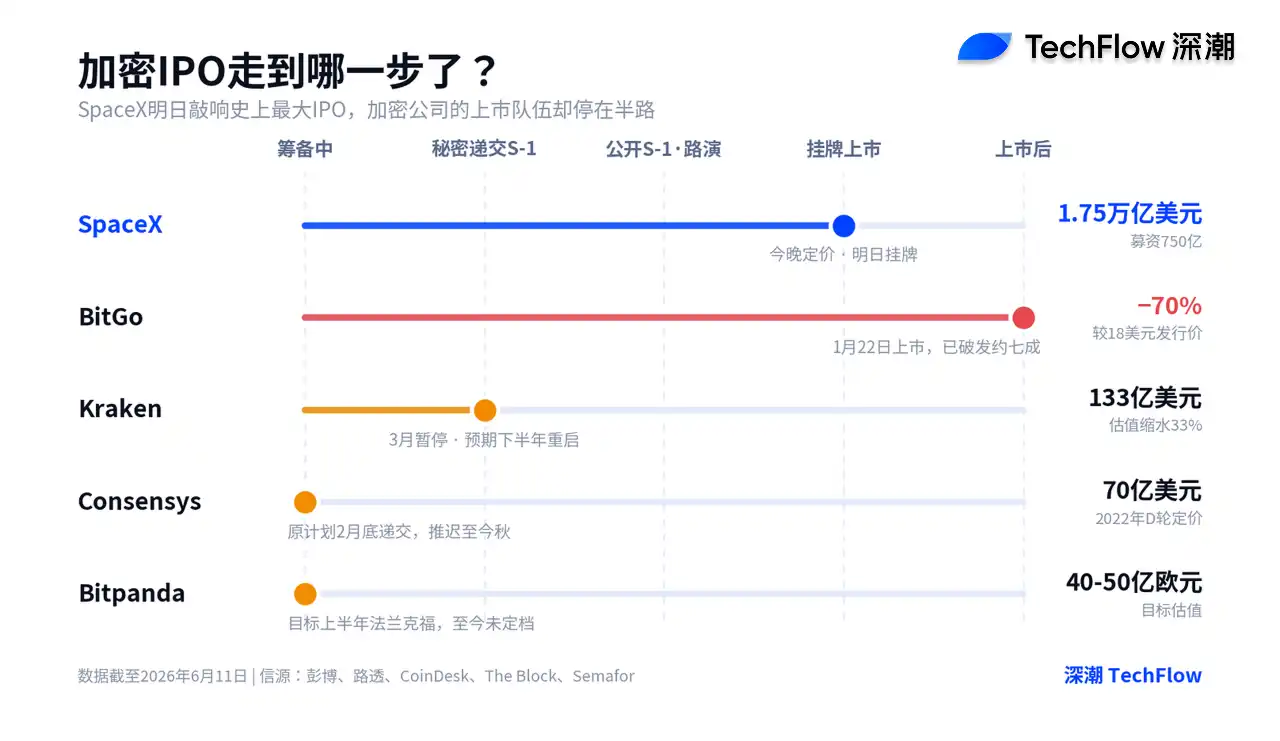
Deep Tide Introduction: SpaceX will price its offering tonight and list on Nasdaq tomorrow, aiming to raise $75 billion with a valuation of $1.75 trillion, marking the largest IPO ever. Meanwhile, the crypto IPO pipeline has frozen solid: the only company to list this year, BitGo, is down about 70% from its issue price; Kraken's valuation has shrunk 33% in five months; Consensys has been pushed back to autumn; Bitpanda is on the verge of missing its deadline. With just five months left until the midterm elections in November, the window for crypto companies to go public is narrowing.

After the U.S. stock market closes tonight, SpaceX will finalize its issue price. Tomorrow, the ticker SPCX will debut on Nasdaq. According to Reuters, the company plans to issue approximately 557 million shares at $135 per share, raising $75 billion at a valuation of $1.75 trillion. This will be the largest IPO in history by both fundraising size and valuation, with the fundraising amount more than double that of the previous record holder, Saudi Aramco.

Outside this grand feast, the queue of crypto companies waiting to go public is falling apart.
SpaceX Siphons Liquidity, Bitcoin Falls Below $60k Concurrently

SpaceX's listing pace is unusually fast. It confidentially filed its registration on April 1, publicly released its S-1 prospectus on May 20, and kicked off its roadshow on June 4, several days ahead of schedule due to an unexpectedly swift SEC review process. It took just over two months from confidential filing to bell-ringing.

The crypto market trended in the exact opposite direction during the same window. According to CoinDesk data, Bitcoin traded around $61,500 on June 10, down about 17% for the week and briefly falling below $60,000 for the first time in 2024. The Fear and Greed Index registered a reading of 9, indicating "Extreme Fear." The total crypto market cap shrank to around $2.21 trillion. The explanation for the capital flows isn't complicated: continuous outflows from Bitcoin ETFs, coupled with funds rotating towards the AI sector and SpaceX's subscription, have seen risk appetite sucked dry by this $1.75 trillion behemoth.

For any company wanting to go public, liquidity is oxygen. $75 billion in subscription demand is locked up by SpaceX alone. Filing a prospectus at this point is like flying a kite in a typhoon.

BitGo: The Year's Only Listing Sample, Stock Down About 70%

The crypto industry hasn't been without attempts. BitGo listed on the NYSE on January 22 with an issue price of $18, above the indicated range of $15 to $17, raising $213 million. It was the first and, so far, only crypto-native company to complete an IPO in 2026.

The start didn't look bad. It opened at $22.43 on its first day, up 24.6% from the issue price, and briefly surged to $24.5 intraday. But those gains were wiped out by the close, ending the day with just a 2.7% gain, followed by a steady decline. According to Benzinga data, BTGO closed at $5.61 on June 3, down about 69% from its issue price. Goldman Sachs cut its price target from $10.5 to $9 on June 4, and even this slashed target is 60% higher than the current price.

BitGo was once hoped to be the bellwether for 2026 crypto IPOs. Now it indeed serves as a bellwether, just pointing in the opposite direction. When Kraken paused its listing plans in March this year, multiple media reports cited BitGo's post-listing slump as a cautionary tale for management. If an infrastructure company with over $100 billion in assets under custody and a defensive business model fares this poorly, what valuation would a pure exchange story receive in the secondary market? The companies in line are well aware.

Kraken: Valuation Evaporates 33% in Five Months, Deutsche Börse Seizes Opportunity

Kraken is the company that progressed the furthest in the queue. On November 19, 2025, its parent company Payward confidentially submitted a draft S-1 to the SEC, shortly after completing an $800 million funding round with investors including Jane Street and Citadel Securities, valuing the company at $20 billion. Reuters reported at the time that its target was to go public in Q1 2026.

Then the market soured. In March this year, multiple media reports stated Kraken had frozen its listing plans. On April 14, co-CEO Arjun Sethi confirmed at the Semafor World Economy Summit in Washington that the confidential filing remained active but declined to provide a timeline, offering size, or valuation range. According to Semafor, Kraken was valued at $13.3 billion in a funding round in April, a 33% contraction from its peak last November.

This funding round contains a noteworthy subplot: Deutsche Börse Group invested $200 million for approximately 1.5% of Kraken's fully diluted shares, with the transaction expected to close in Q2. The operator of the Frankfurt Stock Exchange is buying in at a time when a U.S. exchange's valuation is at its lowest ebb. Considering Bitpanda's choice discussed below, the Germans' intent to snatch business as the U.S. window tightens is quite evident.

Media consensus currently expects Kraken's listing restart to wait until the second half of the year.

Consensys Pushed to Autumn, Bitpanda on the Verge of Missing Deadline

Consensys, the parent company of MetaMask, has a more straightforward script. According to a CoinDesk report on May 13, the company led by Ethereum co-founder Joe Lubin originally planned to confidentially file its S-1 with the SEC by the end of February, with JPMorgan and Goldman Sachs leading the underwriting. However, due to persistently weak market conditions, the IPO has been postponed until at least this autumn. Consensys' last valuation was from its Series D in 2022, a $450 million funding round at a $7 billion valuation. How much of this number can be preserved in the current market environment will only be known when the prospectus is unveiled.

Bitpanda's problem is the calendar. According to a Bloomberg report in January, this Vienna-based company, backed by Peter Thiel, plans to list in Frankfurt with a target valuation of €4-5 billion, with Goldman Sachs, Citigroup, and Deutsche Bank acting as underwriters. The schedule was set for the first half of the year, potentially Q1. Today is June 11, with less than three weeks left in H1, and the company has yet to officially announce a date. Unless it launches suddenly in the coming days, missing its own deadline is almost certain.

Looking at the four together: one listed but is down 70%, one filed but paused, one pushed to autumn, and one on the verge of missing its self-imposed deadline. The original Reddit post described these four as "sprinting to go public within 12 months." The wording isn't wrong, but the sense of direction is. This team isn't sprinting; they're each looking for an exit ramp.

Five Months Until the Midterm Elections

The clustering of crypto companies targeting 2026 for listings has a common, invisible deadline.

This year's regulatory climate has been relatively favorable for the crypto industry, but the U.S. midterm elections in early November could rewrite the congressional power balance. Many companies' timelines were originally compressed before the election, betting on five months of policy certainty.

Precedents aren't encouraging. Among the crypto companies that went public in 2025, Gemini's stock price had fallen over 60% from its issue price (data as of end-January), Bullish hovered around its issue price, and Coinbase, which listed in 2021, remains below its opening price from that year. Circle is a rare exception that has significantly outperformed its issue price. The pricing given by the secondary market with real money is more honest than any roadshow PowerPoint.

Returning to that Reddit post, the poster actually had a valid point: once an exchange goes public, its financials are no longer a black box. Quarterly audited reports will reveal whether revenue truly comes from trading fees, custody fees, or idle fund interest. Retail investors get their first chance to judge an exchange by numbers rather than "withdrawal smoothness."
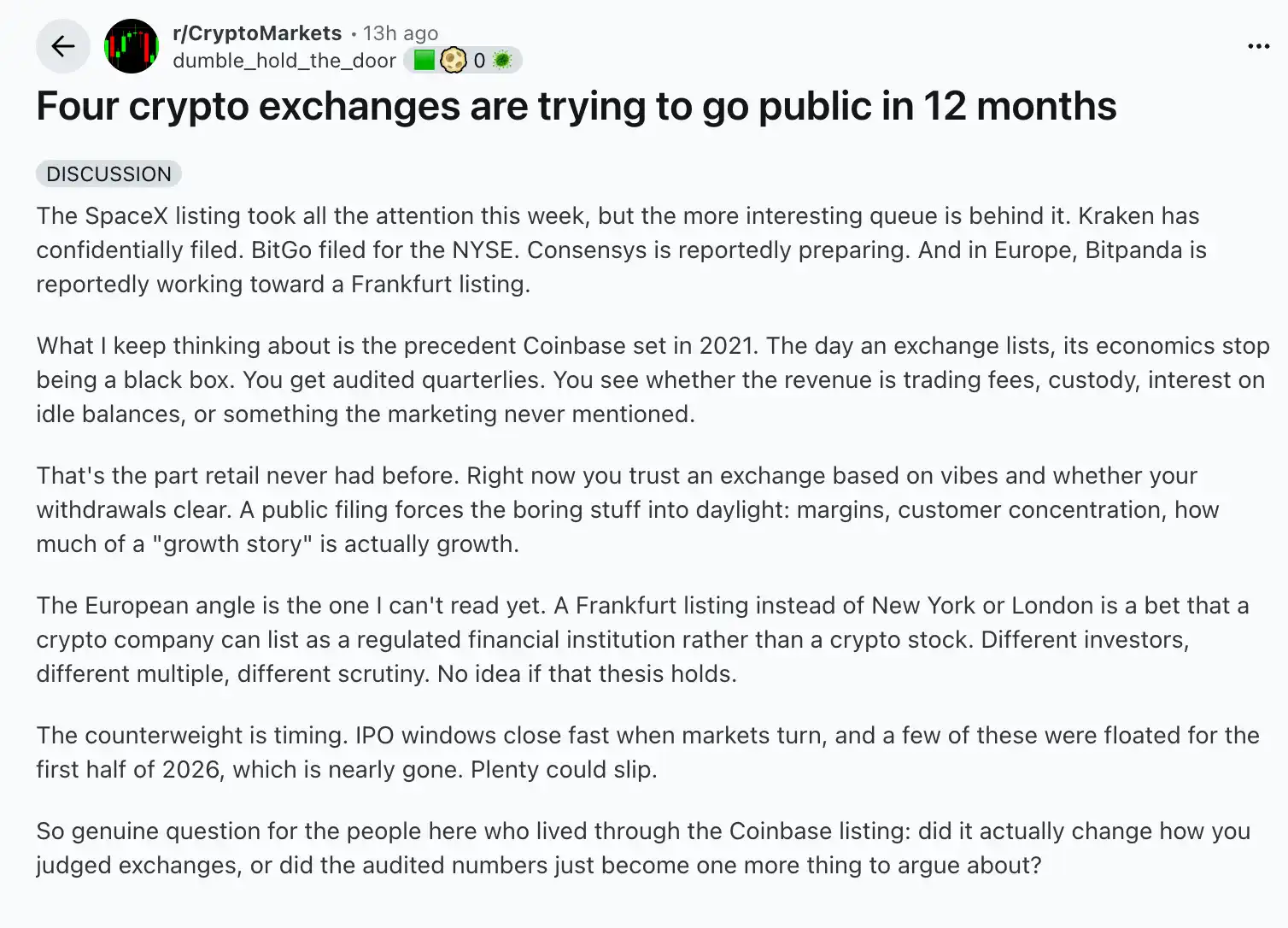
The problem is the sequence. Transparency is a consequence of going public, not the motivation for it. In a market with Bitcoin at $61,500 and the only listing sample down 70%, no company is in a hurry to lay its cards on the table.

Over the next five months, three specific milestones are worth watching: whether Kraken restarts in H2, whether Consensys actually files its S-1 in autumn, and when Bitpanda officially admits to missing its deadline.

There's another variable to be revealed tomorrow. If funds absorbed by SpaceX's listing flow back and market liquidity recovers, this window might crack open again. If even the largest IPO in history performs tepidly, this year's crypto listing wave will likely have to wait until after the elections.


Domande pertinenti

QWhat major event is described as diverting liquidity from the crypto market, coinciding with Bitcoin's price drop?

AThe article describes the upcoming IPO of SpaceX as the major event. SpaceX's planned $75 billion offering, with a $1.75 trillion valuation, was reportedly locking up significant investor capital and risk appetite, creating a 'liquidity drain' that contributed to Bitcoin falling below $60,000.

QAccording to the article, which crypto company is the only one to have completed an IPO in 2026, and how has its stock performed?

AThe only crypto-native company to have completed an IPO in 2026 is BitGo (ticker: BTGO). Its stock has performed poorly, falling approximately 70% from its initial offering price of $18 to around $5.61 by early June.

QWhy did the article suggest several crypto companies originally aimed to go public before November 2026?

AThe article suggests these companies aimed for a pre-November 2026 timeline due to the U.S. midterm elections. They were betting on the current, relatively friendly regulatory environment for crypto, which could change depending on the election outcome, making the five months before the election a window of perceived policy certainty.

QWhat evidence does the article provide that the public listing pipeline for crypto companies is effectively frozen?

AThe article provides several pieces of evidence: BitGo's poor post-IPO performance (-70%), Kraken's paused plans and 33% valuation drop, Consensys's delay to autumn, and Bitpanda's likely missed self-imposed deadline for a first-half listing. It describes the situation as companies 'finding their own excuses' rather than sprinting to go public.

QWhat is one potential positive outcome for crypto companies if SpaceX's IPO goes well, according to the article's conclusion?

AThe article concludes that if SpaceX's IPO performs well and the massive capital it absorbed begins to flow back into the market, improving overall liquidity, the window for crypto IPOs might 'reopen a crack.' However, if even the largest IPO ever performs poorly, any significant crypto listing wave would likely be postponed until after the midterm elections.

Letture associate

10% Position Limit Proposed: UK Retail Authorized Funds to Gain Indirect Exposure to Crypto Assets

The UK Financial Conduct Authority (FCA) is consulting on a proposal (CP26/17) that would allow retail funds, including UCITS and most Non-UCITS Retail Schemes (NURS), to invest up to 10% of their total assets in cryptoasset exchange-traded notes (crypto ETNs). This would enable indirect exposure to cryptoassets for mainstream investors through regulated funds. The rule maintains the existing prohibition on funds holding underlying cryptocurrencies like Bitcoin or Ethereum directly. The proposal introduces a strict 10% cap, positioning crypto ETNs as a potential satellite holding within diversified portfolios. Funds must ensure these investments align with their stated objectives and risk profiles. Notably, the cap does not apply to Qualified Investor Schemes (QIS) for professional clients, while Long-Term Asset Funds (LTAFs) would be prohibited from holding crypto ETNs. This move builds on the FCA's 2025 decision to permit retail trading of crypto ETNs on UK regulated exchanges. However, significant compliance burdens fall on fund managers, who must conduct thorough due diligence, assess liquidity, and provide clear risk disclosures to investors. The FCA emphasizes that even a small allocation can significantly impact a fund's risk profile. The policy's practical impact remains uncertain. Widespread adoption depends on whether asset managers deem the potential benefits worth the operational costs, disclosure requirements, and reputational risks. The consultation is open for feedback until July 13, 2026. Ultimately, the proposal represents a cautious, incremental step toward integrating cryptoassets into the regulated fund landscape, rather than a broad opening.

Foresight News28 min fa

10% Position Limit Proposed: UK Retail Authorized Funds to Gain Indirect Exposure to Crypto Assets

Foresight News28 min fa

Public Version of Mythos Officially Launched: Analyzing the Advantages and Limitations of AI Smart Contract Auditing

Publicly available Mythos, Anthropic's AI model, has officially launched, demonstrating both significant potential and limitations in smart contract security auditing. The article analyzes its capabilities through real-world cases. AI excels in identifying subtle, low-level vulnerabilities through pattern recognition and large-scale code screening. A key example is detecting a storage slot collision between a custom rewards mapping and a third-party library's ReentrancyGuard, a vulnerability easily missed in manual audits. In the recent Zcash incident, AI also rapidly discovered a critical soundness bug that had remained hidden for years. However, AI currently struggles with complex, interconnected scenarios. When tested on the Curve LlamaLend sDOLA exploit, which involved manipulating prices across multiple protocols (Curve pools, lending markets) to trigger liquidations, Fable 5 failed to identify the core cross-protocol attack vector. These scenarios require a deep understanding of DeFi economic models and multi-contract interactions. In conclusion, while AI tools like Mythos significantly boost efficiency in finding standardized, syntactic vulnerabilities, they cannot yet replace expert analysis for complex, business-logic, and cross-protocol attacks. An effective audit workflow combines AI's speed for initial screening with human expertise for in-depth, holistic analysis.

marsbit33 min fa

Public Version of Mythos Officially Launched: Analyzing the Advantages and Limitations of AI Smart Contract Auditing

marsbit33 min fa

Trade.xyz's Rebase Refusal Sparks Controversy, On-Chain Pre-IPO Market Faces Major Pricing Test

The debate surrounding Trade.xyz's refusal to adjust its SPCX (SpaceX pre-IPO) perpetual contract pricing amid updated share count revelations highlights a key challenge for on-chain pre-IPO markets. While several centralized exchanges (CEXs) paused and repriced their contracts after SpaceX's filing showed a ~10% increase in total shares, Trade.xyz maintained its market-driven pricing logic, which tracks expected per-share price sentiment rather than fundamental valuation metrics like market cap. This discrepancy triggered cross-platform arbitrage and caused leveraged long positions on Trade.xyz to suffer significant losses, as the platform's HIP-3 architecture lacks a native "Rebase" mechanism to neutrally adjust all user positions following such corporate actions. The incident underscores the difficulty for decentralized perpetual exchanges (Perp DEXs) to implement Rebase—a process CEXs handle by centrally pausing markets and adjusting ledger data. On-chain, this requires complex smart contract modifications, increasing gas costs, complexity, and potential attack surfaces. While some DEXs have managed similar adjustments, Trade.xyz's current design does not natively support it, though the team is reportedly exploring solutions for future events like stock splits. Ultimately, the controversy serves as a critical case study for the nascent on-chain pre-IPO sector, raising questions about price discovery reliability, transparent rule disclosure, and the readiness of DeFi infrastructures to handle traditional corporate actions as real-world assets (RWAs) gain traction.

marsbit41 min fa

Trade.xyz's Rebase Refusal Sparks Controversy, On-Chain Pre-IPO Market Faces Major Pricing Test

marsbit41 min fa

The 'Middle Eastern Prince' Swindles a Wealthy Woman: Renting Planes and Rolls-Royces, Scamming 120 Million Over Three Years

Two brothers who posed as "Middle Eastern princes" have been sentenced in the United States to 24 and 23 years in prison, respectively, and ordered to pay over $21.2 million in restitution and back taxes. Over three years, they fraudulently obtained approximately $21 million, primarily by promoting fictitious investment projects, including a non-existent cryptocurrency mining operation in a former General Electric industrial park in East Cleveland. The brothers, aged 42 and 33, created elaborate personas: one claimed to be a wealthy royal family heir and the city's "International Economic Advisor," while the other posed as a hedge fund manager with expertise from watching the TV show *Billions*. They bolstered their image by renting luxury cars and private jets and cultivating a relationship with a local mayor's chief of staff, who provided official-looking documents and government event access. A significant portion of the victims' funds, about $18 million, came from a single Chinese investor, a woman from Sichuan with experience in Bitcoin mining. The brothers also defrauded several women, including one former girlfriend. Their scheme unraveled when the primary investor discovered her $6 million worth of mining equipment had been sold off. The case highlights a trend of impostors using fabricated "Middle Eastern royal" identities to target wealthy individuals. Similar incidents include a "Dubai prince" who recently promoted a $500 million family office in Hong Kong and a Colombian man who impersonated a Saudi prince for decades in the US before being caught and sentenced in 2019.

marsbit56 min fa

The 'Middle Eastern Prince' Swindles a Wealthy Woman: Renting Planes and Rolls-Royces, Scamming 120 Million Over Three Years

marsbit56 min fa

Trading

Spot
Futures

Articoli Popolari

Come comprare ONE

Benvenuto in HTX.com! Abbiamo reso l'acquisto di Harmony (ONE) semplice e conveniente. Segui la nostra guida passo passo per intraprendere il tuo viaggio nel mondo delle criptovalute.Step 1: Crea il tuo Account HTXUsa la tua email o numero di telefono per registrarti il tuo account gratuito su HTX. Vivi un'esperienza facile e sblocca tutte le funzionalità,Crea il mio accountStep 2: Vai in Acquista crypto e seleziona il tuo metodo di pagamentoCarta di credito/debito: utilizza la tua Visa o Mastercard per acquistare immediatamente HarmonyONE.Bilancio: Usa i fondi dal bilancio del tuo account HTX per fare trading senza problemi.Terze parti: abbiamo aggiunto metodi di pagamento molto utilizzati come Google Pay e Apple Pay per maggiore comodità.P2P: Fai trading direttamente con altri utenti HTX.Over-the-Counter (OTC): Offriamo servizi su misura e tassi di cambio competitivi per i trader.Step 3: Conserva Harmony (ONE)Dopo aver acquistato Harmony (ONE), conserva nel tuo account HTX. In alternativa, puoi inviare tramite trasferimento blockchain o scambiare per altre criptovalute.Step 4: Scambia Harmony (ONE)Scambia facilmente Harmony (ONE) nel mercato spot di HTX. Accedi al tuo account, seleziona la tua coppia di trading, esegui le tue operazioni e monitora in tempo reale. Offriamo un'esperienza user-friendly sia per chi ha appena iniziato che per i trader più esperti.

320 Totale visualizzazioniPubblicato il 2024.12.12Aggiornato il 2026.06.02

Come comprare ONE

Discussioni

Benvenuto nella Community HTX. Qui puoi rimanere informato sugli ultimi sviluppi della piattaforma e accedere ad approfondimenti esperti sul mercato. Le opinioni degli utenti sul prezzo di ONE ONE sono presentate come di seguito.

活动图片