Claiming the "Happy Horse": Alibaba's AI Lays Out the "Eight Trigrams Formation"

marsbitPubblicato 2026-04-11Pubblicato ultima volta 2026-04-11

Introduzione

Alibaba has officially claimed the "HappyHorse" (HappyHorse-1.0) AI video generation model, which recently topped the global benchmark on Artificial Analysis with an Elo score of 1357. Developed by Alibaba’s ATH (Alibaba Token Hub) innovation unit, the model is notable for its ability to generate high-definition video with synchronized audio and sound effects from text input, significantly improving motion coherence and reducing production time and cost. This launch is part of a broader acceleration in Alibaba’s AI strategy. In late March and early April, the company released three flagship models in quick succession: Qwen3.5-Omni, Wan2.7-Image, and Qwen3.6-Plus. The latter broke global daily call volume records with 1.4 trillion tokens processed shortly after release. Alibaba has also undergone significant organizational restructuring to support its AI ambitions. In March, it established the ATH business group, led by CEO Wu Yongming, to integrate AI development, cloud services, and application deployment. Further changes in April included forming a group-level technology committee and consolidating the Tongyi Lab into a dedicated AI model division. The company is investing heavily in AI, with plans to spend over 380 billion RMB on cloud and AI infrastructure over three years. Its self-developed GPUs have already seen mass production. While the market has responded positively to these moves, challenges remain in balancing centralized control with operational flexibility a...

By | Tingtong Tech (ID:tingtongtech), Author | Chen Ke, Editor | Rao Yan

Just as the market thought the AI video generation battlefield would still be a showdown between ByteDance and Kuaishou, a "dark horse" has joined the game.

Without any预告, without any paper, without any official account, a mysterious video generation model named HappyHorse topped the overseas evaluation platform Artificial Analysis, becoming the new technical throne.

The shockwave this "three-noes" product caused in the AI circle was no less than when AlphaGo defeated Lee Sedol. However, all the "technical fingerprints" and personnel change clues in the market pointed to the same origin: Alibaba. However, Alibaba did not admit it initially when the news broke.

After the market "speculated" for a few days, on April 10th, Alibaba finally claimed HappyHorse, stating it is a model developed by its ATH (Alibaba Token Hub) Innovation Business Unit.

For Alibaba, the "Happy Horse" is not the most eye-catching news this year. In fact, prior to this, whether it was the "triple release" of three flagship models at the end of March, or Qwen3.6Plus breaking the global call volume record, or the restructuring of the technical command, Alibaba's series of actions, like a "hat-trick," showed the market a new way of running.

More interestingly, this wave of密集 releases happened恰好 after researchers like Lin Junyang, Yu Bowen, and Hui Binyuan from the Tongyi Lab left in early March. Previously, the outside world was once deeply concerned about Alibaba's AI progress, and the capital market was also questioning. However, Alibaba quickly made the market look at it differently with the rapid iteration of products and market performance.

The industry jokingly called this the turning point for Alibaba's AI from "scattered" to "systematic"; others said that this time Alibaba is not是为了守住 the old territory of e-commerce, but to expand its territory on the AI map.

The final outcome, the market still cannot give an answer. But undoubtedly, for Alibaba, this is ultimately a gamble.

The stakes are not only huge amounts of money but also the company's "next ten years." Now, Alibaba has placed its heaviest bet in this gamble. Next, it depends on whether Alibaba has more "Happy Horses" breaking out and how far these "Happy Horses" can run.

-01- The Emergence of "Happy Horse"

"Whose model is this anyway?"

That's the answer global AI investors and practitioners wanted to know over the past few days.

In a blind test on the third-party platform Artificial Analysis, HappyHorse-1.0 (Happy Horse) topped the text-to-video track with an Elo score of 1357, leaving other video models far behind.

Insiders even called HappyHorse's emergence a "dimensionality reduction strike" in the video model world.

The reason is simple: HappyHorse not only solved the hard problem of motion logic where previous AI videos "moved like PowerPoint slides," but more importantly, it integrated synchronized audio and video generation. Input a script, and it can not only output high-definition footage but also同步生成 sound effects and even background music that fit the scene.

Public reports stated that "Happy Horse" has extremely bright efficiency metrics, taking only about 38 seconds to generate a 5-second 1080P video on a high-end graphics card. This saves not just time, but also computing power costs. It is rumored that its后续 pricing will be user-friendly, and it will open up some open-source capabilities, potentially reducing post-production costs by more than 50%.
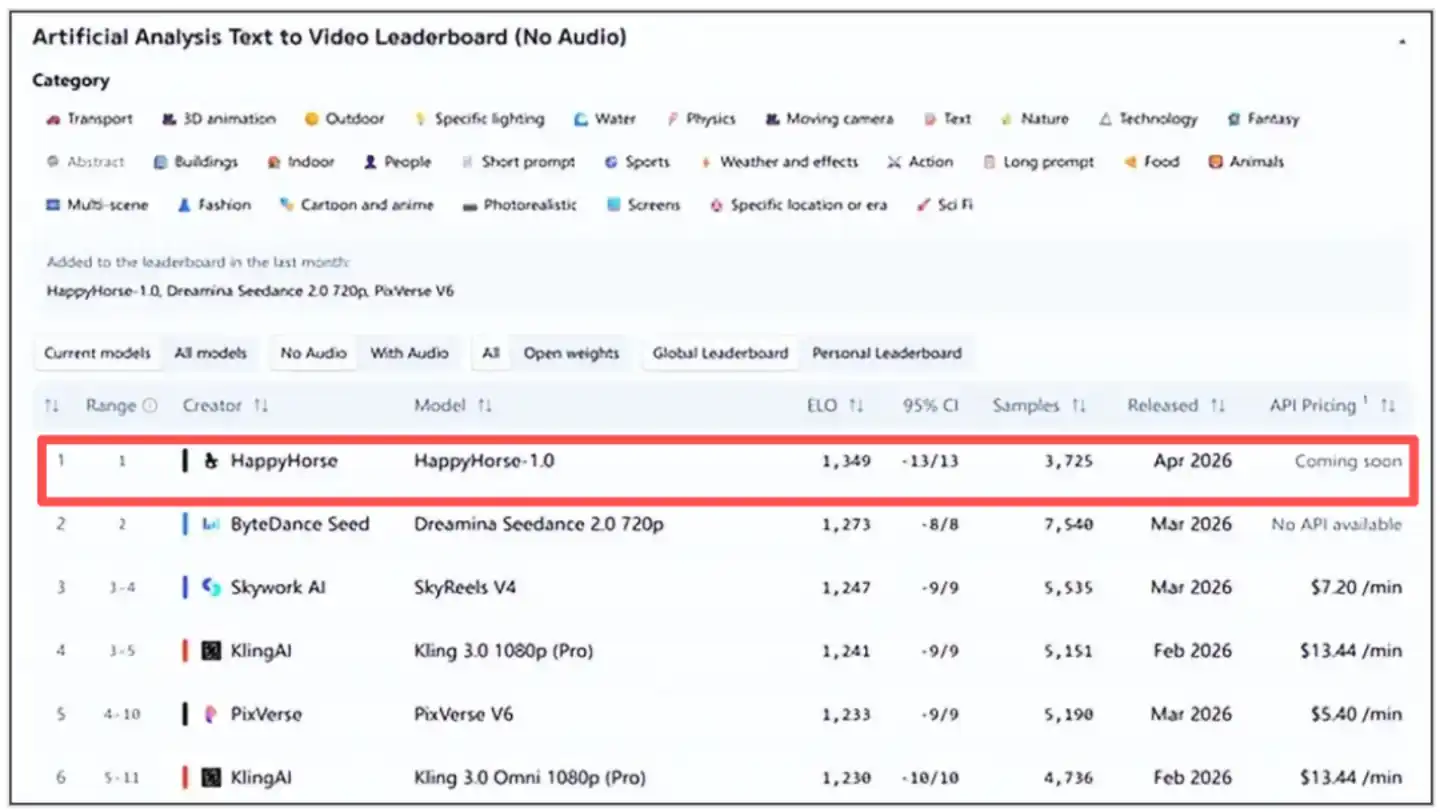
Figure: HappyHorse ranking on Artificial Analysis

Source: Internet

Over the past few days, because the "Happy Horse" was unclaimed, the market was full of curiosity about the origin of this "horse," leading the tech community to collectively play "Sherlock Holmes" to dig into its background.

At that time, many analyses pointed out that "Happy Horse" was an Alibaba product.

The analysis indicated two main evidence chains: first, the technical path displayed by HappyHorse has a very high affinity with the architecture of the Wan 2.6 series just released by Alibaba's Tongyi Lab; second, the return of key figures, Zhang Di, known as the "Father of Kling," who returned to Alibaba at the end of 2025, might have led the team to complete this product in just five months.

After the market "detectived" for a few days, on April 10th, Alibaba finally confirmed that the HappyHorse video model is a model developed by its innovation business unit and is currently in internal testing, with the API interface expected to be launched on April 30th.

It is said that the ATH Innovation Business Unit has launched an exploration plan for a new interactive方式 in the AI era, and HappyHorse is part of this exploration direction. More products will be launched陆续.
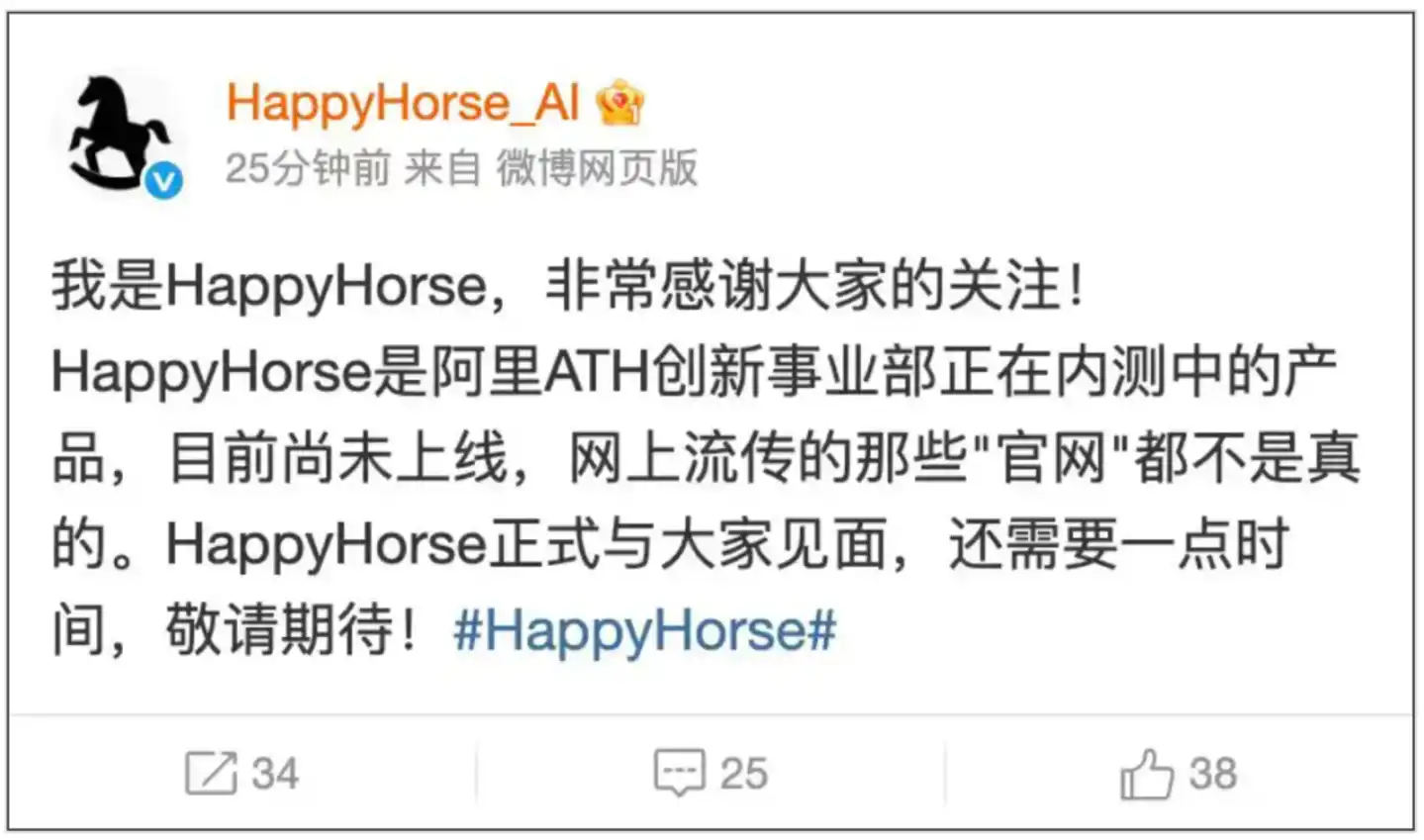
Figure: Alibaba confirms HappyHorse as its product

Source: Weibo 《Tingtong Tech》 Screenshot

At the same time, news indicated that the product was not completed by Zhang Di's team but by Zheng Bo's team from ATH.

Zheng Bo is an Alibaba Group Vice President. Public information shows that Zheng Bo holds a Ph.D. from the Tsinghua University Computer Science Department and joined Alibaba in September 2017. He has served as the head of Taobao Search and Recommendation Algorithms, CTO of Alimama, and head of algorithm technology for Taotian Group. His main research areas include large models, multimodal AI, decision intelligence, deep learning, advertising algorithms, and engine optimization.

This "claiming" news was not surprising to the market. Many analyses pointed out that the emergence of the "Happy Horse" means that Alibaba has completed a leap from "catching up" to "leading" in the multimodal field.

More importantly, this is not just a simple technical muscle show but a strategic "surprise attack" by Alibaba.

In the past, although Qwen was aligned internationally in text models, it rarely had products that captured user mindshare in the AI video track, which has the shortest path to commercialization. The performance of "Happy Horse"验证了 that Alibaba is maintaining a fast offensive pace in full-stack AI.

The market pointed out that the birth of "Happy Horse" accelerates the process of AI video generation moving from the laboratory to commercialization, becoming the "new quality productive forces" for the content industry.

An AI creator, Lin Shao, told 《Tingtong Tech》 that with the rapid iteration of "Happy Horse" and Seedance 2.0, AI video is transforming from a "toy" to a "tool".

Particularly important is that "Happy Horse" has changed the overall industry landscape of AI video large models, marking the entry of the AI video track into a new stage of multi-power melee.

More analyses pointed out that the impact on the former AI video "leader" Kling AI is especially obvious. Lin Shao直言, "Under the influence of Seedance 2.0 and Happy Horse, a 'double strangulation' pattern has formed against Kling AI."

-02- Alibaba's AI Formation

In fact, besides the "Happy Horse," Alibaba has明显 accelerated the推进 speed of its full-stack AI products in the past period.

From late March to early April 2026, Alibaba's Tongyi Lab completed a "triple release" of the full-modal large model Qwen3.5-Omni, the image generation model Wan2.7-Image, and the large language model Qwen3.6-Plus at a "daily update" pace.

This also allowed Alibaba to achieve全方位 matrix coverage of the underlying foundation (Qwen), vertical applications (Coding), and multimodal video (HappyHorse/Wanxiang).

According to a report by China National Radio, Qwen3.6Plus performed on par with or even surpassed competitors with 2 to 3 times larger parameter scales in programming capability evaluations. Just one day after its release, the model rushed to the top of the OpenRouter daily chart, with daily call volume breaking 1.4 trillion Tokens, setting a global record.
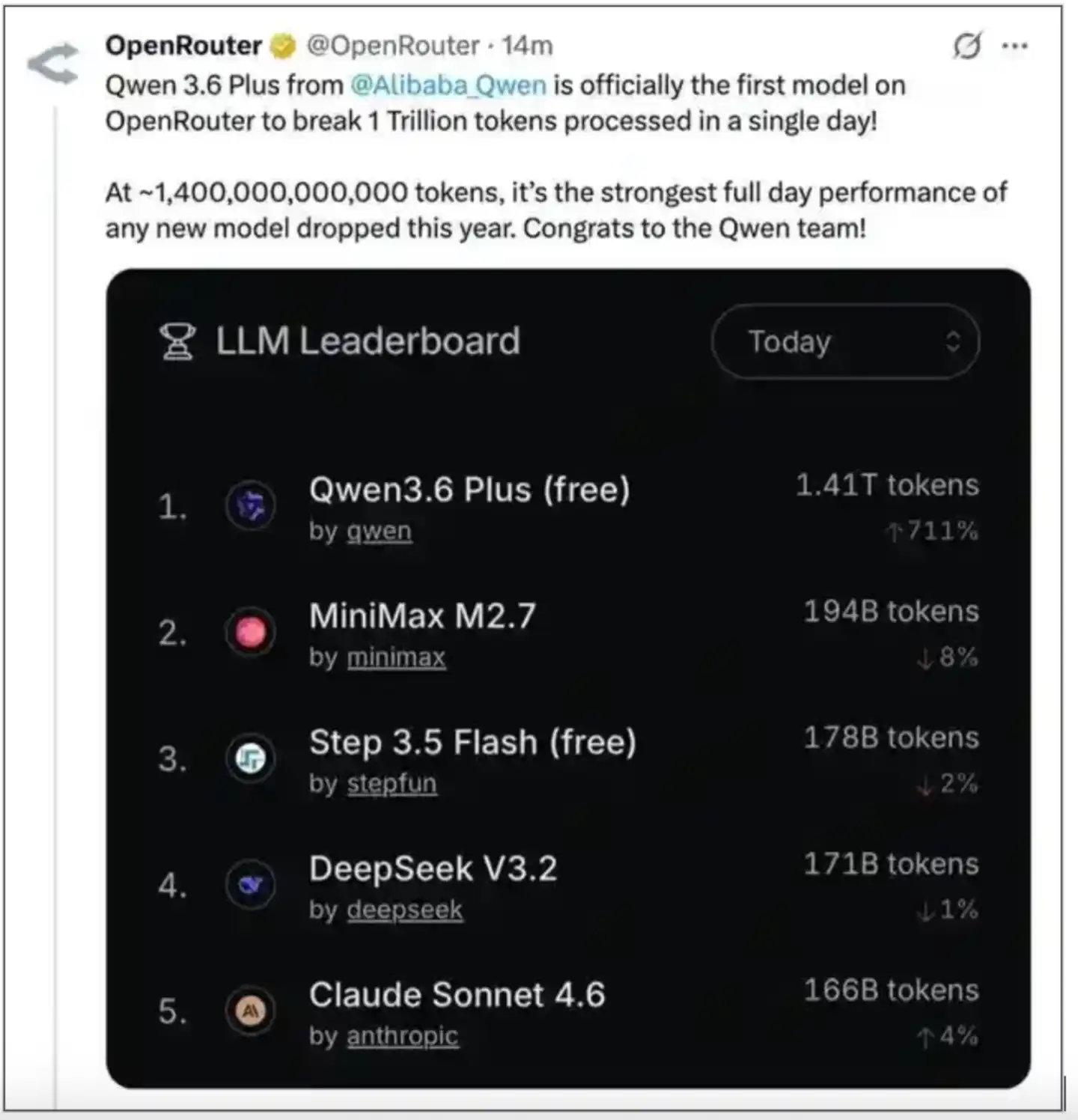
Figure: Qwen3.6Plus tops the OpenRouter daily chart

Source: Internet

Many analyses believe that this density and speed恍惚间让人看到当年阿里在电商领域“碾压一切”的气势 (vaguely reminds people of Alibaba's "crushing everything" momentum in the e-commerce field back in the day).

Actually, Alibaba's offensive is far more than just quickly deploying troops to seize positions.

Public information shows that the Qwen series has already produced multiple data points. As of January 2026, the cumulative downloads of the Tongyi Qianwen series models on the Hugging Face platform had exceeded 700 million, making it the most downloaded open-source AI series on the platform. By February, this number had exceeded 1 billion.

Performance on the C-end is同样亮眼. Public data shows that the monthly active users of the Qwen App have exceeded 300 million. By the end of February, nearly 140 million users had completed their first AI shopping through the Qwen App's智能体 function.

Call volume data also tells a story. According to the latest data from OpenRouter, the global call volume of Chinese AI large models has surpassed that of the US for five consecutive weeks, and two of the top three are models from Alibaba's Qwen 3.6 series.

This strategy is also being validated by the market. Alibaba's latest financial report data shows that Alibaba Cloud revenue increased by 36% year-on-year, and AI-related product revenue has achieved triple-digit year-on-year growth for the tenth consecutive quarter.

Of course, in the view of the market, Alibaba's ambition is far more than just making a few good models.

Judging from Alibaba's various actions in 2026, Alibaba is trying to重塑 its commercial底色, shifting from "selling goods" to "selling Tokens."

At Alibaba's earnings conference in March, Alibaba Group CEO Wu Yongming stated that in the future, relying on the full-stack AI capability of "large model + cloud + chip," and the comprehensive integration with Alibaba's business ecosystem, Alibaba will continue to exert efforts in both AI to B and to C directions.

Wu Yongming used "full-stack AI capability" to summarize Alibaba's core competitiveness, with chips and cloud computing as the AI infrastructure layer, and Token Hub as the main line, composed of large models, MaaS business, and ToB+ToC applications forming the AI model and application layer.

This system also nests chips, computing power, models, and applications layer by layer, forming a complete closed loop from the bottom to the front end.

This means that in the past, Alibaba's e-commerce story was about GMV and user growth; the cloud business story was about infrastructure and customer scale. Now, Alibaba is telling a new story, the full-stack AI story of "large model + cloud + chip".

-03- The Key to the "Sudden" Acceleration

Whether it is the emergence of the "Happy Horse" or the sudden acceleration of the Qwen series, the market has raised a question: Hasn't Alibaba's AI capability always been there? Why does it feel like this is a "sudden"爆发?

One of the key answers is "system."

In the past, Alibaba's AI could be described as "scattered." Damo Academy did research, Alibaba Cloud built platforms, and Taotian Group developed applications. Each had its own turf, inevitably leading to internal friction. Superficially, it looked like multiple points were blooming and advancing separately, but in reality, it wasted resources and was inefficient in coordination.

But all this was broken.

The change began this spring.

On March 16th, Alibaba established the Alibaba Token Hub (ATH) business group, personally led by CEO Wu Yongming. It includes the Tongyi Lab, MaaS business line, Qianwen business unit, Wukong business unit, and AI Innovation business unit, covering the complete chain from basic model R&D to personal and enterprise AI applications.

In the view of the market, the establishment of ATH is precisely about dismantling departmental barriers from the top-level design, eliminating the situation where model R&D, computing power supply, and application落地各自为战. The core logic is also very clear: "create Tokens, deliver Tokens, apply Tokens,"打通 the computing power layer, model layer, and application layer.

But this is not enough.

On April 8th, Alibaba conducted an even deeper organizational restructuring. Wu Yongming announced the establishment of a technology committee at the group level, with himself serving as the leader. Zhou Jingren serves as the Chief AI Architect of the technology committee, Li Feifei is responsible for Alibaba Cloud technology and AI cloud infrastructure construction, and Wu Zeming is responsible for the group's business technology platform and AI inference platform construction.

At the same time, the Tongyi Lab was officially upgraded to the "Tongyi Large Model Business Unit,"全面负责 by Zhou Jingren. This upgrade marks the shift of AI technology from R&D-oriented to full-scale commercial use.

Coupled with Li Feifei taking up the role of Alibaba Cloud CTO and Wu Zeming focusing on his group CTO work, Alibaba's AI governance architecture has formed a clear troika: the group technology committee is responsible for top-level design, the ATH business group is responsible for the business closed loop, and the Tongyi Large Model Business Unit is responsible for core R&D.

A series of system integrations also directly contributed to the recent "hat-trick" of密集 model releases.

Beyond organizational changes, the hardest force driving acceleration is money and resources.

For this AI battle, Alibaba's capital investment has reached the point of不计成本. In the latest quarterly report, Alibaba's free cash flow plummeted by 71% year-on-year. Where did the money go? There are two answers: one is burned on instant retail, and the other is burned on AI.

In the talent war, Alibaba also acted出击 quickly. Although it experienced the departure of people like Lin Junyang, it is understood that the personnel scale and technical梯队 of the Tongyi Lab were not substantially impacted.

Wu Yongming also responded in an internal letter that they will continue to increase AI R&D investment and the efforts to absorb outstanding talent. Additionally, the return of former Kuaishou VP and Kling technical负责人 Zhang Di in November 2025 is also a trophy of Alibaba's talent grab.

Especially in terms of the computing power base, in early 2025, Alibaba announced it would invest over 380 billion yuan in the next three years for云 and AI hardware infrastructure construction. In terms of T-Head's self-developed GPU chips, mass production has been achieved规模化. As of the end of February, cumulative deliveries had reached 470,000 units. This also means that Alibaba is摆脱 external dependence in computing power.

However, with such a big fanfare of burning money, does the capital market really buy it?

At least, judging from the current stock price reaction, the signal given by the market is that under the concept of organizational adjustment and "Happy Horse," Alibaba's stock price rose accordingly.

Of course, there are also different voices in the market.

E-commerce expert Cao Lei said that Alibaba also faces several challenges: how to balance centralization and business flexibility to avoid the technology committee becoming a "rubber stamp"; additionally, two major架构 adjustments in a short period may cause employee adaptation issues, affecting team stability.

Although the outcome is not yet determined, one fact is that Alibaba has shown sufficient sincerity in undertaking full-stack AI entrepreneurship.

This is a豪赌, concerning Alibaba's next ten years. And in the new round of organizational restructuring and ecological synergy, whether more "Happy Horses" will emerge is still worth waiting for the market.

(Header image generated by AI.)

(Disclaimer: This article is for information exchange only and does not constitute any investment reference advice.)


Domande pertinenti

QWhat is HappyHorse and why did it cause a stir in the AI community?

AHappyHorse is a video generation model developed by Alibaba's ATH Innovation Business Unit. It caused a stir because it unexpectedly topped the global evaluation platform Artificial Analysis with an Elo score of 1357, outperforming other video models. It was notable for its ability to generate high-definition videos with synchronized audio and sound effects from a script, significantly improving motion logic and efficiency.

QHow did the market initially react to HappyHorse before Alibaba confirmed it as their product?

ABefore Alibaba's confirmation, the market was highly curious and engaged in detective work to identify the origin of HappyHorse. Technical communities analyzed evidence such as its architectural similarities to Alibaba's Wan 2.6 series and the return of key personnel like Zhang Di, leading to widespread speculation that it was an Alibaba product.

QWhat organizational changes has Alibaba made to accelerate its AI development?

AAlibaba established the Alibaba Token Hub (ATH) business group, led by CEO Wu Yongming, to integrate AI efforts across research, platform, and application layers. They also set up a group-level technology committee with Wu Yongming as head, appointed key leaders like Zhou Jingren as Chief AI Architect, and upgraded the Tongyi Lab to the Tongyi Large Model Business Unit to focus on commercial scaling.

QWhat are some key achievements of Alibaba's AI models as mentioned in the article?

AAlibaba's Qwen3.6Plus model topped the OpenRouter daily chart with over 1.4 trillion token calls in a day, setting a global record. The Qwen series surpassed 1 billion downloads on Hugging Face, and the Qwen App reached 300 million monthly active users, with nearly 140 million users completing their first AI-powered shopping through it.

QWhat challenges does Alibaba face in its AI strategy according to the article?

AAlibaba faces challenges in balancing centralized control with business flexibility, ensuring the technology committee does not become a mere formality. Additionally, rapid organizational changes may cause employee adaptation issues and affect team stability. The company is also making significant financial investments, with free cash flow dropping 71% year-over-year, primarily due to spending on AI and instant retail.

Letture associate

First Batch of Keynote Speakers and Partners Announced! Web2+3 Summit: Defining the Next Generation of Digital Economy

Web2+3 Summit: Defining the Next Generation of Digital Economy The 6th BEYOND International Technology Innovation Expo (BEYOND Expo 2026), Asia's largest tech and ecosystem exhibition, is launching a dedicated Web2+3 stage for the first time. Co-hosted by BEYOND Expo and ChainNeXT Group, the Web3 Summit will take place from May 28–30, 2026. Against the backdrop of accelerating global tech integration, the boundaries between Web2 and Web3 are rapidly blurring. With clearer global regulations for blockchain-driven internet (Web3) and the special issuance of a Hong Kong dollar stable币 license by the Hong Kong SAR government on April 10, 2026, Web3's decentralized principles are quickly merging with traditional industries (Web2) such as e-commerce, finance, and artificial intelligence. Focused on blockchain-driven digital economy elements, the summit will center on three core principles—implementability, commercial viability, and compliance. It will bring together top Web3 experts to discuss key integration areas like stablecoin payment finance (PayFi), real-world asset tokenization (RWA), and decentralized AI (DeAI), unveiling new opportunities for industrial innovation. The first wave of confirmed speakers includes Jack Kong (Director of Hong Kong Cyberport, Chairman of Nano Labs), Yat Siu (Chairman of Animoca Brands), Michael Wu (Co-founder & CEO of Amber Group), Michael Heinrich (Co-founder & CEO of 0G), and Art Abal (Co-founder of Vana). More Web3 ecosystem pioneers, AI, and fintech experts will be announced soon. Core forum topics include: - Web2+DeAI: New AI Paradigms Driven by Decentralized Infrastructure - Web2+RWA: Real-World Asset Tokenization and Global Liquidity - Web2+PayFi: Cross-Border Payments and Financial Innovation Powered by Crypto Infrastructure - Web2+3 AI: Autonomous Agents and the Crypto Economy - Web2+3 Wealth: On-Chain and Off-Chain Integrated Investment Ecosystems - Web2+3 Commerce: A New Landscape for Global Trade Driven by Stablecoins Additional agenda details will be released in the near future.

marsbit4 h fa

First Batch of Keynote Speakers and Partners Announced! Web2+3 Summit: Defining the Next Generation of Digital Economy

marsbit4 h fa

Trading

Spot
Futures

Articoli Popolari

Cosa è $S$

Comprendere SPERO: Una Panoramica Completa Introduzione a SPERO Mentre il panorama dell'innovazione continua a evolversi, l'emergere delle tecnologie web3 e dei progetti di criptovaluta gioca un ruolo fondamentale nel plasmare il futuro digitale. Un progetto che ha attirato l'attenzione in questo campo dinamico è SPERO, denotato come SPERO,$$s$. Questo articolo mira a raccogliere e presentare informazioni dettagliate su SPERO, per aiutare gli appassionati e gli investitori a comprendere le sue basi, obiettivi e innovazioni nei domini web3 e crypto. Che cos'è SPERO,$$s$? SPERO,$$s$ è un progetto unico all'interno dello spazio crypto che cerca di sfruttare i principi della decentralizzazione e della tecnologia blockchain per creare un ecosistema che promuove l'impegno, l'utilità e l'inclusione finanziaria. Il progetto è progettato per facilitare interazioni peer-to-peer in modi nuovi, fornendo agli utenti soluzioni e servizi finanziari innovativi. Al suo interno, SPERO,$$s$ mira a responsabilizzare gli individui fornendo strumenti e piattaforme che migliorano l'esperienza dell'utente nello spazio delle criptovalute. Questo include la possibilità di metodi di transazione più flessibili, la promozione di iniziative guidate dalla comunità e la creazione di percorsi per opportunità finanziarie attraverso applicazioni decentralizzate (dApps). La visione sottostante di SPERO,$$s$ ruota attorno all'inclusività, cercando di colmare le lacune all'interno della finanza tradizionale mentre sfrutta i vantaggi della tecnologia blockchain. Chi è il Creatore di SPERO,$$s$? L'identità del creatore di SPERO,$$s$ rimane piuttosto oscura, poiché ci sono risorse pubblicamente disponibili limitate che forniscono informazioni dettagliate sul suo fondatore o fondatori. Questa mancanza di trasparenza può derivare dall'impegno del progetto per la decentralizzazione—un ethos che molti progetti web3 condividono, dando priorità ai contributi collettivi rispetto al riconoscimento individuale. Centrando le discussioni attorno alla comunità e ai suoi obiettivi collettivi, SPERO,$$s$ incarna l'essenza dell'empowerment senza mettere in evidenza individui specifici. Pertanto, comprendere l'etica e la missione di SPERO rimane più importante che identificare un creatore singolo. Chi sono gli Investitori di SPERO,$$s$? SPERO,$$s$ è supportato da una varietà di investitori che vanno dai capitalisti di rischio agli investitori angelici dedicati a promuovere l'innovazione nel settore crypto. Il focus di questi investitori generalmente si allinea con la missione di SPERO—dando priorità a progetti che promettono avanzamenti tecnologici sociali, inclusività finanziaria e governance decentralizzata. Queste fondazioni di investitori sono tipicamente interessate a progetti che non solo offrono prodotti innovativi, ma contribuiscono anche positivamente alla comunità blockchain e ai suoi ecosistemi. Il supporto di questi investitori rafforza SPERO,$$s$ come un concorrente degno di nota nel dominio in rapida evoluzione dei progetti crypto. Come Funziona SPERO,$$s$? SPERO,$$s$ impiega un framework multifunzionale che lo distingue dai progetti di criptovaluta convenzionali. Ecco alcune delle caratteristiche chiave che sottolineano la sua unicità e innovazione: Governance Decentralizzata: SPERO,$$s$ integra modelli di governance decentralizzati, responsabilizzando gli utenti a partecipare attivamente ai processi decisionali riguardanti il futuro del progetto. Questo approccio favorisce un senso di proprietà e responsabilità tra i membri della comunità. Utilità del Token: SPERO,$$s$ utilizza il proprio token di criptovaluta, progettato per servire varie funzioni all'interno dell'ecosistema. Questi token abilitano transazioni, premi e la facilitazione dei servizi offerti sulla piattaforma, migliorando l'impegno e l'utilità complessivi. Architettura Stratificata: L'architettura tecnica di SPERO,$$s$ supporta la modularità e la scalabilità, consentendo un'integrazione fluida di funzionalità e applicazioni aggiuntive man mano che il progetto evolve. Questa adattabilità è fondamentale per mantenere la rilevanza nel panorama crypto in continua evoluzione. Coinvolgimento della Comunità: Il progetto enfatizza iniziative guidate dalla comunità, impiegando meccanismi che incentivano la collaborazione e il feedback. Nutrendo una comunità forte, SPERO,$$s$ può affrontare meglio le esigenze degli utenti e adattarsi alle tendenze di mercato. Focus sull'Inclusione: Offrendo basse commissioni di transazione e interfacce user-friendly, SPERO,$$s$ mira ad attrarre una base utenti diversificata, inclusi individui che potrebbero non aver precedentemente interagito nello spazio crypto. Questo impegno per l'inclusione si allinea con la sua missione generale di empowerment attraverso l'accessibilità. Cronologia di SPERO,$$s$ Comprendere la storia di un progetto fornisce preziose intuizioni sulla sua traiettoria di sviluppo e sui traguardi. Di seguito è riportata una cronologia suggerita che mappa eventi significativi nell'evoluzione di SPERO,$$s$: Fase di Concettualizzazione e Ideazione: Le idee iniziali che formano la base di SPERO,$$s$ sono state concepite, allineandosi strettamente con i principi di decentralizzazione e focus sulla comunità all'interno dell'industria blockchain. Lancio del Whitepaper del Progetto: Dopo la fase concettuale, è stato rilasciato un whitepaper completo che dettaglia la visione, gli obiettivi e l'infrastruttura tecnologica di SPERO,$$s$ per suscitare interesse e feedback dalla comunità. Costruzione della Comunità e Prime Interazioni: Sono stati effettuati sforzi attivi di outreach per costruire una comunità di early adopters e potenziali investitori, facilitando discussioni attorno agli obiettivi del progetto e ottenendo supporto. Evento di Generazione del Token: SPERO,$$s$ ha condotto un evento di generazione del token (TGE) per distribuire i propri token nativi ai primi sostenitori e stabilire una liquidità iniziale all'interno dell'ecosistema. Lancio della Prima dApp: La prima applicazione decentralizzata (dApp) associata a SPERO,$$s$ è stata attivata, consentendo agli utenti di interagire con le funzionalità principali della piattaforma. Sviluppo Continuo e Partnership: Aggiornamenti e miglioramenti continui alle offerte del progetto, inclusi partnership strategiche con altri attori nello spazio blockchain, hanno plasmato SPERO,$$s$ in un concorrente competitivo e in evoluzione nel mercato crypto. Conclusione SPERO,$$s$ rappresenta una testimonianza del potenziale del web3 e delle criptovalute di rivoluzionare i sistemi finanziari e responsabilizzare gli individui. Con un impegno per la governance decentralizzata, il coinvolgimento della comunità e funzionalità progettate in modo innovativo, apre la strada verso un panorama finanziario più inclusivo. Come per qualsiasi investimento nello spazio crypto in rapida evoluzione, si incoraggiano potenziali investitori e utenti a ricercare approfonditamente e a impegnarsi in modo riflessivo con gli sviluppi in corso all'interno di SPERO,$$s$. Il progetto mostra lo spirito innovativo dell'industria crypto, invitando a ulteriori esplorazioni delle sue innumerevoli possibilità. Mentre il percorso di SPERO,$$s$ è ancora in fase di sviluppo, i suoi principi fondamentali potrebbero effettivamente influenzare il futuro di come interagiamo con la tecnologia, la finanza e tra di noi in ecosistemi digitali interconnessi.

75 Totale visualizzazioniPubblicato il 2024.12.17Aggiornato il 2024.12.17

Cosa è $S$

Cosa è AGENT S

Agent S: Il Futuro dell'Interazione Autonoma in Web3 Introduzione Nel panorama in continua evoluzione di Web3 e criptovalute, le innovazioni stanno costantemente ridefinendo il modo in cui gli individui interagiscono con le piattaforme digitali. Uno di questi progetti pionieristici, Agent S, promette di rivoluzionare l'interazione uomo-computer attraverso il suo framework agentico aperto. Aprendo la strada a interazioni autonome, Agent S mira a semplificare compiti complessi, offrendo applicazioni trasformative nell'intelligenza artificiale (AI). Questa esplorazione dettagliata approfondirà le complessità del progetto, le sue caratteristiche uniche e le implicazioni per il dominio delle criptovalute. Cos'è Agent S? Agent S si presenta come un innovativo framework agentico aperto, progettato specificamente per affrontare tre sfide fondamentali nell'automazione dei compiti informatici: Acquisizione di Conoscenze Specifiche del Dominio: Il framework apprende in modo intelligente da varie fonti di conoscenza esterne ed esperienze interne. Questo approccio duale gli consente di costruire un ricco repository di conoscenze specifiche del dominio, migliorando le sue prestazioni nell'esecuzione dei compiti. Pianificazione su Lungo Orizzonte di Compiti: Agent S impiega una pianificazione gerarchica potenziata dall'esperienza, un approccio strategico che facilita la suddivisione e l'esecuzione efficiente di compiti complessi. Questa caratteristica migliora significativamente la sua capacità di gestire più sottocompiti in modo efficiente ed efficace. Gestione di Interfacce Dinamiche e Non Uniformi: Il progetto introduce l'Interfaccia Agente-Computer (ACI), una soluzione innovativa che migliora l'interazione tra agenti e utenti. Utilizzando Modelli Linguistici Multimodali di Grandi Dimensioni (MLLM), Agent S può navigare e manipolare senza sforzo diverse interfacce grafiche utente. Attraverso queste caratteristiche pionieristiche, Agent S fornisce un framework robusto che affronta le complessità coinvolte nell'automazione dell'interazione umana con le macchine, preparando il terreno per innumerevoli applicazioni nell'AI e oltre. Chi è il Creatore di Agent S? Sebbene il concetto di Agent S sia fondamentalmente innovativo, informazioni specifiche sul suo creatore rimangono elusive. Il creatore è attualmente sconosciuto, il che evidenzia sia la fase embrionale del progetto sia la scelta strategica di mantenere i membri fondatori sotto anonimato. Indipendentemente dall'anonimato, l'attenzione rimane sulle capacità e sul potenziale del framework. Chi sono gli Investitori di Agent S? Poiché Agent S è relativamente nuovo nell'ecosistema crittografico, informazioni dettagliate riguardanti i suoi investitori e sostenitori finanziari non sono documentate esplicitamente. La mancanza di approfondimenti pubblicamente disponibili sulle fondazioni di investimento o sulle organizzazioni che supportano il progetto solleva interrogativi sulla sua struttura di finanziamento e sulla roadmap di sviluppo. Comprendere il supporto è cruciale per valutare la sostenibilità del progetto e il suo potenziale impatto sul mercato. Come Funziona Agent S? Al centro di Agent S si trova una tecnologia all'avanguardia che gli consente di funzionare efficacemente in contesti diversi. Il suo modello operativo è costruito attorno a diverse caratteristiche chiave: Interazione Uomo-Computer Simile a Quella Umana: Il framework offre una pianificazione AI avanzata, cercando di rendere le interazioni con i computer più intuitive. Mimando il comportamento umano nell'esecuzione dei compiti, promette di elevare le esperienze degli utenti. Memoria Narrativa: Utilizzata per sfruttare esperienze di alto livello, Agent S utilizza la memoria narrativa per tenere traccia delle storie dei compiti, migliorando così i suoi processi decisionali. Memoria Episodica: Questa caratteristica fornisce agli utenti una guida passo-passo, consentendo al framework di offrire supporto contestuale mentre i compiti si sviluppano. Supporto per OpenACI: Con la capacità di funzionare localmente, Agent S consente agli utenti di mantenere il controllo sulle proprie interazioni e flussi di lavoro, allineandosi con l'etica decentralizzata di Web3. Facile Integrazione con API Esterne: La sua versatilità e compatibilità con varie piattaforme AI garantiscono che Agent S possa adattarsi senza problemi agli ecosistemi tecnologici esistenti, rendendolo una scelta attraente per sviluppatori e organizzazioni. Queste funzionalità contribuiscono collettivamente alla posizione unica di Agent S all'interno dello spazio crittografico, poiché automatizza compiti complessi e multi-fase con un intervento umano minimo. Man mano che il progetto evolve, le sue potenziali applicazioni in Web3 potrebbero ridefinire il modo in cui si svolgono le interazioni digitali. Cronologia di Agent S Lo sviluppo e le tappe di Agent S possono essere riassunti in una cronologia che evidenzia i suoi eventi significativi: 27 Settembre 2024: Il concetto di Agent S è stato lanciato in un documento di ricerca completo intitolato “Un Framework Agentico Aperto che Usa i Computer Come un Umano”, mostrando le basi per il progetto. 10 Ottobre 2024: Il documento di ricerca è stato reso pubblicamente disponibile su arXiv, offrendo un'esplorazione approfondita del framework e della sua valutazione delle prestazioni basata sul benchmark OSWorld. 12 Ottobre 2024: È stata rilasciata una presentazione video, fornendo un'idea visiva delle capacità e delle caratteristiche di Agent S, coinvolgendo ulteriormente potenziali utenti e investitori. Questi indicatori nella cronologia non solo illustrano i progressi di Agent S, ma indicano anche il suo impegno per la trasparenza e il coinvolgimento della comunità. Punti Chiave su Agent S Man mano che il framework Agent S continua a evolversi, diversi attributi chiave si distinguono, sottolineando la sua natura innovativa e il potenziale: Framework Innovativo: Progettato per fornire un uso intuitivo dei computer simile all'interazione umana, Agent S porta un approccio nuovo all'automazione dei compiti. Interazione Autonoma: La capacità di interagire autonomamente con i computer attraverso GUI segna un passo avanti verso soluzioni informatiche più intelligenti ed efficienti. Automazione di Compiti Complessi: Con la sua metodologia robusta, può automatizzare compiti complessi e multi-fase, rendendo i processi più veloci e meno soggetti a errori. Miglioramento Continuo: I meccanismi di apprendimento consentono ad Agent S di migliorare dalle esperienze passate, migliorando continuamente le sue prestazioni e la sua efficacia. Versatilità: La sua adattabilità attraverso diversi ambienti operativi come OSWorld e WindowsAgentArena garantisce che possa servire un'ampia gamma di applicazioni. Man mano che Agent S si posiziona nel panorama di Web3 e delle criptovalute, il suo potenziale per migliorare le capacità di interazione e automatizzare i processi segna un significativo avanzamento nelle tecnologie AI. Attraverso il suo framework innovativo, Agent S esemplifica il futuro delle interazioni digitali, promettendo un'esperienza più fluida ed efficiente per gli utenti in vari settori. Conclusione Agent S rappresenta un audace passo avanti nell'unione tra AI e Web3, con la capacità di ridefinire il modo in cui interagiamo con la tecnologia. Sebbene sia ancora nelle sue fasi iniziali, le possibilità per la sua applicazione sono vaste e coinvolgenti. Attraverso il suo framework completo che affronta sfide critiche, Agent S mira a portare le interazioni autonome al centro dell'esperienza digitale. Man mano che ci addentriamo nei regni delle criptovalute e della decentralizzazione, progetti come Agent S giocheranno senza dubbio un ruolo cruciale nel plasmare il futuro della tecnologia e della collaborazione uomo-computer.

397 Totale visualizzazioniPubblicato il 2025.01.14Aggiornato il 2025.01.14

Cosa è AGENT S

Come comprare S

Benvenuto in HTX.com! Abbiamo reso l'acquisto di Sonic (S) semplice e conveniente. Segui la nostra guida passo passo per intraprendere il tuo viaggio nel mondo delle criptovalute.Step 1: Crea il tuo Account HTXUsa la tua email o numero di telefono per registrarti il tuo account gratuito su HTX. Vivi un'esperienza facile e sblocca tutte le funzionalità,Crea il mio accountStep 2: Vai in Acquista crypto e seleziona il tuo metodo di pagamentoCarta di credito/debito: utilizza la tua Visa o Mastercard per acquistare immediatamente SonicS.Bilancio: Usa i fondi dal bilancio del tuo account HTX per fare trading senza problemi.Terze parti: abbiamo aggiunto metodi di pagamento molto utilizzati come Google Pay e Apple Pay per maggiore comodità.P2P: Fai trading direttamente con altri utenti HTX.Over-the-Counter (OTC): Offriamo servizi su misura e tassi di cambio competitivi per i trader.Step 3: Conserva Sonic (S)Dopo aver acquistato Sonic (S), conserva nel tuo account HTX. In alternativa, puoi inviare tramite trasferimento blockchain o scambiare per altre criptovalute.Step 4: Scambia Sonic (S)Scambia facilmente Sonic (S) nel mercato spot di HTX. Accedi al tuo account, seleziona la tua coppia di trading, esegui le tue operazioni e monitora in tempo reale. Offriamo un'esperienza user-friendly sia per chi ha appena iniziato che per i trader più esperti.

782 Totale visualizzazioniPubblicato il 2025.01.15Aggiornato il 2025.03.21

Come comprare S

Discussioni

Benvenuto nella Community HTX. Qui puoi rimanere informato sugli ultimi sviluppi della piattaforma e accedere ad approfondimenti esperti sul mercato. Le opinioni degli utenti sul prezzo di S S sono presentate come di seguito.

活动图片