Manus Buyback Plan Emerges: Chinese Investors Plan to Repurchase Equity with $2 Billion, Path to Hong Kong IPO Becomes Clearer

marsbitPubblicato 2026-06-19Pubblicato ultima volta 2026-06-19

Introduzione

According to a report by The Information, early Chinese investors of Manus, including Tencent, Sequoia Capital China, and ZhenFund, are planning to repurchase the company from Meta for $2 billion—the same price Meta paid in its acquisition last December. This move is a direct response to the Chinese government's prohibition of the foreign acquisition in April. As part of the repurchase plan, Manus is considering establishing a Sino-foreign joint venture within China. This structure is seen as a way to ensure regulatory compliance for its Chinese investors and to pave the way for a future IPO in Hong Kong. Notably, U.S. investor Benchmark will not participate in the buyback, which will concentrate ownership even more among Chinese capital. Since its acquisition by Meta, Manus's business has grown rapidly, with its annualized revenue run rate reportedly increasing four-to-fivefold to $400-$500 million in roughly six months. This strong growth underpins the investors' willingness to repurchase at the original price. Financially, the forced unwinding of the deal may benefit the early investors, allowing them to regain equity at a cost far below the company's current implied valuation, with the added prospect of an independent future listing. However, specific terms of the repurchase, including funding proportions and the joint venture's equity structure, are still under negotiation. This "repurchase-joint venture-Hong Kong IPO" approach could serve as a reference model for oth...

By | 强调Next

According to a report by The Information on June 18, early Chinese investors of Manus plan to spend $2 billion, approximately 13.5 billion yuan, to buy back the company from Meta. The investors mentioned in the report include Tencent, Sequoia Capital China (formerly Sequoia Capital China Fund), and ZhenFund.

$2 billion was precisely the consideration Meta paid to acquire Manus in December last year. Liu Yuan, a partner at ZhenFund, publicly stated at the time that this was Meta's third-largest acquisition since its founding, only behind WhatsApp and Scale AI. Now history seems to be repeating itself, but with the roles of buyer and seller completely reversed.

1 · From Distributing Proceeds to Buyback

Insiders revealed that institutions such as Sequoia Capital China, ZhenFund, and Benchmark have already distributed the proceeds from the Meta acquisition to their respective limited partners. Tencent is also a party that has secured its gains.

After the acquisition was halted, Sequoia Capital China and ZhenFund did not ask LPs to return the already distributed profits. Instead, they intend to use newly raised funds to repurchase their respective Manus equity at Meta's original acquisition price. Tencent will also participate in this round of buyback.

It is worth noting that Benchmark will not participate in the buyback. An investor told The Information that this means Chinese investors will ultimately hold a larger proportion of Manus shares, and the company's equity structure will be more concentrated in Chinese capital than before the acquisition.

2 · Joint Venture Structure, Paving the Way for HK Listing

As part of the buyback plan, Manus is considering adjusting its corporate structure by establishing a Sino-foreign joint venture registered in mainland China. Foreign media analysis suggests this joint venture structure is designed to allow Chinese investors to continue holding the company's equity in compliance with regulations, while also preparing for a future Hong Kong IPO. The report states that Chinese investors plan to increase their capital in Manus in US dollars.

This buyback is widely interpreted as a direct response to the halt order issued in April this year. At that time, the Foreign Investment Security Review Office under the National Development and Reform Commission issued an announcement, prohibiting the "foreign acquisition of the Manus project" and requiring the parties involved to rescind the transaction and restore the original equity status.

Bloomberg previously reported two details. First, in May this year, Manus's three founders, Xiao Hong, Ji Yichao, and Zhang Tao, discussed raising about $1 billion from external investors to complete the buyback from Meta, with a valuation not less than the original $2 billion. The funding shortfall might be covered by the founding team with their own funds. Second, since June, Meta has severed the data connection between Manus and its internal systems, and notified employees to gradually migrate Manus-related projects to Meta's own systems, with no new Manus-related work to be initiated. The report by The Information is the most specific disclosure about the buyback plan to date.

3 · Business Data: Revenue Quadrupled or Quintupled in Half a Year

Insiders revealed that since being acquired by Meta, Manus's performance has been growing rapidly. Its current annualized revenue run rate has climbed to $400-500 million, approximately 2.7 to 3.4 billion yuan. At the time of the Meta acquisition, this figure was only $100 million, about 680 million yuan.

In other words, from its acquisition in December last year to now, Manus's revenue scale has increased four to fivefold in about half a year. This growth rate is also a key reason investors are willing to repurchase at the original price rather than trying to bargain for a lower price.

4 · Who Wins

From a financial perspective, the rescission of this acquisition might actually benefit Manus's early investors. Two insiders analyzed that the investors essentially get to reclaim the company's equity at a cost far below its current sale valuation. Furthermore, Manus has the opportunity to pursue an independent listing in the future, no longer needing to be part of the Meta ecosystem.

However, details are still being finalized. Both insiders emphasized that specific terms of the buyback transaction, including the funding ratio, equity design of the joint venture company, and the pace of capital increase, are still under negotiation.

Manus's financing journey has been quite legendary. In the Seed round in February 2023, ZhenFund invested about $3 million, resulting in a post-money valuation of $14 million; in the Angel round in August of the same year, the valuation rose to $50 million; in the Series A round in November 2024, Sequoia Capital China, Tencent, ZhenFund, and Wang Huiwen jointly invested, valuing the company at $85 million; in the Series B round in April 2025, led by Benchmark, the valuation approached $500 million. In just over two years, the valuation increased over a hundredfold, only to be acquired by Meta for $2 billion at the end of last year.
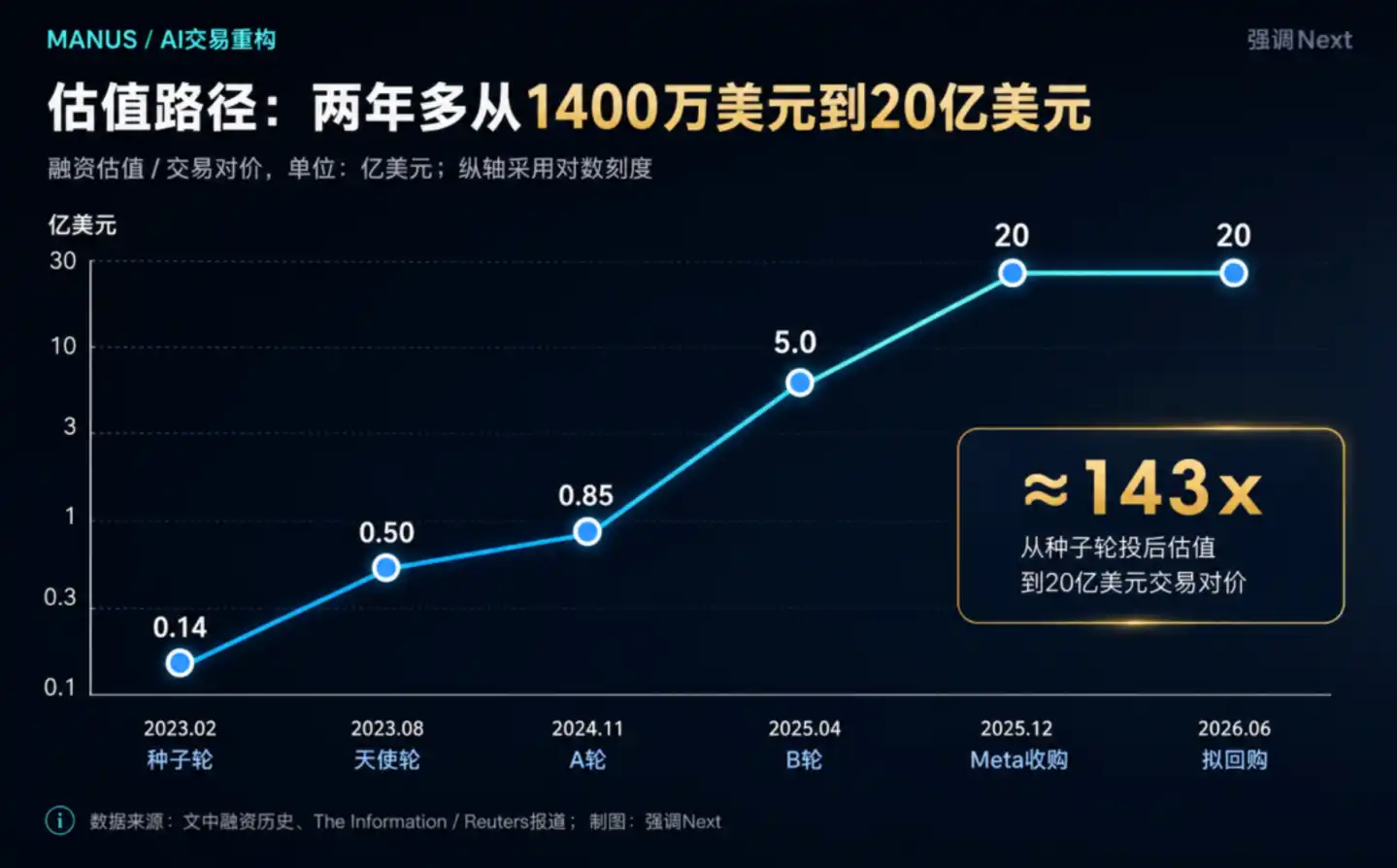
Now, this transaction is being rolled back. For Chinese AI startups, Manus's combination of "buyback + joint venture + Hong Kong IPO" might become a reference case for handling compliance issues in cross-border M&A going forward.


Domande pertinenti

QWhat is the reported plan of Manus' early Chinese investors regarding Meta's ownership, and what is the proposed amount?

AThe early Chinese investors, including Tencent, Sequoia Capital China (formerly Sequoia Capital China Fund), and ZhenFund, plan to repurchase Manus from Meta for $2 billion. This is the same amount Meta paid to acquire the company in December of last year.

QAccording to the article, what is the primary reason behind establishing a Sino-foreign joint venture as part of the repurchase plan?

AThe primary reason for considering a Sino-foreign joint venture structure is to allow the Chinese investment parties to compliantly hold equity in the company and, simultaneously, to pave the way for a future initial public offering (IPO) in Hong Kong.

QHow has Manus's business performance changed since its acquisition by Meta, according to the article?

ASince being acquired by Meta, Manus's business has grown rapidly. Its annualized revenue run rate has climbed to $400-$500 million, which is approximately four to five times the $100 million rate at the time of the Meta acquisition around six months prior.

QWhy does the article suggest the forced divestment might be financially beneficial for Manus's early investors?

AThe article suggests it might be a financial benefit because the investors can repurchase their equity at the original acquisition price of $2 billion, which is likely far lower than the company's current valuation given its rapid revenue growth. This allows them to regain ownership at a favorable cost, with the potential for an independent IPO in the future.

QWhich major early investor, mentioned in the article, has decided not to participate in the repurchase plan?

ABenchmark, a major early investor that led Manus's Series B funding round, has decided not to participate in the repurchase plan led by the Chinese investment consortium.

Letture associate

CPU Makes a Comeback to the Table, A $170 Billion "Power Seizure" Drama Begins

A new era is dawning for the server CPU (Central Processing Unit), driven by the shift from AI model training to large-scale reasoning and the rise of Agentic AI. This article explores how the CPU is reclaiming a central role in the AI data center. For years, the focus has been on the GPU (Graphics Processing Unit) for AI training. However, as AI moves to the inference and Agent phase—where tasks involve complex, multi-step reasoning, tool calls, and data management—the workload balance is flipping. Studies show CPUs now handle over 70% of the workload in Agentic AI, up from 10-30% in training. This is because Agent tasks generate massive intermediate data (KV Cache) that exceeds GPU memory, forcing it to be offloaded to the CPU's larger, more scalable memory pools. This increased importance is translating into market changes. Major players are taking note: NVIDIA launched its first standalone CPU line, Vera, based on ARM architecture and optimized for Agent performance. AMD doubled its server CPU market forecast to over $1200 billion by 2030. Analyst reports project the total server CPU market could reach $1700 billion by 2030, with AI-driven demand being a primary driver. Furthermore, the classic ratio of CPUs to GPUs in AI servers is rapidly changing, converging from 1:8 toward 1:1 for Agent deployments. This surge in demand has led to a rare industry-wide price increase of 10-15% for server CPUs from Intel and AMD, breaking a decade-long trend of "more performance for the same price." Demand is bifurcating into high-core-count CPUs for in-rack GPU support and moderate-core CPUs for standalone Agent task orchestration. In China, this global trend presents an opportunity for domestic CPU manufacturers like Hygon (海光信息) and Huawei Kunpeng, who are bolstered by both growing AI infrastructure needs and national policies promoting technological self-reliance ("xin chuang"). The maturity of their software ecosystems is also accelerating, evidenced by faster adaptation to new AI models. In conclusion, the narrative is shifting from a GPU-centric view to one where CPU-GPU synergy is critical. The CPU is no longer a peripheral component but a performance-defining bottleneck and a key growth driver in the AI hardware stack, opening a massive new market estimated in the hundreds of billions of dollars.

marsbit6 h fa

CPU Makes a Comeback to the Table, A $170 Billion "Power Seizure" Drama Begins

marsbit6 h fa

TechFlow Intelligence: AMD AI Director Publicly Criticizes Claude Code for "Becoming Dumber and Lazier", Trump Claims Full Ceasefire in Hormuz But Strait Still Has 80 Unexploded Mines

TechFlow Intelligence Report: This daily digest covers key developments in AI, crypto, hardware, and geopolitics. In AI, SK Telecom faces US export control scrutiny over its partnership with Anthropic, while a Gemini user reports being misled in a scam scenario, sparking safety debates. China's Z.AI launches the GLM-5.2 model, rivaling Claude Opus without NVIDIA chips. In crypto, Bithumb lists ReProtocol, and Upbit delists KernelDAO. On the hardware front, MIT researchers build a custom OS to study chips, ASML denies US claims its advanced lithography machines are in China, and Amazon considers selling its in-house AI chips. Apple's future A21 Pro chip may use TSMC's latest N2P process. Major tech issues include 10,000 GitHub repositories distributing malware and Apple patching a critical eavesdropping flaw in Beats earbuds. US stocks rise, led by semiconductors, with Intel surging 10.6%, while SpaceX falls 3.5%. Geopolitically, despite a US-Iran deal, the Strait of Hormuz remains risky with ~80 uncleared mines, stalling 80M barrels of oil on standby tankers. Iran postpones Switzerland talks, and Trump calls the agreement an "unconditional surrender." The report highlights a contrast: temporary geopolitical calm versus the ongoing, fundamental restructuring of tech supply chains and chip independence.

marsbit6 h fa

TechFlow Intelligence: AMD AI Director Publicly Criticizes Claude Code for "Becoming Dumber and Lazier", Trump Claims Full Ceasefire in Hormuz But Strait Still Has 80 Unexploded Mines

marsbit6 h fa

Trading

Spot
Futures
活动图片