Ethereum Foundation Cuts 20% of Staff, 54 Depart: The Survival Logic Behind the Restructuring

marsbitPubblicato 2026-06-24Pubblicato ultima volta 2026-06-24

Introduzione

The Ethereum Foundation (EF) has announced a major restructuring, resulting in the departure of 54 staff members, representing approximately 20% of its workforce. This reorganization is not merely a cost-cutting measure but a strategic refocusing. The EF will now concentrate its resources on what it deems critical and unique tasks, structured around five new operational clusters. The new structure comprises clusters dedicated to: the Protocol Layer (ensuring Ethereum's core properties like censorship resistance and security); the Access Layer (enabling trusted, non-intermediated user interactions); the User Layer (grounding decisions in real user needs and constraints); the Community Layer (representing EF's stance and building alliances); and the Institutional Layer (engaging with enterprises, governments, and academia to promote principled adoption). The foundation stated that the layoffs were a difficult but necessary step to align its organization and spending with its long-term mandate, insulating its core work from short-term market fluctuations. Affected employees were offered a severance package and transition support. The restructured EF emerges as a leaner and more focused organization, poised to prioritize the development and preservation of Ethereum's foundational promise of self-sovereignty. Further details on the new operational model are expected in the coming weeks.

Author: Ethereum Foundation

Compilation: Deep Chao TechFlow

Deep Chao Intro: The Ethereum Foundation (EF) has announced a 20% reduction in staff, with 54 people leaving, and has completed a months-long organizational restructuring. This is not a simple cost-cutting measure, but a strategic contraction—the Foundation is concentrating resources on the critical tasks that "only EF can and must do," reorganized into five major clusters. For investors, this signals Ethereum's shift from broad-scatter efforts to focusing on the protocol layer and sovereignty guarantees, but also exposes the financial pressure on non-profit organizations during the bear market.

Today, the Ethereum Foundation (EF) is changing form, concluding a months-long restructuring process, part of implementing our Mandate and treasury management policies.

The restructured EF has the structure, activities, and personnel needed to execute critical future missions. However, 54 colleagues have also departed, representing about 20% of EF's total staff. Many of them will continue contributing to Ethereum in other ways in the coming weeks.

This article briefly introduces the new structure and details how we are supporting those leaving.

New Structure

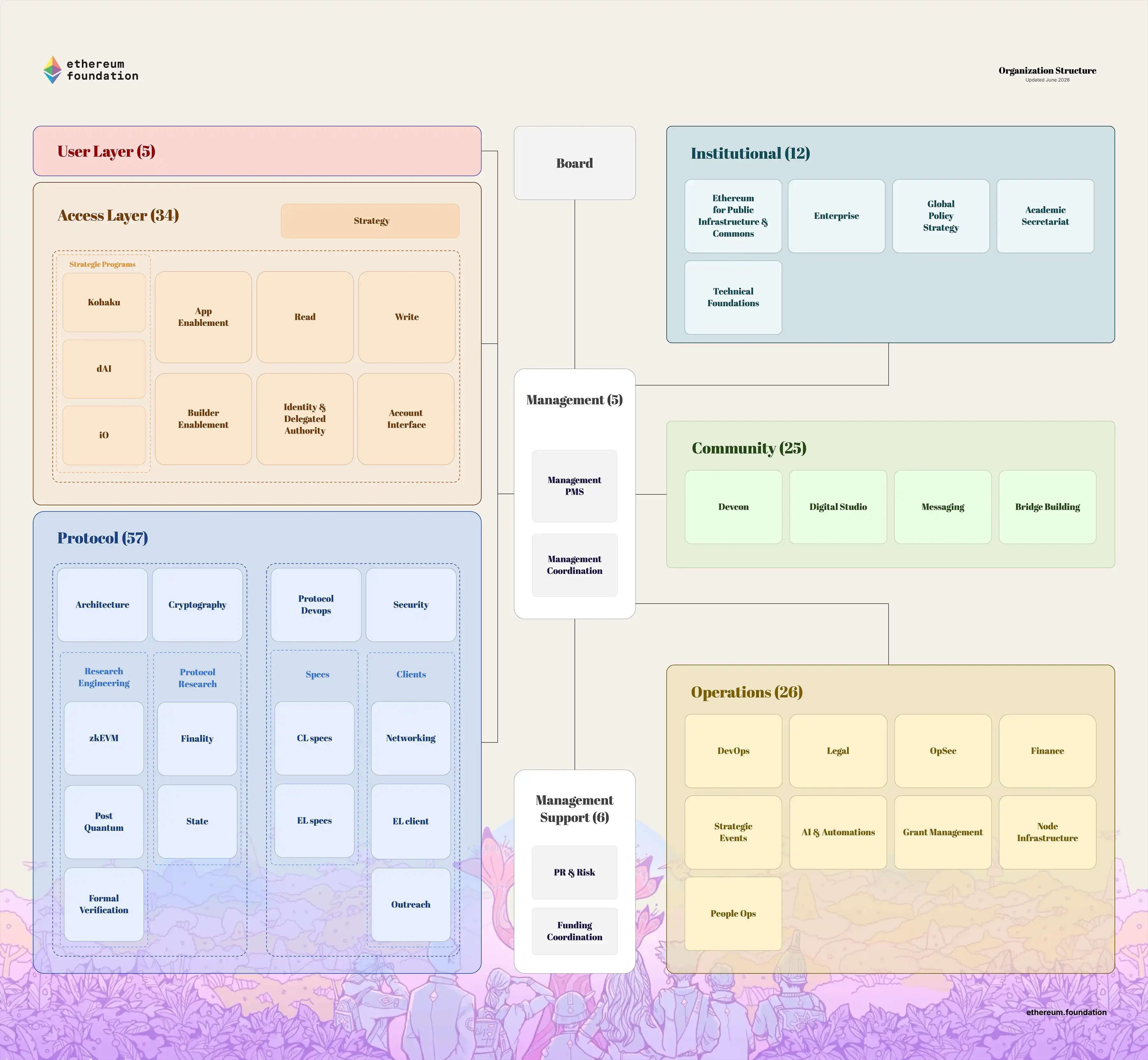
EF now has five clusters, each responsible for a different work area—Protocol Layer, Access Layer, User Layer, Community Layer, and Institutional Layer—plus a cluster focused on operations and a cluster comprising management and teams directly supporting management.

Each work area requires different approaches, is accountable for different types of outcomes, and has a different internal structure tailored to the required workload. We will share more details next month; today, only the highest-level overview is provided.
Protocol Layer

The Protocol cluster carries EF's legacy and responsibility, ensuring Ethereum delivers on its fundamental promise to scale self-sovereignty. It does this by laying the groundwork for strengthening and scaling the Ethereum protocol itself. Its goal is to ensure the Ethereum protocol continues to execute on the properties worth defending: censorship and capture resistance, openness and openness-source, and privacy and security as non-negotiable protocol guarantees.

The Protocol cluster exists to ensure the core protocol advances without compromising sovereignty guarantees. It does not exist to make Ethereum more marketable or focused on short-term interests, nor to make it easier to become another financial rail controlled by intermediaries. Its work is to make Ethereum harder to corrupt or capture, and easier to rely on when counterparties fail, platforms censor, governments overreach, or intermediaries extract rent. This means safely delivering forks, reducing unnecessary complexity, minimizing trusted dependencies, protecting transaction pipelines from harmful MEV and privileged order flow, and accelerating and translating long-term research like post-quantum security, zkEVM, and L1 privacy into protocol changes that preserve and improve sovereignty at scale.

Access Layer

The Access layer is where Ethereum serves—or fails—individuals who actually need CROPS properties. This cluster's work is to make self-sovereignty usable, understandable, and sustainable in critical operations: reading the chain, transacting, proving, delegating, and exiting. These operations must support users, and increasingly agents acting on their behalf, who must be able to read current state, history, and related data without relying on unverifiable intermediaries. They should be able to transact privately and without censorship risk, with outcomes either guaranteed or failing for free if conditions aren't met. As more work shifts to agents, users must retain control, grant limited permissions and revoke at will, and keep custody of their intent rather than exposing it to intermediaries. The interface, from silicon to front-end, must be verifiable, understandable, and recoverable, regardless of frequency of use or depth of technical knowledge.

The principle applied by this cluster is zero option: for every intermediated path, a credible, non-intermediated path must exist and remain accessible. Strategically, this means identifying where stronger CROPS properties can be applied to current infrastructure, and acknowledging that credible alternatives are necessary where economic incentives tend toward aggregation, identification, and control.

User Layer

The User Layer cluster grounds EF's work in the users and organizations with a material interest in using Ethereum self-sovereignly, and extends the tools and norms of such use as broadly as possible. It helps EF understand the most important capabilities, the most severe failure modes, and the trade-offs that are acceptable when necessary.

Its work includes user segmentation, roles, educational materials, use case studies, and impact assessments. The goal is not for EF to become a product studio, but to ensure decisions at the Protocol and Access layers are shaped by real current and potential users, real constraints, and real measures of sovereignty.

Community Layer

The Community cluster is responsible for how EF shows up in the world, both within and outside the Ethereum ecosystem. Its work is to make clear the positions EF represents, and how this differs substantively from zero-sum financial crypto, from crypto compromised by corporations, and from the mundane, status-quo-preserving, incentive-distorted, geostrategic-interest-laundering parts of non-profit grant management. EF commits to maximizing its community value by remaining independent from these and other counterproductive entanglements.

This cluster also builds EF's relationships beyond crypto. Self-sovereignty has natural allies in free and open source, security and local-first software and hardware, privacy and cryptography research and advocacy, and civil liberties, decentralized web, and public interest technology spaces. The cluster works to ensure the overlap between Ethereum and these fields is productive, non-coercive, and high-quality.

Institutional Layer

This cluster is responsible for EF's collaboration with institutions that shape how end users interact with Ethereum through institutional intermediary paths. This can include financial institutions, whether consumer payments, insurance, or others. It can include non-financial enterprises, covering manufacturing, social, publishing, and many other industries. It can include government applications. It can include universities or other non-profits.

In all cases, the goal is to prioritize creating showcase examples of Ethereum and crypto integration that maximize CROPS properties and the guarantees offered to both institutions and users—such as guaranteeing fair and correct execution, ensuring data portability and more generally practical exit capabilities, protecting all participants' privacy, proving data authenticity, better detecting or even preventing malfeasance, and so on. We believe many businesses, governments, and non-profits will realize their incentives align with serving users in ways that strengthen sovereignty, while retaining the guarantees they need to create value or fulfill their mission, and that Ethereum and crypto can be part of achieving this. Beyond direct engagements, the Institutional cluster will pursue these goals by helping establish and thoughtfully communicate best practices, standards, reference architectures, and educational materials for institutional adoption.

The Institutional cluster also works upstream with academia and allied advocacy organizations worldwide to ensure Ethereum is understood correctly in its current form and potential, and to track and respond to policy and regulatory developments that might impact Ethereum's commitment to sovereign use and its core principles of censorship (and capture) resistance, open source, privacy, and security.

Departing Personnel

As part of changing EF's structure, activities, and spending shape, we parted ways with 54 colleagues today.

These decisions were difficult but necessary. We must configure resources and organize in a way that allows us to focus for years ahead on the critical work that only EF can—and therefore must—do, without excessive distraction from short-term market fluctuations.

To ensure leavers are prepared for the transition, the package offered includes severance and transition support. Severance is the higher of one month's salary per year worked at EF or the amount specified by local regulations in the individual's jurisdiction. This matches the severance we've provided to colleagues leaving EF over recent months. Transition support includes assistance finding new contributing positions in the ecosystem and a small transition grant specifically for individual transition costs (career coaching, etc.).

We are grateful to each of them for the talent, dedication, and time they contributed to Ethereum at EF and look forward to continuing to work alongside those who find a home elsewhere in the ecosystem.

What's Next

The EF that emerges from this change is leaner and more focused. We'll share more in the coming weeks and months about how our work is changing and how the ecosystem can best engage with the new structure.


Crypto di tendenza

Domande pertinenti

QWhat is the main reason behind the Ethereum Foundation's 20% staff reduction and organizational restructuring?

AThe main reason is a strategic contraction to focus the Foundation's limited resources on critical tasks that 'only the EF can do and must do.' This involves shifting from a broad-scope approach to concentrating on the protocol layer and self-custody guarantees. The restructuring aims to ensure the EF can fulfill its core mission despite financial pressures in a bear market, reorganizing into five key clusters.

QWhat are the five new operational clusters within the restructured Ethereum Foundation?

AThe five new clusters are: 1) Protocol Layer, 2) Access Layer, 3) User Layer, 4) Community Layer, and 5) Institutional Layer. Additionally, there is an Operations cluster and a management cluster.

QAccording to the article, what is the primary mission of the Protocol Layer cluster?

AThe Protocol Layer cluster's primary mission is to ensure the Ethereum protocol fulfills its fundamental promise of scaling self-custody and upholds its core properties: censorship and capture resistance, open source, and privacy and security as non-negotiable protocol guarantees. Its work focuses on delivering safe protocol upgrades and long-term research like zkEVM and post-quantum security.

QHow is the Ethereum Foundation supporting the 54 employees who are leaving?

AThe Foundation is providing a severance package and transition support. The severance pay is the greater of one month's salary per year of service or the local statutory requirement. Transition support includes assistance finding new roles within the ecosystem and a small transition grant for expenses like career coaching.

QWhat does the 'zero-option' principle mentioned for the Access Layer cluster refer to?

AThe 'zero-option' principle means that for every intermediary-dependent path for users to interact with Ethereum, there must be a trustworthy, non-intermediated path available and accessible. This ensures users always have an option that preserves the core CROPS properties (likely related to censorship-resistance, openness, privacy, security).

Letture associate

Report Analysis: What Is Coherent Planning as CPO Booms?

Title: Report Interpretation: What Moves Is Coherent Making Amid the CPO Boom? Summary: JP Morgan analyst Samik Chatterjee reiterates an Overweight rating on Coherent (COHR), citing undervalued growth potential across three core areas: data center optical transceivers, co-packaged optics (CPO) chips, and industrial lasers/thermal management. COHR's 1.6T data center transceivers are in high demand, with pricing remaining firm. The rise of CPO is seen not as a threat but as a catalyst, creating higher demand for sophisticated optical components, an area where COHR holds a competitive edge with its comprehensive portfolio (lasers, isolators, VCSELs, thermoelectric coolers). Each CPO chip offers significantly greater revenue potential than traditional transceivers. Furthermore, its Optical Circuit Switch (OCS) technology targets a potential $4B market with reliability and power advantages. The company is expanding its InP (Indium Phosphide) device capacity fourfold within two years, securing substrate supply and transitioning to more cost-effective 6-inch wafers. As one of only two major suppliers of high-quality pump lasers—currently in severe shortage—COHR can now move up the value chain from components to complete line cards/systems, boosting ASP over tenfold. Gross margin targets (>42%) may be revised upward due to high-end product premiums, cost improvements from the wafer transition, and contributions from new high-margin products like CPO and OCS. Its efficient thermadite thermal material also offers long-term growth. Industrial segment revenue grows at a steady 5-10%, supported by semiconductor equipment orders. Changes in Apple's Face ID protocol present a re-competition opportunity for 3D sensing. Overall, Coherent is positioned as a key infrastructure provider, with AI-driven compute demand fueling the need for high-speed optical interconnectivity. Growth from CPO/OCS, stable industrial performance, and margin improvement support the bullish thesis. *Disclaimer: This summary interprets a third-party analyst report from JP Morgan. It does not constitute investment advice.*

marsbit24 min fa

Report Analysis: What Is Coherent Planning as CPO Booms?

marsbit24 min fa

After Laying Off 20% of Staff, What Are the Key Points of EF's New Structure?

Following the completion of a months-long organizational restructuring, the Ethereum Foundation (EF) announced a 20% workforce reduction (approximately 54 employees) on June 23rd. It reorganized its teams into five new core clusters: Protocol, Access, User, Community, and Institutional (plus Operations/Management support units). Officially, this move implements the EF's 2026 Mandate and 2025 Treasury Management Policy, aiming to create a more focused and "self-sovereign" organization. The restructuring prioritizes the CROPS principles—Censorship Resistance, Openness & Freedom, Privacy, and Security—as foundational organizational tenets. The Protocol cluster will focus on core protocol R&D, including MEV reduction and zkEVM. The Access cluster emphasizes preserving user "zero option" for non-custodial, permissionless interaction. The User, Community, and Institutional clusters will manage external engagement, with the latter handling institutional and regulatory matters. While offering enhanced severance and transition support for affected employees, the EF did not disclose budget allocations or specific KPIs for the new clusters. This has led to market uncertainty about the impact on project funding and development priorities. Analysts note the announcement's positive tone of mission focus contrasts with a backdrop of recent EF leadership changes and broader ecosystem pressures. The true impact—whether this signifies strategic realignment or reactive contraction—will become clearer as the new structure's resource allocation and project prioritization are revealed in the coming months.

marsbit34 min fa

After Laying Off 20% of Staff, What Are the Key Points of EF's New Structure?

marsbit34 min fa

Top-Tier MEV Bot Loses $7.5 Million: Is 'Approval' the Most Overlooked Fatal Risk On-Chain?

The article discusses a sophisticated attack on a prominent Ethereum MEV (Miner Extractable Value) bot, Jaredfromsubway.eth, resulting in a loss exceeding $7.5 million. Unlike typical exploits involving key leaks or smart contract bugs, this attack was a carefully orchestrated "reverse hunt." The attacker spent weeks deploying fake tokens and liquidity pools that mimicked legitimate assets like WETH and USDC. These pools were designed to appear as profitable arbitrage opportunities, tricking the automated bot's trading logic. During its normal operation, the bot was induced to grant ERC-20 token approvals to the malicious contracts. Once sufficient permissions were accumulated, the attacker drained the bot's funds by calling these pre-approved allowances. This incident highlights the often-underestimated risks associated with token approvals in Web3. The article explains that approvals are a fundamental mechanism, allowing smart contracts (like DEXs) to move a user's tokens on their behalf. However, risks arise from practices like granting infinite approvals, the persistence of approvals even after disconnecting from a dApp, and the potential for a once-trusted contract to become compromised later. The piece concludes with advice for managing approval risks: users should adopt the principle of least privilege (approving only the needed amount), use separate wallets for storage versus interactions, and regularly audit and revoke unnecessary approvals using tools like Revoke.cash. It also emphasizes the role of wallets like imToken in providing proactive defenses, such as risk warnings and clear, readable transaction signing interfaces, to help users make informed decisions. Ultimately, wallet security must extend beyond private key protection to include active management of token approvals.

marsbit39 min fa

Top-Tier MEV Bot Loses $7.5 Million: Is 'Approval' the Most Overlooked Fatal Risk On-Chain?

marsbit39 min fa

Precious Metals Decline Alongside, What Signal is Gold Sending to the Market?

Gold and silver prices have declined recently, moving in tandem with a sell-off in risk assets like South Korean semiconductor stocks. This is unusual, as gold typically rises when equities fall due to its safe-haven status. The synchronized drop signals a shift in market focus: it's not about finding safety, but about the rising cost of holding assets that do not yield interest. This cost is the real interest rate. The key driver is a change in Federal Reserve policy expectations under new Chair Kevin Warsh. Despite holding rates steady, the Fed's rhetoric has turned more hawkish, emphasizing persistent inflation risks. This has led markets to price in a "higher for longer" rate environment, increasing the appeal of cash and bonds while pressuring zero-yield assets like gold and tech stocks with high future cash flow valuations. Technically, gold breached the $4,100/oz support level, approaching the critical $4,000 psychological and technical zone. A break below could trigger accelerated selling from momentum traders and ETFs. While long-term supportive factors like central bank buying and geopolitical risks remain, short-term price action is dominated by liquidity and opportunity cost dynamics. The South Korean market meltdown, driven by crowded AI-trade unwinding, is a symptom—not the cause—of this broader macro repricing. Both markets are reacting to the same pressures: higher real rates and a stronger US dollar. In summary, the concurrent decline in equities and precious metals highlights that diverse assets can share exposure to a common macro variable—the price of money. The near-term path for gold and silver depends primarily on the persistence of Fed hawkishness, dollar strength, and real yields, which currently override their traditional safe-haven narratives.

marsbit48 min fa

Precious Metals Decline Alongside, What Signal is Gold Sending to the Market?

marsbit48 min fa

Trading

Spot
Futures

Articoli Popolari

Cosa è ETH 3.0

ETH3.0 e $eth 3.0: Un'Analisi Approfondita del Futuro di Ethereum Introduzione Nel panorama in rapida evoluzione delle criptovalute e della tecnologia blockchain, ETH3.0, spesso indicato come $eth 3.0, è emerso come un argomento di considerevole interesse e speculazione. Il termine comprende due concetti principali che warrantono chiarimenti: Ethereum 3.0: Questo rappresenta un potenziale futuro aggiornamento volto ad aumentare le capacità dell'attuale blockchain di Ethereum, concentrandosi principalmente sul miglioramento della scalabilità e delle prestazioni. ETH3.0 Meme Token: Questo progetto di criptovaluta distinto cerca di sfruttare la blockchain di Ethereum per creare un ecosistema incentrato sui meme, promuovendo il coinvolgimento all'interno della comunità delle criptovalute. Comprendere questi aspetti di ETH3.0 è essenziale non solo per gli appassionati di criptovalute, ma anche per coloro che osservano tendenze tecnologiche più ampie nello spazio digitale. Che cos'è ETH3.0? Ethereum 3.0 Ethereum 3.0 è pubblicizzato come un aggiornamento proposto per la rete Ethereum già stabilita, che è stata la spina dorsale di molte applicazioni decentralizzate (dApps) e contratti smart sin dalla sua nascita. I miglioramenti previsti si concentrano principalmente sulla scalabilità, integrando tecnologie avanzate come lo sharding e le prove a conoscenza zero (zk-proofs). Queste innovazioni tecnologiche mirano a facilitare un numero senza precedenti di transazioni al secondo (TPS), potenzialmente raggiungendo milioni, affrontando così una delle limitazioni più significative della tecnologia blockchain attuale. Il miglioramento non è meramente tecnico, ma anche strategico; è volto a preparare la rete Ethereum per un'adozione e un'utilità diffuse in un futuro contrassegnato da un aumento della domanda di soluzioni decentralizzate. ETH3.0 Meme Token Al contrario di Ethereum 3.0, l'ETH3.0 Meme Token si avventura in un dominio più leggero e giocoso, combinando la cultura dei meme di internet con la dinamica delle criptovalute. Questo progetto consente agli utenti di acquistare, vendere e scambiare meme sulla blockchain di Ethereum, fornendo una piattaforma che promuove il coinvolgimento della comunità attraverso la creatività e interessi condivisi. L'ETH3.0 Meme Token mira a dimostrare come la tecnologia blockchain possa intersecarsi con la cultura digitale, creando casi d'uso che siano sia divertenti che finanziariamente praticabili. Chi è il Creatore di ETH3.0? Ethereum 3.0 L'iniziativa verso Ethereum 3.0 è principalmente propulsa da un consorzio di sviluppatori e ricercatori all'interno della comunità di Ethereum, tra cui Justin Drake. Conosciuto per le sue intuizioni e contributi all'evoluzione di Ethereum, Drake è stato una figura di spicco nelle discussioni riguardanti la transizione di Ethereum verso un nuovo livello di consenso, chiamato “Beam Chain.” Questo approccio collaborativo allo sviluppo significa che Ethereum 3.0 non è il prodotto di un creatore singolo, ma piuttosto una manifestazione di ingegno collettivo focalizzato sul progresso della tecnologia blockchain. ETH3.0 Meme Token I dettagli riguardanti il creatore dell'ETH3.0 Meme Token sono attualmente non rintracciabili. La natura dei token meme conduce spesso a una struttura più decentralizzata e guidata dalla comunità, il che potrebbe spiegare la mancanza di attribuzione specifica. Questo si allinea con l'etica della comunità crypto più ampia, dove l'innovazione spesso nasce da sforzi collaborativi piuttosto che individuali. Chi sono gli Investitori di ETH3.0? Ethereum 3.0 Il supporto per Ethereum 3.0 proviene principalmente dalla Ethereum Foundation insieme a una comunità entusiasta di sviluppatori e investitori. Questa associazione fondamentale fornisce un considerevole grado di legittimità e migliora le prospettive di implementazione di successo poiché sfrutta la fiducia e la credibilità costruite nel corso degli anni di operazioni della rete. Nel clima in rapida evoluzione delle criptovalute, il supporto della comunità gioca un ruolo cruciale nello sviluppo e nell'adozione, posizionando Ethereum 3.0 come un serio contenditore per i futuri progressi della blockchain. ETH3.0 Meme Token Sebbene le fonti attualmente disponibili non forniscano informazioni esplicite riguardo ai fondamenti o alle organizzazioni di investimento che sostengono l'ETH3.0 Meme Token, ciò è indicativo del modello di finanziamento tipico per i token meme, che spesso si basa sul supporto di base e sul coinvolgimento della comunità. Gli investitori in tali progetti sono tipicamente individui motivati dal potenziale per innovazioni guidate dalla comunità e dallo spirito di cooperazione trovato all'interno della comunità crypto. Come Funziona ETH3.0? Ethereum 3.0 Le caratteristiche distintive dell'Ethereum 3.0 risiedono nella sua proposta di implementazione della tecnologia di sharding e zk-proof. Lo sharding è un metodo di partizionamento della blockchain in pezzi più piccoli e gestibili o “shard,” che possono elaborare transazioni in modo concorrente piuttosto che sequenziale. Questa decentralizzazione dell'elaborazione aiuta a prevenire la congestione e garantisce che la rete rimanga reattiva anche sotto un carico pesante. La tecnologia delle prove a conoscenza zero (zk-proof) contribuisce con un ulteriore livello di sofisticazione consentendo la validazione delle transazioni senza rivelare i dati sottostanti coinvolti. Questo aspetto non solo migliora la privacy, ma aumenta anche l'efficienza complessiva della rete. Si parla anche di incorporare una macchina virtuale Ethereum a conoscenza zero (zkEVM) in questo aggiornamento, amplificando ulteriormente le capacità e l'utilità della rete. ETH3.0 Meme Token L'ETH3.0 Meme Token si distingue capitalizzando sulla popolarità della cultura dei meme. Stabilisce un mercato per gli utenti che desiderano partecipare al trading di meme, non solo per divertimento, ma anche per potenziale guadagno economico. Integrando funzioni come lo staking, la fornitura di liquidità e meccanismi di governance, il progetto promuove un ambiente che incentiva l'interazione e la partecipazione della comunità. Offrendo una miscela unica di intrattenimento e opportunità economica, l'ETH3.0 Meme Token mira ad attrarre un pubblico variegato, che va dagli appassionati di crypto ai semplici intenditori di meme. Timeline di ETH3.0 Ethereum 3.0 11 Novembre 2024: Justin Drake accenna al prossimo aggiornamento ETH 3.0, incentrato sui miglioramenti della scalabilità. Questo annuncio segna l'inizio delle discussioni formali riguardo l'architettura futura di Ethereum. 12 Novembre 2024: La proposta attesa per Ethereum 3.0 dovrebbe essere svelata a Devcon a Bangkok, preparando il terreno per un feedback più ampio della comunità e potenziali passi successivi nello sviluppo. ETH3.0 Meme Token 21 Marzo 2024: L'ETH3.0 Meme Token viene ufficialmente elencato su CoinMarketCap, segnando il suo ingresso nel dominio pubblico delle criptovalute e aumentando la visibilità per il suo ecosistema basato sui meme. Punti Chiave In conclusione, Ethereum 3.0 rappresenta una significativa evoluzione all'interno della rete Ethereum, concentrandosi sul superamento delle limitazioni riguardanti scalabilità e prestazioni attraverso tecnologie avanzate. I suoi aggiornamenti proposti riflettono un approccio proattivo alle future esigenze e usabilità. D'altra parte, l'ETH3.0 Meme Token incarna l'essenza della cultura guidata dalla comunità nello spazio delle criptovalute, sfruttando la cultura dei meme per creare piattaforme coinvolgenti che incoraggiano la creatività e la partecipazione degli utenti. Comprendere gli scopi e le funzionalità distinte di ETH3.0 e $eth 3.0 è fondamentale per chiunque sia interessato ai continui sviluppi nello spazio crypto. Con entrambe le iniziative che tracciano percorsi unici, esse sottolineano collettivamente la natura dinamica e multifacetica dell'innovazione blockchain.

187 Totale visualizzazioniPubblicato il 2024.04.04Aggiornato il 2024.12.03

Cosa è ETH 3.0

Cosa è ETHEREUM

HarryPotterTrumpHomerSimpson777Inu: Panoramica di un Progetto Crypto Web3 Introduzione Nel mondo in rapida evoluzione delle criptovalute e della finanza decentralizzata, progetti innovativi emergono frequentemente, catturando l'interesse della comunità degli investitori e degli appassionati di crypto. Uno di questi progetti è HarryPotterTrumpHomerSimpson777Inu, una criptovaluta che si trova all'incrocio tra cultura popolare e tecnologia blockchain. Questo token guidato dalla comunità mescola personaggi e figure politiche ben noti, con l'obiettivo di creare una piattaforma coinvolgente e promuovere un'adozione diffusa. Che cos'è HarryPotterTrumpHomerSimpson777Inu? HarryPotterTrumpHomerSimpson777Inu è un token costruito sulla blockchain di Ethereum, progettato per essere accessibile e divertente per un pubblico diversificato. L'unicità di questo progetto deriva dal suo approccio tematico, che intreccia elementi di fantasia, politica e intrattenimento. Sfruttando il fascino nostalgico di personaggi amati, il progetto cerca di creare un'esperienza di criptovaluta coinvolgente, incoraggiando il coinvolgimento e la partecipazione della comunità. L'obiettivo principale di HarryPotterTrumpHomerSimpson777Inu è stabilire un token che risuoni con gli utenti a livello personale, promuovendo sia il divertimento che il coinvolgimento nell'ambito crypto. Questo branding distintivo mira ad attrarre individui che in precedenza potrebbero non essersi interessati alle criptovalute, facilitando un nuovo punto di ingresso per utenti potenziali. Creatore di HarryPotterTrumpHomerSimpson777Inu L'identità del creatore dietro HarryPotterTrumpHomerSimpson777Inu rimane sconosciuta. Questa non è una pratica rara nel dominio delle criptovalute, dove l'anonimato è spesso preferito dai fondatori come mezzo di protezione della privacy e promozione di un ethos decentralizzato. Questa oscurità non diminuisce il valore del progetto; al contrario, riflette una tendenza più ampia all'interno del settore, dove molti progetti di successo sono emersi da origini anonime. Investitori di HarryPotterTrumpHomerSimpson777Inu Le informazioni pubbliche riguardo agli investitori di HarryPotterTrumpHomerSimpson777Inu sono limitate. La natura del progetto, incentrata sul coinvolgimento della comunità, suggerisce una dipendenza da investimenti di piccole dimensioni da parte di singoli appassionati piuttosto che da sostegni sostanziali da fondazioni di investimento consolidate o corporation. Questo livello di trasparenza nel finanziamento è tipico di molti progetti di criptovaluta guidati dalla comunità, dove il supporto spesso proviene da movimenti di base piuttosto che da investitori istituzionali. Come Funziona HarryPotterTrumpHomerSimpson777Inu? Operando sulla blockchain di Ethereum, HarryPotterTrumpHomerSimpson777Inu sfrutta la sua solida infrastruttura per facilitare transazioni e promuovere interazioni tra gli utenti all'interno della comunità. Ciò che distingue questo progetto è il suo posizionamento tematico: canalizzando il carisma di personaggi iconici provenienti da diversi ambiti culturali, crea un'identità di marca distintiva. Questo approccio non solo attrae gli utenti, ma coltiva anche una comunità fedele attorno al token. Le meccaniche operative del progetto si concentrano sul coinvolgimento della comunità. Adotta un modello decentralizzato che incoraggia la partecipazione, consentendo agli utenti di interagire attraverso vari canali mentre promuovono lo scambio di idee e esperienze. Inoltre, il progetto abbraccia i principi del Web3, privilegiando la sovranità degli utenti e la decentralizzazione, che sono i pilastri del futuro di Internet. Timeline di HarryPotterTrumpHomerSimpson777Inu La storia di HarryPotterTrumpHomerSimpson777Inu è segnata da diversi eventi decisivi: 12 agosto 2023: L'inizio di HarryPotterTrumpHomerSimpson777Inu, segnando il suo ingresso nell'ecosistema delle criptovalute. Fase di Sviluppo: Un periodo focalizzato sulla costruzione di una strategia completa per stimolare la crescita guidata dalla comunità e il coinvolgimento degli utenti. Listing sugli Scambi: Sebbene i dettagli specifici di listing non siano stati divulgati, il progetto è stato reso accessibile su vari scambi di criptovalute, migliorando la sua visibilità nel mercato. Coinvolgimento della Comunità: Sforzi continui per coinvolgere attivamente la comunità, stabilendo canali di dialogo e promuovendo la partecipazione attraverso varie attività, tra cui concorsi, discussioni e votazioni comunitarie. Aspetti Chiave di HarryPotterTrumpHomerSimpson777Inu Focus sulla Comunità Un tratto distintivo di HarryPotterTrumpHomerSimpson777Inu è la sua forte enfasi sul coinvolgimento della comunità. Il progetto incoraggia attivamente gli utenti a partecipare a discussioni, condividere idee e contribuire all'evoluzione del progetto. Questa interazione coltiva un senso di appartenenza e di ownership tra i membri della comunità, essenziale per la sostenibilità a lungo termine del token. Utilizzo della Blockchain di Ethereum La scelta di costruire sulla blockchain di Ethereum consente a HarryPotterTrumpHomerSimpson777Inu di sfruttare le sue caratteristiche di sicurezza ben consolidate e architettura decentralizzata. Questa base garantisce affidabilità per le transazioni e fornisce un framework affidabile su cui sviluppare varie funzionalità. Approccio Tematico Unico Fusione di elementi della cultura pop nella sua identità, HarryPotterTrumpHomerSimpson777Inu crea una narrazione coinvolgente che lo differenzia da altre criptovalute. L'amalgama di personaggi e temi genera riconoscimento e intrigo immediati, rendendo il token relazionabile a un'ampia gamma di utenti potenziali. Anonimato nello Sviluppo Il creatore anonimo del progetto rimane una caratteristica ricorrente in molte iniziative di criptovaluta. Questo aspetto evidenzia un ethos di decentralizzazione, introducendo anche un livello di mistero che potrebbe affascinare un segmento della comunità crypto, attirando l'attenzione sul progetto e invitando l'impegno da parte di utenti che supportano l'idea di un'iniziativa decentralizzata e gestita dalla comunità. Conclusione HarryPotterTrumpHomerSimpson777Inu si presenta come un'aggiunta distintiva al panorama delle criptovalute, combinando il fascino della cultura popolare con le meccaniche innovative della tecnologia blockchain. Sebbene i dettagli riguardanti il creatore e gli investitori specifici rimangano non divulgati, il focus del progetto sulla comunità e il suo approccio tematico lo contraddistinguono come un potenziale attore influente nel contesto del Web3 e delle criptovalute. Man mano che l'ecosistema delle criptovalute continua ad espandersi, iniziative come HarryPotterTrumpHomerSimpson777Inu ci ricordano le molteplici modalità in cui la blockchain può connettere le comunità globali attraverso narrazioni e valori condivisi.

983 Totale visualizzazioniPubblicato il 2024.04.06Aggiornato il 2024.12.03

Cosa è ETHEREUM

Come comprare ETH

Benvenuto in HTX.com! Abbiamo reso l'acquisto di Ethereum (ETH) semplice e conveniente. Segui la nostra guida passo passo per intraprendere il tuo viaggio nel mondo delle criptovalute.Step 1: Crea il tuo Account HTXUsa la tua email o numero di telefono per registrarti il tuo account gratuito su HTX. Vivi un'esperienza facile e sblocca tutte le funzionalità,Crea il mio accountStep 2: Vai in Acquista crypto e seleziona il tuo metodo di pagamentoCarta di credito/debito: utilizza la tua Visa o Mastercard per acquistare immediatamente EthereumETH.Bilancio: Usa i fondi dal bilancio del tuo account HTX per fare trading senza problemi.Terze parti: abbiamo aggiunto metodi di pagamento molto utilizzati come Google Pay e Apple Pay per maggiore comodità.P2P: Fai trading direttamente con altri utenti HTX.Over-the-Counter (OTC): Offriamo servizi su misura e tassi di cambio competitivi per i trader.Step 3: Conserva Ethereum (ETH)Dopo aver acquistato Ethereum (ETH), conserva nel tuo account HTX. In alternativa, puoi inviare tramite trasferimento blockchain o scambiare per altre criptovalute.Step 4: Scambia Ethereum (ETH)Scambia facilmente Ethereum (ETH) nel mercato spot di HTX. Accedi al tuo account, seleziona la tua coppia di trading, esegui le tue operazioni e monitora in tempo reale. Offriamo un'esperienza user-friendly sia per chi ha appena iniziato che per i trader più esperti.

3.0k Totale visualizzazioniPubblicato il 2024.12.10Aggiornato il 2026.06.02

Come comprare ETH

Discussioni

Benvenuto nella Community HTX. Qui puoi rimanere informato sugli ultimi sviluppi della piattaforma e accedere ad approfondimenti esperti sul mercato. Le opinioni degli utenti sul prezzo di ETH ETH sono presentate come di seguito.

活动图片