Dogecoin ETF Records Worst Trader Activity Since Launch

bitcoinistPubblicato 2025-12-10Pubblicato ultima volta 2025-12-10

Introduzione

An ETF tracking Dogecoin is recording its lowest trading activity since its launch, signaling a significant shift in trader behavior. Retail interest in this passive investment vehicle is waning, while the overall appetite for risk remains strong. Traders are increasingly moving away from the "buy and hold" approach, finding it boring, and are instead seeking excitement, leverage, and community-driven, speculative formats. This trend is evident in the booming meme token sector, where new characters, trading communities, and subcultures are emerging. In contrast to the static value storage offered by an institutional ETF, retail traders are searching for identity, gamification, and the chance to maximize gains from every market move. At this intersection of Dogecoin fatigue and a craving for extreme risk emerges Maxi Doge ($MAXI). It positions itself not just as a meme but as a "pump cult," combining the imagery of a muscular dog with a culture of maximum leverage and competitive mechanics for retail investors. The project, built on Ethereum, features a treasury fund, staking rewards, and trading competitions. Having raised $4.3 million in its presale, $MAXI aims to cater to traders with a "maxi mentality" who seek high returns and active participation, rejecting the sluggish statistics of traditional funds.

Trading activity around Dogecoin this cycle is increasingly shifting from large institutional products to more speculative and "playful" formats. The decline in volume of the Dogecoin exchange-traded fund shows: retail interest in the passive exposure instrument is fading, while the appetite for risk remains.

For many traders, Dogecoin has long transformed from a meme into a "blue chip" among joke tokens, but it is precisely this that kills the adrenaline over time. If the ETF is seeing minimal volumes since its launch, it means traders are getting bored of simply holding DOGE through a traditional fund. They need thrill, leverage, and a community where growth is felt physically.

Simultaneously, the meme token market continues to boil: new characters are emerging, trading communities are appearing, and their own subcultures are forming. Where an institutional product merely offers a store of value, retail seeks identity, play, and the opportunity to "squeeze the maximum" out of every market move. This is especially noticeable from the spikes in activity on platforms with derivatives and yield competitions, as well as from top meme token rankings on specialized resources.

It is at this intersection—fatigue with the "official" Dogecoin and a thirst for extreme risk—that Maxi Doge ($MAXI) emerges. The project offers not just a meme, but a pump cult, combining the image of a buff dog with the culture of maximum leverage and competitive mechanics for retail traders.

BUY MAXI DOGE

Why Meme Tokens and Trading Communities Are Shifting Focus Away from Dogecoin

The declining volumes of the Dogecoin ETF show that the classic "buy and forget" model is ceasing to be the center of retail focus. In a bull market, traders are increasingly choosing assets with the potential for multiple growth and active participation, rather than a boring exchange product.
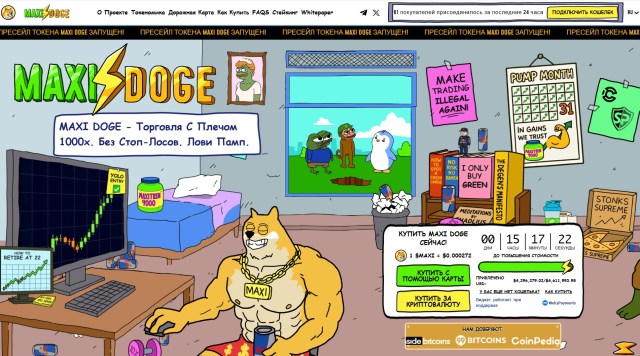
Competition in the meme token segment is intensifying: alongside Dogecoin and Shiba Inu, a whole lineup of new coins with aggressive marketing, gaming mechanics, and their own cults of strength is emerging. Here, not only quotes matter but also engagement in chats, leaderboards, tournaments, and joint actions with derivatives platforms.

Against this backdrop, demand arises for projects that are directly tailored to the retail investor with a "maxi mentality": a drive for high returns, a willingness to take risks, and a desire to compete. Maxi Doge positions itself as one such option, combining a meme, a culture of extreme trading, and tools for gamifying returns, without replacing it with boring institutional play.

Maxi Doge as a Response to Fatigue with Passive Dogecoin

Retail segment traders often lack the capital or confidence of large players but strive for comparable results. Maxi Doge builds a whole philosophy on this: the buff dog symbolizes 1000x leverage, where every community member competes, rather than just watching the chart.

The key idea is "Leverage King Culture": the token and brand convey the energy of maximum leverage and constant competition among traders. Closed competitions for holders with leaderboards for profitability, prize distributions, and partnership events with derivatives platforms turn holding $MAXI into a constant results-driven game, not passive storage.

The token operates on the Ethereum network with supply and distribution management via a smart contract. A treasury Maxi Fund has been created to support liquidity and fund partnerships. Already at the pre-sale stage, $4.3 million was raised at a price of approximately $0.0002725 per $MAXI, signaling significant interest in the concept of a meme token with a trading focus.

An additional layer is the staking mechanic with dynamic yield: daily automatic reward distribution by the smart contract from a specially allocated pool of 5% for up to one year. Combined with meme marketing and an emphasized goal to outperform even the original DOGE in dynamics, this positions $MAXI as a tool for those who do not want to put up with sluggish ETF statistics.


Domande pertinenti

QWhat does the decline in trading volume for the Dogecoin ETF indicate about retail investor behavior?

AThe decline in trading volume for the Dogecoin ETF indicates that retail interest in passive, exposure-based investment instruments is waning, while their appetite for risk remains. Traders are shifting towards more speculative and 'playful' formats that offer excitement, leverage, and a sense of community.

QAccording to the article, what are retail traders seeking instead of traditional ETFs for meme coins like Dogecoin?

AInstead of traditional ETFs, retail traders are seeking identity, a sense of game, and the opportunity to 'squeeze the maximum' out of every market move. They are drawn to platforms with derivatives, yield competitions, and new meme tokens that offer aggressive marketing, gaming mechanics, and their own cults.

QWhat is the name of the ticker symbol for the new project that combines the 'pump cult' with extreme leverage culture?

AThe new project is called Maxi Doge and its ticker symbol is $MAXI.

QWhat is the 'Leverage King Culture' promoted by the Maxi Doge project?

AThe 'Leverage King Culture' promoted by Maxi Doge is a philosophy that symbolizes 1000x leverage. It focuses on constant competition among community members through closed competitions with leaderboards for profitability, prize distributions, and partnership events with derivatives platforms, rather than passive holding.

QWhat are some of the tokenomics and features of the $MAXI token mentioned in the article?

AThe $MAXI token operates on the Ethereum network. It features a managed supply and distribution via a smart contract, a treasury called the Maxi Fund to support liquidity and finance partnerships, and a staking mechanism with dynamic yield. This includes daily automatic reward distribution from a specially allocated pool of 5% for up to one year. The pre-sale raised $4.3 million.

Letture associate

Warsh's First Day in Office, Markets Deliver a 'Wake-up Call': Rate Hike Expected This Year

On his first day in office, newly inaugurated Federal Reserve Chairman Warsh received a stark market warning, with expectations now fully pricing in a 25-basis-point interest rate hike this year. The shift was triggered by hawkish remarks from Fed Governor Waller, who stated that inflation is now the key policy "driver" and that the odds of a hike or cut are evenly split. This sent short-term Treasury yields higher. Waller signaled a significant pivot in his stance, citing disappointing inflation and labor data. He suggested removing "easing bias" language from Fed statements and did not rule out future rate increases if inflation fails to recede, though he noted immediate action isn't warranted without signs of unanchored inflation expectations. Chairman Warsh faces immediate pressure at his first FOMC meeting in June. With the preferred inflation gauge at a three-year high, analysts warn that failing to hike could be interpreted as an implicit easing of policy. The geopolitical situation in the Middle East is adding to existing price pressures. The market's expectation for a hike contrasts sharply with earlier forecasts for multiple cuts. While long-term Treasury yields have been contained by lower energy prices recently, analysts note they remain under structural upward pressure. Warsh's swearing-in at the White House highlights political scrutiny over Fed independence. However, the market has made it clear that inflation is the most urgent challenge, leaving the new chairman little time to settle in.

marsbit3 h fa

Warsh's First Day in Office, Markets Deliver a 'Wake-up Call': Rate Hike Expected This Year

marsbit3 h fa

Has Microsoft Lost Its Way in the AI Race, and Can Copilot Bring It Back on Track?

Microsoft, once seen as an early AI frontrunner due to its investment in OpenAI, is navigating a strategic shift amid increased competition. Its initial reliance on OpenAI’s GPT models has been complicated by OpenAI’s growing ambitions as a direct competitor, rapid advancements from rivals like Claude and Gemini, and the disruptive rise of AI agents, which challenge its traditional SaaS business model. These factors contributed to stock declines and slower-than-expected adoption of its flagship Copilot products. In response, CEO Satya Nadella has taken a hands-on role in product development, signaling the urgency of change. Microsoft is pivoting from a model-centric strategy to a "model-agnostic" enterprise platform approach. It aims to become the foundational layer connecting various AI models—from OpenAI, Anthropic, or its own new "Superintelligence" team—with enterprise workflows, data, security, and cloud services. Recent organizational changes merged consumer and enterprise Copilot teams to accelerate innovation, exemplified by new products like Copilot Tasks and Copilot Cowork. However, this transformation comes at a high cost. Microsoft faces massive capital expenditures, potentially reaching ~$190 billion by 2026, to support AI infrastructure. While its platform strategy shows early signs of traction with growing Azure AI revenue, it must balance startup-like agility with the reliability expected by enterprise clients. The core challenge is no longer being the sole AI winner but defending its position as the essential enterprise software entry point amidst rapid technological commoditization and the shift towards always-on AI agents.

marsbit4 h fa

Has Microsoft Lost Its Way in the AI Race, and Can Copilot Bring It Back on Track?

marsbit4 h fa

Why Haven't Forex Stablecoins Taken Off?

Why FX Stablecoins Never Took Off: A Path Forward via Synthetic FX Despite the explosive growth of stablecoin-powered digital banking, which has seen ~$6B in VC investment and a 24x surge in crypto card spending in under a year, a major limitation persists: these banks are essentially dollar-only accounts. This leaves 95-99% of global accounts, which are denominated in non-USD currencies, underserved. Attempts to create native foreign currency (FX) stablecoins (like EURC) have largely failed, with total FX stablecoin TVL at ~$600M compared to $400B for USD stablecoins—a 700x gap. These FX tokens face critical challenges: fragile pegs due to low liquidity, limited exchange/FinTech acceptance, poor on/off-ramps, complex regional compliance, and a chicken-and-egg adoption problem. The article argues that the solution lies not in competing with entrenched USD stablecoin networks (USDT/USDC), but in adopting a synthetic FX model inspired by traditional finance. Specifically, it advocates for Mark-to-Market Non-Deliverable Forwards (NDFs)—cash-settled FX derivatives that allow users to maintain underlying USD stablecoin holdings while having their account balance and P&L denominated in a foreign currency. This approach offers key advantages: strong oracle-based pegs, retention of deep USD stablecoin liquidity and yield, superior on/off-ramps, scalability to any currency with a reliable feed, and capital efficiency. It mirrors how modern institutional FX markets operate. Primary use cases for on-chain NDFs include: 1. **Digital Banks/Wallets:** Enabling multi-currency accounts for international users without leaving the USD stablecoin ecosystem, boosting deposits and retention. 2. **FX Carry Trade Vaults:** Offering access to sovereign interest rate differentials (e.g., earning yield on BRL) in a more stable and scalable format than crypto-native products like Ethena. 3. **Global Enterprise Payments:** Allowing merchants to receive payments in local currency equivalents while settling in USD stablecoins, similar to services offered by Stripe for fiat. The conclusion is that synthetic FX, not native FX stablecoins, is the viable path to integrating foreign exchange into the growing stablecoin digital banking landscape, potentially unlocking the next phase of institutional DeFi and multi-trillion-dollar global adoption.

链捕手4 h fa

Why Haven't Forex Stablecoins Taken Off?

链捕手4 h fa

Trading

Spot
Futures
活动图片