‘The Big Short’ Prototype Doubles Down on AI Crash Bets: Continues Shorting Nvidia and Palantir, While Buying Software Stocks

marsbitPubblicato 2026-05-09Pubblicato ultima volta 2026-05-09

Introduzione

Michael Burry, the investor made famous by "The Big Short" for betting against the subprime mortgage bubble, is now building a comprehensive portfolio to bet against the AI rally. He maintains and has increased his bearish bets on AI beneficiaries Nvidia and Palantir, while expanding his short positions to include semiconductor ETF SOXX, Nasdaq 100 ETF QQQ, and Oracle. Concurrently, he is buying shares of traditional software companies like Adobe, Autodesk, Salesforce, and Veeva Systems, which have seen their prices decline amid the AI frenzy. Burry's core thesis is that an "AI infrastructure overbuild" is creating a bubble, drawing parallels to the dot-com era. He argues that major cloud customers are extending GPU depreciation schedules to inflate profits and that current capital expenditures are based on overly optimistic demand forecasts. While his short on Palantir is currently profitable, his Nvidia put options are underwater as the stock nears all-time highs. The combination of shorting high-flying AI stocks and buying depressed "AI victim" stocks forms a market-neutral hedge. Burry is betting that a repricing of the AI narrative will punish the former group while benefiting the latter.

Author: Claude, Shenchao TechFlow

Shenchao Insight: As the Nasdaq hits consecutive record highs and Nvidia's market cap nears $5.3 trillion, Michael Burry, the investor who famously shorted the subprime mortgage market during the 2008 financial crisis and was immortalized in the movie "The Big Short," is doubling down on a contrarian bet.

He is not only maintaining his bearish bets on Nvidia and Palantir but also expanding his short positions to include semiconductor and Nasdaq ETFs. Simultaneously, he is buying traditional software stocks that have been pressured by the AI narrative, constructing a complete portfolio betting on a "re-pricing of the AI bubble."
The Nasdaq index set new record highs this week, closing at around 26,247 points on May 8, with the S&P 500 also hitting a record the same day. The Philadelphia Semiconductor Index has risen about 55% since Q2, and Nvidia's stock price is nearing its all-time high of $217.80, with its market cap surpassing $5.2 trillion. The AI-driven tech stock frenzy is at its most fervent stage.

Yet, at the market's most euphoric moment, an investor famous for his contrarian bets is heavily increasing his wager in the opposite direction.

According to a Foreign Policy Journal report on May 7, hedge fund manager Michael Burry, whose prediction of the 2008 crisis was adapted into "The Big Short," disclosed his latest portfolio adjustments in his Substack column "Cassandra Unchained" this week:

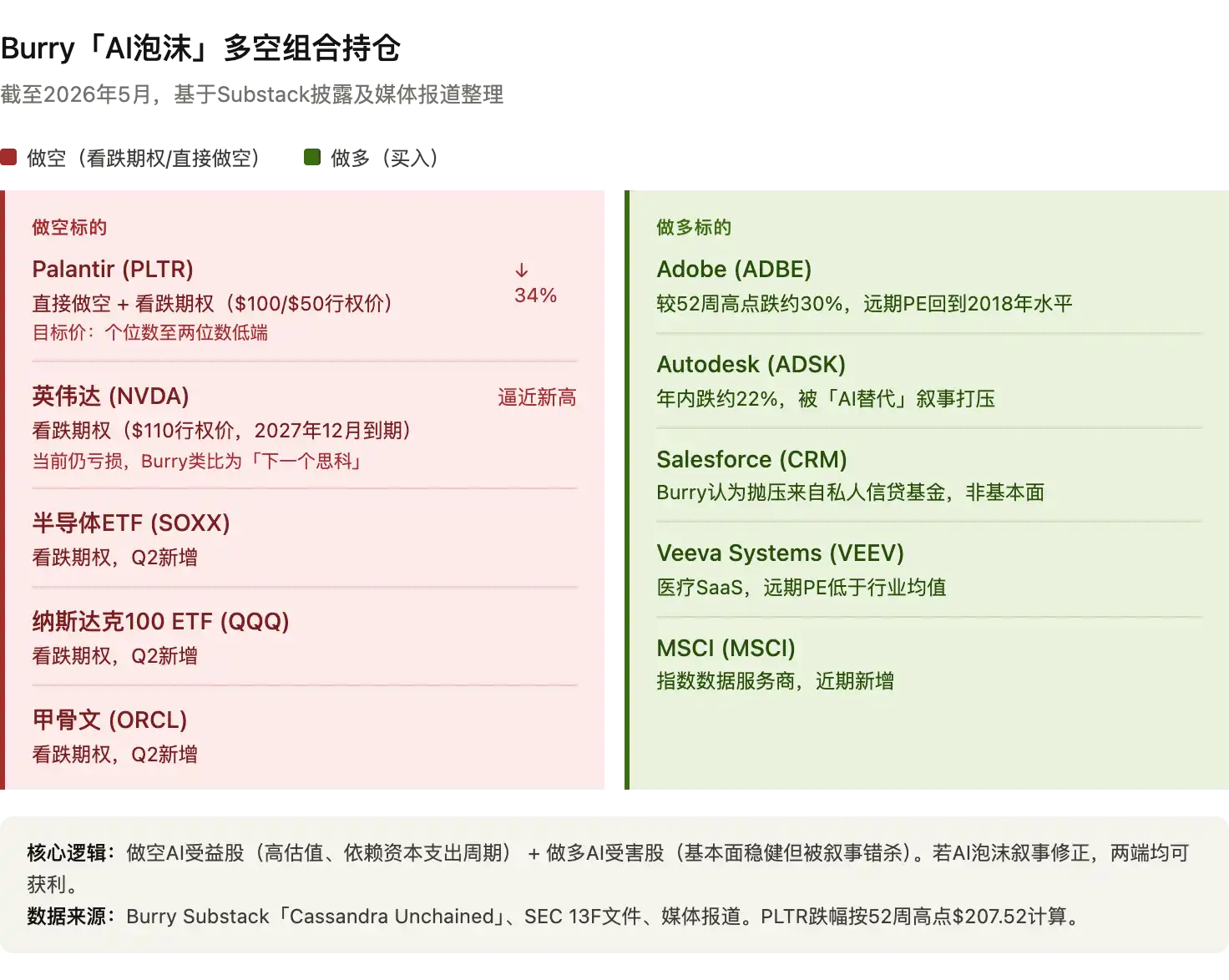
He not only maintained his put options on Nvidia and Palantir but also added a direct short position on Palantir and increased his bearish bets on the semiconductor ETF (SOXX), the Nasdaq 100 ETF (QQQ), and Oracle.

At the same time, he began buying a batch of traditional software companies marginalized by the AI hype, such as Adobe, Autodesk, Salesforce, and Veeva Systems, arguing that their stock price declines stem from panic selling rather than deteriorating fundamentals.

Thus, a complete "Big Short" hedge portfolio has emerged, with a core logic of shorting AI beneficiaries and longing AI casualties.
Starting with the $1.1 Billion Bet Last November

Burry's shorting of the AI sector began in Q3 2025.

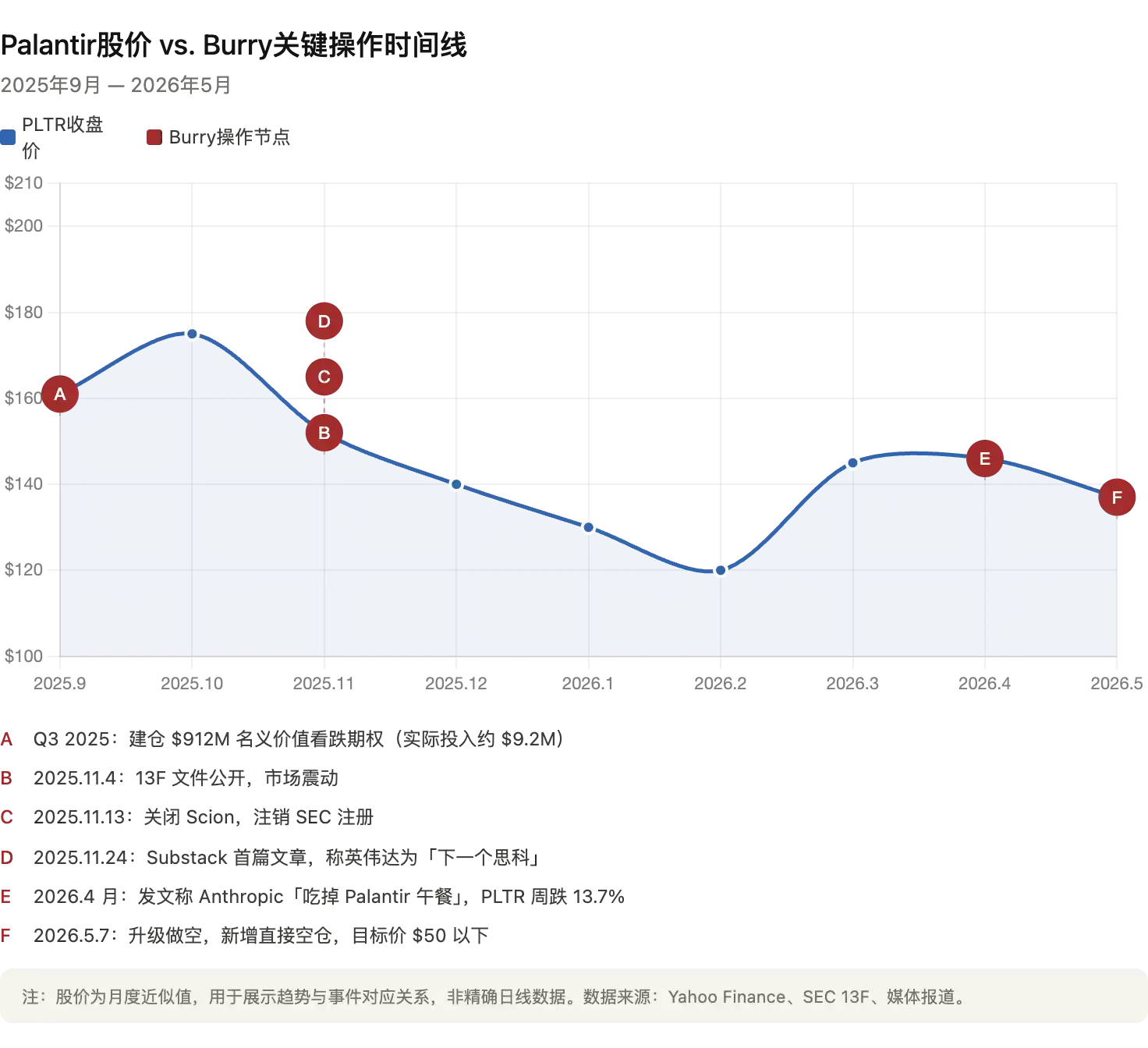
At that time, the 13F filing of his hedge fund, Scion Asset Management, showed he had purchased put options on Palantir with a notional value of about $912 million and on Nvidia with a notional value of about $187 million. When this news was released last November, it shook the market, putting pressure on Palantir and Nvidia's stock prices.

However, Burry later clarified on platform X that his actual capital outlay was about $9.2 million, not the widely reported $912 million—the latter being the notional value of the option contracts, a difference of nearly 100 times. This detail is crucial: the notional value in 13F filings is often misread as the actual invested capital, thereby exaggerating the trade's size.

Shortly after the disclosure, Burry announced the closure of Scion Asset Management and deregistered with the SEC, ending his career of managing external funds.

He subsequently transitioned to being a personal investor and opened a column named "Cassandra Unchained" on Substack (Cassandra being the Greek mythological prophetess who foretold the truth but was never believed), where he continues to publish market analysis.
Palantir Short is Paying Off, But Burry Says "Hasn't Fallen Enough"

In terms of trading results, Burry's Palantir bet is currently profitable. Palantir's stock price has fallen from around $161 when he entered to around $137 currently, down about 34% from its 52-week high of $207. Despite the company recently releasing stellar Q1 2026 earnings (revenue up 85% year-over-year), its stock price actually declined after the report.

Burry has not taken profits. According to his Substack disclosure, he currently holds put options expiring in December 2026 with a strike price of $100, and put options expiring in June 2027 with a strike price of $50, indicating he expects Palantir to fall more than 60% from current levels within the next year. He explicitly stated in a post that Palantir's fair valuation is only in the "single digits to low double digits."

In April this year, Burry posted on Substack stating that Anthropic is "eating Palantir's lunch," noting that this AI safety company's revenue growth rate has exceeded an annualized $300 billion level, and its more user-friendly, lower-cost AI integration tools are replacing Palantir's complex enterprise deployment solutions. After the post, Palantir's stock fell 13.7% in a week, and Burry later deleted it. Wedbush analyst Dan Ives dismissed this view as "fiction," and Palantir CEO Alex Karp had previously publicly stated he "could not understand" Burry's short stance.
Nvidia Short is Still Losing, But Burry Insists "AI is the Bubble"

Compared to the victory with Palantir, Burry's situation with Nvidia is completely different.

Nvidia's stock price closed around $215 on May 8, nearing its all-time high of $217.80, with a market cap of about $5.3 trillion. It is reported that Burry holds Nvidia put options with a strike price of $110, expiring in December 2027, which are currently in deep loss. However, he has not reduced his position; instead, he continued adding to it in his recent portfolio adjustments.

The core logic behind Burry's Nvidia short is "overbuilding of AI infrastructure." In his first Substack article last November, he compared the current AI investment frenzy to the internet bubble of the late 1990s, likening Nvidia to Cisco back then. Cisco's stock rose 3,800% between 1995 and 2000, once becoming the world's most valuable company, before plummeting over 80% during the dot-com bust.

Burry's key arguments include: Hyperscale customers like Microsoft, Google, Meta, Amazon, and Oracle are extending GPU depreciation schedules to beautify their financial reports; he estimates that between 2026 and 2028, these accounting treatments will cumulatively understate approximately $176 billion in depreciation expenses, inflating the entire industry's profits. Furthermore, he argues that the massive capital expenditure on current AI infrastructure is built on overly optimistic demand forecasts, mirroring the situation when telecom companies frantically laid fiber optic cables around 2000.

This viewpoint drew a direct rebuttal from Nvidia. According to CNBC, Nvidia privately distributed a seven-page memo to Wall Street sell-side analysts, responding point-by-point to Burry's allegations, specifically citing Burry's X platform posts as sources of information needing refutation. Nvidia stated in the memo that its customers set GPU depreciation periods at four to six years based on actual useful life, and early products (like the A100 released in 2020) still maintain high utilization rates. Burry responded, "I'm not saying Nvidia is Enron," but stood by his analysis.

Going Long on AI-Pressured Software Stocks: A Complete Bubble Hedge Portfolio

Perhaps the most noteworthy aspect of Burry's portfolio adjustments is not the shorts themselves, but his long positions.

He recently bought stocks like Adobe, Autodesk, Salesforce, Veeva Systems, and MSCI. The common characteristic of these companies is: their business fundamentals remain robust, but their stock prices have suffered significant declines due to the market narrative of "being disrupted by AI" and forced selling by private credit funds.

Adobe is currently down about 30% from its 52-week high, Autodesk is down about 22% year-to-date, and both have seen their forward P/E ratios fall back to 2018-2019 levels.

Burry explained on Substack that he "does not believe the technical selling pressure from private credit and software debt is sufficient to impact these stocks in the long term." In other words, he believes the market is over-penalizing companies labeled "AI losers" and over-praising those labeled "AI winners"—and he is betting on a correction of this mispricing.

Looking at both the short and long sides together, Burry has constructed a typical long/short hedge portfolio: If the AI bubble narrative bursts, high-valuation beneficiaries like Nvidia and Palantir will bear the brunt, while wrongly punished traditional software stocks may see valuation recovery. Even if the overall market declines, this structure could potentially achieve positive returns.

In his letter to investors when closing Scion, Burry admitted: "My judgments on the value of securities have been out of sync with the market for a long time now." This statement is both self-reflection and seems like his consistent manifesto.

At the peak of the AI frenzy, he chooses to stand against the crowd.

Domande pertinenti

QWho is Michael Burry and what is his current investment stance regarding the AI sector?

AMichael Burry is the hedge fund manager famously portrayed in the movie 'The Big Short' for his successful bet against the subprime mortgage market. He is now adopting a contrarian position against the AI sector. His strategy involves shorting AI-beneficiary stocks like Nvidia and Palantir, as well as related ETFs like SOXX and QQQ. Simultaneously, he is buying undervalued traditional software stocks like Adobe, Autodesk, Salesforce, and Veeva Systems, which have been sold off due to the AI narrative. He views the current AI investment surge as a bubble comparable to the dot-com era.

QWhat are the key details of Michael Burry's bearish bets on Palantir?

AMichael Burry's bearish bets on Palantir involve both put options and direct short positions. He holds put options with a strike price of $100 expiring in December 2026 and a strike price of $50 expiring in June 2027. This indicates he expects Palantir's stock to fall significantly from its current price of around $137. He has stated that Palantir's fair valuation is in the 'single digits to low double digits.' Despite Palantir reporting strong Q1 2026 earnings, Burry's position is currently profitable as the stock has declined from his entry point.

QWhat is the core reasoning behind Michael Burry's short position on Nvidia?

AMichael Burry's core argument for shorting Nvidia is his belief in an 'AI infrastructure overbuild' bubble. He compares the current AI investment boom to the dot-com bubble and likens Nvidia to Cisco during that period. His key points include: 1) Major cloud customers (Microsoft, Google, Meta, Amazon, Oracle) are extending the depreciation life of GPUs to artificially boost their earnings, which he estimates could inflate industry profits by $176 billion between 2026-2028. 2) The massive capital expenditure on AI infrastructure is based on overly optimistic demand forecasts, similar to the telecom fiber overbuild in the early 2000s. He believes this will lead to a significant correction.

QWhich companies is Michael Burry buying as part of his 'AI bubble re-pricing' strategy, and why?

AMichael Burry is buying traditional software companies like Adobe, Autodesk, Salesforce, Veeva Systems, and MSCI. He is investing in them because he believes these stocks have been unfairly punished by the market's 'AI disruption' narrative and technical selling pressure from private credit funds, despite their fundamentally sound businesses. Their stock prices and forward P/E ratios have fallen to levels seen in 2018-2019. Burry's thesis is that the market has over-penalized these 'AI losers' and over-hyped the 'AI winners,' creating a mispricing he aims to profit from when the narrative corrects.

QWhat is the overall structure of the portfolio Michael Burry is building, and what is its intended purpose?

AMichael Burry is building a long/short hedge portfolio designed to profit from a potential correction in the AI narrative. The structure is: Short side: Betting against high-valuation AI beneficiary stocks (Nvidia, Palantir) and related ETFs (SOXX, QQQ). Long side: Buying undervalued traditional software stocks (Adobe, Autodesk, Salesforce, Veeva) that have been sold off as 'AI losers.' The intended purpose is that if the AI bubble narrative bursts, the short positions would profit from the decline of overvalued stocks, while the long positions could benefit from a valuation rebound in the oversold stocks. This structure aims to generate positive returns even if the overall market declines.

Letture associate

Prime Minister Backing, SBI's "Shopping Spree," Lawson's Pilot: Japan Seizing the Compliance Dividend in Crypto

Japan is moving decisively to establish itself as a leader in the compliant crypto ecosystem through a coordinated national strategy. This commitment is underscored by consistent high-level political support, with successive prime ministers addressing the WebX conference to promote regulatory reform and position Web3 as a core industry. The financial giant SBI Holdings is executing a strategic, multi-billion dollar investment spree to build a comprehensive infrastructure stack. Key moves include acquiring the major exchange Bitbank, investing in core infrastructure firms like Gauntlet and EDX Markets, and forming "SBI Solana Global" to develop a yen-denominated stablecoin (JPYSC) and tokenized assets on the Solana network. Concurrently, a pilot by convenience store chain Lawson will test stablecoin payments in a real-world retail setting. The Japanese approach combines high regulatory barriers, which limit competition, with strategic capital from established financial conglomerates (zaibatsu) rather than standalone crypto firms. Upcoming tax reforms, planning to slash crypto capital gains tax from 55% to 20%, are designed to attract domestic savings. This integrated model—strict licensing, deep-pocketed traditional finance, real-world use cases, and favorable taxation—creates a formidable, closed-loop system for early entrants like SBI. It offers a potential blueprint for other jurisdictions seeking to formalize their crypto industries, signaling a shift from regulatory arbitrage to a race for compliance and legitimacy.

marsbit22 min fa

Prime Minister Backing, SBI's "Shopping Spree," Lawson's Pilot: Japan Seizing the Compliance Dividend in Crypto

marsbit22 min fa

An AI Uncovers a 15-Year-Old Linux Vulnerability in 5 Seconds, While Another AI Turns an Innocent Journalist into a Car Thief Suspect

AI Discovered a 15-Year-Old Linux Bug but Also Wrongly Targeted a Journalist An AI security tool, VEGA, identified "GhostLock" (CVE-2026-43499), a severe Linux kernel vulnerability hidden for 15 years since 2011, affecting nearly all distributions. Exploiting a flaw in the kernel's lock management, an attacker could gain root privileges in about 5 seconds from a standard user account. This demonstrates AI's growing ability to find complex bugs humans missed. In a stark contrast, another AI system caused a dangerous police confrontation. Automotive journalist Joel Feder was surrounded by four police cars after Flock Safety's automated license plate recognition (ALPR) cameras mistakenly flagged his vehicle. The error originated from a typo in a national stolen vehicle database ("34 03 DTM" was entered as "34 DTM"). Feder's manufacturer plate, "34 10 DTM," was misread due to its small font, triggering a nationwide alert. Police, with hands on holsters, detained Feder for an hour before resolving the mistake. The two cases highlight the dual nature of AI in security. On one hand, it can efficiently uncover critical software vulnerabilities, enhancing safety. On the other, it can exponentially amplify human errors—like a simple data entry mistake—when deployed in automated, large-scale surveillance systems without adequate human oversight. The incident underscores the critical need for robust review mechanisms in AI-driven decision systems, especially in high-stakes areas like law enforcement. The greatest vulnerability in the AI era may not be in code, but in the unchecked delegation of final judgment to automated processes.

marsbit48 min fa

An AI Uncovers a 15-Year-Old Linux Vulnerability in 5 Seconds, While Another AI Turns an Innocent Journalist into a Car Thief Suspect

marsbit48 min fa

Is Ethereum Truly a "World Computer"?

Ethereum has long been branded as a "world computer," yet its current infrastructure reveals significant geographic concentration, challenging this claim. An analysis of validator node distribution shows the network heavily leans toward Western nations. The U.S. alone hosts 38.19% of all validators, while Germany accounts for 13.04%, meaning these two countries comprise over half the network. Notably, a substantial portion of U.S. validators are residential nodes run from home connections, reflecting grassroots participation. In contrast, representation from Asia, South America, the Middle East, and Africa is minimal. Examining only professionally-operated institutional validators shows a more balanced picture, with countries like Singapore, Hong Kong, Japan, and South Korea collectively reaching nearly 25%. This shift indicates strategic institutional deployment to meet local regulatory requirements and reduce latency for regional users. A core problem is Ethereum's peer-to-peer gossip protocol, which systematically disadvantages regions with low node density. Late message arrival reduces a node's "peer score," pushing it to the network's periphery, further delaying future messages. This can impact validator rewards and network performance in these areas, posing a challenge to decentralization. However, this geographic imbalance also presents a significant opportunity. For Ethereum to truly become a global settlement layer, localized infrastructure is essential. Pioneering reliable validator operations in underserved regions like the Middle East, South America, or Africa could establish a crucial first-mover advantage, meeting growing demand for compliant, low-latency staking services in these markets.

marsbit1 h fa

Is Ethereum Truly a "World Computer"?

marsbit1 h fa

Trading

Spot
活动图片