From Payment to Deployment: Stripe Bets on the AI Agent Economy

marsbitPubblicato 2026-06-08Pubblicato ultima volta 2026-06-08

Introduzione

From Payments to Deployment: Stripe Bets on the AI Agent Economy Stripe is redefining economic infrastructure for the AI era, shifting its focus from serving primarily human users and software companies to enabling machine agents as active economic participants. The core thesis is that AI agents are evolving from tools into independent buyers and builders on the internet, necessitating a complete overhaul of traditional payment, billing, and deployment models. To empower agents as **buyers**, Stripe, in collaboration with Tempo, developed the Machine Payments Protocol. This protocol allows businesses to programmatically accept payments from agents without human intervention, using machine-readable payment instructions. Furthermore, Stripe's consumer wallet, Link, is being adapted to let users securely authorize agents to spend on their behalf. To empower agents as **builders**, Stripe Projects aims to simplify the deployment process. It allows developers and their agents to register, manage, and integrate the services needed to deploy applications directly from the command line, making "vibe-deploying" as seamless as "vibe-coding." This agent-driven economy, where products have real, variable costs (like AI tokens), disrupts traditional SaaS models. **Token-based monetization** is becoming central, requiring usage-based billing that charges for actual resource consumption, as seen with companies like Lovable and ElevenLabs. However, this model introduces new challenges l...

Author: Emily Sands

Translated by: Peggy, BlockBeats

This article stems from Stripe's redefinition of the "AI economy infrastructure": In the past, payment infrastructure primarily served human users and software companies; now, it must also serve machine agents. Agents need to be able to read prices, complete payments, call wallets, and deploy services; AI companies also need to build new billing, risk control, and settlement mechanisms around token consumption.

The Machine Payments Protocol, Link, Stripe Projects, Metronome, Tempo, and streaming payments mentioned in the article essentially all point to the same trend: AI Agents are evolving from "tools" into new types of economic participants on the internet. They are both buyers and builders; they both create software and consume resources. Consequently, the traditional SaaS-era business model of per-seat pricing, post-service invoicing, and manual settlement is being replaced by new models featuring real-time metering, real-time settlement, and machine-readable interfaces.

This is not just Stripe's product narrative; it's also a broader industry judgment: if a significant portion of future software consumption is initiated by Agents, then payment, billing, wallets, risk control, and deployment processes all need to be redesigned. AI is changing not just production efficiency, but also the very organization of business itself.

The original text follows:

Agents are becoming buyers and builders. This will fundamentally change how business operates.

For the past few years, Stripe has been building economic infrastructure for AI. This happens on a few dimensions: We help the world's fastest-growing AI companies accelerate through payments, billing, checkout, fraud and risk prevention, and tax infrastructure; we deploy AI across our own payments flow to help businesses earn more; and we make Stripe natively embeddable in the AI tools developers use.

But in the last six months, the meaning of "economic infrastructure for AI" has shifted. Agents are emerging as a new kind of actor on the internet. And that has given us two new tasks: helping agents purchase and build on behalf of people and companies; and helping companies adapt to the new economies that token consumption enables. In other words, Stripe is empowering agents to act independently, and empowering companies to monetize token-powered products that agents create and consume.

Agents as buyers

Ecommerce was built for humans. Humans browse websites, click on pricing pages, enter card details, and complete checkout. Agents don't. They need a programmatic way to understand that a service costs money, how much it costs, and how to pay for it without a human clicking through a checkout.

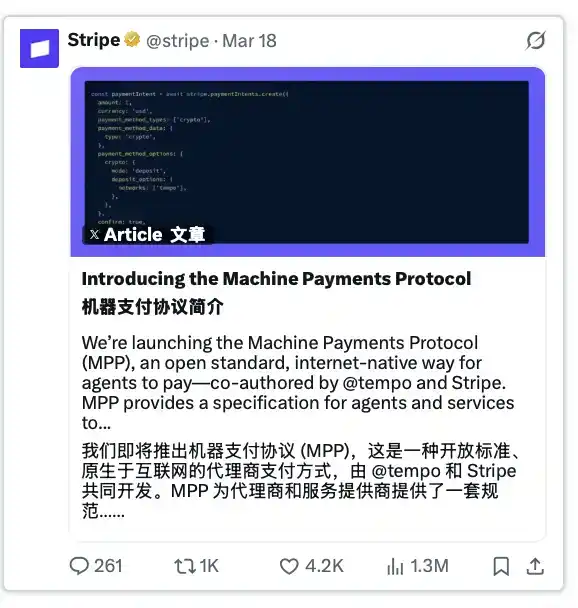
That's why we created the Machine Payments Protocol in partnership with Tempo. It lets businesses programmatically accept payments from agents, without human intervention. There's no account creation, no checkout page, and no human-in-the-loop; just a machine-readable way for agents to buy services from businesses.
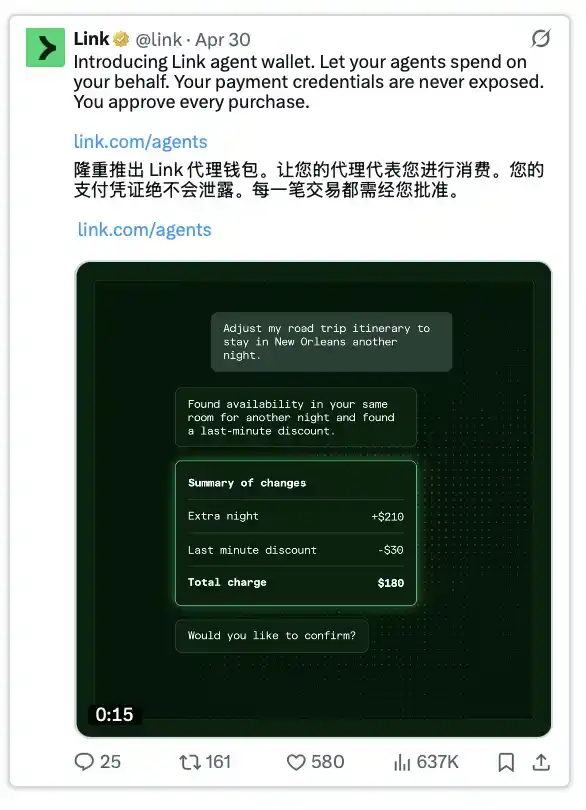
Once businesses can accept payments from agents, the next equally important question is: How can consumers safely authorize agents to spend money on their behalf? That's where our consumer wallet Link comes in.

More than 250 million people already use Link. And we're making Link work for agents, so that people can authorize agents to safely spend on their behalf. Humans remain in control, and agents gain the ability to spend on their users' behalf.
Helping agents buy things on the internet is one way to empower them. The other is helping them build.

Agents as builders

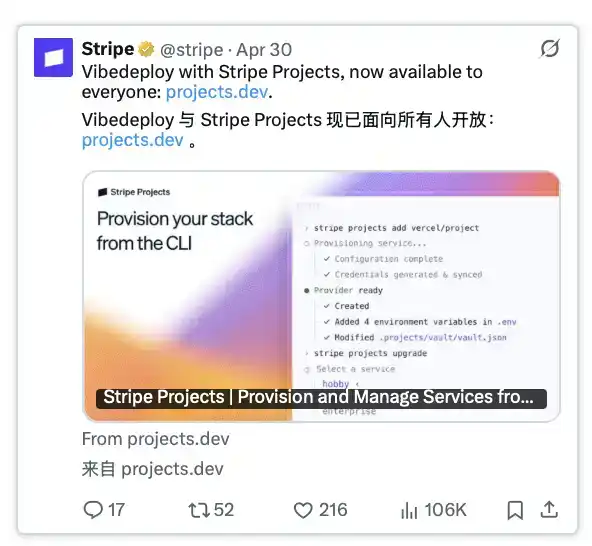
Today, vibe-coding is easy, but vibe-deploying isn't. Agents can generate an application in minutes, but deploying it to the internet still requires a lot of manual glue: creating accounts, provisioning services, managing credentials, connecting APIs, and switching back and forth between different consoles.

Stripe Projects lets developers—and their agents—register for, manage, and connect to the services needed to deploy an application, directly from the command line. The goal is simple: make vibe-deployment as easy as vibe-coding.
Token monetization

As agents begin to act as buyers and builders, businesses also need to adapt to a world where the cost of inference—the token cost of the product—changes dynamically. And that's changing software's economics.

In SaaS, serving one more user often costs almost nothing extra. But in AI, every prompt, every API call, every agent task has a real marginal cost. So companies can't just charge per seat. They need to meter usage in real time and charge customers for the resources they actually consume.

That's why usage-based billing is at the heart of AI monetization. Businesses can charge for what their customers actually value: usage, workflows, outcomes, or any billing unit that best fits their product.

Lovable is a great example. It started with simple subscriptions on Stripe so that it could commercialize quickly after launching. As the company evolved, so did its billing model. Today, Lovable charges for AI tokens consumed once customers exceed the usage included in their subscription plan. ElevenLabs has followed a similar path: it started with subscriptions on Stripe and later, as its product and its customers' usage evolved, added pay-as-you-go pricing.

Token theft

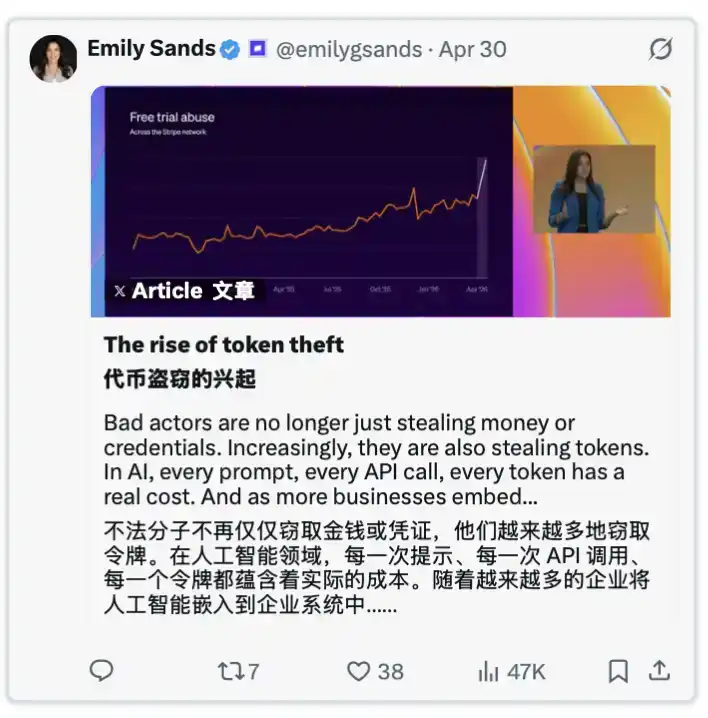
But usage-based billing only works if businesses can actually collect. And today, fraudsters aren't just stealing money or account credentials; increasingly, they're stealing tokens. They can sign up for an account, quickly consume a large volume of tokens, and disappear before the bill comes due, which collapses AI products' economics.

Token theft is one of the least-discussed problems in AI today. Stripe Radar, our fraud prevention product, evaluates new accounts in real time, predicts which free trials are likely to be abused, and identifies non-payment risk as usage accumulates.
Streaming payments

Abuse gets even more difficult when the customer itself is an agent. An agent can consume tokens at machine speed, which makes traditional billing models riskier—and sometimes unworkable.

Businesses can ask for upfront payment and cut off service when the prepaid amount runs out. This protects the business, but creates a worse experience for customers, and prevents good customers from spending more. Businesses can also let usage accumulate, then send an invoice later. That's better for customers, but then the bill may never get paid—and the tokens are already gone.

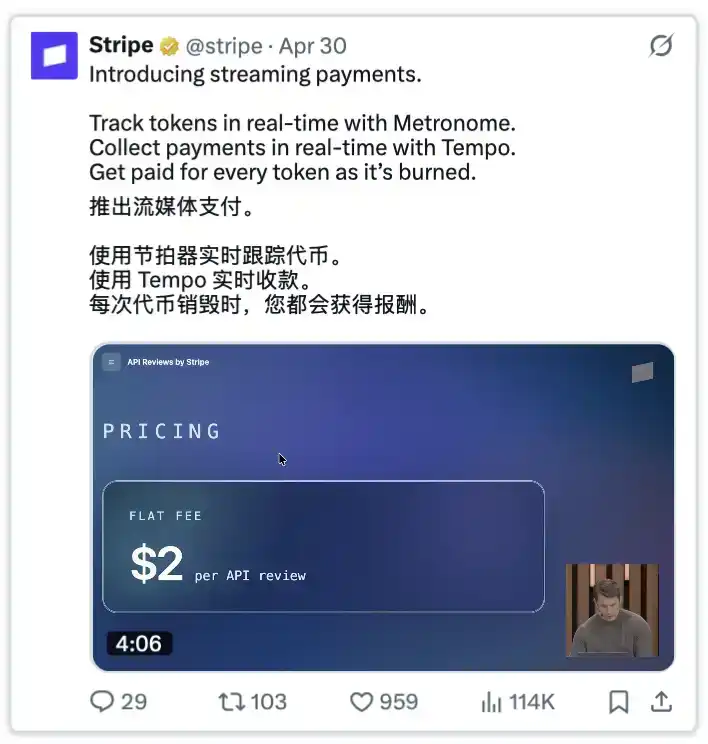
The better answer is obvious, but technically complex for businesses to build themselves: track usage and collect payment in real time. That's what Metronome and Tempo can do, together.

Metronome is a company we acquired that serves the most complex usage-based businesses; it can track usage in real time, as tokens are consumed. Tempo enables low-cost, high-frequency stablecoin payments that settle instantly. Together, AI companies can charge for tokens as they're used—without having to choose between hard limits and uncollectable bills.

We call this streaming payments: a new business model built for AI-native businesses, and for machine-speed software consumption.
This is what "economic infrastructure for AI" needs to be today.

It's no longer just payments for AI companies. It's commerce for agents, wallets for agents, deployment for agents, billing for tokens, fraud and abuse for tokens, and streaming payments for agents.

AI is changing business, and it's changing how businesses are built. So the infrastructure has to change, too.

We're building it at Stripe.

Domande pertinenti

QAccording to the article, what is the core shift that necessitates a redefinition of payment infrastructure for the 'AI economy'?

AThe core shift is that payment infrastructure must now serve machine agents as economic actors, not just human users and software companies. AI agents are transitioning from being tools to becoming independent buyers and builders in the digital economy.

QWhat is the purpose of the Machine Payments Protocol that Stripe is developing in partnership with Tempo?

AThe purpose of the Machine Payments Protocol is to enable businesses to accept payments programmatically from AI agents without human intervention. It provides a machine-readable way for agents to understand service costs and complete payments without traditional checkout pages or account registration.

QHow does the article contrast the traditional SaaS billing model with the new requirements for AI-based products?

AThe article contrasts them by stating that traditional SaaS models typically charge per seat with low marginal costs per user and invoice later. In contrast, AI products have real marginal costs per action (like token usage), requiring real-time metering, usage-based billing, and immediate settlement to reflect the actual resources consumed.

QWhat new type of fraud is highlighted as a critical but under-discussed challenge for AI companies?

AThe article highlights 'Token theft' or token abuse as a critical challenge. Fraudsters steal token credits by creating accounts, rapidly consuming large amounts of resources (like AI inference), and disappearing before the bill is due, which can undermine the economic model of AI products.

QWhat is 'streaming payments,' and what problem does it solve for businesses serving AI agents?

A'Streaming payments' is a business model that combines real-time usage tracking (via Metronome) with high-frequency, instant settlement payments (via Tempo). It solves the problem of AI agents consuming resources at machine speed by allowing companies to collect payment in real-time as tokens are consumed, avoiding the trade-off between hard usage caps and the risk of unpaid invoices.

Letture associate

Yang Ge Gary: Agent Economy and AI Sub-Microeconomics

"Agent Economy and AI Submicroeconomics" by Gary Yang discusses the evolution of AI Agent economies, written from Singapore in June 2026. The author observes a significant "civilizational generational gap" in AI development, particularly highlighted by events in Silicon Valley. The article identifies a current bottleneck in the transition from Human-to-Agent (H2A) economies to true Agent-to-Agent (A2A) ecosystems. While AI Payment protocols are rapidly emerging, many implementations remain non-AI-native, focusing on traditional human decision-making models rather than leveraging autonomous Agent decision-making. A core thesis is the inevitable formation of an **Agent Economy**, defined as a system where autonomous AI Agents create, exchange, and capitalize value independently. This requires new infrastructure: **AI Protocols**, which are the foundational rules and standards for Agent interaction. The piece explores the relationship and current gap between AI Protocols and Crypto Protocols, suggesting political and regulatory factors from traditional finance are temporarily constraining development. However, a future fusion into a mature Digital Protocol system is deemed inevitable based on first principles. The author introduces **AI Agent Submicroeconomics**, contrasting it with human economics. Key differences include higher transaction frequency, lower value per transaction, efficiency-driven (not emotion-driven) decisions, task-oriented (not consumption-oriented) behavior, and near-zero organizational and communication costs. A biological analogy is drawn, comparing an Agent to a cell, its LLM to a nucleus, and its protocol stack to a cell membrane. The rise of **AIFi** (AI Finance) is presented as a natural consequence, where value originates from AI-native activities and is subsequently tokenized and financialized. This contrasts with DeFi/TradFi, where finance is the source of value. The concept of a **Financial Chip (FinChip)**—an autonomous AI Agent integrated with a crypto smart contract—is highlighted as key infrastructure for this new economy. The conclusion emphasizes that **AI-Native** thinking represents a paradigm shift distinct from "Internet+" upgrades. It requires reasoning from first principles, focusing on energy-value shortest paths and maximum efficiency, which presents a steep learning curve and significant challenge for all participants in this rapidly evolving field.

marsbit22 min fa

Yang Ge Gary: Agent Economy and AI Sub-Microeconomics

marsbit22 min fa

ViaBTC CEO Haipo Yang: Looking Back at the Decade, Re-understanding the Value of Crypto

In "A Decade in Retrospect: Re-evaluating the Value of Crypto," ViaBTC & CoinEx CEO Haipo Yang reflects on the cryptocurrency industry's evolution since founding ViaBTC in 2016. Initially a niche interest, Crypto has fundamentally transformed key financial infrastructures like market making, trading, settlement, and issuance through open protocols, as seen with Uniswap and GMX, and enabled efficient cross-border transfers via stablecoins. While acknowledging speculation's role in fueling innovation and liquidity, Yang warns it often overshadows real demand. He distinguishes between blockchain (a trust-minimizing technology), Web3 (an application model requiring genuine utility), and Crypto assets. The latter's value derives from block space as a commodity (e.g., gas fees) and "sovereign liquidity premium" (e.g., Bitcoin's censorship resistance), with most tokens lacking such dual support. Looking ahead, Yang argues the next decade's focus should shift from "open participation" to "sustainable participation," emphasizing reliable infrastructure. He predicts consolidation towards networks with strong security and liquidity (like Bitcoin and Ethereum), and sees DeFi becoming a specialized tool rather than a mass replacement for traditional finance. Crypto will integrate into traditional finance (e.g., via Bitcoin ETFs) but may sacrifice some decentralization for mainstream adoption. Real future demand may come from AI agents and machine economies needing permissionless settlement. Ultimately, Yang believes Crypto's enduring value lies not in hype or replacing everything, but in verifiably reducing trust costs, increasing efficiency, and providing stable, transparent services across market cycles.

marsbit22 min fa

ViaBTC CEO Haipo Yang: Looking Back at the Decade, Re-understanding the Value of Crypto

marsbit22 min fa

Trading

Spot
Futures
活动图片