What Are the Characteristics of Projects Delisted by Major Exchanges?

marsbitPubblicato 2026-03-20Pubblicato ultima volta 2026-03-20

Introduzione

Major cryptocurrency exchanges like Binance, Coinbase, and OKX are increasingly delisting tokens, signaling a shift from expansion to contraction in asset listings. Recent delistings include projects such as FORTH, HOOK, LRC, and RDNT, many of which were once high-profile in narratives like DeFi, Layer 2, and memes. A key reason for delisting is the lack of sustainable technology or business models. Once market hype fades, these projects fail to deliver, becoming "zombie" assets with low liquidity and community engagement. Additionally, insufficient transparency—such as inactive teams, poor communication, and unclear roadmaps—has become a critical factor. Exchanges now prioritize tokens with clear governance, active development, and regular updates. This trend reflects a broader industry move towards higher-quality, compliant assets, including tokenized stocks, which offer clearer value and regulatory alignment. The delisting wave acts as a market cleanse, urging projects to maintain transparency and viability or risk removal.

Author: Hu Tao, ChainCatcher

In the crypto industry, "listing" once meant the birth of another wealth creation myth, but now, it may just be a prelude to a prolonged clearing process.

On March 18, Binance announced it would cease trading and delist 8 tokens, including Ampleforth (FORTH), Hooked Protocol (HOOK), IDEX (IDEX), Loopring (LRC), Neutron (NTRN), Radiant Capital (RDNT), and others.

On March 16, Coinbase announced the delisting of 25 contract trading pairs, including REZ-PERP, BABY-PERP, GMX-PERP, T-PERP, YB-PERP, HOME-PERP, CATI-PERP, DOGS-PERP, DRIFT-PERP, and others.

On March 12, Binance Alpha announced it would remove over 21 tokens, including DGC (DecentralGPT), BNB Card (BNB Card), PFVS (Puffverse), RDO (Reddio), MILK (MilkyWay), TAT (Tell A Tale), and others.

Earlier in January, OKX announced the delisting of 7 tokens, including ULTI, GEAR, VRA, DAO, CXT, RDNT, and ELON. Additionally, Bithumb and Upbit also announced the delisting of multiple tokens.

This "delisting storm" spanning both spot and derivatives markets sends a cold and clear signal to the outside world: top-tier cryptocurrency exchanges are undergoing a paradigm shift from an "expansion phase" to a "contraction phase" in assets.

They are reassessing asset targets, establishing new token listing and delisting mechanisms based on the liquidity, quality, transparency, etc., of tokens/projects. This serves as a deterrent to other listed or potential listing projects while better protecting investor interests.

I. "Zombified" Survival Under a Glossy Exterior

It is lamentable that the "cleanup" list includes promising stars of their time, such as LRC, FORTH, NTRN, RDNT, and others.

Among them, Loopring (LRC) became a rising star in the DeFi track with its "Layer2 scaling + decentralized exchange" narrative, as well as a shining example of Chinese projects; ELON became a hot meme coin subject due to the Musk IP effect, with its market value rapidly climbing in a short time; MilkyWay (MILK) once secured $5 million in funding with the label of a Celestia liquid staking solution, backed by well-known institutions such as Polychain and Hack VC.

The crypto market in a bull market has never been short of glossy narratives. Tracks like DeFi, NFT, meme, InfoFi, and RWA have taken turns on stage. A slogan, a white paper could easily raise tens of millions in funding; a brand-new concept could support a valuation of hundreds of millions and gain favor from various top-tier exchanges.

But these seemingly glamorous projects mostly share the same fatal problem—a lack of core technology for implementation and a sustainable business model. When market heat fades and narratives are gradually disproven, the shortcomings of these projects are infinitely magnified.

For exchanges, maintaining these projects that have lost community momentum not only means huge compliance costs but also an invisible drain on platform credibility. In an era of存量博弈 (stock game), exchanges are no longer tolerating "air assets" occupying precious liquidity resources for a long time, which is also an inevitable result of the past野蛮发展 (barbaric development) stage.

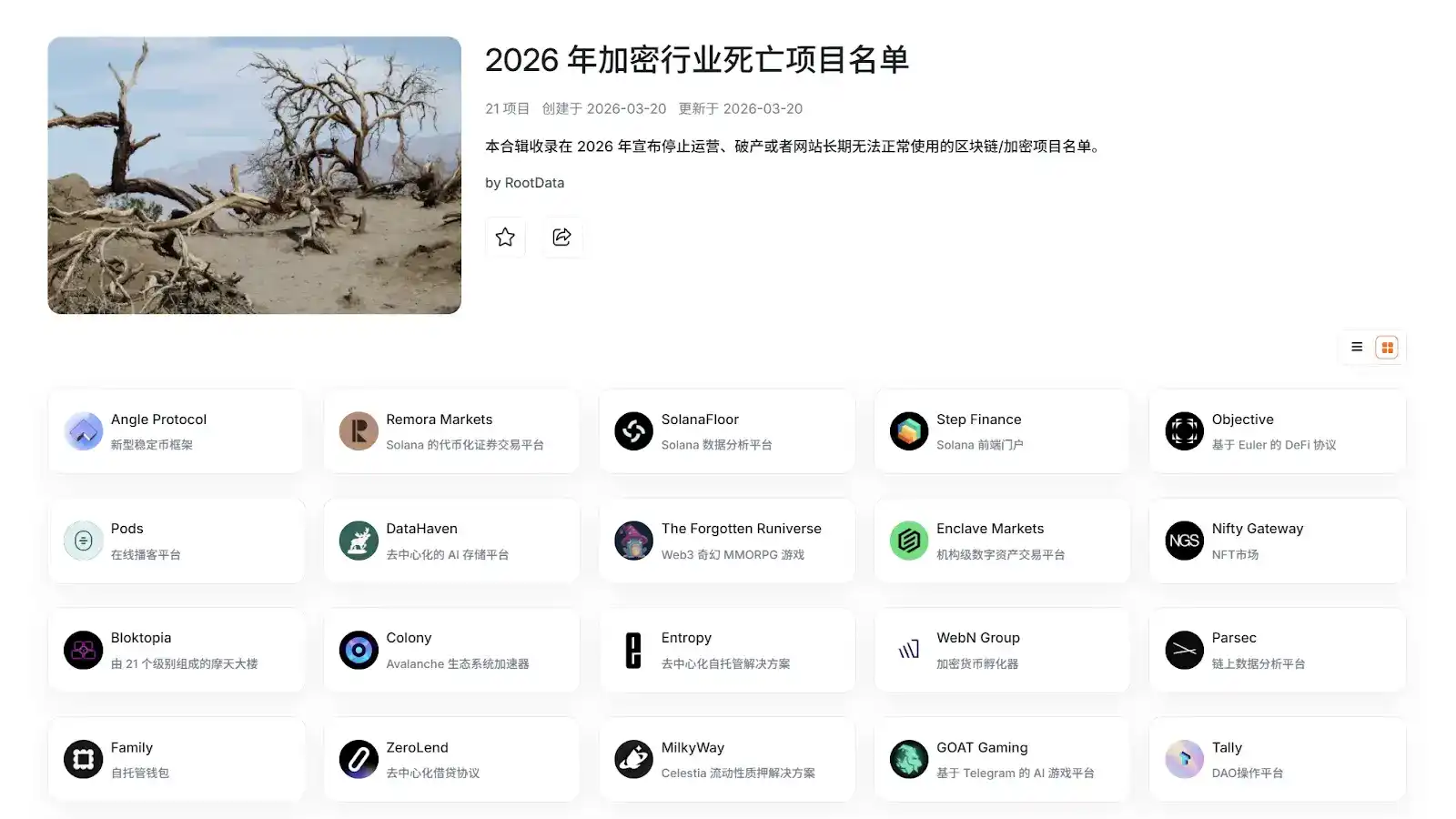
Looking at these delisted projects, DeFi and gaming are the hardest-hit areas, while also covering Layer1, DAO, and other fields, which corresponds to the changes in mainstream industry narratives. More serious than delisting is that many projects have publicly announced they are no longer operating. According to RootData statistics, these include the decentralized storage platform DataHaven, DeFi options protocol Polynomial, DAO governance platform Tally, metaverse Bloktopia, incubator Colony, data analysis platform Parsec, and others.
At the same time, cryptocurrency exchanges have successively shifted their listing focus to tokenized stocks. These assets have clear business models and market competitiveness while solving the problem of limited trading hours in traditional stock exchanges. Binance, Kraken, OKX, Bitget, Bybit, Gate, and other exchanges have already supported the trading of such assets, with the latter three supporting over 100 stock assets within months, showing strong strategic ambition.

II. Transparency is Becoming a Red Line

In addition to insufficient industry momentum, lack of transparency is also a major reason for the delisting of many projects.

As regulatory efforts in the crypto industry continue to strengthen and investor risk awareness increases, exchanges' requirements for token project transparency are becoming increasingly strict. According to official news, Binance has clearly incorporated "the level of public communication, community engagement, and transparency of the project team" and "the team's commitment to the project" into the evaluation conditions for token health.

This means that having clear team and roadmap information, a sound information disclosure mechanism, and active community communication channels are crucial for any token. But for many projects, the摆烂 (slacking off) state of "lying flat after listing" has become an awkward and harsh reality.

According to the transparency score recently launched by RootData, most of the tokens delisted by Binance and other exchanges in this round have a transparency score below 70%, with varying degrees of problems such as insufficient disclosure of project progress and missing team members. Stagnant community communication has become the norm, which leads to a significant weakening of user attention to the project and even trading willingness, forming a vicious cycle of insufficient trading volume and liquidity.

Taking Ultiverse, invested in by YZi Labs, as an example, the project has hardly posted any tweets since January, only reposting a few messages, and several core team members have done the same.

This "black box" operation not only challenges the risk defense line of exchanges but also directly harms the right to know of retail investors. The collective "great clearance" by exchanges is essentially a supply-side reform targeting "bad money," allocating more resources to assets with high transparency and solid competitiveness. In this way, exchanges are forming an institutional deterrent to on-platform projects: transparency is no longer a soft "bonus point" but a must-have for survival.

Against the backdrop of accelerated penetration by traditional capital and the gradual clarification of global regulatory frameworks, the competitive dimension of exchanges has undergone a qualitative change. The focus is no longer on trading scale and user numbers but on the quality of asset targets and the compliance of the platform. The synchronized steps of top exchanges like Binance, Coinbase, and OKX预示 (foreshadow) that a "dehydration" cycle to squeeze out the泡沫 (bubble) has already begun.


Domande pertinenti

QWhat are the main reasons for major exchanges like Binance and Coinbase to delist certain tokens recently?

AThe main reasons include lack of liquidity, poor project quality, insufficient transparency, and failure to meet the exchanges' updated listing criteria. Many delisted projects were deemed to have unsustainable business models, low community engagement, or were effectively 'zombie' projects with no active development.

QWhich types of crypto projects were most affected by the recent delisting wave?

ADeFi and gaming projects were the hardest hit, but the delistings also affected Layer 1 protocols, DAOs, and meme coins. This reflects a shift in industry narratives and a cleanup of projects that failed to deliver on their promises or maintain operational transparency.

QHow has the strategy of cryptocurrency exchanges changed regarding asset listing?

AExchanges have shifted from an 'expansion phase' to a 'contraction phase,' moving away from listing numerous speculative assets. They are focusing more on high-quality assets with clear value propositions, such as tokenized stocks, and are implementing stricter evaluation mechanisms based on liquidity, project commitment, and transparency.

QWhy is transparency becoming a critical factor for token listings?

ATransparency is now a survival necessity due to increasing regulatory scrutiny and investor demand for accountability. Exchanges evaluate factors like public communication, community engagement, and team commitment. Projects with low transparency scores, inactive teams, or poor disclosure practices are at high risk of being delisted to protect investors and maintain platform credibility.

QWhat signal does this delisting trend send to the broader cryptocurrency market?

AThe coordinated delistings by major exchanges signal a market-wide 'de-leveraging' and 'dehydration' cycle, moving away from speculative hype towards fundamentals. It emphasizes that exchanges are prioritizing asset quality, sustainability, and compliance, which could deter low-quality projects and encourage higher industry standards.

Letture associate

From 'Global Computer/Settlement Layer' to 'Bulletin Board': What Are Ethereum and Vitalik Trying to Achieve?

In a significant shift of perspective, Vitalik Buterin recently proposed that Ethereum's core value may not lie in its function as a "world computer" or "global settlement layer," but rather as a simple yet powerful primitive: a cryptographically secure, globally shared "public bulletin board." This concept emphasizes data availability—a neutral, uncensorable, and permanent data layer where anyone can read and write information, but no single entity (including governments or developers) can alter or erase it. This "global shared memory" supports applications like secure voting systems, certificate revocation lists, and decentralized coordination—scenarios that require verifiable and tamper-proof data publishing rather than complex on-chain execution. The emergence of AI further validates this direction. As AI agents and services grow, so does the need for privacy-preserving and trustless interactions. Proposals like ZK API Usage Credits illustrate how Ethereum can enable anonymous AI model access and agent-to-agent economic coordination, relying precisely on the blockchain’s transparent and immutable data layer. Rather than a step back, this reframing represents a maturation of Ethereum’s vision—from defining what it can do to serving as essential infrastructure for what the world truly needs: a foundational layer of truth in an increasingly automated and opaque digital era.

marsbit1 h fa

From 'Global Computer/Settlement Layer' to 'Bulletin Board': What Are Ethereum and Vitalik Trying to Achieve?

marsbit1 h fa

When Wall Street's ETH Starts to 'Earn': From BlackRock's ETHB to Ethereum's Asset Attribute Shift

Wall Street Embraces Staking: BlackRock's ETHB and Ethereum's Shift to a Yield-Generating Asset On March 12, 2026, BlackRock launched the iShares Staked Ethereum Trust (ETHB) on Nasdaq, a groundbreaking Ethereum ETF that not only holds spot ETH but also stakes a significant portion (70-95%) of its assets to generate and distribute yield to investors. This move effectively answers a long-debated question: whether ETH can be accepted by mainstream finance as a yield-bearing asset. ETHB operates by delegating staking to professional validators like Figment via Coinbase Prime. It distributes approximately 82% of the staking rewards (estimated at 2.3%-2.5% APY after fees) to shareholders monthly, while retaining 18% as service fees and charging a 0.25% annual management fee. This provides a predictable, automated cash flow, though it lacks the compounding effect of native on-chain staking unless investors manually reinvest distributions. This development is significant as it marks the formal entry of staking—a core crypto-native activity—into Wall Street's asset framework. Under new SEC leadership, regulatory barriers have eased, allowing BlackRock to legitimize staking rewards as a viable investment return. This paves the way for other PoS-based ETFs (e.g., Solana, Cardano) and may shift substantial capital from traditional spot ETFs to yield-generating products. While on-chain staking options remain popular (e.g., native staking, liquid staking via Lido/Rocket Pool, or wallet-based staking), ETHB’s introduction signals a broader shift: ETH is increasingly viewed not just as a speculative asset, but as a productive, cash-flow-generating machine. The trend of making assets "work" is now irreversible, whether through traditional financial products or decentralized protocols.

marsbit2 h fa

When Wall Street's ETH Starts to 'Earn': From BlackRock's ETHB to Ethereum's Asset Attribute Shift

marsbit2 h fa

The 4 Truths and Fee Traps Behind Polymarket's LP Market Making Incentives

Polymarket, a prediction market platform, has recently shifted its focus to incentivizing liquidity providers (LPs) to address its core issue of low liquidity. While most markets remain free, it now charges a taker fee on specific markets like crypto price movements and select sports events. This fee, highest near 50% probability, funds new LP reward programs. There are two primary reward systems: one pays LPs when their limit orders are executed (maker rewards), and another rewards simply for placing orders within a set spread to provide liquidity, even if they don't get filled. A third mechanism allows anyone to sponsor additional incentives for specific markets. A positive view argues this structure values genuine liquidity over mere trading volume, making fees earned and rewards received a potential key, anti-sybil metric for a future POLY token airdrop. It rewards users who improve market depth and stability. A contrasting, negative view claims the LP program is a "trap." Critics argue that professional market makers avoid it due to insider trading risks and that most LPs are actually losing money due to hidden "LP wear and tear" (impermanent loss), only participating based on speculation of a valuable airdrop. They warn that if Polymarket expands fees to fund these unsustainable rewards, it could lose its competitive edge of zero fees and better odds compared to traditional sportsbooks. Proposed solutions include a fixed fee only on profits, using a native POLY pool for liquidity, or charging for premium products like parlays instead of core markets.

marsbit4 h fa

The 4 Truths and Fee Traps Behind Polymarket's LP Market Making Incentives

marsbit4 h fa

Trading

Spot
Futures
活动图片