As Web3 gaming recedes from the hype and bubble of 2021, the questions left behind become more direct: Does gaming still have a chance? Will AI become the next variable? How should we reinterpret communities, KOLs, growth, and investment logic?
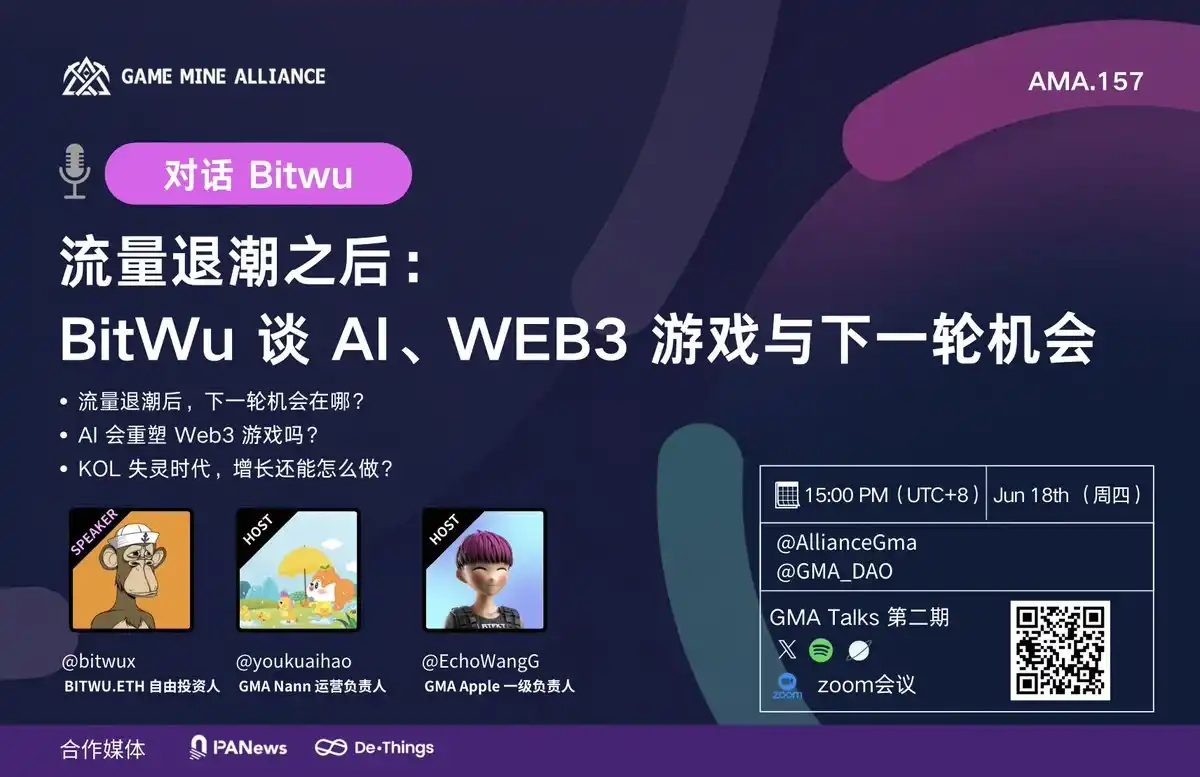
This exclusive interview invites renowned investor and content creator BitWu to have a candid conversation about the industry's next chapter. The discussion covers a wide range of topics, from personal investment systems and bull/bear market insights to AI Agents, stablecoins, RWA, a post-mortem on Web3 gaming failures, and the next round of opportunities.
Rather than chasing narratives, it feels more like a deep dive into "how to survive, how to identify opportunities, and how to avoid repeating past mistakes."
Guest: Renowned investor BitWu
Hosts: GMA Apple, GMA nann
Interview Time: June 18th (Thursday) 3:00 PM
GMA Talk Q&A
Q1: How would you define yourself? More of an investor, content creator, researcher, or entrepreneur?
BitWu: I think of myself more as an investor and a practitioner of long-termism. In this industry, you can't really avoid the word "investment." Whether you're creating content, conducting research, or doing anything else, it ultimately comes back to how to get better at investing, how to find your own investment path and model, and how to build your own investment system. As for long-termism, I've always seen my life system as a very long-term map. I have many things I want to accomplish and hope to meet like-minded people along the way. Whether it's building trust, finding friends to work with, or investing itself, long-termism is an unavoidable theme. The entrepreneur label doesn't quite fit me, as my personality isn't really suited for entrepreneurship. I've tried, but the results were mostly failures.
Q2: Why have you stayed in the Crypto industry for so many years? What attracts you most?
BitWu: I stay in this industry because it's where you can see the world changing the fastest. In Crypto, you see many cutting-edge concepts and technologies, which often intersect with Blockchain in one way or another. This includes AI, the hottest topic right now, which also has some inseparable connections with Crypto. Another reason is that this industry exposes the most naked aspects of human nature. Crypto isn't just a speculative financial market; it encompasses technology, finance, social psychology, global liquidity, narrative dissemination, and the game of human nature. It's rare to find so many elements combined in any other single industry.
Q3: After experiencing several bull and bear cycles, what's the biggest change in your understanding?
BitWu: I think there are three major changes. First, it shifted from pursuing overnight riches to pursuing "survive first, then seek compound interest." When you first enter the space, many people think this industry can make money you can't earn elsewhere. That desire for instant wealth is normal. But later, I realized there are indeed many opportunities, but the premise is you can't die. You need capital and must stay in the market to use your profits to pursue compound interest. Second, it changed from just believing stories and narratives to being more willing to verify structures. Early on, it's easy to be captivated by a story or narrative. But if you want to be a qualified investor, you can't stop at the story level. You need to verify, to deeply consider whether the underlying structure holds up. Third, it's about truly establishing your own investment system. Only after experiencing bull and bear cycles, and even having assets go to zero, will you seriously think about whether you need to build an investment system and how to build one suitable for yourself.
Q4: What pitfalls are newcomers to Crypto most likely to step into?
BitWu: The most common mistake newcomers make is mistaking rewards from a bull market for their own ability. Most people enter during a bull market because that's when all the wealth legends spread. Many people make money right away, possibly earning in one or two months what would take years in Web2, leading them to mistakenly believe they have exceptional talent. Once you have that mindset, you're likely to lose money later because the market won't go up forever. The transition from bull to bear market is merciless. Many people end up not only losing their bull market profits but also their principal. I had a similar experience myself. I made a lot of money during the 2017 ICO phase, thought I was great at investing, started investing recklessly, and ended up losing all the BTC and ETH I had made. The second mistake is lacking position management skills. No position management essentially means no discipline, making it easy to operate based on emotions. Many people don't listen to veterans' advice on this until they lose money themselves. The third mistake is focusing only on potential returns when seeing an opportunity, ignoring the risks. I think the biggest difference between an OG and a newcomer is that an OG looks at the risk first, not just the return.
Q5: What ability should newcomers prioritize cultivating?
BitWu: I think newcomers should prioritize developing risk identification ability. Researching projects, trading skills, and information gathering are all important but should come later. Because this industry isn't short of opportunities; as long as you don't die, opportunities will always arise. Risk identification ability can be cultivated gradually. For example, you can record your initial reactions, judgments, decisions, and the resulting outcomes for various pieces of information you encounter daily. Through constant comparison and reflection, you'll gradually develop the ability to predict and identify risks. An even better way is to form a small group, find one or two slightly more capable friends to help with risk identification; that's also very important.
Q6: What do you think is the biggest difference between this cycle and 2021?
BitWu: My biggest takeaway from 2021 was that it was still a retail-driven Crypto market back then. Many projects could soar based on a concept, a community, or a liquidity sentiment. We saw the so-called 'altcoin season,' where many altcoins could rise tens, hundreds, even thousands of times. But the biggest difference this time is that Crypto is gradually transitioning from a speculative market into a financial infrastructure market. Now, the most talked-about topics are AI, stablecoins, RWA, ETFs, institutions, and compliance. This indicates Crypto is no longer just an internal cycle for retail crypto enthusiasts; it's becoming part of the global financial market, albeit still a very small part. This also means it will be harder for ordinary people to make money in the market. In 2021, you could probably make a lot of beta just by being bold. But now, you need to not only understand the Crypto market but also the global financial market. You need stronger information filtering skills and better position discipline to potentially earn significant money.
Q7: In the next 2-3 years, which directions are you most focused on?
BitWu: I'm focusing on three directions: stablecoins, RWA, and AI. First, stablecoins. Stablecoins are one of the few things in Crypto that already have real demand, real users, and real trading volume. They address issues like global payment settlement, dollar liquidity, and internet finance. Compared to many other concepts still stuck in the story phase, stablecoins have already broken through. Second, RWA. RWA isn't simply about putting assets on-chain; it has the potential to help traditional finance and other sectors better prepare for asset tokenization. It's a direction that traditional finance is also willing to adopt. Third, AI. Especially in the next 2-3 years, if AI Agents become widespread, they will need identity, accounts, wallets, payments, asset management, and incentive layers. Crypto can provide these infrastructures for Agents. So, the intersection between AI and Crypto will become increasingly evident.
Q8: Where might AI's biggest impact on Crypto occur?
BitWu: I think AI might transform Crypto from "assets for humans to speculate on" into "financial rails for machines." If a large number of AI Agents serve us in the future, Crypto could very well become the channel for AI Agent fund flows. In the future, AI Agents could hold Crypto, interact with on-chain protocols, purchase data, purchase computing power, manage assets, perform automatic settlements, and even do risk management. So, I believe the biggest impact of AI on Crypto is making Crypto the most suitable financial system for machines in the AI era. It's a 7×24, global, programmable, borderless financial system.
Q9: What kind of AI + Gaming products are you anticipating?
BitWu: I look forward to an evolving game. A game that can reshape scenarios, exploration, combat, management, and social interactions based on players' experiences and preferences. You could think of it as an AI director. Everyone might be playing the same game, but the content each person experiences isn't exactly the same. It might be based on the same storyline, but different players have different main narratives. Looking at the integration of AI and GameFi, I think we can view it in three layers. The first layer is reducing development costs. For instance, I recently used Codex to create over 20 different games with my child. He would make games suitable for himself based on his own preferences and ideas, and if something wasn't fun, he'd change it himself. The second layer is creating more realistic AI NPCs. NPCs in past games were rigid and lifeless, but AI can give NPCs more natural dialogue, companionship, and even help players with tasks. The third layer is forming a "living game world." AI can drive long-term memory, record player behavior and feedback, ultimately leading to an evolution of the world state. That might get closer to the metaverse we imagine.
Q10: In the AI era, will KOLs be replaced?
BitWu: Some KOLs will be replaced. If a KOL merely repackages information or repeats what's already available in the market, letting AI fetch, categorize, and summarize it, then this type will be largely replaced by AI. Because AI is faster, cheaper, and more stable, so there's less reason for humans to do it. But truly valuable KOLs won't be replaced. A truly valuable KOL doesn't just repackage information; they have their own experiences, judgments, taste, and the expression that comes from having faced risks. AI can help you gather information and summarize materials, but it can't experience bull and bear markets for you, nor can it feel the psychological impact of volatility with real money. AI can imitate some things and gather some things, but it's hard to replicate a person's style and credibility accumulated over the long term. In the future, the bar for being a KOL will only get higher, not be completely replaced by AI.
Q11: Why did past Web3 games fail? Why would future players stay?
BitWu: In 2021, GameFi was once very hot, but its rise and fall were both extremely rapid. The real logic of gaming should be: the game is exceptionally fun, so users stay, a community naturally forms, and then certain economic systems and assetization states gradually emerge. But many past Web3 games ended up as Play to Earn. People came purely to farm tokens. Project teams raised funds frantically, rushed to issue tokens, or used airdrop expectations to attract users for token farming. Eventually, massive sell pressure emerged, and projects entered a death spiral. This process essentially replaced the fun of the game itself with an economic model. If GameFi has a chance to rise again in the future, I think three directions are important: AI, social, and UGC. AI can make the game world more alive, NPCs more human-like, and the experience more personalized. Social elements can make players stay. UGC allows content to keep growing. A good Web3 game should first make users feel it's fun, then get more people to stay, forming a positive cycle, rather than falling back into a death spiral.
Q12: If you were to invest in a Web3 game now, what would you value most?
BitWu: If investing in a Web3 game now, I wouldn't primarily look at project background, token design, dual-token model, earning mechanisms, or airdrop expectations like before. Now, the most important thing is whether the team has the ability to create a long-term game world. I would look at whether this team has created impressive games before, if they understand players, if they have real gaming experience, and if they have the funding and patience to weather bear markets. Many past Web3 games weren't essentially building games; they were building fundraising products, with the game merely being a shell. Their whitepapers were full of economic models, NFT staking, dual-token rewards, and airdrop expectations, with no clear indication of what makes the game truly fun. So now the key question is: Is this game truly fun and playable? Can this team actually deliver it? In terms of data, I wouldn't just look at registered users, wallet numbers, or NFT purchase records. These might only indicate good early marketing, but what comes fast can go fast. What really matters is playtime, replay rates, player demographics, and whether the game is driven by gaming behavior or financial behavior. It must be driven by gaming behavior, not financial behavior. As for token design, I think the simpler, the better in the early stages. Many projects don't need to design tokens just for the sake of it. In the mid-to-late stages, designs can be introduced based on the game's development, rather than starting with overly complex economic models.
Q13: Why do many projects collaborate with KOLs, seem to get exposure, but don't achieve actual growth?
BitWu: First, project teams need to ask themselves: What kind of growth are they really aiming for with this round of promotion? Different goals lead to completely different outcomes. If the goal is to expand brand awareness in the Chinese-speaking region, to let more people know the brand, then you need to design a strategy centered on exposure, finding channels and KOLs that can deliver brand visibility. If the goal is user retention, like CEXs or DEXs needing lots of users to stay and trade, then you need to find community-oriented KOLs, people who can genuinely bring user actions and conversions. Second, choosing the right platform is crucial. Some content suits Twitter, some Instagram, some YouTube, some news media. Different products suit different exposure channels, leading to different effects. Third, choosing the right KOL is key. If you want growth, find KOLs with strong community-building abilities. If you want exposure, find KOLs with high market recognition, long-term reputation, and accumulated trust. Often, when growth fails, the reasons might be unclear project goals, wrong platform choices, or incorrect choices for the promotion targets.
Q14: In the next three years, will communities become more or less important?
BitWu: I think communities will become increasingly important, but communities will differentiate. In the past, when people talked about communities, they might have thought of airdrop communities, shilling communities, task communities. These types of communities will gradually fade. Because users join these communities not because they believe in the project, but for a money-making opportunity—like farming airdrops, information arbitrage, or wealth codes. They might seem large in numbers but are essentially false prosperity. In the future, truly valuable communities need three factors. First, they must establish a sense of trust. This trust can be based on an individual or a certain belief. The core of a community is consensus, just like the early Bitcoin community. That won't change. Second, there needs to be a common goal. For example, everyone working together to find the next big opportunity, or doing long-term DCA around one or two projects. The community needs to engage in sustained activities around a theme. Third, it should transition from online relationships to more long-term, real-life relationships. Better communities in the future should build stronger, longer-lasting interpersonal connections through offline events. The real value in a community lies in its people, so communities that can retain people will become increasingly important.