a16z Crypto Partner: Cash Flow is the Moat

链捕手Pubblicato 2026-06-12Pubblicato ultima volta 2026-06-12

Introduzione

Title: a16z Crypto Partner: Cash Flow Is the Moat Summary: Historically, many of the best businesses were built by positioning themselves within the "flow of funds"—facilitating the creation and transfer of value within a network and taking a cut. The more value flows through, the larger the business grows. Cryptocurrency is the first modern technology natively built for this purpose. If a startup hasn't architected its product and business to benefit from these principles, it's missing a major opportunity. Thanks to stablecoins, capital and value now move at internet speed—globally settled, 24/7, with end-to-end programmability. Blockchains are inherently network businesses. Each transaction settles on a shared ledger, and every new participant strengthens the same underlying network. Network tokens amplify this effect. A well-designed token aligns all participants—users, developers, suppliers, validators, the protocol—around a single goal: growing the network. Participants are paid proportionally to their contributions, creating a transparent feedback loop between value flowing in the system and value accumulating to those building it. This model isn't new; crypto simply makes it more accessible and scalable for startups. The pattern is consistent: find where value flows and position yourself in the middle. Examples range from railroads (earning from freight) and Standard Oil to Google, Meta, and AWS (earning from attention, commerce, and compute flows, respectively). Fi...

Author: Jason Rosenthal, a16z Operating Partner

Compiled by: Hu Tao, ChainCatcher Highlights

Many of history's greatest businesses were built by positioning themselves in the "flow of funds" – facilitating the creation and transfer of value within a network and taking a cut. The more value that flows through the network, the larger the business typically grows.

Cryptocurrency is the first modern technology natively built for this purpose. If your startup hasn't yet architected its product and business to benefit from these principles, you're missing an opportunity. Thanks to stablecoins, funds and value now flow at internet speed – 24/7, with global settlement, and end-to-end programmability. Payment rails are frictionless, unit economics are transparent, and every dollar flowing globally is addressable.

The Specific Model

Blockchains are network businesses by design. Every transaction settles on a shared ledger. Every new participant strengthens the same underlying network that the next builder can use. As more people use and build on it, the network becomes more valuable for all users.

Most companies spend years manufacturing network effects on top of traditional infrastructure. Crypto founders inherit them as starting conditions.

Network tokens amplify this. A well-designed token aligns users, developers, suppliers, validators, and the protocol around a single outcome—growing the network—and pays each proportionally to their contribution. But the protocol's revenue belongs to the people who use it. No partner rebates, no side deals. Just a feedback loop between value flowing in the system and value accumulating in the hands of the people building and growing it.

This isn't a new model. Cryptocurrency just makes it accessible and scalable for startups for the first time.

Railroads didn't make money on locomotives. They made money on every ton of grain, coal, and steel that crossed their tracks. Standard Oil, U.S. Steel, and AT&T were companies in the flow of funds. Google and Meta replaced print and TV not because their ads were better, but because they sat at the choke point where attention turned into commerce, enabling them to take a cut of trillions in commercial intent. AWS is in the flow of compute.

The pattern is consistent: find where value moves and put yourself in the middle.
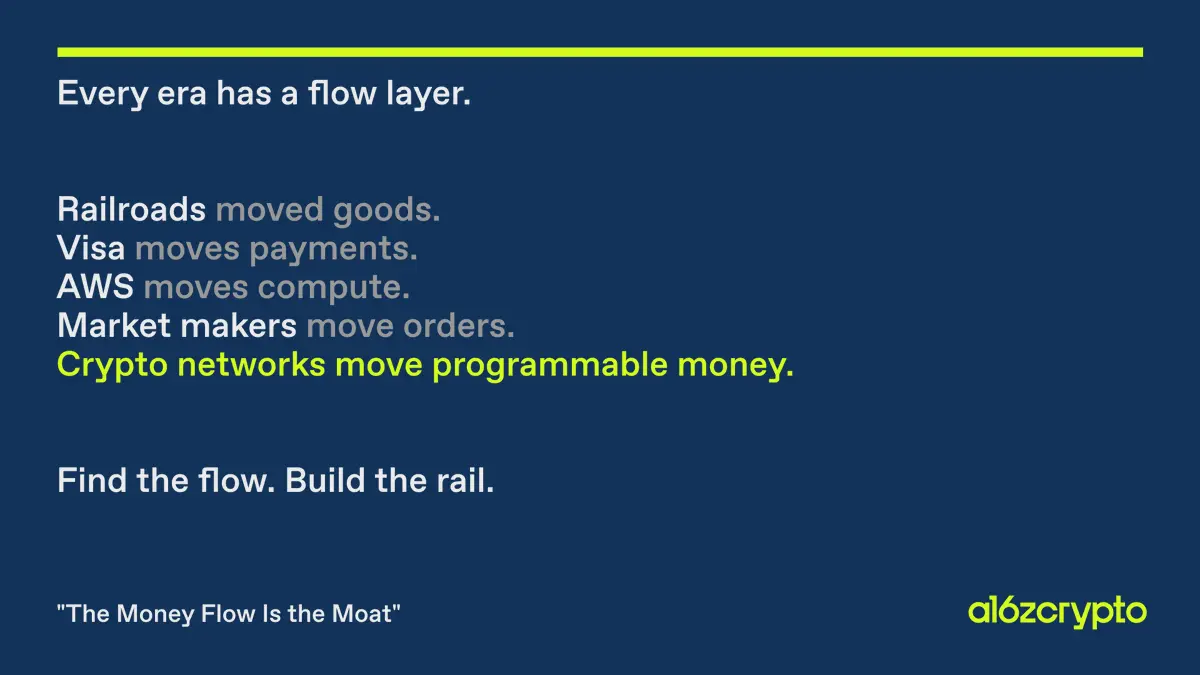
Financial markets make this model even clearer. Visa processed $15.7 trillion in payment volume in FY 2024 and reported $35.9 billion in net income. Jane Street posted $20.5 billion in net trading income last year – more than Citigroup or Bank of America. The top five US market makers handled 87% of order flow payment: they don't predict markets; they sit in the flow of every order and earn more as volume grows.

These businesses share another trait: network effects. Visa is more useful to more merchants because there are more cards; more useful to more cardholders because more merchants accept it. Same with order flow – each additional broker tightens spreads, attracting more brokers, which attracts more flow.

Flow of funds plus network effects is one of the most durable business structures ever.

Your Margin Is My Opportunity

Bezos called it “your margin is my opportunity.” He was talking about retail, but it applies even more to traditional financial services – the world's largest pool of profit extraction. Payments, custody, lending, FX, securitization, settlement, market making, without exception. Visa and Mastercard charge 2–3% transaction fees on networks designed in the 1960s. Remittance corridors take 6–9%. Prime brokers and custodians take a piece of every securities trade. Even after the US moved to T+1 settlement in 2024, funds still sit idle overnight as a structural tax on everyone involved.

Each of these margins is a target. Compress the cost, increase the speed, and potentially expand the whole market. Stripe and Square proved this was possible in payments.

Crypto founders have the opportunity to build the next version – programmable, instant, global, and natively in the flow of funds.

And the frontier extends far beyond financial services. Compute and GPU markets. Memory chips. AI training data. Energy. Robotics. Space. Rare earth metals. Each is a category where global value can begin to move at volumes the existing rails were never designed to carry.

Each is greenfield for building a flow-of-funds business on programmable infrastructure from the ground up. These markets have no existing rails, no entrenched intermediaries, and nothing to defend.

As a founder, ask yourself:

1. Are you in the flow of funds today?

2. When the value of activity on your product grows 10x, does your revenue grow with it?

3. If you're building a new product, where in your target market is the profit extraction highest relative to the value being created?
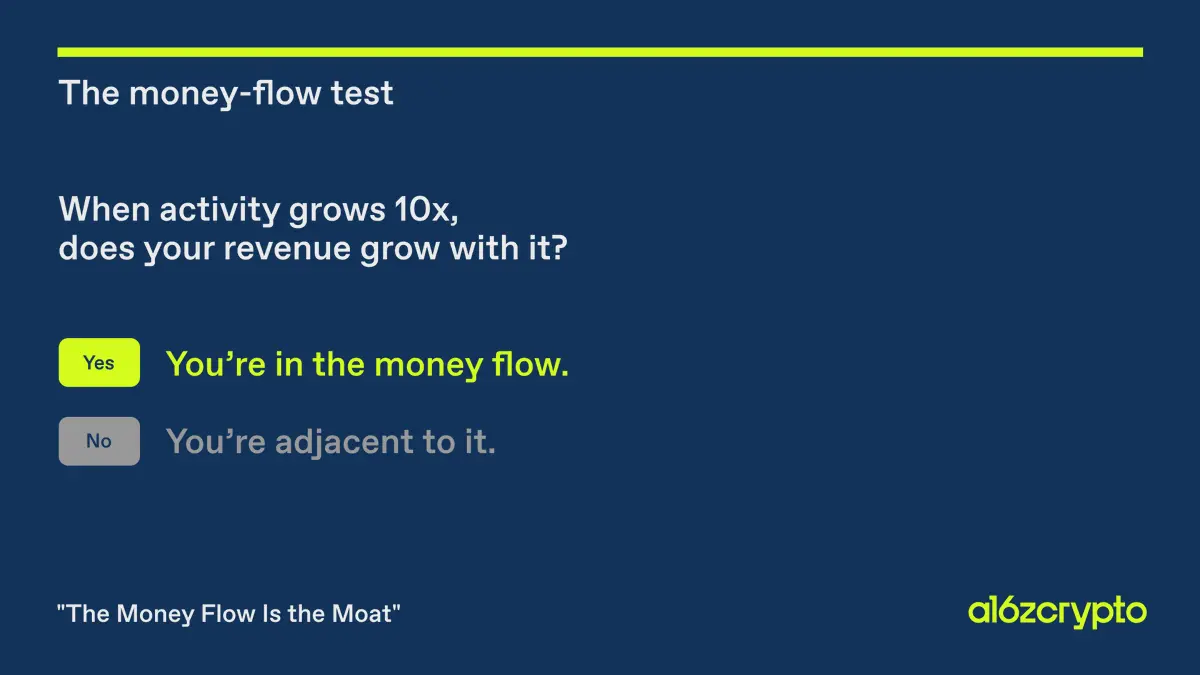
The opportunity is there. Take it, get into the new flow, and let the network compound from there.


Domande pertinenti

QAccording to the article, what is the core principle shared by historically great businesses like railroads, Google, Meta, and AWS?

AThe core principle is that historically great businesses position themselves within the 'flow of funds.' They facilitate the creation and transfer of value within a network and capture a portion of it. The more value that flows through the network, the larger the business typically becomes.

QHow does the article describe the unique advantage that cryptocurrency provides for startups regarding business models?

ACryptocurrency is the first modern technology natively built for the 'flow of funds' model. It enables value to move at internet speed—24/7, settled globally, with end-to-end programmability. This gives startups the advantage of inheriting network effects from the start and building on programmable infrastructure where payment rails are frictionless.

QWhat two powerful business concepts, when combined, does the article claim create one of the most durable business structures ever?

AThe combination of being in the 'flow of funds' and having 'network effects' creates one of the most durable business structures ever. The flow of funds generates revenue, while network effects make the service more valuable as more participants join, creating a powerful, self-reinforcing cycle.

QWhat does the article suggest is the primary target for crypto founders looking to disrupt traditional industries?

AThe primary target is the high-profit margins extracted by entrenched intermediaries in traditional industries, especially in financial services (payments, custody, lending, FX, etc.). The article quotes Jeff Bezos: 'Your margin is my opportunity.' Crypto founders can build cheaper, faster, and more programmable alternatives.

QWhat are the three key questions the article advises founders to ask themselves about their business?

A1. Are you in the flow of funds today? 2. When the value of activity on your product grows 10x, does your revenue scale with it? 3. If you're building a new product, where in your target market is profit extraction highest relative to the value being created?

Letture associate

"Agents' Last Exam", Claude Fable 5 Actually Loses to GPT 5.5

Surprisingly, in the newly released "Agents' Last Exam" (ALE) benchmark from UC Berkeley, GPT-5.5 has outperformed the recently launched and highly-regarded Claude Fable 5. ALE tests AI agents on their ability to perform real-world tasks across 55 professional domains—such as 3D modeling in Siemens NX, creating game scenes in Unreal Engine, and visual effects work in Adobe After Effects—by granting them full GUI and command-line access. In the core task completion rate ranking, GPT-5.5 configurations secured the top two spots (24.0% and 23.0%), while Claude Fable 5 with Claude Code came in third (22.0%). Notably, the highest pass rate was only 24%, and the most difficult "Last-Exam" tier saw most top models, including GPT-5.5 and Fable 5, scoring zero. The benchmark also revealed significant cost and efficiency gaps: Fable 5 spent over four times more money than GPT-5.5's most expensive configuration for a slightly lower score, and was much slower. ALE differs from previous knowledge-based benchmarks by evaluating practical "ability to do" rather than static knowledge retrieval. Its tasks are derived from real expert projects, automatically scored, and designed to prevent cheating through a rotating pool of private challenges. The results suggest that high performance on traditional benchmarks does not necessarily translate to proficiency in complex, open-ended real-world work. The study also notes that agents often fail by prematurely declaring tasks complete without proper verification, and that no single model excels uniformly across all diverse domains.

marsbit2 min fa

"Agents' Last Exam", Claude Fable 5 Actually Loses to GPT 5.5

marsbit2 min fa

Retail Ecology Dwindles, ZKsync Bets on Bank Pilots for a Breakthrough

Amidst declining retail activity, ZKsync is pivoting to target institutional banking as its primary growth strategy. The article explores this shift, contrasting it with the competitive "survival of the fittest" narrative by highlighting a cooperative model inspired by naturalist Peter Kropotkin. ZKsync is developing infrastructure like its private, permissioned Prividium suite for banks (e.g., Deutsche Bank's use case via Memento), enabling private transactions with public verifiability via zero-knowledge proofs. This appeals to institutions needing privacy, compliance, and Ethereum-based settlement security, unlike fully private chains (e.g., JPMorgan's Kinaxis) or consortium models (e.g., R3 Corda). However, this strategic focus has coincided with a steep decline in its public DeFi ecosystem, evidenced by plunging TVL and the departure of major protocols like Aave due to low fees. The network's future now hinges on banking adoption, with upcoming pilots like the Cari Network involving regional banks holding over $600 billion in deposits. A significant challenge is balancing this institutional focus with ZKsync's decentralized governance. Banks must operate on a network where rules and fees (denominated in the volatile ZK token) can be changed via community vote, and where a Security Council holds emergency control—a stark contrast to the predictable, contract-bound environments of traditional finance. The coming 18 months will test whether ZKsync can successfully onboard traditional banks onto a dynamically governed public chain or if institutions will ultimately revert to proprietary solutions.

Foresight News44 min fa

Retail Ecology Dwindles, ZKsync Bets on Bank Pilots for a Breakthrough

Foresight News44 min fa

The Recursive AI Anthropic Warned About: Tian Yuandong's New Company Has Just Taken the "First Step"

Anthropic recently highlighted the rapid progress toward "recursive self-improvement," where AI systems autonomously design and train their successors. In response, Recursive Superintelligence, a new company co-founded by former Meta researcher Tian Yuan Dong, has publicly demonstrated its first step toward automating AI research. The company released a system designed to autonomously execute the full AI research cycle: generating ideas, implementing code, running experiments, and learning from results. It validated this approach by achieving state-of-the-art results on three diverse benchmarks: 1. **NanoChat Autoresearch:** Optimizing a small language model's validation loss under a fixed 5-minute GPU budget, improving upon the community's best result. 2. **NanoGPT Speedrun:** Reducing the time to train a GPT model to a specific loss on 8 H100 GPUs from 79.7 seconds to 77.5 seconds, beating a highly optimized, human-driven community effort. 3. **SOL-ExecBench:** Improving the overall score on NVIDIA's suite of 235 GPU kernel optimization tasks by 18%, closing the gap to the hardware limit. The system discovered novel optimizations in this highly specialized domain without direct human expertise. Recursive's system operates as a general framework, capable of parallel exploration and cross-task knowledge transfer while incorporating safeguards against reward hacking. The company, backed by $650M in funding and a star-studded team including Richard Socher and Alexey Dosovitskiy, aims to create AI that recursively enhances its own research capabilities. This development represents an early but concrete move toward a new paradigm where AI accelerates its own advancement. It occurs alongside Anthropic's warnings about the need for industry coordination and potential pauses when recursive self-improvement thresholds are reached, highlighting the dual trajectory of rapid technical progress and growing calls for careful stewardship.

marsbit51 min fa

The Recursive AI Anthropic Warned About: Tian Yuandong's New Company Has Just Taken the "First Step"

marsbit51 min fa

Trading

Spot
Futures

Articoli Popolari

Come comprare FLOW

Benvenuto in HTX.com! Abbiamo reso l'acquisto di Flow (FLOW) semplice e conveniente. Segui la nostra guida passo passo per intraprendere il tuo viaggio nel mondo delle criptovalute.Step 1: Crea il tuo Account HTXUsa la tua email o numero di telefono per registrarti il tuo account gratuito su HTX. Vivi un'esperienza facile e sblocca tutte le funzionalità,Crea il mio accountStep 2: Vai in Acquista crypto e seleziona il tuo metodo di pagamentoCarta di credito/debito: utilizza la tua Visa o Mastercard per acquistare immediatamente FlowFLOW.Bilancio: Usa i fondi dal bilancio del tuo account HTX per fare trading senza problemi.Terze parti: abbiamo aggiunto metodi di pagamento molto utilizzati come Google Pay e Apple Pay per maggiore comodità.P2P: Fai trading direttamente con altri utenti HTX.Over-the-Counter (OTC): Offriamo servizi su misura e tassi di cambio competitivi per i trader.Step 3: Conserva Flow (FLOW)Dopo aver acquistato Flow (FLOW), conserva nel tuo account HTX. In alternativa, puoi inviare tramite trasferimento blockchain o scambiare per altre criptovalute.Step 4: Scambia Flow (FLOW)Scambia facilmente Flow (FLOW) nel mercato spot di HTX. Accedi al tuo account, seleziona la tua coppia di trading, esegui le tue operazioni e monitora in tempo reale. Offriamo un'esperienza user-friendly sia per chi ha appena iniziato che per i trader più esperti.

183 Totale visualizzazioniPubblicato il 2024.12.10Aggiornato il 2026.06.02

Come comprare FLOW

Discussioni

Benvenuto nella Community HTX. Qui puoi rimanere informato sugli ultimi sviluppi della piattaforma e accedere ad approfondimenti esperti sul mercato. Le opinioni degli utenti sul prezzo di FLOW FLOW sono presentate come di seguito.

活动图片