Organized & Compiled: Deep Tide TechFlow
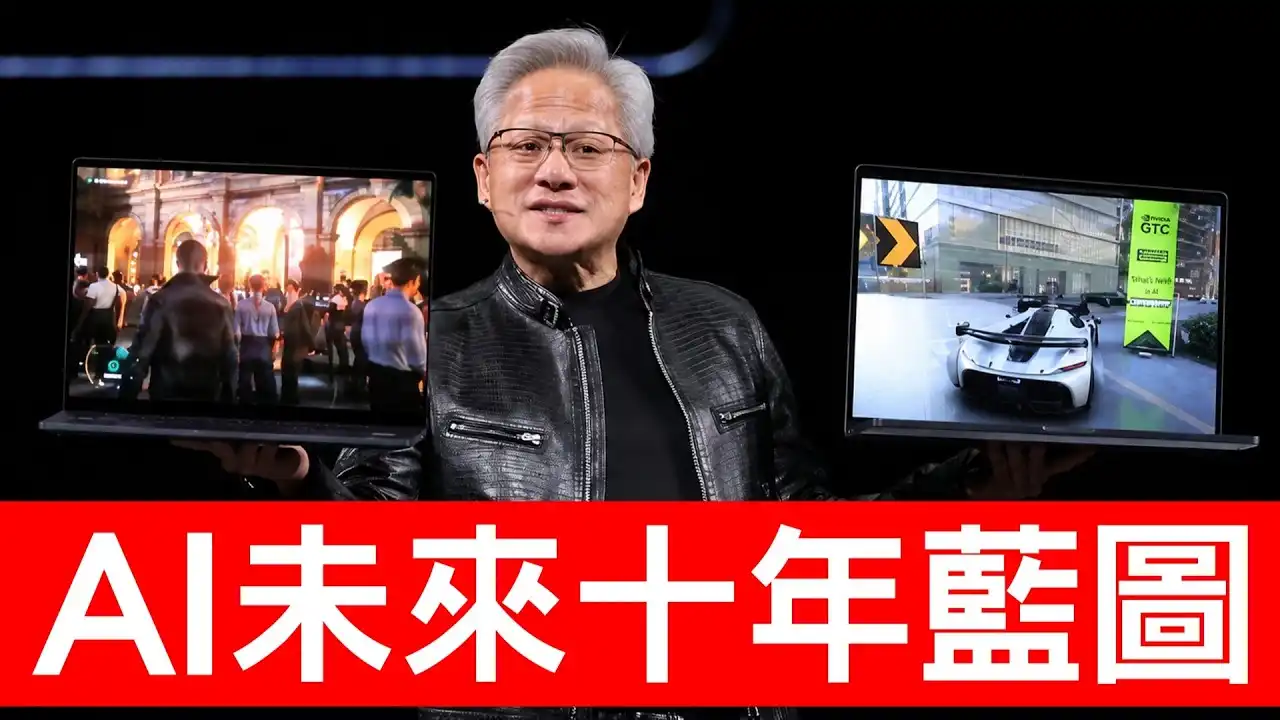
Guest: Jensen Huang, CEO of NVIDIA
Podcast Source: Bonnie Blockchain
Original Title: 7 Core Points from Jensen Huang's 2026 GTC Taipei Speech, NVIDIA's Latest Strategy Cheat Sheet! 【Bonnie Blockchain】
Broadcast Date: June 2, 2026
Summary of Key Points
In his 2026 GTC Taipei speech, Jensen Huang focused NVIDIA's next-phase strategy on one core judgment: AI has transitioned from generating content into the era of functional agents. Tokens are no longer just technical metrics but units of production for revenue, profit, and GDP. Centered around this shift, NVIDIA introduced Vera Rubin, Vera CPU, an enterprise-grade agent toolkit, new-generation PCs in collaboration with Microsoft, and Cosmos 3, Alpamayo 2, and Isaac GR00T for physical AI. Huang emphasized that the computing paradigm for the next decade will be composed of models, agent frameworks, tool skills, and runtimes, diffusing from the cloud, enterprises, and local PCs to robots, factories, satellites, and edge devices. For Taiwan's supply chain, this means AI factories, power efficiency, infrastructure delivery speed, and full-stack synergy will become the keys to the next wave of industry growth.
Excerpts of Highlights
The Arrival of the AI Agent Era
- "Useful AI has arrived; AI is now a profit generator and a GDP generator. Behind it is not just large language models, but a brand-new computing paradigm: agents."
- "Agents are composed of large language models and an agent framework. The framework connects memory, tools, reasoning, planning, and action like an operating system."
- "The breakthrough in agent systems comes from large language models now being capable of thinking, reasoning, planning, and using tools, as well as from agent frameworks capable of managing memory, coordinating workflows, and dispatching tools."
- "Every company will become an agent company; every company will run agents internally, and every company will need its own agent operating system."
Tokens, AI Factories, and Infrastructure Economics
- "Tokens are now profitable units of revenue. AI companies wanting to produce more tokens will build more AI factories, which is precisely why Taiwan's computing demand is exploding."
- "Computing is revenue, computing is profit. Without revenue and profit, it's a loss."
- "If an AI factory has only 1 gigawatt of power, that 1 GW is the limit; under this constraint, throughput per watt is revenue, because every token has value."
- "Choosing the wrong architecture just because the chip is cheaper doesn't translate into real returns; you need to ensure revenue per watt. The more you buy, the more you earn."
Vera Rubin and NVIDIA's Infrastructure Transformation
- "Vera Rubin is not a chip, nor just a GPU; it's a complete system built end-to-end."
- "NVIDIA was a GPU company, then became a systems company, and is now further evolving into an infrastructure company, helping customers build AI factories."
- "Vera Rubin is NVIDIA's most ambitious engineering project in history. All 40,000 engineers in the company are involved, and Taiwan's supply chain also participated in creating this system."
- "Grace Blackwell was built to handle AI, especially inference; Vera Rubin is built to run agents."
Vera CPU and the Computational Needs of Agents
- "All CPUs until now were built for humans; this CPU is built for agents."
- "Agents have no patience. They live in a world measured not in seconds, but in nanoseconds. When an agent uses a tool, it wants the response as fast as possible; when it accesses a database, it wants results returned instantly."
- "Vera CPU is a CPU built for agents, emphasizing single-threaded performance, instructions per clock, bandwidth per core, and total system bandwidth."
- "This market will certainly be larger than the previous one because the number of agents will far exceed humans, and agents are extremely impatient. This is the NVIDIA Vera CPU."
Next-Generation Personal Computers
- "The future agent computing paradigm will run on the AI cloud, within enterprises, and on your PC."
- "The new operating system will be the traditional OS plus a large language model; in many ways, the large language model is the modern equivalent of DirectX, an intelligent extension of the computer."
- "Applications will be replaced by agent runtimes; the modern application will become an agent."
- "NVIDIA and Microsoft are reinventing the PC, launching a new generation of Windows machines covering desktops, notebooks, and workstations."
Physical AI, Autonomous Driving, and Robotics
- "Language models are trained on data from a human perspective, but robots need to understand the world from the robot's own perspective. The biggest problem for physical AI is data."
- "Cosmos 3 is a foundational model at the forefront of physical AI, capable of understanding, reasoning, generating, simulating in closed loops, and even becoming the strategy itself."
- "With AI, computing itself will also become data; Cosmos 3 can be used to train more AI models and be enhanced into your own proprietary model."
- "Whether it's cloud agents, PC agents, autonomous driving systems, or humanoid robots, the underlying computing pattern is the same: model, framework, tool skills, and runtime."
Jensen Huang Names Taiwanese Snacks as Part of AI Supply Chain
Jensen Huang:
The scale of the Taiwan ecosystem's development today is truly incredible. When most people talk about ecosystems, they first think of our software stack, the developer ecosystem built on top of NVIDIA computing systems. But NVIDIA's ecosystem goes beyond that; it extends all the way up to the Taiwan supply chain, where everything begins, and all the way down to the data center, ultimately reaching end users.
Today, we'll discuss almost every part of this ecosystem. There are so many people to thank. I love the ecosystem here; there are many companies, and many of my favorite ecosystem partners. Taiwan has an incredibly rich ecosystem; it's the best supply chain ecosystem in the world.
The AI Agent Era Has Arrived
Jensen Huang:
Two years ago when I came here, I started talking about how AI would move from generative AI to the next wave, which is agentic AI. Today we can say that agentic AI has arrived, useful AI has arrived.
From an industry perspective, this means demand for tokens is becoming extremely strong. Because if AI can actually do things, people will want to produce more of this capability. Tokens are now profitable units, revenue-generating units. Since it can make money, AI companies will want to build more tokens, generate more tokens, construct more AI factories, which is also the reason for the explosive growth in computing demand in Taiwan.
This is exactly why you're all so busy and your business performance is so good. In fact, it seems reflected in the stock prices of some of your companies. The computing paradigm has changed; everything has changed.
The first key point: Useful AI has arrived; AI is now a profit generator and a GDP generator. Behind it is a brand-new computing paradigm. It's not just large language models, but agents. Almost everything we discuss today will be built on this foundation.
Let me take a moment to explain what I mean. Inside is an agent, an agent application. In the past, this would have been an application, code, an operating system—code within the application running on top of the OS. Today, it's an agent, composed of one or more large language models placed within an agent framework. This framework helps coordinate its work, enabling it to truly accomplish productive tasks.
When input enters the system, the agent must understand, observe, reason, act, and use tools. Tools can be spreadsheets, web browsers, data processing engines, or database engines. Every flow of information, whether processing context, understanding what's happening, reasoning what to do next, or forming an actionable plan, needs to be coordinated by some software.
So, the essence of an agent is such a system. It handles short-term memory, or working memory, and also long-term memory, just like humans. The memory management system thus becomes extremely important. The entire system is called the agent. The large language model is responsible for thinking, and the agent framework connects everything, like an operating system.
This is the new computing paradigm and the reason agents can accomplish amazing tasks. This is a major breakthrough: Large language models are now good at thinking, reasoning, planning, using tools; at the same time, we also have agent frameworks capable of managing memory, coordinating workflows, and invoking tools. Therefore, we can now do many things we couldn't before.
What are Tokens in AI Factories?
Jensen Huang:
Tokens, DSX, GPU, CPU, Vera... We've already built the next-generation system Vera Rubin. Vera Rubin is not a chip, nor just a GPU. It starts with the GPU but goes far beyond it. The entire end-to-end system is Vera Rubin.
It includes the GPU, Vera Rubin NVLink 72, coordinated by the Vera CPU which I'll introduce later. It also includes the revolutionary Vera storage system, CX9, our software stack DOCA, and built-in security processors. All data in the system, whether at rest, in transit, or in use, is encrypted. The entire system is secure because AI models are extremely valuable. This is why the whole system follows confidential computing principles.
Any one of these systems alone could be a full revolution. Vera Rubin is NVIDIA's most ambitious engineering project in history. All 40,000 engineers in the company participated in the work on Vera Rubin, not to mention those of you present who also participated in creating the entire system. Vera Rubin is truly a marvel; it's not just a chip, but a system composed of many components.
It goes even further. Long ago, NVIDIA was a GPU company; over the years, we've evolved into a systems company. What you see now is the most complex system we've ever designed from scratch. But ultimately, our customers and partners don't want to buy computers; they want to build AI factories.
This is why NVIDIA is beginning to transform again. As you can see, many of our technologies have expanded to the full infrastructure scale. Our partners are also at the infrastructure scale: power plants, cooling systems, grid suppliers, and many industrial companies are now part of our ecosystem. In the end, we need to build the full technology stack, just like we built GPUs, Grace Blackwell, NVLink 72; now, we need to build full-stack systems enabling customers to build outstanding AI infrastructure.
Doing this well, helping customers build and deploy AI factories, is extremely important. The reason is simple: Computing is revenue, computing is profit. Without revenue and profit, it's a loss.
Everyone needs to understand one thing: When an AI infrastructure goes online, it can go live quickly, or it can drag on; throughput can be high or low; elasticity and reliability can be good or bad; effective service life can be long or short. Because this represents investments of 50, 60, or even 100 billion dollars, this curve is extremely important.
This is also why NVIDIA is a great partner. We have full integration capabilities, not just making a presentation slide, but actually creating the entire infrastructure, connecting everything, and building at scale ourselves to ensure the system runs well. Therefore, our first token time, first inference time, training startup time are all faster.
Second, our throughput per watt, tokens per watt are world-class. The reason is we integrate everything, design everything from scratch, simulate the entire system, and employ extreme co-design. Just like the Vera Rubin rack shown earlier, everything is designed for incredible throughput.
If your data center, your factory has 1 gigawatt of power, it won't get any more; that's all the generation capacity you get. Under 1 GW of power, throughput per watt is revenue, because every token generates profit, every token is revenue.
This is the future. Computing is revenue; performance per watt is your revenue. Choosing the wrong architecture just because the chip is cheaper doesn't translate into real returns; you need to ensure revenue per watt. The more you buy, the more you earn.
Standing before you now, I can tell you: Vera Rubin is in full production. The supply chain scale we've built for Vera Rubin is twice that of Grace Blackwell. Where assembling a Grace Blackwell rack used to take two hours, now it takes only five minutes. So not only is capacity higher, but production throughput is much faster, and we need all of this to meet demand.
This ecosystem is extraordinary. To support Grace Blackwell and prepare for Vera Rubin's ramp, millions of square feet of capacity have come online. I want to thank you all. Vera Rubin is in full production. Thank you.
Vera Rubin System Introduction
Jensen Huang:
Vera Rubin wasn't built just for AI. Vera Rubin wasn't built just to run AI; it was built to run agents. It's an agentic system. Imagine the complexity. And precisely because of this, agents are the final computer science breakthrough. It took so many years to finally realize their potential and become useful. The computer that can run them should also be the world's most advanced.
This is Vera Rubin. Let's take a look. Please bring Vera Rubin up.
This is Vera Rubin, Vera Rubin NVLink 72. This is part of the next-generation system; at the next GTC, I'll talk more about it; we have a lot to cover today. This is the Vera CPU rack, 256 CPUs, all liquid-cooled. I'll introduce Vera later. This is the Vera BlueField storage processing system, also the security system. And of course, our Mellanox networking, the world's first CPO. This is Vera Rubin, an amazing combination of technologies.
When we built Hopper, it was for pre-training. Pre-training was the most important application then, the most important workload we faced. When building Grace Blackwell, people said: "Jensen, NVIDIA is great at pre-training; inference is simple." Remember? Many said: "Inference is simple; we can do it too."
But you know, inference equals money. Models are very complex; achieving excellence simultaneously in high response speed, fast interaction, and high throughput is very difficult. This is why we created NVLink 72.
Today, NVIDIA's token cost is the lowest in the world. Not just 10% lower, but multiples lower, even orders of magnitude. All because we did extreme co-design, because we understood the computational model and pattern of inference, and created NVLink 72.
With Vera Rubin, things have gone beyond inference. Now it's inference within agentic systems. This is Vera Rubin. No cables, no hoses, no fans. Last time I showed it to you, cables were everywhere.
VERA CPU: The CPU for AI Agents
Jensen Huang:
Vera CPU is a CPU built for the AI era. So far, all CPUs have been built for people. We were users, we were tenants. The way humans use CPUs is living in a world measured in seconds. We rent CPU resources in the cloud; more CPU cores mean more resources to rent. The usage scenarios and economics of old CPUs are completely different from those of agents.
Agents have no patience. They live in a world measured not in seconds, but in nanoseconds. When an agent uses a tool, it wants the response as fast as possible; when it accesses a database, it wants results returned instantly. Every moment an agent waits, it's prevented from moving to the next step, and the next, and the next. Therefore, we must make the CPU as low-latency and interactive as possible.
This is why we created Vera CPU for the AI era. In our system, it has three uses. The first, of course, is for thinking within Vera Rubin. In the Vera Rubin rack, there are already two CPUs. You know, we are manufacturing and selling millions of Vera Rubins, and have already sold millions of Grace Blackwells. NVIDIA is already one of the world's largest CPU manufacturers.
The two CPUs in the Vera Rubin rack: one coordinates and manages the GPUs, manages the KV cache, and handles various software running in the rack. We also have Grace BlueField for security and isolation. The Vera compute portion is for the agent framework, responsible for coordinating AI models, tool usage, and database access.
The data server here is Vera BlueField, the world's fastest storage server and storage system. It's crucial because agents access memory at extremely high speeds. Storage servers and CPUs are now on the critical path of the most expensive part of the data center.
There's a good reason why this is the most expensive. The core economics of an AI factory are tokens, and tokens are created here. So, you naturally want to produce and generate as many tokens as possible. Economic value is concentrated here, and the CPU and storage system must not become bottlenecks.
Therefore, Vera CPU puts a lot of pressure on CPU architecture, which is also why we built a completely new architecture from scratch. This is a CPU the world has never seen before; we call it Vera. This is a CPU built for agents. All CPUs until now were built for humans; this CPU is built for agents.
First, Vera's instructions per clock (IPC) must be extremely strong because we need to reduce latency, reduce processing time. We want single-threaded performance, not just throughput. Single-threaded performance must be world-class, the best. So Vera's IPC is extremely high, among the highest in the world: 10 instructions fetched, decoded, and executed per clock cycle.
Second, the bandwidth the CPU needs for data in and out must be world-class. This includes both per-core bandwidth and total bandwidth. As I said earlier, agentic systems are inherently decoupled and distributed. When computing is decoupled and distributed, networking becomes the issue. Therefore, we must move data as fast as possible between CPU cores, between CPU and storage, and between CPU and GPU.
Bandwidth around the system and inside the CPU cores must be world-class because CPU cores are communicating with each other at extremely high bandwidth. They are not rented out one core at a time; they all collaborate together. Vera's cross-sectional bandwidth is amazing. It's the first system to support PCI Express Gen 6, also first to feature LPDDR5, with bandwidth reaching 1.2 to 2 TB per second, 2 to 3 times that of the highest-performance CPUs.
This is a CPU built for agents. This market will certainly be larger than the previous one because the number of agents will far exceed humans, and agents are extremely impatient. This is the NVIDIA Vera CPU.
The Most Important Computing Paradigm for the Next Decade
Jensen Huang:
This is truly the most important slide. The core conclusion here is: This is the application pattern for the next decade, and also the computing pattern for the next decade. Agents, agent frameworks, and the large language models coordinated by the framework—every company will run this. Every company will become an agent company; every company will have agents running internally; every company will find that agents need their own operating system.
Every company is asking us: How to run agents securely? How to build agents for our workloads? So, we have the NVIDIA Enterprise AI Agent Toolkit. You've actually seen me building it publicly step by step.
Almost everything NVIDIA does, as you know, if you look back at my GTC speeches 5 or 10 years ago, you'll see I've been talking about these things for years because we've been preparing for this moment.
For enterprises to build agents as a service, or agents for operations, they need four things. First, they need models. Of course, the smarter, cheaper, and faster the large language model, the better. Second, they need a framework to coordinate the entire system. Third, these models want to use tools, and these tools come with skills. I just showed the CUDA-X libraries; they will become powerful tools for agents in the future. Fourth, they need a runtime, an operating system that ties everything together.
This is the NVIDIA Agent Toolkit. It includes modifiable models, namely NVIDIA's world-class open-source models. I want to show more. You can run agents from anywhere; you can run powerful agents like Claude Code, or powerful agents like Codex. You can place them within a framework called Open Shell for highly secure operation within the enterprise.
This Shell protects the agent, keeping it always constrained by security policies. Privacy is protected, permissions and privileges are explicitly assigned, identity is protected. Therefore, Open Shell is being adopted globally. NVIDIA Open Shell is open-source; you'll see many companies adopting it, including Red Hat, Canonical, and Microsoft. It will be adopted everywhere.
This is an important runtime, and this runtime is fully optimized for the ubiquitous NVIDIA AI platform. You can run Open Shell on any cloud, on-premises, even on devices. Now, you have tools and libraries agents can use, models you can modify or use directly, and agent frameworks. These agent frameworks can now run on-premises or anywhere else.
One of my favorite agent use cases is chip designers. This is one of NVIDIA's most important jobs. So, of course, we worked with Cadence to build a chip design super-agent. It's coordinated by Codex or Claude Code, taking RTL, architecture diagrams, schematics, or specifications as input, helping you fix what needs fixing. We've built some super-agents together and optimized Nemotron for the NVIDIA runtime.
NVIDIA is committed to building open models for the world, so you, all of us, can create our own agents. Today, we announce Nemotron 3 Ultra, our next-generation open model, and it's very smart. Nemotron models not only give you the model, but also all the data we used to train the model.
Because we have a strong partner alliance, you can see all the partners listed here. We work together, contribute data to each other. Through these great partnerships, everything—from the model to the training scripts to the data—will be fully opened to you. This is the best form of open model, the world's best open model system policy. The goal is simple: You can take everything, add to it, make it better, and make it your own model.
Nemotron 3 Ultra is 5 times faster, costs 30% less, and is fully open. We are very firm on this. This is Nemotron 3, and we are also developing Nemotron 4. It's this complete toolkit of models, frameworks, tool skills, and runtimes that enables every enterprise globally to create their own agents, just like Cadence with its super-agent.
NVIDIA's New Generation Personal Computers
Jensen Huang:
Microsoft and NVIDIA will reinvent the PC. This will become the new PC. Tomorrow night, our tomorrow night here, I'll be with Satya to talk more about the work we've been advancing together over the past three years. Microsoft and NVIDIA have spent so much time completely rethinking how the PC operates, precisely to prepare for this moment.
As I mentioned earlier, this agent computing paradigm will run on the AI cloud, within enterprises, and on your PC. What happens when a PC has an autonomous agent? It helps you, understands you. You can talk to it; it can see you. You can have it read files, help you with research. It can do even more, which I'll show later.
The new operating system, of course, is the old OS plus a large language model. In many ways, the large language model is the modern version of DirectX. It has input and output, understands prompts, understands computer vision, can generate video, can generate sound. It's a modern intelligent extension of the PC, of the computer.
On top of that, as I said earlier, applications will be replaced by agent runtimes, and the modern application is the agent.
Everyone, the NVIDIA RTX Spark laptop. Thank you. I have too many things in my pockets. Okay, this is the world's most amazing chip. This is the N1X we built in collaboration with MediaTek. I think I just saw Rick. This is the N1X, a beautiful chip. Frankly, it's a chip that took 33 years to build.
The reason is, 100% of the NVIDIA software stack can run here. Want to do digital biology? No problem. Want to do seismic processing? No problem. Want to do astrophysics? No problem. Everything related to CUDA, all physics, all biology, all genomics, all AI, no problem. All computer graphics, no problem.
Every application NVIDIA has ever created, and every application Windows has ever run, Microsoft and NVIDIA have meticulously optimized so that this computer can truly run everything the world has ever created. On top of that, it can now run agents. This is an incredible computer; I'm very proud of it.
This computer can have a local Nemotron 3 Ultra model, or a Nemotron 3 super model; it can also connect to cloud-based Claude Code, Codex, or other models; it can also connect to models on the network. It will work and accomplish amazing things. RTX Spark is a reinvention of the laptop, but in fact, Microsoft and NVIDIA are reinventing the entire PC.
Today, we announce a brand-new product line: three revolutionary Windows machines, covering desktop, notebook, and workstation. They are 100% compatible with Windows, 100% support CUDA, 100% equipped with NVIDIA AI Tensor Cores. Everything you've seen running on various NVIDIA platforms globally can run here.
We have a roadmap for this. This is a brand-new product family. For each generation architecture, we'll have desktop, notebook, workstation; the next generation will still have desktop, notebook, workstation. I'm very happy and honored that 100% of the global PC industry has joined us in reinventing the PC. This is a new product line and a new beginning.
Cosmos 3: The Foundational Model for Physical AI
Jensen Huang:
In the context of language models, the English and various languages we train on from the internet are from a human perspective. They are written by us and read by us. However, to create data for AI robots, it must be from the robot's perception and perspective. The vast majority of video data in the world is from a third-person perspective, not first-person.
Therefore, for agentic systems, robotic systems, and physical AI, data is the hardest problem. You've seen us climb this ladder. We started with teleoperation, essentially human demonstration. This is no different from the human feedback breakthrough in reinforcement learning. Then, we used simulation, which is where Omniverse comes into play. This is also analogous to verifiable rewards in reinforcement learning.
We use these systems to bootstrap AI models, bootstrap physical AI models. Eventually, we can learn from a third-person perspective and reproject it to a first-person perspective. Through this bootstrapping process, we end up with a world foundation model that can understand the physical world from any perspective you want. Third-person, first-person, outside-in, inside-out, all possible. This is indeed a major breakthrough.
Today, we announce Cosmos 3. Cosmos 3 is the forefront of physical AI. We are at the forefront in language models; many are researching them. But in physical AI, we are absolutely the strongest globally. I'm immensely proud of the team for achieving this.
This is your foundational model for all your work. Whether you want to create robots, factory robots, or robots working in factories, as long as it involves the physical world, you now have a partner: Cosmos 3. It can understand and reason, can generate, can simulate in closed loops, and can even become the strategy itself. It leads in various global benchmarks. I'm very proud of Cosmos. Today, we announce Cosmos 3.
It used to be data plus computing equals AI. Now we have AI, and computing will also become data. So, using Cosmos 3, train a large batch of AI models. Cosmos is a very excellent open model system, exactly like Nemotron. We open the model, open the data, even open the training methods, so you can enhance it for yourself and turn Cosmos into your proprietary model.
Alpamayo 2: Autonomous Vehicle Inference
Jensen Huang:
Today, we announce Alpamayo 2, an open model for autonomous vehicles. We are collaborating with global automotive companies. Looking at these brands that have joined NVIDIA Hyperion, are building NVIDIA Hyperion cars, they represent about 80% of global car production. That is, these manufacturers cover around 80% of global cars.
There will be a large number of NVIDIA Hyperion systems in the future, capable of running Alpamayo and any other autonomous driving technology stack. We also connect to mobility services. About 97% of global mobility services are connecting with us. Therefore, when we deploy Alpamayo on the Hyperion runtime and Halos operating system, we can connect to these global services.
Isaac GR00T: Humanoid Robots
Jensen Huang:
NVIDIA Isaac GR00T is our humanoid robot technology stack, containing models, data generation, simulation, runtime, and operating system. It represents the GR00T platform, the Isaac GR00T platform.
As you can see, every one of our systems follows the exact same pattern: whether it's cloud-based agentic systems, agentic systems on PCs, robotic systems for autonomous vehicles, or robotic systems for humanoid robots, it's the same pattern.
Of course, in each case, we build everything completely. We do vertical integration, complete integration, employ co-design and extreme co-design, then open it up so everyone can use any part as they need. You want to use something; we'll even help you modify it.
But there's still one thing missing: robotic systems need a reference platform. These robotic systems are too complex, with many motors and sensors, and very fragile. However, we need a way to deliver these reference platforms. Just like we did for PCs, DGX, cloud, and autonomous vehicles, now we must do the same for robots.
Today, we announce NVIDIA Isaac GR00T, a fully integrated humanoid robot reference platform. It has 25 degrees of freedom per hand, 31 degrees of freedom for the robot body, stands 6 feet tall, weighs 150 lbs. Just like me, except the first number is smaller than mine, the second larger, otherwise similar.
This platform runs the new Thor, along with our complete software stack, data generation stack, data simulation stack, and runtime. Everything is integrated into a single robot platform for everyone to use. We built it for higher education and university researchers because building such a platform themselves is too difficult.
Recap and Summary
Jensen Huang:
Over the past six months, the computer industry has been completely transformed. The reason for the change is that agents have finally been realized and have converged with the latest frontier models, enabling AI to now do truly useful work.
This computing pattern will repeat over and over: an agent composed of models and a framework, using tools with skills, and running on a certain runtime. The runtime depends on whether it's in the cloud, on-premises enterprise environment, PC, or robot. But the computing pattern is exactly the same.
You will use different frameworks based on your preference, and different models based on your preference. You will improve them for your proprietary uses. You will create super-agents, rent them to others, help others accomplish work. This agentic platform, this agentic pattern, is precisely what the NVIDIA Enterprise AI Toolkit aims to support. For you, this is a great way to participate in AI; for us, it's also a huge growth opportunity.
Vera Rubin is in full production. Grace Blackwell was built to handle AI, especially inference; Vera Rubin was built to run agents. It is in full production. It is far more than just a GPU; it's an entire decoupled, distributed agent processing system.
NVIDIA has truly become an infrastructure company. Not just a GPU company, not just a systems company, but an infrastructure company. Our goal is to help you create maximum revenue, maximum profit, and do so as quickly as possible.
In the world of agents, this new way of computing means CPUs must also be built for agents, not for people. CPUs built for agents have their own special requirements. Our NVIDIA Vera is a revolution. I'm happy to see its ramp and order status; it will be the fastest, most successful product launch in NVIDIA's history.
NVIDIA and Microsoft have created a brand-new PC product line. This is a new beginning. Of course, the same agentic processing pattern, agentic computing pattern I just described, will also run on various devices. I mentioned PCs, but in the future, it will appear in robots, satellites, base stations, factories, cloud, on-premises, edge devices. This agentic AI system, agentic computing pattern, will be replicated in all kinds of computers. Our understanding of the personal computer will likely change.