After Rising 11 Times in a Year, Micron's Earnings Report Becomes a Stress Test for the AI Memory Market

marsbitPubblicato 2026-06-22Pubblicato ultima volta 2026-06-22

Introduzione

**Micron's Upcoming Earnings: A Crucial Test for the AI Memory Rally** Investors in AI memory stocks face a critical moment on June 24th, when Micron Technology reports quarterly earnings. The stock, having surged approximately 11-fold from $103 to $1,134 over the past year, carries immense market expectations. Wall Street consensus forecasts a staggering ~932% year-over-year jump in EPS to around $19.72 and ~270% revenue growth to ~$345 billion, largely driven by sold-out HBM (High Bandwidth Memory) capacity through 2026. Analysts have aggressively revised estimates upward over the last 90 days, with EPS expectations rising 68%. This creates a high bar: even strong results risk a sell-off if they fail to meet these elevated projections. Notably, price forecasts from institutions like Citi (predicting ~200% DRAM price increases in 2026) are already among the most bullish on Wall Street, not conservative. The key metric to watch is gross margin, guided to a record ~81%. Such peak profitability raises questions about sustainability in the historically cyclical memory sector. While management has signaled continued strength, the stock's direction post-earnings will likely hinge more on forward guidance for the next quarter and details on HBM capacity expansion for 2027, rather than the already-anticipated stellar past results. The report represents a major pressure test for the high-flying AI memory trade.

Author: Claude, Deep Tide TechFlow

Deep Tide Intro: Those betting on AI memory face a crucial test on June 24. Micron will announce its quarterly earnings after the market closes that day. Its stock price has soared from $103 a year ago to $1,134, roughly an 11-fold increase, with a market cap of $1.28 trillion. The market is betting on continued growth, with the Wall Street consensus expecting earnings per share (EPS) to skyrocket by about 932% year-over-year and revenue to grow by about 270% for the quarter. The higher the climb, the higher the expectations the earnings report must meet. This report is the moment to validate this bet and represents the toughest hurdle for this year's AI memory market rally.

If you hold Micron stock or are watching the AI, chip, or memory sector, this earnings report after the close on June 24 is worth paying attention to.

Micron's stock price has risen from $103 to $1,134 over the past year, an increase of about 11 times. Its market cap is $1.28 trillion, up about 297% year-to-date. At this level, anyone buying further up is certainly thinking "how much longer can this rally last?" The earnings report is the moment to validate this bet.

Currently, the market consensus remains bullish.

According to cryptobriefing, Wall Street expects Micron's EPS for this fiscal quarter to be around $19.72, compared to just $1.91 in the same period last year, a year-over-year increase of about 932%; revenue is expected to be around $34.5 billion, a year-over-year increase of about 270%. These numbers are supported by High Bandwidth Memory (HBM, specialized high-speed memory chips for AI accelerators). Micron's HBM production capacity for the full year 2026 is already completely sold out, with orders booked through the end of the year.

Analysts Have Been Revising All Year, Expectations Keep Chasing Higher

This rally didn't come out of thin air. Over the past three months, Wall Street has been consistently raising its profit forecasts for Micron, and doing so urgently.

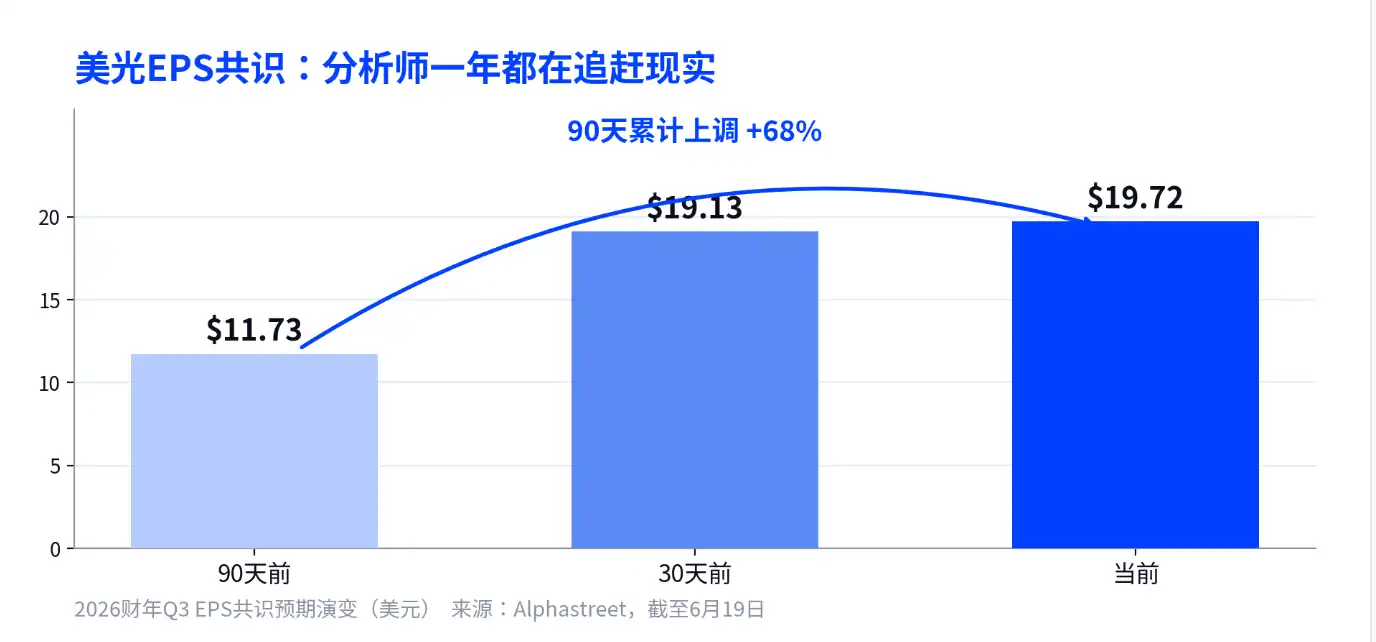
According to Alphastreet data, the consensus EPS for Micron this fiscal quarter was $11.73 90 days ago, rose to $19.13 30 days ago, and is now at $19.72, a cumulative increase of 68%. Wall Street's assessment of the company three months ago was nearly half of what it is now.

The 31 analysts' EPS forecasts range from $7.53 to $24.08, and revenue forecasts range from $19.7 billion to $40.1 billion, a huge gap. The steepness of this inflection point is something analysts themselves haven't fully figured out, forcing them to constantly revise estimates upwards based on actual data.

For the average investor, this is a double-edged signal.

Repeatedly raised expectations indicate that fundamentals are indeed exceeding expectations; but even if the earnings are good on report day, if they fall short of this pushed-to-the-limit consensus, the stock price could still fall.
Don't Believe "Citi Is Too Conservative," That's Actually One of the Most Aggressive Forecasts

There's a narrative on social platforms suggesting that Citi's assumptions on memory prices are too conservative, and that Micron's earnings will therefore significantly exceed expectations. This judgment has the direction wrong, and basing decisions on it could lead to pitfalls.

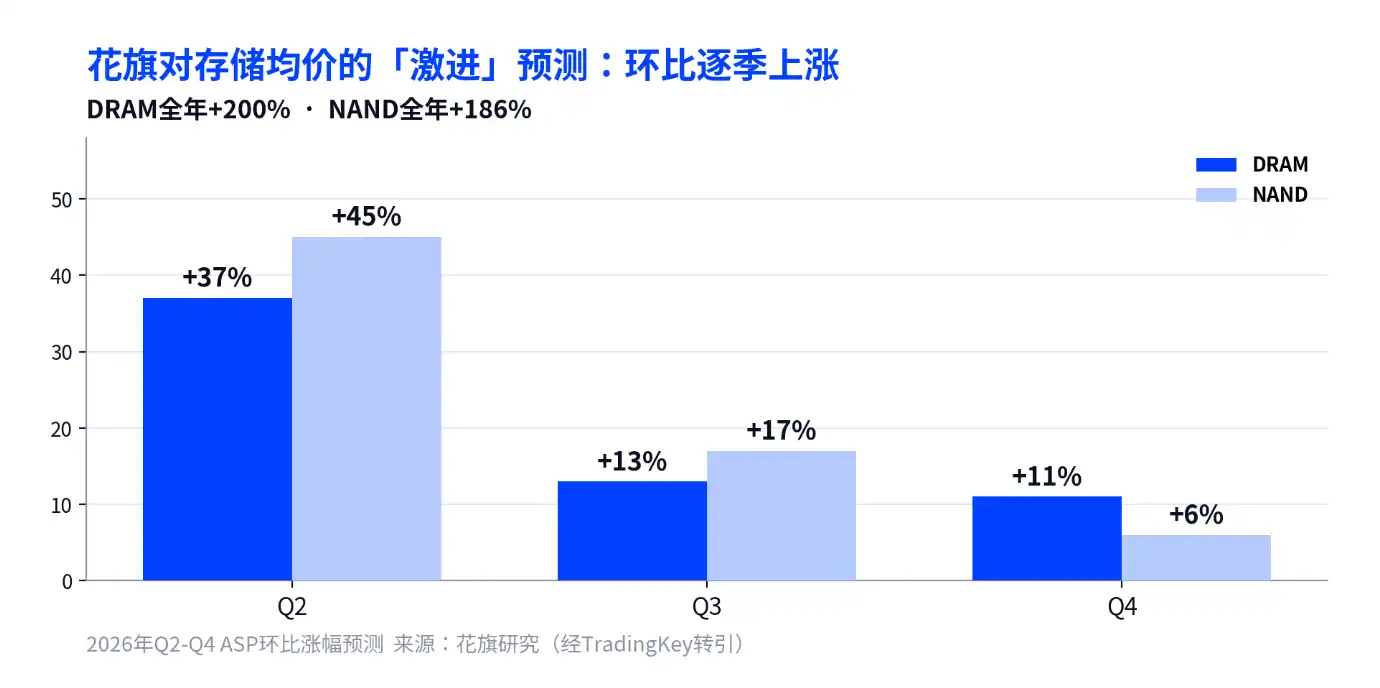
According to TradingKey, Citi forecasts DRAM average selling prices to rise about 200% for the full year 2026, with sequential increases of 37%, 13%, and 11% in Q2 to Q4, respectively; NAND flash prices to rise about 186% for the year, with sequential increases of 45%, 17%, and 6%. A 200% full-year increase is among the most aggressive forecasts on Wall Street for memory prices, not conservative. Based on this, Citi raised its price target to $1,200, while Deutsche Bank gave a target of $1,500; both extended their judgment of a memory shortage through 2028.
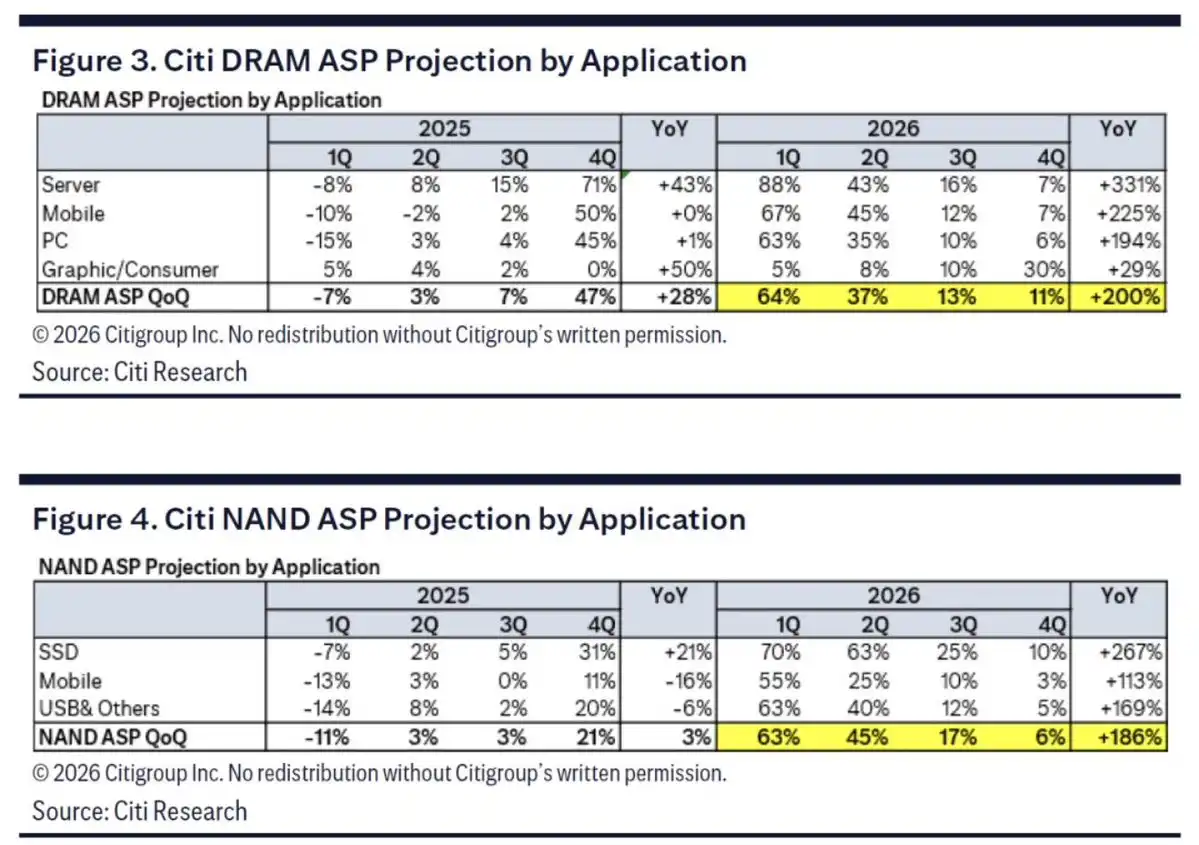
The risk lies here: even the most aggressive institutions have built their forecasts on "200% increases." The earnings report must surpass a bar that has already been repeatedly raised. Expecting to bet on an upside surprise based on "Citi underestimated" is not a solid logical foundation.
Gross Margin Around 81% is the Historical High, and Also the Day's Biggest Suspense

The figure to watch most closely in the earnings report is the gross margin.

According to TradingKey, Micron's own guidance is for revenue of $33.5 billion plus or minus $750 million, EPS around $19.15, and a gross margin around 81%. This is the company's highest historical gross margin and ranks among the top in the semiconductor industry. The net margin was 23.4% in the same period last year and 58.8% last quarter—more than doubling profitability in a year, a magnitude rarely seen in semiconductors.

The higher the gross margin, the more prominent the question of sustainability becomes. Micron has historically been one of the most cyclical tech stocks; everyone knows the boom and bust cycles of memory. On earnings day, any signs suggesting margins have peaked or that prices for mainstream memory categories are starting to soften, even if revenue numbers are impressive, will put pressure on the stock price.

According to TIKR, Micron's Executive Vice President of Global Operations, Manish Bhatia, said at a J.P. Morgan conference that the company's financial outlook is stronger than during the last earnings call, and this quarter is expected to set another free cash flow record; supply tightness for HBM, DRAM, and NAND will persist beyond 2026, and the ramp-up speed for HBM4 capacity is twice that of HBM3E last year. These statements are relatively optimistic, but they are all pre-earnings commentary; their truth will be verified by the day's data.

What Determines the Stock Price Direction is the Guidance, Not This Quarter's Performance

This quarter's revenue and profits are highly likely to be impressive—the market already expects that.

Which way the stock moves on the day depends more on Micron's guidance for the fourth fiscal quarter—for example, whether sequential growth can continue—that's the watershed. Next are the progress of HBM volume ramp and capacity allocation for 2027, as these two items determine whether the story for next year remains viable.

In the history of the memory industry, the easiest time to get caught is not when performance is worst, but when expectations are fullest. Micron is currently at the point of fullest expectations. If you plan to act after the earnings report, look at the guidance and HBM first, then at total revenue.


Crypto di tendenza

Domande pertinenti

QWhat is the primary risk for Micron's stock price following its June 24th earnings report, according to the article?

AThe primary risk is failing to meet or exceed the extremely high market expectations that have been built up. Even if the reported earnings are excellent, the stock price could still fall if the results do not surpass the elevated consensus estimates, which have been revised upwards multiple times. Furthermore, any sign in the guidance of peaking margins or a loosening in pricing for commodity memory could pressure the stock.

QWhy does the article state that the view 'Citigroup's forecast is too conservative' is incorrect?

AThe article argues this view is incorrect because Citigroup's forecast of a ~200% full-year price increase for DRAM is actually one of the most aggressive predictions on Wall Street, not a conservative one. Therefore, expecting Micron to significantly beat earnings based on the idea that Citigroup underestimated price growth is flawed logic.

QWhat specific financial metric is highlighted as the most critical to watch in Micron's earnings report, and why?

AThe gross margin is highlighted as the most critical metric. Micron's guidance points to a gross margin of approximately 81%, which would be a record high for the company and among the best in the semiconductor industry. The sustainability of this extremely high profitability is a major focus, as any indication that margins have peaked could negatively impact the stock despite strong revenue.

QWhat is the more important factor for determining Micron's stock price direction on earnings day: the Q3 results or the Q4 guidance?

AThe more important factor is the guidance for the fourth fiscal quarter (Q4). While the Q3 results are expected to be strong, the market has already largely priced this in. The stock's direction will depend more on whether Micron's forward-looking guidance indicates continued growth, particularly regarding HBM progress and 2027 capacity planning, which are crucial for sustaining the investment narrative.

QWhat evidence does the article provide to show that Wall Street expectations for Micron have been rising rapidly?

AThe article cites data from Alphastreet showing that the consensus earnings per share (EPS) estimate for Micron's current quarter was $11.73 ninety days ago, rose to $19.13 thirty days ago, and is now $19.72. This represents a cumulative upward revision of 68% over just three months, demonstrating how analysts have been chasing the actual performance data with increasingly higher forecasts.

Letture associate

Report Interpretation: J.P. Morgan Details Micron's Pre-Earnings Sentiment, Current Hardware Sector Dynamics

Morgan Stanley analyst Joshua Meyers' report (June 21, 2026) highlights key trends in the hardware and semiconductor sector ahead of Micron's earnings. The core takeaways are: 1. **Micron & Memory:** Memory remains a high-conviction long theme, driven by strong AI demand and rising ASPs. However, investor focus is shifting to the sustainability of Micron's >80% gross margins and the specifics of potential new long-term supply agreements (SCAs). 2. **Hardware Supply Chain:** AI-related demand for servers, networking, and storage remains robust, but company performance is diverging. Celestica (CLS) shows improved margin confidence, Western Digital and Seagate benefit from pricing, Fabrinet (FN) sees predictable AI optics growth, and Teradyne (TER) anticipates a new Google customer. 3. **AI Capex & WFE Forecasts:** JPMorgan increased its Wafer Fab Equipment (WFE) market growth forecasts to 28% in 2026 and 29% in 2027. AI infrastructure financing is evolving, with higher project-level debt reducing constraints on capex expansion. The report signals that while the AI-driven hardware cycle is strong, the market is entering a phase focused on execution verification (e.g., Micron's SCA details, Fabrinet's ramp with Amazon) and valuation sustainability. Key near-term signals include Micron's guidance, Arista Networks' outlook, and the pace of demand normalization post potential tariff-related pull-ins.

marsbit2 h fa

Report Interpretation: J.P. Morgan Details Micron's Pre-Earnings Sentiment, Current Hardware Sector Dynamics

marsbit2 h fa

Research Report Analysis: The Fed's New Chair's Debut – New Leader, But Same Script?

Report Analysis: Federal Reserve's New Chair Debut – A New Captain, But the Same Script? Morgan Stanley's chief global economist Seth B. Carpenter analyzes the first FOMC meeting under new Fed Chair Kevin Warsh in a June 21 report. Warsh deliberately avoided providing forward guidance on interest rates, aligning with his philosophy. However, market expectations for a rate hike this year were reinforced. Key signals lie elsewhere: inflation may fall more than expected, and quantitative tightening (QT) could be more aggressive than anticipated. The FOMC's "dot plot" suggests only one rate hike in 2026. Carpenter argues that if inflation undershoots forecasts, the logic for even a single hike weakens, especially as projections indicate potential rate cuts in 2027. On QT, Warsh's stance is clear. Carpenter notes that measures like halving the Treasury's account balance could shrink the Fed's balance sheet by around $500 billion with minimal market impact. Combined with adjustments to reserve interest and liquidity rules, the ultimate QT scale may exceed expectations, though its market effect might be less disruptive unless the Fed actively sells Mortgage-Backed Securities (MBS). While Warsh initiated a review of the Fed's policy framework, the 2% inflation target remains intact for now. The report concludes that the market may be overestimating the significance of reduced forward guidance and the near-term rate hike risk, while potentially underestimating the scope and manageable nature of the coming balance sheet reduction. The key debates will hinge on upcoming core PCE data, the specifics of the QT path, and the framework review's findings.

marsbit2 h fa

Research Report Analysis: The Fed's New Chair's Debut – New Leader, But Same Script?

marsbit2 h fa

Critical Game Week: BTC Retracement Confirmation vs. HYPE Support Battle | Guest Analysis

This weekly analysis outlines a critical juncture for BTC and HYPE markets, focusing on key price level confirmations. **BTC Analysis:** BTC is at a pivotal point after a five-wave rally from the June 5th low of $59,100. The price has broken below a short-term rising channel's lower boundary, with the current move seen as a pullback to test this breakdown. Failure to reclaim this level could lead to a retest of the $59,000-$60,000 support zone. The core scenario hinges on this channel retest outcome. * **Key Levels:** Resistance at $64,500-$65,000 (channel boundary) and $69,500-$70,500. Support at $59,000-$60,000 and $55,000. * **Strategy:** A core bearish stance is maintained (20% short from last week), with short-term plans for tactical trades. Three detailed contingency plans (A/B/C) are provided for short positions on resistance tests or breakdowns, emphasizing strict stop-loss discipline. **HYPE Analysis:** HYPE shows strong momentum but is currently in a corrective phase after hitting a new high of $76.94. The price is retesting the crucial $64-$66 support area. * **Key Levels:** Resistance near $77 and $80-$82. Support at $64-$66 and $52-$54. * **Strategy:** The short-term approach is "buy on dips, avoid chasing rallies." A long position is considered only if clear stabilization signals appear at the $64-$66 or deeper $52-$54 support zones, with tight risk controls. **General Risk Management:** A standardized trailing stop-loss protocol is emphasized: set initial stop, breakeven at +1% profit, then trail stops upward to lock in gains. *Disclaimer: All analysis is presented as a personal trading framework, not investment advice. Market conditions are complex and require dynamic adjustment.*

marsbit3 h fa

Critical Game Week: BTC Retracement Confirmation vs. HYPE Support Battle | Guest Analysis

marsbit3 h fa

Research Report Interpretation: Citi Attends AWS Summit, Bullish on Cloud Business Acceleration but Data Governance Remains Key Variable

Citi analyst Tyler Radke's team attended the AWS New York Summit (June 17-18), engaging with over 10 clients and partners. In a June 19 report, they highlighted the summit's focus on scaling agent AI for enterprise deployment. Citi maintains a "Buy" rating on Amazon, forecasting AWS revenue growth to accelerate to 37% in FY27 from 30% in FY26, noting this estimate may be conservative. Key takeaways: 1. **AWS Strategy Shift:** AWS is moving from proof-of-concepts to scalable deployment. New offerings like AWS Context (building enterprise knowledge graphs), Amazon Quick (cross-application AI assistant), and security tool Continuum address core enterprise pain points for AI adoption. 2. **Data Infrastructure Beneficiaries:** Data infrastructure companies like Snowflake, Elastic, Oracle, and ClickHouse are seen as direct beneficiaries of scaling AI workloads, as evidenced by strong growth and use cases presented. 3. **Critical Role of Data Governance:** As AI agents scale from hundreds to thousands, effective data governance becomes the key variable for deploying AI in core business processes. AWS Context represents AWS's strategic extension from providing compute/models to offering a data governance infrastructure layer. The report emphasizes that without solving data governance, AI will remain confined to pilot projects. The investment thesis focuses on AWS revenue acceleration and data infrastructure vendors' growth, while monitoring signals like AWS's quarterly revenue growth, Bedrock AgentCore task volume, and pricing impacts on companies like Elastic.

marsbit3 h fa

Research Report Interpretation: Citi Attends AWS Summit, Bullish on Cloud Business Acceleration but Data Governance Remains Key Variable

marsbit3 h fa

Trading

Spot
Futures

Articoli Popolari

Come comprare F

Benvenuto in HTX.com! Abbiamo reso l'acquisto di Synfutures (F) semplice e conveniente. Segui la nostra guida passo passo per intraprendere il tuo viaggio nel mondo delle criptovalute.Step 1: Crea il tuo Account HTXUsa la tua email o numero di telefono per registrarti il tuo account gratuito su HTX. Vivi un'esperienza facile e sblocca tutte le funzionalità,Crea il mio accountStep 2: Vai in Acquista crypto e seleziona il tuo metodo di pagamentoCarta di credito/debito: utilizza la tua Visa o Mastercard per acquistare immediatamente SynfuturesF.Bilancio: Usa i fondi dal bilancio del tuo account HTX per fare trading senza problemi.Terze parti: abbiamo aggiunto metodi di pagamento molto utilizzati come Google Pay e Apple Pay per maggiore comodità.P2P: Fai trading direttamente con altri utenti HTX.Over-the-Counter (OTC): Offriamo servizi su misura e tassi di cambio competitivi per i trader.Step 3: Conserva Synfutures (F)Dopo aver acquistato Synfutures (F), conserva nel tuo account HTX. In alternativa, puoi inviare tramite trasferimento blockchain o scambiare per altre criptovalute.Step 4: Scambia Synfutures (F)Scambia facilmente Synfutures (F) nel mercato spot di HTX. Accedi al tuo account, seleziona la tua coppia di trading, esegui le tue operazioni e monitora in tempo reale. Offriamo un'esperienza user-friendly sia per chi ha appena iniziato che per i trader più esperti.

285 Totale visualizzazioniPubblicato il 2024.12.21Aggiornato il 2026.06.02

Come comprare F

Discussioni

Benvenuto nella Community HTX. Qui puoi rimanere informato sugli ultimi sviluppi della piattaforma e accedere ad approfondimenti esperti sul mercato. Le opinioni degli utenti sul prezzo di F F sono presentate come di seguito.

活动图片