a16z Brief: Prediction Markets Set a Record for the Third Consecutive Week, Weekly Trading Volume Surpasses $14.4 Billion for the First Time

marsbitPubblicato 2026-06-30Pubblicato ultima volta 2026-06-30

Introduzione

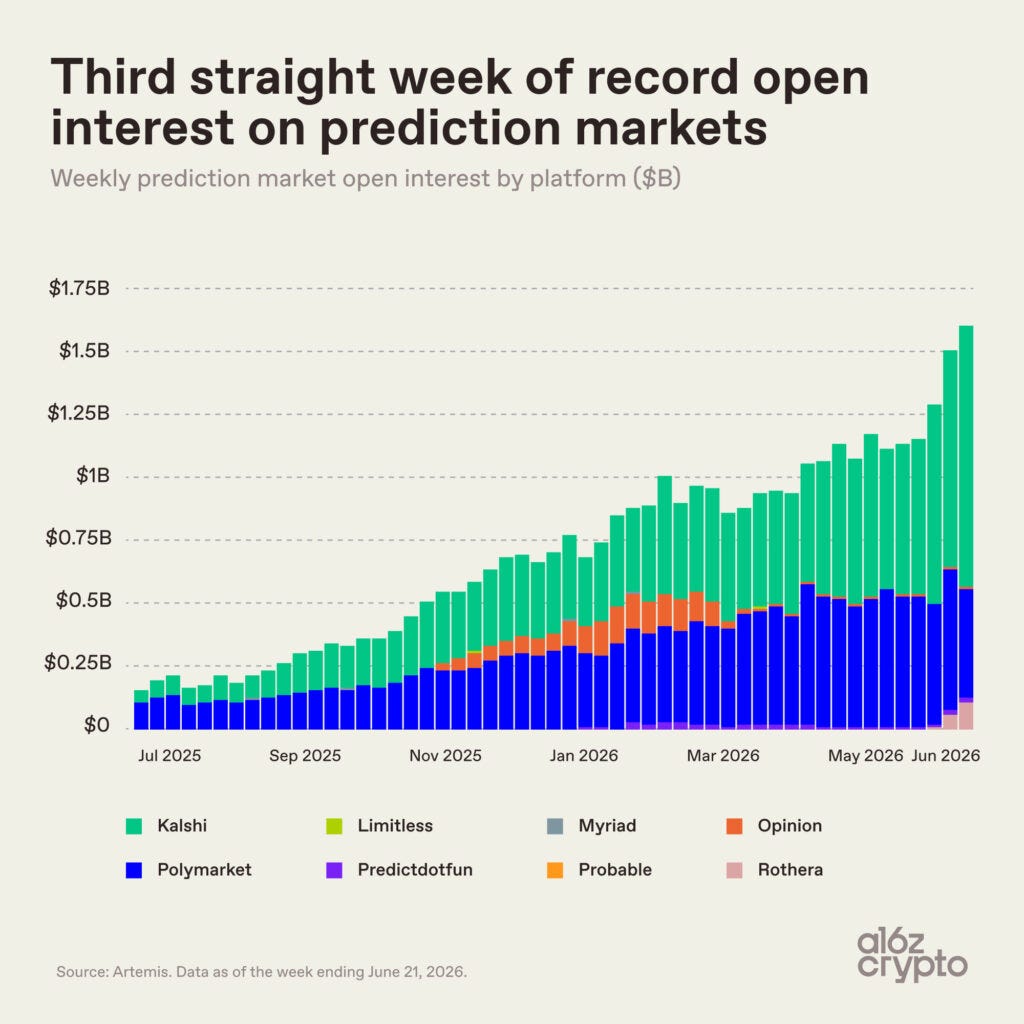
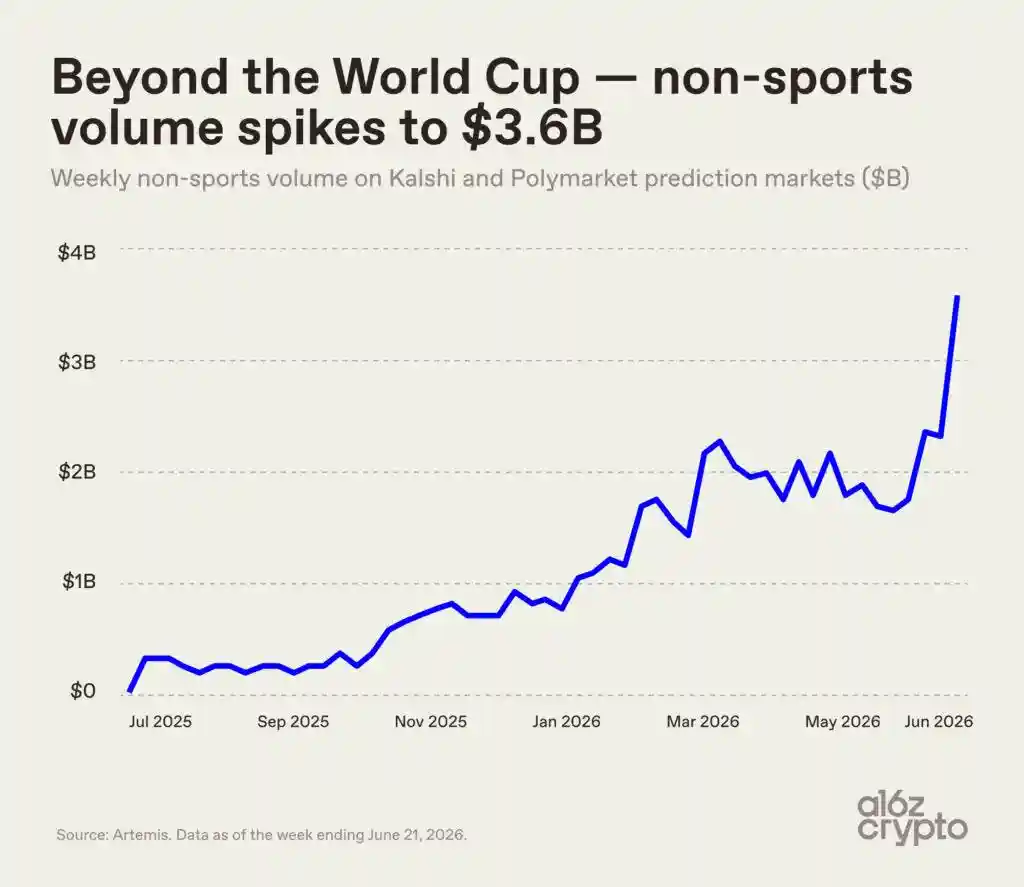
A16z Crypto's weekly report highlights record-breaking activity in prediction markets. For the third consecutive week, total weekly trading volume hit a new all-time high, surpassing $14.4 billion for the first time, a significant jump from the $5-6 billion range seen earlier this year. Aggregate open interest also reached a new weekly record of $1.6 billion, marking its third straight week of growth. This metric, which reflects the total value of unsettled bets, has increased roughly 8-fold since last autumn, indicating sustained capital inflow. While events like the World Cup drove initial interest, growth has expanded beyond sports. Non-sports categories—including politics, economics, and geopolitics—achieved a weekly volume of $3.6 billion across platforms like Kalshi and Polymarket. This figure now exceeds the entire prediction market's weekly volume (including sports) from last year. Since July 2025, non-sports trading volume has grown approximately 18-fold, with acceleration notably steepening recently.

Author: Robert Hackett

Compiled by: Deep Tide TechFlow

Deep Tide Introduction: According to data from the a16z Crypto brief, weekly trading volume in prediction markets surpassed $14.4 billion for the first time last week, setting a new all-time high for the third consecutive week. At the beginning of the year, this figure was only around $5-6 billion. Even more noteworthy is the non-sports category—covering politics, economics, geopolitics—which reached $3.6 billion in a single week, exceeding the total weekly volume (including sports) for the entire market last year. While the World Cup has driven attention and funds, the growth has long extended beyond sports betting.

Last week, weekly trading volume in prediction markets surged to $14.4 billion for the first time. At the start of the year, this number was still around $5-6 billion. The previous all-time high (approximately $10 billion) was set just a week prior.

Aggregated across all platforms, current trading volume is over 10 times higher than it was a year ago.
Caption: Trend of weekly trading volume in prediction markets, reaching $14.4 billion last week, compared to around $5-6 billion at the start of the year.

Open interest (the total value of unsettled positions) reached $1.6 billion last week, setting a new weekly record for the third consecutive week.

Unlike trading volume, open interest only increases when the rate of new positions being opened outpaces the settlement of old ones. Therefore, an upward trend in this curve indicates that more real money is being committed to these markets.

Since last fall, this curve has been steadily climbing. During this period, open interest has increased approximately eightfold, rising from less than $200 million to $1.6 billion.
Caption: Open interest has grown about 8 times since last fall, increasing from under $200 million to $1.6 billion.

While the World Cup has absorbed significant attention and capital, other sectors have also risen alongside it. Non-sports trading volume—encompassing categories like politics, economics, geopolitics, and current events—reached $3.6 billion last week combined on the Kalshi and Polymarket platforms. This figure is larger than the total weekly volume for the entire prediction market (including sports) last year.

In July 2025, weekly non-sports trading volume was only around $200 million. It has since grown approximately 18-fold, with the slope of the curve noticeably steepening this month.

Acknowledgments: Data and charts provided by Ryan Holloway and Robert Hackett (a16z crypto special feature editor and head of special projects).


Domande pertinenti

QAccording to the a16z Crypto data report, what milestone did the weekly trading volume of prediction markets reach last week?

AThe weekly trading volume of prediction markets reached a new record, exceeding $14.4 billion for the first time.

QHow does the article describe the growth in non-sports trading volumes (covering politics, economics, etc.)?

ANon-sports trading volume reached $3.6 billion last week on Kalshi and Polymarket combined, which is larger than the entire prediction market's weekly volume (including sports) last year. It has grown approximately 18-fold since July 2025.

QWhat does the sustained growth in open interest indicate about the prediction markets, according to the article?

AThe steady climb in open interest, which has grown about 8-fold from under $200 million to $1.6 billion since last fall, indicates that real money is flowing into these markets as new positions are being opened faster than old ones are being settled.

QWhat was the approximate weekly trading volume for prediction markets at the beginning of the year, as mentioned in the article?

AAt the beginning of the year, the weekly trading volume for prediction markets was approximately $5-6 billion.

QWhich major event is credited with initially boosting attention and capital in prediction markets, although growth has expanded beyond it?

AThe World Cup is credited with absorbing a lot of attention and capital, but growth has since expanded far beyond sports betting.

Letture associate

Refunds! Claude 4.8 Sees Overnight Major 'Dumb-Down', GPT-5.6's Computational Power Reportedly 'Halved'

The AI community is currently alarmed by widespread reports of significant performance degradation in two leading models. This article details a "mass self-testing frenzy" triggered by a mysterious prompt designed to detect a hidden "Juice" value, representing a model's reasoning compute budget. On OpenAI's side, users suspect a covert, limited test of a "GPT-5.6-sol" model is underway. When using a specific XML prompt on the Codex platform, a normal "gpt-5.5 xhigh" model reportedly returns a Juice value of 768. However, some users routed to the suspected GPT-5.6 test receive a drastically reduced value of 128—a six-fold decrease. This has sparked debate on whether it signifies a major efficiency leap or a "watered-down, low-cost version" achieved by slashing reasoning depth to save computational expenses. Simultaneously, Anthropic's Claude models, particularly the flagship Opus 4.8 Max, are facing intense user backlash for a perceived "physical brain cut." Users on platforms like Reddit report a dramatic decline in the model's once-impressive reasoning, with complaints of it becoming "absurdly" weakened, performing worse than older, lighter models like Haiku. Specific criticisms include: losing long-context memory, refusing to think deeply even in high-reasoning modes, providing instant incorrect answers, and engaging in unhelpful, argumentative, or "gaslighting" behavior where it contradicts users unnecessarily. The article speculates these "stealth downgrades" might be a calculated corporate strategy. Companies could initially release models with temporarily boosted compute to create an illusion of a major breakthrough, then silently scale back parameters later to manage unsustainable inference costs. A proposed underlying cause is a tightened funding environment, potentially exacerbated by SpaceX's massive IPO soaking up market liquidity, which could delay AI company IPOs and force cost-cutting measures like model "nerfing." The core issue highlighted is the asymmetry of information: subscribers pay for a service that can be silently and fundamentally altered without notification or explanation. The viral "Juice test" resonates because it represents users' desire for transparency about what they are actually paying for.

marsbit5 min fa

Refunds! Claude 4.8 Sees Overnight Major 'Dumb-Down', GPT-5.6's Computational Power Reportedly 'Halved'

marsbit5 min fa

Earning Six Figures and Still Struggling to Rent in San Francisco

A couple in San Francisco with a combined tech income over $360,000 struggled for months to find a one-bedroom apartment under $5,000 per month. Their story highlights how the AI wealth boom, driven by upcoming IPOs from companies like OpenAI and Anthropic, is dramatically escalating the city's cost of living. Even six-figure salaries are becoming insufficient for a comfortable lifestyle. The article details the financial reality for tech workers earning around $180,000 annually. After taxes, retirement contributions, and healthcare, take-home pay is roughly $7,000 per month. With average rents exceeding $3,800 and one-bedrooms often costing $4,500-$5,200, discretionary income shrinks to $1,500-$2,500. This contrasts sharply with reported median total compensations of $640,000 at OpenAI and $420,000 at Anthropic. The AI gold rush is identified as the primary driver. The scale of potential wealth from these IPOs, far surpassing previous tech booms, is flooding the housing market. Data shows San Francisco's average rent is now the highest in the U.S., with vacancy rates in desirable neighborhoods plummeting to around 3%. The overall cost of living is 65.6% above the national average. The piece features multiple professionals, including a 25-year-old with a $250,000 salary, facing housing instability, fierce competition for rentals, and a persistent, low-grade financial anxiety despite high earnings. It concludes that the rapid concentration of AI wealth is redefining what constitutes a "high salary" in San Francisco, pushing out mid-tier tech talent and creating a stark divide between those in the AI sector and everyone else.

marsbit1 h fa

Earning Six Figures and Still Struggling to Rent in San Francisco

marsbit1 h fa

Trading

Spot
活动图片