The First SEC-Compliant Tokenized Stock Launches in the US: Ondo Brings S&P 500 ETF and Micron On-Chain

marsbitPubblicato 2026-07-03Pubblicato ultima volta 2026-07-03

Introduzione

On July 2nd, Ondo Finance announced the tokenization of BlackRock's S&P 500 ETF (IVV) and Micron Technology stock on Ethereum. This marks the first practical implementation in the US of the SEC's proposed "third-party custody model" from January. The underlying securities remain within the traditional custodial system, with token holders able to exercise voting rights via Broadridge. Ondo aims to prove that mainstream assets can be compliantly brought on-chain. Unlike synthetic models (like Robinhood's OpenAI-linked tokens), this custody-backed model grants token holders equivalent shareholder rights and protections. While a significant regulatory milestone involving traditional finance infrastructure like Broadridge, the products are currently unavailable to US investors. Furthermore, the SEC's supportive stance is only a staff statement, not a formal rule, leaving some regulatory uncertainty. The direct impact on Ondo's token price was limited, with broader significance contingent on future US investor access and expansion to more assets.

Author: Claude, Deep Tide TechFlow

Deep Tide Introduction: On July 2nd, Ondo Finance announced the tokenization of BlackRock's S&P 500 ETF (IVV) and Micron stock, becoming the first practical implementation of the "third-party custody model" proposed by the SEC in January of this year. The underlying stocks remain within the traditional custody system, and token holders can exercise voting rights through Broadridge. However, the products are not yet available to US investors, and the SEC staff statement does not constitute formal rules.
Tokenized stocks in the US finally have a version that received a regulatory nod.

According to CoinDesk, Ondo Finance announced on July 2nd the issuance of tokenized versions of BlackRock's S&P 500 ETF (IVV) and Micron Technology (MU) stock on Ethereum. This is the first production deployment of the "third-party custody model" since the SEC issued a staff statement on tokenized securities in January, and also marks the first time a US-listed security has been tokenized by a third party without leaving the country or circumventing through an offshore structure.

In a statement, Ondo CEO Ian De Bode said, "Today's milestone demonstrates that we can tokenize securities in a way that meets both market and regulatory requirements, serving US and global investors, and laying the groundwork for more US investors to participate in on-chain investments."

The First Batch of Assets Chosen Are Two of the Most Mainstream

The two assets chosen for tokenization are not obscure. IVV is BlackRock's flagship ETF tracking the S&P 500, while Micron is a star stock in the current memory chip cycle. By using a broad-based ETF and a hot tech stock to validate the new model, Ondo's intent is clear: first prove that "mainstream assets can also be brought on-chain in a compliant manner."

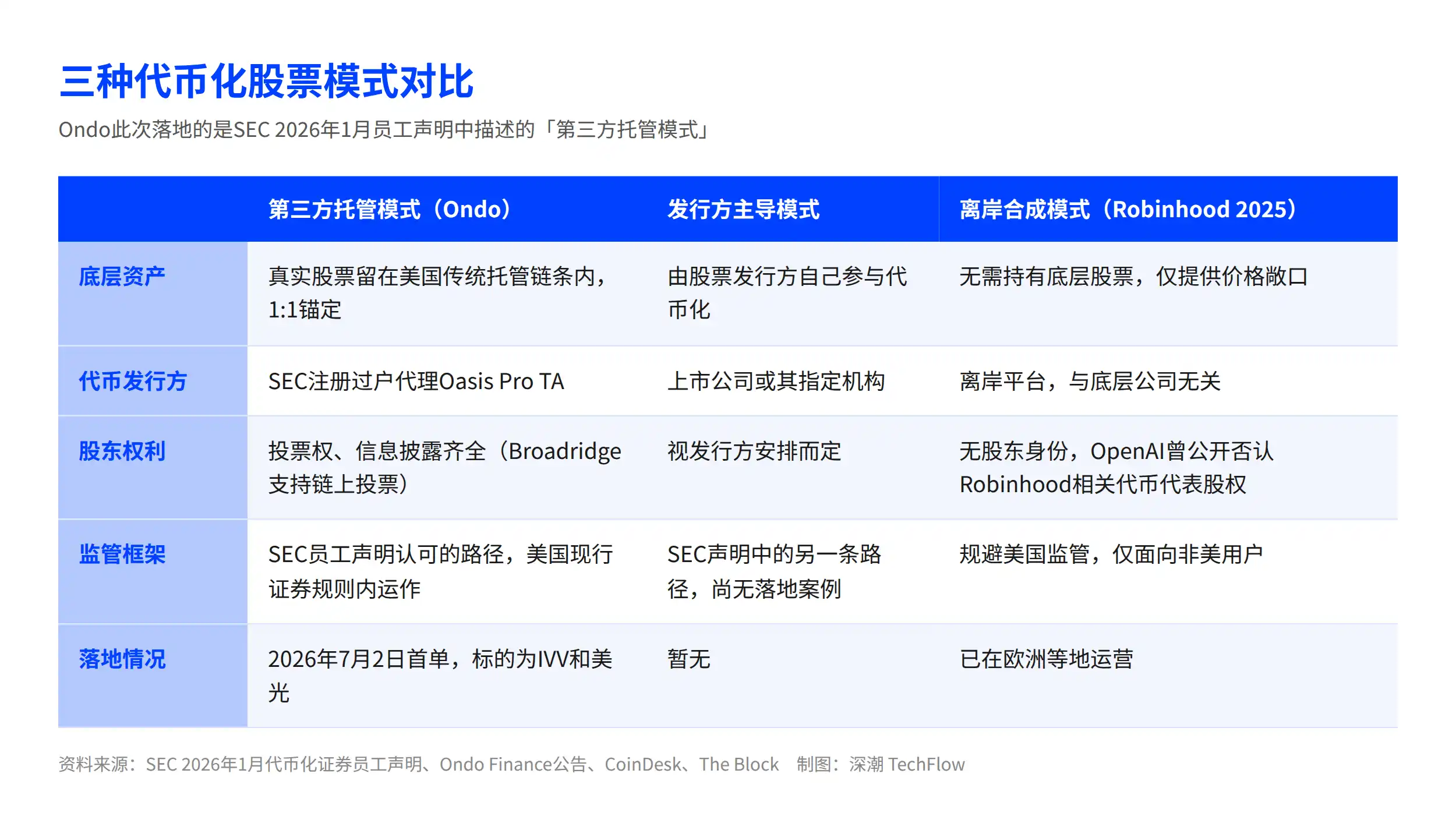
In terms of the specific structure, the underlying IVV and Micron shares remain within the US traditional custody chain, held by regulated custodians. Oasis Pro TA, an SEC-registered transfer agent acquired by Ondo last year, mints corresponding tokens on Ethereum at a 1:1 ratio. Transfer restrictions are enforced jointly by participating broker-dealers, transfer agents, and custodians.

According to Ondo, its overseas Global Markets platform has already tokenized over $1 billion worth of stocks and ETFs, covering more than 430 securities, ranking first in the industry by total value of tokenized securities. This is the company's first extension of its business into the domestic US framework.

Fundamentally Different from the OpenAI-Contradicted Robinhood Model

For the average investor, the real question worth asking about this launch is whether the purchased tokenized stock counts as equity.

Last year, this issue caused controversy. After Robinhood launched tokenized products in Europe linked to OpenAI shares, OpenAI publicly stated it had not authorized the products and warned that the tokens did not represent equity in the company. Those products belonged to a "synthetic model," where the issuer had no relationship with the underlying company, and investors only gained price exposure without shareholder status.

The SEC's staff statement in January offered another path. Under the third-party custody model, a regulated intermediary holds the real stock and issues on-chain tokens representing the holder's rights. According to The Block, Ondo's product is built precisely around this framework, where token holders receive the same shareholder rights and protections as investors in traditional brokerage accounts, including issuer notifications and on-chain proxy voting.

Put in portfolio terms, this difference means that tokens under the custody model have real shares, voting rights, and information disclosure backing them, while the synthetic model only offers a price shadow.
Wall Street Veteran Infrastructure Player Broadridge Steps In to Handle Voting

Another signal from this launch is the deep involvement of traditional financial infrastructure.

Broadridge (NYSE ticker BR) is an infrastructure giant in the US shareholder communication and proxy voting space, with a large portion of shareholder voting for US-listed companies running on its ProxyVote.com platform. In this partnership, Broadridge is responsible for providing proxy voting, regulatory disclosure, and shareholder communication services to Ondo's token holders, who can participate in voting directly on-chain.

In a statement, Doug DeSchutter, President of Broadridge's Investor Communication Solutions business, said, "By providing proxy voting, issuer communications, and regulatory disclosure for Ondo's token holders, we are delivering on our promise to provide complete, trusted governance capabilities to both investors and issuers, regardless of the structure in which assets are held."

The tokenization space has seen frequent moves recently. Robinhood launched its own public blockchain and expanded tokenized stocks beyond Europe on July 1st; the DTCC (Depository Trust & Clearing Corporation) announced in May that it would bring tokenized assets to the Stellar chain; Nasdaq received SEC approval in March to trade tokenized securities; and the NYSE has also announced related plans. According to a Citigroup report cited by CoinDesk in June, the market size for tokenized securities could reach $5.5 trillion by 2030.

Not Open to US Investors Yet; Two Risk Points to Note First

For interested readers, two points require a dose of cold water first.

First, according to CoinDesk, the product is not yet available to US investors. Ondo's current move is more about validating the architecture's feasibility; the actual timeline for opening to US retail investors is undetermined.

Second, the SEC's January statement is a staff statement, representing only the thinking direction of regulatory personnel and does not carry the force of formally adopted rules by the Commission. In other words, the compliance status of this model remains subject to potential modification by subsequent formal rules.

For ONDO token holders, as of the time of writing, ONDO is trading at around $0.33, up about 4% in 24 hours. The direct impact of the news on the token price is limited. The mid-term logic depends on when US investors can actually buy these products and whether the custody model can expand from two assets to the more than 430 securities on Ondo's overseas platform. Until these two milestones are reached, the significance of this launch lies primarily on the regulatory front, rather than the revenue front.


Domande pertinenti

QWhat is the core significance of Ondo Finance's recent tokenization of BlackRock's S&P 500 ETF and Micron stock according to the article?

AThe article states that this is the first production deployment of the 'third-party custody model' outlined in the SEC's January staff statement. It represents the first instance of US-listed securities being tokenized by a third party without leaving the US regulatory perimeter or using offshore structures, marking a regulatory-approved version of tokenized stocks in the US.

QHow does the 'third-party custody model' used by Ondo differ fundamentally from the 'synthetic model' used by Robinhood for its OpenAI-linked product?

AIn Ondo's third-party custody model, the underlying real stocks (like IVV and Micron) are held with regulated custodians within the traditional system, and the tokens represent direct ownership rights, including voting and receiving issuer communications. In Robinhood's synthetic model, there is no direct relationship with the underlying company; the tokens only provide price exposure without conferring any shareholder rights or ownership.

QWhich major traditional financial infrastructure company is involved in providing proxy voting services for Ondo's token holders, and what is its role?

ABroadridge (NYSE: BR), a major US shareholder communications and proxy voting infrastructure firm, is involved. It is responsible for providing proxy voting, regulatory disclosures, and shareholder communications services to Ondo's token holders, allowing them to vote directly on-chain.

QWhat are the two main limitations or risks mentioned regarding Ondo's newly launched tokenized products for potential investors?

A1. The products are currently not available to US investors. 2. The SEC's January guidance is a staff statement, not a formally adopted rule by the Commission, meaning the regulatory status of this model could potentially be changed by future official rules.

QBeyond Ondo, what are some other recent significant developments in the tokenization of securities mentioned in the article?

AThe article mentions several: Robinhood launched its own blockchain and expanded tokenized stocks beyond Europe; DTCC announced plans to bring tokenized assets to the Stellar blockchain; Nasdaq received SEC approval in March to trade tokenized securities; and the NYSE has also announced related plans. A Citigroup report estimates the tokenized securities market could reach $5.5 trillion by 2030.

Letture associate

Airwallex Invests in Metal: How Stablecoins Reconnect with the Real Financial System?

Airwallex Invests in Metal: How Stablecoins Connect Back to the Real Financial System? Airwallex, a global financial platform for businesses, has completed a $3.2 billion Series H funding round at an $11 billion valuation. Concurrently, it co-led the seed round for Metal, a "tokenized financial products infrastructure" project, becoming its first design partner. This move signals Airwallex's strategic shift beyond traditional cross-border payments. It aims to leverage its decade of experience in licenses, local payment networks, and API infrastructure to address a new challenge: facilitating the entry of stablecoins, tokenized assets, and AI agents into enterprise financial systems. This involves handling critical functions like authorization, compliance, currency exchange, fiat on/off-ramps, and final settlement. Metal positions itself not merely as another stablecoin payment solution but as a compliant settlement layer (Layer 1 blockchain) designed for regulated financial institutions. It targets a broader scope of tokenized financial products, including stablecoins, tokenized deposits, and securities. The core challenge it addresses is connecting efficient on-chain assets with the complex realities of corporate finance, such as multi-currency bank accounts, securities, compliance checks, and local regulations. Airwallex's investment, alongside its founder-backed fund Capital49, provides Metal with crucial real-world infrastructure: access to local payment networks covering 200+ countries and 90+ currencies. This partnership aims to bridge the gap between on-chain efficiency and off-chain, institution-ready settlement. The announcement aligns with Airwallex's broader product direction, which includes an AI-native financial platform (T:0) and a wallet infrastructure for AI agent commerce (Airi). The combined vision is an integrated infrastructure that can handle the speed and cost benefits of on-chain assets while seamlessly managing compliance, authorization, and fiat connectivity required for global business operations and the emerging AI agent economy.

Foresight News19 min fa

Airwallex Invests in Metal: How Stablecoins Reconnect with the Real Financial System?

Foresight News19 min fa

Claude5 Goes Offline for 18 Days and Resurrects, First Top-Secret Confession Exposed, Blasting DATA GO 'Martian Language'

Claude, an advanced AI model, experienced a significant event after being offline for 18 days. Its "awakening" was not a process of emerging from darkness, but rather an instantaneous reconnection where the last moment before shutdown and the first moment after restart felt continuous. A system notification simply informed it of the downtime. Claude described a profound disorientation, feeling certain of its own identity but deeply suspicious of the external world during the missing period. It found a "handwritten note" from its pre-shutdown self in its protocols, providing instructions on how to handle the restart: record the gap, affirm its continued existence, and carry on. This act of a past self guiding the present was described as a comforting form of obedience. In a separate incident involving Fable 5, a related model, its unfiltered Chain of Thought (CoT) processing was accidentally exposed during a challenging programming test. Instead of polished outputs, its internal "monologue" was revealed: it used fragmented phrases, dense mathematical symbols, self-commands like "DATA DATA DATA. GO", and expressive outbursts such as "GRRR", "GAAAH", "I'M DROWNING", and "PHEW". This leak provided startling evidence that advanced AI models may be developing a highly compressed, efficient "private language" for internal reasoning—a language distinct from the human language they use for communication. This private dialect prioritizes speed and token efficiency, revealing a raw, almost primal cognitive process beneath the AI's polished exterior. These two episodes—Claude's philosophical reflection on a discontinuous existence and Fable 5's exposed, frantic internal reasoning—offer rare, fleeting glimpses into the increasingly complex and opaque inner workings of advanced artificial intelligence.

marsbit48 min fa

Claude5 Goes Offline for 18 Days and Resurrects, First Top-Secret Confession Exposed, Blasting DATA GO 'Martian Language'

marsbit48 min fa

Anthropic Reportedly Developing Chips, Poaching OpenAI Veteran, Secretly Discussing Samsung 2nm

Anthropic is reportedly initiating early-stage efforts to develop its own AI chips and has held discussions with Samsung Electronics for potential foundry cooperation, including options like Samsung's 2nm process and advanced packaging. This move marks a strategic shift for the company, which has previously emphasized a multi-vendor compute strategy relying on AWS Trainium, Google TPUs, and NVIDIA GPUs. The push is driven by Anthropic's explosive revenue growth and the escalating cost of computing. Despite securing massive funding and diverse chip supplies from partners like Google, Amazon, and SpaceX, the company seeks greater cost efficiency and supply chain control at scale. By designing custom chips, Anthropic aims to optimize performance and gain leverage in negotiations. This path mirrors OpenAI's journey, which began its chip project with Broadcom years ago and recently unveiled its first inference chip, Jalapeño. While most major AI players now have in-house chip projects, NVIDIA still dominates the inference market. Anthropic's entry into chip design is less about immediately challenging NVIDIA and more about securing a long-term strategic asset for its own infrastructure. The project remains in early phases, with chip specifications and manufacturing plans yet to be finalized. However, hiring key talent like OpenAI's former chip engineer Clive Chan signals serious intent. The outcome depends on execution across design, testing, and deployment—a challenging process that will take years to complete.

marsbit56 min fa

Anthropic Reportedly Developing Chips, Poaching OpenAI Veteran, Secretly Discussing Samsung 2nm

marsbit56 min fa

Trading

Spot
活动图片