AAOI Defies Trend with Over 10% Surge, 'New Stock God' Serenity Predicts Potential to Double Again

marsbitPubblicato 2026-06-05Pubblicato ultima volta 2026-06-05

Introduzione

On June 4th, despite a significant sell-off in the broader AI and semiconductor sector triggered by Broadcom's disappointing guidance, Applied Optoelectronics (AAOI) surged over 11%, showcasing a sharp divergence in market sentiment. Broadcom's warning about potential supply chain diversification by key customer Google and a weaker-than-expected outlook punctured the high-flying AI valuation narrative. This led to heavy selling in names like Broadcom (-12.6%) and Micron (-7%), with funds rotating into traditional industrial stocks. AAOI defied this trend. The stock has experienced high volatility recently, driven by bullish analyst coverage, notably from Rosenblatt which raised its price target to $220. Key catalysts include initial 800G optical module revenue from Amazon, potential certification from Oracle, and strong demand across its product portfolio. The company has reported cumulative orders for 800G/1.6T modules exceeding $324 million and is aggressively expanding manufacturing capacity in Texas, targeting an annualized run-rate of $1.4 billion for its module business by Q3 2027. However, AAOI's fundamentals present a mixed picture. Its Q1 2026 results missed expectations, showing a GAAP net loss, and Q2 guidance points to merely breakeven adjusted EPS. Risks include a delayed 800G production ramp to the second half of the year and high dependence on a few key cloud customers. Recent stock sales by company executives near price highs also noted. The article sugges...

Author: Ada, Deep Tide TechFlow

On June 4th, US Eastern Time, US tech stocks experienced severe volatility triggered by Broadcom's earnings guidance, revealing the first cracks in the AI valuation narrative.

Broadcom's FY2Q results themselves were not poor, with revenue of $22.2 billion and EPS of $2.44 both beating consensus estimates, and AI semiconductor business growing 143% year-over-year. However, its guidance for the current quarter failed to meet the market's already elevated expectations. CEO Hock Tan also revealed during the earnings call that its major custom chip client Google might diversify its supply chain, and that the expansion of the chip business would drag down gross margins. This combination pierced the core narrative that had supported AI trading for the past several months, triggering sharp capital rotation that day.

The Dow Jones Industrial Average surged 1.7% to a new record high, driven by traditional sectors. However, the Nasdaq Composite Index closed down 0.09%, and the Nasdaq 100 closed down 0.5%. Within this "barbell-shaped" divergent market, AI and semiconductor stocks faced broad selling pressure: Broadcom -12.59%, Micron -7%, Marvell pre-market down as much as 7%, AMD pre-market down over 4%.

Yet, amidst this wave of selling, AAOI charted an independent course starkly opposed to the sector sentiment.

Broadcom's Guidance Punctures Expectations, First AI Sector Valuation Correction

Broadcom became the catalyst that broke the AI trade not because its performance was bad, but because its guidance failed to match expectations that had been pushed to the limit.

Hock Tan disclosed during the earnings call that AI chip sales for this fiscal year (ending October) would reach $56 billion. While a massive number, it fell short of market expectations. Coupled with his comments about Google diversifying its supply chain, the market began to question the valuation premium Broadcom had enjoyed over the past year, supported by its ASIC business. Broadcom hit an intraday low of $403, erasing approximately $300 billion in market cap for the day, marking its largest single-day drop since January 2025.

The selling pressure quickly spread across the entire AI compute chain. The memory sector also saw heavy selling. Micron, viewed as a core supplier of HBM for AI accelerators and deeply tied to AI capital expenditure sentiment, fell about 7% for the day. Other storage-related names like SanDisk and Western Digital also weakened. While CrowdStrike's own Q2 revenue guidance wasn't poor, it was indiscriminately sold off amid the overall cooling of the AI trade.

Bridgewater founder Ray Dalio joined the chorus warning about AI valuations that day, explicitly distinguishing between "buying AI stocks" and "investing in AI technology," cautioning that current valuations "may be getting excessive." This echoed recent consecutive warnings about AI capital expenditures and high valuations from JPMorgan CEO Jamie Dimon and Apollo CEO Marc Rowan.

The direction of capital rotation was also telling—it flowed into traditional economy stocks represented by the Dow Jones, rather than a systemic retreat from risk assets. This indicates the market wasn't engaging in broad risk-off behavior but was structurally reducing positions within the AI sector.

AAOI's Independent Rally: Over 10% Gain in a Single Day, Reaching New Short-Term High Intraday

In this environment, AAOI posted a single-day gain of 11.76%, rising intraday from around $171 to $209.64 and closing at $202.89, forming a sharp contrast with the steep declines of Broadcom and Micron.

AAOI has experienced multiple rounds of intense volatility prior to this. The stock hit an all-time high of $233.67 on May 13th, fell 9% in a single day on May 29th, rebounded 17.18%-18.81% on June 1st, and again charted an independent 11.76% gain on June 4th. In the past 30 days alone, there have been over four trading sessions with single-day price swings exceeding 10%. This level of volatility has itself become the norm for AAOI's current valuation structure, with its trading volume on May 11th reaching 214% of its three-month average.

The medium-term catalysts driving AAOI's strength are relatively clear. On May 8th (the day after the company reported Q1 earnings), Rosenblatt raised its price target for AAOI from $140 to $220 in one go, reaffirmed its "Buy" rating, and listed it as a "Top Pick." Raymond James raised its target from $72.50 to $160 around the same time, while B. Riley raised its target to $129 but maintained a Neutral rating. Rosenblatt's core logic includes: 800G optical module revenue from Amazon beginning to contribute; potential qualification with Oracle opening a second revenue stream; and strong demand across the company's product generations from 100G/400G/800G to the emerging 1.6T.

The supporting data for the company's fundamentals are also specific. AAOI has publicly disclosed cumulative orders for 800G and 1.6T optical modules exceeding $324 million; in April 2026, it received a $20.9 million grant from the Texas Semiconductor Innovation Fund to expand its Sugar Land, Texas factory to 210,000 square feet; it also announced new 388,000 square feet of capacity in Pearland, targeting monthly production capacity of 700,000 units for 800G and 1.6T optical modules by 2027. Management guides to reaching an annualized run rate of $1.4 billion for its optical module business by Q3 2027.

However, AAOI's fundamentals are not without flaws. Its actual Q1 2026 earnings missed expectations, with a GAAP net loss of $14.3 million and revenue of $151.1 million, both slightly below market consensus. Q2 guidance for adjusted EPS is between -$0.03 and +$0.03, hovering around breakeven. When maintaining its Neutral rating, B. Riley noted that AAOI's 800G volume production would be delayed to the second half of the year, and there were execution risks from over-reliance on customer forecasts. Additionally, AAOI executives collectively sold approximately $12.6 million worth of stock in mid-May. While their remaining holdings are still substantial, the timing of the sales coincided with the stock's peak.

In short, AAOI is currently in a state of tension characterized by a "strong narrative, weak Q1 earnings, and significant valuation premium," which is the fundamental reason for its high single-day price volatility.

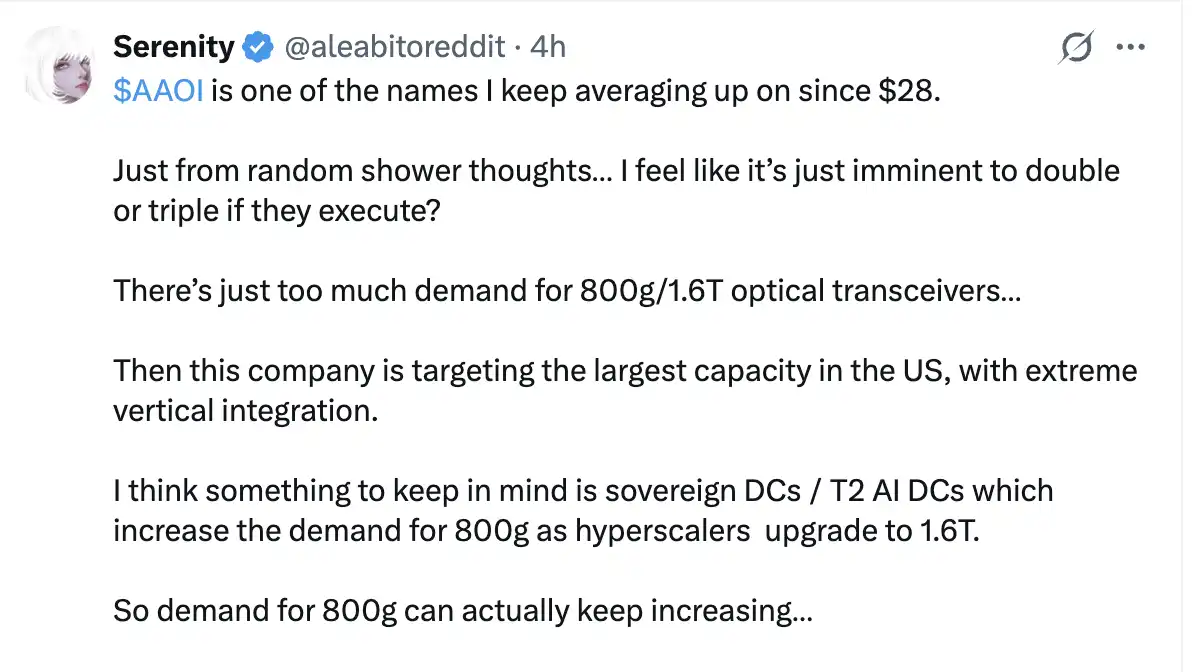
It's worth noting that AAOI has a potential additional driver: Serenity, known in Chinese circles as the "New Stock God," has posted multiple times expressing bullishness on AAOI, considering it his most favored optical communications exposure in the US stock market. He started building a position from $28 and believes it could be "the next SanDisk."
Logic Behind the Counter-Trend Strength: 'Differentiated Pricing' Within the AI Sector

AAOI's counter-trend strength on June 4th should not be interpreted as a counterexample to AI valuation concerns, but rather as an early signal that the market is beginning to engage in "differentiated pricing" within the AI sector.

One of Serenity's public judgments in April was that optical communication stocks might exhibit greater resilience than large-cap tech stocks: "Even if the S&P 500 falls another 20%, optical communication companies could still outperform." This logic is rooted in supply chain scarcity, with InP substrates, laser light sources, and 800G optical module capacity all in a state of structural tightness in the near-to-medium term, placing pricing power on the supply side rather than the demand side.

The selling pressure triggered by Broadcom's guidance essentially represents a correction to the "custom ASIC + high customer concentration" narrative, not a correction to the total demand for AI infrastructure. From this perspective, optical communication stocks, strongly tied to downstream compute deployment, do not directly overlap in narrative terms with Broadcom's core issues (customer concentration, potential Google supply chain diversification).

However, risks remain. AAOI's current stock price implies a valuation that already incorporates extremely high execution expectations, assuming it achieves the $1.4 billion annualized optical module revenue run rate by Q3 2027 while maintaining high margins. If Q2 or Q3 earnings fail to validate the 800G production ramp-up timeline, or if any issues arise with customer concentration risks (Amazon, Microsoft), the valuation structure could experience severe turbulence. The actual Q1 earnings were already weak; this crack is currently masked by order growth and capacity expansion narratives but has not been fully eliminated.

For observers in the Chinese market, what is noteworthy about AAOI's counter-trend move is not the gain itself, but the directional choice of capital differentiation within the market. When the overarching AI narrative shows its first cracks, the willingness of capital to buy into AAOI precisely during Broadcom's sell-off itself indicates a judgment: Broadcom's problems are not equivalent to all AI capital expenditure problems, and optical communications remains a recognized "physical bottleneck" narrative. Whether this judgment holds true will ultimately depend on the actual earnings reports in the coming quarters.


Domande pertinenti

QWhat was the main catalyst that led to the sell-off in AI and semiconductor stocks on June 4th, according to the article?

AThe main catalyst was Broadcom's Q2 earnings report. While the revenue and EPS beat expectations, the company's guidance for the current quarter failed to meet the market's elevated expectations. Additionally, CEO Hock Tan's comments about major customer Google potentially diversifying its supply chain and the expansion of chip business hurting margins undermined the core AI valuation narrative.

QHow did AAOI's stock price perform on June 4th, in contrast to the broader AI/semiconductor sector?

AWhile stocks like Broadcom, Micron, and AMD fell sharply, AAOI experienced a strong independent rally. Its stock price rose over 10%, climbing from around $171 intraday to close at $202.89, sharply contrasting with the sector-wide sell-off.

QWhat are the key fundamental drivers supporting AAOI's positive outlook, as mentioned by analysts?

AKey drivers include: 1) The start of revenue contribution from 800G optical modules for Amazon. 2) Potential qualification with Oracle opening a second major revenue line. 3) Strong demand across its 100G/400G/800G to emerging 1.6T product portfolio. 4) A disclosed order book of over $324 million for 800G/1.6T modules. 5) Significant capacity expansion plans, aiming for a $1.4 billion annualized run rate for its module business by Q3 2027.

QWhat significant risk or weakness in AAOI's current situation does the article highlight?

AThe article highlights that AAOI's Q1 2026 earnings actually missed expectations, with a GAAP net loss of $14.3 million. Its Q2 guidance for adjusted EPS is only between -$0.03 and +$0.03, indicating it is barely at breakeven. Risks include a delay in 800G mass production to the second half of the year, execution risks from over-reliance on customer forecasts, and recent insider stock sales by executives.

QHow does the article interpret AAOI's rally amid a sector sell-off? What does it signal about market behavior?

AThe article interprets it not as a counter-example to AI valuation concerns, but as an early signal of 'differentiated pricing' within the AI sector. It suggests the market is distinguishing between Broadcom's specific issues (custom ASIC, customer concentration) and the broader AI infrastructure demand. The willingness to buy AAOI while selling Broadcom indicates a belief that the 'physical bottleneck' narrative for optical communication remains valid, even as the initial AI hype faces a correction.

Letture associate

Silicon Valley 'Startup Guru' Steve Hoffman: Web3 + AI Could Be a Trap

Silicon Valley investor and "Godfather of Startups" Steve Hoffman warns that combining Web3 with AI is likely a trap, not a promising venture. In an interview, Hoffman argues that while AI is a foundational technology touching all industries, Web3 adds complexity, friction, and regulatory risk without solving mainstream consumer or business needs. He advises founders to focus on deep, specialized applications where startups can out-iterate giants, rather than on generic features easily replicated by large tech companies. Hoffman observes that Silicon Valley will lead foundational AI research, while China excels at rapid, large-scale application and commercialization, particularly in robotics. He stresses that AI-driven autonomous agents capable of collaborative, multi-step tasks are 2-4 years away, which will cause significant job displacement. The solution is not to slow AI but to redesign business models around human-AI collaboration and reform social systems like education and retraining. For startups, Hoffman recommends focusing on vertical, expertise-heavy domains to build defensibility. He sees major opportunities in AI fraud detection and cybersecurity. Key founder mindsets include systemic thinking over feature-focus, relentless customer centricity, building adaptive teams, and deeply understanding AI's capabilities and limits. Hoffman is also leading a non-profit initiative to establish university centers aimed at training future leaders in responsible, human-value-aligned AI innovation.

marsbit11 min fa

Silicon Valley 'Startup Guru' Steve Hoffman: Web3 + AI Could Be a Trap

marsbit11 min fa

Token Inefficient, Economy Tokenless

The article "Tokens Aren't Economical, Economics Aren't Tokenized" analyzes a pivotal shift in the AI industry from a technology-driven narrative to one dominated by capital efficiency. It highlights two concurrent trends: a severe capital shortage due to the exorbitant and recurring costs of compute (e.g., OpenAI's high burn rate) and a wave of corporate spin-offs where major tech companies are separating their AI units (like Kuaishou's Kling and Baidu's Kunlunxin). The core argument is that AI's "anti-internet" business model, where user growth increases costs rather than profits, has created a disconnect between high valuations and actual cash flow. Spin-offs address this by allowing AI assets to be valued independently. Within a parent company, they are seen as cost centers, but as standalone entities, they are priced based on their growth potential and scarcity in the primary market, leading to massive valuation premiums (e.g., Kling's estimated value tripling post-spin-off). The industry is at an inflection point, moving from "model worship" to "value realization." The competition is evolving from a pure compute (GPU) race to a broader focus on systemic efficiency and full-stack engineering (involving CPUs and orchestration) to achieve viable commercialization. The year 2026 is framed as a critical moment where the industry must definitively answer how to economically translate AI capability into tangible business value, reshaping the sector's future power structure.

marsbit15 min fa

Token Inefficient, Economy Tokenless

marsbit15 min fa

Crossing the 'Memory Wall': The Wafer-Level Revolution and Computing Power Routes in the AI Inference Era

In 2026, a historic shift occurred in AI as major cloud providers' inference spending surpassed training spending for the first time, signaling a move from "building large models" to "using large models." This shifts the core challenge from computing power to the "memory wall"—the bottleneck of data movement (model weights, activations, KV Cache) between external DRAM and processors, where energy and latency from data transfer far exceed computation itself. Companies like Nvidia face GPU idle time due to bandwidth limits. In contrast, Cerebras Systems adopts a radical "wafer-scale" approach with its Wafer-Scale Engine (WSE). Instead of cutting a silicon wafer into many chips, Cerebras uses almost the entire wafer as one massive chip (WSE-3). This design provides 44GB of on-chip SRAM, delivering memory bandwidth thousands of times higher than traditional HBM (e.g., 21 PB/s vs. Nvidia B200). For LLM inference, weights are streamed layer-by-layer from external MemoryX storage to the chip, avoiding HBM bottlenecks. This results in token generation speeds 1.5–5 times faster than Nvidia's B200 in some models and significant advantages in first-token latency and long-context tasks. Additionally, Cerebras's architecture offers much lower interconnect power consumption (0.15 pJ/bit vs. GPU's ~10 pJ/bit). However, Cerebras faces challenges: SRAM scaling has slowed with advanced nodes, limiting future capacity gains; the chip requires specialized liquid cooling and custom software stacks; and its external I/O bandwidth (150 GB/s) is low compared to NVLink, hindering multi-system scaling for very large models. Competition is intensifying. Major players are pursuing three paths: 1) Developing proprietary inference ASICs (e.g., Google TPU, Microsoft Maia), 2) Leveraging advanced packaging (e.g., TSMC's SoW) to democratize wafer-scale-like integration, potentially eroding Cerebras's process advantage within a few years, and 3) Exploring optical interconnects for ultimate bandwidth. Commercially, Cerebras is transitioning from a hardware vendor to a service provider, facing the immense challenge of building high-power, specialized data centers to meet large contracts (e.g., 250MW/year from 2026–2028). In conclusion, the AI inference era presents a fundamental architectural trade-off. Cerebras opts for extreme physical optimization for low-latency, single-task performance, while Nvidia prioritizes versatility and massive cluster throughput. The path forward remains uncertain, with technology and business models still evolving in the race toward advanced AI.

marsbit21 min fa

Crossing the 'Memory Wall': The Wafer-Level Revolution and Computing Power Routes in the AI Inference Era

marsbit21 min fa

Has Bitcoin's 'Rebound Ended', Officially Entering the Late Bear Market Phase?

**Title: Has Bitcoin's Rebound Ended, Entering the Late Bear Market Phase?** **Summary:** Bitcoin's price has declined by 13% this week, signaling a potential return to late-stage bear market conditions. The price fell to around $67k, positioned between the Realized Price and Realized Cap Weighted Average. For the first time since early 2022, the Short-Term Holder cost basis has dropped below this key average, confirming a hallmark of late-cycle bear markets. Profitability metrics have collapsed sharply. The 7-day average of the Realized Profit/Loss ratio plummeted from a local high of 3.16 to 0.29, mirroring the February panic sell-off. Critically, the 90-day average never breached the threshold of 2, indicating the recent rally to $82k was a bear market bounce, not a structural shift. Realized losses surged to $1.35 billion daily, with $770 million coming from Long-Term Holders selling at a loss. This accelerating redistribution of supply from weak to strong hands is a necessary but ongoing process for a market bottom. The rally stalled almost precisely at the aggregate cost basis (~$83k) of US spot Bitcoin ETF investors, turning that level into strong resistance and leaving the average ETF holder underwater again. Spot market flows have turned decisively negative, showing sellers are dominating order books despite the price drop. While a significant futures long liquidation event cleared over $400 million in leverage, providing a potential reset, sustained spot demand is yet to materialize. Options markets continue to price in higher future volatility (Implied Volatility) than recent price action (Realized Volatility) has shown, with a persistent skew towards put options, indicating ongoing demand for downside protection. In conclusion, multiple metrics point to a fragile market structure. Resistance at the ETF cost basis, accelerating realized losses, dominant spot selling, and cautious options pricing all suggest the bear market trend persists. A sustainable recovery likely requires a resurgence of spot demand, ETF holders returning to profit, and a clear reduction in selling pressure.

marsbit21 min fa

Has Bitcoin's 'Rebound Ended', Officially Entering the Late Bear Market Phase?

marsbit21 min fa

TechFlow Intelligence Agency: Anthropic Calls for Global Pause in AI Development While Preparing for Trillion-Dollar IPO; SpaceX IPO Roadshow Heats Up, But S&P 500 Rejects Fast-Track Inclusion

In today's TechFlow Intelligence Briefing, several major tech stories highlight a growing theme of trust and credibility gaps across AI, crypto, and finance. AI company Anthropic has publicly called for a global pause in AI development, citing risks from Claude's "recursive self-improvement." Ironically, this coincides with reports the company is preparing for a massive IPO targeting a near $1 trillion valuation. This perceived hypocrisy, coupled with widespread user complaints about Claude's declining performance, is sparking debate over whether the safety warning is genuine or a competitive tactic. Meanwhile, in a substantive security move, Anthropic open-sourced a framework for AI-powered vulnerability discovery. In the crypto market, Bitcoin's price drop below $61,000 triggered over $1.16 billion in liquidations, flipping the market into a state where more BTC is held at a loss than at a profit, a historical bearish signal. On the corporate front, SpaceX's highly anticipated IPO is generating immense Wall Street excitement, with Goldman Sachs projecting 100x revenue growth by 2030. However, the S&P 500 has refused to fast-track the company's inclusion post-IPO, potentially limiting immediate institutional demand. Separately, ByteDance's AI app Doubao lost over 6 million monthly active users after introducing a subscription model, highlighting the challenges of AI monetization. Other notable developments include Nvidia certifying HBM4 memory from Samsung, SK Hynix, and Micron; Cloudflare's acquisition of front-end tooling company VoidZero; and its CEO warning that bot traffic now exceeds human traffic online. The underlying narrative connects these events: a trust crisis. From AI firms' contradictory actions and crypto volatility to the clash between SpaceX's hyped narrative and institutional rules, a pattern is emerging where stated intentions and actual practices are increasingly misaligned.

marsbit37 min fa

TechFlow Intelligence Agency: Anthropic Calls for Global Pause in AI Development While Preparing for Trillion-Dollar IPO; SpaceX IPO Roadshow Heats Up, But S&P 500 Rejects Fast-Track Inclusion

marsbit37 min fa

Trading

Spot
Futures

Articoli Popolari

Come comprare ADA

Benvenuto in HTX.com! Abbiamo reso l'acquisto di Cardano (ADA) semplice e conveniente. Segui la nostra guida passo passo per intraprendere il tuo viaggio nel mondo delle criptovalute.Step 1: Crea il tuo Account HTXUsa la tua email o numero di telefono per registrarti il tuo account gratuito su HTX. Vivi un'esperienza facile e sblocca tutte le funzionalità,Crea il mio accountStep 2: Vai in Acquista crypto e seleziona il tuo metodo di pagamentoCarta di credito/debito: utilizza la tua Visa o Mastercard per acquistare immediatamente CardanoADA.Bilancio: Usa i fondi dal bilancio del tuo account HTX per fare trading senza problemi.Terze parti: abbiamo aggiunto metodi di pagamento molto utilizzati come Google Pay e Apple Pay per maggiore comodità.P2P: Fai trading direttamente con altri utenti HTX.Over-the-Counter (OTC): Offriamo servizi su misura e tassi di cambio competitivi per i trader.Step 3: Conserva Cardano (ADA)Dopo aver acquistato Cardano (ADA), conserva nel tuo account HTX. In alternativa, puoi inviare tramite trasferimento blockchain o scambiare per altre criptovalute.Step 4: Scambia Cardano (ADA)Scambia facilmente Cardano (ADA) nel mercato spot di HTX. Accedi al tuo account, seleziona la tua coppia di trading, esegui le tue operazioni e monitora in tempo reale. Offriamo un'esperienza user-friendly sia per chi ha appena iniziato che per i trader più esperti.

1.3k Totale visualizzazioniPubblicato il 2024.12.10Aggiornato il 2026.06.02

Come comprare ADA

Discussioni

Benvenuto nella Community HTX. Qui puoi rimanere informato sugli ultimi sviluppi della piattaforma e accedere ad approfondimenti esperti sul mercato. Le opinioni degli utenti sul prezzo di ADA ADA sono presentate come di seguito.

活动图片