Optical Modules Soar, Why Is NOK the Second Leader After MRVL?

marsbitPubblicato 2026-06-03Pubblicato ultima volta 2026-06-03

Introduzione

Nokia's stock has surged nearly 170% to around $16.8 since Nvidia's $1 billion investment and AI-RAN partnership in October 2025, reflecting a market re-rating from a cyclical telecom equipment provider to an AI infrastructure player. This rise, adding roughly $60 billion in market cap, is driven by AI capex expansion into telecom edge, RAN, and optical networks. The company's Q1 2026 results showed strong momentum, with AI & Cloud net sales up 49% and 10 billion euros in new orders, prompting Nokia to raise its AI & Cloud market growth forecast to a 27% CAGR (2025-2028). Optical network growth of 20% further strengthens its position in connecting AI data centers. Recent tests with operators like T-Mobile and the opening of an AI Networking Innovation Lab demonstrate progress from concept to early commercial deployment. Nokia's strategy integrates Nvidia GPUs into its network hardware, enabling concurrent AI processing and RAN tasks for real-time optimization and new edge services. However, with a trailing P/E nearing 100x and consensus price targets lagging the current stock price, significant future growth is already priced in. The key constraint now is the pace and scale of large-scale operator deployments. While execution signals remain positive and the company's position in AI edge infrastructure is established, high valuation leaves limited room for error, making tangible commercial contracts the critical factor for further stock performance.

Nokia's share price is currently around $16.8, having accumulated an increase of nearly 170% since Nvidia's subscription to new shares at $6.01 in October 2025. Its market capitalization has increased by approximately $60 billion, reaching a 16-year high. The market no longer views it merely as a cyclical telecom equipment supplier but is rapidly re-rating it as an AI network and edge infrastructure player. Nvidia's equity investment and technical collaboration have been the most direct catalyst.

Behind this is the major trend of AI capital expenditure shifting from core data centers to the telecom edge, wireless access networks, and optical networks. The question is, how far has this re-rating progressed, and how much support can future actual implementation provide for the stock price?

Nokia's Stock Price Has Completed the AI Infrastructure Re-rating

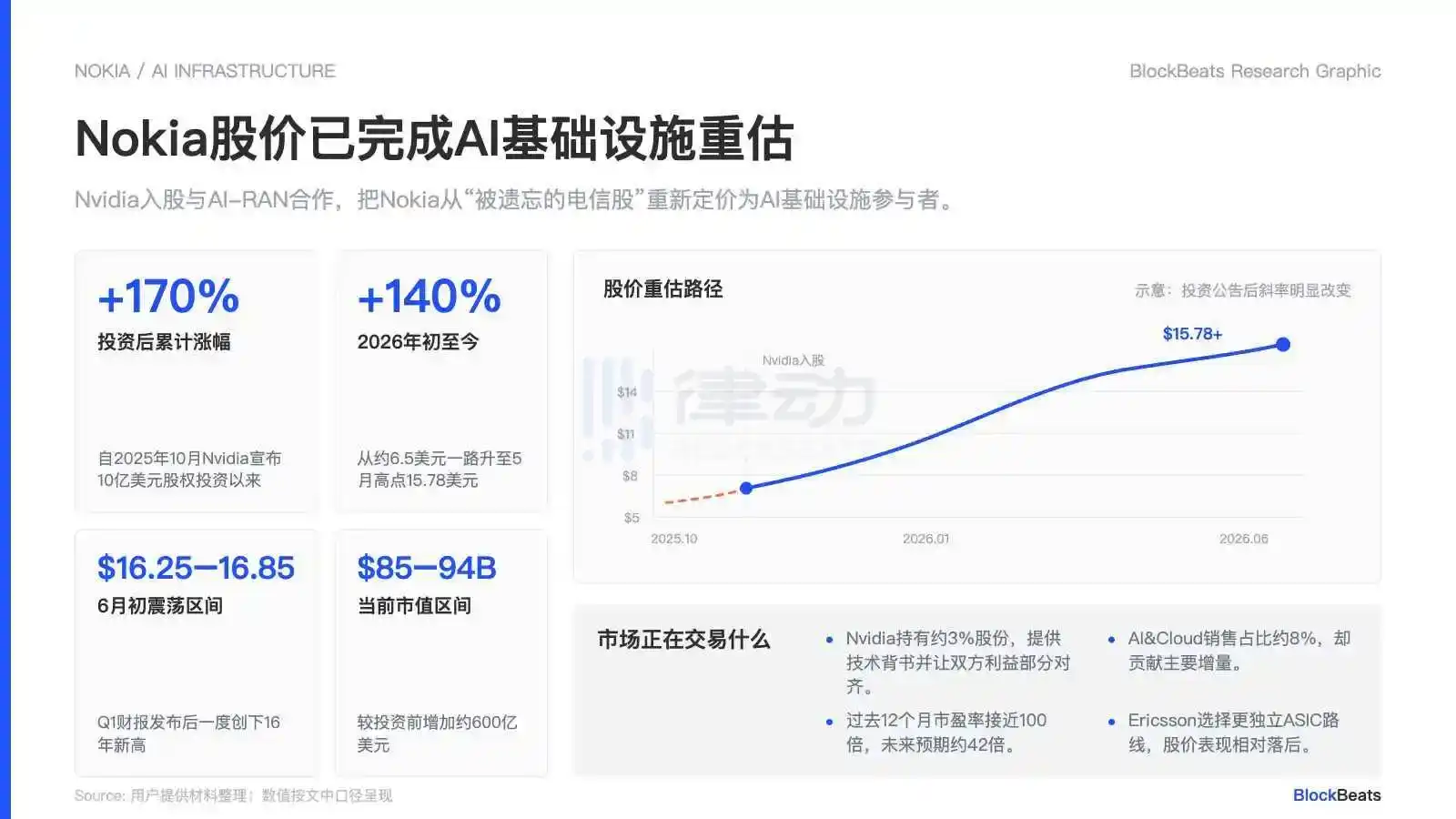
Since Nvidia announced a $1 billion equity investment and reached an AI-RAN strategic cooperation agreement in October 2025, Nokia's share price has accumulated gains of nearly 170%. Year-to-date in 2026, the increase exceeds 140%, rising from around $6.5 to a peak of $15.78 in May, and fluctuating in the $16.25-$16.85 range in early June. Following the Q1 earnings release, it once hit a 16-year high.

The current market capitalization is approximately $85-94 billion, an increase of about $60 billion from pre-investment. The AI&Cloud business accounts for about 8% of group sales but contributes the majority of the incremental value. The trailing twelve-month P/E ratio is close to 100 times, while the forward P/E ratio is about 42 times, significantly higher than traditional telecom peers but still lower than pure-play AI infrastructure companies. In contrast, Ericsson's share price performance lags due to its choice of a more independent ASIC chip strategy.

These changes indicate that the market is already trading on Nokia's transformation from a "forgotten telecom stock" to an AI infrastructure participant. Nvidia holds approximately 3% of the shares, providing both technical endorsement and partially aligning interests. Coupled with the narrative of the U.S. pushing to regain leadership in the telecom field, this has collectively accelerated this round of re-rating.

However, after significantly outperforming, what actual business progress is the market truly trading on?
Q1 Orders and Guidance Raise Validate Accelerated Transformation

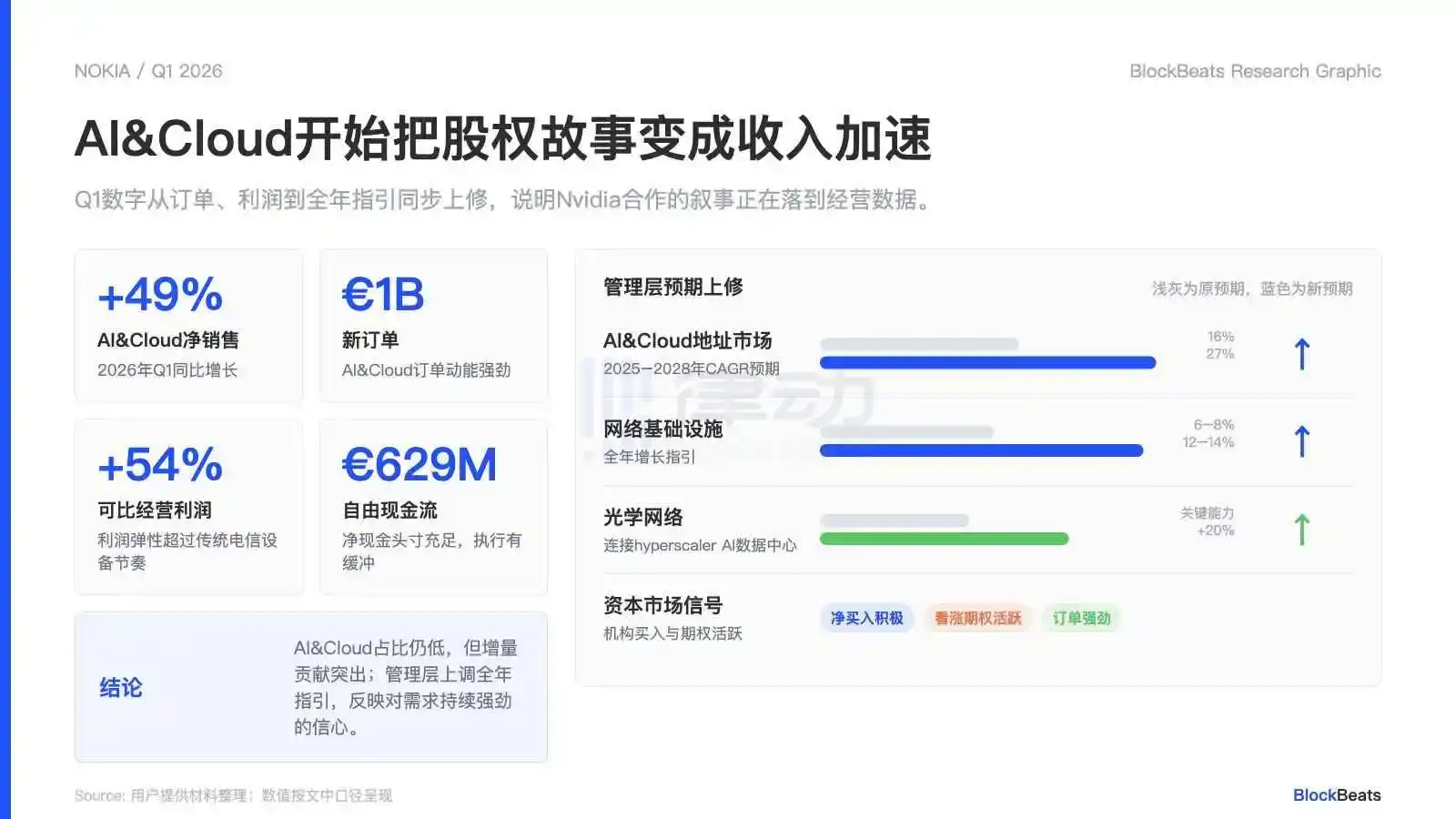
In the Q1 2026 earnings report, Nokia's AI&Cloud net sales increased by 49% year-over-year, securing €1 billion in new orders, with comparable operating profit surging by 54%. Consequently, the company raised its expected annual compound growth rate for the AI&Cloud addressable market from 16% to 27% for 2025-2028, and its full-year growth guidance for network infrastructure from 6-8% to 12-14%.

Optical network business grew by 20% during the same period, becoming a key part of connecting hyperscaler AI data centers. This capability was further strengthened following the acquisition of Infinera. New order intake is strong, free cash flow reached €629 million, and the net cash position is ample, providing a buffer for future execution.

These figures indicate that the cooperation with Nvidia is shifting from an equity story to visible revenue acceleration. Although AI&Cloud still represents a low proportion, its incremental contribution is prominent. The company's raised full-year guidance reflects management's confidence in sustained strong demand. Institutions have been net buyers over the past 12 months, and call option activity is higher than normal levels, further supporting this assessment.
MWC Tests and Innovation Lab Confirm Early Commercial Pathway

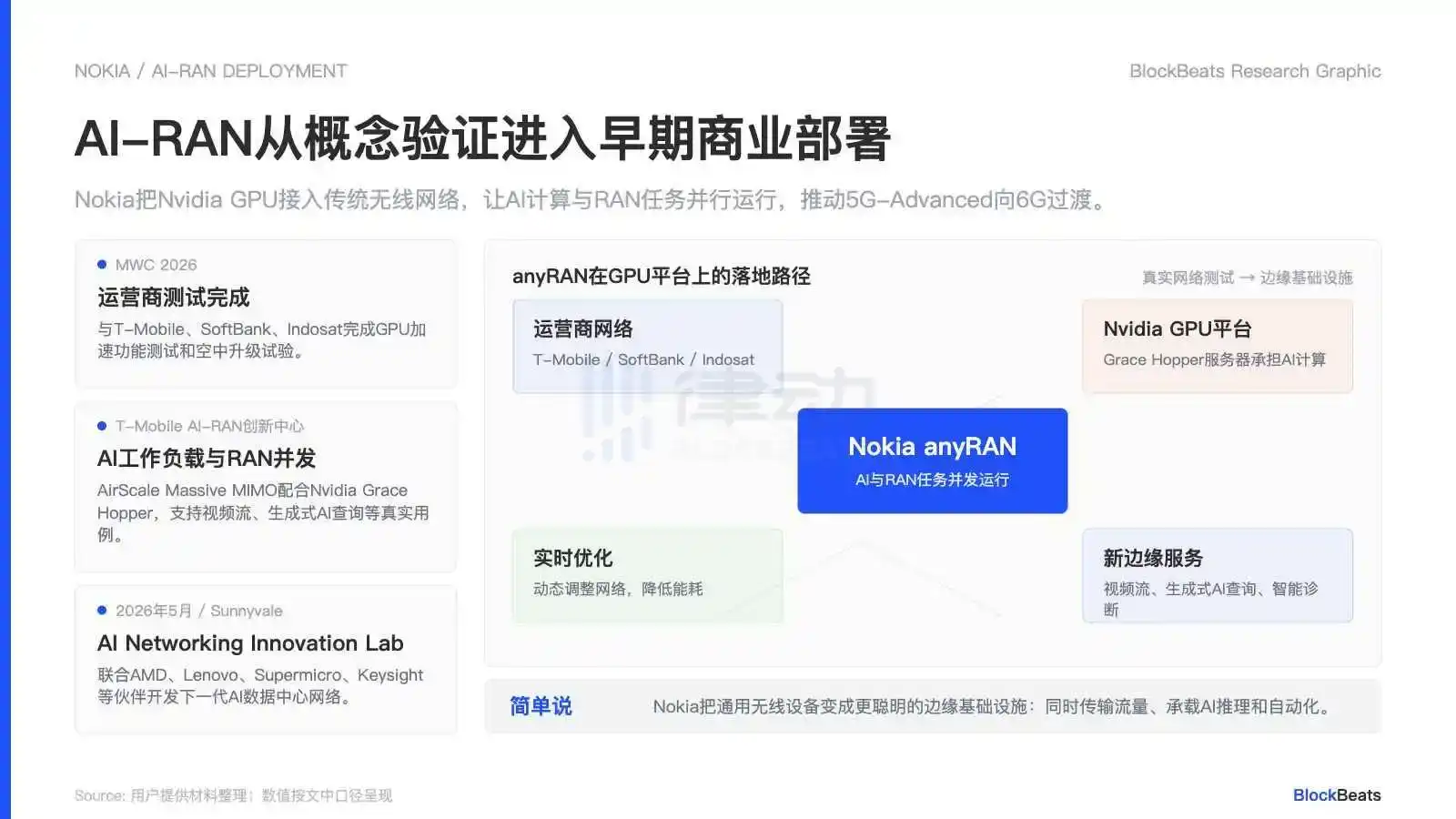
During MWC 2026, Nokia completed functional tests and over-the-air upgrade trials with operators like T-Mobile, SoftBank, and Indosat. At T-Mobile's AI-RAN Innovation Center, they used Nokia's AirScale Massive MIMO radio equipment alongside Nvidia Grace Hopper servers, successfully running AI workloads concurrently with RAN (Radio Access Network) tasks, supporting practical use cases like video streaming and generative AI queries.

In May 2026, Nokia opened the AI Networking Innovation Lab in Sunnyvale, California, collaborating with partners like AMD, Lenovo, Supermicro, and Keysight to develop next-generation AI data center networks. Concurrently, it introduced AI agent features for fixed broadband products, helping operators diagnose problems automatically, reduce costs, and accelerate fiber deployment.

These developments show that the acceleration path for Nokia's anyRAN software on Nvidia GPU platforms is now implementable. AI-RAN (using AI to optimize wireless access networks) is no longer just a concept but can deliver real-time optimization, reduce energy consumption, and generate new edge services within actual operator networks, providing a viable path for the transition from 5G-Advanced to 6G. Nokia CEO Justin Hotard stated that the cooperation is moving from validation to early commercial deployment.

Simply put, Nokia is applying Nvidia GPUs to traditional wireless network hardware, enabling AI computing and network transmission tasks to run in parallel. This allows for real-time network adjustments, saves power, and facilitates the development of new services. This approach turns general-purpose equipment into smarter edge infrastructure.
Deployment Scale Becomes the Biggest Constraint Under High Valuation

Although Q1 data, test results, and ecosystem partner expansion are relatively positive, the current P/E ratio is close to 100 times. Analyst consensus target prices are around €9.4-€12 (some investment banks have raised to around €12-€14), significantly lagging the current stock price. This indicates that the market has already priced in considerable optimism for long-term AI-RAN penetration and the 27% growth expectation, leaving a significantly compressed margin for error.

Over the next 12-24 months, the conversion speed of actual deployment contracts from major operators, the overall pace of AI capital expenditure, and differences in approach compared to Ericsson (which insists on independent ASICs, avoiding deep ties to a single GPU supplier) will become the core variables. If subsequent orders fall short of expectations or AI spending slows, the risk of a pullback will significantly increase.

Institutional net buying and bullish option preferences currently still support share price momentum, but these ultimately need to be validated by execution. Nokia's position as a representative AI edge infrastructure player has gained recognition, and the combination of optical networks with wireless access networks expands the overall market opportunity. However, there is a noticeable distance from current early orders to truly commercial deployment at hyperscaler scale.

It is still in the early acceleration phase, with overall execution signals being positive. However, the high valuation has already tightened the margin for error considerably. Investors should focus next on actual large-scale deployment progress rather than new demonstrations to gauge how much further this trend of AI expanding to the telecom edge can go.

Domande pertinenti

QAccording to the article, why has Nokia's stock price experienced a significant revaluation recently?

ANokia's stock price has been revalued because the market is no longer viewing it just as a cyclical telecom equipment vendor, but as an AI network and edge infrastructure player. This shift was catalyzed by a strategic investment and AI-RAN collaboration with Nvidia, aligning with the trend of AI capital expenditure moving from core data centers into telecom edges and optical networks.

QWhat were the key performance highlights for Nokia's AI & Cloud business in Q1 2026?

AIn Q1 2026, Nokia's AI & Cloud business saw net sales grow by 49% year-over-year, secured 1 billion euros in new orders, and comparable operating profit increased by 54%. Due to this strong performance, the company raised its growth expectations for the AI & Cloud addressable market.

QWhat practical demonstrations at MWC 2026 validated Nokia's AI-RAN path?

AAt MWC 2026, Nokia conducted functional tests and over-the-air upgrade trials with operators like T-Mobile, SoftBank, and Indosat. A key test at T-Mobile's AI-RAN Innovation Center successfully ran AI workloads concurrently with RAN tasks using Nokia's AirScale Massive MIMO hardware and Nvidia Grace Hopper servers, supporting real use cases like video streaming and generative AI queries.

QWhat is a major constraint for Nokia's stock mentioned in the article, given its current valuation?

AA major constraint is the high valuation, with a trailing P/E close to 100x. This high valuation reflects significant market optimism upfront, leaving little room for error. The key variable now is the conversion speed of large-scale operator deployment contracts and the overall pace of AI capital expenditure over the next 12-24 months.

QHow does Nokia's strategic approach differ from its competitor Ericsson's according to the article?

ANokia's strategy involves a deep technical collaboration and equity investment from Nvidia, integrating Nvidia's GPU technology into its telecom hardware. In contrast, Ericsson is pursuing a more independent ASIC chip route, avoiding deep binding to a single GPU vendor like Nvidia.

Letture associate

After Marvell's 32% Surge, the Chinese Chip Family Behind It Emerges

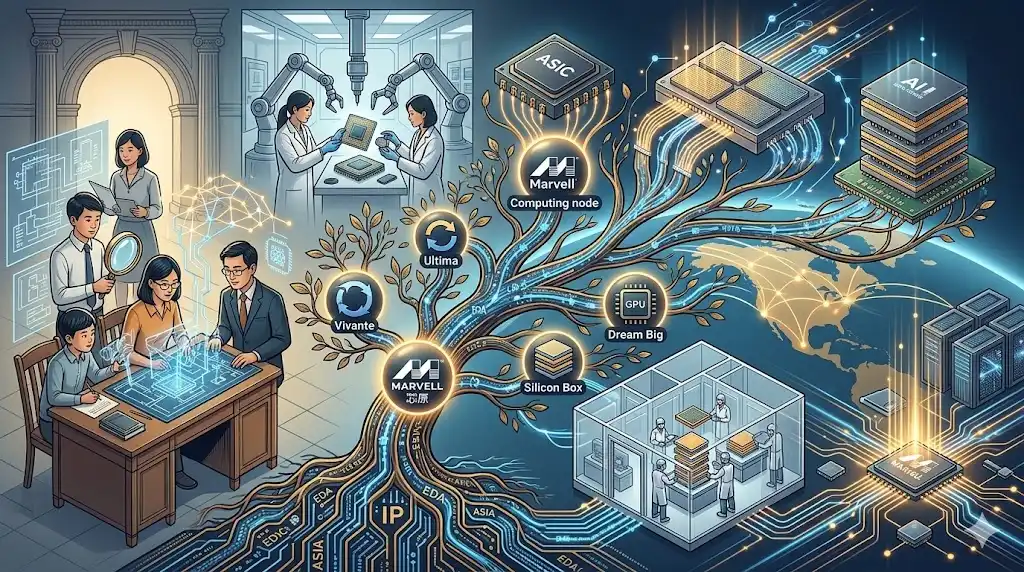
The stock price of Marvell Technology surged 32.5% on June 2nd, driven by NVIDIA CEO Jensen Huang highlighting its custom ASICs and optical interconnects as core to AI data center architecture. This event brought attention to the Chinese semiconductor family behind Marvell: the Dai siblings. The story centers on three siblings, all UC Berkeley graduates, whose three-decade entrepreneurial journey aligns with major semiconductor industry shifts. In 1995, youngest sister Dai Wei Li co-founded Marvell with her husband Sehat Sutardja and his brother, focusing on storage controllers. Eldest brother Dai Wei Min founded EDA company Ultima, later sold to Cadence, and later founded VeriSilicon (芯原) in China, becoming a leading semiconductor IP provider. Second brother Dai Wei Jin co-founded EDA firm Silicon Perspective (sold to Cadence) and GPU IP company Vivante, later acquired by VeriSilicon. The combined "Dai-Sutardja" family network extends beyond Marvell. Their ventures and investments form a comprehensive ecosystem for the post-Moore's Law, chiplet era. Key holdings include: Dream Big Semiconductor (AI SuperNICs, acquired by Arm), Alphawave (high-speed SerDes IP, acquired by Qualcomm), and Silicon Box (a chiplet advanced packaging foundry). VeriSilicon itself thrives on the AI ASIC and IP boom in China. Collectively, the family's AI infrastructure-related portfolio is estimated at over $22 billion. Their strategy represents a distinct path: building critical components for open standards and key manufacturing capacity in the chiplet era, rather than pursuing standalone AI chip dominance. While this path may not create the next NVIDIA, it has enabled repeated successful exits and sustained influence within the global semiconductor industry.

marsbit40 min fa

After Marvell's 32% Surge, the Chinese Chip Family Behind It Emerges

marsbit40 min fa

Microsoft is Afraid of Being Marginalized by AI Giants

Microsoft, once the defining force of the PC era, now faces a familiar challenge in the AI age: the risk of being relegated to a profitable but invisible infrastructure provider. This anxiety was laid bare at Build 2026, where CEO Satya Nadella unveiled a major strategic pivot. The catalyst was a quiet April agreement that dissolved Microsoft's exclusive licensing and cloud-hosting deal with OpenAI, its once-vital partner. This erased Microsoft's key AI moat. With OpenAI and Anthropic defining AI applications and gaining enterprise traction—even within Microsoft's own ranks—Nadella had to answer: without exclusivity, what is Microsoft's role? The answer was a suite of seven in-house AI models, a developer-focused AI workstation (Surface RTX Spark Dev Box), and, most crucially, the Agent 365 platform for enterprise AI governance. The models, notably targeting Anthropic's strengths in coding and enterprise, signal a defensive move. However, the broader strategy is to make the models themselves less decisive. Financially, Microsoft's AI revenue is strong, driven largely by Azure running others' models. Yet its user-facing products like Copilot show weak penetration and engagement. Microsoft earns infrastructure money but lacks direct user mindshare. Nadella's core fear is being "hollowed out." As OpenAI and Anthropic prepare for IPOs and gain financial independence, they may build their own infrastructure, threatening Azure's lucrative AI revenue stream. Microsoft's window is to entrench itself deeper: not as the model creator, but as the indispensable platform for securely deploying, managing, and governing all AI models within the enterprise through Agent 365. Build 2026 revealed Microsoft's bet: in the AI era, the ultimate power lies not in any single model, but in the enterprise "operating system" that controls them. Nadella is determined to ensure Microsoft is the driver of this new era, not just a passenger.

marsbit54 min fa

Microsoft is Afraid of Being Marginalized by AI Giants

marsbit54 min fa

CPU, Quietly Returning to the Center of the AI Computing Power Stage

Over the past three years, AI computing power narratives have been dominated by GPUs. However, starting in 2026, this story began to shift. While training large models remains GPU-intensive, the rapid growth of inference and AI agent workloads, which require high levels of task orchestration, concurrency, and data flow management, has highlighted a renewed critical role for CPUs. These are tasks GPUs are not designed to handle. Intel's recent launch of the Xeon 6+ processor, built on its Intel 18A process and featuring up to 288 efficiency cores (E-cores), exemplifies this strategic pivot. It is positioned not as a mere companion to GPUs but as the essential "control plane" for AI infrastructure, optimized for high-density, energy-efficient, and high-throughput workloads characteristic of AI agents and inference. This "CPU resurgence" is not about CPUs outperforming GPUs in raw computation. It reflects a systemic bottleneck: as AI scales from training single models to deploying countless intelligent agents, the demand for coordination and data handling surges. Major cloud providers are also developing their own high-density ARM-based server CPUs for similar workloads. However, Intel's success with this strategy faces significant challenges. Competition includes NVIDIA's integrated CPU-GPU solutions, the expanding adoption of cloud vendors' in-house ARM CPUs, and the crucial market test of Intel's 18A manufacturing process against rivals like TSMC's N2. In conclusion, CPUs are indeed reclaiming a central, though redefined, role in AI compute—managing the complex orchestration that enables massive-scale AI deployment. While the trend is clear, which company will ultimately lead this CPU resurgence remains an open question to be decided in the data centers of 2027 and beyond.

marsbit1 h fa

CPU, Quietly Returning to the Center of the AI Computing Power Stage

marsbit1 h fa

Trading

Spot
Futures
活动图片