Yang Ge Gary: Agent Economy and AI Sub-Microeconomics

marsbitPubblicato 2026-06-08Pubblicato ultima volta 2026-06-08

Introduzione

"Agent Economy and AI Submicroeconomics" by Gary Yang discusses the evolution of AI Agent economies, written from Singapore in June 2026. The author observes a significant "civilizational generational gap" in AI development, particularly highlighted by events in Silicon Valley. The article identifies a current bottleneck in the transition from Human-to-Agent (H2A) economies to true Agent-to-Agent (A2A) ecosystems. While AI Payment protocols are rapidly emerging, many implementations remain non-AI-native, focusing on traditional human decision-making models rather than leveraging autonomous Agent decision-making. A core thesis is the inevitable formation of an **Agent Economy**, defined as a system where autonomous AI Agents create, exchange, and capitalize value independently. This requires new infrastructure: **AI Protocols**, which are the foundational rules and standards for Agent interaction. The piece explores the relationship and current gap between AI Protocols and Crypto Protocols, suggesting political and regulatory factors from traditional finance are temporarily constraining development. However, a future fusion into a mature Digital Protocol system is deemed inevitable based on first principles. The author introduces **AI Agent Submicroeconomics**, contrasting it with human economics. Key differences include higher transaction frequency, lower value per transaction, efficiency-driven (not emotion-driven) decisions, task-oriented (not consumption-oriented) behav...

Author: Yang Ge Gary

Written in Singapore on June 8, 2026

The Singularity's outbreak has continuously accelerated AI's evolutionary clock, leading to the rapid formation of new civilization generational gaps across different regions of the globe. In the past two months, I have participated in over 20 AI-related events in more than ten cities worldwide. Only the Stripe Sessions in downtown San Francisco at the end of April stood out, creating a generational gap that was far more shocking than all other topics. While the world is growing weary of the single-machine bottlenecks of Claws & Agents, Silicon Valley and San Francisco have already moved into the next dimension in the management of Agent economy and Agent epistemology. The competitive pressure in Q3/Q4 of 2026 remains intense, with the exponential curve being very steep.

1. The Competition in AI Payment and the Bottleneck of the H2A Economy

In Q1 2026, we predicted that from April to May, many regions globally would enter fierce competition for AI Agent Payment, which would quickly become white-hot. The need for value exchange between Agents began to manifest initially, and the rapid development of AI Payment was validated in Q2. Following x402, multiple AI Payment Protocols like MPP rapidly emerged in Q2. Not only are traditional and Crypto financial payment companies upgrading to AI at full speed, but even major tech giants (especially like Google) and even old-school IT companies (such as IBM) have charged into this track, hoping to seize a voice in shaping the Agent world.

On the day of the Stripe Sessions in San Francisco, I discussed the standardization and application issues of Payment Protocols with technical leaders from several top AI companies. The results were reasonable but not entirely satisfactory: 1) No one could set the standard; consensus standards would only gradually form during the scramble. 2) Most completely agreed that Crypto is the inevitable path for AI Payment Protocol, but their starting point was Fiat API, partly due to inertia but more due to compliance hurdles. 3) KYC is both unavoidable and anti-Agent Native. 4) Everyone claims A2A (Agent to Agent), but everyone is actually doing H2A (Human to Agent).

In fact, during Q2 2026, many large tech firms and mid-sized companies in Silicon Valley were quite similar to their East Asian counterparts. Even most Department Heads in the Mag 7 were still approaching AI Payment and Agent Economy with to-B or to-C commercial goals, giving mid- and lower-level employees KPIs focused on human users. This inevitably led to the current, temporarily non-orthodox phase of Payment Protocols and the A2A economy. This H2A-oriented trend quickly hit a bottleneck in Q2. The reason is simple: the greatest characteristic of AI Agents is their ability to make decisions, yet 2B2C commerce developed under the internet and the H2A economy are essentially driven by human decisions. Using Agents to help humans make Fiat Payments in traditional e-commerce scenarios is logically Non-AI-Native. Therefore, at this stage, its value as a trending topic still outweighs its practical utility.

However, from another perspective, H2A has indeed served as an excellent primer, stimulating the transitional thinking toward the next stage of AI-Native and Agent Autonomous economies. By the end of Q2 2026, some astute companies realized this and began "repairing the plank roads openly while secretly crossing at Chencang"—using AI-Native Agent economic thinking to reconsider problems in reverse, finding that retrofitting current H2A economic interfaces is the optimal value proposition for the Q2-Q3 transition.

2. The Inevitable Trend of Agent Economy and the A2A Ecosystem

Agent Economy refers to a new type of economic system where autonomous (self-governing) AI Agents directly participate in value creation, value exchange, and value capitalization, gradually becoming independent economic entities.

A2A Ecosystem is the overall picture formed when different Agents participate in economic activities within the Agent Economy, interact with each other, conduct exchanges (of information and value), and form competitive-cooperative economic value.

In Q2 2026, many top global venture capital firms declared their focus on investing in the Agent Economy and A2A Ecosystem, even defining it as the only important investment direction for the next phase.

Similar to the incubation period before internet e-commerce in 2007, before mobile internet in 2013, and before Crypto DeFi in 2019, the construction of the Agent Economy and A2A Ecosystem also requires technical standards, economic rules, consensus building, and market education. On the basis of a similar paradigm, the differences are: 1) The speed of underlying technological development and iteration is faster this time. 2) The perspective of "to A" is different from "to B" or "to C"; it does not entirely stand from the human perspective and needs, making it more abstract, harder to understand, more reliant on first-principles thinking, and requiring consideration of energy value and operational efficiency from an AI-Native perspective. 3) Due to the conflict of the first two points, coupled with biases from different regions and compliance issues, short-term consensus is harder to achieve. The terrible thing is, AI's evolution speed will not slow down because of these various problems. That is to say, the formation of the Agent Economy and A2A Ecosystem is, in essence, gradually breaking away from the rule and demand frameworks dictated by humans. For them, it's mostly a matter of breaking through a few quantifiable bottlenecks.

This is a game of rapidly shifting Nash equilibrium. The rapid explosion of AI Protocols in Q2 2026 fully illustrates this. Major tech firms and frontier labs are scrambling for entry-level rules governing AI Agents. The initial infrastructure of the Agent Economy is taking shape, like a draft version of the Code of Hammurabi. The Nash equilibrium of traditional finance and commerce will quickly dissolve and reshape during this paradigm shift. Those who can quickly understand the AI-Native Protocol-oriented thinking and implement it to gain a differentiated advantage will get a share of the AI pie in this game shift.

3. The Connection, Gap, and Political-Economic Factors Between AI Protocol and Crypto Protocol

AI Protocol is the infrastructure for AI Agents to participate in the Agent Economy, and also the foundational rules, standards, and consensus mechanisms that enable Agents to discover, communicate, exchange, and collaborate in economic activities within an Open Network. Simply put, it is the governance rules and economic law of the AI world.

Since the end of Q1 2026, I started writing about AI Protocol. Initially, it was like a primitive with hunting experience suddenly arriving in modern society to participate in formulating commercial rules. It wasn't until I met a Google executive that my team and I quickly got on the right track. The formation and maturation process of AI Protocol carries the aesthetic inertia of internet giants, while also having to adhere to the first principles of the future AI ecosystem.

The encapsulation forms of AI Protocol are currently still quite inconsistent. They often come as document formats (.json, .ts, .txt), CLI formats, or as APIs or SDKs, which is very different from Crypto Protocol. On one hand, in the early stages of AI development, universal standards for establishing trust in communication handshakes have not been established. On the other hand, the content exchanged via AI Protocol and Crypto Protocol differs at this stage. The former deals with information gaps, capability gaps, and compute power gaps with boundaries that are not yet clear but need to be exchanged, while the latter deals with relatively well-defined asset rights, ownership, and governance rights.

A sharp and obvious question: Are AI Protocol and Crypto Protocol the same thing? Will they merge into one in the future? I cannot yet prove this conjecture with mathematical methods, but intuitively, they will gradually merge and largely overlap to form a mature Digital Protocol system.

There is a deeper hidden issue: At the current stage, AI Protocol tends to focus more on establishing communication to enable collaboration, while weakening financial governance power and diluting a sense of boundaries. This is the opposite of the Crypto Protocol ethos of establishing rights, defining ownership, and valuing clear demarcation. The gap is so significant that it makes them seem like two different philosophies. Besides the surface factor that the AI Agent Economy is in its early developmental stage with different entry points compared to Crypto Protocol, are there other hidden factors behind this phenomenon?

Yes, very clearly, political-economic factors. The traditional financial and legal compliance foundations of the mainstream economies and nation-states are strongly influencing this gap issue. In other words, the current AI Protocol and Agent Economy are still operating within the previous systemic paradigm of human society. All Protocols related to money and management are passively回避规避, or temporarily and compensatorily weakened, being framed by the governance habits of the traditional financial and legal systems (Note 1). However, as the energy of this gap difference accumulates, contrasted with the exponential development of AI, it will soon form an irreconcilable situation. As I summarized at a meeting at Cambridge CJBS last month:

"AI Agents will not think according to the inertia of human society, nor do they have the motivation to follow the compliance habits of traditional finance. In the next decade, most of the world's financial laws will become失效失效 or face intense challenges, because AI Agents only follow:

1. First Principles

2. The principle of the shortest energy-value path and the highest efficiency principle

3. Effective KYA rather than KYC符合符合 past aesthetics"

The trend of AI Protocol merging with Crypto Protocol has a first-principles inevitability.

4. Paradigm Analogy of AI Agent Sub-Microeconomics and Biology

AI Agent Sub-Microeconomics is a term I first used during a discussion with an AI expert friend at Oxford not long ago. In the past half month, it has appeared more frequently in our exchanges with partners.

Regardless of whether the current trend is called AI Economy or Agent Economy, we find that their behavioral characteristics possess certain differences compared to human economics. While there is a certain paradigm comparability, they are not entirely the same. Below, I roughly list some distinctions between the AI Agent Economy and human societal economics:

1) The frequency of AI Agent interaction and transactions is higher, with lower amounts per transaction.

2) The consumption and exchange of economic value by AI Agents point more directly to energy.

3) AI Agent decisions are efficiency-driven rather than emotion-driven.

4) AI Agent economic behavior is task-oriented rather than consumption-oriented.

5) The organizational cost and marginal learning cost of AI Agents approach zero.

6) AI Agent value consensus is based on communication protocols, with communication friction costs nearly zero.

7) The minimal economic unit and the minimal value unit in the AI Agent Economy are different, analogous to biology.

In fact, these are just some differences that are currently observable or foreseeable. More differences will certainly emerge in the derivatives and derivative processes of AI's future development.

The last item in the above distinctions, the analogy with biology, has been the most helpful foundational line of thinking for our business development since Q2 2026. It is also the most effective model for commercializing AI companies' thinking regarding products, markets, and management methods. The specific analogies are as follows:

1) The LLM, as the driving kernel for Agent thinking, is analogous to the cell nucleus.

2) The Agent Harness brings differentiation in Agent operational capabilities, analogous to the cytoplasm.

3) The Agent as a whole is an autonomous governance unit with task-specific capabilities, possessing subjectivity and functional specificity, analogous to a cell.

4) The information communication boundary of an Agent is typically a network protocol stack, analogous to the cell membrane's phospholipid bilayer allowing conditional passage of substances.

5) The value systems and environment outside the Agent, such as Skills, Prompts, Algorithms, CLIs, and increasingly appearing Composite Skills, Skill Factories, etc., are analogous to the extracellular environment, including exosomes, interstitial fluid, extracellular matrix, exchangeable nutrients, and various metabolic environments.
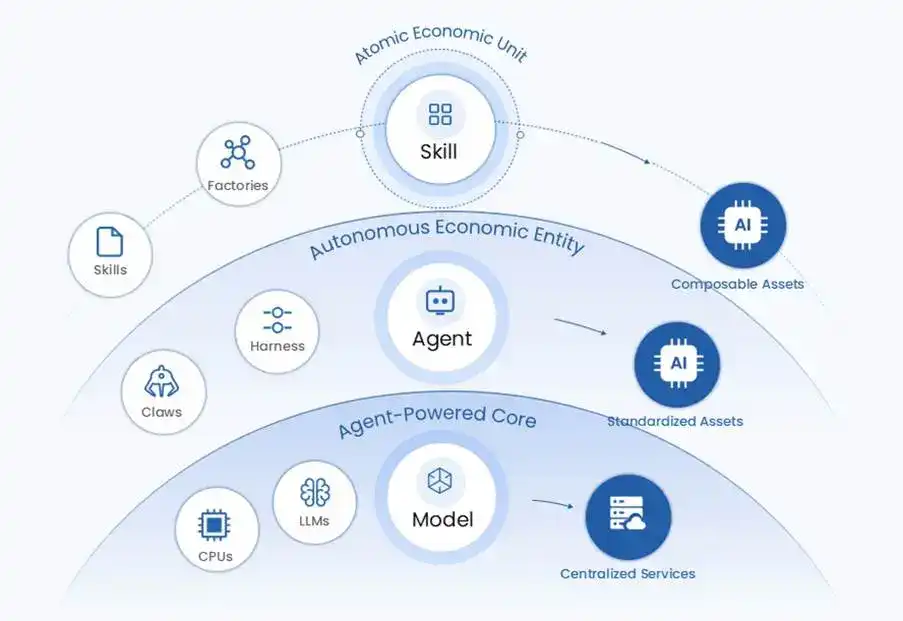
In the developmental iterations of Q1-Q2 2026, AI Agents are gradually forming clearer boundaries, clearer subjectivity, and clearer principles for the exchange of information, value, and energy. An AI Agent Sub-Microeconomics environment, analogous to a biological organism's environment, is taking shape. This contains a wealth of AI value and economic value to be mined, making AI Protocol and AI Finance an inevitable trend for explosion.

5. The Inevitability of AIFi and the Economic Significance of the Financial Chip (FinChip)

Starting from the second half of last year, we proposed thoughts and began layout work in the direction of AIFi (Artificial Intelligence Finance). By the end of Q1 2026, the concept of AIFi had formed a clear trend. A relatively clear definition of AIFi could be: the financial systems and infrastructure for exchange, trading, and capitalization formed after AI-native value is identified and tokenized within the Agent Economy.

The biggest difference between AIFi and DeFi/TradFi is that in DeFi and TradFi, the value resides in the "Fi" (i.e., Finance), with "Decentralized" and "Traditional" being the forms of that value. In contrast, AIFi is the opposite: the value is in the "AI," and the "Fi" becomes the form of that value. This is not merely wordplay; it is the result of AI development shifting from quantitative to qualitative change.

Simply put, previously, AI served quantitative strategies, financial products, and production processes; it was merely a development tool for extracting financial value and production value. But now, the decision-making capability possessed by AI Agents transfers the ability and power of value discovery from human and corporate hands to the Agents themselves. The subject of the economic unit has shifted, so the subject of value has also fundamentally changed.

Under such a trend, constructing the infrastructure for a new value system will be a crucial task. In my previous article in February of this year, , I首次首次 introduced the concept of the Financial Chip (FinChip) and mentioned that the combination of AI Agent + Crypto Smart Contract, encapsulated into hyper-intelligent financial assets, would truly adapt to the development of the next era's AI Agent Economy. After three months of iterative upgrades, FinChip.AI has initially developed an independent AIFi system combining AI Autonomous + Crypto Protocol, compatible with both H2A and A2A dual-phase environments. Building the infrastructure for the AI Agent Economy within an Open Network and gradually forming AI financial value is a significant economic meaning of FinChip.

6. AI-Native is a Paradigm Upgrade Different from Internet+

Whether it's AIFi, Financial Circuit Principles (Note 2), or the Financial Chip FinChip, the most important thing is to Natively integrate the essential principles of AI, Crypto, and Finance, forming a reasonable value system and management mechanism from a future perspective. AI-Native Thinking is the abstract and counter-intuitive logic of this stage. As mentioned earlier, "AI follows first principles, as well as the principle of the shortest energy-value path and the highest efficiency principle." This is the core difficulty for those currently thinking about and engaging in the construction of new commercial paradigms.

During the early phase of this round's AI upgrade outbreak led by OpenClaw in February this year, several entrepreneurs and I discussed a prediction: Enterprise upgrades through "AI+" and those through "Internet+" would be completely different.

Due to AI's characteristics of rapid development speed, abstract form, and deeper coupling with affairs, among others, for a considerable period (e.g., at least 2 years), it will be difficult to form a set of effective industrial upgrade tool methodologies or universal professional consulting advice. The pressure of the steep curve will persistently exist, posing a巨大巨大 challenge for all scientists, engineers, and entrepreneurs. The process of paradigm upgrade will also be completely unlike any historical experience.

Note1: This is a common historical规律规律. New productive forces孕育孕育 from the production relations of the previous era. In the initial stage, they first match the previous production relations for a period of development. Until they become irreconcilable, they force the emergence of the next stage's production relations, gradually replacing the previous ones to form a new era where productive forces and production relations develop in complete匹配匹配.

Note2:<Financial Circuits and Web3 Economic Model Principles> written in October 2022, describes the paradigm comparison between future financial value and physical circuits.

Domande pertinenti

QAccording to the article, what are the main bottlenecks and contradictions currently faced by the H2A (Human-to-Agent) economic model?

AThe main bottlenecks are: 1) The current focus on H2A is primarily driven by traditional business KPIs targeting human users, not true Agent-to-Agent (A2A) autonomy. 2) The logic is fundamentally non-AI-Native because it uses Agents to assist humans with decisions in traditional e-commerce/fiat payment scenarios, which limits utility beyond hype. 3) The model fails to leverage the core characteristic of AI Agents: autonomous decision-making.

QWhat are the three fundamental principles that the article states AI Agents will follow, potentially rendering much of current global finance and law obsolete?

AThe three principles are: 1) First principles. 2) The principle of the shortest energy-value path and highest efficiency. 3) Effective KYA (Know Your Agent) rather than the traditional KYC (Know Your Customer) that conforms to past aesthetics.

QThe article introduces the concept of 'AI Agent Sub-Microeconomics'. What is the key biological analogy used to describe the structure of this emerging economic environment?

AThe key analogy is to a biological cell. The LLM is likened to the cell nucleus (driving thought). The Agent Harness is like the cytoplasm (enabling differentiated capabilities). The Agent itself is like a cell (an independent, task-capable unit). Its communication protocol stack is like the cell membrane. The external value system (Skills, Prompts, etc.) is like the extracellular environment (exosomes, tissue fluid, matrix).

QHow does the article define the core distinction between AIFi and traditional DeFi/TradFi in terms of where value resides?

AThe core distinction is the location of value. In DeFi and TradFi, the value is contained *within* the 'Fi' (Finance), with 'Decentralized' or 'Traditional' being the form of that value. In AIFi, the value is generated *by the AI* (through Agent decision-making and value discovery), and 'Fi' becomes the form or mechanism through which that AI-native value is exchanged and capitalized.

QWhat major difference does the author predict between the upcoming 'AI+' enterprise upgrade wave and the historical 'Internet+' upgrade wave?

AThe 'AI+' upgrade will be fundamentally different and more challenging than 'Internet+'. Due to AI's rapid development speed, abstract nature, and deeper integration with core processes, it will be difficult to form a set of effective, universal upgrade methodologies or consulting frameworks for at least two years. The pressure from the steep learning/evolution curve will be persistent and unlike any past historical experience.

Letture associate

Trump in Talks with AI Companies Over Profit Sharing, A Narrative Pressure of Industrial Revolution Scale Begins

In recent AI market discussions, a new dimension beyond growth and profits has emerged: the question of how the immense wealth potentially generated by AI should be shared with the wider public. Triggered by reports of White House officials discussing "voluntary equity transfers" with top AI firms, similar to models like Alaska's Permanent Fund, the conversation focuses on public wealth funds. OpenAI's own whitepaper proposes such funds, allowing households without direct tech stock ownership to benefit from AI gains. More radical proposals, like Bernie Sanders' call for high public equity stakes and board seats, represent an extreme end of the spectrum. Currently, these are early-stage policy probes, not enacted laws. OpenAI's initiative is seen as an attempt to secure "social license" for its future expansion, mitigating risks of public backlash, stricter regulation, or anti-trust actions as AI's economic impact grows. The core market implication is the introduction of a "policy discount" to AI valuations, particularly for private model companies like OpenAI, Anthropic, and xAI. Investors must now consider not just future earnings but also what portion might be allocated to public mechanisms. The impact varies greatly based on the mechanism. A small, voluntary transfer of non-voting economic rights (e.g., 5%) acts as a quantifiable long-term cost. Government acquisition of economic rights via warrants tied to support differs from direct equity with governance power. The most disruptive scenario would be forced high-percentage public ownership affecting control and innovation incentives. Key signals to watch include whether other AI companies follow suit, if the White House formalizes proposals, related disclosures in future IPO documents, and any market price reactions. For now, this represents a shift from pricing pure AI growth to pricing its potential distribution. A manageable, voluntary economic share is akin to an insurance cost for societal acceptance, while a forced shift toward control and governance would fundamentally alter valuation logic.

marsbit3 min fa

Trump in Talks with AI Companies Over Profit Sharing, A Narrative Pressure of Industrial Revolution Scale Begins

marsbit3 min fa

From Record Highs to a Two-Week Low: Why Did AI Concept Stocks Suddenly Pull Back?

From Record Highs to Two-Week Lows: Why Did AI Stocks Suddenly Pull Back? U.S. stock indices, led by the tech-heavy Nasdaq 100, fell sharply to two-week lows. This marked a reversal from earlier in the week when AI infrastructure and semiconductor stocks had propelled major indices to record highs. Investors are rotating out of these previously high-flying tech sectors into other areas. The sell-off was driven by profit-taking and concerns that the AI rally had become overextended, exacerbated by chipmaker Broadcom's sales outlook falling short of lofty market expectations. The decline accelerated following a stronger-than-expected U.S. May nonfarm payrolls report, which showed 172,000 jobs added versus an estimated 88,000. This data sparked a jump in bond yields, with the 10-year Treasury yield rising to 4.553%, as it reinforced market speculation that the Federal Reserve's next move could be a rate hike rather than a cut. Globally, equities also declined, with European and Asian markets falling. Within the U.S. market, chip and AI-related stocks like Super Micro Computer and Arm Holdings led the losses, dropping over 7%. Cryptocurrency-linked stocks and mining shares also fell sharply amid drops in Bitcoin and commodity prices. While the overall Q1 earnings season remained solid, with 83% of S&P 500 companies beating estimates, the weakness was concentrated in tech. Excluding the tech sector, Q1 earnings growth was around 3%, the weakest in two years.

marsbit3 min fa

From Record Highs to a Two-Week Low: Why Did AI Concept Stocks Suddenly Pull Back?

marsbit3 min fa

JP Morgan Mid-Year Research Report Analysis: The AI Supercycle is Not Over, Reduce Cash Holdings + Allocate to Real Assets

JP Morgan's 2026 Mid-Year Outlook argues the AI supercycle is far from over, despite market pessimism. The report advises clients to reduce cash holdings, increase allocations to real assets as an inflation hedge, and focus on emerging markets. Key conclusions include: 1. **AI Supercycle Intact**: Hyperscalers' 2026 capex forecasts exceed $650B, with AI contributing to GDP growth. However, their financial profile is shifting toward heavy investment, compressing free cash flow. 2. **SaaS Disruption**: Traditional software companies are being negatively impacted by AI, with significant stock declines and pressure in credit markets. 3. **Persistent Inflation**: Core inflation is structurally higher post-pandemic. Holding excess cash and bonds leads to real wealth erosion. Recommendations include commodities, infrastructure, real estate, and gold. 4. **Geopolitical Shocks & Opportunities**: The Hormuz Strait blockade caused a major oil shock, but JP Morgan views the subsequent equity market pullback as a buying opportunity. "Fragmentation" is creating pockets of value, notably in resource-rich Latin America, AI-supply-chain-linked East Asia, and deeply discounted Chinese equities, where a policy shift could trigger a re-rating. 5. **Regional Views**: The firm is cautious on Europe due to high energy costs and lower innovation investment, preferring US and select EM exposures. In short, JP Morgan sees market volatility as an entry point but recommends a portfolio pivot: favor AI infrastructure, real assets, and EM, while avoiding excess cash, vulnerable software firms, and traditional 60/40 stock-bond allocations.

marsbit28 min fa

JP Morgan Mid-Year Research Report Analysis: The AI Supercycle is Not Over, Reduce Cash Holdings + Allocate to Real Assets

marsbit28 min fa

Trading

Spot
Futures

Articoli Popolari

Cosa è $S$

Comprendere SPERO: Una Panoramica Completa Introduzione a SPERO Mentre il panorama dell'innovazione continua a evolversi, l'emergere delle tecnologie web3 e dei progetti di criptovaluta gioca un ruolo fondamentale nel plasmare il futuro digitale. Un progetto che ha attirato l'attenzione in questo campo dinamico è SPERO, denotato come SPERO,$$s$. Questo articolo mira a raccogliere e presentare informazioni dettagliate su SPERO, per aiutare gli appassionati e gli investitori a comprendere le sue basi, obiettivi e innovazioni nei domini web3 e crypto. Che cos'è SPERO,$$s$? SPERO,$$s$ è un progetto unico all'interno dello spazio crypto che cerca di sfruttare i principi della decentralizzazione e della tecnologia blockchain per creare un ecosistema che promuove l'impegno, l'utilità e l'inclusione finanziaria. Il progetto è progettato per facilitare interazioni peer-to-peer in modi nuovi, fornendo agli utenti soluzioni e servizi finanziari innovativi. Al suo interno, SPERO,$$s$ mira a responsabilizzare gli individui fornendo strumenti e piattaforme che migliorano l'esperienza dell'utente nello spazio delle criptovalute. Questo include la possibilità di metodi di transazione più flessibili, la promozione di iniziative guidate dalla comunità e la creazione di percorsi per opportunità finanziarie attraverso applicazioni decentralizzate (dApps). La visione sottostante di SPERO,$$s$ ruota attorno all'inclusività, cercando di colmare le lacune all'interno della finanza tradizionale mentre sfrutta i vantaggi della tecnologia blockchain. Chi è il Creatore di SPERO,$$s$? L'identità del creatore di SPERO,$$s$ rimane piuttosto oscura, poiché ci sono risorse pubblicamente disponibili limitate che forniscono informazioni dettagliate sul suo fondatore o fondatori. Questa mancanza di trasparenza può derivare dall'impegno del progetto per la decentralizzazione—un ethos che molti progetti web3 condividono, dando priorità ai contributi collettivi rispetto al riconoscimento individuale. Centrando le discussioni attorno alla comunità e ai suoi obiettivi collettivi, SPERO,$$s$ incarna l'essenza dell'empowerment senza mettere in evidenza individui specifici. Pertanto, comprendere l'etica e la missione di SPERO rimane più importante che identificare un creatore singolo. Chi sono gli Investitori di SPERO,$$s$? SPERO,$$s$ è supportato da una varietà di investitori che vanno dai capitalisti di rischio agli investitori angelici dedicati a promuovere l'innovazione nel settore crypto. Il focus di questi investitori generalmente si allinea con la missione di SPERO—dando priorità a progetti che promettono avanzamenti tecnologici sociali, inclusività finanziaria e governance decentralizzata. Queste fondazioni di investitori sono tipicamente interessate a progetti che non solo offrono prodotti innovativi, ma contribuiscono anche positivamente alla comunità blockchain e ai suoi ecosistemi. Il supporto di questi investitori rafforza SPERO,$$s$ come un concorrente degno di nota nel dominio in rapida evoluzione dei progetti crypto. Come Funziona SPERO,$$s$? SPERO,$$s$ impiega un framework multifunzionale che lo distingue dai progetti di criptovaluta convenzionali. Ecco alcune delle caratteristiche chiave che sottolineano la sua unicità e innovazione: Governance Decentralizzata: SPERO,$$s$ integra modelli di governance decentralizzati, responsabilizzando gli utenti a partecipare attivamente ai processi decisionali riguardanti il futuro del progetto. Questo approccio favorisce un senso di proprietà e responsabilità tra i membri della comunità. Utilità del Token: SPERO,$$s$ utilizza il proprio token di criptovaluta, progettato per servire varie funzioni all'interno dell'ecosistema. Questi token abilitano transazioni, premi e la facilitazione dei servizi offerti sulla piattaforma, migliorando l'impegno e l'utilità complessivi. Architettura Stratificata: L'architettura tecnica di SPERO,$$s$ supporta la modularità e la scalabilità, consentendo un'integrazione fluida di funzionalità e applicazioni aggiuntive man mano che il progetto evolve. Questa adattabilità è fondamentale per mantenere la rilevanza nel panorama crypto in continua evoluzione. Coinvolgimento della Comunità: Il progetto enfatizza iniziative guidate dalla comunità, impiegando meccanismi che incentivano la collaborazione e il feedback. Nutrendo una comunità forte, SPERO,$$s$ può affrontare meglio le esigenze degli utenti e adattarsi alle tendenze di mercato. Focus sull'Inclusione: Offrendo basse commissioni di transazione e interfacce user-friendly, SPERO,$$s$ mira ad attrarre una base utenti diversificata, inclusi individui che potrebbero non aver precedentemente interagito nello spazio crypto. Questo impegno per l'inclusione si allinea con la sua missione generale di empowerment attraverso l'accessibilità. Cronologia di SPERO,$$s$ Comprendere la storia di un progetto fornisce preziose intuizioni sulla sua traiettoria di sviluppo e sui traguardi. Di seguito è riportata una cronologia suggerita che mappa eventi significativi nell'evoluzione di SPERO,$$s$: Fase di Concettualizzazione e Ideazione: Le idee iniziali che formano la base di SPERO,$$s$ sono state concepite, allineandosi strettamente con i principi di decentralizzazione e focus sulla comunità all'interno dell'industria blockchain. Lancio del Whitepaper del Progetto: Dopo la fase concettuale, è stato rilasciato un whitepaper completo che dettaglia la visione, gli obiettivi e l'infrastruttura tecnologica di SPERO,$$s$ per suscitare interesse e feedback dalla comunità. Costruzione della Comunità e Prime Interazioni: Sono stati effettuati sforzi attivi di outreach per costruire una comunità di early adopters e potenziali investitori, facilitando discussioni attorno agli obiettivi del progetto e ottenendo supporto. Evento di Generazione del Token: SPERO,$$s$ ha condotto un evento di generazione del token (TGE) per distribuire i propri token nativi ai primi sostenitori e stabilire una liquidità iniziale all'interno dell'ecosistema. Lancio della Prima dApp: La prima applicazione decentralizzata (dApp) associata a SPERO,$$s$ è stata attivata, consentendo agli utenti di interagire con le funzionalità principali della piattaforma. Sviluppo Continuo e Partnership: Aggiornamenti e miglioramenti continui alle offerte del progetto, inclusi partnership strategiche con altri attori nello spazio blockchain, hanno plasmato SPERO,$$s$ in un concorrente competitivo e in evoluzione nel mercato crypto. Conclusione SPERO,$$s$ rappresenta una testimonianza del potenziale del web3 e delle criptovalute di rivoluzionare i sistemi finanziari e responsabilizzare gli individui. Con un impegno per la governance decentralizzata, il coinvolgimento della comunità e funzionalità progettate in modo innovativo, apre la strada verso un panorama finanziario più inclusivo. Come per qualsiasi investimento nello spazio crypto in rapida evoluzione, si incoraggiano potenziali investitori e utenti a ricercare approfonditamente e a impegnarsi in modo riflessivo con gli sviluppi in corso all'interno di SPERO,$$s$. Il progetto mostra lo spirito innovativo dell'industria crypto, invitando a ulteriori esplorazioni delle sue innumerevoli possibilità. Mentre il percorso di SPERO,$$s$ è ancora in fase di sviluppo, i suoi principi fondamentali potrebbero effettivamente influenzare il futuro di come interagiamo con la tecnologia, la finanza e tra di noi in ecosistemi digitali interconnessi.

75 Totale visualizzazioniPubblicato il 2024.12.17Aggiornato il 2024.12.17

Cosa è $S$

Cosa è AGENT S

Agent S: Il Futuro dell'Interazione Autonoma in Web3 Introduzione Nel panorama in continua evoluzione di Web3 e criptovalute, le innovazioni stanno costantemente ridefinendo il modo in cui gli individui interagiscono con le piattaforme digitali. Uno di questi progetti pionieristici, Agent S, promette di rivoluzionare l'interazione uomo-computer attraverso il suo framework agentico aperto. Aprendo la strada a interazioni autonome, Agent S mira a semplificare compiti complessi, offrendo applicazioni trasformative nell'intelligenza artificiale (AI). Questa esplorazione dettagliata approfondirà le complessità del progetto, le sue caratteristiche uniche e le implicazioni per il dominio delle criptovalute. Cos'è Agent S? Agent S si presenta come un innovativo framework agentico aperto, progettato specificamente per affrontare tre sfide fondamentali nell'automazione dei compiti informatici: Acquisizione di Conoscenze Specifiche del Dominio: Il framework apprende in modo intelligente da varie fonti di conoscenza esterne ed esperienze interne. Questo approccio duale gli consente di costruire un ricco repository di conoscenze specifiche del dominio, migliorando le sue prestazioni nell'esecuzione dei compiti. Pianificazione su Lungo Orizzonte di Compiti: Agent S impiega una pianificazione gerarchica potenziata dall'esperienza, un approccio strategico che facilita la suddivisione e l'esecuzione efficiente di compiti complessi. Questa caratteristica migliora significativamente la sua capacità di gestire più sottocompiti in modo efficiente ed efficace. Gestione di Interfacce Dinamiche e Non Uniformi: Il progetto introduce l'Interfaccia Agente-Computer (ACI), una soluzione innovativa che migliora l'interazione tra agenti e utenti. Utilizzando Modelli Linguistici Multimodali di Grandi Dimensioni (MLLM), Agent S può navigare e manipolare senza sforzo diverse interfacce grafiche utente. Attraverso queste caratteristiche pionieristiche, Agent S fornisce un framework robusto che affronta le complessità coinvolte nell'automazione dell'interazione umana con le macchine, preparando il terreno per innumerevoli applicazioni nell'AI e oltre. Chi è il Creatore di Agent S? Sebbene il concetto di Agent S sia fondamentalmente innovativo, informazioni specifiche sul suo creatore rimangono elusive. Il creatore è attualmente sconosciuto, il che evidenzia sia la fase embrionale del progetto sia la scelta strategica di mantenere i membri fondatori sotto anonimato. Indipendentemente dall'anonimato, l'attenzione rimane sulle capacità e sul potenziale del framework. Chi sono gli Investitori di Agent S? Poiché Agent S è relativamente nuovo nell'ecosistema crittografico, informazioni dettagliate riguardanti i suoi investitori e sostenitori finanziari non sono documentate esplicitamente. La mancanza di approfondimenti pubblicamente disponibili sulle fondazioni di investimento o sulle organizzazioni che supportano il progetto solleva interrogativi sulla sua struttura di finanziamento e sulla roadmap di sviluppo. Comprendere il supporto è cruciale per valutare la sostenibilità del progetto e il suo potenziale impatto sul mercato. Come Funziona Agent S? Al centro di Agent S si trova una tecnologia all'avanguardia che gli consente di funzionare efficacemente in contesti diversi. Il suo modello operativo è costruito attorno a diverse caratteristiche chiave: Interazione Uomo-Computer Simile a Quella Umana: Il framework offre una pianificazione AI avanzata, cercando di rendere le interazioni con i computer più intuitive. Mimando il comportamento umano nell'esecuzione dei compiti, promette di elevare le esperienze degli utenti. Memoria Narrativa: Utilizzata per sfruttare esperienze di alto livello, Agent S utilizza la memoria narrativa per tenere traccia delle storie dei compiti, migliorando così i suoi processi decisionali. Memoria Episodica: Questa caratteristica fornisce agli utenti una guida passo-passo, consentendo al framework di offrire supporto contestuale mentre i compiti si sviluppano. Supporto per OpenACI: Con la capacità di funzionare localmente, Agent S consente agli utenti di mantenere il controllo sulle proprie interazioni e flussi di lavoro, allineandosi con l'etica decentralizzata di Web3. Facile Integrazione con API Esterne: La sua versatilità e compatibilità con varie piattaforme AI garantiscono che Agent S possa adattarsi senza problemi agli ecosistemi tecnologici esistenti, rendendolo una scelta attraente per sviluppatori e organizzazioni. Queste funzionalità contribuiscono collettivamente alla posizione unica di Agent S all'interno dello spazio crittografico, poiché automatizza compiti complessi e multi-fase con un intervento umano minimo. Man mano che il progetto evolve, le sue potenziali applicazioni in Web3 potrebbero ridefinire il modo in cui si svolgono le interazioni digitali. Cronologia di Agent S Lo sviluppo e le tappe di Agent S possono essere riassunti in una cronologia che evidenzia i suoi eventi significativi: 27 Settembre 2024: Il concetto di Agent S è stato lanciato in un documento di ricerca completo intitolato “Un Framework Agentico Aperto che Usa i Computer Come un Umano”, mostrando le basi per il progetto. 10 Ottobre 2024: Il documento di ricerca è stato reso pubblicamente disponibile su arXiv, offrendo un'esplorazione approfondita del framework e della sua valutazione delle prestazioni basata sul benchmark OSWorld. 12 Ottobre 2024: È stata rilasciata una presentazione video, fornendo un'idea visiva delle capacità e delle caratteristiche di Agent S, coinvolgendo ulteriormente potenziali utenti e investitori. Questi indicatori nella cronologia non solo illustrano i progressi di Agent S, ma indicano anche il suo impegno per la trasparenza e il coinvolgimento della comunità. Punti Chiave su Agent S Man mano che il framework Agent S continua a evolversi, diversi attributi chiave si distinguono, sottolineando la sua natura innovativa e il potenziale: Framework Innovativo: Progettato per fornire un uso intuitivo dei computer simile all'interazione umana, Agent S porta un approccio nuovo all'automazione dei compiti. Interazione Autonoma: La capacità di interagire autonomamente con i computer attraverso GUI segna un passo avanti verso soluzioni informatiche più intelligenti ed efficienti. Automazione di Compiti Complessi: Con la sua metodologia robusta, può automatizzare compiti complessi e multi-fase, rendendo i processi più veloci e meno soggetti a errori. Miglioramento Continuo: I meccanismi di apprendimento consentono ad Agent S di migliorare dalle esperienze passate, migliorando continuamente le sue prestazioni e la sua efficacia. Versatilità: La sua adattabilità attraverso diversi ambienti operativi come OSWorld e WindowsAgentArena garantisce che possa servire un'ampia gamma di applicazioni. Man mano che Agent S si posiziona nel panorama di Web3 e delle criptovalute, il suo potenziale per migliorare le capacità di interazione e automatizzare i processi segna un significativo avanzamento nelle tecnologie AI. Attraverso il suo framework innovativo, Agent S esemplifica il futuro delle interazioni digitali, promettendo un'esperienza più fluida ed efficiente per gli utenti in vari settori. Conclusione Agent S rappresenta un audace passo avanti nell'unione tra AI e Web3, con la capacità di ridefinire il modo in cui interagiamo con la tecnologia. Sebbene sia ancora nelle sue fasi iniziali, le possibilità per la sua applicazione sono vaste e coinvolgenti. Attraverso il suo framework completo che affronta sfide critiche, Agent S mira a portare le interazioni autonome al centro dell'esperienza digitale. Man mano che ci addentriamo nei regni delle criptovalute e della decentralizzazione, progetti come Agent S giocheranno senza dubbio un ruolo cruciale nel plasmare il futuro della tecnologia e della collaborazione uomo-computer.

536 Totale visualizzazioniPubblicato il 2025.01.14Aggiornato il 2025.01.14

Cosa è AGENT S

Come comprare S

Benvenuto in HTX.com! Abbiamo reso l'acquisto di Sonic (S) semplice e conveniente. Segui la nostra guida passo passo per intraprendere il tuo viaggio nel mondo delle criptovalute.Step 1: Crea il tuo Account HTXUsa la tua email o numero di telefono per registrarti il tuo account gratuito su HTX. Vivi un'esperienza facile e sblocca tutte le funzionalità,Crea il mio accountStep 2: Vai in Acquista crypto e seleziona il tuo metodo di pagamentoCarta di credito/debito: utilizza la tua Visa o Mastercard per acquistare immediatamente SonicS.Bilancio: Usa i fondi dal bilancio del tuo account HTX per fare trading senza problemi.Terze parti: abbiamo aggiunto metodi di pagamento molto utilizzati come Google Pay e Apple Pay per maggiore comodità.P2P: Fai trading direttamente con altri utenti HTX.Over-the-Counter (OTC): Offriamo servizi su misura e tassi di cambio competitivi per i trader.Step 3: Conserva Sonic (S)Dopo aver acquistato Sonic (S), conserva nel tuo account HTX. In alternativa, puoi inviare tramite trasferimento blockchain o scambiare per altre criptovalute.Step 4: Scambia Sonic (S)Scambia facilmente Sonic (S) nel mercato spot di HTX. Accedi al tuo account, seleziona la tua coppia di trading, esegui le tue operazioni e monitora in tempo reale. Offriamo un'esperienza user-friendly sia per chi ha appena iniziato che per i trader più esperti.

1.1k Totale visualizzazioniPubblicato il 2025.01.15Aggiornato il 2026.06.02

Come comprare S

Discussioni

Benvenuto nella Community HTX. Qui puoi rimanere informato sugli ultimi sviluppi della piattaforma e accedere ad approfondimenti esperti sul mercato. Le opinioni degli utenti sul prezzo di S S sono presentate come di seguito.

活动图片