Ethereum Reduced to a Chinese Concept Stock

marsbitPubblicato 2026-05-26Pubblicato ultima volta 2026-05-26

Introduzione

The article titled "Ethereum Becomes a Chinese Concept Stock" presents a critical analysis of Ethereum's perceived decline in market confidence and its structural parallels to Chinese companies listed on US stock exchanges. It begins by noting significant sell-offs by early investors like Wanxiang and key figures like Bankless's Hoffman in 2026, despite Ethereum's strong fundamental activity. The piece questions the erosion of trust in Vitalik Buterin and the Ethereum Foundation (EF), arguing that while other ecosystems have faced founder controversies, Ethereum's issues stem from its internal governance model. The author draws a direct comparison to "China concept stocks," which are Chinese businesses operating globally but reliant on foreign capital and listings. Similarly, Ethereum, funded early by Chinese capital like Wanxiang, developed a strong institutional framework from its IXO to its PoS transition. The core problem, according to the article, is a leadership vacuum regarding price and direction. Vitalik's move to make the EF smaller and less active is framed as a mistake. While he advocates for ETH as a "commodity," the ecosystem lacks a clear entity to steward its price stability, creating tension within the PoS system, as seen with Lido's challenges. The narrative suggests that excessive abstraction and a hands-off approach from the EF have left the community adrift, contrasting with more proactive foundations like Solana's. The article then examines emerging t...

In 2023, early Ethereum investor Wanxiang sold tokens multiple times, at an average price of $2,047. In May 2026, Bankless founder Hoffman fully liquidated his ETH holdings, also at an average price of around $2,000.

Bankless can be considered Ethereum's external propaganda department, single-handedly amplifying the top-tier meme concept of 'ETH is Money.' During the 2021 bull market, fervor for ETH equated to a firm bullish stance on the future of blockchain.

Perhaps due to its importance, or perhaps due to eight consecutive departures from the Ethereum Foundation, Ethereum's founder and spiritual leader, Vitalik Buterin, wrote a long confessional article. He candidly stated that the EF (Ethereum Foundation) controls only 0.16% of the ETH supply and should not hold a position superior to other ecosystem nodes. He also mentioned he would gradually withdraw from operations, returning freedom to Ethereum.

Ethereum Has No Killer

ETH is Money?

Whether you believe it or not, I certainly do.

But how did all this vanish? I'm referring to the market's confidence in $ETH's price, and holders' trust in the Ethereum Foundation and Vitalik. In terms of fundamental activity, now is arguably Ethereum's strongest period of dominance. So why is there so much discontent? Is it just because of the token price?

If $BTC plunges, it's seen as a good buying opportunity. If $SOL drops sharply, its extreme rebound post-FTX has proven its value. If $HYPE falls, one can trade the waves with Arthur Hayes.

Attributing it to Vitalik personally is a convenient reason. However, there's no shortage of abstract public chain founders and foundations. Solana founder Anatoly proactively hard-pitches Perp DEX concepts within the Hyperliquid community. Multiple Ripple founders engaged in wholesale dumping of $XRP. Let alone the proliferation of L2 founders in this era, mostly ego-inflated masters of TGE, seen with the Movement clique.

Upon careful comparison, while Vitalik might be abstract and the EF might be 'inefficient,' it's hard to say they created Ethereum's current predicament. If they are not the problem themselves, then perhaps the broader environment is.
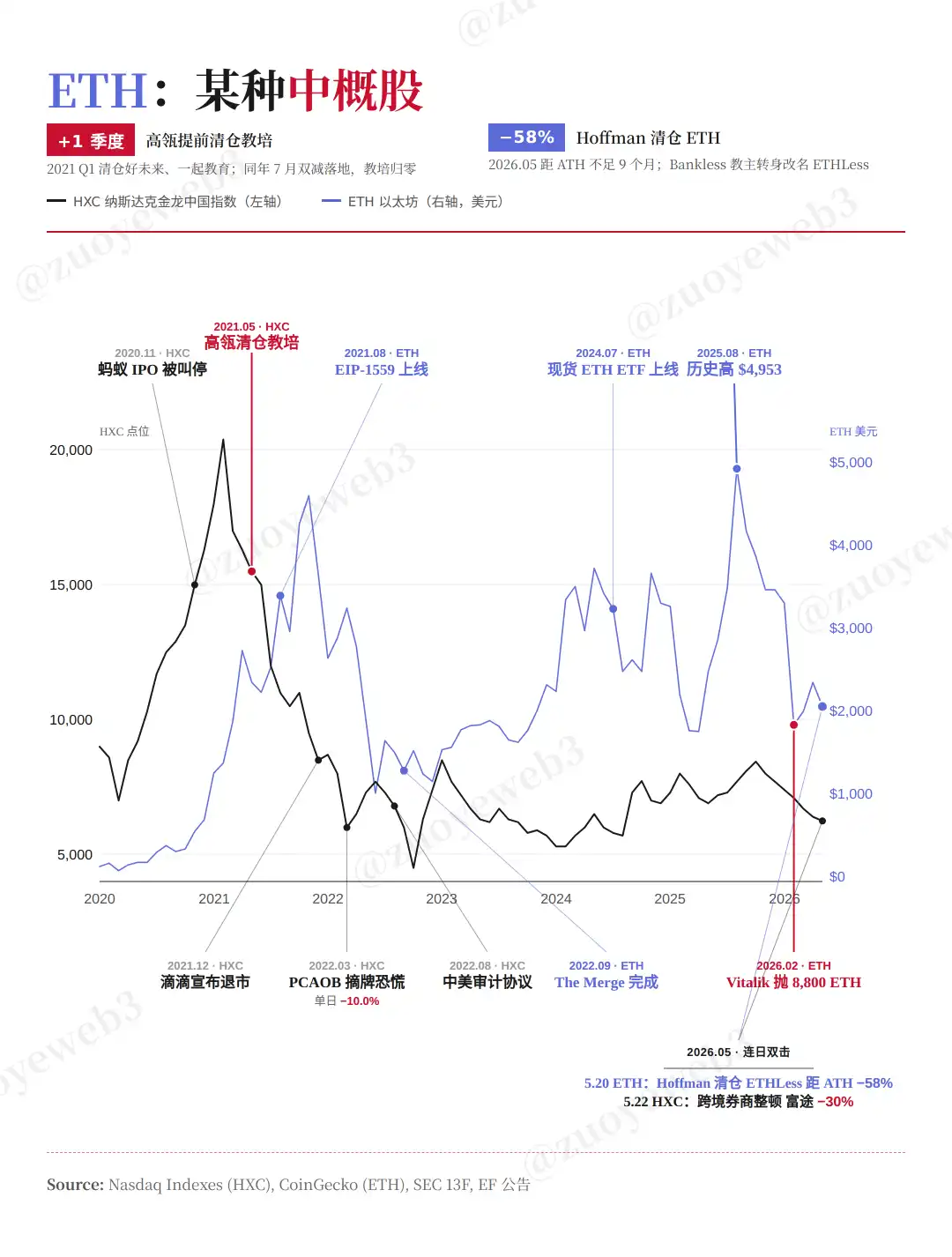
Image Caption: ETH is Money?

Image Source: @zuoyeweb3

The most typical case is Chinese concept stocks. Offshore structures + dollar funds + US IPO created a wealth myth over the past 20 years. Setting aside trial products like Brilliance Auto and China.com, the true first Chinese concept stock was Sina.com in 2000, formally initiating the wave.

The division of labor model of 'US concept + Chinese implementation' we see today is a legacy of this system. Even Ethereum itself is the last remnant of a certain type of Chinese implementation that went global.

In 2014/15, Vitalik first became a guest of Shen Bo and then received a $500,000 investment from Wanxiang, led by Xiao Feng. Unlike Bitcoin's mining model, Ethereum's IXO fundraising, PoW mining, and later PoS staking pulled three waves of passengers onto one vehicle.

In other words, ETH has been a system with relatively strong institutional involvement from the start. I don't mean to say ETH is a heavily manipulated token, and Vitalik indeed wishes for the EF to be just an ordinary node. However, within the Ethereum ecosystem, there absolutely does not exist a state of equal status uniformly distributed among all nodes. It wasn't before, isn't now, and won't be in the future.

Under these circumstances, the public chain founder and foundation actually need to take on more functions. This is unrelated to the token price. Precisely because Ethereum is fragmented with competing powers, someone must stand up and use relatively strong appeal to curb the system's disorderly entropy increase.

But Vitalik chose to first let the EF become bloated, from 'Infinite Garden' to the 'Ladder' theory. Excessive abstraction has left token holders at a loss, especially during the rsETH incident where Aave founder Stani essentially became the 'Duke Huan of Qi,' acting in the name of the king to pacify the lords.

Even the Solana Foundation set aside past grievances to actively endorse DeFi United, only to be met with the EF's routine token sales and Vitalik's personal silence.

Doing too much is centralization. But doing nothing, being overly restrained, is also an abuse of a dominant position—deliberately suppressing oneself, premised on 'the self believing it is important.'

Therefore, Vitalik's choice to make the EF smaller is a mistake. The correct approach would be for Vitalik to recede into the background as a mysterious figure and hand the foundation over to strong institutional players, more pragmatically focused on Ethereum's future.

Apart from Bitcoin, all other public chains need to face the practical demands of ecosystem development and adoption rates. On this point, the Ethereum Foundation holds no special status. The enthusiasm for DeFi and ETH is precisely a memory of past times, not pure wealth effect.

In terms of ecological prosperity and real-world adoption, Ethereum's 'killers' have never succeeded. Solana might be anxious about Hyperliquid, but Ethereum is not, just as BTC isn't anxious about Ethereum.

But this preferential treatment is fading. The crisis does not come from external forces but from within. The real distinction lies in: who is responsible for ETH's price, and who is responsible for Ethereum's direction?

Now, Vitalik is choosing to go all-in on privacy, but he should not 'prevent' others from taking responsibility for the token price.

New Narratives Await the Right Price

Commodity or Productive money?

After the $rsETH incident and the approval of staking ETFs, players like BitMine are rapidly building their own Staking services. Meanwhile, LST players like Lido are increasingly focusing on the 'productive ETH' narrative, with protocols like Spark only recognizing Lido's $wstETH product.

Everything is being reassessed. Lido is not as comfortable as it claims. With ETH prices lingering around $2,000, the marginal effect of continuing to scale diminishes, while the pressure to maintain APR returns increases, casting a shadow over the productivity narrative as well.

This highlights the importance of price—or rather, who is responsible for ETH's price. Currently, the situation is that the EF is not responsible, Lido cannot be responsible, and the entire Ethereum PoS system operates in this awkward environment.

Drawing another parallel to Chinese concept stocks: after US stock markets effectively ceased to be viable exit channels, ChangXin Memory Storage latched onto the AI concept, DeepSeek transformed with state capital taking the lead, and aerospace/robotics concepts oscillate between A-shares and H-shares. Whether you like it or not, this is the new narrative framework.
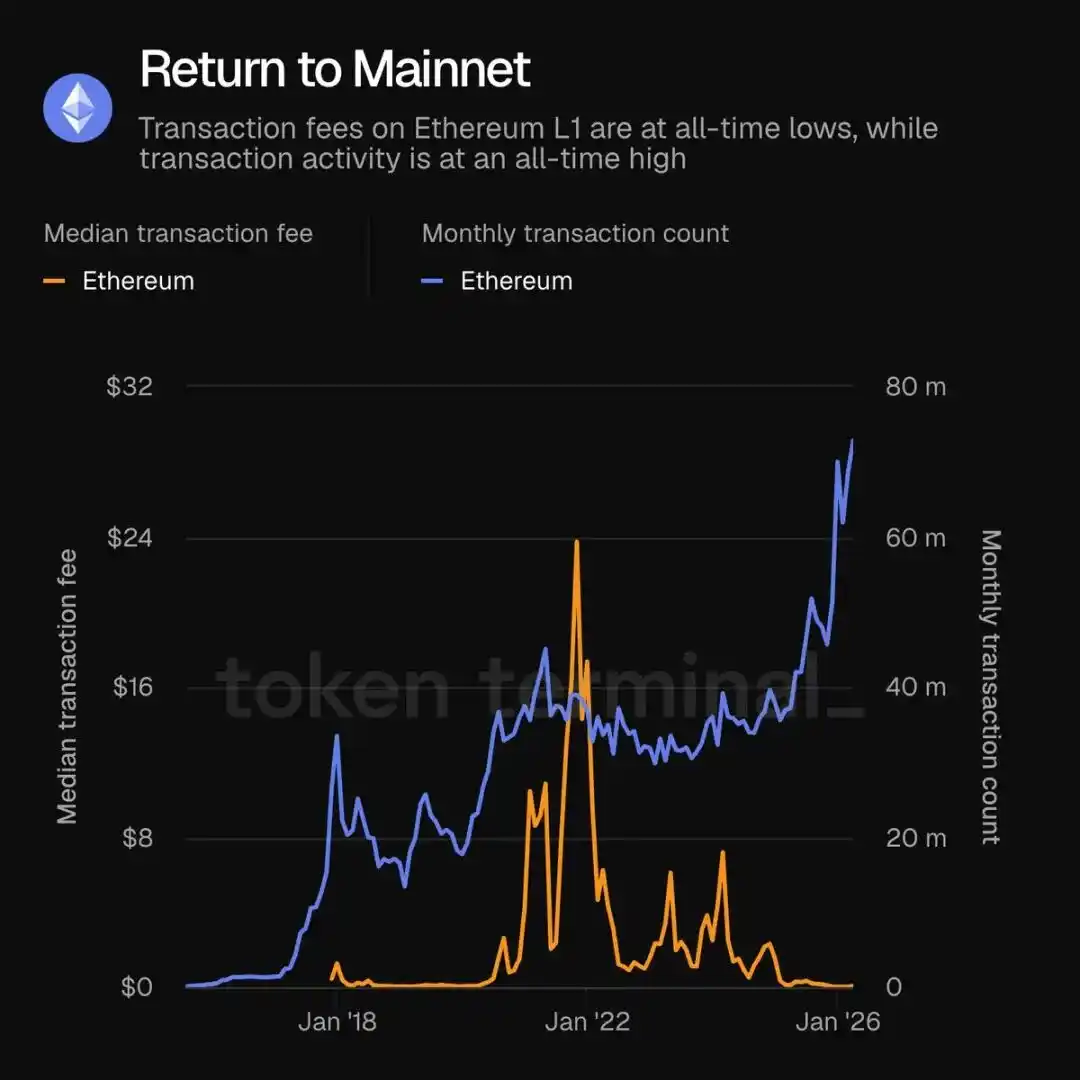
Image Caption: Return to Mainnet.

Image Source: @tokenterminal

With Ethereum's shift back to focusing on L1, mainnet activity exploded. Yet, you don't feel the Ethereum ecosystem is genuinely improving, let alone the token price rising. Something is clearly wrong, but people can't define the problem.

So, what about the current Ethereum technical narratives?

  1. Privacy: Everything can be ZK, the last bastion of decentralization ideals.
  2. AI: Teams like dAI are migrating centralized architectures on-chain, focusing on small model on-device deployment and Agent invocation.
  3. L1: Complete abandonment of the L2-centric model, with all competition over speed and revenue returning to L1.

Compared to the 'world computer' and smart contract technical synergy, Ethereum now needs to forge more connections with reality. Beyond the three above, there are stablecoins, RWA, and many other narratives. But these are not how Ethereum views the world; rather, it's Ethereum's place *within* the world.

The subject and object are inverted, or rather, its position in the new world is unclear. The grand ambition of 'everything can go on-chain' and 'blockchain fights for the future' is gone. Yet, there's always a feeling blockchain can do more. This contradiction, entanglement, and repetition form the threefold chorus of current market sentiment. People hope to see a better Ethereum, but seeing a good Ethereum seems unlikely.

After over a decade of striving, Ethereum did not become the world computer, but it is truly an open computer. Any activity or idea can be experimented with and run on it. While Bankless promoted 'ETH is Money,' Vitalik insisted 'ETH is a Commodity,' a digital product carrying specific functions.

On this point, no one can accuse Vitalik of lying. When Vitalik sold 8,800 tokens in February 2026, he did so slowly via CowSwap. He didn't follow Curve's founder by staking $CRV for stablecoins, nor did he emulate Justin Sun's tactics with $USDD to fleece retail investors.

But as in the Chiang Mai dialogue in January 2026, when asked if given a chance to turn back time ten years, would one choose blockchain or AI, Vitalik didn't give a firm answer. Yet, the reality is set: more and more crypto project teams are pivoting to AI, skillfully applying Go-To-Market methodologies.

  • Hermes Agent broke into the mainstream AI developer circle, with the founding team from Nous Research.
  • xBubble is developed by DappOS, combining AI + intent execution frameworks.
  • OpenRouter founder Alex Atallah is from OpenSea.

You'll find crypto project teams' marketing capabilities aren't limited to on-chain activities. Even in the globally watched AI trend, they can repeatedly keep pace. Even the transit hub model intertwines with stablecoins, traffic distribution, and operations.

But all this has a weak connection to Ethereum. Although dAI and virtuals jointly proposed ERC-8183, attempting to define an autonomous Agent economic activity framework, it's not that the team isn't working. It feels more like active adaptation rather than a leading posture.

If we consider the present a moment for narrative bottom-fishing, the core question is: what value does a public chain hold in the AI era?

Claude repeatedly attacks SaaS, security, and external Agent frameworks. Imagine an absurd scenario: if Claude created its own chain, what would happen to Ethereum?

Under the PoS mechanism, asset migration costs are low enough. But in terms of compliance costs, Claude would still be bound by human legal constraints. An unrestricted free financial testing ground might be Ethereum's most unique value proposition.

Just as when Mythos hammered Palantir's stock, QiAnXin would surge against the trend because hitting the opponent triggers an arms race among counterparts across the ocean, creating an infinite loop.

In other words, in a world of increasing polarization, the demand for connecting the globe will persist long-term. Canton belongs to Wall Street, but Ethereum belongs to all humanity. Just as people in the Sahara have no shoes, pessimists exit, and optimists rejoice.

However, the golden age of $ETH will not return. Wanxiang, the EF, and other institutions will continue to sell. But ETH at $2,000 is at least ten times $200. We stand at a new starting point; we just need a course to sail.

Conclusion

Destined to be alike, ETH truly shares a fate similar to Chinese concept stocks. Both are assets from Country A, invested in by Country B's capital, and exited on Country B's secondary markets. Country A only bears market and channel value.

This is the best of times. Under such fragmentation, new markets will be born. Following Country B's dynamics, similar assets in Country A will experience analogous cycles. Amidst the fragmentation, both A and B still need new connection points. Ethereum remains the best choice.


Domande pertinenti

QWhat is the main argument presented in the article regarding Ethereum's current predicament?

AThe article argues that Ethereum's core problem is not its technology or competitors, but a lack of clear leadership and responsibility for its price and direction. It draws a parallel to Chinese concept stocks (中概股), suggesting Ethereum suffers from a similar disconnect where its primary value accrual (price/exit) happens in a market (B country/crypto speculation) separate from its core development and user base (A country/decentralized ethos). Vitalik Buterin and the Ethereum Foundation's move towards excessive abstraction and minimal intervention, rather than proactive stewardship, has created a leadership vacuum and eroded confidence.

QAccording to the article, how does the 'ETH is Money' narrative conflict with Vitalik Buterin's own view?

AThe 'ETH is Money' narrative, heavily promoted by entities like Bankless, positioned ETH as a form of currency or sound money during the 2021 bull market. However, the article states that Vitalik Buterin himself has consistently viewed ETH not as 'money' but as a 'Commodity'—a digital product designed to carry specific functions (like paying for gas fees) within the Ethereum ecosystem.

QWhat three key technical narratives is Ethereum currently pursuing, as mentioned in the article?

AThe article lists three key technical narratives for Ethereum: 1. Privacy: Focusing on zero-knowledge (ZK) proofs as the last bastion of decentralization. 2. AI: Projects like dAI aim to bring centralized AI architectures on-chain, focusing on small model on-device deployment and Agent invocation. 3. L1 Focus: Shifting away from an L2-centric roadmap and refocusing competition on Layer-1 speed and revenue generation.

QWhat analogy does the article make between Ethereum and Chinese concept stocks (中概股)?

AThe article draws a direct analogy, stating Ethereum has become like a Chinese concept stock. Both are seen as 'A-country assets' (Ethereum's tech/decentralized ideals / China's companies) funded by 'B-country capital' (global crypto VCs / US dollar funds) with their primary exit and valuation mechanism in the 'B-country secondary market' (global crypto exchanges / US stock markets). The 'A-country' (core ecosystem/China) mainly provides market access and utility, but doesn't fully capture the financial value creation.

QWhat does the article suggest is Ethereum's unique and enduring value proposition in the current landscape?

AThe article suggests Ethereum's unique value is as a 'limitless financial testing ground' and a global, permissionless linking layer. In an increasingly fragmented world with rising geopolitical tensions, the need for a neutral, global financial and coordination platform persists. While projects like Canton Network serve institutional Wall Street, Ethereum belongs to 'all of humanity,' offering a space for uncensored experimentation that centralized entities or AI models like Claude, bound by human laws, cannot replicate.

Letture associate

Microsoft Halts Vibe Coding: "Burning Tokens" Is Now More Expensive Than Employees

Microsoft has halted the widespread internal use of Claude Code, withdrawing licenses from most employees by the end of its fiscal year, June 30, 2026. This reversal comes just six months after actively promoting the AI coding tool to boost productivity via "vibe coding"—where developers describe intent in natural language and let the LLM generate code. The core issue isn't the tool's effectiveness; internal reports suggest employees preferred Claude Code over Microsoft's own Copilot CLI. The problem is financial: the "copilot mode" adds a variable, consumption-based token cost on top of existing employee salaries without a proportional revenue increase. As usage grew, the token bills became unsustainable, leading to what sources describe as a cost-structure failure. Similar overruns have been reported at other firms like Uber. The article contrasts this with the approach of AI-native startups, exemplified by Y Combinator's philosophy. Here, high token consumption is strategic—it replaces, rather than supplements, human labor. Startups operate with tiny teams where AI agents handle work previously done by many, making the high token bill financially viable as it offsets much larger personnel costs. The conclusion is that "vibe coding" isn't dead, but its economics fail within traditional corporate structures that treat AI as a productivity add-on for existing staff. Success requires a foundational shift to an AI-native organization, where processes are built to be "legible to AI," and the company's core knowledge and assets reside in documented, AI-accessible systems rather than solely in employees' minds. The future divide will be between companies that merely add AI tools and those that redesign their organizations around them.

marsbit15 min fa

Microsoft Halts Vibe Coding: "Burning Tokens" Is Now More Expensive Than Employees

marsbit15 min fa

Metrics Ventures Market Watch: The Brewing Storm

In the past month, the market has been actively trading contrasting expectations, balancing global supply chain disruptions fueling re-inflation against both actual and anticipated (Walsh) interest rate hikes. This volatility has impacted commodities and most equities, though tech has temporarily benefited from concentrated short-term liquidity. Fundamentally, as previously analyzed regarding the Strait of Hormuz situation, the US faces deep-seated balance sheet issues beyond what any single Fed chair can resolve. Hypotheses around a figure like Walsh could only materialize if AI fundamentally reshapes production relations. Until then, most non-AI-leading nations (effectively all except the US and China) risk fiscal and monetary policy collapse, rendering the identity of the Fed chair ultimately irrelevant. For crypto assets, there is currently no clear role in these dominant narratives. The market remains strongly capped by the 200-day moving average. While trends may shift from "anything but AI" to "anything but mines," this phase is dominated by the silicon vs. carbon (AI vs. traditional) dichotomy, leaving little room for crypto—though its time will come. **Market Overview & Commentary** The crypto market lacks significant catalysts beyond hype, plagued by low volume and scarce innovation, with clear technical resistance. Currently, crypto struggles for attention as global focus lies elsewhere. Assets like gold, oil, and grains are more direct hedges against supply-chain-driven inflation/stagflation. Bitcoin needs more time for capitulation and consolidation; this reset is expected to last until at least Q4 2026. Looking ahead, three factors will likely drive future market volatility: 1. Whether Walsh repeats the patterns of predecessors like Bassant or Musk, shifting stance into a new policy cycle. 2. The market underestimates the severity of global supply chain damage and the prolonged time needed for repair, which will eventually lead to recognition of acute resource shortages and price swings. 3. AI non-beneficiary, high-inflation nations (e.g., UK, Japan) will face severe fiscal and monetary crises. Rapid AI-driven displacement could trigger a collapse of existing credit and welfare systems. Ultimately, the market may realize that an AI bubble burst could spark contagious sovereign credit crises. The monetary and fiscal responses to such a scenario could serve as the ultimate catalyst for Bitcoin's next major bull run.

marsbit1 h fa

Metrics Ventures Market Watch: The Brewing Storm

marsbit1 h fa

Insiders Betting on Musk Are Reaping 'Historic Returns'

The largest IPO in history is imminent as SpaceX, led by Elon Musk, is set to price its offering on June 12. At a targeted valuation near $2 trillion, this event will mint new billionaires from Musk's inner circle of long-time allies, rewarding their loyalty with unprecedented returns. Key beneficiaries include Antonio Gracias, Musk's close friend and confidant, who holds a 7.3% stake potentially worth over $140 billion, making him the second-largest individual shareholder. Gwynne Shotwell, President and COO since 2002, holds shares valued at roughly $2 billion. Bret Johnsen, the CFO, holds stock worth approximately $1.4 billion. Luke Nosek, a PayPal co-founder and early investor, stands to gain about $5.3 billion. The IPO filing also reveals complex and controversial financial arrangements. SpaceX has guaranteed nearly $20 billion in payments from xAI's subsidiary to Gracias's Valor Equity Partners for AI hardware leases—deals auditors flagged as "failed sale-leaseback" transactions, forcing SpaceX to record them as debt. Despite rapid revenue growth, SpaceX is not profitable, posting a $49 billion loss in 2025 and a $4.3 billion loss in Q1 2026. Capital expenditures are soaring, with over 60% directed toward AI. Public investors will inherit these losses, significant debts, and a governance structure heavily controlled by insiders, including a provision granting Musk up to a billion additional shares if one million people live on Mars.

链捕手1 h fa

Insiders Betting on Musk Are Reaping 'Historic Returns'

链捕手1 h fa

Trading

Spot
Futures

Articoli Popolari

Cosa è ETH 3.0

ETH3.0 e $eth 3.0: Un'Analisi Approfondita del Futuro di Ethereum Introduzione Nel panorama in rapida evoluzione delle criptovalute e della tecnologia blockchain, ETH3.0, spesso indicato come $eth 3.0, è emerso come un argomento di considerevole interesse e speculazione. Il termine comprende due concetti principali che warrantono chiarimenti: Ethereum 3.0: Questo rappresenta un potenziale futuro aggiornamento volto ad aumentare le capacità dell'attuale blockchain di Ethereum, concentrandosi principalmente sul miglioramento della scalabilità e delle prestazioni. ETH3.0 Meme Token: Questo progetto di criptovaluta distinto cerca di sfruttare la blockchain di Ethereum per creare un ecosistema incentrato sui meme, promuovendo il coinvolgimento all'interno della comunità delle criptovalute. Comprendere questi aspetti di ETH3.0 è essenziale non solo per gli appassionati di criptovalute, ma anche per coloro che osservano tendenze tecnologiche più ampie nello spazio digitale. Che cos'è ETH3.0? Ethereum 3.0 Ethereum 3.0 è pubblicizzato come un aggiornamento proposto per la rete Ethereum già stabilita, che è stata la spina dorsale di molte applicazioni decentralizzate (dApps) e contratti smart sin dalla sua nascita. I miglioramenti previsti si concentrano principalmente sulla scalabilità, integrando tecnologie avanzate come lo sharding e le prove a conoscenza zero (zk-proofs). Queste innovazioni tecnologiche mirano a facilitare un numero senza precedenti di transazioni al secondo (TPS), potenzialmente raggiungendo milioni, affrontando così una delle limitazioni più significative della tecnologia blockchain attuale. Il miglioramento non è meramente tecnico, ma anche strategico; è volto a preparare la rete Ethereum per un'adozione e un'utilità diffuse in un futuro contrassegnato da un aumento della domanda di soluzioni decentralizzate. ETH3.0 Meme Token Al contrario di Ethereum 3.0, l'ETH3.0 Meme Token si avventura in un dominio più leggero e giocoso, combinando la cultura dei meme di internet con la dinamica delle criptovalute. Questo progetto consente agli utenti di acquistare, vendere e scambiare meme sulla blockchain di Ethereum, fornendo una piattaforma che promuove il coinvolgimento della comunità attraverso la creatività e interessi condivisi. L'ETH3.0 Meme Token mira a dimostrare come la tecnologia blockchain possa intersecarsi con la cultura digitale, creando casi d'uso che siano sia divertenti che finanziariamente praticabili. Chi è il Creatore di ETH3.0? Ethereum 3.0 L'iniziativa verso Ethereum 3.0 è principalmente propulsa da un consorzio di sviluppatori e ricercatori all'interno della comunità di Ethereum, tra cui Justin Drake. Conosciuto per le sue intuizioni e contributi all'evoluzione di Ethereum, Drake è stato una figura di spicco nelle discussioni riguardanti la transizione di Ethereum verso un nuovo livello di consenso, chiamato “Beam Chain.” Questo approccio collaborativo allo sviluppo significa che Ethereum 3.0 non è il prodotto di un creatore singolo, ma piuttosto una manifestazione di ingegno collettivo focalizzato sul progresso della tecnologia blockchain. ETH3.0 Meme Token I dettagli riguardanti il creatore dell'ETH3.0 Meme Token sono attualmente non rintracciabili. La natura dei token meme conduce spesso a una struttura più decentralizzata e guidata dalla comunità, il che potrebbe spiegare la mancanza di attribuzione specifica. Questo si allinea con l'etica della comunità crypto più ampia, dove l'innovazione spesso nasce da sforzi collaborativi piuttosto che individuali. Chi sono gli Investitori di ETH3.0? Ethereum 3.0 Il supporto per Ethereum 3.0 proviene principalmente dalla Ethereum Foundation insieme a una comunità entusiasta di sviluppatori e investitori. Questa associazione fondamentale fornisce un considerevole grado di legittimità e migliora le prospettive di implementazione di successo poiché sfrutta la fiducia e la credibilità costruite nel corso degli anni di operazioni della rete. Nel clima in rapida evoluzione delle criptovalute, il supporto della comunità gioca un ruolo cruciale nello sviluppo e nell'adozione, posizionando Ethereum 3.0 come un serio contenditore per i futuri progressi della blockchain. ETH3.0 Meme Token Sebbene le fonti attualmente disponibili non forniscano informazioni esplicite riguardo ai fondamenti o alle organizzazioni di investimento che sostengono l'ETH3.0 Meme Token, ciò è indicativo del modello di finanziamento tipico per i token meme, che spesso si basa sul supporto di base e sul coinvolgimento della comunità. Gli investitori in tali progetti sono tipicamente individui motivati dal potenziale per innovazioni guidate dalla comunità e dallo spirito di cooperazione trovato all'interno della comunità crypto. Come Funziona ETH3.0? Ethereum 3.0 Le caratteristiche distintive dell'Ethereum 3.0 risiedono nella sua proposta di implementazione della tecnologia di sharding e zk-proof. Lo sharding è un metodo di partizionamento della blockchain in pezzi più piccoli e gestibili o “shard,” che possono elaborare transazioni in modo concorrente piuttosto che sequenziale. Questa decentralizzazione dell'elaborazione aiuta a prevenire la congestione e garantisce che la rete rimanga reattiva anche sotto un carico pesante. La tecnologia delle prove a conoscenza zero (zk-proof) contribuisce con un ulteriore livello di sofisticazione consentendo la validazione delle transazioni senza rivelare i dati sottostanti coinvolti. Questo aspetto non solo migliora la privacy, ma aumenta anche l'efficienza complessiva della rete. Si parla anche di incorporare una macchina virtuale Ethereum a conoscenza zero (zkEVM) in questo aggiornamento, amplificando ulteriormente le capacità e l'utilità della rete. ETH3.0 Meme Token L'ETH3.0 Meme Token si distingue capitalizzando sulla popolarità della cultura dei meme. Stabilisce un mercato per gli utenti che desiderano partecipare al trading di meme, non solo per divertimento, ma anche per potenziale guadagno economico. Integrando funzioni come lo staking, la fornitura di liquidità e meccanismi di governance, il progetto promuove un ambiente che incentiva l'interazione e la partecipazione della comunità. Offrendo una miscela unica di intrattenimento e opportunità economica, l'ETH3.0 Meme Token mira ad attrarre un pubblico variegato, che va dagli appassionati di crypto ai semplici intenditori di meme. Timeline di ETH3.0 Ethereum 3.0 11 Novembre 2024: Justin Drake accenna al prossimo aggiornamento ETH 3.0, incentrato sui miglioramenti della scalabilità. Questo annuncio segna l'inizio delle discussioni formali riguardo l'architettura futura di Ethereum. 12 Novembre 2024: La proposta attesa per Ethereum 3.0 dovrebbe essere svelata a Devcon a Bangkok, preparando il terreno per un feedback più ampio della comunità e potenziali passi successivi nello sviluppo. ETH3.0 Meme Token 21 Marzo 2024: L'ETH3.0 Meme Token viene ufficialmente elencato su CoinMarketCap, segnando il suo ingresso nel dominio pubblico delle criptovalute e aumentando la visibilità per il suo ecosistema basato sui meme. Punti Chiave In conclusione, Ethereum 3.0 rappresenta una significativa evoluzione all'interno della rete Ethereum, concentrandosi sul superamento delle limitazioni riguardanti scalabilità e prestazioni attraverso tecnologie avanzate. I suoi aggiornamenti proposti riflettono un approccio proattivo alle future esigenze e usabilità. D'altra parte, l'ETH3.0 Meme Token incarna l'essenza della cultura guidata dalla comunità nello spazio delle criptovalute, sfruttando la cultura dei meme per creare piattaforme coinvolgenti che incoraggiano la creatività e la partecipazione degli utenti. Comprendere gli scopi e le funzionalità distinte di ETH3.0 e $eth 3.0 è fondamentale per chiunque sia interessato ai continui sviluppi nello spazio crypto. Con entrambe le iniziative che tracciano percorsi unici, esse sottolineano collettivamente la natura dinamica e multifacetica dell'innovazione blockchain.

173 Totale visualizzazioniPubblicato il 2024.04.04Aggiornato il 2024.12.03

Cosa è ETH 3.0

Cosa è ETHEREUM

HarryPotterTrumpHomerSimpson777Inu: Panoramica di un Progetto Crypto Web3 Introduzione Nel mondo in rapida evoluzione delle criptovalute e della finanza decentralizzata, progetti innovativi emergono frequentemente, catturando l'interesse della comunità degli investitori e degli appassionati di crypto. Uno di questi progetti è HarryPotterTrumpHomerSimpson777Inu, una criptovaluta che si trova all'incrocio tra cultura popolare e tecnologia blockchain. Questo token guidato dalla comunità mescola personaggi e figure politiche ben noti, con l'obiettivo di creare una piattaforma coinvolgente e promuovere un'adozione diffusa. Che cos'è HarryPotterTrumpHomerSimpson777Inu? HarryPotterTrumpHomerSimpson777Inu è un token costruito sulla blockchain di Ethereum, progettato per essere accessibile e divertente per un pubblico diversificato. L'unicità di questo progetto deriva dal suo approccio tematico, che intreccia elementi di fantasia, politica e intrattenimento. Sfruttando il fascino nostalgico di personaggi amati, il progetto cerca di creare un'esperienza di criptovaluta coinvolgente, incoraggiando il coinvolgimento e la partecipazione della comunità. L'obiettivo principale di HarryPotterTrumpHomerSimpson777Inu è stabilire un token che risuoni con gli utenti a livello personale, promuovendo sia il divertimento che il coinvolgimento nell'ambito crypto. Questo branding distintivo mira ad attrarre individui che in precedenza potrebbero non essersi interessati alle criptovalute, facilitando un nuovo punto di ingresso per utenti potenziali. Creatore di HarryPotterTrumpHomerSimpson777Inu L'identità del creatore dietro HarryPotterTrumpHomerSimpson777Inu rimane sconosciuta. Questa non è una pratica rara nel dominio delle criptovalute, dove l'anonimato è spesso preferito dai fondatori come mezzo di protezione della privacy e promozione di un ethos decentralizzato. Questa oscurità non diminuisce il valore del progetto; al contrario, riflette una tendenza più ampia all'interno del settore, dove molti progetti di successo sono emersi da origini anonime. Investitori di HarryPotterTrumpHomerSimpson777Inu Le informazioni pubbliche riguardo agli investitori di HarryPotterTrumpHomerSimpson777Inu sono limitate. La natura del progetto, incentrata sul coinvolgimento della comunità, suggerisce una dipendenza da investimenti di piccole dimensioni da parte di singoli appassionati piuttosto che da sostegni sostanziali da fondazioni di investimento consolidate o corporation. Questo livello di trasparenza nel finanziamento è tipico di molti progetti di criptovaluta guidati dalla comunità, dove il supporto spesso proviene da movimenti di base piuttosto che da investitori istituzionali. Come Funziona HarryPotterTrumpHomerSimpson777Inu? Operando sulla blockchain di Ethereum, HarryPotterTrumpHomerSimpson777Inu sfrutta la sua solida infrastruttura per facilitare transazioni e promuovere interazioni tra gli utenti all'interno della comunità. Ciò che distingue questo progetto è il suo posizionamento tematico: canalizzando il carisma di personaggi iconici provenienti da diversi ambiti culturali, crea un'identità di marca distintiva. Questo approccio non solo attrae gli utenti, ma coltiva anche una comunità fedele attorno al token. Le meccaniche operative del progetto si concentrano sul coinvolgimento della comunità. Adotta un modello decentralizzato che incoraggia la partecipazione, consentendo agli utenti di interagire attraverso vari canali mentre promuovono lo scambio di idee e esperienze. Inoltre, il progetto abbraccia i principi del Web3, privilegiando la sovranità degli utenti e la decentralizzazione, che sono i pilastri del futuro di Internet. Timeline di HarryPotterTrumpHomerSimpson777Inu La storia di HarryPotterTrumpHomerSimpson777Inu è segnata da diversi eventi decisivi: 12 agosto 2023: L'inizio di HarryPotterTrumpHomerSimpson777Inu, segnando il suo ingresso nell'ecosistema delle criptovalute. Fase di Sviluppo: Un periodo focalizzato sulla costruzione di una strategia completa per stimolare la crescita guidata dalla comunità e il coinvolgimento degli utenti. Listing sugli Scambi: Sebbene i dettagli specifici di listing non siano stati divulgati, il progetto è stato reso accessibile su vari scambi di criptovalute, migliorando la sua visibilità nel mercato. Coinvolgimento della Comunità: Sforzi continui per coinvolgere attivamente la comunità, stabilendo canali di dialogo e promuovendo la partecipazione attraverso varie attività, tra cui concorsi, discussioni e votazioni comunitarie. Aspetti Chiave di HarryPotterTrumpHomerSimpson777Inu Focus sulla Comunità Un tratto distintivo di HarryPotterTrumpHomerSimpson777Inu è la sua forte enfasi sul coinvolgimento della comunità. Il progetto incoraggia attivamente gli utenti a partecipare a discussioni, condividere idee e contribuire all'evoluzione del progetto. Questa interazione coltiva un senso di appartenenza e di ownership tra i membri della comunità, essenziale per la sostenibilità a lungo termine del token. Utilizzo della Blockchain di Ethereum La scelta di costruire sulla blockchain di Ethereum consente a HarryPotterTrumpHomerSimpson777Inu di sfruttare le sue caratteristiche di sicurezza ben consolidate e architettura decentralizzata. Questa base garantisce affidabilità per le transazioni e fornisce un framework affidabile su cui sviluppare varie funzionalità. Approccio Tematico Unico Fusione di elementi della cultura pop nella sua identità, HarryPotterTrumpHomerSimpson777Inu crea una narrazione coinvolgente che lo differenzia da altre criptovalute. L'amalgama di personaggi e temi genera riconoscimento e intrigo immediati, rendendo il token relazionabile a un'ampia gamma di utenti potenziali. Anonimato nello Sviluppo Il creatore anonimo del progetto rimane una caratteristica ricorrente in molte iniziative di criptovaluta. Questo aspetto evidenzia un ethos di decentralizzazione, introducendo anche un livello di mistero che potrebbe affascinare un segmento della comunità crypto, attirando l'attenzione sul progetto e invitando l'impegno da parte di utenti che supportano l'idea di un'iniziativa decentralizzata e gestita dalla comunità. Conclusione HarryPotterTrumpHomerSimpson777Inu si presenta come un'aggiunta distintiva al panorama delle criptovalute, combinando il fascino della cultura popolare con le meccaniche innovative della tecnologia blockchain. Sebbene i dettagli riguardanti il creatore e gli investitori specifici rimangano non divulgati, il focus del progetto sulla comunità e il suo approccio tematico lo contraddistinguono come un potenziale attore influente nel contesto del Web3 e delle criptovalute. Man mano che l'ecosistema delle criptovalute continua ad espandersi, iniziative come HarryPotterTrumpHomerSimpson777Inu ci ricordano le molteplici modalità in cui la blockchain può connettere le comunità globali attraverso narrazioni e valori condivisi.

873 Totale visualizzazioniPubblicato il 2024.04.06Aggiornato il 2024.12.03

Cosa è ETHEREUM

Come comprare ETH

Benvenuto in HTX.com! Abbiamo reso l'acquisto di Ethereum (ETH) semplice e conveniente. Segui la nostra guida passo passo per intraprendere il tuo viaggio nel mondo delle criptovalute.Step 1: Crea il tuo Account HTXUsa la tua email o numero di telefono per registrarti il tuo account gratuito su HTX. Vivi un'esperienza facile e sblocca tutte le funzionalità,Crea il mio accountStep 2: Vai in Acquista crypto e seleziona il tuo metodo di pagamentoCarta di credito/debito: utilizza la tua Visa o Mastercard per acquistare immediatamente EthereumETH.Bilancio: Usa i fondi dal bilancio del tuo account HTX per fare trading senza problemi.Terze parti: abbiamo aggiunto metodi di pagamento molto utilizzati come Google Pay e Apple Pay per maggiore comodità.P2P: Fai trading direttamente con altri utenti HTX.Over-the-Counter (OTC): Offriamo servizi su misura e tassi di cambio competitivi per i trader.Step 3: Conserva Ethereum (ETH)Dopo aver acquistato Ethereum (ETH), conserva nel tuo account HTX. In alternativa, puoi inviare tramite trasferimento blockchain o scambiare per altre criptovalute.Step 4: Scambia Ethereum (ETH)Scambia facilmente Ethereum (ETH) nel mercato spot di HTX. Accedi al tuo account, seleziona la tua coppia di trading, esegui le tue operazioni e monitora in tempo reale. Offriamo un'esperienza user-friendly sia per chi ha appena iniziato che per i trader più esperti.

2.9k Totale visualizzazioniPubblicato il 2024.12.10Aggiornato il 2025.03.21

Come comprare ETH

Discussioni

Benvenuto nella Community HTX. Qui puoi rimanere informato sugli ultimi sviluppi della piattaforma e accedere ad approfondimenti esperti sul mercato. Le opinioni degli utenti sul prezzo di ETH ETH sono presentate come di seguito.

活动图片