The Full Story Behind Encryption Unicorn Blockstream's Deep Entanglement in Serious Fraud Allegations

链捕手Pubblicato 2026-06-24Pubblicato ultima volta 2026-06-24

Introduzione

This article details allegations of serious fraud surrounding the crypto company Blockstream, founded by Bitcoin pioneer Adam Back. Investigation account NatInfoSec accuses Blockstream of raising billions through its Blockstream Mining Note (BMN) products, which offer high fixed yields of up to 20% from purported mining revenue. The core allegations are: 1) Blockstream's public mining hash rate (15 EH/s) appears insufficient to cover the massive payout obligations from sold BMN notes, raising questions about the true source of investor payouts. 2) Key executive Christopher William Cook, central to the mining operations, has a prior federal conviction for mail fraud, a fact not disclosed to investors. Cook's background and lavish lifestyle are highlighted as red flags. 3) The structure allows payouts from any source of BTC, not necessarily mining revenue, which critics argue gives it Ponzi-like characteristics. The controversy also touches on Bitcoin Standard Treasury Company (BSTR), a related entity planning a SPAC上市. Critics question whether BMN's liabilities and Cook's record should be disclosed in BSTR's filings. BitMEX Research offered a tempered analysis, confirming Cook's criminal record is likely true and the high yields concerning, but found other claims like insufficient抵押证据 less substantiated. Community debate centers on the need for verifiable proof of Blockstream's mining output and revenue. The article concludes that while fraud is not proven, BMN presents si...

Author: Zhou, ChainCatcher


This year, Bitcoin pioneer Adam Back and the company he founded, Blockstream, have repeatedly found themselves at the center of discussions within the crypto community.

In February, documents related to Epstein released by the U.S. Department of Justice disclosed that Jeffrey Epstein had invested in Blockstream in 2014 through a fund related to Joichi Ito.

In April, an investigative report published by The New York Times listed Adam Back as one of the strongest candidates for being Bitcoin's inventor, Satoshi Nakamoto.

Simultaneously, the Bitcoin treasury company BSTR, which he is involved in promoting, is preparing to go public via a SPAC merger.

However, new controversies soon emerged. Earlier this month, the investigative account NatInfoSec published a lengthy article alleging that Blockstream may be raising billions of dollars from investors under the guise of mining revenue, but the actual mining facilities and supporting hash rate are questionable, and the structure resembles a Ponzi scheme.

The article used strong language. Although some inferences still require independent verification, the several points of doubt it raised have prompted the market to re-examine Blockstream.
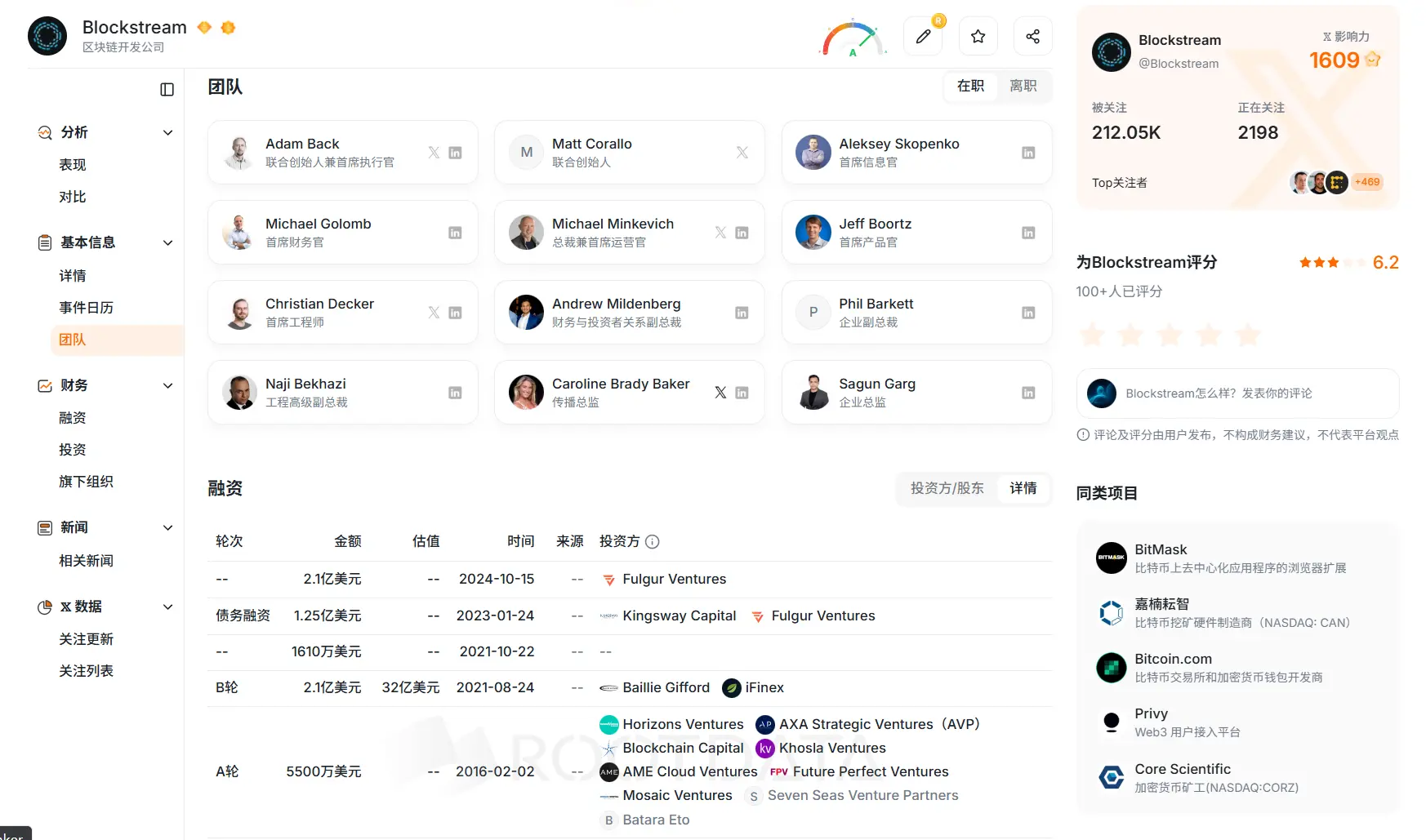
Image source:RootData


Chain of Allegations: Hash Rate, Revenue, and Disclosure Doubts

1. Doubts About Hash Rate and Payment Capacity

This is the most solid part of the financial logic in the allegations. NatInfoSec points out that to meet the obligations of the currently issued BMNs (Blockstream Mining Notes), Blockstream would need to operate over 20 EH/s of hash rate. If contract buffer clauses are included, the required hash rate could be as high as 35 to 45 EH/s. However, Blockstream's own dashboard shows its current actual hash rate is only 15 EH/s.

A mining facility of that scale should appear in public records such as ERCOT grid connection filings in Texas, power purchase agreements with Hydro-Québec, customs import data for ASIC equipment, hash rate attribution on mining pools, and coinbase signatures on-chain. NatInfoSec claims it could not find evidence matching the scale of Blockstream's notes in the aforementioned public channels.

In NatInfoSec's view, if mining output cannot cover payment obligations, it is necessary to question where the BTC ultimately received by investors comes from. The article specifically mentions the 'Substitute Performance BTC' mechanism in the BMN2 terms, stating that this clause allows Blockstream to fulfill its delivery obligations with BTC from any source during the 48-month contract period, without prior notice, without disclosing the source, and with no upper limit on quantity.

The article also claims that BMN1 once made up for payment shortfalls by purchasing BTC on the open market. This shifts the core question of BMNs from "is the mining revenue sufficient" to "is the source of payments verifiable."

2. High Returns and High-Risk Debt

The article mentions that Blockstream has issued related notes of different tiers through platforms like STOKR, with yields gradually increasing from about 9.775% to 18%, with the latest tier approaching 20%.However, some maturity arrangements are reportedly not direct principal repayments but are rolled over into new notes with higher yields. However, these claims still need further verification against the original issuance documents.

It is well known that Bitcoin mining is a highly cyclical industry, with real-time fluctuations in miner prices, network hash rate, difficulty adjustments, electricity prices, and BTC prices, making it difficult for mining companies to promise static fixed returns externally. Fixed annualized returns around 20%, in this industry context, require the issuer to provide a clear source explanation.

3. Chris Cook's Past Conviction and Disclosure Issues

The most impactful part of the allegations concerns the background of Christopher William Cook.

NatInfoSec states that Cook was once an important person in charge of Blockstream's mining business and currently serves as the CEO of Exacore. The article points out that Exacore is a related operating entity spun off from Blockstream's mining business. After reviewing U.S. federal court records, NatInfoSec claims to have found that Cook was sentenced in 2008 by the U.S. District Court for the Southern District of Florida to 41 months in federal prison for mail fraud (case number 06-80187) and ordered to pay approximately $1.85 million in restitution.

The core method of the case was commercial credit fraud: registering multiple shell companies, forging financial statements and bank information to defraud goods worth over $1.8 million from more than 30 retailers, then reselling them for cash.

The article notes that this conviction record does not appear in any BMN issuance documents. Furthermore, Blockstream's marketing materials on the STOKR platform allegedly claimed Cook "formerly worked at NASA," but his actual connection to NASA was reportedly only a student tour project he participated in at age 18.

Additionally, NatInfoSec further listed clues about Cook's recent purchases of mansions, airplanes, yachts, investments in Trump Media stock, and several supplier lawsuits, alleging funding flow and governance risks behind the BMNs.
4. BSTR/SPAC Controversy and Linkage

NatInfoSec also attempts to extend the BMN controversy to Bitcoin Standard Treasury Company (referred to as BSTR). The company, related to Adam Back, is reportedly preparing to go public via a SPAC merger. NatInfoSec questions why Cook's conviction record and the BMNs' massive potential liabilities do not appear in SEC registration filings and raises concerns about BSTR's governance structure, including Adam Back signing agreements representing both sides of the transaction and custodian Komainu having equity ties with Blockstream.

However, this is the part of the allegations most easily rebutted. The legal relationships, guarantee structures, and liability boundaries between BMNs, Blockstream, Exacore, and BSTR are currently not clear. If the related notes have no group guarantee and are not included in the BSTR listing entity, directly equating BMN risk with BSTR risk may involve excessive extrapolation.


BitMEX Cools the Waters, Community Demands Verifiability

On June 21, BitMEX Research published a commentary article addressing NatInfoSec's allegations point by point. BitMEX acknowledged that Cook's criminal past is likely true and that NatInfoSec probably identified the same person. Regarding the nearly 20% yield, BitMEX also expressed concern, stating it requires further explanation from the issuer.

However, for the other allegations, BitMEX considered the evidence insufficient or misleading. Regarding the non-disclosure of Cook's past in BSTR SEC filings, BitMEX's judgment was that Cook is not a director of BSTR, and the mining business is not expected to be included in the listing entity, so there is no mandatory disclosure obligation. Regarding whether BMN liabilities should be counted in BSTR, BitMEX believes there are no group guarantee clauses in the BMN documents, making them legally independent structures. Regarding the allegation of insufficient L-BTC collateral, BitMEX considered that the original article cited data from a code error on the liquid.network website, which has been fixed and now displays normally.

Furthermore, the debate continues at the community level. Former Blockstream CSO, now Jan3 CEO, Samson Mow, defended the BSTR narrative on X. He argued that the market should not focus only on short-term controversies but see that more Bitcoin treasury companies are about to enter the market. Mow stated that BSTR is about to enter the market with $1.5 billion in funds and will become an important competitor in the BTC asset accumulation race.

But critics quickly brought the question back to the BMNs themselves. Prominent Bitcoin commentator Matthew R. Kratter responded by directly questioning whether Adam Back's so-called "cloud mining Ponzi" allegations would affect BSTR's launch. He then further questioned which mining pool Blockstream actually uses, whether the public can verify pool shares accordingly, and demanded a response on whether Cook's background should have been disclosed in SEC filings.
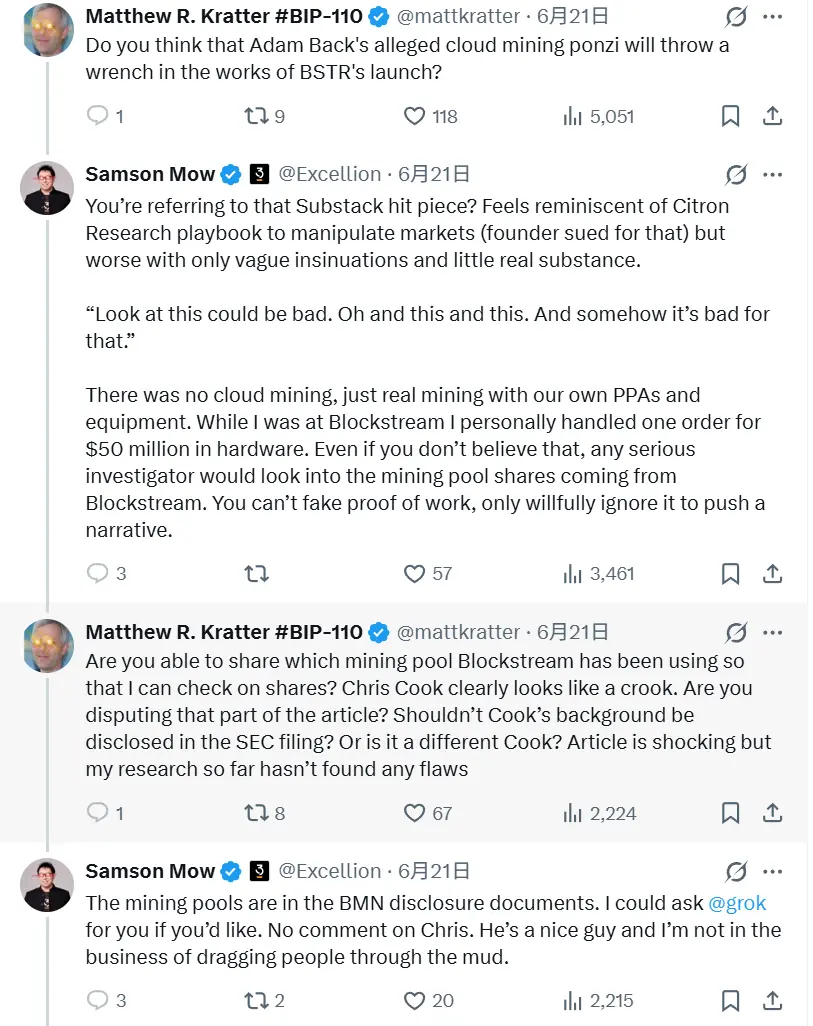
The debate escalated further around hash rate verifiability. Mow responded that the term "cloud mining" is not accurate; Blockstream is engaged in real mining using its own PPAs and equipment. He also mentioned that during his tenure at Blockstream, he personally handled a $50 million hardware order and stated that serious investigators should look at the mining pool shares from Blockstream, not ignore PoW evidence.

However, skeptics did not accept this explanation. Developer Chris Guida countered, asking where the public can openly verify hash rate from Blockstream. He argued that merely knowing which mining pools are mentioned in BMN documents does not prove that the valid shares in those pools actually come from Blockstream, unless Blockstream or the pools publicly label the source of that hash rate.

This debate compresses the core issue of BMNs to one point: Whether Blockstream is engaged in real mining is not the only problem; the real problem is whether investors and external observers can independently verify this hash rate, revenue, and source of payments.


BMNs Still Await Answers: Real Assets and Liability Boundaries

Despite the evident polarization of community views on this incident, it has not resolved the questions surrounding the BMNs themselves. Regarding this mining note product, the market still lacks several key pieces of information.

First, what exactly are the actual issuance scale, outstanding obligations, and liability boundaries of the BMNs? Authorized issuance scale, actual issuance scale, outstanding scale, maturity structure, and related guarantees are not the same thing. The market needs to know where the risk of this mining note actually resides and whether it could spill over to Blockstream or other related companies.

Second, does the mining facility's hash rate suffice to support payment expectations? If the publicly visible mining facility locations, power contracts, miner scale, pool revenue, and historical output do not match the issuance scale and payment arrangements, the natural question becomes whether the revenue truly comes from mining or from other funding sources.

Third, where exactly does the nearly 20% fixed return come from? High returns themselves do not equal fraud, but in a highly cyclical industry, they necessitate higher transparency.

Fourth, are the BTC or L-BTC payments to investors verifiable? If BMN payments involve L-BTC on the Liquid network, then on-chain transparency, peg-out risks, and proof-of-reserves will all become real concerns for investors.

Fifth, what are Cook's actual authority and beneficial relationship within the BMNs and Exacore? If he holds a core position in fund usage, mining assets, or note design, the importance of disclosure increases.

These questions currently do not directly prove fraudulent activity by Blockstream. Objectively speaking, as a mining note product for investors, its premium and relatively high yield carry relatively obvious risks. This means BMNs still have considerable room for further explanation regarding their actual scale, fund usage, source of returns, and governance disclosure.

As of publication, Blockstream has not yet issued a systematic official response to the related controversies.


 

Crypto di tendenza

Domande pertinenti

QWhat are the main accusations against Blockstream's Blockstream Mining Note (BMN) program?

AThe main accusations center on the program's potential inability to meet its payment obligations. It is alleged that the required mining hashrate to cover BMN obligations is between 20-45 EH/s, while Blockstream's public dashboard only shows around 15 EH/s. Furthermore, it is claimed that public data cannot verify the existence of corresponding mining infrastructure (electricity contracts, ASIC imports, pool contributions). The high promised fixed yields (up to ~20%) are also flagged as suspicious for a cyclical industry. A key personnel risk is highlighted, as Christopher Cook, a former lead for Blockstream's mining operations, is reported to have a federal conviction for mail fraud, a fact allegedly not disclosed in offering documents.

QHow did BitMEX Research evaluate the accusations made by NatInfoSec?

ABitMEX Research confirmed that Christopher Cook's criminal record was likely true and expressed concern over the ~20% yield. However, they found other accusations lacking evidence or potentially misleading. They stated that Cook's record was not required to be disclosed in BSTR's SEC filings as he was not a director, and that BMN liabilities are legally separate from BSTR with no group guarantee. They also attributed claims about insufficient L-BTC collateral to a temporary bug on the liquid.network website which has since been fixed. Overall, BitMEX Research provided a more tempered view, separating the risks of BMN from the unrelated BSTR SPAC.

QWhat is the core issue raised about the verifiability of Blockstream's mining operations?

AThe core issue is that investors and external observers cannot independently verify if the bitcoin used for BMN payouts genuinely comes from Blockstream's own mining activities. While Blockstream claims to conduct real mining with its own hardware and power agreements, critics argue there is no public way to link specific mining pool shares or block rewards definitively to Blockstream's operations. The contract clause allowing Blockstream to use BTC from any source (Substitute Performance BTC) further complicates verification. The debate centers on the lack of transparent, auditable proof linking promised yields to actual mining output.

QWhat is the connection, if any, between the BMN controversy and the Bitcoin Standard Treasury Company (BSTR) SPAC?

AThe connection is primarily through Adam Back, who is a key figure in both Blockstream and BSTR. Critics have raised concerns that the potential liabilities and reputational risks from the BMN program could spill over and affect the BSTR SPAC. However, according to legal analyses like the one from BitMEX Research, there is no direct financial link: BMN obligations reportedly have no group guarantee from Blockstream, and the mining operations are not expected to be part of the BSTR上市 entity. Therefore, while the controversy creates negative associations, the direct legal and financial risk transfer to BSTR is considered limited.

QWhat key questions about BMN remain unanswered according to the article?

AThe article identifies several key unanswered questions: 1) The exact scale, outstanding obligations, and legal boundaries of BMN liabilities. 2) Whether the actual mining hashrate and infrastructure can support the promised payouts. 3) The source of the high, fixed yields in a volatile industry. 4) The verifiability of the BTC or L-BTC used for investor payouts, including reserve proof for L-BTC. 5) The precise role, authority, and beneficial relationships of Christopher Cook within the BMN program and Exacore. The article concludes that these questions create significant uncertainty and require further clarification from Blockstream.

Letture associate

The Full Story of How Crypto Unicorn Blockstream Is Mired in Serious Fraud Allegations

This article details serious allegations of fraud against Bitcoin infrastructure company Blockstream, founded by Bitcoin pioneer Adam Back. In June 2024, investigative account NatInfoSec published a report accusing Blockstream's mining note (BMN) program of potentially operating a multi-billion dollar scheme with Ponzi-like characteristics. The core allegations focus on Blockstream Mining Notes (BMNs), which offer investors fixed annual yields up to approximately 20% from Bitcoin mining. NatInfoSec's investigation raises several key issues: 1. **Suspicious Hashrate & Payout Capacity**: The analysis suggests Blockstream would need 20-45 EH/s of mining power to cover its BMN obligations, but its public dashboard shows only around 15 EH/s. Furthermore, no verifiable public evidence (e.g., grid connection records, import data) was found to support the massive mining operation required. 2. **Questionable Payout Source**: The BMN contract allows Blockstream to use Bitcoin from *any source* (Substitute Performance BTC) to fulfill investor payouts, raising concerns that payouts may not come from actual mining revenue. 3. **High-Risk, Fixed Returns**: Offering ~20% fixed yields in the volatile, cyclical Bitcoin mining industry is viewed as highly unusual and requires clear explanation. 4. **Undisclosed Criminal Record of Key Figure**: Christopher William Cook, a key figure in Blockstream's mining operations and CEO of spin-off Exacore, was found to have a federal felony conviction for mail fraud in 2008, a fact not disclosed in BMN offering documents. His background was also allegedly embellished. 5. **Potential Contagion to BSTR SPAC**: Questions were raised about whether these liabilities and Cook's record should have been disclosed in the SEC filings for Bitcoin Standard Treasury Company (BSTR), a separate Adam Back-associated firm planning a SPAC merger. The crypto community is divided. BitMEX Research validated Cook's criminal record and expressed concern over the high yields but found other evidence lacking or misleading, noting the legal separation between BMN, Blockstream, and BSTR. Blockstream defenders, like Samson Mow, argue the mining is real. Critics, however, emphasize the lack of independent, verifiable proof of the mining operation's scale and the true source of investor payouts. The article concludes that BMN remains shrouded in key unanswered questions regarding its actual size, the verifiability of its underlying mining assets and payouts, the source of its high yields, and the full role and disclosure concerning Chris Cook. Blockstream had not issued a comprehensive response at the time of writing.

marsbit2 h fa

The Full Story of How Crypto Unicorn Blockstream Is Mired in Serious Fraud Allegations

marsbit2 h fa

Trading

Spot
Futures

Articoli Popolari

Cosa è $S$

Comprendere SPERO: Una Panoramica Completa Introduzione a SPERO Mentre il panorama dell'innovazione continua a evolversi, l'emergere delle tecnologie web3 e dei progetti di criptovaluta gioca un ruolo fondamentale nel plasmare il futuro digitale. Un progetto che ha attirato l'attenzione in questo campo dinamico è SPERO, denotato come SPERO,$$s$. Questo articolo mira a raccogliere e presentare informazioni dettagliate su SPERO, per aiutare gli appassionati e gli investitori a comprendere le sue basi, obiettivi e innovazioni nei domini web3 e crypto. Che cos'è SPERO,$$s$? SPERO,$$s$ è un progetto unico all'interno dello spazio crypto che cerca di sfruttare i principi della decentralizzazione e della tecnologia blockchain per creare un ecosistema che promuove l'impegno, l'utilità e l'inclusione finanziaria. Il progetto è progettato per facilitare interazioni peer-to-peer in modi nuovi, fornendo agli utenti soluzioni e servizi finanziari innovativi. Al suo interno, SPERO,$$s$ mira a responsabilizzare gli individui fornendo strumenti e piattaforme che migliorano l'esperienza dell'utente nello spazio delle criptovalute. Questo include la possibilità di metodi di transazione più flessibili, la promozione di iniziative guidate dalla comunità e la creazione di percorsi per opportunità finanziarie attraverso applicazioni decentralizzate (dApps). La visione sottostante di SPERO,$$s$ ruota attorno all'inclusività, cercando di colmare le lacune all'interno della finanza tradizionale mentre sfrutta i vantaggi della tecnologia blockchain. Chi è il Creatore di SPERO,$$s$? L'identità del creatore di SPERO,$$s$ rimane piuttosto oscura, poiché ci sono risorse pubblicamente disponibili limitate che forniscono informazioni dettagliate sul suo fondatore o fondatori. Questa mancanza di trasparenza può derivare dall'impegno del progetto per la decentralizzazione—un ethos che molti progetti web3 condividono, dando priorità ai contributi collettivi rispetto al riconoscimento individuale. Centrando le discussioni attorno alla comunità e ai suoi obiettivi collettivi, SPERO,$$s$ incarna l'essenza dell'empowerment senza mettere in evidenza individui specifici. Pertanto, comprendere l'etica e la missione di SPERO rimane più importante che identificare un creatore singolo. Chi sono gli Investitori di SPERO,$$s$? SPERO,$$s$ è supportato da una varietà di investitori che vanno dai capitalisti di rischio agli investitori angelici dedicati a promuovere l'innovazione nel settore crypto. Il focus di questi investitori generalmente si allinea con la missione di SPERO—dando priorità a progetti che promettono avanzamenti tecnologici sociali, inclusività finanziaria e governance decentralizzata. Queste fondazioni di investitori sono tipicamente interessate a progetti che non solo offrono prodotti innovativi, ma contribuiscono anche positivamente alla comunità blockchain e ai suoi ecosistemi. Il supporto di questi investitori rafforza SPERO,$$s$ come un concorrente degno di nota nel dominio in rapida evoluzione dei progetti crypto. Come Funziona SPERO,$$s$? SPERO,$$s$ impiega un framework multifunzionale che lo distingue dai progetti di criptovaluta convenzionali. Ecco alcune delle caratteristiche chiave che sottolineano la sua unicità e innovazione: Governance Decentralizzata: SPERO,$$s$ integra modelli di governance decentralizzati, responsabilizzando gli utenti a partecipare attivamente ai processi decisionali riguardanti il futuro del progetto. Questo approccio favorisce un senso di proprietà e responsabilità tra i membri della comunità. Utilità del Token: SPERO,$$s$ utilizza il proprio token di criptovaluta, progettato per servire varie funzioni all'interno dell'ecosistema. Questi token abilitano transazioni, premi e la facilitazione dei servizi offerti sulla piattaforma, migliorando l'impegno e l'utilità complessivi. Architettura Stratificata: L'architettura tecnica di SPERO,$$s$ supporta la modularità e la scalabilità, consentendo un'integrazione fluida di funzionalità e applicazioni aggiuntive man mano che il progetto evolve. Questa adattabilità è fondamentale per mantenere la rilevanza nel panorama crypto in continua evoluzione. Coinvolgimento della Comunità: Il progetto enfatizza iniziative guidate dalla comunità, impiegando meccanismi che incentivano la collaborazione e il feedback. Nutrendo una comunità forte, SPERO,$$s$ può affrontare meglio le esigenze degli utenti e adattarsi alle tendenze di mercato. Focus sull'Inclusione: Offrendo basse commissioni di transazione e interfacce user-friendly, SPERO,$$s$ mira ad attrarre una base utenti diversificata, inclusi individui che potrebbero non aver precedentemente interagito nello spazio crypto. Questo impegno per l'inclusione si allinea con la sua missione generale di empowerment attraverso l'accessibilità. Cronologia di SPERO,$$s$ Comprendere la storia di un progetto fornisce preziose intuizioni sulla sua traiettoria di sviluppo e sui traguardi. Di seguito è riportata una cronologia suggerita che mappa eventi significativi nell'evoluzione di SPERO,$$s$: Fase di Concettualizzazione e Ideazione: Le idee iniziali che formano la base di SPERO,$$s$ sono state concepite, allineandosi strettamente con i principi di decentralizzazione e focus sulla comunità all'interno dell'industria blockchain. Lancio del Whitepaper del Progetto: Dopo la fase concettuale, è stato rilasciato un whitepaper completo che dettaglia la visione, gli obiettivi e l'infrastruttura tecnologica di SPERO,$$s$ per suscitare interesse e feedback dalla comunità. Costruzione della Comunità e Prime Interazioni: Sono stati effettuati sforzi attivi di outreach per costruire una comunità di early adopters e potenziali investitori, facilitando discussioni attorno agli obiettivi del progetto e ottenendo supporto. Evento di Generazione del Token: SPERO,$$s$ ha condotto un evento di generazione del token (TGE) per distribuire i propri token nativi ai primi sostenitori e stabilire una liquidità iniziale all'interno dell'ecosistema. Lancio della Prima dApp: La prima applicazione decentralizzata (dApp) associata a SPERO,$$s$ è stata attivata, consentendo agli utenti di interagire con le funzionalità principali della piattaforma. Sviluppo Continuo e Partnership: Aggiornamenti e miglioramenti continui alle offerte del progetto, inclusi partnership strategiche con altri attori nello spazio blockchain, hanno plasmato SPERO,$$s$ in un concorrente competitivo e in evoluzione nel mercato crypto. Conclusione SPERO,$$s$ rappresenta una testimonianza del potenziale del web3 e delle criptovalute di rivoluzionare i sistemi finanziari e responsabilizzare gli individui. Con un impegno per la governance decentralizzata, il coinvolgimento della comunità e funzionalità progettate in modo innovativo, apre la strada verso un panorama finanziario più inclusivo. Come per qualsiasi investimento nello spazio crypto in rapida evoluzione, si incoraggiano potenziali investitori e utenti a ricercare approfonditamente e a impegnarsi in modo riflessivo con gli sviluppi in corso all'interno di SPERO,$$s$. Il progetto mostra lo spirito innovativo dell'industria crypto, invitando a ulteriori esplorazioni delle sue innumerevoli possibilità. Mentre il percorso di SPERO,$$s$ è ancora in fase di sviluppo, i suoi principi fondamentali potrebbero effettivamente influenzare il futuro di come interagiamo con la tecnologia, la finanza e tra di noi in ecosistemi digitali interconnessi.

87 Totale visualizzazioniPubblicato il 2024.12.17Aggiornato il 2024.12.17

Cosa è $S$

Cosa è AGENT S

Agent S: Il Futuro dell'Interazione Autonoma in Web3 Introduzione Nel panorama in continua evoluzione di Web3 e criptovalute, le innovazioni stanno costantemente ridefinendo il modo in cui gli individui interagiscono con le piattaforme digitali. Uno di questi progetti pionieristici, Agent S, promette di rivoluzionare l'interazione uomo-computer attraverso il suo framework agentico aperto. Aprendo la strada a interazioni autonome, Agent S mira a semplificare compiti complessi, offrendo applicazioni trasformative nell'intelligenza artificiale (AI). Questa esplorazione dettagliata approfondirà le complessità del progetto, le sue caratteristiche uniche e le implicazioni per il dominio delle criptovalute. Cos'è Agent S? Agent S si presenta come un innovativo framework agentico aperto, progettato specificamente per affrontare tre sfide fondamentali nell'automazione dei compiti informatici: Acquisizione di Conoscenze Specifiche del Dominio: Il framework apprende in modo intelligente da varie fonti di conoscenza esterne ed esperienze interne. Questo approccio duale gli consente di costruire un ricco repository di conoscenze specifiche del dominio, migliorando le sue prestazioni nell'esecuzione dei compiti. Pianificazione su Lungo Orizzonte di Compiti: Agent S impiega una pianificazione gerarchica potenziata dall'esperienza, un approccio strategico che facilita la suddivisione e l'esecuzione efficiente di compiti complessi. Questa caratteristica migliora significativamente la sua capacità di gestire più sottocompiti in modo efficiente ed efficace. Gestione di Interfacce Dinamiche e Non Uniformi: Il progetto introduce l'Interfaccia Agente-Computer (ACI), una soluzione innovativa che migliora l'interazione tra agenti e utenti. Utilizzando Modelli Linguistici Multimodali di Grandi Dimensioni (MLLM), Agent S può navigare e manipolare senza sforzo diverse interfacce grafiche utente. Attraverso queste caratteristiche pionieristiche, Agent S fornisce un framework robusto che affronta le complessità coinvolte nell'automazione dell'interazione umana con le macchine, preparando il terreno per innumerevoli applicazioni nell'AI e oltre. Chi è il Creatore di Agent S? Sebbene il concetto di Agent S sia fondamentalmente innovativo, informazioni specifiche sul suo creatore rimangono elusive. Il creatore è attualmente sconosciuto, il che evidenzia sia la fase embrionale del progetto sia la scelta strategica di mantenere i membri fondatori sotto anonimato. Indipendentemente dall'anonimato, l'attenzione rimane sulle capacità e sul potenziale del framework. Chi sono gli Investitori di Agent S? Poiché Agent S è relativamente nuovo nell'ecosistema crittografico, informazioni dettagliate riguardanti i suoi investitori e sostenitori finanziari non sono documentate esplicitamente. La mancanza di approfondimenti pubblicamente disponibili sulle fondazioni di investimento o sulle organizzazioni che supportano il progetto solleva interrogativi sulla sua struttura di finanziamento e sulla roadmap di sviluppo. Comprendere il supporto è cruciale per valutare la sostenibilità del progetto e il suo potenziale impatto sul mercato. Come Funziona Agent S? Al centro di Agent S si trova una tecnologia all'avanguardia che gli consente di funzionare efficacemente in contesti diversi. Il suo modello operativo è costruito attorno a diverse caratteristiche chiave: Interazione Uomo-Computer Simile a Quella Umana: Il framework offre una pianificazione AI avanzata, cercando di rendere le interazioni con i computer più intuitive. Mimando il comportamento umano nell'esecuzione dei compiti, promette di elevare le esperienze degli utenti. Memoria Narrativa: Utilizzata per sfruttare esperienze di alto livello, Agent S utilizza la memoria narrativa per tenere traccia delle storie dei compiti, migliorando così i suoi processi decisionali. Memoria Episodica: Questa caratteristica fornisce agli utenti una guida passo-passo, consentendo al framework di offrire supporto contestuale mentre i compiti si sviluppano. Supporto per OpenACI: Con la capacità di funzionare localmente, Agent S consente agli utenti di mantenere il controllo sulle proprie interazioni e flussi di lavoro, allineandosi con l'etica decentralizzata di Web3. Facile Integrazione con API Esterne: La sua versatilità e compatibilità con varie piattaforme AI garantiscono che Agent S possa adattarsi senza problemi agli ecosistemi tecnologici esistenti, rendendolo una scelta attraente per sviluppatori e organizzazioni. Queste funzionalità contribuiscono collettivamente alla posizione unica di Agent S all'interno dello spazio crittografico, poiché automatizza compiti complessi e multi-fase con un intervento umano minimo. Man mano che il progetto evolve, le sue potenziali applicazioni in Web3 potrebbero ridefinire il modo in cui si svolgono le interazioni digitali. Cronologia di Agent S Lo sviluppo e le tappe di Agent S possono essere riassunti in una cronologia che evidenzia i suoi eventi significativi: 27 Settembre 2024: Il concetto di Agent S è stato lanciato in un documento di ricerca completo intitolato “Un Framework Agentico Aperto che Usa i Computer Come un Umano”, mostrando le basi per il progetto. 10 Ottobre 2024: Il documento di ricerca è stato reso pubblicamente disponibile su arXiv, offrendo un'esplorazione approfondita del framework e della sua valutazione delle prestazioni basata sul benchmark OSWorld. 12 Ottobre 2024: È stata rilasciata una presentazione video, fornendo un'idea visiva delle capacità e delle caratteristiche di Agent S, coinvolgendo ulteriormente potenziali utenti e investitori. Questi indicatori nella cronologia non solo illustrano i progressi di Agent S, ma indicano anche il suo impegno per la trasparenza e il coinvolgimento della comunità. Punti Chiave su Agent S Man mano che il framework Agent S continua a evolversi, diversi attributi chiave si distinguono, sottolineando la sua natura innovativa e il potenziale: Framework Innovativo: Progettato per fornire un uso intuitivo dei computer simile all'interazione umana, Agent S porta un approccio nuovo all'automazione dei compiti. Interazione Autonoma: La capacità di interagire autonomamente con i computer attraverso GUI segna un passo avanti verso soluzioni informatiche più intelligenti ed efficienti. Automazione di Compiti Complessi: Con la sua metodologia robusta, può automatizzare compiti complessi e multi-fase, rendendo i processi più veloci e meno soggetti a errori. Miglioramento Continuo: I meccanismi di apprendimento consentono ad Agent S di migliorare dalle esperienze passate, migliorando continuamente le sue prestazioni e la sua efficacia. Versatilità: La sua adattabilità attraverso diversi ambienti operativi come OSWorld e WindowsAgentArena garantisce che possa servire un'ampia gamma di applicazioni. Man mano che Agent S si posiziona nel panorama di Web3 e delle criptovalute, il suo potenziale per migliorare le capacità di interazione e automatizzare i processi segna un significativo avanzamento nelle tecnologie AI. Attraverso il suo framework innovativo, Agent S esemplifica il futuro delle interazioni digitali, promettendo un'esperienza più fluida ed efficiente per gli utenti in vari settori. Conclusione Agent S rappresenta un audace passo avanti nell'unione tra AI e Web3, con la capacità di ridefinire il modo in cui interagiamo con la tecnologia. Sebbene sia ancora nelle sue fasi iniziali, le possibilità per la sua applicazione sono vaste e coinvolgenti. Attraverso il suo framework completo che affronta sfide critiche, Agent S mira a portare le interazioni autonome al centro dell'esperienza digitale. Man mano che ci addentriamo nei regni delle criptovalute e della decentralizzazione, progetti come Agent S giocheranno senza dubbio un ruolo cruciale nel plasmare il futuro della tecnologia e della collaborazione uomo-computer.

554 Totale visualizzazioniPubblicato il 2025.01.14Aggiornato il 2025.01.14

Cosa è AGENT S

Come comprare S

Benvenuto in HTX.com! Abbiamo reso l'acquisto di Sonic (S) semplice e conveniente. Segui la nostra guida passo passo per intraprendere il tuo viaggio nel mondo delle criptovalute.Step 1: Crea il tuo Account HTXUsa la tua email o numero di telefono per registrarti il tuo account gratuito su HTX. Vivi un'esperienza facile e sblocca tutte le funzionalità,Crea il mio accountStep 2: Vai in Acquista crypto e seleziona il tuo metodo di pagamentoCarta di credito/debito: utilizza la tua Visa o Mastercard per acquistare immediatamente SonicS.Bilancio: Usa i fondi dal bilancio del tuo account HTX per fare trading senza problemi.Terze parti: abbiamo aggiunto metodi di pagamento molto utilizzati come Google Pay e Apple Pay per maggiore comodità.P2P: Fai trading direttamente con altri utenti HTX.Over-the-Counter (OTC): Offriamo servizi su misura e tassi di cambio competitivi per i trader.Step 3: Conserva Sonic (S)Dopo aver acquistato Sonic (S), conserva nel tuo account HTX. In alternativa, puoi inviare tramite trasferimento blockchain o scambiare per altre criptovalute.Step 4: Scambia Sonic (S)Scambia facilmente Sonic (S) nel mercato spot di HTX. Accedi al tuo account, seleziona la tua coppia di trading, esegui le tue operazioni e monitora in tempo reale. Offriamo un'esperienza user-friendly sia per chi ha appena iniziato che per i trader più esperti.

1.1k Totale visualizzazioniPubblicato il 2025.01.15Aggiornato il 2026.06.02

Come comprare S

Discussioni

Benvenuto nella Community HTX. Qui puoi rimanere informato sugli ultimi sviluppi della piattaforma e accedere ad approfondimenti esperti sul mercato. Le opinioni degli utenti sul prezzo di S S sono presentate come di seguito.

活动图片