Ethereum 2026: Decoding EF's Latest Protocol Roadmap, Officially Entering the Era of 'Engineering Upgrades'?

marsbitPubblicato 2026-02-26Pubblicato ultima volta 2026-02-26

Introduzione

Ethereum Foundation's 2026 protocol roadmap signals a major shift toward predictable, engineering-driven upgrades, moving from fragmented EIP-focused updates to a structured tri-annual hard fork schedule. Following successful dual upgrades (Pectra and Fusaka) in 2025, the 2026 plan—centered on Glamsterdam and Hegotá—prioritizes three core pillars: Scale, Improve UX, and Harden the L1. Scale focuses on parallel execution via Block-level Access Lists and ePBS integration to boost throughput, with gas limits potentially doubling. Improve UX aims to eliminate cross-chain fragmentation through intent-based architectures (Open Intents Framework) and native account abstraction, streamlining user interactions. Harden the L1 strengthens security with anti-censorship measures like FOCIL and quantum-resistant cryptography research. This structured, collaborative approach marks Ethereum’s transition from a research-oriented project to a mature, institutional-grade platform, emphasizing security and usability while targeting global adoption as a foundational financial layer.

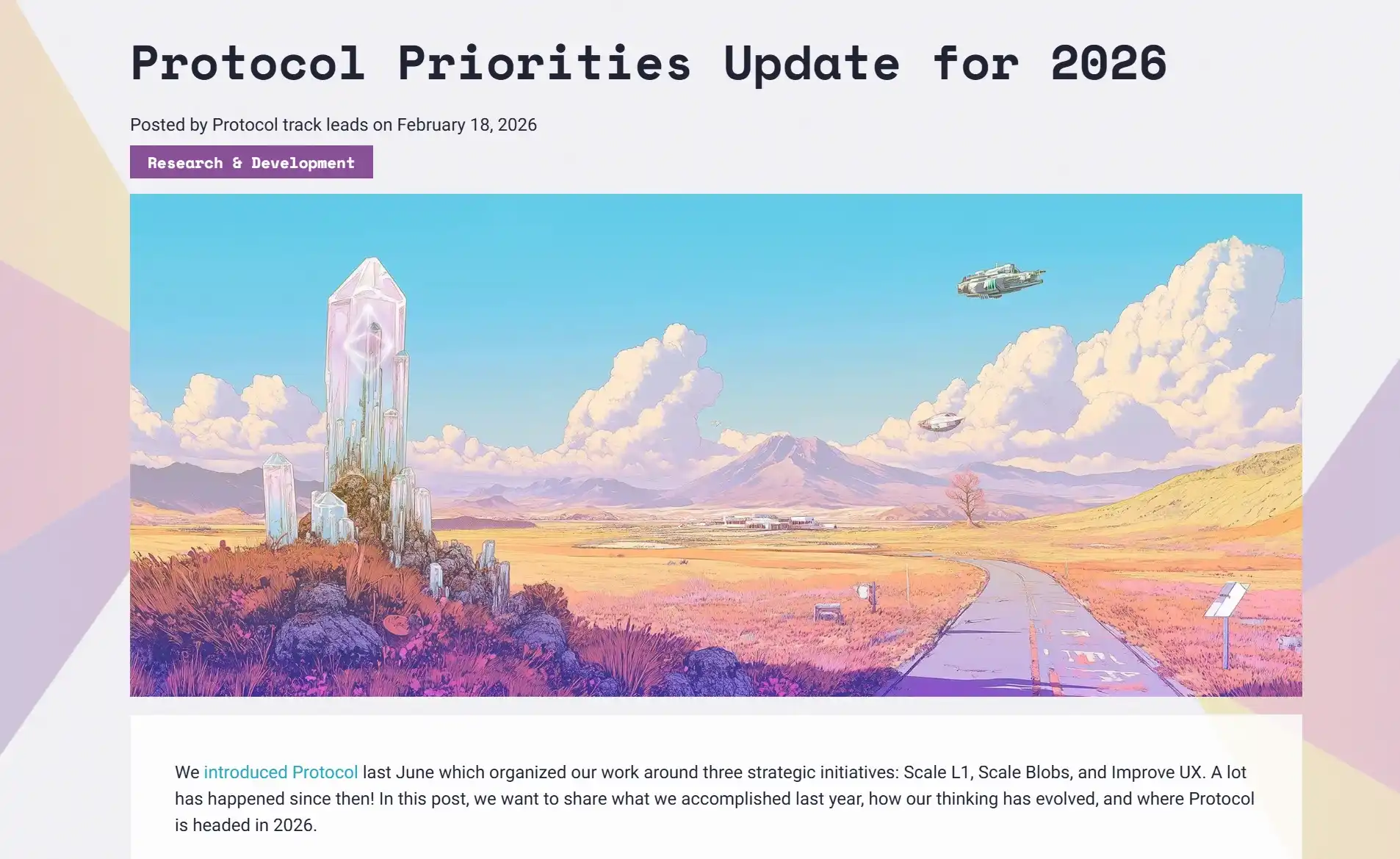
On February 18, the Ethereum Foundation (EF) released the "Protocol Priorities Update for 2026." Compared to the previous fragmented updates centered around EIPs, this roadmap more closely resembles a strategic schedule, clarifying the upgrade cadence, priority allocation, and the three main themes that the protocol layer will revolve around in the coming year: Scale, Improve UX, and Harden the L1.

Behind this, from the successful delivery of two hard forks (Pectra/Fusaka) in 2025 to the advanced planning of the dual mainlines for 2026, Glamsterdam and Hegotá, we are also witnessing a deeper shift in Ethereum development towards "predictable engineering delivery." And this might be the most important protocol layer signal in recent years.
I. Ethereum of 2025: Turmoil and Institutionalization in Parallel

If you have been following Ethereum consistently, you would know that 2025 was a year of intertwined contradictions for this protocol. While the ETH price might have hovered at low levels, the protocol layer underwent unprecedented intensive changes.

Especially in early 2025, Ethereum went through a rather awkward period. The EF was once at the center of a public opinion storm—community criticism surged, with some even calling for the introduction of a so-called "wartime CEO" to drive change. Eventually, a series of internal struggles became public, forcing the highest-level power restructuring since the EF's founding:

  • In February, Executive Director Aya Miyaguchi was promoted to President, and Vitalik Buterin promised to restructure the leadership;
  • Subsequently, Hsiao-Wei Wang and Tomasz K. Stańczak were appointed as Co-Executive Directors;
  • Furthermore, the new marketing agency Etherealize, led by former researcher Danny Ryan, was established;
  • Simultaneously, the EF further restructured its board of directors, clarifying its cypherpunk value orientation;
  • By mid-year, the Foundation also restructured its R&D department, integrating teams and making personnel adjustments to ensure a focus on core protocol priorities;

As it turned out, this combination of measures significantly hardened Ethereum's execution capability. Particularly, just 7 months after the Pectra upgrade in May, the Fusaka upgrade at the end of the year was successfully deployed, proving that the EF, despite undergoing major leadership changes, still has the ability to drive significant updates. This also marks Ethereum's official entry into an accelerated development rhythm of "two hard forks per year."

After all, since the network transitioned to PoS via The Merge in September 2022, the Ethereum network has basically aimed for only one major upgrade per year, such as the Shapella upgrade in April 2023 and the Dencun upgrade in March 2024: the former opened staking withdrawals, completing a key part of the PoS transition; the latter launched EIP-4844, formally opening the Blob data channel, which significantly reduced L2 costs.

In contrast, 2025 saw the completion of two important hard fork upgrades, Pectra and Fusaka. More crucially, 2025 saw the first systematic planning of named upgrades for the next two years, namely Glamsterdam and Hegotá.

Although not formally stipulated, interestingly, at the end of last year, The Block cited sources from Consensys stating that since The Merge, Ethereum researchers had aimed for one major upgrade per year, but they were now planning to "accelerate the pace of hard fork releases to once every six months," and explicitly stated that Fusaka initiated Ethereum's twice-yearly upgrade cycle.
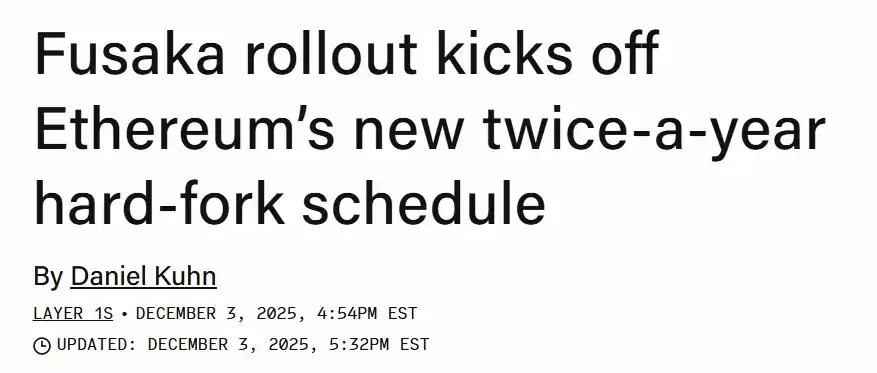
It can be said that this "institutional" change regarding the upgrade cadence is quite milestone. The reason is simple: the previous release rhythm depended more on R&D readiness. For developers and infrastructure providers, the expected window was not stable, and as those familiar know, delays were not uncommon.

This also means that the successful delivery of two major upgrades in 2025 validated the feasibility of "upgrades every six months." The first systematic planning of two named upgrades (Glamsterdam and Hegotá) for 2026, with three development tracks arranging priorities around these two nodes, is a further step towards institutionalized implementation.

Theoretically, it's somewhat similar to the release rhythm of Apple or Android systems, aiming to reduce uncertainty for developers and is expected to bring three positive impacts: Enhanced predictability for L2s, for example, Rollups can plan parameter adjustments and protocol adaptations in advance; Clear adaptation windows for wallets and infrastructure, allowing product teams to plan compatibility and feature releases according to the rhythm; Stable risk assessment periods for institutions, as upgrades are no longer sudden events but an engineering norm.

This structured rhythm is essentially a manifestation of engineering management and also highlights, from the side, Ethereum's transition from scientific exploration to engineering delivery.

II. The "Three Legs" of 2026 Protocol Development

Looking closely at the 2026 protocol priority update plan, one will also find that the EF no longer simply lists scattered EIPs, but has reorganized protocol development into three strategic directions: Scale, Improve UX, and Harden the L1.

First is Scale, which merges the previous "Scale L1" and "Scale blobs," as the EF realized that scaling the L1 execution layer and widening the data availability layer are two sides of the same coin.

Therefore, in the upcoming Glamsterdam upgrade in the first half of the year, the most eye-catching technology is "Block-level Access Lists," aimed at fundamentally changing Ethereum's current transaction execution model—it can be understood as changing from a sequentially processed "single lane" to a parallel processed "multi-lane":

Block producers will pre-calculate and mark which transactions can run simultaneously without conflict, and clients can accordingly distribute transactions to multiple CPU cores for parallel processing, greatly improving efficiency; Meanwhile, ePBS (enshrined proposer-builder separation) will also be included in the upgrade. It embeds the MEV-Boost process, which currently relies on external relays, into the protocol itself, not only reducing centralization risks but also reserving a more ample time window for validators to verify ZK proofs.

Alongside these underlying optimizations, the race for the Gas limit will intensify in 2026. The EF has clearly stated the goal is to "move towards 100 million and above." More radical predictions suggest that after ePBS, the Gas limit could potentially double to 200 million or even higher. For L2s, the increase in blob count is equally crucial, with the number of data blobs per block expected to increase to 72 or more, supporting L2 networks processing hundreds of thousands of transactions per second.

Second is Improve UX, aimed at eliminating cross-chain barriers and popularizing cross-chain interoperability and native account abstraction. As mentioned earlier, the EF believes the core to solving L2 fragmentation is making Ethereum "feel like one chain again." This vision relies on the maturation of the intent architecture.

For example, the Open Intents Framework, launched by the EF jointly with several teams, is becoming a universal standard. It allows users to simply declare the "desired outcome" when transferring assets between L2s, while the complex path calculation is completed by a solver network behind the scenes (Extended reading: When "Intents" Become the Standard: How OIF Ends Cross-Chain Fragmentation and Returns Web3 to User Intuition?); Going further, the Ethereum Interoperability Layer (EIL) attempts to build a trustless transport layer, aiming to give cross-L2 transactions an experience indistinguishable from single-chain transactions (Extended reading: Ethereum Interop Roadmap: How to Unlock the 'Last Mile' of Mass Adoption).

At the wallet level, native account abstraction will still be a key focus this year. Following the first step with EIP-7702 in the 2025 Pectra upgrade, the EF plans to promote proposals like EIP-7701 or EIP-8141 in 2026, with the ultimate goal of making every wallet on Ethereum a smart contract wallet by default, completely abolishing complex EOA wallets and additional Gas payment intermediaries.

Furthermore, the implementation of L1 fast confirmation rules will drastically reduce confirmation times from the current 13-19 minutes to 15-30 seconds. This will directly benefit all cross-chain applications relying on L1 finality, which is significant for cross-chain bridges, stablecoin settlements, and RWA asset trading.

Finally, Harden the L1, aiming at a trillion-dollar security defense line. This is also thanks to the fact that as the value locked in the Ethereum ecosystem continues to grow, the security resilience of the L1 layer has been elevated to a strategic height.

Regarding anti-censorship, FOCIL (Fork Choice Inclusion List, EIP-7805) is becoming a core solution. It grants multiple validators the power to强制要求 specific transactions be included in a block. Even if a block producer attempts censorship, as long as part of the network is honest, the user's transaction will eventually be included on-chain.

Facing the long-term threat of quantum computing, the EF formed a new Post-Quantum (PQ) research team at the beginning of the year. The work in 2026 will focus on researching quantum-resistant signature algorithms and beginning to consider how to seamlessly migrate them to the Ethereum mainnet, ensuring the security of future tens of billions of dollars in assets is not threatened by quantum algorithm cracking.

III. A More "Collaborative" Ethereum is Here

Overall, if one word were to summarize Ethereum in 2026, it might be "collaboration."

Upgrades no longer revolve around a single explosive innovation but around the collaborative advancement of three main lines: Scale handles throughput and cost; Improve UX handles usability and adoption; Harden the L1 handles security and neutrality. These three together determine whether Ethereum can support the on-chain economy of the next decade.

At the same time, more noteworthy than the technical roadmap is the strategic shift reflected behind this "three-track" structure.

As mentioned above, when the Fusaka upgrade was successfully completed at the end of 2025 and the rhythm of two hard forks per year was established, Ethereum actually completed a "institutionalized" leap in its development model. The priority update released at the beginning of 2026 further extends this institutionalization to the planning level of technical directions—in the past, Ethereum upgrades often revolved around a certain "star proposal" (like EIP-1559, The Merge, EIP-4844). Now, upgrades are no longer defined by a single proposal but by the collaborative advancement of three tracks.

From a more macro perspective, 2026 is also a crucial year for the重构 (reconstruction/reframing) of Ethereum's "value narrative." In the past few years, the market's pricing of Ethereum revolved more around "fee growth brought by L2 scaling." As the mainnet performance improves and the positioning of L2s shifts from "shards" to a "trust spectrum," Ethereum's core value is being re-anchored to the irreplaceable position of "the world's most secure settlement layer."

What does this mean? Simply put, Ethereum is transitioning from a platform relying on "transaction fee revenue" to an asset anchor relying on a "security premium." The profound impact of this转变 (transition/change) may gradually manifest in the coming years—when stablecoin issuers, RWA tokenization institutions, and sovereign wealth funds choose a settlement layer, they are not choosing the cheapest network, but the most secure one.

Ethereum is tangibly evolving from a "technology testing ground" to an "engineering delivery platform." The institutionalization of Ethereum protocol governance may truly mature in 2026.

And we might be at a奇妙 (wonderful/peculiar) node: the underlying technology is becoming increasingly complex (like parallel execution, PQ algorithms), but the user experience is becoming simpler. The maturation of account abstraction and intent frameworks is pushing Ethereum towards that ideal endpoint—returning Web3 to user intuition.

If it can truly achieve this, the Ethereum of 2026 might indeed transform from a blockchain testing ground into a global financial base layer capable of supporting trillions of dollars in assets, where users don't need to understand the underlying protocol.

Domande pertinenti

QWhat are the three main strategic priorities for Ethereum's protocol development in 2026 as outlined by the Ethereum Foundation?

AThe three main strategic priorities for Ethereum's protocol development in 2026 are Scale, Improve UX, and Harden the L1.

QWhat significant change in Ethereum's development cadence was established in 2025 and is set to continue in 2026?

AIn 2025, Ethereum successfully delivered two hard forks (Pectra and Fusaka), establishing a new 'twice-yearly hard fork' upgrade cadence. This accelerated, predictable schedule is set to continue in 2026 with the planned Glamsterdam and Hegotá upgrades.

QWhat is the primary goal of the 'Improve UX' track, and what key technologies is it focusing on?

AThe primary goal of the 'Improve UX' track is to eliminate cross-chain fragmentation and popularize cross-chain interoperability and native account abstraction. It focuses on key technologies like the Open Intents Framework, the Ethereum Interoperability Layer (EIL), and proposals for native account abstraction such as EIP-7701 or EIP-8141.

QHow does the 'Block-level Access Lists' feature in the Glamsterdam upgrade aim to improve Ethereum's scalability?

AThe 'Block-level Access Lists' feature aims to improve scalability by changing Ethereum's transaction execution model from sequential processing (a 'single lane') to parallel processing ('multiple lanes'). Block producers pre-calculate which transactions can run simultaneously without conflict, allowing clients to distribute them across multiple CPU cores for significantly improved efficiency.

QAccording to the article, how is the core value proposition of Ethereum shifting in its long-term narrative?

AEthereum's core value proposition is shifting from being a platform reliant on 'fee revenue' from transactions to an asset anchor point reliant on a 'security premium.' It is positioning itself as the 'globally most secure settlement layer,' which is an irreplaceable定位 for institutions like stablecoin issuers and RWA tokenization agencies who prioritize security over low cost.

Letture associate

Former Twitter Co-founder's Sincere Layoff Letter: AI Can Do Your Job, You Can Go Now

Block, the financial technology company led by Twitter co-founder Jack Dorsey, saw its stock surge 25% after announcing plans to lay off nearly half its workforce—cutting 10,000 employees down to 6,000. The move added approximately $3 billion in market value, equating to about $750,000 per terminated employee. Dorsey attributed the cuts directly to AI, stating that “intelligence tools” enable smaller teams to achieve more with greater efficiency. He emphasized that the decision was intentional and immediate, avoiding prolonged uncertainty. Unlike typical corporate messaging that obscures layoffs with strategic jargon, Dorsey was explicit: AI can now do many jobs better and cheaper. The company had expanded rapidly during the pandemic, tripling in size since 2019. Now, much of that growth is being reversed under the banner of AI-driven efficiency. Dorsey’s approach mirrors actions taken by Elon Musk at Twitter (now X), but with a key difference: Block paired the layoffs with strong financial results and a clear AI transformation narrative, which investors rewarded. Internally, the transition has been turbulent. Employees were recently mandated to use AI tools and required to email Dorsey weekly summaries of their contributions—summaries he processed using AI. Many expressed low morale and job insecurity. Despite offering relatively generous severance, Dorsey’s blunt honesty underscores a harsh new truth: proficiency in AI or proving one’s value may not guarantee job security if companies prioritize cost-cutting through automation. Dorsey predicts most companies will follow suit within a year. For workers, the message is clear: as AI reshapes work, relying solely on a single employer carries increasing risk.

marsbit38 min fa

Former Twitter Co-founder's Sincere Layoff Letter: AI Can Do Your Job, You Can Go Now

marsbit38 min fa

Trading

Spot
Futures

Articoli Popolari

Cosa è ETH 3.0

ETH3.0 e $eth 3.0: Un'Analisi Approfondita del Futuro di Ethereum Introduzione Nel panorama in rapida evoluzione delle criptovalute e della tecnologia blockchain, ETH3.0, spesso indicato come $eth 3.0, è emerso come un argomento di considerevole interesse e speculazione. Il termine comprende due concetti principali che warrantono chiarimenti: Ethereum 3.0: Questo rappresenta un potenziale futuro aggiornamento volto ad aumentare le capacità dell'attuale blockchain di Ethereum, concentrandosi principalmente sul miglioramento della scalabilità e delle prestazioni. ETH3.0 Meme Token: Questo progetto di criptovaluta distinto cerca di sfruttare la blockchain di Ethereum per creare un ecosistema incentrato sui meme, promuovendo il coinvolgimento all'interno della comunità delle criptovalute. Comprendere questi aspetti di ETH3.0 è essenziale non solo per gli appassionati di criptovalute, ma anche per coloro che osservano tendenze tecnologiche più ampie nello spazio digitale. Che cos'è ETH3.0? Ethereum 3.0 Ethereum 3.0 è pubblicizzato come un aggiornamento proposto per la rete Ethereum già stabilita, che è stata la spina dorsale di molte applicazioni decentralizzate (dApps) e contratti smart sin dalla sua nascita. I miglioramenti previsti si concentrano principalmente sulla scalabilità, integrando tecnologie avanzate come lo sharding e le prove a conoscenza zero (zk-proofs). Queste innovazioni tecnologiche mirano a facilitare un numero senza precedenti di transazioni al secondo (TPS), potenzialmente raggiungendo milioni, affrontando così una delle limitazioni più significative della tecnologia blockchain attuale. Il miglioramento non è meramente tecnico, ma anche strategico; è volto a preparare la rete Ethereum per un'adozione e un'utilità diffuse in un futuro contrassegnato da un aumento della domanda di soluzioni decentralizzate. ETH3.0 Meme Token Al contrario di Ethereum 3.0, l'ETH3.0 Meme Token si avventura in un dominio più leggero e giocoso, combinando la cultura dei meme di internet con la dinamica delle criptovalute. Questo progetto consente agli utenti di acquistare, vendere e scambiare meme sulla blockchain di Ethereum, fornendo una piattaforma che promuove il coinvolgimento della comunità attraverso la creatività e interessi condivisi. L'ETH3.0 Meme Token mira a dimostrare come la tecnologia blockchain possa intersecarsi con la cultura digitale, creando casi d'uso che siano sia divertenti che finanziariamente praticabili. Chi è il Creatore di ETH3.0? Ethereum 3.0 L'iniziativa verso Ethereum 3.0 è principalmente propulsa da un consorzio di sviluppatori e ricercatori all'interno della comunità di Ethereum, tra cui Justin Drake. Conosciuto per le sue intuizioni e contributi all'evoluzione di Ethereum, Drake è stato una figura di spicco nelle discussioni riguardanti la transizione di Ethereum verso un nuovo livello di consenso, chiamato “Beam Chain.” Questo approccio collaborativo allo sviluppo significa che Ethereum 3.0 non è il prodotto di un creatore singolo, ma piuttosto una manifestazione di ingegno collettivo focalizzato sul progresso della tecnologia blockchain. ETH3.0 Meme Token I dettagli riguardanti il creatore dell'ETH3.0 Meme Token sono attualmente non rintracciabili. La natura dei token meme conduce spesso a una struttura più decentralizzata e guidata dalla comunità, il che potrebbe spiegare la mancanza di attribuzione specifica. Questo si allinea con l'etica della comunità crypto più ampia, dove l'innovazione spesso nasce da sforzi collaborativi piuttosto che individuali. Chi sono gli Investitori di ETH3.0? Ethereum 3.0 Il supporto per Ethereum 3.0 proviene principalmente dalla Ethereum Foundation insieme a una comunità entusiasta di sviluppatori e investitori. Questa associazione fondamentale fornisce un considerevole grado di legittimità e migliora le prospettive di implementazione di successo poiché sfrutta la fiducia e la credibilità costruite nel corso degli anni di operazioni della rete. Nel clima in rapida evoluzione delle criptovalute, il supporto della comunità gioca un ruolo cruciale nello sviluppo e nell'adozione, posizionando Ethereum 3.0 come un serio contenditore per i futuri progressi della blockchain. ETH3.0 Meme Token Sebbene le fonti attualmente disponibili non forniscano informazioni esplicite riguardo ai fondamenti o alle organizzazioni di investimento che sostengono l'ETH3.0 Meme Token, ciò è indicativo del modello di finanziamento tipico per i token meme, che spesso si basa sul supporto di base e sul coinvolgimento della comunità. Gli investitori in tali progetti sono tipicamente individui motivati dal potenziale per innovazioni guidate dalla comunità e dallo spirito di cooperazione trovato all'interno della comunità crypto. Come Funziona ETH3.0? Ethereum 3.0 Le caratteristiche distintive dell'Ethereum 3.0 risiedono nella sua proposta di implementazione della tecnologia di sharding e zk-proof. Lo sharding è un metodo di partizionamento della blockchain in pezzi più piccoli e gestibili o “shard,” che possono elaborare transazioni in modo concorrente piuttosto che sequenziale. Questa decentralizzazione dell'elaborazione aiuta a prevenire la congestione e garantisce che la rete rimanga reattiva anche sotto un carico pesante. La tecnologia delle prove a conoscenza zero (zk-proof) contribuisce con un ulteriore livello di sofisticazione consentendo la validazione delle transazioni senza rivelare i dati sottostanti coinvolti. Questo aspetto non solo migliora la privacy, ma aumenta anche l'efficienza complessiva della rete. Si parla anche di incorporare una macchina virtuale Ethereum a conoscenza zero (zkEVM) in questo aggiornamento, amplificando ulteriormente le capacità e l'utilità della rete. ETH3.0 Meme Token L'ETH3.0 Meme Token si distingue capitalizzando sulla popolarità della cultura dei meme. Stabilisce un mercato per gli utenti che desiderano partecipare al trading di meme, non solo per divertimento, ma anche per potenziale guadagno economico. Integrando funzioni come lo staking, la fornitura di liquidità e meccanismi di governance, il progetto promuove un ambiente che incentiva l'interazione e la partecipazione della comunità. Offrendo una miscela unica di intrattenimento e opportunità economica, l'ETH3.0 Meme Token mira ad attrarre un pubblico variegato, che va dagli appassionati di crypto ai semplici intenditori di meme. Timeline di ETH3.0 Ethereum 3.0 11 Novembre 2024: Justin Drake accenna al prossimo aggiornamento ETH 3.0, incentrato sui miglioramenti della scalabilità. Questo annuncio segna l'inizio delle discussioni formali riguardo l'architettura futura di Ethereum. 12 Novembre 2024: La proposta attesa per Ethereum 3.0 dovrebbe essere svelata a Devcon a Bangkok, preparando il terreno per un feedback più ampio della comunità e potenziali passi successivi nello sviluppo. ETH3.0 Meme Token 21 Marzo 2024: L'ETH3.0 Meme Token viene ufficialmente elencato su CoinMarketCap, segnando il suo ingresso nel dominio pubblico delle criptovalute e aumentando la visibilità per il suo ecosistema basato sui meme. Punti Chiave In conclusione, Ethereum 3.0 rappresenta una significativa evoluzione all'interno della rete Ethereum, concentrandosi sul superamento delle limitazioni riguardanti scalabilità e prestazioni attraverso tecnologie avanzate. I suoi aggiornamenti proposti riflettono un approccio proattivo alle future esigenze e usabilità. D'altra parte, l'ETH3.0 Meme Token incarna l'essenza della cultura guidata dalla comunità nello spazio delle criptovalute, sfruttando la cultura dei meme per creare piattaforme coinvolgenti che incoraggiano la creatività e la partecipazione degli utenti. Comprendere gli scopi e le funzionalità distinte di ETH3.0 e $eth 3.0 è fondamentale per chiunque sia interessato ai continui sviluppi nello spazio crypto. Con entrambe le iniziative che tracciano percorsi unici, esse sottolineano collettivamente la natura dinamica e multifacetica dell'innovazione blockchain.

170 Totale visualizzazioniPubblicato il 2024.04.04Aggiornato il 2024.12.03

Cosa è ETHEREUM

HarryPotterTrumpHomerSimpson777Inu: Panoramica di un Progetto Crypto Web3 Introduzione Nel mondo in rapida evoluzione delle criptovalute e della finanza decentralizzata, progetti innovativi emergono frequentemente, catturando l'interesse della comunità degli investitori e degli appassionati di crypto. Uno di questi progetti è HarryPotterTrumpHomerSimpson777Inu, una criptovaluta che si trova all'incrocio tra cultura popolare e tecnologia blockchain. Questo token guidato dalla comunità mescola personaggi e figure politiche ben noti, con l'obiettivo di creare una piattaforma coinvolgente e promuovere un'adozione diffusa. Che cos'è HarryPotterTrumpHomerSimpson777Inu? HarryPotterTrumpHomerSimpson777Inu è un token costruito sulla blockchain di Ethereum, progettato per essere accessibile e divertente per un pubblico diversificato. L'unicità di questo progetto deriva dal suo approccio tematico, che intreccia elementi di fantasia, politica e intrattenimento. Sfruttando il fascino nostalgico di personaggi amati, il progetto cerca di creare un'esperienza di criptovaluta coinvolgente, incoraggiando il coinvolgimento e la partecipazione della comunità. L'obiettivo principale di HarryPotterTrumpHomerSimpson777Inu è stabilire un token che risuoni con gli utenti a livello personale, promuovendo sia il divertimento che il coinvolgimento nell'ambito crypto. Questo branding distintivo mira ad attrarre individui che in precedenza potrebbero non essersi interessati alle criptovalute, facilitando un nuovo punto di ingresso per utenti potenziali. Creatore di HarryPotterTrumpHomerSimpson777Inu L'identità del creatore dietro HarryPotterTrumpHomerSimpson777Inu rimane sconosciuta. Questa non è una pratica rara nel dominio delle criptovalute, dove l'anonimato è spesso preferito dai fondatori come mezzo di protezione della privacy e promozione di un ethos decentralizzato. Questa oscurità non diminuisce il valore del progetto; al contrario, riflette una tendenza più ampia all'interno del settore, dove molti progetti di successo sono emersi da origini anonime. Investitori di HarryPotterTrumpHomerSimpson777Inu Le informazioni pubbliche riguardo agli investitori di HarryPotterTrumpHomerSimpson777Inu sono limitate. La natura del progetto, incentrata sul coinvolgimento della comunità, suggerisce una dipendenza da investimenti di piccole dimensioni da parte di singoli appassionati piuttosto che da sostegni sostanziali da fondazioni di investimento consolidate o corporation. Questo livello di trasparenza nel finanziamento è tipico di molti progetti di criptovaluta guidati dalla comunità, dove il supporto spesso proviene da movimenti di base piuttosto che da investitori istituzionali. Come Funziona HarryPotterTrumpHomerSimpson777Inu? Operando sulla blockchain di Ethereum, HarryPotterTrumpHomerSimpson777Inu sfrutta la sua solida infrastruttura per facilitare transazioni e promuovere interazioni tra gli utenti all'interno della comunità. Ciò che distingue questo progetto è il suo posizionamento tematico: canalizzando il carisma di personaggi iconici provenienti da diversi ambiti culturali, crea un'identità di marca distintiva. Questo approccio non solo attrae gli utenti, ma coltiva anche una comunità fedele attorno al token. Le meccaniche operative del progetto si concentrano sul coinvolgimento della comunità. Adotta un modello decentralizzato che incoraggia la partecipazione, consentendo agli utenti di interagire attraverso vari canali mentre promuovono lo scambio di idee e esperienze. Inoltre, il progetto abbraccia i principi del Web3, privilegiando la sovranità degli utenti e la decentralizzazione, che sono i pilastri del futuro di Internet. Timeline di HarryPotterTrumpHomerSimpson777Inu La storia di HarryPotterTrumpHomerSimpson777Inu è segnata da diversi eventi decisivi: 12 agosto 2023: L'inizio di HarryPotterTrumpHomerSimpson777Inu, segnando il suo ingresso nell'ecosistema delle criptovalute. Fase di Sviluppo: Un periodo focalizzato sulla costruzione di una strategia completa per stimolare la crescita guidata dalla comunità e il coinvolgimento degli utenti. Listing sugli Scambi: Sebbene i dettagli specifici di listing non siano stati divulgati, il progetto è stato reso accessibile su vari scambi di criptovalute, migliorando la sua visibilità nel mercato. Coinvolgimento della Comunità: Sforzi continui per coinvolgere attivamente la comunità, stabilendo canali di dialogo e promuovendo la partecipazione attraverso varie attività, tra cui concorsi, discussioni e votazioni comunitarie. Aspetti Chiave di HarryPotterTrumpHomerSimpson777Inu Focus sulla Comunità Un tratto distintivo di HarryPotterTrumpHomerSimpson777Inu è la sua forte enfasi sul coinvolgimento della comunità. Il progetto incoraggia attivamente gli utenti a partecipare a discussioni, condividere idee e contribuire all'evoluzione del progetto. Questa interazione coltiva un senso di appartenenza e di ownership tra i membri della comunità, essenziale per la sostenibilità a lungo termine del token. Utilizzo della Blockchain di Ethereum La scelta di costruire sulla blockchain di Ethereum consente a HarryPotterTrumpHomerSimpson777Inu di sfruttare le sue caratteristiche di sicurezza ben consolidate e architettura decentralizzata. Questa base garantisce affidabilità per le transazioni e fornisce un framework affidabile su cui sviluppare varie funzionalità. Approccio Tematico Unico Fusione di elementi della cultura pop nella sua identità, HarryPotterTrumpHomerSimpson777Inu crea una narrazione coinvolgente che lo differenzia da altre criptovalute. L'amalgama di personaggi e temi genera riconoscimento e intrigo immediati, rendendo il token relazionabile a un'ampia gamma di utenti potenziali. Anonimato nello Sviluppo Il creatore anonimo del progetto rimane una caratteristica ricorrente in molte iniziative di criptovaluta. Questo aspetto evidenzia un ethos di decentralizzazione, introducendo anche un livello di mistero che potrebbe affascinare un segmento della comunità crypto, attirando l'attenzione sul progetto e invitando l'impegno da parte di utenti che supportano l'idea di un'iniziativa decentralizzata e gestita dalla comunità. Conclusione HarryPotterTrumpHomerSimpson777Inu si presenta come un'aggiunta distintiva al panorama delle criptovalute, combinando il fascino della cultura popolare con le meccaniche innovative della tecnologia blockchain. Sebbene i dettagli riguardanti il creatore e gli investitori specifici rimangano non divulgati, il focus del progetto sulla comunità e il suo approccio tematico lo contraddistinguono come un potenziale attore influente nel contesto del Web3 e delle criptovalute. Man mano che l'ecosistema delle criptovalute continua ad espandersi, iniziative come HarryPotterTrumpHomerSimpson777Inu ci ricordano le molteplici modalità in cui la blockchain può connettere le comunità globali attraverso narrazioni e valori condivisi.

532 Totale visualizzazioniPubblicato il 2024.04.06Aggiornato il 2024.12.03

Come comprare ETH

Benvenuto in HTX.com! Abbiamo reso l'acquisto di Ethereum (ETH) semplice e conveniente. Segui la nostra guida passo passo per intraprendere il tuo viaggio nel mondo delle criptovalute.Step 1: Crea il tuo Account HTXUsa la tua email o numero di telefono per registrarti il tuo account gratuito su HTX. Vivi un'esperienza facile e sblocca tutte le funzionalità,Crea il mio accountStep 2: Vai in Acquista crypto e seleziona il tuo metodo di pagamentoCarta di credito/debito: utilizza la tua Visa o Mastercard per acquistare immediatamente EthereumETH.Bilancio: Usa i fondi dal bilancio del tuo account HTX per fare trading senza problemi.Terze parti: abbiamo aggiunto metodi di pagamento molto utilizzati come Google Pay e Apple Pay per maggiore comodità.P2P: Fai trading direttamente con altri utenti HTX.Over-the-Counter (OTC): Offriamo servizi su misura e tassi di cambio competitivi per i trader.Step 3: Conserva Ethereum (ETH)Dopo aver acquistato Ethereum (ETH), conserva nel tuo account HTX. In alternativa, puoi inviare tramite trasferimento blockchain o scambiare per altre criptovalute.Step 4: Scambia Ethereum (ETH)Scambia facilmente Ethereum (ETH) nel mercato spot di HTX. Accedi al tuo account, seleziona la tua coppia di trading, esegui le tue operazioni e monitora in tempo reale. Offriamo un'esperienza user-friendly sia per chi ha appena iniziato che per i trader più esperti.

2.4k Totale visualizzazioniPubblicato il 2024.12.10Aggiornato il 2025.03.21

Discussioni

Benvenuto nella Community HTX. Qui puoi rimanere informato sugli ultimi sviluppi della piattaforma e accedere ad approfondimenti esperti sul mercato. Le opinioni degli utenti sul prezzo di ETH ETH sono presentate come di seguito.

活动图片