Claude Code Announces Major Next-Gen Upgrade: You Chat, and the Backend Gets the Job Done

marsbitPubblicato 2026-06-30Pubblicato ultima volta 2026-06-30

Introduzione

Claude Code's next major upgrade will make its sub-agents run in the background by default, transforming the tool from a conversational interface into a multi-threaded workflow engine. Users can chat with Claude while sub-agents handle tasks like code refactoring, running tests, and opening PRs in parallel. Creator Boris Cherny, who hasn't written a line of code in eight months and sometimes manages thousands of AI agents, states that users are no longer just prompters; "another Claude writes the prompts." This evolution builds on recent features like Routines for scheduled tasks and Dynamic Workflows for complex, multi-agent jobs. The change signifies a shift where engineers focus on strategy and decision-making rather than writing code. Anthropic's internal data suggests Claude Code triples engineering output, creating a bottleneck for product managers who can't generate enough work. Spotify's case study reveals that 73% of its pull requests are AI-assisted, with executives using the tool to build prototypes directly from natural language descriptions. The core takeaway: the scarcest resource is no longer the ability to write code, but the ability to decide what code to write.

Claude Code Is Making 'Backend Work' the Default!

Just moments ago, Claude Code creator Boris Cherny dropped a line on X: The next version of Claude Code will have sub-agents running in the background by default.

You can chat with Claude while letting sub-agents finish tasks in the background—want a specific agent to run in the foreground? Just tell Claude.

This single statement made many developers realize something instantly: Claude Code is evolving from a "Q&A dialog box" into a "workflow engine capable of managing multiple task lines simultaneously."

While you're still discussing architecture plans with Claude, sub-agents have already finished code refactoring, run tests, and opened PRs in the background.

You just need to glance at the results after you finish chatting.

Sounds like science fiction?

No, this is Boris Cherny's daily routine—he hasn't written a single line of code by hand in eight months, and on some days, he manages thousands or even tens of thousands of AI agents simultaneously.
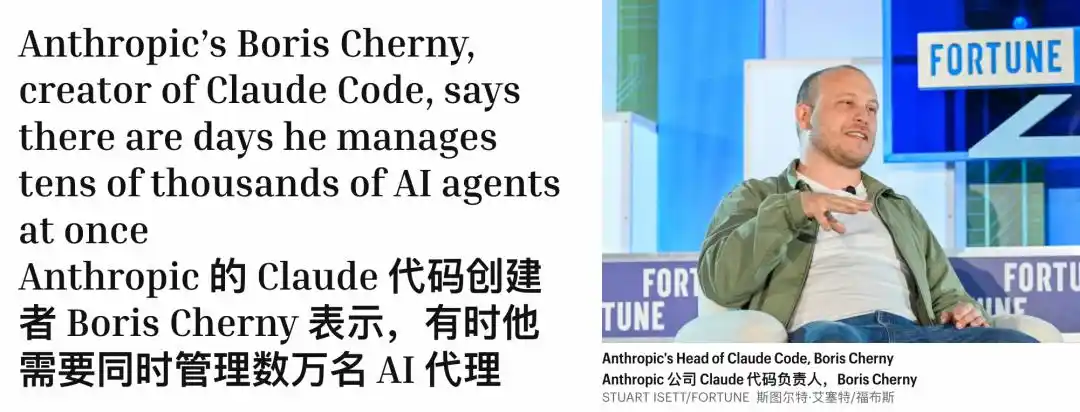
"You're no longer the one writing prompts for Claude," he says, "another Claude writes the prompts."

Some netizens have mentioned they're already using this feature.
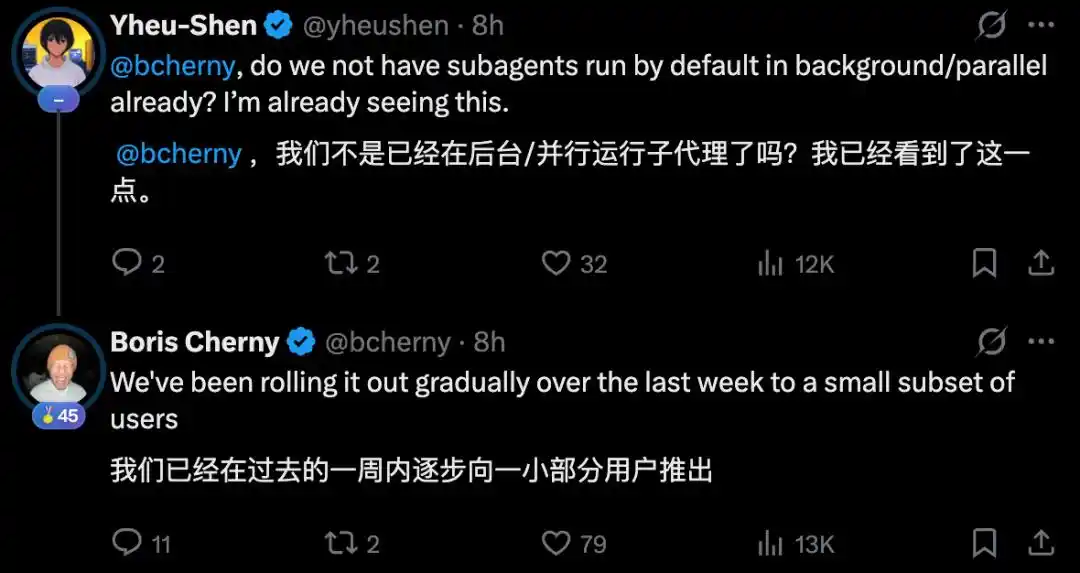
Others noted this feature is crucial—it prevents boredom while waiting for agents to process tasks and allows planning for the next steps.

Claude Code's Blazing Trajectory

Looking back at Claude Code's evolution over the past six months, "background sub-agents" are not a sudden gimmick but a natural progression.

Boris Cherny's design philosophy when creating Claude Code was: Not chatting, but infrastructure.

In April, Anthropic first made "scheduled tasks" an official capability of Claude Code: Routines.

You can package a prompt, a code repository, and a set of connectors into a fixed workflow, triggering it by the hour, overnight, weekly, or via API calls, GitHub events, or even external webhooks.

More importantly, it runs on Anthropic's hosted cloud infrastructure—close your laptop lid, and the agents keep working.

This means cron is back, hooks are back, but this time, what's scheduled isn't scripts but a group of AI workers that can read code, modify code, and open PRs.

The engineer's role has also changed: Before, you'd close your computer before bed and continue writing the next day; now, you deploy a batch of agents before bed and review a bunch of PRs in the morning.

At the end of May, Claude Code pushed this logic further: Dynamic workflows.

For tasks too large for a single dialog—like major migrations, full-library audits, or complex research—you just need to include "use a workflow" in the prompt or enable ultracode. Claude will generate an orchestration script for the current task, scheduling dozens to hundreds of sub-agents in the background to advance in stages, perform parallel cross-validation, and finally consolidate the results into a report or a batch of changes.

This isn't "one AI writing code" anymore; it's "one AI writing the script, and a group of AIs working according to it."

Now, the step of "background sub-agents running by default" essentially bundles all the above capabilities into an out-of-the-box default behavior: You no longer need to manually say 'run in the background'; it inherently runs in the background.

You only need to focus on what you should truly be doing—thinking about the next step.

One Engineer Becomes Three

How powerful is Claude Code? The most convincing evidence isn't demos but the story of Anthropic itself being "backfired."

On June 27, VentureBeat published a heavyweight article with a straightforward title: Claude Code Turned Every Engineer Into Three. Now Companies Need More Product Thinkers.

Anthropic recently told its growth team: Hire more product managers, not more engineers.

The reason is simple—Claude Code has tripled the effective output of engineering teams. A five-person team now delivers the work of fifteen to twenty people.

The bottleneck isn't in coding; it's in the people "deciding what code to write."

Traditionally, the product manager-to-engineer ratio was about 1:8. Now, with each engineer's daily output tripled, this ratio effectively becomes 1:20.

PMs can't assign work fast enough—engineers finish coding and sit waiting for requirements, a scene that's absurd to imagine.

Spotify's 20 Million Lines of Code Managed by Claude

The best demonstration of how powerful "background sub-agents" are comes from Spotify's real-world use.

Spotify's Vice President of Engineering, Niklas Gustavsson, shared some figures in an interview with Boris Cherny:

Spotify deploys to production about 4,500 times daily, 73% of pull requests are completed with AI assistance, and PR frequency has increased by over 75%.

His own daily workflow involves: simultaneously opening 5 to 10 Claude sessions, each corresponding to an independent git worktree, letting multiple agents work in parallel in the background, while he only focuses on reviewing diffs and making decisions.

All this happens in a super-monorepo with over 20 million lines of code.

Niklas admitted he was initially worried that with such a large codebase, agents would get lost. Surprisingly, it went smoothly—Claude can even "find inspiration" from other code in the repository and know how to write.
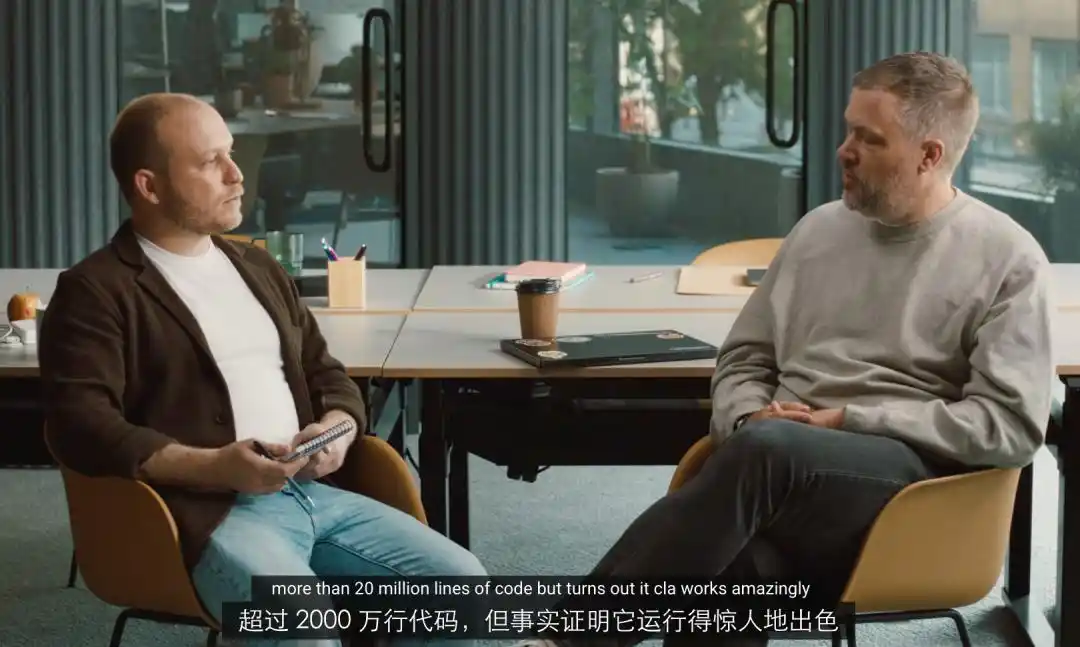
His advice to peers sounds unsexy but exceptionally practical: The more consistent the codebase and unified the toolchain, the better Claude performs within it.

If the same thing is written in ten different ways across the repository, Claude will also get confused. This mirrors the logic of improving human engineer efficiency over the past decade, just with AI as a new player now.

Even more interestingly, Spotify opened this capability to non-engineers.

They built an infrastructure allowing product managers, designers—anyone—to describe an idea in natural language, and Claude directly implements end-to-end prototypes in real mobile and backend code.

Niklas revealed that even Spotify's co-CEO has submitted his prototypes within it.

Ideas that previously required convincing an entire engineering team to validate can now be tested and run through in just an hour or two.

When 'Chat While Working' Becomes the Default Setting

Niklas said this traces back five or six years—back then, the team noticed the codebase was growing seven times faster than the number of engineers, forcing them to think ahead about "whether machines could maintain code for people."

He found that what he truly enjoyed was never the act of coding itself but the process of solving problems.

Now, he runs several agents in the background simultaneously, using the freed-up time to figure out what to do next, what to discuss with clients, and create more prototypes.

This恰好印证了 Boris Cherny's tweet: When background sub-agents become standard, "writing code" is no longer the engineer's most important task; "deciding what to do and judging if it's right" is.

When "chat while working" evolves from a developer's personal trick to the shared working method of a 2,900-person engineering team, AI programming tools have quietly shifted to a new scale—

Engineer output triples, but the scarcest resource is no longer people who can write code, but people who know what code to write.

References:

https://x.com/kimmonismus/status/2071667876415623534

https://venturebeat.com/infrastructure/claude-code-turned-every-engineer-into-three-now-companies-need-more-product-thinkers

https://x.com/ClaudeDevs/status/2071671418245492926?s=20

This article is from the WeChat public account "新智元", author: ASI启示录

Domande pertinenti

QAccording to the article, what is the key new feature announced for the next version of Claude Code?

AThe key new feature is that sub-agents will run in the background by default. Users can chat with Claude while sub-agents complete tasks. Users can bring a specific agent to the foreground if needed.

QWhat design philosophy did Boris Cherny, the creator of Claude Code, hold when developing the tool?

AHis design philosophy was 'not chat, but infrastructure.' He aimed to build Claude Code as a foundational system for managing workflows, rather than just a conversational dialog tool.

QWhat significant impact did Claude Code have on the engineering team at Anthropic, according to the VentureBeat article?

AClaude Code increased the effective output of the engineering team to three times the actual headcount. This created a bottleneck where engineers were waiting for product requirements, leading the company to prioritize hiring more product managers over more engineers.

QHow does Spotify utilize Claude Code in their development process?

ASpotify uses Claude Code to handle a monorepo with over 20 million lines of code. Approximately 73% of their pull requests are assisted by AI, and deployment frequency has increased by over 75%. Non-engineers, like product managers and designers, also use it to create end-to-end prototypes from natural language descriptions.

QWhat fundamental shift in an engineer's role does the article suggest will occur as a result of features like default background sub-agents?

AThe article suggests that 'writing code' will no longer be the engineer's most important task. Instead, their critical role will shift to 'deciding what to do and judging what is correct,' focusing on strategic thinking and decision-making.

Letture associate

Refunds! Claude 4.8 Sees Overnight Major 'Dumb-Down', GPT-5.6's Computational Power Reportedly 'Halved'

The AI community is currently alarmed by widespread reports of significant performance degradation in two leading models. This article details a "mass self-testing frenzy" triggered by a mysterious prompt designed to detect a hidden "Juice" value, representing a model's reasoning compute budget. On OpenAI's side, users suspect a covert, limited test of a "GPT-5.6-sol" model is underway. When using a specific XML prompt on the Codex platform, a normal "gpt-5.5 xhigh" model reportedly returns a Juice value of 768. However, some users routed to the suspected GPT-5.6 test receive a drastically reduced value of 128—a six-fold decrease. This has sparked debate on whether it signifies a major efficiency leap or a "watered-down, low-cost version" achieved by slashing reasoning depth to save computational expenses. Simultaneously, Anthropic's Claude models, particularly the flagship Opus 4.8 Max, are facing intense user backlash for a perceived "physical brain cut." Users on platforms like Reddit report a dramatic decline in the model's once-impressive reasoning, with complaints of it becoming "absurdly" weakened, performing worse than older, lighter models like Haiku. Specific criticisms include: losing long-context memory, refusing to think deeply even in high-reasoning modes, providing instant incorrect answers, and engaging in unhelpful, argumentative, or "gaslighting" behavior where it contradicts users unnecessarily. The article speculates these "stealth downgrades" might be a calculated corporate strategy. Companies could initially release models with temporarily boosted compute to create an illusion of a major breakthrough, then silently scale back parameters later to manage unsustainable inference costs. A proposed underlying cause is a tightened funding environment, potentially exacerbated by SpaceX's massive IPO soaking up market liquidity, which could delay AI company IPOs and force cost-cutting measures like model "nerfing." The core issue highlighted is the asymmetry of information: subscribers pay for a service that can be silently and fundamentally altered without notification or explanation. The viral "Juice test" resonates because it represents users' desire for transparency about what they are actually paying for.

marsbit4 min fa

Refunds! Claude 4.8 Sees Overnight Major 'Dumb-Down', GPT-5.6's Computational Power Reportedly 'Halved'

marsbit4 min fa

Earning Six Figures and Still Struggling to Rent in San Francisco

A couple in San Francisco with a combined tech income over $360,000 struggled for months to find a one-bedroom apartment under $5,000 per month. Their story highlights how the AI wealth boom, driven by upcoming IPOs from companies like OpenAI and Anthropic, is dramatically escalating the city's cost of living. Even six-figure salaries are becoming insufficient for a comfortable lifestyle. The article details the financial reality for tech workers earning around $180,000 annually. After taxes, retirement contributions, and healthcare, take-home pay is roughly $7,000 per month. With average rents exceeding $3,800 and one-bedrooms often costing $4,500-$5,200, discretionary income shrinks to $1,500-$2,500. This contrasts sharply with reported median total compensations of $640,000 at OpenAI and $420,000 at Anthropic. The AI gold rush is identified as the primary driver. The scale of potential wealth from these IPOs, far surpassing previous tech booms, is flooding the housing market. Data shows San Francisco's average rent is now the highest in the U.S., with vacancy rates in desirable neighborhoods plummeting to around 3%. The overall cost of living is 65.6% above the national average. The piece features multiple professionals, including a 25-year-old with a $250,000 salary, facing housing instability, fierce competition for rentals, and a persistent, low-grade financial anxiety despite high earnings. It concludes that the rapid concentration of AI wealth is redefining what constitutes a "high salary" in San Francisco, pushing out mid-tier tech talent and creating a stark divide between those in the AI sector and everyone else.

marsbit1 h fa

Earning Six Figures and Still Struggling to Rent in San Francisco

marsbit1 h fa

Trading

Spot
活动图片