Less Money, More Problems: Maple's Opaque Buybacks, Uniswap V4 Fees Kick In, Sky's Unreadable Ledger

marsbitPubblicato 2026-07-15Pubblicato ultima volta 2026-07-15

Introduzione

The article discusses a shift in the crypto industry from vanity metrics like TVL to a focus on real revenue generation and how that value is distributed. It highlights three key examples: * **Maple's Opaque Buybacks:** While implementing a revenue-linked token buyback program, the purchased tokens go to a Strategic Fund for undefined uses, leading to community concerns about a lack of true value accrual for holders. * **Uniswap V4 Fees & LP Concerns:** With fees activated on Uniswap V4, there is a risk that liquidity providers (LPs) may migrate to avoid them. Proposals suggest making fees conditional on LP profitability. * **Sky's Complex Value Flow:** Despite strong revenue, Sky’s structure involving Prime Agents makes it difficult for token holders to track and claim their share of value, as profits can flow to various ecosystem entities. The piece also notes the trend of tokenized assets (like Fidelity's fund in Theo's thBILL) evolving from simple issuance to becoming useful components in DeFi products, and covers other developments like Ondo's new perps product using tokenized stocks as collateral.

Author: Castle Labs

Compiled by: Deep Chao TechFlow

Deep Chao Introduction: The crypto industry used to rely on vanity metrics like TVL and trading volume to put on a show. Now, investors are starting to ask the hard questions about real money: Where does the profit you earn go? Maple uses revenue to buy back tokens but doesn't disclose what happens to the purchased coins. Uniswap V4's fee extraction from LPs might drive liquidity away. Sky's ledger is so complex that token holders can't figure out what rights they have. When protocols start talking about revenue distribution, the rules of the game change.

For years, the crypto industry has used on-chain activity metrics as benchmarks for success: TVL, trading volume, user count, transaction count, and active addresses.

This cycle, a more critical question is rapidly gaining consensus: Are these businesses sustainable? Can the activity be translated into actual revenue? And who gets to keep that revenue?

This is the focus of this week's Chronicle:

  • Maple's new rule-based buybacks
  • Uniswap turning on the fee switch for v4 pools
  • Sky's strong revenue numbers but complicated accounting
  • Theo adds Fidelity's FILQ to thBILL
  • OndoPerps turns tokenized stocks into collateral

Revenue alone is not enough: It needs a clear path to value accrual.

Does it flow to token holders, stakers, LPs, or treasury? Or is it captured by other layers in the stack before holders see it?

We'll revisit a similar question in the upcoming Castle x Kaiko report later this week: How do blockchains make money? It's becoming increasingly clear that despite raising massive capital and having huge valuations, very few are running sustainable, profitable businesses.

Maple's Revenue-Linked Buybacks

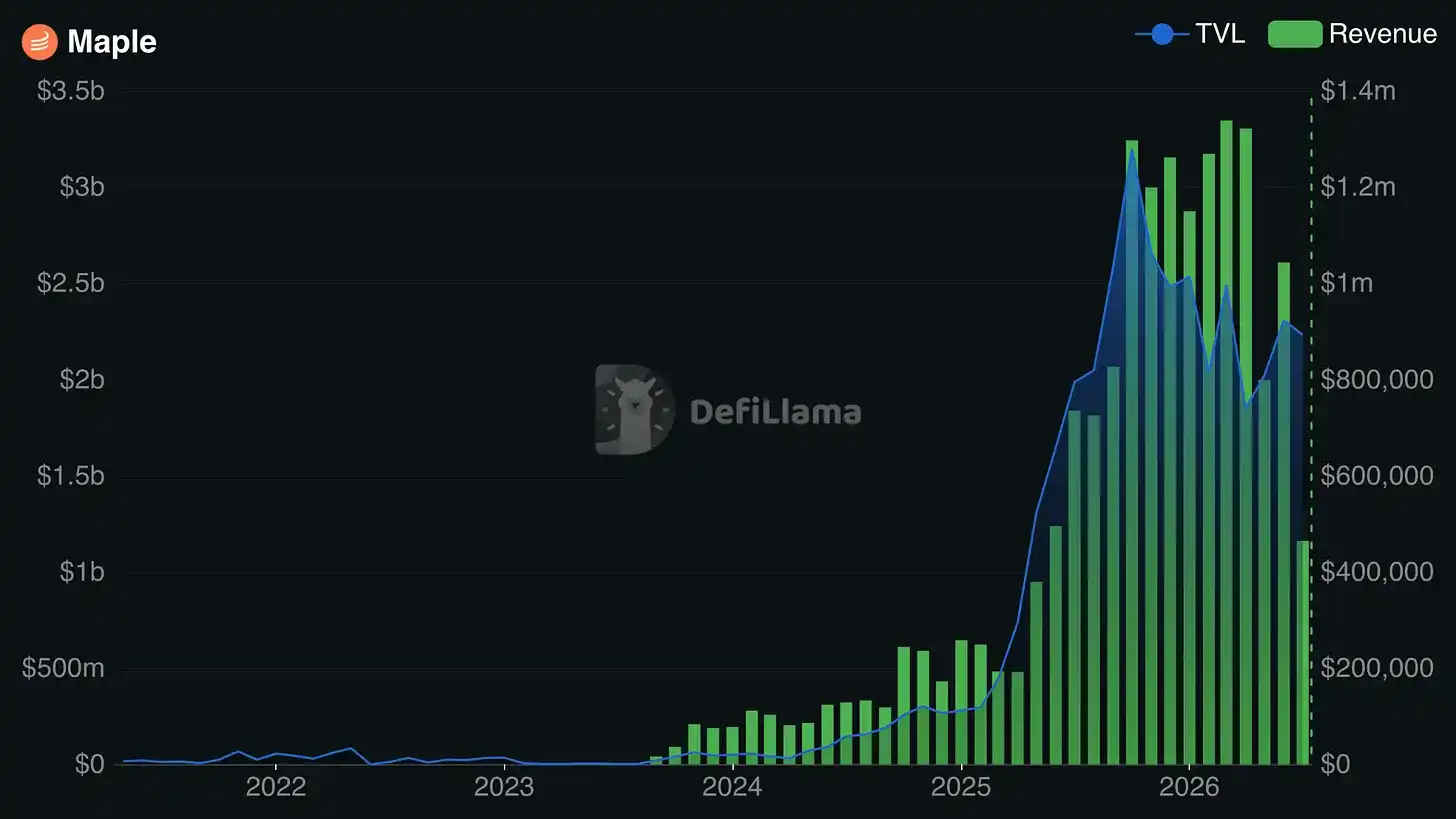
Maple has recently been a huge success story in crypto, offering professionally managed, permissioned, and secure lending services to sophisticated allocators. They just finished a record-breaking first half, with AUM at $4.6B (up 81% YoY) and Q2 revenue at $4.4M (up 47% YoY), while their business grew 22% even as DeFi lending contracted 31%.
Following that, Q3 has started strongly with the launch of syrupUSDG, Maple's first new Syrup asset in two years. syrupUSDG brings Maple's on-chain credit engine to Global Dollar (USDG) and Robinhood Chain, giving holders exposure to lending strategies originated by Maple.

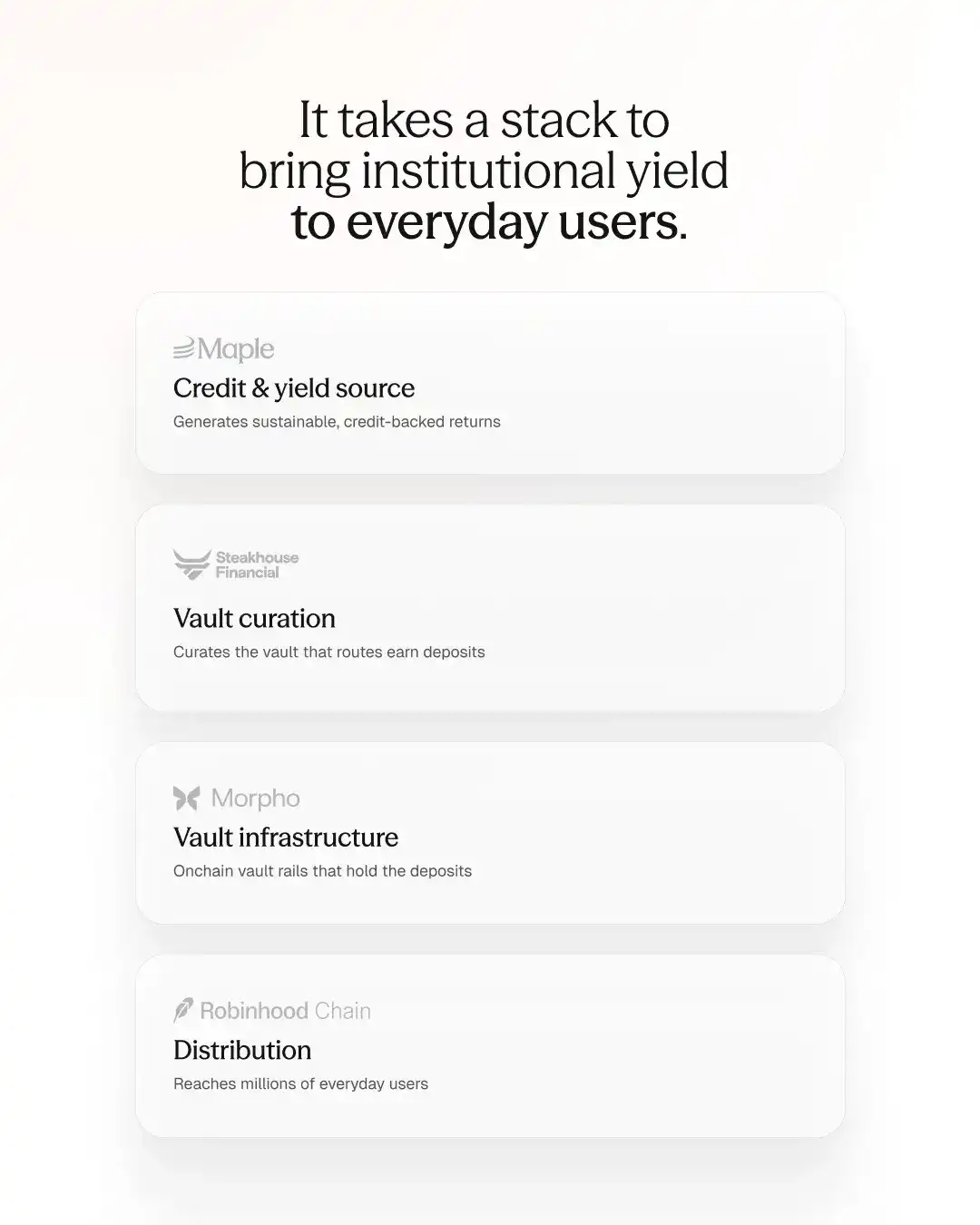
syrupUSDG can be placed in Robinhood Earn, offering up to 7% APY. This APY bundles Robinhood's distribution, Morpho's vault infrastructure, Steakhouse Financial's curation, and Maple's institutional credit as the yield source.
So how do SYRUP holders benefit from all this?

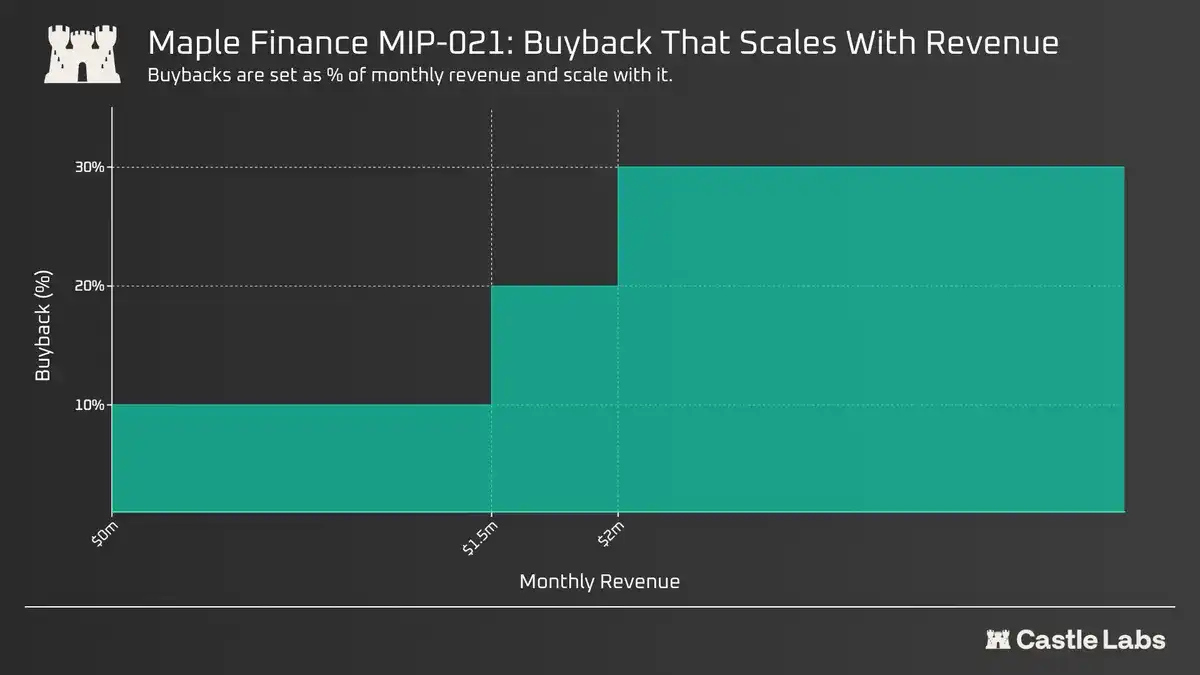
Recently, Maple implemented discretionary buybacks (MIP-019) but is now preparing to replace them with a rule-based framework (MIP-021). This will tie the buyback ratio directly to monthly gross revenue:

  • Below $1.5M: 10% allocated to SYRUP buybacks
  • $1.5M to $2M: 20% allocated to buybacks
  • Above $2M: 30% allocated to buybacks

Buybacks occur at the end of each month after monthly revenue is finalized. The purchased SYRUP is allocated to the SYRUP Strategic Fund (SSF), which Maple defines as working capital for strategic growth, token liquidity, capital reserves, and buybacks.

Most buybacks aim to distribute profits (dividends), cancel shares (burn supply), or reduce float (lock supply). Maple's route doesn't really do these things, making it look more like a treasury management strategy.

This has been raised in the forum, with community members asking for purchased SYRUP to be held in a public reserve address and treated as non-circulating, non-voting, and non-transferable unless a new governance proposal is made. However, these safeguards do not seem to be included in the current proposal.

Thus, the definition and use of these strategically recaptured SYRUP remain up in the air. This is likely to color public perception of this buyback framework, causing it to be seen more as a treasury management action rather than any real value accrual for SYRUP holders.

Follow the snapshot vote here.

Uniswap Brings Fees to V4

Yesterday, Uniswap's Hayden shared that the protocol is now collecting over $5 million in fees per day, second only to USDT and USDC.
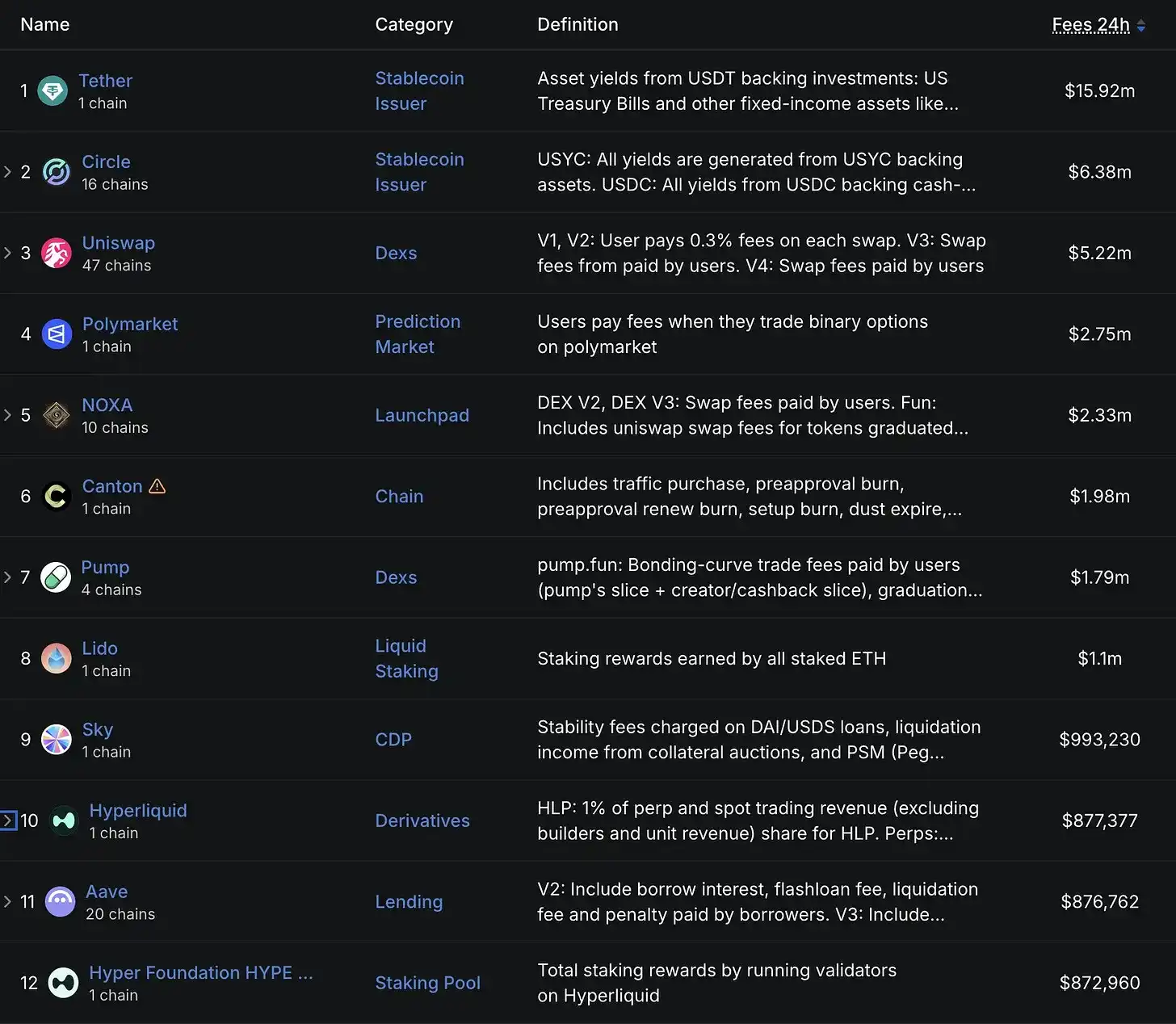
Much of this revenue growth came from the launch of Robinhood Chain. However, while very popular, these statistics are neither annualized nor likely to last long. In fact, we expect Robinhood to internalize these fees as soon as possible.

In recent years, there has been considerable debate about UNI's utility and its revenue and fee distribution.

Ultimately, Uniswap is also activating protocol fees on V4.
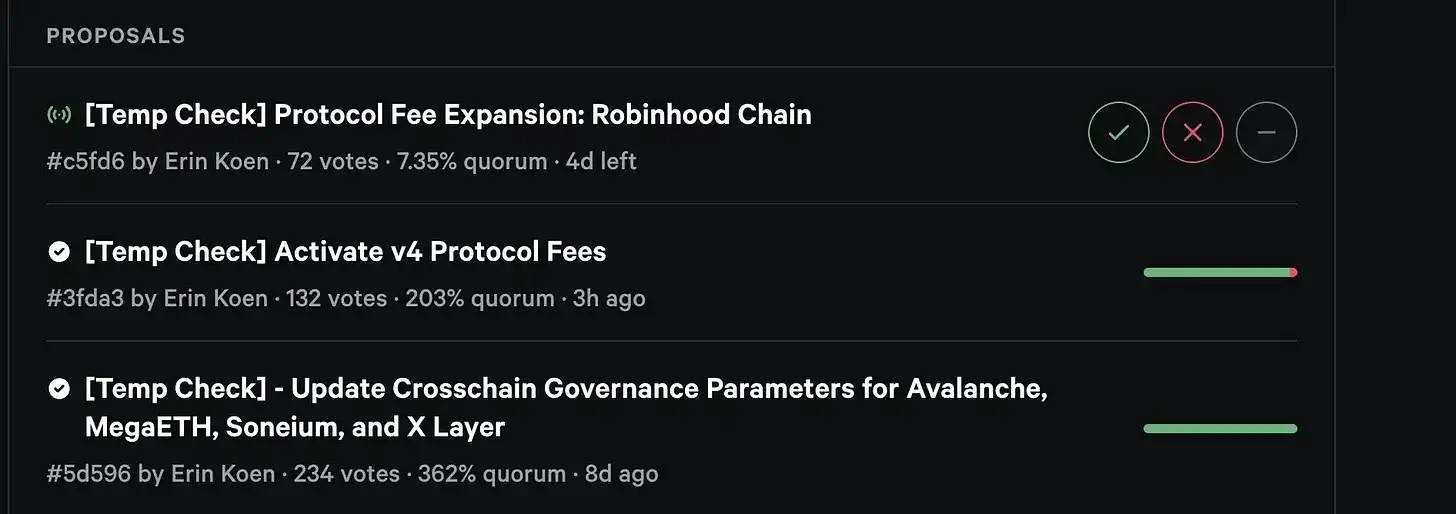
Previously, turning on the fee switch on V2/V3 led many LPs to migrate to V4, an incentive to encourage capital migration. How will this change affect LPs now? Will it increase Uniswap's overall capital efficiency, helping deprecate V2 and V3 in favor of V4?

Due to its architecture, V4 requires a more flexible and customizable approach to the fee switch. This is primarily due to the Hook architecture and dynamic fees, allowing for multiple fee tiers.

Therefore, governance rules in V4 will be defined by a "fee controller system," a practical approach ensuring governance can set rules for different "pool families" (V4FeePolicy) while still retaining enough flexibility to override or adjust these policies at any time (V4FeeAdapter).

The question remains: How will this change affect LPs?

Previous fee switches on V2 and V3 resulted in a 25% cut to LPs, prompting them to move to V4.

Now that V4 fees are active, can Uniswap retain LPs, or will they move to other fee-less trading venues?

Governance participants have already expressed these concerns.

A proposed solution is to conditionally enable the fee switch for V4. That is, enable it only when LPs are profitable.

One user suggested as follows: "If a pool's implied volatility is consistently higher than its realized volatility, then governance can take a cut without breaking LP trading.

Conversely, if RV > IV, then LPs are already undercompensated. Taking 25% of their fees won't make the protocol money. It will push LPs further into negative expected value."

We will closely monitor capital flows to V4 to answer this question.

V4 fees will be used for LP rewards/buyback distribution, with a split ratio closer to 5-25% / 75%-95%. Here's a comparison with Hyperliquid buybacks:
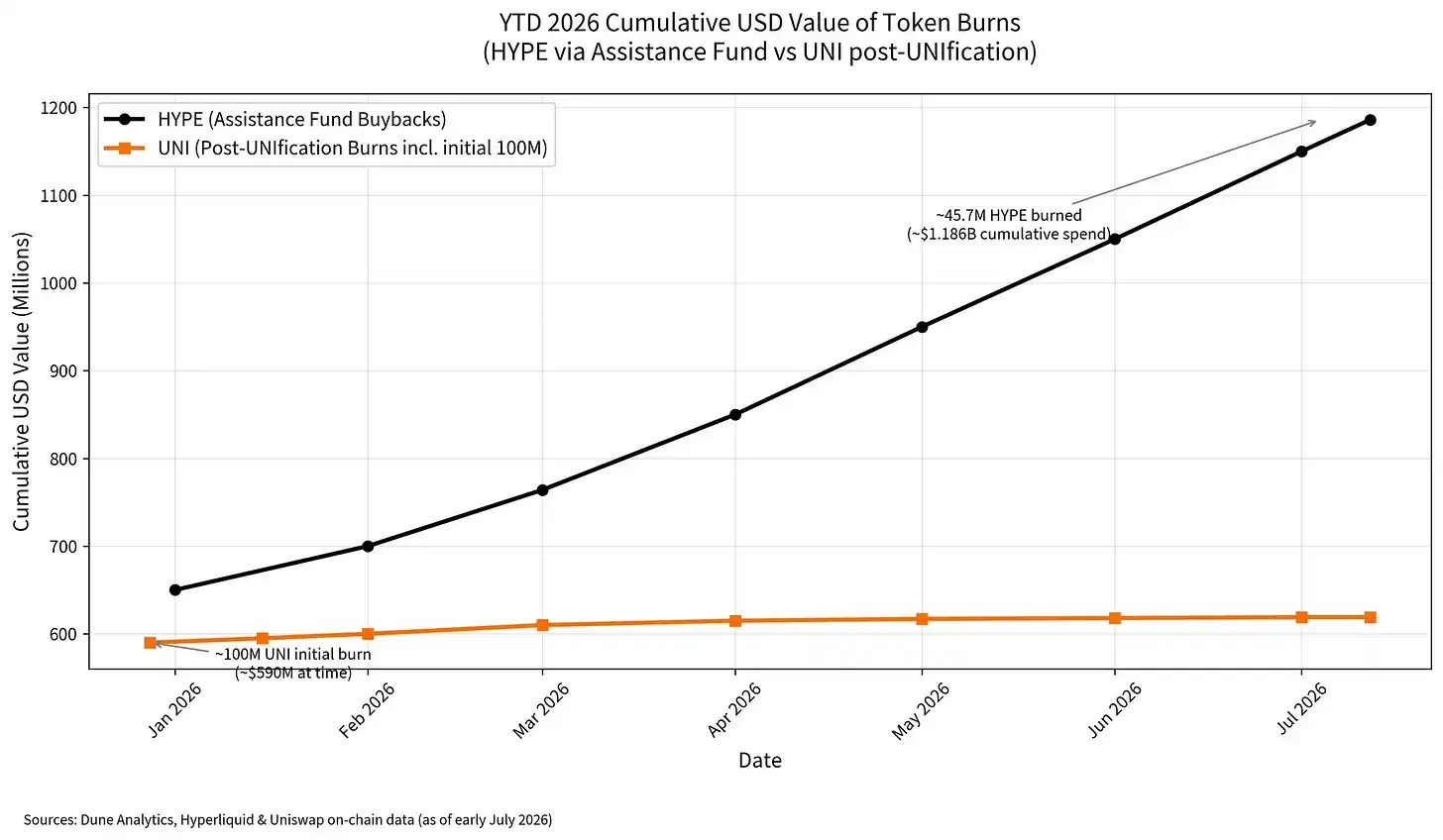
To date, Uniswap has burned over 6 million UNI tokens.
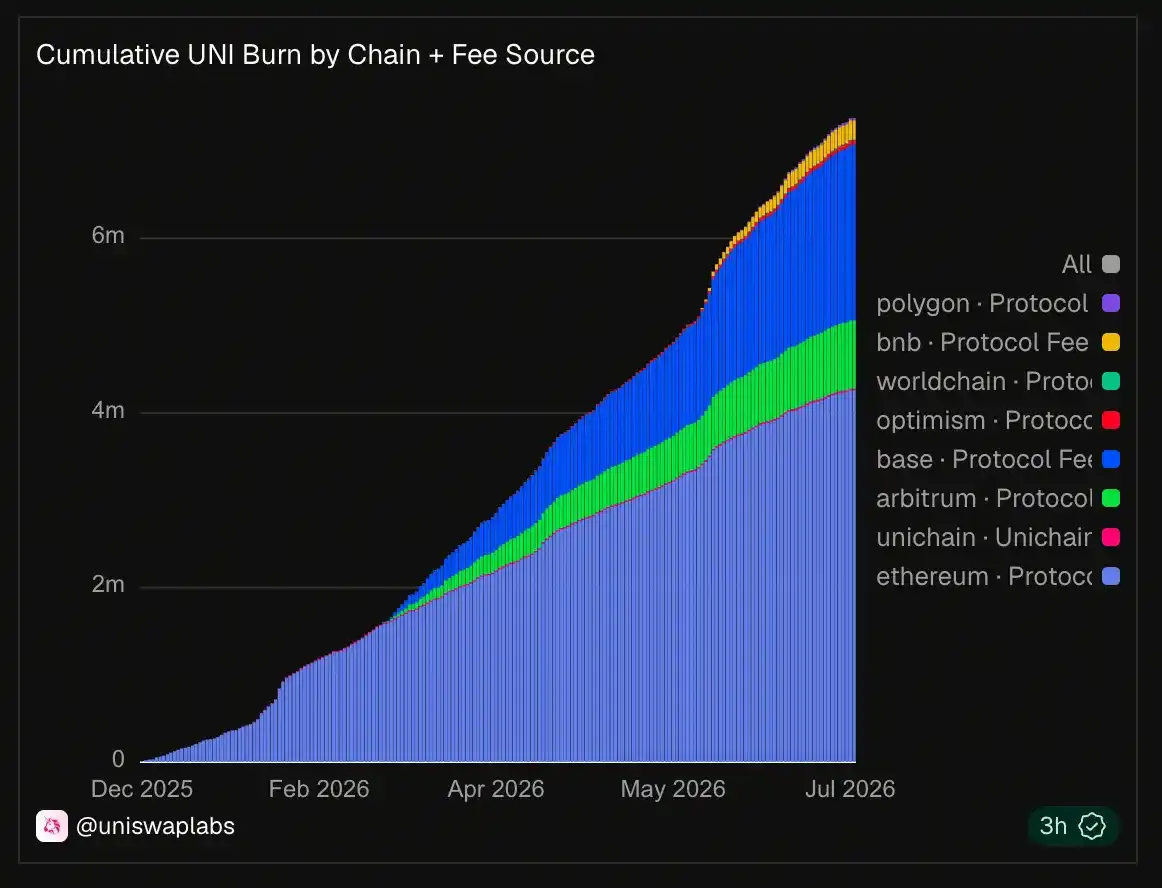
More statistics on UNI burns are available here.

Another noteworthy point is the impact of these buybacks, along with overall revenue and fees for token holders.

Projects allocate these in very different ways.

Stay tuned; we are writing a related report.

Sky Posts Record Revenue

June was a record month for Sky! In case you missed it:

  • Record revenue run rate of $419M
  • USDS yield distribution exceeding $250M
  • Sky Reserve continues to grow
  • Increased activity in the Sky Agent Network
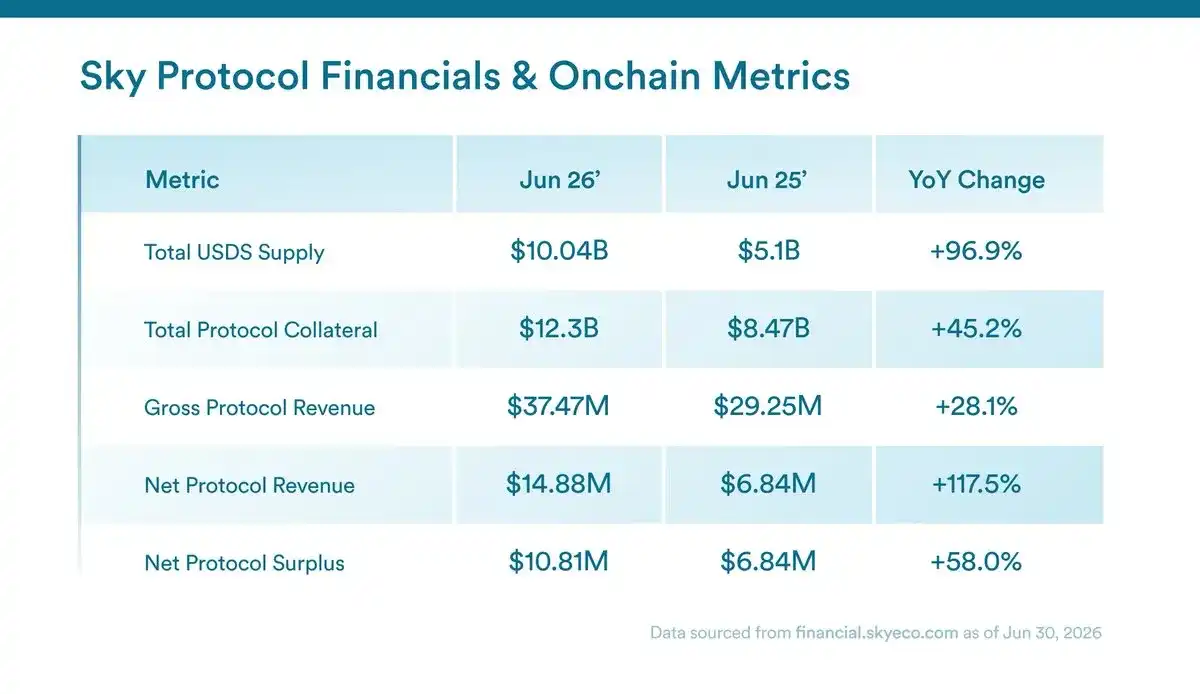
Without a doubt, Sky is generating revenue, building new products, and driving more activity through Spark, Grove, and the broader Prime Agent structure.

But what do these record numbers mean for SKY holders?
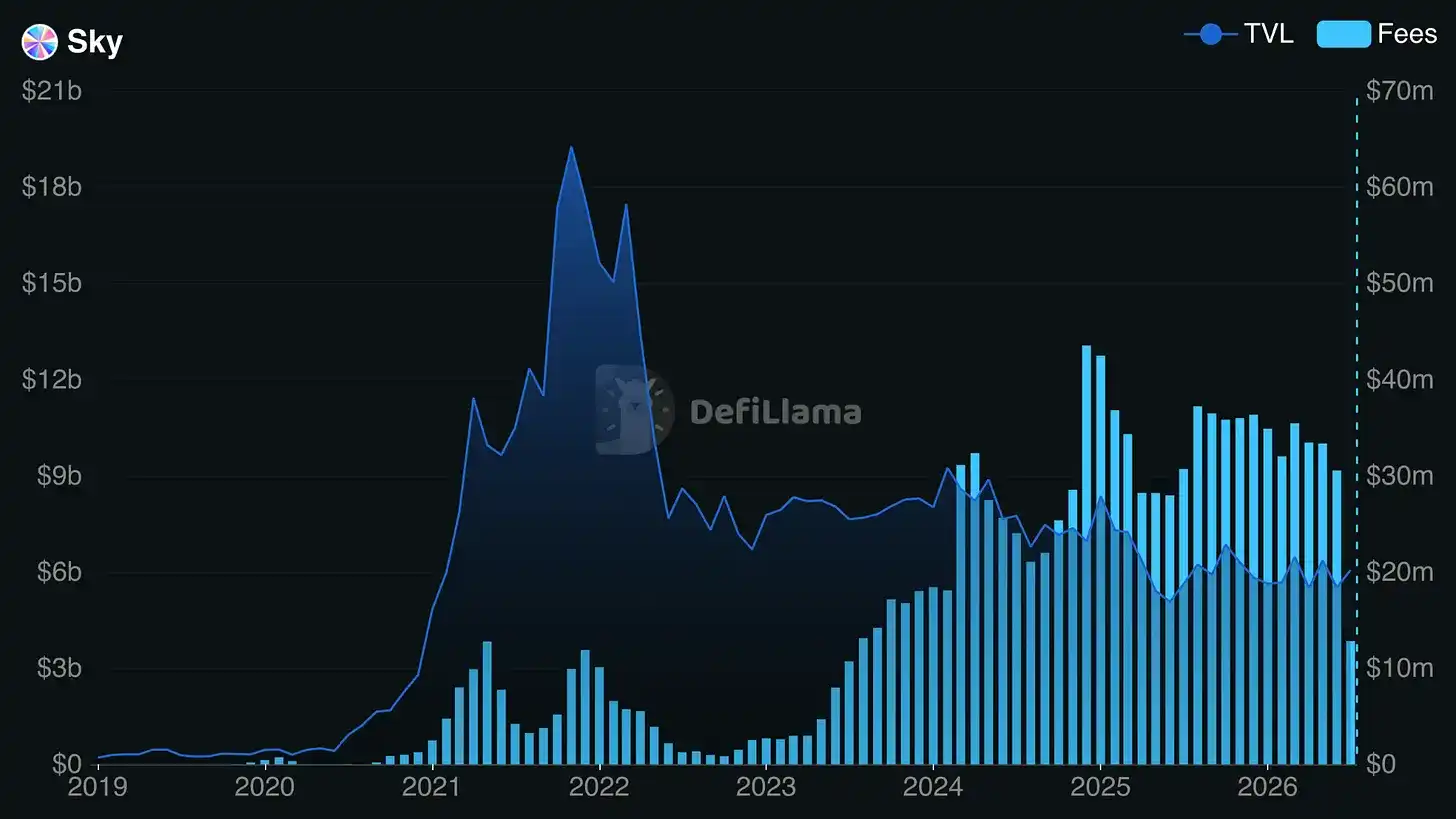
SKY does have an accrual mechanism. Protocol revenue from stability fees and Sky Agent performance is used to buy back SKY on the open market, and these tokens are distributed to participants in the Sky Staking Engine. However, Sky is not a simple single-token, single-balance-sheet story. Prime Agents have their own roles, tokens, holders, and economics. For context, Prime Agents are professional capital allocators within the Sky ecosystem. Sky can fund or support them, they can owe money to Sky, their performance can be factored into protocol profit. This profit should then support the SKY buyback and staking reward mechanism.

This makes the question for token holders harder to answer clearly. You can look at protocol revenue, cost of revenue, reserves, staking rewards, and token holder income. But once Prime Agents are around the core protocol, the balance sheet becomes harder to read. Some value might accrue to SKY. Some might stay with the agents. Some might flow through sUSDS or ecosystem rewards. Some might accrue to SPK, GROVE, or future agent tokens.

PaperImperium wrote a useful post this week about exactly this, arguing that Sky's financials are difficult to interpret because Prime Agents aren't treated consistently in the accounts. If it's too complex to determine what token holders are entitled to, the value proposition itself might be undermined.

OndoPerps Launches, Using Tokenized Stocks as Collateral

Ondo just launched OndoPerps, its perpetual contract product for trading stock perps with leverage up to 20x.
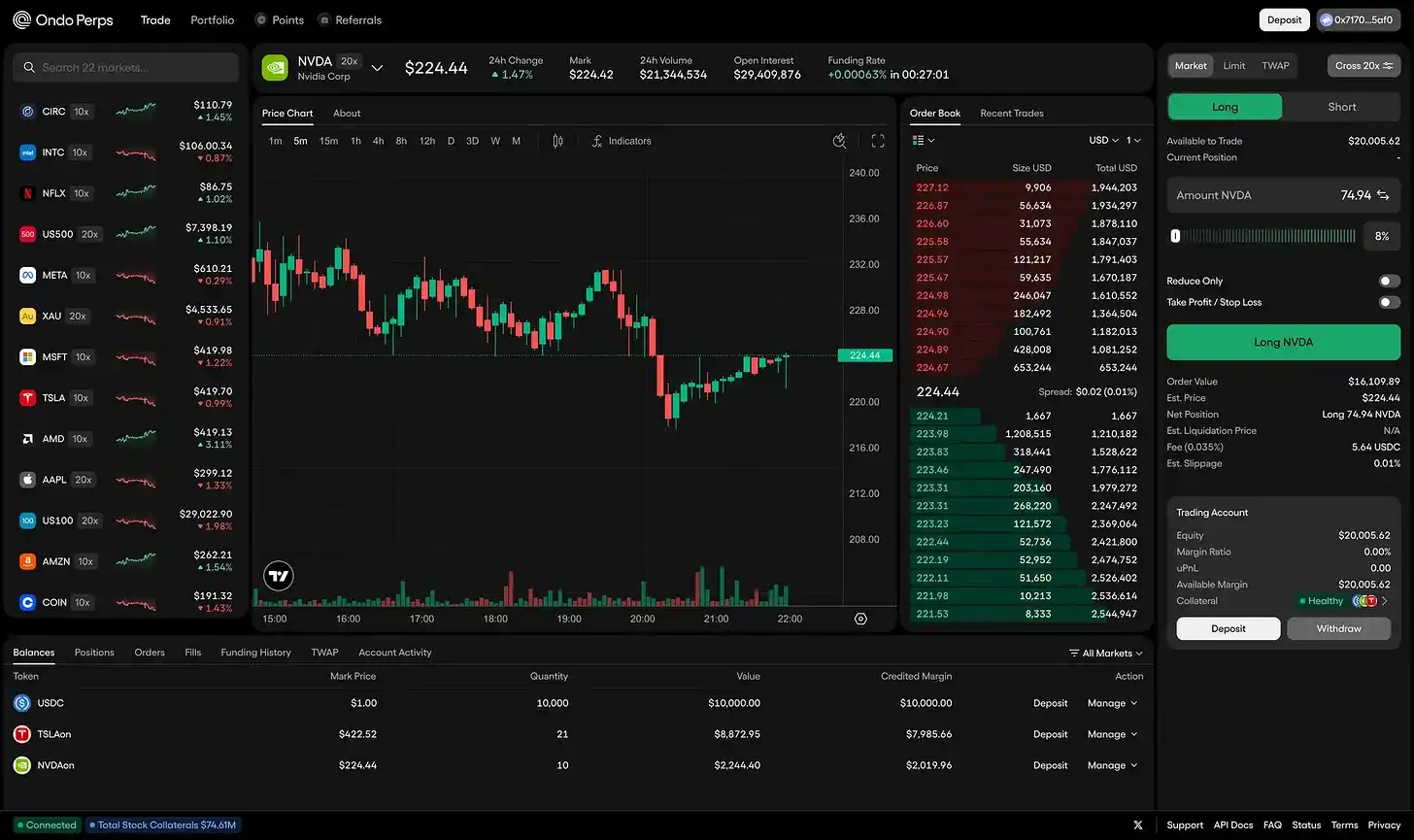
This complements Ondo's spot stock products and allows it to compete with venues like Trade.xyz, which have already captured the majority of perpetual open interest in RWAs.

Listed markets include commodities like oil, gold, silver; stocks like Apple, Tesla, Nvidia, Microsoft, Amazon, Alphabet, Meta, Netflix, Intel, AMD, Oracle, Micron, Palantir, SpaceX, Strategy, Coinbase, Circle, Robinhood; and indices like US100 and US500.
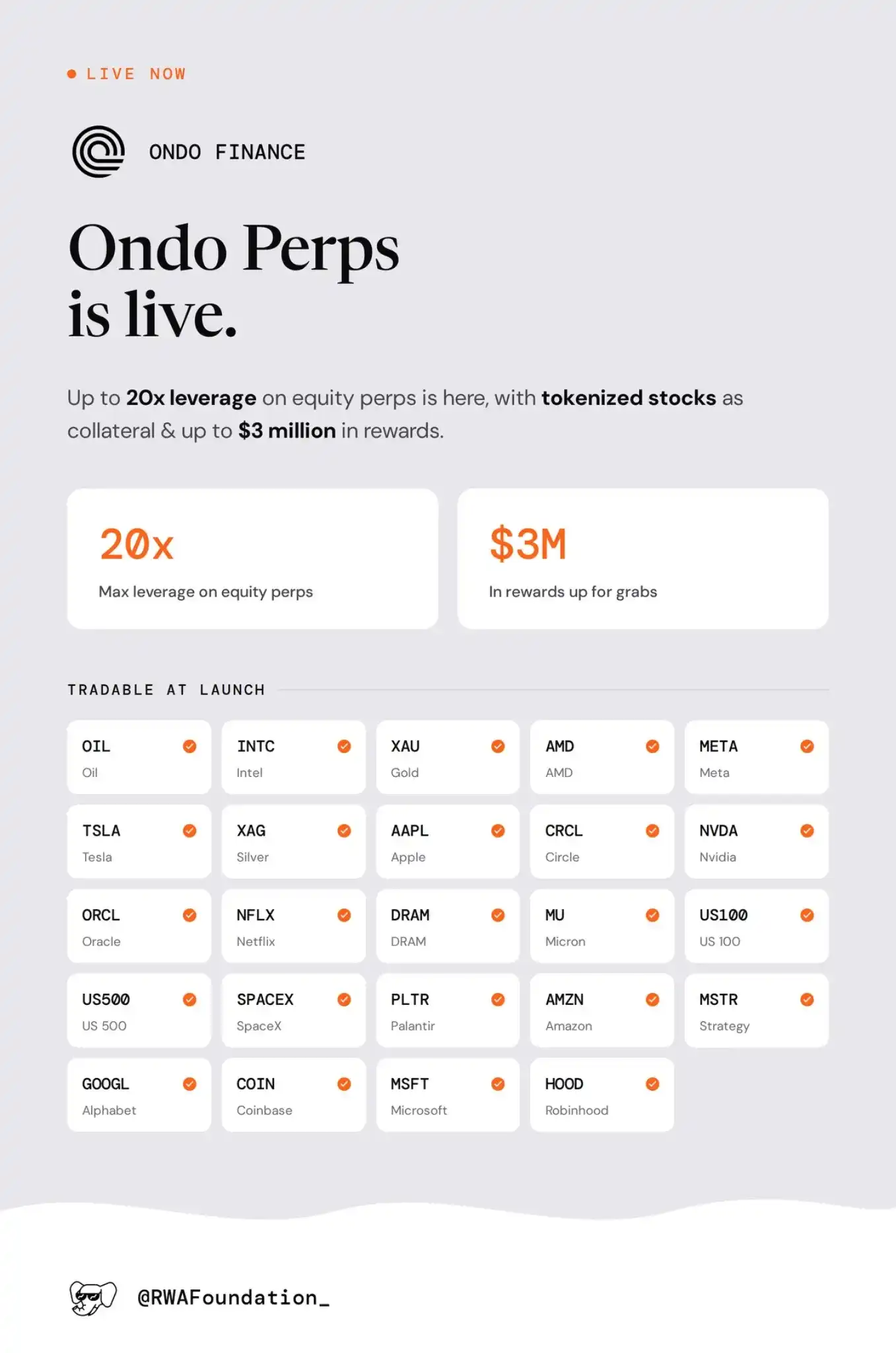
What's special about this launch is that it complements Ondo's existing offerings, allowing tokenized stocks to be used as collateral for 24/7 perpetual exposure to commodities, stocks, or indices. This is a key differentiator from Hyperliquid and other trading platforms: unified margin across all products, supporting a wider range of strategies including hedging, delta-neutral, etc.

Now Ondo spot stock holders will be able to use these as collateral and hedge or leverage their current exposure.

There's still a long way to go in perpetual markets, and we can expect RWA perpetual trading to be one of the fastest-growing segments in the near term. The trend is clear.
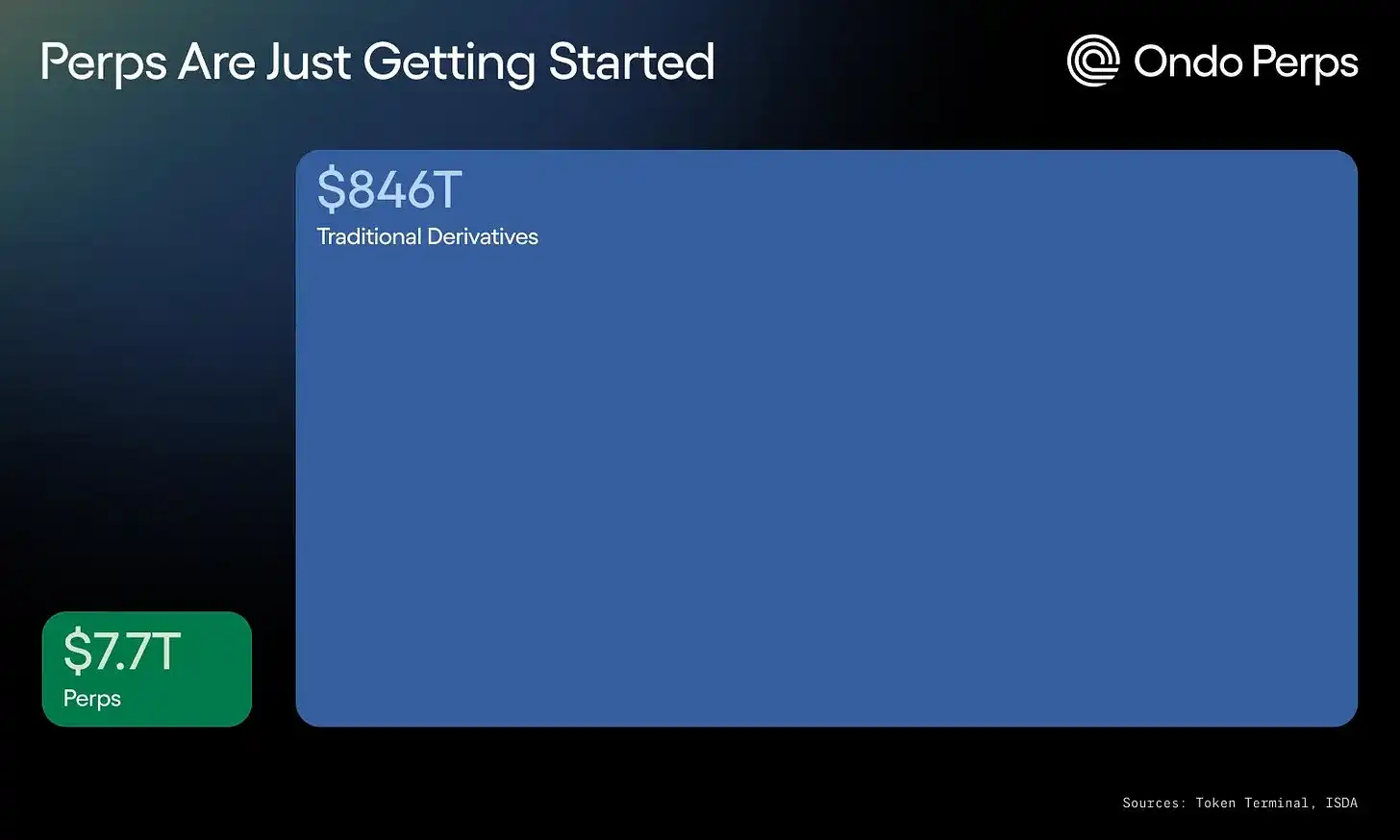
On the backend, liquidity is ensured by a combination of institutional market makers and user flow.

Tokenized Funds Are Moving From Issuance to Utility

Over the past two years, the RWA market has largely measured progress by what gets issued on-chain.

Another fund tokenized, another asset manager onboarded, another chain supported.

The next stage is about what these assets are used for.

That's why we sat down with Theo today to discuss their FILQ integration.

Theo invested $20M in Fidelity International's tokenized U.S. Dollar Digital Liquidity Fund (FILQ) via Sygnum, adding FILQ as the second institutional underlying asset in its existing product thBILL.

While direct holding is the familiar starting point, once a fund is on-chain, the more interesting question is where else it can sit: inside stablecoins, treasury products, collateral systems, lending markets, vaults, or settlement flows.

"Most investors don't want a money market fund; they want yield, and in a form they can actually use."

Evan, Theo's GTM and Chief of Staff, said: "Direct holding only gets you returns and nothing else. Wrapping it into a composable product allows the same dollar to make money and be liquid at the same time... Tokenizing the fund gets it to an institutional grade; the on-chain product makes it useful."

thBILL previously integrated Wellington's tokenized treasury fund. Adding FILQ now introduces Fidelity International as the second institutional manager. This gives thBILL a broader foundation and shows the structure can add new managers without rebuilding the entire product each time.

If tokenized funds remain standalone wrappers, the market will only compete on issuer brand, AUM, and supported chains. But if they become inputs into more customizable on-chain products, competition shifts to what additional value can be built around them.

Fidelity International's own messaging follows a similar line. Emma Pecenicic, Head of Digital Assets Distribution at Fidelity International, said the firm sees tokenization as a "fundamental shift in how global financial markets operate," combining investment expertise with digital-native infrastructure to "bring regulated, institution-grade on-chain liquidity to markets that operate 24/7."

So what is the shift we expect?

Theo's view is: "Direct holding is step one because it's familiar. It maps to how funds work today. But the value of putting assets on-chain is what you can do next: use them as collateral, import strategies, instant settlement."

The end goal for these assets is clearly utility.

Can they sit in a treasury product? Back a stablecoin? Serve as collateral? Flow through lending markets, vaults, or structured products without becoming a compliance headache?

The integration of FILQ into thBILL is a small but useful example of this shift. The fund isn't the end product; it's a balance sheet item for Theo, strengthening their product, readying them for growth and expansion into places Fidelity can't easily reach.

The next wave of tokenized fund adoption will be driven less by direct holders of these institutional assets and more by their embedded use in on-chain products.

What We're Watching

Circle and agent payments: Jeremy Allaire posted an article about the Circle Agent Stack, suggesting that if agents take on more corporate work and value flows natively across programmable networks, the agent economy and the on-chain economy begin to overlap. The thing to watch is whether this becomes real payment flows. Do agents actually hold balances, pay for services, rebalance wallets, settle bills, or trigger transactions in USDC? Will developers build around Circle's stack instead of generic wallets and APIs?

Castle x Kaiko Revenue Report: We will be releasing a report later this week with Kaiko on how operating a blockchain business is changing. Chains used to rely primarily on block space fees but are now forced to diversify into other vertical revenue streams—MEV, sequencer economics, app capture—and ensure they can capture value where it truly accrues.

Robinhood Chain's Staying Power: Robinhood Chain's first week made a considerable splash in the on-chain landscape. We flagged it as the 5th largest chain by 24h DEX volume shortly after launch, with over $370M in daily volume, $1.35B cumulative volume, driven largely by CASHCAT. It later rose to 2nd in 24h DEX volume, behind only Solana. While Robinhood has everything it needs to be a serious consumer distribution channel for on-chain finance, they are leaning into the meme world, hence seeing great early on-chain metrics. We'll watch to see how these two worlds find a better balance over the coming months.

SEC Public Market Access Roundtable on IPOs: Clearly, cryptocurrency is having an impact on traditional financial markets, with multiple large trading platforms opening doors, more assets being tokenized, and even IPOs coming on-chain. Now, the SEC is hosting a virtual roundtable on modernizing IPOs and expanding public market access.

Crypto di tendenza

Domande pertinenti

QAccording to the article, what is the main problem with Maple's new rule-based share buyback framework (MIP-021)?

AThe main problem is that the purchased SYRUP tokens are allocated to the SYRUP Strategic Fund (SSF) for ambiguous "strategic purposes" like growth, liquidity, and treasury management, instead of being clearly distributed to token holders (e.g., as dividends), burned, or permanently locked. This lack of transparency and clear value accumulation for holders makes it appear more like a treasury management tactic.

QWhat concern does the article raise about Uniswap V4 activating protocol fees?

AThe article raises the concern that activating fees on V4 might drive liquidity providers (LPs) away to other fee-free trading venues, similar to what happened when fees were activated on V2/V3. A proposed solution is to conditionally enable the fee switch only when LPs are profitable to avoid pushing them into negative returns.

QWhy is it difficult for SKY token holders to understand their rights and value accumulation from Sky's record revenues?

AIt's difficult because Sky has a complex multi-token ecosystem involving Prime Agents with their own tokens, economics, and balance sheets. Protocol profits that should support SKY buybacks flow through this network, and value can be captured by various ecosystem actors (like agents, sUSDS, SPK, GROVE), making the overall financial statements and value flow to SKY holders opaque and hard to interpret.

QWhat key differentiation does OndoPerps offer compared to other perpetual trading platforms, as mentioned in the article?

AA key differentiation of OndoPerps is unified margin, allowing tokenized stocks (from Ondo's existing spot product) to be used as collateral for trading perpetual contracts on commodities, stocks, or indices. This enables more complex strategies like hedging or leveraging existing stock exposure.

QWhat shift in the RWA (Real-World Assets) market does the article's discussion about Theo and FILQ illustrate?

AIt illustrates a shift from focusing primarily on the issuance of tokenized funds (e.g., which fund is on-chain) to focusing on the utility and composability of these assets. The integration of Fidelity's FILQ into Theo's thBILL product shows that tokenized funds are becoming inputs for building more useful, yield-generating, and liquid on-chain products (like stablecoins, collateral, vaults) rather than just being standalone holdings.

Letture associate

Founder of Real Vision: We Are Living in the Era of Exponential Growth

Real Vision founder Raoul Pal argues that humanity is now in an "Age of Exponential Growth," a reality the human brain's linear intuition struggles to comprehend. The core drivers are the convergence of multiple, mutually-reinforcing technological curves: Artificial Intelligence, robotics, solar & storage, biotechnology, and blockchain networks. He notes that while his 2021 analysis correctly identified fiat currency debasement and assets like Bitcoin as inflation hedges, he underestimated the scale of change. Beyond monetary liquidity, a more profound force is at work: these key technologies have moved from theoretical promise into simultaneous, accelerating commercialization. They are no longer growing in parallel but are fusing, creating a "double exponential" growth curve. AI and robotics create an "artificial labor supply," breaking the cycle of debt-driven growth needed to offset aging demographics. Energy, particularly solar power guided by Wright's Law, is seeing collapsing costs, removing a key bottleneck for compute-hungry AI. Cryptocurrencies are evolving from monetary assets into the essential, programmable settlement layer for transactions between future AI agents. This fusion creates a feedback loop: AI optimizes energy grids, cheaper energy powers more compute, which builds better AI, and crypto networks settle the transactions. This leads to "Reed's Law" playing out at scale, where intelligent nodes (AI agents) form and re-form groups at machine speed, creating network value that grows at 2^n. Pal concludes that the critical question is no longer how to protect jobs from machines, but how to own a share of the machines and their foundational infrastructure. He sees the 2030-2032 period as a potential "Economic Singularity" where these trends fully merge, fundamentally transforming the economy. The data, he asserts, shows this is not a bubble but an observable, quantifiable new era.

Foresight News37 min fa

Founder of Real Vision: We Are Living in the Era of Exponential Growth

Foresight News37 min fa

Golden Age VS Crisis Era? Bank of Korea Set to Hike Rates, Brokerage Margin Requirements May Increase 5-Fold

South Korea's financial authorities are taking coordinated action to cool an overheated and volatile stock market. The Bank of Korea is widely expected to raise its benchmark interest rate by 25 basis points to 2.75% on Thursday, which would be its first hike in approximately three and a half years since January 2023. Analysts predict further increases, potentially bringing the rate to 3.00% by year-end. This move aims to tighten market liquidity, raising costs for leveraged investments. Concurrently, major Korean brokerages have agreed to raise the minimum investment requirement for single-stock leveraged ETFs fivefold, from 10 million won to 50 million won, to curb excessive retail speculation. This follows extreme market swings focused on major chip stocks like Samsung Electronics and SK Hynix, which together account for nearly half of the KOSPI index's weight. The index itself has seen a dramatic 204% surge from its recent low. President Yoon Suk Yeol acknowledged market instability and urged regulators to address risks from leveraged products. Meanwhile, financial watchdogs are imposing new limits on stock-backed loans to individual investors to prevent bubble formation. These measures come as foreign investors have been massive net sellers this year, offloading a record $110 billion in assets, while domestic retail investors, using significant leverage, have been the primary buyers, absorbing the sales pressure. The government's multi-pronged strategy seeks to stabilize the market by restricting leverage, raising barriers, and tightening monetary policy.

Odaily星球日报47 min fa

Golden Age VS Crisis Era? Bank of Korea Set to Hike Rates, Brokerage Margin Requirements May Increase 5-Fold

Odaily星球日报47 min fa

Trading

Spot

Articoli Popolari

Cosa è $S$

Comprendere SPERO: Una Panoramica Completa Introduzione a SPERO Mentre il panorama dell'innovazione continua a evolversi, l'emergere delle tecnologie web3 e dei progetti di criptovaluta gioca un ruolo fondamentale nel plasmare il futuro digitale. Un progetto che ha attirato l'attenzione in questo campo dinamico è SPERO, denotato come SPERO,$$s$. Questo articolo mira a raccogliere e presentare informazioni dettagliate su SPERO, per aiutare gli appassionati e gli investitori a comprendere le sue basi, obiettivi e innovazioni nei domini web3 e crypto. Che cos'è SPERO,$$s$? SPERO,$$s$ è un progetto unico all'interno dello spazio crypto che cerca di sfruttare i principi della decentralizzazione e della tecnologia blockchain per creare un ecosistema che promuove l'impegno, l'utilità e l'inclusione finanziaria. Il progetto è progettato per facilitare interazioni peer-to-peer in modi nuovi, fornendo agli utenti soluzioni e servizi finanziari innovativi. Al suo interno, SPERO,$$s$ mira a responsabilizzare gli individui fornendo strumenti e piattaforme che migliorano l'esperienza dell'utente nello spazio delle criptovalute. Questo include la possibilità di metodi di transazione più flessibili, la promozione di iniziative guidate dalla comunità e la creazione di percorsi per opportunità finanziarie attraverso applicazioni decentralizzate (dApps). La visione sottostante di SPERO,$$s$ ruota attorno all'inclusività, cercando di colmare le lacune all'interno della finanza tradizionale mentre sfrutta i vantaggi della tecnologia blockchain. Chi è il Creatore di SPERO,$$s$? L'identità del creatore di SPERO,$$s$ rimane piuttosto oscura, poiché ci sono risorse pubblicamente disponibili limitate che forniscono informazioni dettagliate sul suo fondatore o fondatori. Questa mancanza di trasparenza può derivare dall'impegno del progetto per la decentralizzazione—un ethos che molti progetti web3 condividono, dando priorità ai contributi collettivi rispetto al riconoscimento individuale. Centrando le discussioni attorno alla comunità e ai suoi obiettivi collettivi, SPERO,$$s$ incarna l'essenza dell'empowerment senza mettere in evidenza individui specifici. Pertanto, comprendere l'etica e la missione di SPERO rimane più importante che identificare un creatore singolo. Chi sono gli Investitori di SPERO,$$s$? SPERO,$$s$ è supportato da una varietà di investitori che vanno dai capitalisti di rischio agli investitori angelici dedicati a promuovere l'innovazione nel settore crypto. Il focus di questi investitori generalmente si allinea con la missione di SPERO—dando priorità a progetti che promettono avanzamenti tecnologici sociali, inclusività finanziaria e governance decentralizzata. Queste fondazioni di investitori sono tipicamente interessate a progetti che non solo offrono prodotti innovativi, ma contribuiscono anche positivamente alla comunità blockchain e ai suoi ecosistemi. Il supporto di questi investitori rafforza SPERO,$$s$ come un concorrente degno di nota nel dominio in rapida evoluzione dei progetti crypto. Come Funziona SPERO,$$s$? SPERO,$$s$ impiega un framework multifunzionale che lo distingue dai progetti di criptovaluta convenzionali. Ecco alcune delle caratteristiche chiave che sottolineano la sua unicità e innovazione: Governance Decentralizzata: SPERO,$$s$ integra modelli di governance decentralizzati, responsabilizzando gli utenti a partecipare attivamente ai processi decisionali riguardanti il futuro del progetto. Questo approccio favorisce un senso di proprietà e responsabilità tra i membri della comunità. Utilità del Token: SPERO,$$s$ utilizza il proprio token di criptovaluta, progettato per servire varie funzioni all'interno dell'ecosistema. Questi token abilitano transazioni, premi e la facilitazione dei servizi offerti sulla piattaforma, migliorando l'impegno e l'utilità complessivi. Architettura Stratificata: L'architettura tecnica di SPERO,$$s$ supporta la modularità e la scalabilità, consentendo un'integrazione fluida di funzionalità e applicazioni aggiuntive man mano che il progetto evolve. Questa adattabilità è fondamentale per mantenere la rilevanza nel panorama crypto in continua evoluzione. Coinvolgimento della Comunità: Il progetto enfatizza iniziative guidate dalla comunità, impiegando meccanismi che incentivano la collaborazione e il feedback. Nutrendo una comunità forte, SPERO,$$s$ può affrontare meglio le esigenze degli utenti e adattarsi alle tendenze di mercato. Focus sull'Inclusione: Offrendo basse commissioni di transazione e interfacce user-friendly, SPERO,$$s$ mira ad attrarre una base utenti diversificata, inclusi individui che potrebbero non aver precedentemente interagito nello spazio crypto. Questo impegno per l'inclusione si allinea con la sua missione generale di empowerment attraverso l'accessibilità. Cronologia di SPERO,$$s$ Comprendere la storia di un progetto fornisce preziose intuizioni sulla sua traiettoria di sviluppo e sui traguardi. Di seguito è riportata una cronologia suggerita che mappa eventi significativi nell'evoluzione di SPERO,$$s$: Fase di Concettualizzazione e Ideazione: Le idee iniziali che formano la base di SPERO,$$s$ sono state concepite, allineandosi strettamente con i principi di decentralizzazione e focus sulla comunità all'interno dell'industria blockchain. Lancio del Whitepaper del Progetto: Dopo la fase concettuale, è stato rilasciato un whitepaper completo che dettaglia la visione, gli obiettivi e l'infrastruttura tecnologica di SPERO,$$s$ per suscitare interesse e feedback dalla comunità. Costruzione della Comunità e Prime Interazioni: Sono stati effettuati sforzi attivi di outreach per costruire una comunità di early adopters e potenziali investitori, facilitando discussioni attorno agli obiettivi del progetto e ottenendo supporto. Evento di Generazione del Token: SPERO,$$s$ ha condotto un evento di generazione del token (TGE) per distribuire i propri token nativi ai primi sostenitori e stabilire una liquidità iniziale all'interno dell'ecosistema. Lancio della Prima dApp: La prima applicazione decentralizzata (dApp) associata a SPERO,$$s$ è stata attivata, consentendo agli utenti di interagire con le funzionalità principali della piattaforma. Sviluppo Continuo e Partnership: Aggiornamenti e miglioramenti continui alle offerte del progetto, inclusi partnership strategiche con altri attori nello spazio blockchain, hanno plasmato SPERO,$$s$ in un concorrente competitivo e in evoluzione nel mercato crypto. Conclusione SPERO,$$s$ rappresenta una testimonianza del potenziale del web3 e delle criptovalute di rivoluzionare i sistemi finanziari e responsabilizzare gli individui. Con un impegno per la governance decentralizzata, il coinvolgimento della comunità e funzionalità progettate in modo innovativo, apre la strada verso un panorama finanziario più inclusivo. Come per qualsiasi investimento nello spazio crypto in rapida evoluzione, si incoraggiano potenziali investitori e utenti a ricercare approfonditamente e a impegnarsi in modo riflessivo con gli sviluppi in corso all'interno di SPERO,$$s$. Il progetto mostra lo spirito innovativo dell'industria crypto, invitando a ulteriori esplorazioni delle sue innumerevoli possibilità. Mentre il percorso di SPERO,$$s$ è ancora in fase di sviluppo, i suoi principi fondamentali potrebbero effettivamente influenzare il futuro di come interagiamo con la tecnologia, la finanza e tra di noi in ecosistemi digitali interconnessi.

120 Totale visualizzazioniPubblicato il 2024.12.17Aggiornato il 2024.12.17

Cosa è $S$

Cosa è AGENT S

Agent S: Il Futuro dell'Interazione Autonoma in Web3 Introduzione Nel panorama in continua evoluzione di Web3 e criptovalute, le innovazioni stanno costantemente ridefinendo il modo in cui gli individui interagiscono con le piattaforme digitali. Uno di questi progetti pionieristici, Agent S, promette di rivoluzionare l'interazione uomo-computer attraverso il suo framework agentico aperto. Aprendo la strada a interazioni autonome, Agent S mira a semplificare compiti complessi, offrendo applicazioni trasformative nell'intelligenza artificiale (AI). Questa esplorazione dettagliata approfondirà le complessità del progetto, le sue caratteristiche uniche e le implicazioni per il dominio delle criptovalute. Cos'è Agent S? Agent S si presenta come un innovativo framework agentico aperto, progettato specificamente per affrontare tre sfide fondamentali nell'automazione dei compiti informatici: Acquisizione di Conoscenze Specifiche del Dominio: Il framework apprende in modo intelligente da varie fonti di conoscenza esterne ed esperienze interne. Questo approccio duale gli consente di costruire un ricco repository di conoscenze specifiche del dominio, migliorando le sue prestazioni nell'esecuzione dei compiti. Pianificazione su Lungo Orizzonte di Compiti: Agent S impiega una pianificazione gerarchica potenziata dall'esperienza, un approccio strategico che facilita la suddivisione e l'esecuzione efficiente di compiti complessi. Questa caratteristica migliora significativamente la sua capacità di gestire più sottocompiti in modo efficiente ed efficace. Gestione di Interfacce Dinamiche e Non Uniformi: Il progetto introduce l'Interfaccia Agente-Computer (ACI), una soluzione innovativa che migliora l'interazione tra agenti e utenti. Utilizzando Modelli Linguistici Multimodali di Grandi Dimensioni (MLLM), Agent S può navigare e manipolare senza sforzo diverse interfacce grafiche utente. Attraverso queste caratteristiche pionieristiche, Agent S fornisce un framework robusto che affronta le complessità coinvolte nell'automazione dell'interazione umana con le macchine, preparando il terreno per innumerevoli applicazioni nell'AI e oltre. Chi è il Creatore di Agent S? Sebbene il concetto di Agent S sia fondamentalmente innovativo, informazioni specifiche sul suo creatore rimangono elusive. Il creatore è attualmente sconosciuto, il che evidenzia sia la fase embrionale del progetto sia la scelta strategica di mantenere i membri fondatori sotto anonimato. Indipendentemente dall'anonimato, l'attenzione rimane sulle capacità e sul potenziale del framework. Chi sono gli Investitori di Agent S? Poiché Agent S è relativamente nuovo nell'ecosistema crittografico, informazioni dettagliate riguardanti i suoi investitori e sostenitori finanziari non sono documentate esplicitamente. La mancanza di approfondimenti pubblicamente disponibili sulle fondazioni di investimento o sulle organizzazioni che supportano il progetto solleva interrogativi sulla sua struttura di finanziamento e sulla roadmap di sviluppo. Comprendere il supporto è cruciale per valutare la sostenibilità del progetto e il suo potenziale impatto sul mercato. Come Funziona Agent S? Al centro di Agent S si trova una tecnologia all'avanguardia che gli consente di funzionare efficacemente in contesti diversi. Il suo modello operativo è costruito attorno a diverse caratteristiche chiave: Interazione Uomo-Computer Simile a Quella Umana: Il framework offre una pianificazione AI avanzata, cercando di rendere le interazioni con i computer più intuitive. Mimando il comportamento umano nell'esecuzione dei compiti, promette di elevare le esperienze degli utenti. Memoria Narrativa: Utilizzata per sfruttare esperienze di alto livello, Agent S utilizza la memoria narrativa per tenere traccia delle storie dei compiti, migliorando così i suoi processi decisionali. Memoria Episodica: Questa caratteristica fornisce agli utenti una guida passo-passo, consentendo al framework di offrire supporto contestuale mentre i compiti si sviluppano. Supporto per OpenACI: Con la capacità di funzionare localmente, Agent S consente agli utenti di mantenere il controllo sulle proprie interazioni e flussi di lavoro, allineandosi con l'etica decentralizzata di Web3. Facile Integrazione con API Esterne: La sua versatilità e compatibilità con varie piattaforme AI garantiscono che Agent S possa adattarsi senza problemi agli ecosistemi tecnologici esistenti, rendendolo una scelta attraente per sviluppatori e organizzazioni. Queste funzionalità contribuiscono collettivamente alla posizione unica di Agent S all'interno dello spazio crittografico, poiché automatizza compiti complessi e multi-fase con un intervento umano minimo. Man mano che il progetto evolve, le sue potenziali applicazioni in Web3 potrebbero ridefinire il modo in cui si svolgono le interazioni digitali. Cronologia di Agent S Lo sviluppo e le tappe di Agent S possono essere riassunti in una cronologia che evidenzia i suoi eventi significativi: 27 Settembre 2024: Il concetto di Agent S è stato lanciato in un documento di ricerca completo intitolato “Un Framework Agentico Aperto che Usa i Computer Come un Umano”, mostrando le basi per il progetto. 10 Ottobre 2024: Il documento di ricerca è stato reso pubblicamente disponibile su arXiv, offrendo un'esplorazione approfondita del framework e della sua valutazione delle prestazioni basata sul benchmark OSWorld. 12 Ottobre 2024: È stata rilasciata una presentazione video, fornendo un'idea visiva delle capacità e delle caratteristiche di Agent S, coinvolgendo ulteriormente potenziali utenti e investitori. Questi indicatori nella cronologia non solo illustrano i progressi di Agent S, ma indicano anche il suo impegno per la trasparenza e il coinvolgimento della comunità. Punti Chiave su Agent S Man mano che il framework Agent S continua a evolversi, diversi attributi chiave si distinguono, sottolineando la sua natura innovativa e il potenziale: Framework Innovativo: Progettato per fornire un uso intuitivo dei computer simile all'interazione umana, Agent S porta un approccio nuovo all'automazione dei compiti. Interazione Autonoma: La capacità di interagire autonomamente con i computer attraverso GUI segna un passo avanti verso soluzioni informatiche più intelligenti ed efficienti. Automazione di Compiti Complessi: Con la sua metodologia robusta, può automatizzare compiti complessi e multi-fase, rendendo i processi più veloci e meno soggetti a errori. Miglioramento Continuo: I meccanismi di apprendimento consentono ad Agent S di migliorare dalle esperienze passate, migliorando continuamente le sue prestazioni e la sua efficacia. Versatilità: La sua adattabilità attraverso diversi ambienti operativi come OSWorld e WindowsAgentArena garantisce che possa servire un'ampia gamma di applicazioni. Man mano che Agent S si posiziona nel panorama di Web3 e delle criptovalute, il suo potenziale per migliorare le capacità di interazione e automatizzare i processi segna un significativo avanzamento nelle tecnologie AI. Attraverso il suo framework innovativo, Agent S esemplifica il futuro delle interazioni digitali, promettendo un'esperienza più fluida ed efficiente per gli utenti in vari settori. Conclusione Agent S rappresenta un audace passo avanti nell'unione tra AI e Web3, con la capacità di ridefinire il modo in cui interagiamo con la tecnologia. Sebbene sia ancora nelle sue fasi iniziali, le possibilità per la sua applicazione sono vaste e coinvolgenti. Attraverso il suo framework completo che affronta sfide critiche, Agent S mira a portare le interazioni autonome al centro dell'esperienza digitale. Man mano che ci addentriamo nei regni delle criptovalute e della decentralizzazione, progetti come Agent S giocheranno senza dubbio un ruolo cruciale nel plasmare il futuro della tecnologia e della collaborazione uomo-computer.

575 Totale visualizzazioniPubblicato il 2025.01.14Aggiornato il 2025.01.14

Cosa è AGENT S

Come comprare S

Benvenuto in HTX.com! Abbiamo reso l'acquisto di Sonic (S) semplice e conveniente. Segui la nostra guida passo passo per intraprendere il tuo viaggio nel mondo delle criptovalute.Step 1: Crea il tuo Account HTXUsa la tua email o numero di telefono per registrarti il tuo account gratuito su HTX. Vivi un'esperienza facile e sblocca tutte le funzionalità,Crea il mio accountStep 2: Vai in Acquista crypto e seleziona il tuo metodo di pagamentoCarta di credito/debito: utilizza la tua Visa o Mastercard per acquistare immediatamente SonicS.Bilancio: Usa i fondi dal bilancio del tuo account HTX per fare trading senza problemi.Terze parti: abbiamo aggiunto metodi di pagamento molto utilizzati come Google Pay e Apple Pay per maggiore comodità.P2P: Fai trading direttamente con altri utenti HTX.Over-the-Counter (OTC): Offriamo servizi su misura e tassi di cambio competitivi per i trader.Step 3: Conserva Sonic (S)Dopo aver acquistato Sonic (S), conserva nel tuo account HTX. In alternativa, puoi inviare tramite trasferimento blockchain o scambiare per altre criptovalute.Step 4: Scambia Sonic (S)Scambia facilmente Sonic (S) nel mercato spot di HTX. Accedi al tuo account, seleziona la tua coppia di trading, esegui le tue operazioni e monitora in tempo reale. Offriamo un'esperienza user-friendly sia per chi ha appena iniziato che per i trader più esperti.

1.1k Totale visualizzazioniPubblicato il 2025.01.15Aggiornato il 2026.06.02

Come comprare S

Discussioni

Benvenuto nella Community HTX. Qui puoi rimanere informato sugli ultimi sviluppi della piattaforma e accedere ad approfondimenti esperti sul mercato. Le opinioni degli utenti sul prezzo di S S sono presentate come di seguito.

活动图片