Global Shift Towards Easing, ETH May Have Taken the 'Best Offensive Position'

比推Pubblicato 2025-12-12Pubblicato ultima volta 2025-12-12

Introduzione

Global monetary policy is shifting towards easing, creating a favorable environment for risk assets. Despite a significant market decline in October, the long-term trend of crypto integration with traditional finance continues. A key narrative is emerging: U.S. political and economic elites are building a capital network connecting U.S. Treasury bonds, stablecoins, and Ethereum-based RWA (Real World Assets) protocols. This chain funnels dollar credit into assets ultimately settled on Ethereum and its Layer 2s. Ethereum's recent Fusaka upgrade is a milestone, addressing the issue of L1 value capture diminished by L2 growth. By introducing a dynamic floor price for data blobs (EIP-7918), it ensures L2 activity consistently contributes to ETH burning. Post-upgrade, blob fees have become the primary source of ETH burn, potentially returning ETH to a deflationary state. Technically, ETH appears strong. Leverage in the market is at historically low levels (~4%), and the Long BTC/Short ETH trade has been failing since November. ETH exchange reserves are at a multi-year low, suggesting a potential short squeeze. With anticipated friendly monetary policy from both the U.S. and China, ETH is positioned in a favorable accumulation zone.

Author: Trend Research

Original Title: Under Global Easing Expectations, ETH Has Entered the Value 'Sweet Spot'


Since the market crash on October 11, the entire cryptocurrency market has been sluggish, with market makers and investors suffering heavy losses. The recovery of capital and sentiment will take time.

However, the cryptocurrency market is never short of new fluctuations and opportunities, and we remain optimistic about the future market.

This is because the trend of mainstream crypto assets integrating with traditional finance to form new ecosystems has not changed; instead, it has rapidly built moats during the market downturn.

I. Wall Street Consensus Strengthens

On December 3, U.S. SEC Chairman Paul Atkins stated in an exclusive interview with FOX on the New York Stock Exchange: "In the coming years, the entire U.S. financial market may migrate to the blockchain."

Atkins said:

  1. The core advantage of tokenization is that if assets exist on the blockchain, the ownership structure and asset attributes will be highly transparent. Currently, listed companies often do not know who their shareholders are, where they are located, or where the shares are held.

  2. Tokenization is also expected to achieve "T+0" settlement, replacing the current "T+1" trading settlement cycle. In principle, the delivery versus payment (DVP)/receive versus payment (RVP) mechanism on-chain can reduce market risks and improve transparency. The time gap between clearing, settlement, and fund delivery is currently a source of systemic risk.

  3. Tokenization is seen as an inevitable trend in financial services, with mainstream banks and brokerages already moving toward tokenization. The world may not even take 10 years... perhaps it will become a reality in just a few years. We are actively embracing new technologies to ensure the U.S. remains at the forefront in areas like cryptocurrency.

In reality, Wall Street and Washington have already built a capital network deeply embedded in crypto, forming a new narrative chain: U.S. political and economic elites → U.S. bonds (Treasury bonds) → Stablecoins / Crypto treasury companies → Ethereum + RWA + L2
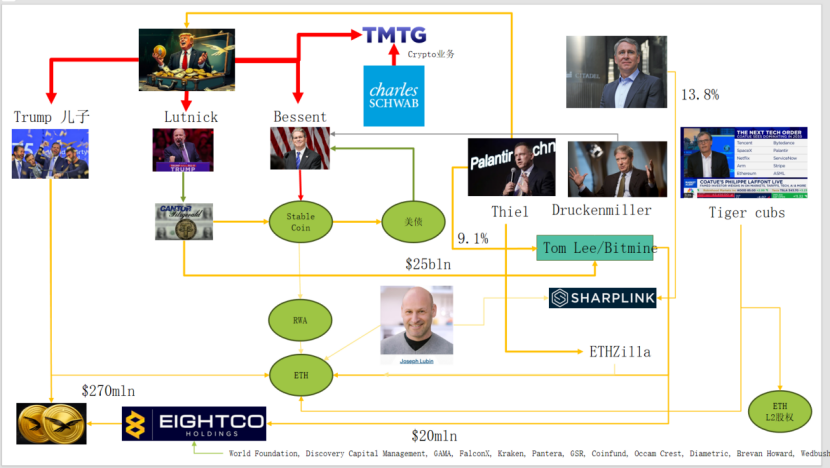
From this chart, we can see the intricate connections between the Trump family, traditional bond market makers, the Treasury, tech companies, and crypto companies, with the green elliptical links forming the backbone:

(1) Stable Coins (USDT, USDC, dollar assets behind WLD, etc.)

The majority of reserve assets are short-term U.S. bonds + bank deposits, held through brokers like Cantor.

(2) U.S. Bonds (U.S. Treasuries)

Issued and managed by the Treasury / Bessent side.

Used by Palantir, Druckenmiller, Tiger Cubs, etc., as low-risk interest rate base holdings.

Also the yield assets pursued by stablecoins / treasury companies.

(3) RWA (Real World Assets)

From U.S. bonds, mortgages, accounts receivable to housing finance.

Tokenized through Ethereum L1 / L2 protocols.

(4) ETH & ETH L2 Equity

Ethereum is the main chain承接 RWA, stablecoins, DeFi, and AI-DeFi.

L2 equity / Token represents a claim on future trading volume and fee cash flows.

This chain expresses:

U.S. dollar credit → U.S. bonds → Stablecoin reserves → Various crypto treasury / RWA protocols → Ultimately沉淀 on ETH / L2.

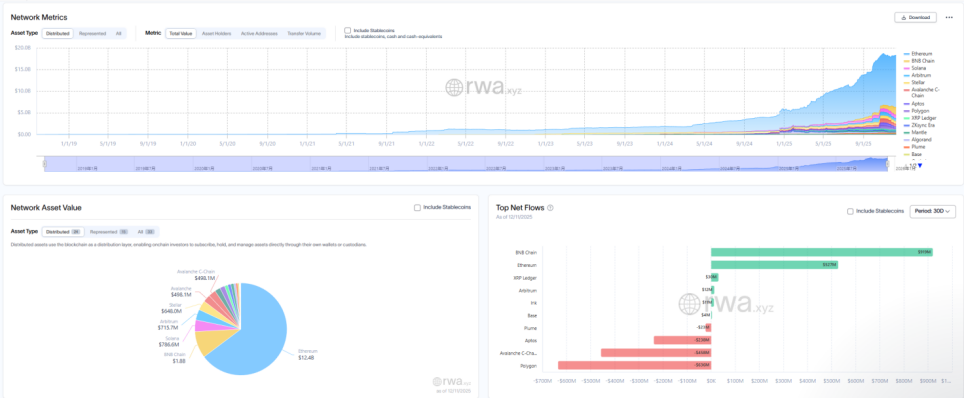
In terms of RWA TVL, compared to other public chains that declined after the October 11 crash, ETH is the only public chain that quickly recovered and rose. Its current TVL is $12.4 billion, accounting for 64.5% of the total crypto market.
II. Ethereum Explores Value Capture

The recent Ethereum Fusaka upgrade did not cause much stir in the market, but from the perspective of network structure and economic model evolution, it is a "milestone event." Fusaka is not just about scaling through EIPs like PeerDAS but also attempts to address the issue of insufficient value capture by the L1 mainnet due to L2 development.
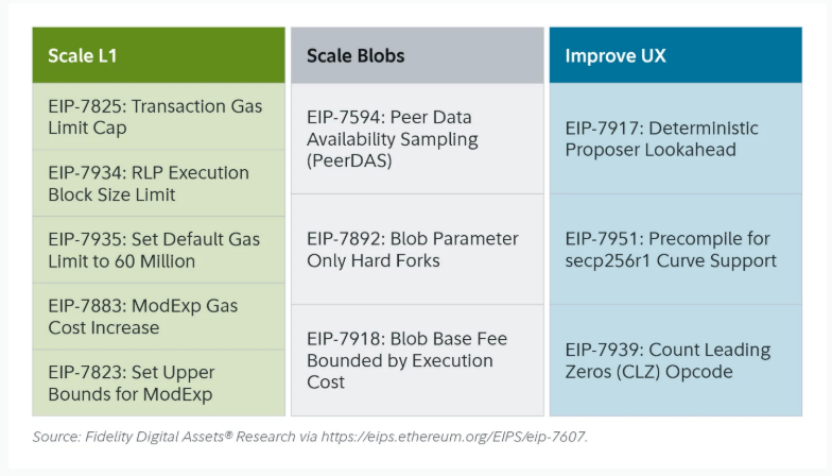
Through EIP-7918, ETH introduces a "dynamic floor price" for blob base fees, binding its lower limit to the L1 execution layer base fee, requiring blobs to pay at least about 1/16 of the L1 base fee unit price for DA fees. This means Rollups can no longer occupy blob bandwidth at near-zero cost for extended periods, and the corresponding fees will be burned and回流 to ETH holders.
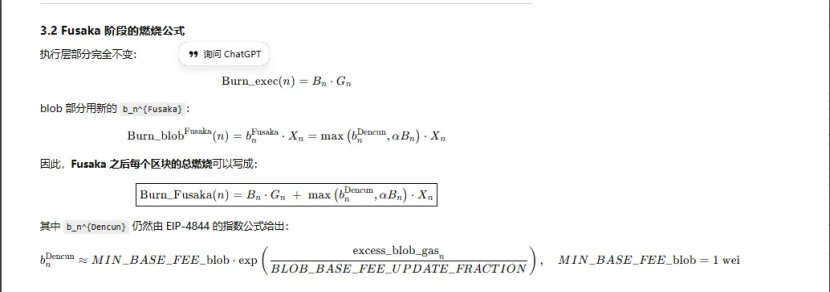
There have been three upgrades related to "burning" in Ethereum:

(1) London (Single-dimension): Only burned the execution layer; ETH began to experience structural burning due to L1 usage.

(2) Dencun (Dual-dimension + independent blob market): Burned execution layer + blob; L2 data写入 blob also burned ETH, but during low demand, the blob portion was almost 0.

(3) Fusaka (Dual-dimension + blob bound to L1): To use L2 (blob), one must pay at least a fixed proportion of the L1 base fee, which is burned. L2 activity is more stably mapped to ETH burning.
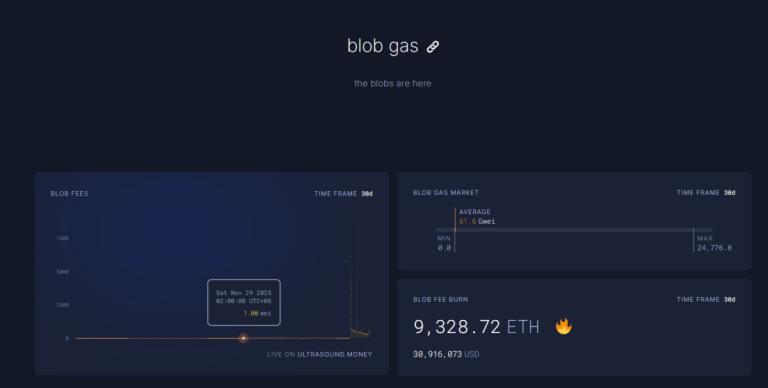
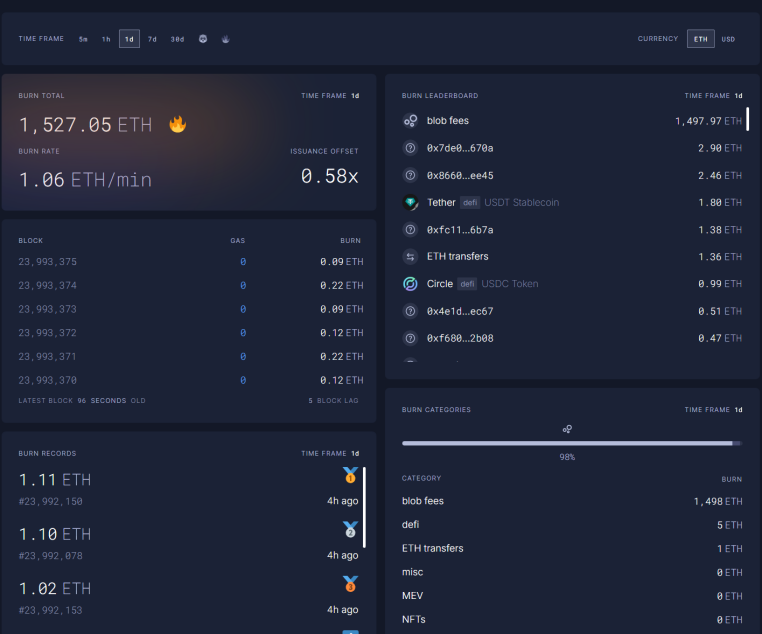
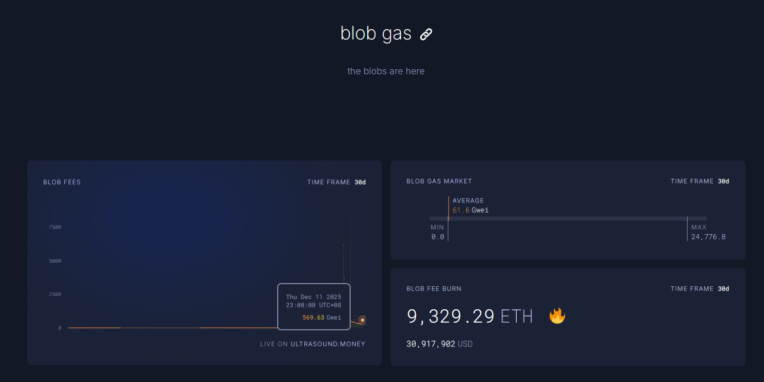
As of December 11, 23:00, the 1-hour blob fees have reached 569.63 billion times the pre-Fusaka upgrade level, burning 1,527 ETH in one day. Blob fees now contribute the highest proportion to burning,高达 98%. As ETH L2 becomes more active, this upgrade is expected to return ETH to deflation.

III. Ethereum Technicals Strengthen

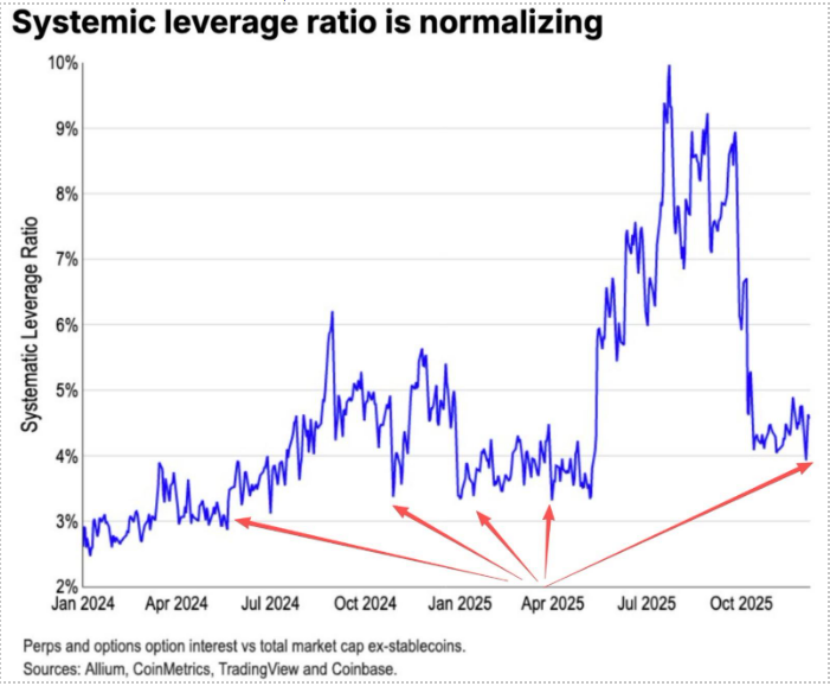
During the October 11 crash, ETH's futures leverage was thoroughly cleared, eventually reaching the spot leverage盘. At the same time, many with insufficient faith in ETH led to many early OG investors reducing their holdings and fleeing. According to Coinbase data, speculative leverage in the crypto圈 has dropped to a historically low region of 4%.
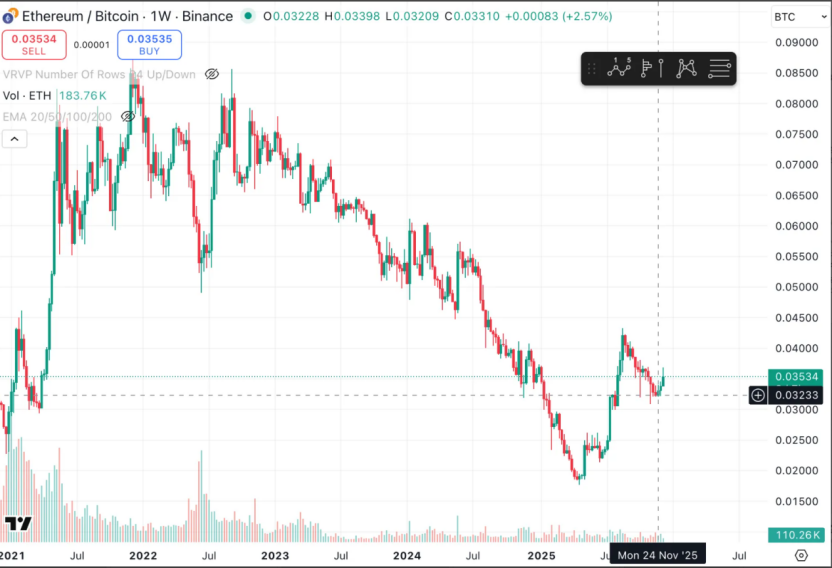
In the past, a significant portion of ETH short positions came from traditional Long BTC/Short ETH paired trades, which generally performed very well during bear markets. However, this time an意外 occurred. The ETH/BTC ratio has maintained a sideways resistance trend since November.
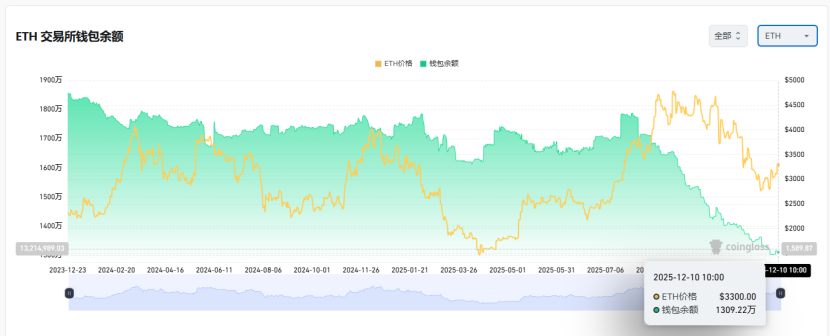
ETH's current存量 on exchanges is 13 million coins, about 10% of the total supply, at a historical low. As the Long BTC/Short ETH pairing has failed since November, during extreme panic, a "short squeeze" opportunity may gradually emerge.
As we approach the interaction between 2025 and 2026, future monetary and fiscal policies from both China and the U.S. have released friendly signals:

The U.S. will actively pursue tax cuts, interest rate reductions, and relaxed crypto regulations. China will implement appropriate easing and financial stability (suppressing volatility).

Under the expectations of relative easing in China and the U.S., and scenarios suppressing downward asset volatility, during extreme panic when capital and sentiment have not fully recovered, ETH is still in a good buying "sweet spot."


Twitter:https://twitter.com/BitpushNewsCN

Bitpush TG Discussion Group:https://t.me/BitPushCommunity

Bitpush TG Subscription: https://t.me/bitpush

Original Link:https://www.bitpush.news/articles/7595197

Domande pertinenti

QWhat is the new narrative chain formed by Wall Street and Washington in the crypto space according to the article?

AThe narrative chain is: U.S. political and economic elites → U.S. Treasury bonds (national debt) → Stablecoins / crypto treasury companies → Ethereum + RWA + L2.

QHow does the Fusaka upgrade aim to address the issue of L1 value capture on Ethereum?

AThe Fusaka upgrade introduces EIP-7918, which binds the blob base fee to a 'dynamic floor price' linked to the L1 execution layer base fee. This requires Rollups to pay at least approximately 1/16 of the L1 base fee for data availability, ensuring fees are burned and value flows back to ETH holders.

QWhat advantage does tokenization bring to asset ownership and settlement as highlighted by SEC Chairman Paul Atkins?

ATokenization provides high transparency in ownership structure and asset attributes, and enables 'T+0' settlement, replacing the current 'T+1' cycle, thereby reducing market risk and improving transparency.

QWhy is ETH considered to be in a good 'buying zone' or 'best offensive position' according to the article?

AETH is in a favorable position due to low leverage in the market (4%), reduced exchange supply (10% of total supply), the failure of Long BTC/Short ETH paired trades, and expectations of宽松 monetary policies from both the U.S. and China in 2025-2026.

QWhat role does Ethereum play in the RWA (Real World Assets) ecosystem based on the article?

AEthereum is the main chain hosting RWA protocols, stablecoins, and DeFi, with its L1/L2 used for tokenizing assets like U.S. Treasury bonds, mortgages, and accounts receivable. It holds 64.5% of the total crypto TVL in RWA.

Letture associate

Gensyn AI: Don't Let AI Repeat the Mistakes of the Internet

In recent months, the rapid growth of the AI industry has attracted significant talent from the crypto sector. A persistent question among researchers intersecting both fields is whether blockchain can become a foundational part of AI infrastructure. While many previous AI and Crypto projects focused on application layers (like AI Agents, on-chain reasoning, data markets, and compute rentals), few achieved viable commercial models. Gensyn differentiates itself by targeting the most critical and expensive layer of AI: model training. Gensyn aims to organize globally distributed GPU resources into an open AI training network. Developers can submit training tasks, nodes provide computational power, and the network verifies results while distributing incentives. The core issue addressed is not decentralization for its own sake, but the increasing centralization of compute power among tech giants. In the era of large models, access to GPUs (like the H100) has become a decisive bottleneck, dictating the pace of AI development. Major AI companies are heavily dependent on large cloud providers for compute resources. Gensyn's approach is significant for several reasons: 1) It operates at the core infrastructure layer (model training), the most resource-intensive and technically demanding part of the AI value chain. 2) It proposes a more open, collaborative model for compute, potentially increasing resource utilization by dynamically pooling idle GPUs, similar to early cloud computing logic. 3) Its technical moat lies in solving complex challenges like verifying training results, ensuring node honesty, and maintaining reliability in a distributed environment—making it more of a deep-tech infrastructure company. 4) It targets a validated, high-growth market with genuine demand, rather than pursuing blockchain integration without purpose. Ultimately, the boundaries between Crypto and AI are blurring. AI requires global resource coordination, incentive mechanisms, and collaborative systems—areas where crypto-native solutions excel. Gensyn represents a step toward making advanced training capabilities more accessible and collaborative, moving beyond a niche controlled by a few giants. If successful, it could evolve into a fundamental piece of AI infrastructure, where the most enduring value in the AI era is often created.

marsbit9 h fa

Gensyn AI: Don't Let AI Repeat the Mistakes of the Internet

marsbit9 h fa

Why is China's AI Developing So Fast? The Answer Lies Inside the Labs

A US researcher's visit to China's top AI labs reveals distinct cultural and organizational factors driving China's rapid AI development. While talent, data, and compute are similar to the West, Chinese labs excel through a pragmatic, execution-focused culture: less emphasis on individual stardom and conceptual debate, and more on teamwork, engineering optimization, and mastering the full tech stack. A key advantage is the integration of young students and researchers who approach model-building with fresh perspectives and low ego, prioritizing collective progress over personal credit. This contrasts with the US culture of self-promotion and "star scientist" narratives. Chinese labs also exhibit a strong "build, don't buy" mentality, preferring to develop core capabilities—like data pipelines and environments—in-house rather than relying on external services. The ecosystem feels more collaborative than tribal, with mutual respect among labs. While government support exists, its scale is unclear, and technical decisions appear driven by labs, not state mandates. Chinese companies across sectors, from platforms to consumer tech, are building their own foundational models to control their tech destiny, reflecting a broader cultural drive for technological sovereignty. Demand for AI is emerging, with spending patterns potentially mirroring cloud infrastructure more than traditional SaaS. Despite challenges like a less mature data industry and GPU shortages, Chinese labs are propelled by vast talent, rapid iteration, and deep integration with the open-source community. The competition is evolving beyond a pure model race into a contest of organizational execution, developer ecosystems, and industrial pragmatism.

marsbit11 h fa

Why is China's AI Developing So Fast? The Answer Lies Inside the Labs

marsbit11 h fa

3 Years, 5 Times: The Rebirth of a Century-Old Glass Factory

Corning, a 175-year-old glass company, is experiencing a dramatic revival as a key player in AI infrastructure, driven by surging demand for high-performance optical fiber in data centers. AI data centers require vastly more fiber than traditional ones—5 to 10 times as much per rack—to handle high-speed data transmission between GPUs. This structural demand shift, coupled with supply constraints from the lengthy expansion cycle for fiber preforms, has created a significant supply-demand gap. Nvidia has invested in Corning, along with Lumentum and Coherent, in a $4.5 billion total commitment to secure the optical supply chain for AI. Corning's competitive edge lies in its expertise in producing ultra-low-loss, high-density, and bend-resistant specialty fiber, which is critical for 800G+ and future 1.6T data rates. Its deep involvement in co-packaged optics (CPO) with partners like Nvidia further solidifies its position. While not the largest fiber manufacturer globally, Corning's revenue from enterprise/data center clients now exceeds 40% of its optical communications sales, and it has secured multi-year supply agreements with major hyperscalers including Meta and Nvidia. Financially, Corning's optical communications revenue has surged, doubling from $1.3 billion in 2023 to over $3 billion in 2025. Its stock price has risen nearly 6-fold since late 2023. Key future catalysts include the rollout of Nvidia's CPO products and the scale of undisclosed customer agreements. However, risks include high current valuations and potential disruption from next-generation technologies like hollow-core fiber. The company's long-term bet on light over electricity, maintained even through the telecom bubble crash, is now being validated by the AI boom.

marsbit11 h fa

3 Years, 5 Times: The Rebirth of a Century-Old Glass Factory

marsbit11 h fa

Trading

Spot
Futures

Articoli Popolari

Come comprare MAY

Benvenuto in HTX.com! Abbiamo reso l'acquisto di Mayflower (MAY) semplice e conveniente. Segui la nostra guida passo passo per intraprendere il tuo viaggio nel mondo delle criptovalute.Step 1: Crea il tuo Account HTXUsa la tua email o numero di telefono per registrarti il tuo account gratuito su HTX. Vivi un'esperienza facile e sblocca tutte le funzionalità,Crea il mio accountStep 2: Vai in Acquista crypto e seleziona il tuo metodo di pagamentoCarta di credito/debito: utilizza la tua Visa o Mastercard per acquistare immediatamente MayflowerMAY.Bilancio: Usa i fondi dal bilancio del tuo account HTX per fare trading senza problemi.Terze parti: abbiamo aggiunto metodi di pagamento molto utilizzati come Google Pay e Apple Pay per maggiore comodità.P2P: Fai trading direttamente con altri utenti HTX.Over-the-Counter (OTC): Offriamo servizi su misura e tassi di cambio competitivi per i trader.Step 3: Conserva Mayflower (MAY)Dopo aver acquistato Mayflower (MAY), conserva nel tuo account HTX. In alternativa, puoi inviare tramite trasferimento blockchain o scambiare per altre criptovalute.Step 4: Scambia Mayflower (MAY)Scambia facilmente Mayflower (MAY) nel mercato spot di HTX. Accedi al tuo account, seleziona la tua coppia di trading, esegui le tue operazioni e monitora in tempo reale. Offriamo un'esperienza user-friendly sia per chi ha appena iniziato che per i trader più esperti.

150 Totale visualizzazioniPubblicato il 2025.07.01Aggiornato il 2025.07.01

Come comprare MAY

Discussioni

Benvenuto nella Community HTX. Qui puoi rimanere informato sugli ultimi sviluppi della piattaforma e accedere ad approfondimenti esperti sul mercato. Le opinioni degli utenti sul prezzo di MAY MAY sono presentate come di seguito.

活动图片