Hash Global Founder: Why I Also Choose to Liquidate All My ETH Holdings?

marsbitPubblicato 2026-05-28Pubblicato ultima volta 2026-05-28

Introduzione

Hash Global founder explains his decision to sell all ETH holdings, despite recognizing the potential regulatory clarity from the US CLARITY Act as a positive development. He argues against the narrative that such clarity would automatically grant ETH a "monetary premium" comparable to Bitcoin or gold. The core of his critique is that market valuation for ETH remains tied to fundamental network metrics—like mainnet revenue, DeFi activity, staking yield, and competition—rather than a pure store-of-value narrative. He contends that legal classification solves compliance issues for institutions but does not inherently create the deep, historical consensus required for monetary status. Furthermore, Ethereum's complexity and role as a multi-functional infrastructure asset (gas, collateral, settlement layer) work against the simple narrative needed for such a premium. Looking forward, he suggests that the rise of DeFi and tokenized real-world assets (RWA) will mean ETH is not the only yield-bearing asset; tokenized gold, treasuries, and others will also offer programmable yield. Thus, ETH's "yielding" advantage diminishes. He believes monetary premium will likely remain with Bitcoin, physical gold, and potentially tokenized gold, while ETH's value is more accurately framed as a crucial infrastructure asset. Ultimately, he views CLARITY's benefit as reducing a "regulatory discount" on ETH, not unlocking trillions in monetary re-rating. ETH's long-term value is significant but ste...

Author: HashGlobal KK Hash Global Founder

Compiled by: Jiahuan, ChainCatcher

The author has liquidated all held ETH positions. This article was published on May 24th.
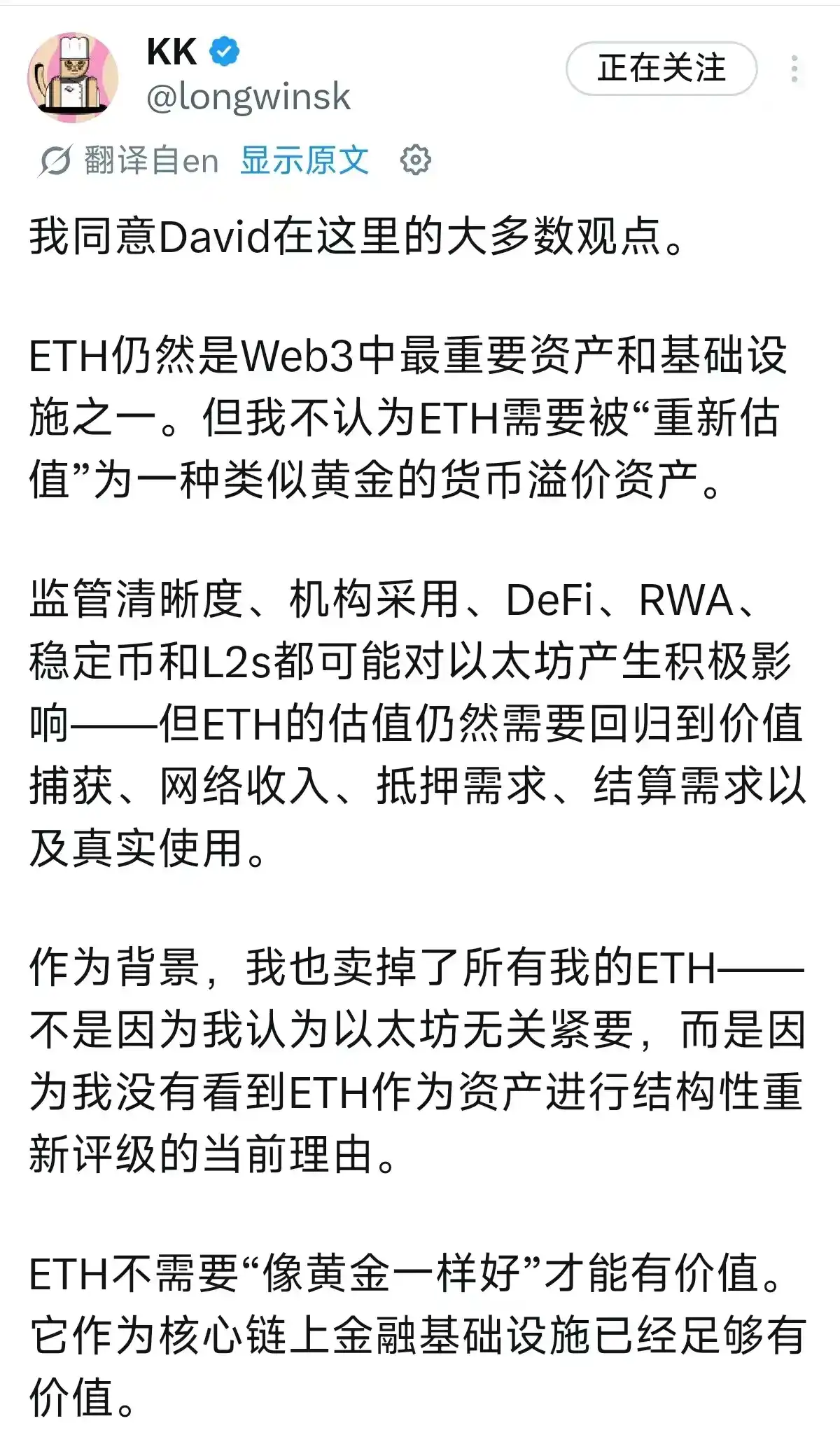
Recently I read an article with the viewpoint that if the US CLARITY Act passes, Ethereum will become the biggest winner.

Its core argument is that ETH could become the only asset under the US regulatory framework that possesses both "decentralized digital commodity" and "programmable smart contract platform" attributes. Therefore, ETH's valuation framework should shift from network revenue logic to a monetary premium logic similar to BTC, gold, or even sovereign reserve assets.

I find this viewpoint enlightening, but the conclusion may be somewhat overextended.

This is not to say I am bearish on ETH or deny the benefits of CLARITY.

On the contrary, regulatory clarity is undoubtedly a significant positive for ETH. It will reduce compliance concerns for institutional allocation to ETH and help further develop ETFs, custody services, staking, institutional DeFi, RWA, and on-chain settlement businesses.

However, regulatory clarity is not equivalent to a monetary premium.

CLARITY may resolve ETH's "regulatory discount," but it will not automatically open up valuation space related to gold, real estate, or global reserve assets.

These are two distinctly different matters and should be analyzed separately.

1. The Market Hasn't Bought Into This Logic Yet

If the market truly viewed ETH as "programmable gold" or a "yield-bearing monetary asset," its valuation should be much closer to BTC's.

But that is not the case.

When evaluating ETH, the market still focuses on specific metrics:

  • Ethereum mainnet revenue;
  • DeFi activity levels;
  • Whether stablecoins and RWAs settle primarily within the Ethereum ecosystem;
  • Value flow from L2 to L1;
  • ETH staking yields;
  • Fund inflows into ETH ETFs;
  • Competition from ecosystems like Solana, BNB Chain, and Base.

These are essentially valuation logics for network assets, platform assets, and ecosystem assets.

BTC is different. It has no cash flow, no application ecosystem, and no discussion of network revenue. Its logic is simple: 21 million supply cap, non-sovereign, censorship-resistant, digital gold. People may not agree with this narrative, but it is simple, clear, and easy to propagate.

ETH's narrative is far more complex. ETH serves as gas fees, a staking asset, DeFi collateral, an L2 settlement asset, and infrastructure for institutional on-chain finance. While multiple functions are an advantage, monetary premiums typically require an extremely simple narrative.

Complexity benefits ecosystem development but does not necessarily contribute to forming a monetary premium like gold and BTC.

2. Legal Classification is Just the Entry Ticket

The original article makes a critical leap: because ETH may be legally recognized as a decentralized digital commodity, it should enter the valuation framework of top-tier monetary premium assets.

I believe this inference is problematic.

Legal classification solves the question: Can institutions hold it compliantly? Can they trade it compliantly? Can they provide compliant custody? Can they develop related products compliantly?

Monetary premium solves the question: Is the global market willing to hold it as a long-term store of wealth?

These are two different questions.

Gold possesses a monetary premium not because any single law classifies it as such, but because millennia of historical consensus, physical scarcity, central bank reserve demand, and geopolitical safe-haven attributes have collectively formed a massive consensus.

BTC possesses a monetary premium not because it can execute smart contracts, but because it is simple enough, pure enough, and sufficiently resembles "digital gold."

For ETH to gain a monetary premium, regulatory classification alone is insufficient. It must also prove that global capital is willing to hold ETH as a long-term store of value, not just as a significant on-chain financial infrastructure asset.

There remains a significant gap between these two states.

3. DeFi Will Weaken ETH's "Sole Yield-Bearing" Narrative

The original article emphasizes an advantage of ETH: ETH can generate yield through staking, whereas BTC and gold cannot.

While this holds some truth today, the situation may change in the coming years.

With the development of DeFi and RWAs, many assets will be tokenized in the future. Gold, treasuries, money market funds, real estate funds, income rights, commodities, and stock ETFs can all enter the on-chain financial system as tokens.

Once these assets are on-chain, they will also gain new capabilities:

  • Can be used as collateral;
  • Can be borrowed/lent;
  • Can be used for market making;
  • Can be combined into structured yield products;
  • Can be integrated with DeFi protocols;
  • Can form closed-loop on-chain capital flows with stablecoins.

Therefore, in the future, ETH will not be the only asset that "generates yield."

Tokenized gold integrated with DeFi can also generate on-chain yield. Tokenized treasuries and money market funds inherently possess underlying yields. Tokenized real estate funds and other RWAs can also generate cash flow.

By then, the question will no longer be "ETH can generate yield, gold cannot."

The real questions will become: Which is better collateral? Which has lower volatility? Which has clearer yield sources? Which has higher regulatory acceptance? Which is more suitable for institutional balance sheets? Which is easier for global capital to hold long-term?

From this perspective, ETH may have no advantage compared to tokenized gold, tokenized treasuries, or tokenized money market funds.

ETH's staking yield comes from network security mechanisms, not traditional risk-free returns. It carries protocol risk, validator risk, slashing risk, liquid staking protocol risk, regulatory risk, and price volatility risk.

For institutions, ETH staking is certainly a valuable feature, but it should not be directly equated with "superior to gold."

4. Monetary Premium Belongs to BTC, Gold, and Tokenized Gold

I am more inclined to believe that in the future, monetary premiums will primarily belong to BTC, gold, and potentially tokenized gold.

BTC's positioning is clear: digital gold.

Gold's positioning is also clear: the most important non-sovereign store of value in the traditional world.

If tokenized gold develops, the situation could become very attractive. It would inherit gold's historical credibility while gaining on-chain liquidity, composability, and collateral capability. In this scenario, gold's monetary premium wouldn't necessarily flow to ETH; on the contrary, it might be further strengthened by tokenized gold itself.

This isn't necessarily bad for ETH. These tokenized assets also require on-chain infrastructure and could be issued, traded, and collateralized on Ethereum or Ethereum L2s.

However, this means ETH is more of an infrastructure asset, not the ultimate monetary premium asset.

Infrastructure is certainly valuable. But infrastructure valuations typically revert to usage metrics, revenue, network effects, and value capture, not direct analogies to gold's total market cap, real estate's monetary premium, or the global reserve asset pool.

5. Ethereum's Value Capture Problem Remains Unresolved

The original article posits that CLARITY will widen the gap between ETH and other smart contract platforms, with other L1s potentially entering a second-tier valuation, while ETH remains in the first tier.

This judgment also requires cautious treatment.

The real world will not choose a blockchain based solely on US regulatory classification.

Different countries, assets, and institutions will choose underlying networks based on multiple factors:

  • Cost;
  • Performance;
  • Compliance interfaces;
  • KYC/AML requirements;
  • Local regulatory attitudes;
  • Ecosystem resources;
  • Liquidity;
  • Relationships with asset issuers and service providers;
  • Need for a permissioned environment.

Many RWA, stablecoin, and payment scenarios may not necessarily choose the Ethereum mainnet. They might opt for L2s, app-chains, consortium chains, or other L1s that better align with local regulations and business needs.

More importantly, even if significant activity occurs within the Ethereum ecosystem, it does not guarantee that ETH will capture value proportionally.

As we have seen in recent years, while L2s expand the Ethereum ecosystem, they also pose a question: once L2s scale, how much value truly flows back to ETH?

If large transaction volumes occur on L2s with continuously decreasing fees, and the application layer and L2s themselves capture more user value, while the ETH mainnet only handles final settlement and security, then ETH's value capture capability remains to be proven.

One cannot assume that Ethereum ecosystem growth automatically translates into proportional ETH value appreciation.

This is why I believe ETH's valuation must revert to concrete questions about network revenue, settlement demand, collateral demand, staking yield, and ecosystem value flow.

6. Using Ethereum ≠ Buying ETH

Another distinction is needed: institutions entering on-chain finance does not mean they will allocate ETH as a core asset.

Institutions might:

  • Use the Ethereum network;
  • Use Ethereum L2s;
  • Issue tokenized funds;
  • Use stablecoins for settlement;
  • Use on-chain custody and compliant transfer tools;
  • Use DeFi or permissioned DeFi;
  • Indirectly access on-chain finance through service providers.

None of these require them to purchase large amounts of ETH.

Just as companies heavily using cloud services do not necessarily buy the cloud service company's stock, institutions using blockchain infrastructure do not necessarily need to hold the underlying token long-term.

For ETH to transition from a "used network" to a "long-term held asset," a clear value capture mechanism is needed.

If this mechanism remains unclear, the market will continue to evaluate ETH based on revenue, fees, staking yield, and ecosystem growth.

7. Grand Narratives Can't Support Valuation Anymore

In the last cycle, the market was willing to assign valuations based on grand narratives.

"World computer," "Internet of Value," "Global settlement layer," "Decentralized financial cornerstone" – these narratives were very powerful. Ethereum was undoubtedly the most important representative.

But the market has changed.

Investors are increasingly asking: Where is the revenue? Where are the users? Where is the value capture? Where is the real demand? Where is the regulatory path? Where is the closed-loop business logic?

As we have repeatedly emphasized in recent years, Web3 cannot just stay at the vision stage; it must ultimately return to fundamental value and basic business logic.

Can it make money? Can it provide a better user experience? Can it create real economic value? If these questions cannot be answered, even the grandest narratives will struggle to sustain valuation long-term.

The same applies to ETH.

While it is certainly one of the most important Web3 infrastructures, for higher valuation, the market may need to see:

  • Resurgence of DeFi growth;
  • Recovery of mainnet revenue;
  • Clearer value flow from L2 to L1;
  • Real settlement demand for stablecoins and RWAs within the Ethereum ecosystem;
  • Sustained growth in ETH collateral demand;
  • Institutions not just using Ethereum, but genuinely needing to hold ETH.

None of these can be automatically achieved by a single piece of legislation.

8. CLARITY's Real Significance is Fixing the Regulatory Discount

Therefore, I tend to view CLARITY's impact on ETH as reducing the regulatory discount, not unlocking a multi-trillion dollar monetary premium revaluation potential.

ETH did face regulatory uncertainty in the past. If US regulators more clearly recognize ETH's commodity attribute, that would be a significant positive.

However, this would shift ETH from a "network asset with regulatory tail risk" to a "network asset with clearer regulation."

This is already significant.

But it does not mean ETH will automatically become a substitute for gold, BTC, or global reserve assets.

If the market continues to evaluate ETH based on network revenue, staking yield, L2 value flow, DeFi activity, RWA settlement volume, and institutional usage, then ETH's valuation will remain constrained by fundamentals.

This isn't necessarily bad. Excellent infrastructure assets deserve high value. But they are not equivalent to monetary premium assets.

9. My Stance on ETH

I still believe ETH is one of the most important assets in the digital asset industry.

Its long-term value stems from several aspects: First, it is the most important open smart contract network.

Second, it is a key settlement layer for DeFi, stablecoins, RWAs, and on-chain finance.

Third, from a regulatory perspective, it is one of the most defensible decentralized infrastructures.

Fourth, it has accumulated long-term developer, application, asset, and institutional recognition.

Fifth, as Web3 enters large-scale commercial applications, it may become an extremely important underlying trust and settlement asset.

However, these values are more akin to infrastructure value, network value, ecosystem value, and collateral value.

It may enjoy some scarcity premium, regulatory clarity premium, and network effect premium, but not necessarily the pure monetary premium enjoyed by BTC or gold.

ETH has significant long-term value, but its valuation framework should not be incorrectly substituted.

10. CLARITY Benefits ETH, But Don't Treat ETH Like Gold

My core judgment on this matter is straightforward:

CLARITY benefits ETH, but this does not mean ETH should be valued like gold.

Regulatory clarity is a positive, but it is not equivalent to a monetary premium.

ETH is an extremely important on-chain financial infrastructure asset, but it may not become the ultimate store of wealth for the world.

In the future, those truly enjoying monetary premiums will likely still primarily be BTC, gold, and potentially tokenized gold and other high-credit store-of-value assets. ETH is more likely to serve as the core infrastructure for these assets to be on-chain, circulated, collateralized, settled, and composed.

This position is already important enough; there's no need to force-fit ETH into a "superior to gold" narrative.

A more robust valuation framework for ETH might be: regulatory clarity drives discount repair; institutional entry drives demand increase; DeFi, RWA, stablecoin, and L2 ecosystems determine network usage; network revenue, collateral demand, and value flow determine long-term valuation; monetary premium can be an optimistic scenario but should not be the base assumption.

These are my main reservations regarding the ETH revaluation argument.

The Web3 industry often extrapolates real positives into huge valuation stories. While imagination is valuable, returning to fundamental questions is more critical.

What problem does this asset actually solve? Who will hold it long-term? What are the returns and risks of holding it? Where does its value truly come from? If the ecosystem develops, will value really accumulate to this token?

If these questions cannot be clearly answered, regulatory classification alone will struggle to support a genuine valuation leap.


Domande pertinenti

QWhat is the author's main argument regarding the impact of the CLARITY Act on ETH's valuation?

AThe author argues that while the CLARITY Act is undoubtedly a positive regulatory development for ETH, it should be viewed primarily as reducing the 'regulatory discount' on ETH rather than unlocking a 'monetary premium' valuation comparable to gold or Bitcoin. The Act will ease institutional compliance and adoption but does not automatically elevate ETH into the valuation framework of a global reserve or monetary asset.

QAccording to the author, why does ETH currently lack a 'monetary premium' like Bitcoin?

AThe author states that ETH lacks a monetary premium because its narrative is complex—it functions as gas, a staking asset, DeFi collateral, and infrastructure. In contrast, Bitcoin's value proposition is simple and pure: a fixed supply, non-sovereign, censorship-resistant 'digital gold.' Monetary premiums typically require simple, easily communicable narratives.

QHow does the author believe DeFi and RWA development will affect ETH's 'yield-bearing' narrative?

AThe author believes that as DeFi and Real-World Assets (RWA) develop, many assets like tokenized gold, treasuries, and real estate will also become yield-bearing on-chain through their use as collateral, in lending, and in structured products. Therefore, ETH will not be the only 'yield-bearing' asset, and its staking yield, which carries protocol and volatility risks, may not hold a distinct advantage over traditional yield-bearing assets in the eyes of institutions.

QWhat key distinction does the author make between 'using Ethereum' and 'buying ETH'?

AThe author distinguishes that institutions may use the Ethereum network, its L2s, or issue tokenized assets on it without needing to hold significant amounts of ETH as a core asset on their balance sheets. Just as using cloud services doesn't require buying the cloud provider's stock, using blockchain infrastructure does not necessitate holding the underlying token. For ETH's valuation to rise, a clear mechanism for value capture is needed.

QWhat does the author identify as the primary driver for ETH's long-term valuation, as opposed to a monetary premium?

AThe author identifies that ETH's long-term valuation should be driven by fundamentals such as network revenue, staking yields, demand for ETH as collateral, value flow from L2s to L1, DeFi activity, and real settlement demand for stablecoins and RWAs within its ecosystem. Its value is that of a critical infrastructure, network, and ecosystem asset, not primarily a monetary store-of-value asset.

Letture associate

The Truth About Global Payments, Exposed by Airwallex

Airwallex's founder, Jack Zhang, outlines the three primary paths in the global payments industry and explains why the company chooses the most demanding one: building its own global financial infrastructure. The article begins by highlighting a common industry problem: payment platforms appear homogenized on the surface, offering similar features like global acquiring and multi-currency accounts. However, their underlying capabilities differ vastly. Customers truly care about payment stability, compliance robustness, and reliable market entry support. Zhang identifies three strategic paths: 1. **Bypassing Traditional Systems (Web3/Crypto):** This path promises efficiency via stablecoins and blockchain settlement but struggles with mainstream adoption, significant regulatory friction, and a lack of competitive edge against established players, often leaving it with niche or non-compliant markets. 2. **Packaging Existing Infrastructure:** The most common route, where companies layer a modern interface over legacy banking and partner networks. While enabling fast expansion, it fails to solve core issues like dependency on correspondent banks and intermediary risk, merely postponing the need for solid foundations. 3. **Building Own Global Infrastructure:** The path chosen by Airwallex, Ant International, and others. It involves obtaining local licenses, establishing direct regulatory relationships, building local teams, and controlling the full technology stack. This "heavy" approach is slow and capital-intensive but aims to internalize complexity, providing customers with a "lighter" experience. The core argument is that for business clients, the highest cost isn't transaction fees but hidden risks like frozen accounts, payment delays, and regulatory shocks. By investing heavily in its own infrastructure, Airwallex seeks to absorb these complexities, offering customers greater stability, cost savings (beyond fees), and long-term certainty. This foundational investment, though initially slow, enables compound growth, as evidenced by Airwallex's accelerated revenue scaling. In conclusion, while shortcuts enable faster growth, mastering the most difficult aspects—owning the underlying infrastructure—creates durable value for customers and sustainable advantage for the payment provider.

marsbit2 h fa

The Truth About Global Payments, Exposed by Airwallex

marsbit2 h fa

The Truth About Global Payments, Revealed by Airwallex

The article discusses Airwallex's approach to global payments, highlighting the key challenges and different strategic paths in the industry. It begins by addressing common user questions about platform reliability, cryptocurrency payments, and the necessity of Airwallex's "heavy" infrastructure model. The core argument is that while many payment platforms appear similar on the surface—offering features like global acquiring and multi-currency accounts—their underlying capabilities differ drastically. The piece identifies three primary paths for global payment providers: 1. **Bypassing Traditional Infrastructure (Web3/Crypto):** This path promises efficiency through stablecoins and on-chain settlements but faces significant regulatory hurdles and offers little advantage over established players for mainstream use, often serving only niche or non-compliant markets. 2. **Aggregating/Packaging Existing Infrastructure:** The most common route, where companies layer a better user experience over legacy banking and partner networks. While fast to market, this approach does not solve fundamental issues like dependency on intermediaries, correspondent banking risks, and compliance fragility. 3. **Building Proprietary Global Infrastructure:** The path chosen by Airwallex and similar firms. This involves obtaining local licenses, building direct regulatory relationships, establishing local teams, and controlling the compliance and technology stack. This is the most difficult and capital-intensive route but aims to internalize complexity. Airwallex's strategy of "heavy" investment in its own infrastructure is framed not as inefficiency, but as a long-term bet to provide clients with greater stability, cost savings beyond fees, and certainty. The platform's "heaviness" absorbs risk and operational complexity, aiming to deliver a "lighter" experience for business customers. The article concludes that in global payments, while shortcuts enable faster growth, mastering the most difficult aspects—the underlying infrastructure—is what creates durable value for clients and sustainable competitive advantage.

链捕手2 h fa

The Truth About Global Payments, Revealed by Airwallex

链捕手2 h fa

Trading

Spot
Futures

Articoli Popolari

Cosa è ETH 3.0

ETH3.0 e $eth 3.0: Un'Analisi Approfondita del Futuro di Ethereum Introduzione Nel panorama in rapida evoluzione delle criptovalute e della tecnologia blockchain, ETH3.0, spesso indicato come $eth 3.0, è emerso come un argomento di considerevole interesse e speculazione. Il termine comprende due concetti principali che warrantono chiarimenti: Ethereum 3.0: Questo rappresenta un potenziale futuro aggiornamento volto ad aumentare le capacità dell'attuale blockchain di Ethereum, concentrandosi principalmente sul miglioramento della scalabilità e delle prestazioni. ETH3.0 Meme Token: Questo progetto di criptovaluta distinto cerca di sfruttare la blockchain di Ethereum per creare un ecosistema incentrato sui meme, promuovendo il coinvolgimento all'interno della comunità delle criptovalute. Comprendere questi aspetti di ETH3.0 è essenziale non solo per gli appassionati di criptovalute, ma anche per coloro che osservano tendenze tecnologiche più ampie nello spazio digitale. Che cos'è ETH3.0? Ethereum 3.0 Ethereum 3.0 è pubblicizzato come un aggiornamento proposto per la rete Ethereum già stabilita, che è stata la spina dorsale di molte applicazioni decentralizzate (dApps) e contratti smart sin dalla sua nascita. I miglioramenti previsti si concentrano principalmente sulla scalabilità, integrando tecnologie avanzate come lo sharding e le prove a conoscenza zero (zk-proofs). Queste innovazioni tecnologiche mirano a facilitare un numero senza precedenti di transazioni al secondo (TPS), potenzialmente raggiungendo milioni, affrontando così una delle limitazioni più significative della tecnologia blockchain attuale. Il miglioramento non è meramente tecnico, ma anche strategico; è volto a preparare la rete Ethereum per un'adozione e un'utilità diffuse in un futuro contrassegnato da un aumento della domanda di soluzioni decentralizzate. ETH3.0 Meme Token Al contrario di Ethereum 3.0, l'ETH3.0 Meme Token si avventura in un dominio più leggero e giocoso, combinando la cultura dei meme di internet con la dinamica delle criptovalute. Questo progetto consente agli utenti di acquistare, vendere e scambiare meme sulla blockchain di Ethereum, fornendo una piattaforma che promuove il coinvolgimento della comunità attraverso la creatività e interessi condivisi. L'ETH3.0 Meme Token mira a dimostrare come la tecnologia blockchain possa intersecarsi con la cultura digitale, creando casi d'uso che siano sia divertenti che finanziariamente praticabili. Chi è il Creatore di ETH3.0? Ethereum 3.0 L'iniziativa verso Ethereum 3.0 è principalmente propulsa da un consorzio di sviluppatori e ricercatori all'interno della comunità di Ethereum, tra cui Justin Drake. Conosciuto per le sue intuizioni e contributi all'evoluzione di Ethereum, Drake è stato una figura di spicco nelle discussioni riguardanti la transizione di Ethereum verso un nuovo livello di consenso, chiamato “Beam Chain.” Questo approccio collaborativo allo sviluppo significa che Ethereum 3.0 non è il prodotto di un creatore singolo, ma piuttosto una manifestazione di ingegno collettivo focalizzato sul progresso della tecnologia blockchain. ETH3.0 Meme Token I dettagli riguardanti il creatore dell'ETH3.0 Meme Token sono attualmente non rintracciabili. La natura dei token meme conduce spesso a una struttura più decentralizzata e guidata dalla comunità, il che potrebbe spiegare la mancanza di attribuzione specifica. Questo si allinea con l'etica della comunità crypto più ampia, dove l'innovazione spesso nasce da sforzi collaborativi piuttosto che individuali. Chi sono gli Investitori di ETH3.0? Ethereum 3.0 Il supporto per Ethereum 3.0 proviene principalmente dalla Ethereum Foundation insieme a una comunità entusiasta di sviluppatori e investitori. Questa associazione fondamentale fornisce un considerevole grado di legittimità e migliora le prospettive di implementazione di successo poiché sfrutta la fiducia e la credibilità costruite nel corso degli anni di operazioni della rete. Nel clima in rapida evoluzione delle criptovalute, il supporto della comunità gioca un ruolo cruciale nello sviluppo e nell'adozione, posizionando Ethereum 3.0 come un serio contenditore per i futuri progressi della blockchain. ETH3.0 Meme Token Sebbene le fonti attualmente disponibili non forniscano informazioni esplicite riguardo ai fondamenti o alle organizzazioni di investimento che sostengono l'ETH3.0 Meme Token, ciò è indicativo del modello di finanziamento tipico per i token meme, che spesso si basa sul supporto di base e sul coinvolgimento della comunità. Gli investitori in tali progetti sono tipicamente individui motivati dal potenziale per innovazioni guidate dalla comunità e dallo spirito di cooperazione trovato all'interno della comunità crypto. Come Funziona ETH3.0? Ethereum 3.0 Le caratteristiche distintive dell'Ethereum 3.0 risiedono nella sua proposta di implementazione della tecnologia di sharding e zk-proof. Lo sharding è un metodo di partizionamento della blockchain in pezzi più piccoli e gestibili o “shard,” che possono elaborare transazioni in modo concorrente piuttosto che sequenziale. Questa decentralizzazione dell'elaborazione aiuta a prevenire la congestione e garantisce che la rete rimanga reattiva anche sotto un carico pesante. La tecnologia delle prove a conoscenza zero (zk-proof) contribuisce con un ulteriore livello di sofisticazione consentendo la validazione delle transazioni senza rivelare i dati sottostanti coinvolti. Questo aspetto non solo migliora la privacy, ma aumenta anche l'efficienza complessiva della rete. Si parla anche di incorporare una macchina virtuale Ethereum a conoscenza zero (zkEVM) in questo aggiornamento, amplificando ulteriormente le capacità e l'utilità della rete. ETH3.0 Meme Token L'ETH3.0 Meme Token si distingue capitalizzando sulla popolarità della cultura dei meme. Stabilisce un mercato per gli utenti che desiderano partecipare al trading di meme, non solo per divertimento, ma anche per potenziale guadagno economico. Integrando funzioni come lo staking, la fornitura di liquidità e meccanismi di governance, il progetto promuove un ambiente che incentiva l'interazione e la partecipazione della comunità. Offrendo una miscela unica di intrattenimento e opportunità economica, l'ETH3.0 Meme Token mira ad attrarre un pubblico variegato, che va dagli appassionati di crypto ai semplici intenditori di meme. Timeline di ETH3.0 Ethereum 3.0 11 Novembre 2024: Justin Drake accenna al prossimo aggiornamento ETH 3.0, incentrato sui miglioramenti della scalabilità. Questo annuncio segna l'inizio delle discussioni formali riguardo l'architettura futura di Ethereum. 12 Novembre 2024: La proposta attesa per Ethereum 3.0 dovrebbe essere svelata a Devcon a Bangkok, preparando il terreno per un feedback più ampio della comunità e potenziali passi successivi nello sviluppo. ETH3.0 Meme Token 21 Marzo 2024: L'ETH3.0 Meme Token viene ufficialmente elencato su CoinMarketCap, segnando il suo ingresso nel dominio pubblico delle criptovalute e aumentando la visibilità per il suo ecosistema basato sui meme. Punti Chiave In conclusione, Ethereum 3.0 rappresenta una significativa evoluzione all'interno della rete Ethereum, concentrandosi sul superamento delle limitazioni riguardanti scalabilità e prestazioni attraverso tecnologie avanzate. I suoi aggiornamenti proposti riflettono un approccio proattivo alle future esigenze e usabilità. D'altra parte, l'ETH3.0 Meme Token incarna l'essenza della cultura guidata dalla comunità nello spazio delle criptovalute, sfruttando la cultura dei meme per creare piattaforme coinvolgenti che incoraggiano la creatività e la partecipazione degli utenti. Comprendere gli scopi e le funzionalità distinte di ETH3.0 e $eth 3.0 è fondamentale per chiunque sia interessato ai continui sviluppi nello spazio crypto. Con entrambe le iniziative che tracciano percorsi unici, esse sottolineano collettivamente la natura dinamica e multifacetica dell'innovazione blockchain.

173 Totale visualizzazioniPubblicato il 2024.04.04Aggiornato il 2024.12.03

Cosa è ETH 3.0

Cosa è ETHEREUM

HarryPotterTrumpHomerSimpson777Inu: Panoramica di un Progetto Crypto Web3 Introduzione Nel mondo in rapida evoluzione delle criptovalute e della finanza decentralizzata, progetti innovativi emergono frequentemente, catturando l'interesse della comunità degli investitori e degli appassionati di crypto. Uno di questi progetti è HarryPotterTrumpHomerSimpson777Inu, una criptovaluta che si trova all'incrocio tra cultura popolare e tecnologia blockchain. Questo token guidato dalla comunità mescola personaggi e figure politiche ben noti, con l'obiettivo di creare una piattaforma coinvolgente e promuovere un'adozione diffusa. Che cos'è HarryPotterTrumpHomerSimpson777Inu? HarryPotterTrumpHomerSimpson777Inu è un token costruito sulla blockchain di Ethereum, progettato per essere accessibile e divertente per un pubblico diversificato. L'unicità di questo progetto deriva dal suo approccio tematico, che intreccia elementi di fantasia, politica e intrattenimento. Sfruttando il fascino nostalgico di personaggi amati, il progetto cerca di creare un'esperienza di criptovaluta coinvolgente, incoraggiando il coinvolgimento e la partecipazione della comunità. L'obiettivo principale di HarryPotterTrumpHomerSimpson777Inu è stabilire un token che risuoni con gli utenti a livello personale, promuovendo sia il divertimento che il coinvolgimento nell'ambito crypto. Questo branding distintivo mira ad attrarre individui che in precedenza potrebbero non essersi interessati alle criptovalute, facilitando un nuovo punto di ingresso per utenti potenziali. Creatore di HarryPotterTrumpHomerSimpson777Inu L'identità del creatore dietro HarryPotterTrumpHomerSimpson777Inu rimane sconosciuta. Questa non è una pratica rara nel dominio delle criptovalute, dove l'anonimato è spesso preferito dai fondatori come mezzo di protezione della privacy e promozione di un ethos decentralizzato. Questa oscurità non diminuisce il valore del progetto; al contrario, riflette una tendenza più ampia all'interno del settore, dove molti progetti di successo sono emersi da origini anonime. Investitori di HarryPotterTrumpHomerSimpson777Inu Le informazioni pubbliche riguardo agli investitori di HarryPotterTrumpHomerSimpson777Inu sono limitate. La natura del progetto, incentrata sul coinvolgimento della comunità, suggerisce una dipendenza da investimenti di piccole dimensioni da parte di singoli appassionati piuttosto che da sostegni sostanziali da fondazioni di investimento consolidate o corporation. Questo livello di trasparenza nel finanziamento è tipico di molti progetti di criptovaluta guidati dalla comunità, dove il supporto spesso proviene da movimenti di base piuttosto che da investitori istituzionali. Come Funziona HarryPotterTrumpHomerSimpson777Inu? Operando sulla blockchain di Ethereum, HarryPotterTrumpHomerSimpson777Inu sfrutta la sua solida infrastruttura per facilitare transazioni e promuovere interazioni tra gli utenti all'interno della comunità. Ciò che distingue questo progetto è il suo posizionamento tematico: canalizzando il carisma di personaggi iconici provenienti da diversi ambiti culturali, crea un'identità di marca distintiva. Questo approccio non solo attrae gli utenti, ma coltiva anche una comunità fedele attorno al token. Le meccaniche operative del progetto si concentrano sul coinvolgimento della comunità. Adotta un modello decentralizzato che incoraggia la partecipazione, consentendo agli utenti di interagire attraverso vari canali mentre promuovono lo scambio di idee e esperienze. Inoltre, il progetto abbraccia i principi del Web3, privilegiando la sovranità degli utenti e la decentralizzazione, che sono i pilastri del futuro di Internet. Timeline di HarryPotterTrumpHomerSimpson777Inu La storia di HarryPotterTrumpHomerSimpson777Inu è segnata da diversi eventi decisivi: 12 agosto 2023: L'inizio di HarryPotterTrumpHomerSimpson777Inu, segnando il suo ingresso nell'ecosistema delle criptovalute. Fase di Sviluppo: Un periodo focalizzato sulla costruzione di una strategia completa per stimolare la crescita guidata dalla comunità e il coinvolgimento degli utenti. Listing sugli Scambi: Sebbene i dettagli specifici di listing non siano stati divulgati, il progetto è stato reso accessibile su vari scambi di criptovalute, migliorando la sua visibilità nel mercato. Coinvolgimento della Comunità: Sforzi continui per coinvolgere attivamente la comunità, stabilendo canali di dialogo e promuovendo la partecipazione attraverso varie attività, tra cui concorsi, discussioni e votazioni comunitarie. Aspetti Chiave di HarryPotterTrumpHomerSimpson777Inu Focus sulla Comunità Un tratto distintivo di HarryPotterTrumpHomerSimpson777Inu è la sua forte enfasi sul coinvolgimento della comunità. Il progetto incoraggia attivamente gli utenti a partecipare a discussioni, condividere idee e contribuire all'evoluzione del progetto. Questa interazione coltiva un senso di appartenenza e di ownership tra i membri della comunità, essenziale per la sostenibilità a lungo termine del token. Utilizzo della Blockchain di Ethereum La scelta di costruire sulla blockchain di Ethereum consente a HarryPotterTrumpHomerSimpson777Inu di sfruttare le sue caratteristiche di sicurezza ben consolidate e architettura decentralizzata. Questa base garantisce affidabilità per le transazioni e fornisce un framework affidabile su cui sviluppare varie funzionalità. Approccio Tematico Unico Fusione di elementi della cultura pop nella sua identità, HarryPotterTrumpHomerSimpson777Inu crea una narrazione coinvolgente che lo differenzia da altre criptovalute. L'amalgama di personaggi e temi genera riconoscimento e intrigo immediati, rendendo il token relazionabile a un'ampia gamma di utenti potenziali. Anonimato nello Sviluppo Il creatore anonimo del progetto rimane una caratteristica ricorrente in molte iniziative di criptovaluta. Questo aspetto evidenzia un ethos di decentralizzazione, introducendo anche un livello di mistero che potrebbe affascinare un segmento della comunità crypto, attirando l'attenzione sul progetto e invitando l'impegno da parte di utenti che supportano l'idea di un'iniziativa decentralizzata e gestita dalla comunità. Conclusione HarryPotterTrumpHomerSimpson777Inu si presenta come un'aggiunta distintiva al panorama delle criptovalute, combinando il fascino della cultura popolare con le meccaniche innovative della tecnologia blockchain. Sebbene i dettagli riguardanti il creatore e gli investitori specifici rimangano non divulgati, il focus del progetto sulla comunità e il suo approccio tematico lo contraddistinguono come un potenziale attore influente nel contesto del Web3 e delle criptovalute. Man mano che l'ecosistema delle criptovalute continua ad espandersi, iniziative come HarryPotterTrumpHomerSimpson777Inu ci ricordano le molteplici modalità in cui la blockchain può connettere le comunità globali attraverso narrazioni e valori condivisi.

874 Totale visualizzazioniPubblicato il 2024.04.06Aggiornato il 2024.12.03

Cosa è ETHEREUM

Come comprare ETH

Benvenuto in HTX.com! Abbiamo reso l'acquisto di Ethereum (ETH) semplice e conveniente. Segui la nostra guida passo passo per intraprendere il tuo viaggio nel mondo delle criptovalute.Step 1: Crea il tuo Account HTXUsa la tua email o numero di telefono per registrarti il tuo account gratuito su HTX. Vivi un'esperienza facile e sblocca tutte le funzionalità,Crea il mio accountStep 2: Vai in Acquista crypto e seleziona il tuo metodo di pagamentoCarta di credito/debito: utilizza la tua Visa o Mastercard per acquistare immediatamente EthereumETH.Bilancio: Usa i fondi dal bilancio del tuo account HTX per fare trading senza problemi.Terze parti: abbiamo aggiunto metodi di pagamento molto utilizzati come Google Pay e Apple Pay per maggiore comodità.P2P: Fai trading direttamente con altri utenti HTX.Over-the-Counter (OTC): Offriamo servizi su misura e tassi di cambio competitivi per i trader.Step 3: Conserva Ethereum (ETH)Dopo aver acquistato Ethereum (ETH), conserva nel tuo account HTX. In alternativa, puoi inviare tramite trasferimento blockchain o scambiare per altre criptovalute.Step 4: Scambia Ethereum (ETH)Scambia facilmente Ethereum (ETH) nel mercato spot di HTX. Accedi al tuo account, seleziona la tua coppia di trading, esegui le tue operazioni e monitora in tempo reale. Offriamo un'esperienza user-friendly sia per chi ha appena iniziato che per i trader più esperti.

2.9k Totale visualizzazioniPubblicato il 2024.12.10Aggiornato il 2025.03.21

Come comprare ETH

Discussioni

Benvenuto nella Community HTX. Qui puoi rimanere informato sugli ultimi sviluppi della piattaforma e accedere ad approfondimenti esperti sul mercato. Le opinioni degli utenti sul prezzo di ETH ETH sono presentate come di seguito.

活动图片