From Ethereum to AI's 'CROPS': What Exactly is This Set of 'Slow Variables' That Vitalik Repeatedly Emphasizes?

marsbitPubblicato 2026-06-05Pubblicato ultima volta 2026-06-05

Introduzione

In recent discussions, Vitalik Buterin has frequently emphasized the concept of "CROPS," a framework defining core values for Ethereum's development. CROPS stands for Censorship Resistance, Capture Resistance, Open Source, Privacy, and Security. Initially outlined in the Ethereum Foundation's "EF Mandate," it represents a commitment to user sovereignty, ensuring that the network resists external control, remains open, protects privacy, and prioritizes security. The relevance of CROPS extends beyond Ethereum's foundational principles, becoming crucial in the context of AI integration. As AI agents begin handling wallet operations and automated transactions, the risk increases that users may cede control over their digital assets, privacy, and intentions to centralized AI service providers. A "CROPS AI" would therefore emphasize local execution where possible, privacy-preserving remote model calls (e.g., using zero-knowledge proofs), and transparent, verifiable processes to maintain user agency. Vitalik highlights a significant convergence between "CROPS Ethereum access layer" and "CROPS AI." Both address the same fundamental challenge: how users can access powerful services—be it blockchain data via RPCs or AI models—without exposing sensitive information or relinquishing ultimate control. This intersection points toward a future digital entry point that is more private, secure, and user-controlled. Ultimately, CROPS is not merely an abstract ideal but a practical guidepost...

Author: imToken

Over the past period, Vitalik has repeatedly mentioned a seemingly unfamiliar term: CROPS.

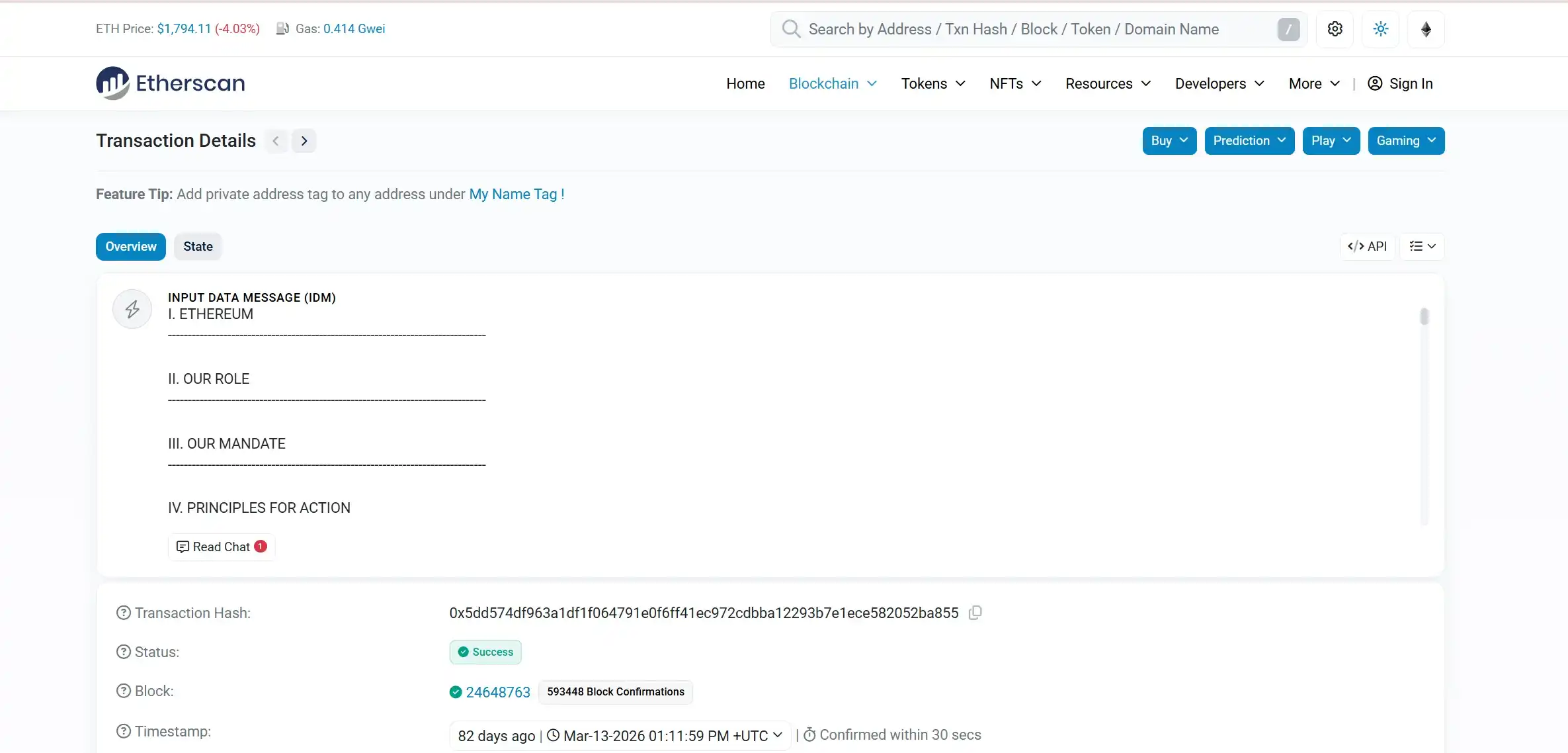
The systematic emergence of this concept can be traced back to March 13th. The Ethereum Foundation Board released the "EF Mandate" document, clearly stating its primary focus on Ethereum's censorship resistance, open source, privacy, and security—namely CROPS—to serve user self-sovereignty while maintaining anti-extraction and a more seamless user experience.

This statement is actually very important, especially as AI begins to enter wallet and automated execution scenarios, CROPS is no longer confined to Ethereum's value questions but could potentially become an issue of whether users can continue to control their digital lives in the AI era.
一、What Exactly is CROPS?

To understand CROPS, one must first step out of a common misconception: while Ethereum certainly needs to improve performance and reduce costs, it is not just competing with other public chains on who is faster or who has lower fees.

Although speed and cost are the most intuitive aspects of short-term user experience, looking at the longer term, Ethereum's stance over the past two years has become increasingly clear: what it truly aims to provide is a set of more foundational capabilities: users can hold assets, express identity, sign transactions, and participate in coordination without relying on a single platform, without surrendering ultimate control, and without being arbitrarily blocked by a centralized service.

This is the significance of CROPS.

In the context of the EF Mandate, CROPS primarily points to five directions, which are also the abbreviations of their keywords: Censorship Resistance, Capture Resistance (this was actually added later by Vitalik), Open Source, Privacy, Security:

  • C - Censorship Resistance: Ensuring the immutability of transactions and smart contracts, not being terminated due to any external political or centralized entity pressure;
  • R - Capture Resistance: Preventing Ethereum's governance, development roadmap, and key entry points from being controlled long-term by a few vested interests;
  • O - Open Source / Openness: Insisting on completely open-source code and maintaining absolute freedom of access for the ecosystem;
  • P - Privacy: Preserving the user's right to not be spied on through cryptographic technology on top of a transparent ledger;
  • S - Security: Adhering to fundamental bottom lines, providing ultimate settlement security that is unbreakable;

Looking at these items together, it's actually a set of selection and guiding principles with a clear orientation, which aligns well with Ethereum's consistent value route.

For example, at the protocol layer, it means Ethereum needs to continuously improve censorship resistance, client diversity, validator decentralization, formal verification, etc.; at the application layer, wallets, RPCs, browsers, signature interfaces, and account systems also need to reduce reliance on centralized entry points; at the user experience layer, security cannot rely solely on users understanding complex transactions themselves, but must preempt risks through clearer signature displays, more verifiable interactions, and more comprehensive risk warnings before operations occur.

This is also why the EF has recently advanced some more specific directions around security, privacy, protocol resilience, and ecosystem public goods. For instance, the Ethereum Audit Subsidy program aims to lower the threshold for Ethereum ecosystem developers to obtain high-quality security audits. Extending this view, it's not just about subsidizing costs, but about pushing "security" from a high-cost service only affordable by large projects towards more small and medium-sized developers.

In late May, Vitalik also reiterated his views on the future direction of the EF, emphasizing that the EF should become a smaller, more distinct, and more focused organization dedicated to long-term sustainability, rather than trying to cover all needs in the ecosystem. The reason is pragmatic: after all, the EF does not possess unlimited resources nor a continuous revenue stream from staking or transaction fees. Therefore, it should more effectively invest its limited resources into tasks crucial for Ethereum to realize CROPS values and that are difficult for other entities to reliably undertake.

In other words, in the current transitional historical stage Ethereum finds itself in, CROPS is not an abstract slogan of "ideology over reality," but rather a framework that externally defines and constrains what the EF should and should not do.

二、 When CROPS Meets AI: The Convergence of Two Parallel Universes

The most recent time Vitalik Buterin pushed CROPS into broader discussion was in the context of AI.

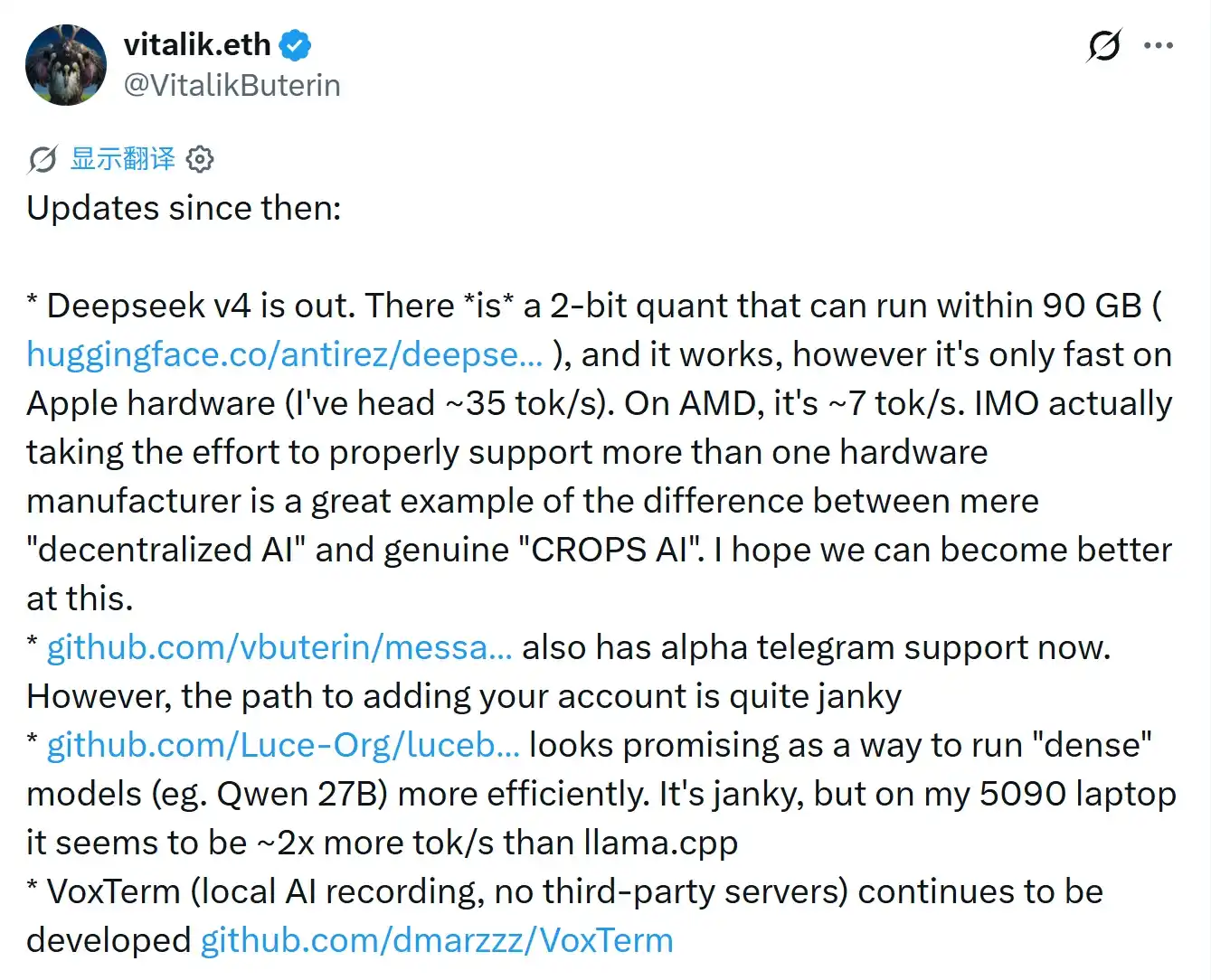
On May 28th, Vitalik Buterin posted an update on his localized AI progress, stating that DeepSeek V4 has released a 2-bit quantized version that can run within about 90 GB of VRAM, achieving speeds of about 35 tok/s on Apple hardware and about 7 tok/s on AMD hardware. He also noted that a true "CROPS AI" should support multiple hardware platforms, not just be "decentralized AI."

Simultaneously, he pointed out significant overlap between the CROPS Ethereum access layer and CROPS AI. Examples include using zero-knowledge proofs for paid remote LLM calls and private Ethereum RPC reads. In the future, there should also be more AI models fine-tuned for Ethereum scenarios to improve smart contracts, protocol code, and ecosystem security.

This actually places Ethereum and AI within the same problem framework.
When we discussed AI in the past, we often focused on model capabilities, like whether it could write code, especially whether it could perform complex tasks replacing humans. But from a user security perspective, the real change brought by AI is not just "greater capability," but that it is altering the entry point for digital operations.

Again, a familiar point: applications used to be relatively clear interfaces. We opened wallets to transfer, opened DApps to trade, opened browsers to search, opened social products to post. Each application had relatively clear boundaries. But with the emergence of AI Agents, these boundaries are becoming increasingly blurred. Users no longer click functions one by one but express intent in natural language:

Find me the optimal cross-chain route, help me make a swap, help me organize assets, help me execute a certain DeFi strategy, help me generate and send a transaction...

This sounds convenient, but it also implies a more critical question: when AI becomes your digital agent, what exactly is it signing on your behalf, and even what privacy is it exposing?

If AI runs entirely on centralized clouds, users' asset information, transaction intent, address relationships, identity preferences, and operational habits could be concentrated in the hands of a few service providers. Especially when executing on-chain operations relying on opaque APIs, centralized RPCs, black-box plugins, and unverifiable inference processes, users might become more convenient but also find it harder to know what they are truly giving away.

This is the question CROPS AI aims to answer.

An AI more aligned with CROPS is not just about being capable, but also should be as censorship-resistant, open, privacy-preserving, and secure as possible. It should ideally run locally, at least minimizing reliance on centralized cloud services in sensitive scenarios, minimizing information leakage, and allowing users to understand, confirm, and retain final control.

In other words, AI cannot just be a smarter black box, especially in Web3 scenarios. In the future, AI may not just help summarize articles, write code, or provide customer service, but directly participate in asset management and automated execution.

The closer it gets to user assets, the more important CROPS becomes.

This is also why the CROPS Ethereum access layer and CROPS AI overlap.

三、 What Web3 Incrementals Can Be Explored in This Overlap?

From this perspective, Vitalik's recent mention of overlap between the CROPS Ethereum Access Layer and CROPS AI is very natural.

Because whether it's Ethereum or AI, the core problem users face is increasingly becoming the same—how do I use AI assistance without completely handing over my privacy, identity, assets, and right to choose to centralized intermediaries?

  • On the Ethereum side, this problem manifests as: How do users access on-chain data? How do they connect to RPC? How do they sign transactions? How do they confirm if DApp interactions are safe? How do they avoid having all wallet queries, balance reads, and transaction broadcasts pass through a few centralized services?
  • On the AI side, this problem manifests as: How do users call models? How do they ensure prompts and personal data are not misused? How do they let local models handle sensitive tasks? How, when needing remote large model capabilities, do they avoid exposing their identity and intent as much as possible?

These two sets of problems seem different but are fundamentally similar.

For example, when Ethereum users query balances, read transaction history, or simulate transaction results, they often need to go through RPC services. While RPC might seem like just a technical interface, it could know your IP, address, query habits, asset structure, and interaction paths. If this data is centrally collected, users' on-chain privacy will be gradually pieced together.

But AI users calling remote models might also expose their preferences, financial information, and even identity clues. If users employ AI to handle wallet operations in the future, the risks amplify further.

Therefore, what Vitalik mentioned about ZK-paid remote LLM calls and private Ethereum RPC reads are essentially attempts to solve the same problem: how can one obtain services while calling remote capabilities without exposing all their information?

This is where the intersection of CROPS Ethereum and CROPS AI lies. On one side is a more private, more verifiable, and less trust-assuming on-chain access layer; on the other side is a more open, more localized, and more secure AI execution environment. Together, they might form a new entry point for users into the digital world in the future.

Extending outward along the underlying logic of CROPS, the entire Web3 ecosystem (especially the wallet layer as a traffic entry point) will undoubtedly assume more roles:

When users start expressing on-chain needs in natural language, a wallet is no longer just a signing tool but a control console for users' digital actions. It needs to help users determine: Can this DApp connect? What exactly will this transaction do? Is this AI Agent calling unnecessary data?

From this perspective, CROPS is not an abstract value but will directly influence the design direction of wallet products and drive the development shift of the next decade's integrated Web3 interaction experience and the wallet sector.

Conclusion

Although, in the current market sentiment, many people's attention to pure concepts may not be as high.

But the colder the market, the easier it is to overlook those technological variables that may not be sexy enough in the short term but truly determine the direction in the long run.

The reason CROPS deserves attention is not because it creates a new buzzword, but because it reframes the long-term problems of Ethereum and AI within the same framework: As digital systems become increasingly powerful, can users continue to retain their own control?

After all, security and privacy cannot just be afterthoughts.

From this perspective, in an era where AI is accelerating its takeover of the digital world, perhaps this is the truly positive variable that makes Ethereum continue to be worth building and using.

In an era where AI is accelerating its takeover of the digital world, being more understandable, more verifiable, more private, and more secure may be the real reasons Ethereum continues to be worth building and using.

Domande pertinenti

QWhat does the acronym CROPS stand for, as defined in the context of Ethereum?

ACROPS stands for Censorship Resistance, Capture Resistance, Open Source / Openness, Privacy, and Security.

QWhy does the article suggest that CROPS becomes critically important in the AI era, particularly in Web3?

AAs AI agents begin handling tasks like asset management and transaction execution, CROPS ensures that users do not surrender control over their privacy, assets, and sovereignty to centralized AI services, making it essential for maintaining user autonomy in a digital world increasingly mediated by AI.

QWhat specific intersection does Vitalik Buterin highlight between CROPS for Ethereum and CROPS for AI?

AHe highlights the intersection in creating a private and verifiable access layer, such as using zero-knowledge proofs for paid remote LLM calls and private Ethereum RPC reads, to allow users to utilize remote services without exposing sensitive personal data or intentions.

QAccording to the article, what shift in role might wallets undergo in a future shaped by CROPS principles and AI integration?

AWallets may evolve from being simple signature tools into becoming central control consoles for users' digital actions, responsible for interpreting natural language commands, verifying the safety of DApp connections and transactions, and monitoring AI agent behavior to protect user data and assets.

QWhat is the stated purpose of the Ethereum Foundation's focus on CROPS, beyond being a philosophical stance?

AIt serves as a practical framework to define and constrain the Ethereum Foundation's priorities, directing its limited resources toward long-term, sustainable tasks that are critical for achieving CROPS values and are unlikely to be reliably undertaken by other entities in the ecosystem.

Letture associate

Anthropic's IPO Launch: Commercial Miracle or Valuation Bubble?

Anthropic has confidentially filed for an IPO, led by Morgan Stanley and Goldman Sachs, potentially going public by October. Following its latest $650 billion funding round, its pre-IPO valuation stands at $965 billion, with projections reaching up to $2 trillion at listing, which would make it the highest-valued private company ever. The article, written by Fu Sheng, addresses skepticism that this represents an AI bubble akin to the 2000 dot-com crash. It argues the current situation differs fundamentally. Unlike the internet bubble era, which relied on speculative narratives with little revenue, Anthropic's valuation is backed by unprecedented, measurable financial performance. Key data points include: * **Revenue Growth:** ARR skyrocketed from $10 billion in early 2025 to $470 billion by May 2026, targeting $100 billion by year-end—a growth curve unmatched in business history. * **Profitability:** It achieved operating profitability in Q2 2026 with an estimated $5.6 billion profit. * **Efficiency:** With ~3,000 employees and ~$470 billion ARR, its revenue per employee exceeds $10 million. Products like Claude Code, launched less than a year ago, already generate $25 billion in annualized revenue. * **Enterprise Adoption:** It boasts a strong enterprise client base, with 8 of the Fortune 10 and over 1,000 large firms spending over $1 million annually on Claude. The valuation is framed using a traditional SaaS model (e.g., a 10x Price-to-Sales multiple on $100 billion revenue). The author contends the core question for analysts has shifted from "How big could this be?" to "How much is it earning and will earn next quarter?" The discussion extends beyond Anthropic to a broader paradigm shift: the transition from a "carbon-based" to a "silicon-based" economy. Companies are increasingly prioritizing investment in compute and AI capabilities over human resources, as these directly scale productivity and competitive advantage. Anthropic's IPO is thus positioned not just as a corporate milestone, but as a price anchor for this new economic era.

链捕手16 min fa

Anthropic's IPO Launch: Commercial Miracle or Valuation Bubble?

链捕手16 min fa

Near Returns to the AI Stage: Transformation into a Public Chain Due to 'Payroll Difficulties,' Agent and Privacy Emerge as New Growth Narratives

NEAR Returns to AI Origins: From Payroll Struggles to Blockchain, Now Focusing on AI Agents and Privacy NEAR Protocol's journey began not with grand blockchain ambitions, but from a practical hurdle: its AI startup founders, including Transformer paper co-author Illia Polosukhin, couldn't efficiently pay international developers in 2017. This led them to pivot and build a high-performance, scalable blockchain. After years navigating various crypto narratives like sharding and cross-chain interoperability, NEAR is now leveraging its AI roots to re-enter the AI arena. A key driver is its "NEAR Intents" layer, which abstracts complex cross-chain transactions. Users simply state their goal (e.g., swap BTC for ETH), and a solver network finds the optimal route. This system has processed over $20B in cross-chain volume, generating significant fee revenue. A major growth area is private transactions via "Confidential Intents/Swaps," which hide trade details until settlement to protect against MEV and front-running. Remarkably, private swaps recently accounted for over 40% of NEAR's transaction volume, highlighting strong demand but also potential regulatory scrutiny. With its AI-founder pedigree, NEAR is positioning itself at the intersection of blockchain, AI agents, and privacy, aiming to become infrastructure for the emerging agent economy while navigating the challenges of its rapid adoption.

marsbit2 h fa

Near Returns to the AI Stage: Transformation into a Public Chain Due to 'Payroll Difficulties,' Agent and Privacy Emerge as New Growth Narratives

marsbit2 h fa

Trading

Spot
Futures

Articoli Popolari

Cosa è ETH 3.0

ETH3.0 e $eth 3.0: Un'Analisi Approfondita del Futuro di Ethereum Introduzione Nel panorama in rapida evoluzione delle criptovalute e della tecnologia blockchain, ETH3.0, spesso indicato come $eth 3.0, è emerso come un argomento di considerevole interesse e speculazione. Il termine comprende due concetti principali che warrantono chiarimenti: Ethereum 3.0: Questo rappresenta un potenziale futuro aggiornamento volto ad aumentare le capacità dell'attuale blockchain di Ethereum, concentrandosi principalmente sul miglioramento della scalabilità e delle prestazioni. ETH3.0 Meme Token: Questo progetto di criptovaluta distinto cerca di sfruttare la blockchain di Ethereum per creare un ecosistema incentrato sui meme, promuovendo il coinvolgimento all'interno della comunità delle criptovalute. Comprendere questi aspetti di ETH3.0 è essenziale non solo per gli appassionati di criptovalute, ma anche per coloro che osservano tendenze tecnologiche più ampie nello spazio digitale. Che cos'è ETH3.0? Ethereum 3.0 Ethereum 3.0 è pubblicizzato come un aggiornamento proposto per la rete Ethereum già stabilita, che è stata la spina dorsale di molte applicazioni decentralizzate (dApps) e contratti smart sin dalla sua nascita. I miglioramenti previsti si concentrano principalmente sulla scalabilità, integrando tecnologie avanzate come lo sharding e le prove a conoscenza zero (zk-proofs). Queste innovazioni tecnologiche mirano a facilitare un numero senza precedenti di transazioni al secondo (TPS), potenzialmente raggiungendo milioni, affrontando così una delle limitazioni più significative della tecnologia blockchain attuale. Il miglioramento non è meramente tecnico, ma anche strategico; è volto a preparare la rete Ethereum per un'adozione e un'utilità diffuse in un futuro contrassegnato da un aumento della domanda di soluzioni decentralizzate. ETH3.0 Meme Token Al contrario di Ethereum 3.0, l'ETH3.0 Meme Token si avventura in un dominio più leggero e giocoso, combinando la cultura dei meme di internet con la dinamica delle criptovalute. Questo progetto consente agli utenti di acquistare, vendere e scambiare meme sulla blockchain di Ethereum, fornendo una piattaforma che promuove il coinvolgimento della comunità attraverso la creatività e interessi condivisi. L'ETH3.0 Meme Token mira a dimostrare come la tecnologia blockchain possa intersecarsi con la cultura digitale, creando casi d'uso che siano sia divertenti che finanziariamente praticabili. Chi è il Creatore di ETH3.0? Ethereum 3.0 L'iniziativa verso Ethereum 3.0 è principalmente propulsa da un consorzio di sviluppatori e ricercatori all'interno della comunità di Ethereum, tra cui Justin Drake. Conosciuto per le sue intuizioni e contributi all'evoluzione di Ethereum, Drake è stato una figura di spicco nelle discussioni riguardanti la transizione di Ethereum verso un nuovo livello di consenso, chiamato “Beam Chain.” Questo approccio collaborativo allo sviluppo significa che Ethereum 3.0 non è il prodotto di un creatore singolo, ma piuttosto una manifestazione di ingegno collettivo focalizzato sul progresso della tecnologia blockchain. ETH3.0 Meme Token I dettagli riguardanti il creatore dell'ETH3.0 Meme Token sono attualmente non rintracciabili. La natura dei token meme conduce spesso a una struttura più decentralizzata e guidata dalla comunità, il che potrebbe spiegare la mancanza di attribuzione specifica. Questo si allinea con l'etica della comunità crypto più ampia, dove l'innovazione spesso nasce da sforzi collaborativi piuttosto che individuali. Chi sono gli Investitori di ETH3.0? Ethereum 3.0 Il supporto per Ethereum 3.0 proviene principalmente dalla Ethereum Foundation insieme a una comunità entusiasta di sviluppatori e investitori. Questa associazione fondamentale fornisce un considerevole grado di legittimità e migliora le prospettive di implementazione di successo poiché sfrutta la fiducia e la credibilità costruite nel corso degli anni di operazioni della rete. Nel clima in rapida evoluzione delle criptovalute, il supporto della comunità gioca un ruolo cruciale nello sviluppo e nell'adozione, posizionando Ethereum 3.0 come un serio contenditore per i futuri progressi della blockchain. ETH3.0 Meme Token Sebbene le fonti attualmente disponibili non forniscano informazioni esplicite riguardo ai fondamenti o alle organizzazioni di investimento che sostengono l'ETH3.0 Meme Token, ciò è indicativo del modello di finanziamento tipico per i token meme, che spesso si basa sul supporto di base e sul coinvolgimento della comunità. Gli investitori in tali progetti sono tipicamente individui motivati dal potenziale per innovazioni guidate dalla comunità e dallo spirito di cooperazione trovato all'interno della comunità crypto. Come Funziona ETH3.0? Ethereum 3.0 Le caratteristiche distintive dell'Ethereum 3.0 risiedono nella sua proposta di implementazione della tecnologia di sharding e zk-proof. Lo sharding è un metodo di partizionamento della blockchain in pezzi più piccoli e gestibili o “shard,” che possono elaborare transazioni in modo concorrente piuttosto che sequenziale. Questa decentralizzazione dell'elaborazione aiuta a prevenire la congestione e garantisce che la rete rimanga reattiva anche sotto un carico pesante. La tecnologia delle prove a conoscenza zero (zk-proof) contribuisce con un ulteriore livello di sofisticazione consentendo la validazione delle transazioni senza rivelare i dati sottostanti coinvolti. Questo aspetto non solo migliora la privacy, ma aumenta anche l'efficienza complessiva della rete. Si parla anche di incorporare una macchina virtuale Ethereum a conoscenza zero (zkEVM) in questo aggiornamento, amplificando ulteriormente le capacità e l'utilità della rete. ETH3.0 Meme Token L'ETH3.0 Meme Token si distingue capitalizzando sulla popolarità della cultura dei meme. Stabilisce un mercato per gli utenti che desiderano partecipare al trading di meme, non solo per divertimento, ma anche per potenziale guadagno economico. Integrando funzioni come lo staking, la fornitura di liquidità e meccanismi di governance, il progetto promuove un ambiente che incentiva l'interazione e la partecipazione della comunità. Offrendo una miscela unica di intrattenimento e opportunità economica, l'ETH3.0 Meme Token mira ad attrarre un pubblico variegato, che va dagli appassionati di crypto ai semplici intenditori di meme. Timeline di ETH3.0 Ethereum 3.0 11 Novembre 2024: Justin Drake accenna al prossimo aggiornamento ETH 3.0, incentrato sui miglioramenti della scalabilità. Questo annuncio segna l'inizio delle discussioni formali riguardo l'architettura futura di Ethereum. 12 Novembre 2024: La proposta attesa per Ethereum 3.0 dovrebbe essere svelata a Devcon a Bangkok, preparando il terreno per un feedback più ampio della comunità e potenziali passi successivi nello sviluppo. ETH3.0 Meme Token 21 Marzo 2024: L'ETH3.0 Meme Token viene ufficialmente elencato su CoinMarketCap, segnando il suo ingresso nel dominio pubblico delle criptovalute e aumentando la visibilità per il suo ecosistema basato sui meme. Punti Chiave In conclusione, Ethereum 3.0 rappresenta una significativa evoluzione all'interno della rete Ethereum, concentrandosi sul superamento delle limitazioni riguardanti scalabilità e prestazioni attraverso tecnologie avanzate. I suoi aggiornamenti proposti riflettono un approccio proattivo alle future esigenze e usabilità. D'altra parte, l'ETH3.0 Meme Token incarna l'essenza della cultura guidata dalla comunità nello spazio delle criptovalute, sfruttando la cultura dei meme per creare piattaforme coinvolgenti che incoraggiano la creatività e la partecipazione degli utenti. Comprendere gli scopi e le funzionalità distinte di ETH3.0 e $eth 3.0 è fondamentale per chiunque sia interessato ai continui sviluppi nello spazio crypto. Con entrambe le iniziative che tracciano percorsi unici, esse sottolineano collettivamente la natura dinamica e multifacetica dell'innovazione blockchain.

173 Totale visualizzazioniPubblicato il 2024.04.04Aggiornato il 2024.12.03

Cosa è ETH 3.0

Cosa è ETHEREUM

HarryPotterTrumpHomerSimpson777Inu: Panoramica di un Progetto Crypto Web3 Introduzione Nel mondo in rapida evoluzione delle criptovalute e della finanza decentralizzata, progetti innovativi emergono frequentemente, catturando l'interesse della comunità degli investitori e degli appassionati di crypto. Uno di questi progetti è HarryPotterTrumpHomerSimpson777Inu, una criptovaluta che si trova all'incrocio tra cultura popolare e tecnologia blockchain. Questo token guidato dalla comunità mescola personaggi e figure politiche ben noti, con l'obiettivo di creare una piattaforma coinvolgente e promuovere un'adozione diffusa. Che cos'è HarryPotterTrumpHomerSimpson777Inu? HarryPotterTrumpHomerSimpson777Inu è un token costruito sulla blockchain di Ethereum, progettato per essere accessibile e divertente per un pubblico diversificato. L'unicità di questo progetto deriva dal suo approccio tematico, che intreccia elementi di fantasia, politica e intrattenimento. Sfruttando il fascino nostalgico di personaggi amati, il progetto cerca di creare un'esperienza di criptovaluta coinvolgente, incoraggiando il coinvolgimento e la partecipazione della comunità. L'obiettivo principale di HarryPotterTrumpHomerSimpson777Inu è stabilire un token che risuoni con gli utenti a livello personale, promuovendo sia il divertimento che il coinvolgimento nell'ambito crypto. Questo branding distintivo mira ad attrarre individui che in precedenza potrebbero non essersi interessati alle criptovalute, facilitando un nuovo punto di ingresso per utenti potenziali. Creatore di HarryPotterTrumpHomerSimpson777Inu L'identità del creatore dietro HarryPotterTrumpHomerSimpson777Inu rimane sconosciuta. Questa non è una pratica rara nel dominio delle criptovalute, dove l'anonimato è spesso preferito dai fondatori come mezzo di protezione della privacy e promozione di un ethos decentralizzato. Questa oscurità non diminuisce il valore del progetto; al contrario, riflette una tendenza più ampia all'interno del settore, dove molti progetti di successo sono emersi da origini anonime. Investitori di HarryPotterTrumpHomerSimpson777Inu Le informazioni pubbliche riguardo agli investitori di HarryPotterTrumpHomerSimpson777Inu sono limitate. La natura del progetto, incentrata sul coinvolgimento della comunità, suggerisce una dipendenza da investimenti di piccole dimensioni da parte di singoli appassionati piuttosto che da sostegni sostanziali da fondazioni di investimento consolidate o corporation. Questo livello di trasparenza nel finanziamento è tipico di molti progetti di criptovaluta guidati dalla comunità, dove il supporto spesso proviene da movimenti di base piuttosto che da investitori istituzionali. Come Funziona HarryPotterTrumpHomerSimpson777Inu? Operando sulla blockchain di Ethereum, HarryPotterTrumpHomerSimpson777Inu sfrutta la sua solida infrastruttura per facilitare transazioni e promuovere interazioni tra gli utenti all'interno della comunità. Ciò che distingue questo progetto è il suo posizionamento tematico: canalizzando il carisma di personaggi iconici provenienti da diversi ambiti culturali, crea un'identità di marca distintiva. Questo approccio non solo attrae gli utenti, ma coltiva anche una comunità fedele attorno al token. Le meccaniche operative del progetto si concentrano sul coinvolgimento della comunità. Adotta un modello decentralizzato che incoraggia la partecipazione, consentendo agli utenti di interagire attraverso vari canali mentre promuovono lo scambio di idee e esperienze. Inoltre, il progetto abbraccia i principi del Web3, privilegiando la sovranità degli utenti e la decentralizzazione, che sono i pilastri del futuro di Internet. Timeline di HarryPotterTrumpHomerSimpson777Inu La storia di HarryPotterTrumpHomerSimpson777Inu è segnata da diversi eventi decisivi: 12 agosto 2023: L'inizio di HarryPotterTrumpHomerSimpson777Inu, segnando il suo ingresso nell'ecosistema delle criptovalute. Fase di Sviluppo: Un periodo focalizzato sulla costruzione di una strategia completa per stimolare la crescita guidata dalla comunità e il coinvolgimento degli utenti. Listing sugli Scambi: Sebbene i dettagli specifici di listing non siano stati divulgati, il progetto è stato reso accessibile su vari scambi di criptovalute, migliorando la sua visibilità nel mercato. Coinvolgimento della Comunità: Sforzi continui per coinvolgere attivamente la comunità, stabilendo canali di dialogo e promuovendo la partecipazione attraverso varie attività, tra cui concorsi, discussioni e votazioni comunitarie. Aspetti Chiave di HarryPotterTrumpHomerSimpson777Inu Focus sulla Comunità Un tratto distintivo di HarryPotterTrumpHomerSimpson777Inu è la sua forte enfasi sul coinvolgimento della comunità. Il progetto incoraggia attivamente gli utenti a partecipare a discussioni, condividere idee e contribuire all'evoluzione del progetto. Questa interazione coltiva un senso di appartenenza e di ownership tra i membri della comunità, essenziale per la sostenibilità a lungo termine del token. Utilizzo della Blockchain di Ethereum La scelta di costruire sulla blockchain di Ethereum consente a HarryPotterTrumpHomerSimpson777Inu di sfruttare le sue caratteristiche di sicurezza ben consolidate e architettura decentralizzata. Questa base garantisce affidabilità per le transazioni e fornisce un framework affidabile su cui sviluppare varie funzionalità. Approccio Tematico Unico Fusione di elementi della cultura pop nella sua identità, HarryPotterTrumpHomerSimpson777Inu crea una narrazione coinvolgente che lo differenzia da altre criptovalute. L'amalgama di personaggi e temi genera riconoscimento e intrigo immediati, rendendo il token relazionabile a un'ampia gamma di utenti potenziali. Anonimato nello Sviluppo Il creatore anonimo del progetto rimane una caratteristica ricorrente in molte iniziative di criptovaluta. Questo aspetto evidenzia un ethos di decentralizzazione, introducendo anche un livello di mistero che potrebbe affascinare un segmento della comunità crypto, attirando l'attenzione sul progetto e invitando l'impegno da parte di utenti che supportano l'idea di un'iniziativa decentralizzata e gestita dalla comunità. Conclusione HarryPotterTrumpHomerSimpson777Inu si presenta come un'aggiunta distintiva al panorama delle criptovalute, combinando il fascino della cultura popolare con le meccaniche innovative della tecnologia blockchain. Sebbene i dettagli riguardanti il creatore e gli investitori specifici rimangano non divulgati, il focus del progetto sulla comunità e il suo approccio tematico lo contraddistinguono come un potenziale attore influente nel contesto del Web3 e delle criptovalute. Man mano che l'ecosistema delle criptovalute continua ad espandersi, iniziative come HarryPotterTrumpHomerSimpson777Inu ci ricordano le molteplici modalità in cui la blockchain può connettere le comunità globali attraverso narrazioni e valori condivisi.

904 Totale visualizzazioniPubblicato il 2024.04.06Aggiornato il 2024.12.03

Cosa è ETHEREUM

Come comprare ETH

Benvenuto in HTX.com! Abbiamo reso l'acquisto di Ethereum (ETH) semplice e conveniente. Segui la nostra guida passo passo per intraprendere il tuo viaggio nel mondo delle criptovalute.Step 1: Crea il tuo Account HTXUsa la tua email o numero di telefono per registrarti il tuo account gratuito su HTX. Vivi un'esperienza facile e sblocca tutte le funzionalità,Crea il mio accountStep 2: Vai in Acquista crypto e seleziona il tuo metodo di pagamentoCarta di credito/debito: utilizza la tua Visa o Mastercard per acquistare immediatamente EthereumETH.Bilancio: Usa i fondi dal bilancio del tuo account HTX per fare trading senza problemi.Terze parti: abbiamo aggiunto metodi di pagamento molto utilizzati come Google Pay e Apple Pay per maggiore comodità.P2P: Fai trading direttamente con altri utenti HTX.Over-the-Counter (OTC): Offriamo servizi su misura e tassi di cambio competitivi per i trader.Step 3: Conserva Ethereum (ETH)Dopo aver acquistato Ethereum (ETH), conserva nel tuo account HTX. In alternativa, puoi inviare tramite trasferimento blockchain o scambiare per altre criptovalute.Step 4: Scambia Ethereum (ETH)Scambia facilmente Ethereum (ETH) nel mercato spot di HTX. Accedi al tuo account, seleziona la tua coppia di trading, esegui le tue operazioni e monitora in tempo reale. Offriamo un'esperienza user-friendly sia per chi ha appena iniziato che per i trader più esperti.

2.9k Totale visualizzazioniPubblicato il 2024.12.10Aggiornato il 2026.06.02

Come comprare ETH

Discussioni

Benvenuto nella Community HTX. Qui puoi rimanere informato sugli ultimi sviluppi della piattaforma e accedere ad approfondimenti esperti sul mercato. Le opinioni degli utenti sul prezzo di ETH ETH sono presentate come di seguito.

活动图片