Now the Greatest Regret Is to My Family: Crypto Experts Took a Stumble in the Stock Market

marsbitPubblicato 2026-07-30Pubblicato ultima volta 2026-07-30

Introduzione

Summary: This article examines the significant losses recently suffered by cryptocurrency traders and influencers who ventured into the stock market, specifically by heavily investing in AI-related and semiconductor storage stocks. The narrative centers on the dramatic reversal in the Korean and US equity markets in late July, with stocks like SK Hynix and related leveraged ETFs experiencing historic plunges, erasing massive gains. The analysis highlights several key factors behind the "flip." Traders, accustomed to crypto's high volatility and frustrated by a stagnant market, chased the apparent momentum in AI-themed equities. Many made fatal mistakes: applying high-leverage strategies common in crypto (e.g., 2x ETFs, on-chain perpetual contracts) to stocks, and failing to understand the distinct rules of different stock markets (like Korean pre-market trading). This led to widespread liquidations, especially when a thin Korean pre-market trade triggered a cascading flash crash on a decentralized exchange. Post-crash reflections from prominent figures reveal deep regret and self-criticism. They acknowledge misjudging their expertise, overestimating their edge against sophisticated institutional players, and the dangers of leverage. The article concludes that while such setbacks are part of trading, surviving long-term requires recognizing one's limitations and the inherent risks of cross-market strategies.

"Now, the greatest regret is to my family."

Lately, the frequency of hearing this phrase is no less than that of "Do you believe in the light?" and "You should stand in the light, not let the light stand there" from two months ago.

These two short sentences encapsulate a 180-degree reversal in the market and a landscape of shattered hearts.

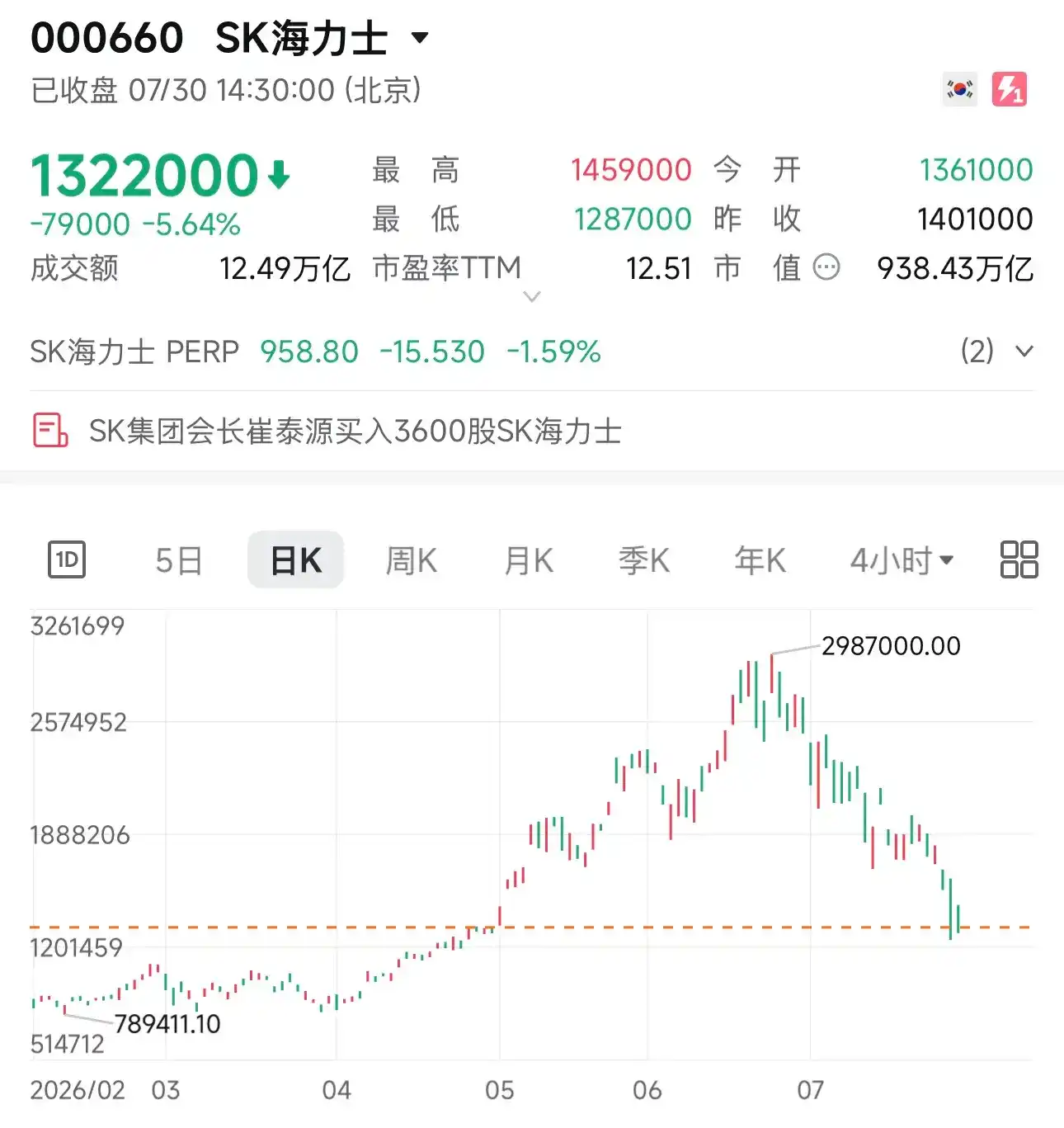
According to public data, South Korean stock SK Hynix has halved from its June high, erasing over 1,000 trillion won (approximately $800 billion) in market capitalization. The KOSPI index has retreated about 30% from its peak and has experienced 9 trading halts this year.

On July 28th, SK Hynix fell over 10%. U.S. memory stocks also plunged collectively, with SanDisk, Western Digital, Seagate, and Micron dropping 8% to 13% in a single day.

On July 29th, SK Hynix fell sharply again, dropping nearly 20% intraday, while a 2x long Hynix ETF plummeted over 30%, both setting their largest single-day declines in history.
A cross-market bloodbath thus unfolded. The extreme volatility flushed out numerous big V's and traders from the crypto circle. Among them were those who had earned their first pot of gold in the crypto market and those who had already achieved financial freedom. Now, all that's left are reflections and declarations of leaving the scene.
Half Market Conditions, Half Human Nature

Perhaps because the crypto market had been too quiet for too long, memory stocks became the best destination for active capital.

Dp Dapeng (@Dp520888) posted that from the end of last year to the first half of this year, the crypto market was in a constant downtrend. Bitcoin barely caught its breath around $60,000, while South Korean and U.S. stock markets soared on the AI narrative during the same period. Major exchanges, in their efforts to expand markets, had also opened up stock trading access.

He noted that he saw many crypto peers painfully cut losses on their crypto assets and go all-in on Micron and SanDisk at highs, only to lose over 30% subsequently. Had this money stayed in crypto, they could have at least held on until Bitcoin fell to $40,000.

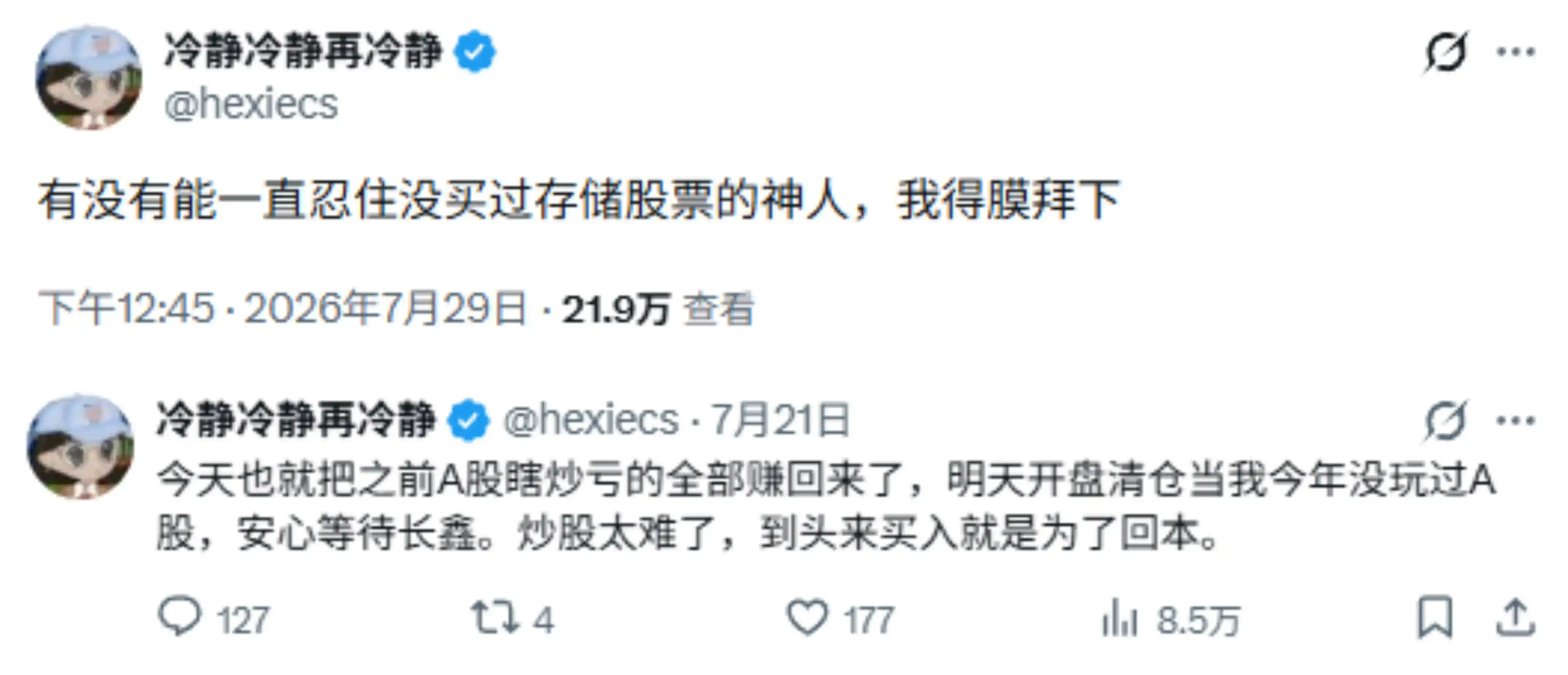
People accustomed to high volatility and tormented by the lack of profit-making opportunities for over half a year found it hard to resist chasing the market that seemed more lucrative. As @hexiecs posted, "Is there any god who has always resisted buying memory stocks? I need to worship them."
However, narratives like AI, GPU, and storage come and go quickly in capital markets. Nvidia's stock price peaked in May and has already wiped out this year's gains, with its total market cap recently overtaken again by Apple. Now it's just storage's turn.

So, the starting point of this crash is half market conditions, half human nature.

Why the Crash This Time?

People transitioning from the crypto circle to the stock market are prone to culture shock.

On one hand, it's the leverage habit. Many start with 2x long positions or add even higher leverage via on-chain perpetual contracts. The same bearish candle that represents a mere pullback in a spot account becomes a liquidation event in a leveraged account.

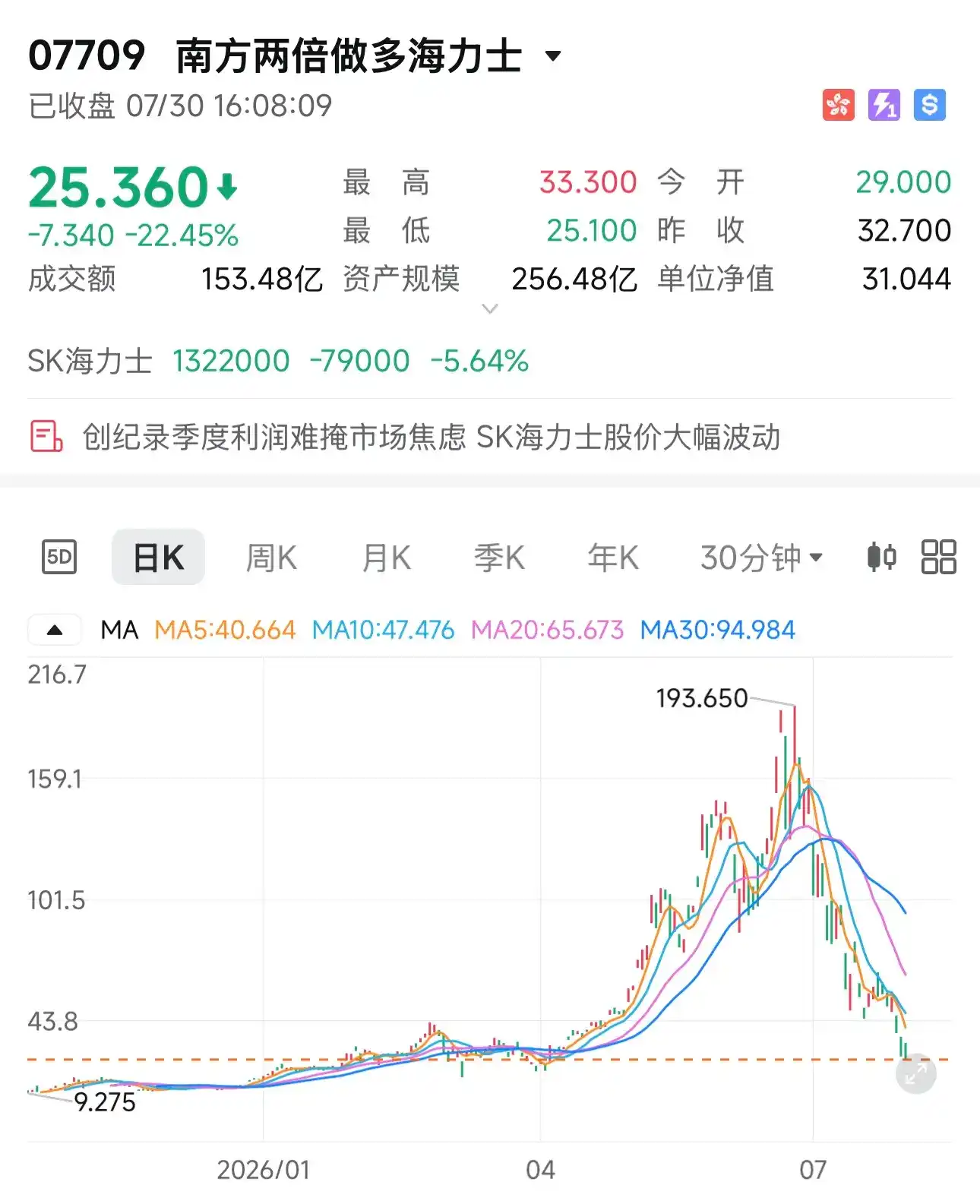
How severe the damage to leveraged products was this round can be seen by looking at the South Korean 2x Long Hynix ETF. This fund was once the world's largest single-stock leveraged product, with peak assets around 130 billion HKD. Its cumulative decline since July has exceeded 80%, with assets now down to 25.6 billion HKD. Another 2x Long Samsung Electronics ETF also fell about 70% this month.
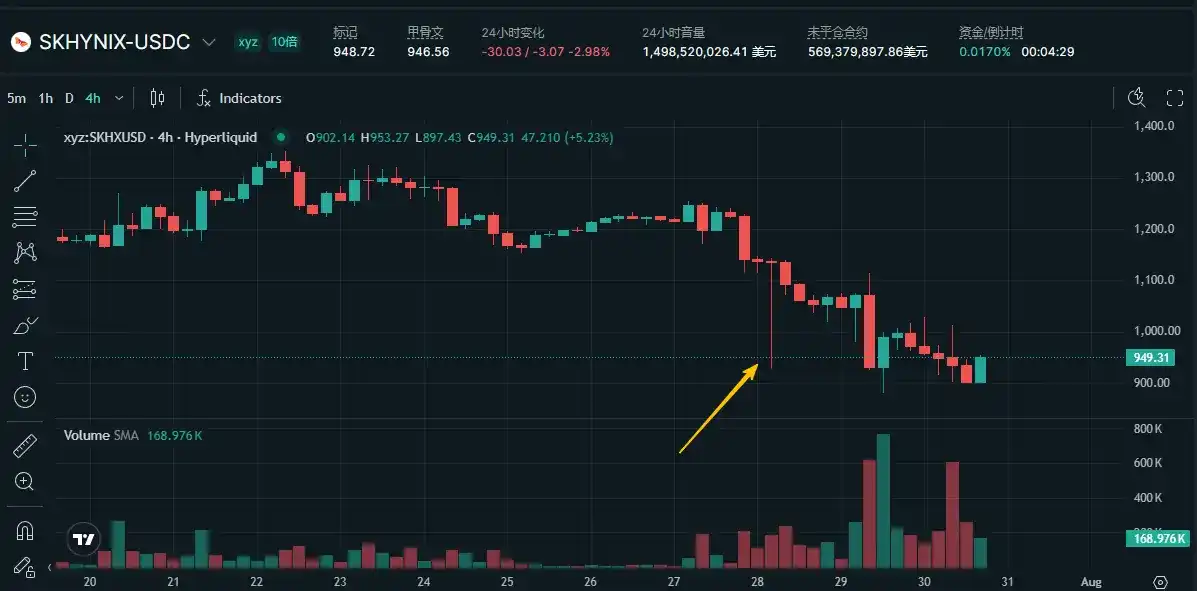
According to Hyperliquid data, on July 29th, the combined 24-hour trading volume for Hynix-related contracts SKHX and SKHY on the platform reached $1.765 billion, becoming the most actively traded asset on the platform, with heat and volume even surpassing BTC.

On the other hand, it's the rule differences. The stock market itself has several sets of rules: U.S. stocks have after-hours trading, South Korean stocks have NXT pre-market, A-shares have price limits, Hong Kong stocks have another set, each with its own trading hours, price bands, and settlement rhythms.

When these underlying assets are packaged into on-chain perpetual contracts, the extreme rules of other markets are bundled in as well. The wick on Hyperliquid on July 28th is a living example.

It is reported that on that day, only one lot of SK Hynix traded in the South Korean pre-market at around $868, about 30% lower than the previous close, right near the lower limit of the price band. This less than $900 real transaction was fed into the chain via the oracle, causing the SKHX perpetual contract to flash crash about 18% in one minute.

According to on-chain data, approximately $80 million was liquidated in the subsequent four hours, with open interest evaporating about $150 million.
Trade.xyz announced that this price was synchronized from that real transaction in the South Korean pre-market, with the oracle operating according to specifications and no technical error. Although Trade.xyz decided to fully compensate for the liquidation losses this time, it specifically stated this does not constitute a guarantee for similar situations in the future.

Reflections After the Bloodbath

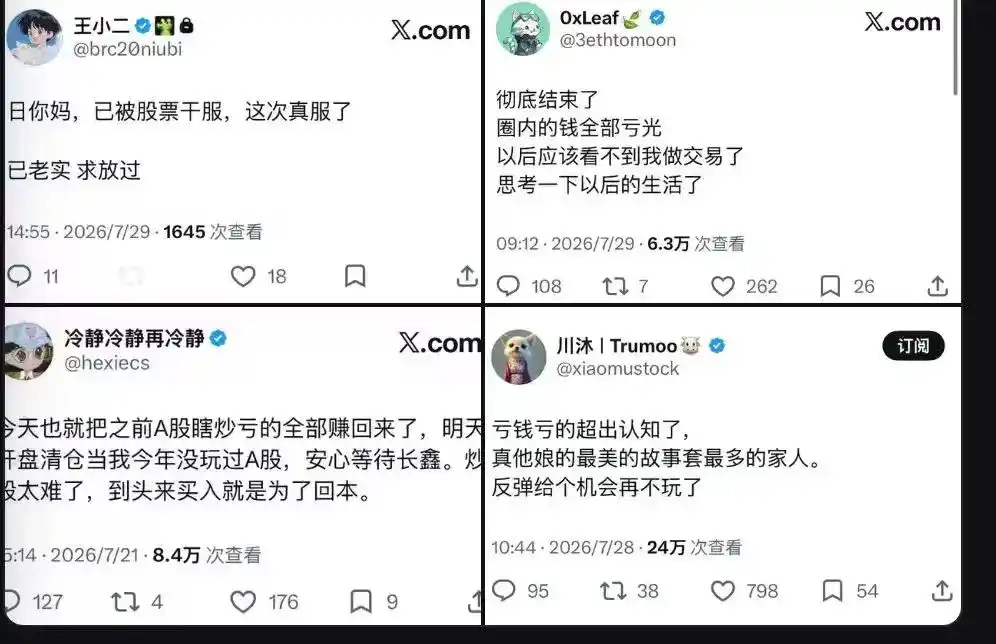
After this bloodbath, many big V's on X began to reflect. Their review focus largely fell on whether the methods they had relied on to make money over the years were still effective after switching markets.

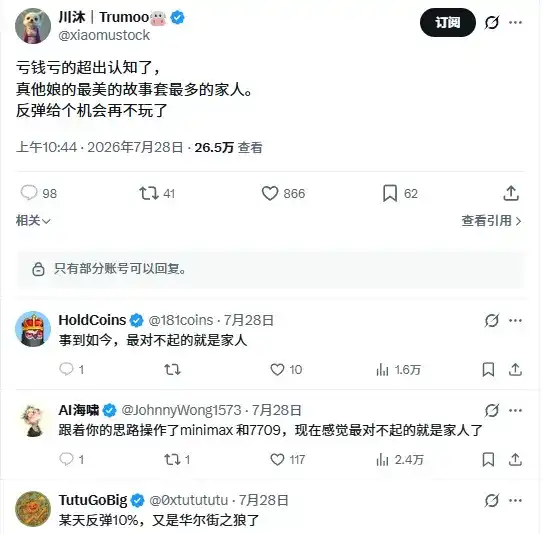
Chuanmu (@xiaomustock) stated that he made and lost money on storage stocks this year. The reason Buffett has survived in the capital market for so long is inseparable from his style of avoiding leverage, not going all-in, and always holding significant idle cash. Ordinary people either lose sleep from anxiety over using leverage to get rich quickly, or continue using leverage after making money, anxious in both profit and loss.
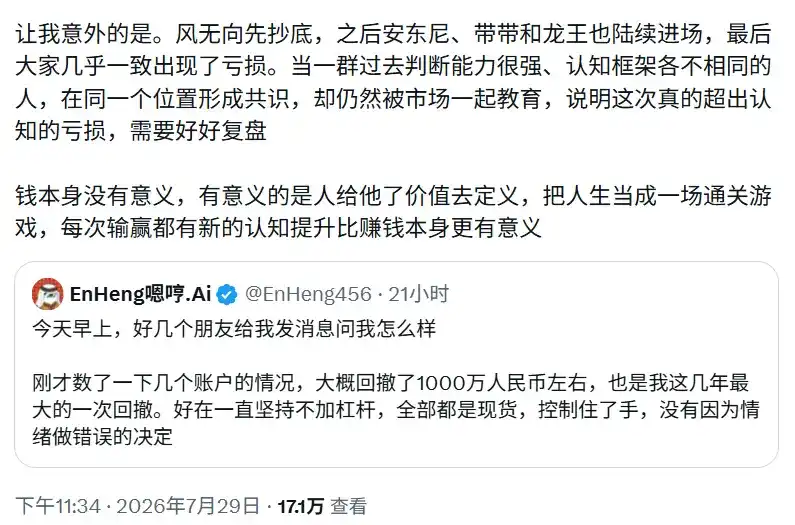
KOL En Heng (@EnHeng456) recounted his three major losses since entering the industry, with this storage wave being the heaviest, resulting in a combined drawdown of over ten million across several accounts, but fortunately, it was all spot trading with no leverage.

He also pointed out that multiple traders with consistently strong judgment and different cognitive frameworks successively entered the market, yet almost all ended up losing. When such a group forms a consensus at the same position but is collectively taught a lesson by the market, it indicates that this loss indeed exceeded their original understanding.
Zishi (@silverfang888), who claimed to have been liquidated for $20 million in semiconductors, also said his biggest regret was moving from crypto to trading stocks. In his view, he is merely a crypto player with limited insight, sitting across from people in the U.S. stock market arena whose cognition and capital far surpass his own.

After being liquidated, many fell into intense self-negation, attributing the losses of these months to their own shallow insight and low cognition. The concentrated outbreak of such emotions also serves as a reminder to everyone using leverage as an amplifier: what the market takes is never just the principal.

Some offered comfort, saying whose trading career hasn't experienced a few such drawdowns? Money lost can be treated as tuition paid. As long as one is still here with spirit intact, there will always be another journey ahead.

In truth, there are very few who can consistently win in the market. Those who can journey a bit further are often those who can still see their own boundaries at different stages.


Crypto di tendenza

Domande pertinenti

QAccording to the article, what is the main reason behind the significant losses of crypto traders in the stock market?

AThe main reasons are a combination of market conditions and human nature. Crypto traders, accustomed to high volatility, moved to the AI-driven stock market for better returns. However, they faced issues like improper use of leverage and unfamiliarity with the different trading rules of stock markets (like pre-market sessions and price bands), which led to severe losses when the storage sector crashed.

QHow did the specific event on Hyperliquid on July 28th cause major liquidations?

AOn July 28th, a single SK Hynix share traded for around $868 in the Korean pre-market, about 30% lower than the previous close. This price, fed into the chain via an oracle, caused the SKHX perpetual contract on Hyperliquid to flash-crash by about 18% in one minute. This led to approximately $80 million in liquidations and a $150 million drop in open interest over the next four hours.

QWhat is one key trading habit from the crypto world that proved detrimental in the stock market?

AOne key detrimental habit was the immediate use of high leverage. Many traders started with 2x leveraged ETFs or even higher leverage on perpetual contracts. This meant that a price decline that would be a simple drawdown in a spot account resulted in margin calls and liquidations in leveraged positions.

QWhat major reflection did trader '川沐' (@xiaomustock) share after the losses?

ATrader '川沐' reflected that his gains and losses this year both came from the storage sector. He noted that Warren Buffett's longevity in the market is tied to his style of avoiding leverage, not going all-in, and always keeping a large amount of cash on hand. In contrast, ordinary people either lose sleep over leverage-driven anxiety to get rich or continue using leverage after profits, leading to anxiety in both winning and losing.

QWhat was the final attitude or lesson some traders expressed after the market crash?

AAfter the crash, some traders expressed a lesson in humility and recognizing one's boundaries. They acknowledged that moving from the crypto circle to the stock market meant competing against players with far superior knowledge and capital. While some fell into self-doubt, others offered comfort, stating that such drawdowns are part of a trading career, and as long as one's spirit remains, there will always be another opportunity.

Letture associate

Expect news tomorrow: this time the Bank of Japan will announce its interest rate decision! What impact will this have on Bitcoin?

A day before the Bank of Japan's (BOJ) interest rate decision announcement, the Japanese yen surged nearly 3% against the US dollar. The sharp move in the currency market fueled speculation that the Japanese government may have intervened again to support the yen. The USD/JPY pair fell over 400 pips to 158.5, its steepest daily drop since Japan's currency intervention earlier this year. Market participants suspect the rapid, strong yen appreciation could be due to direct foreign currency sales by Japanese authorities, though the Ministry of Finance has made no official statement. The yen had previously fallen to its weakest level against the dollar in nearly 40 years. In late April and May, the government intervened with roughly 9.6 trillion yen to prevent the USD/JPY from rising sustainably above 160, but the yen faced renewed selling pressure afterward. Investors are now focused on the BOJ's rate decision and its signals on future monetary policy. Potential hawkish signals from the BOJ are seen as a factor that could support further yen strength. A sharp yen appreciation could create short-term selling pressure on Bitcoin by increasing the risk of unwinding carry trades, where investors borrow low-yielding yen to invest in Bitcoin and other risky assets. This pressure could intensify if the BOJ takes a hawkish stance or raises interest rates.

cryptonews.ru39 min fa

Expect news tomorrow: this time the Bank of Japan will announce its interest rate decision! What impact will this have on Bitcoin?

cryptonews.ru39 min fa

Bernstein Reveals Details of Core Scientific's $14 Billion Deal with AMD

Analysts from Bernstein revealed details of a deal between Core Scientific and AMD with a potential total value of over $14 billion. According to the report, initial contracts for 530 MW of capacity could generate this revenue over 15 years, with AMD acting as a credit guarantor for part of the bitcoin miner's infrastructure. The partnership, announced on July 28, has the potential to allocate up to 2.5 GW of data center capacity for AI. Bernstein broke down the 530 MW into 377 MW of direct triple-net lease for AMD and 152 MW for an unnamed cloud provider backed by AMD's credit. This structure is seen as lowering financing costs and counterparty risk. AMD also received warrants to buy 30 million Core Scientific shares at $23.47 each, which vest upon reaching the 2.5 GW target. Average annual revenue from the deal is estimated at around $0.9 billion, or about $1.8 million per megawatt, which is 5-25% below recent AI hosting deals by other miners. However, the 377 MW triple-net lease for AMD carries a margin close to 100%. Core Scientific expects capital expenditures for the deal to be $11-12 million per MW, totaling about $6 billion. Bernstein views this partnership as a new phase in the transformation of former bitcoin miners into AI infrastructure operators, with AI chipmakers like AMD now acting as direct anchor tenants. Recent similar deals include Hut 8 allocating 704 MW to a tenant believed to be Nvidia, and AMD reserving 200 MW with Riot Platforms. Core Scientific also paid Block $41.9 million to terminate a mining chip supply contract as part of its accelerated diversification into AI.

cryptonews.ru1 h fa

Bernstein Reveals Details of Core Scientific's $14 Billion Deal with AMD

cryptonews.ru1 h fa

Trading

Spot

Articoli Popolari

Come comprare T

Benvenuto in HTX.com! Abbiamo reso l'acquisto di Threshold Network Token (T) semplice e conveniente. Segui la nostra guida passo passo per intraprendere il tuo viaggio nel mondo delle criptovalute.Step 1: Crea il tuo Account HTXUsa la tua email o numero di telefono per registrarti il tuo account gratuito su HTX. Vivi un'esperienza facile e sblocca tutte le funzionalità,Crea il mio accountStep 2: Vai in Acquista crypto e seleziona il tuo metodo di pagamentoCarta di credito/debito: utilizza la tua Visa o Mastercard per acquistare immediatamente Threshold Network TokenT.Bilancio: Usa i fondi dal bilancio del tuo account HTX per fare trading senza problemi.Terze parti: abbiamo aggiunto metodi di pagamento molto utilizzati come Google Pay e Apple Pay per maggiore comodità.P2P: Fai trading direttamente con altri utenti HTX.Over-the-Counter (OTC): Offriamo servizi su misura e tassi di cambio competitivi per i trader.Step 3: Conserva Threshold Network Token (T)Dopo aver acquistato Threshold Network Token (T), conserva nel tuo account HTX. In alternativa, puoi inviare tramite trasferimento blockchain o scambiare per altre criptovalute.Step 4: Scambia Threshold Network Token (T)Scambia facilmente Threshold Network Token (T) nel mercato spot di HTX. Accedi al tuo account, seleziona la tua coppia di trading, esegui le tue operazioni e monitora in tempo reale. Offriamo un'esperienza user-friendly sia per chi ha appena iniziato che per i trader più esperti.

457 Totale visualizzazioniPubblicato il 2024.12.10Aggiornato il 2026.06.02

Come comprare T

Discussioni

Benvenuto nella Community HTX. Qui puoi rimanere informato sugli ultimi sviluppi della piattaforma e accedere ad approfondimenti esperti sul mercato. Le opinioni degli utenti sul prezzo di T T sono presentate come di seguito.

活动图片