Facing Competition from Fomo, Why is Pump.fun Spending Heavily to 'Poach' and Compete for Trading Volume?

marsbitPubblicato 2026-08-13Pubblicato ultima volta 2026-08-13

Introduzione

In the competitive meme coin market, Pump.fun and Fomo are battling for dominance in speculative trading. Fomo has seen rapid growth on Robinhood Chain by socializing trading—allowing users to follow traders, view portfolios, and copy trades. However, as Solana remains the core hub for such activity, Pump.fun, which provides much of the underlying infrastructure for platforms like Fomo, is now aggressively moving to capture the front-end user market directly. Pump.fun is employing tactics like offering lucrative contracts to poach top traders from Fomo and implementing a zero-fee front-end policy—subsidies possible due to its profitable bond curve and PumpSwap mechanisms. This creates a complex dynamic where the two are partners in infrastructure but direct competitors for users. The conflict highlights a trend of established crypto infrastructure projects vertically integrating to control consumer-facing applications, similar to Uniswap's moves on Robinhood Chain. The article suggests the ultimate winner may hinge on *trust*. While Fomo promotes transparency, the inherent risk in social trading is that traders can manipulate signals. Pump.fun's aggressive tactics, including the alleged poaching, have also impacted its reputation. The platform that best ensures the authenticity of trading signals and maintains user trust will likely prevail.

Written by: David Christopher

Compiled by: Saoirse, Foresight News

The meme coin battlefield is filled with smoke, as Pump.fun and Fomo vie for industry dominance.

Over the past few weeks, another titan clash has unfolded in the crypto industry: Pump versus Fomo. The arena for their competition is the most widespread product in the crypto market—speculative trading.

Fomo has proven well how quality consumer-facing experiences can shape a trading product. It has socialized, publicized, and trackable trading: users can follow traders, view their holdings, copy trades or take the opposite position, and observe the complete trading process in real-time.

This product design has driven rapid platform growth. Riding the wave of renewed market speculation, Fomo became a core battleground for the meme coin frenzy on Robinhood Chain, with weekly platform fees and trader numbers surging accordingly.
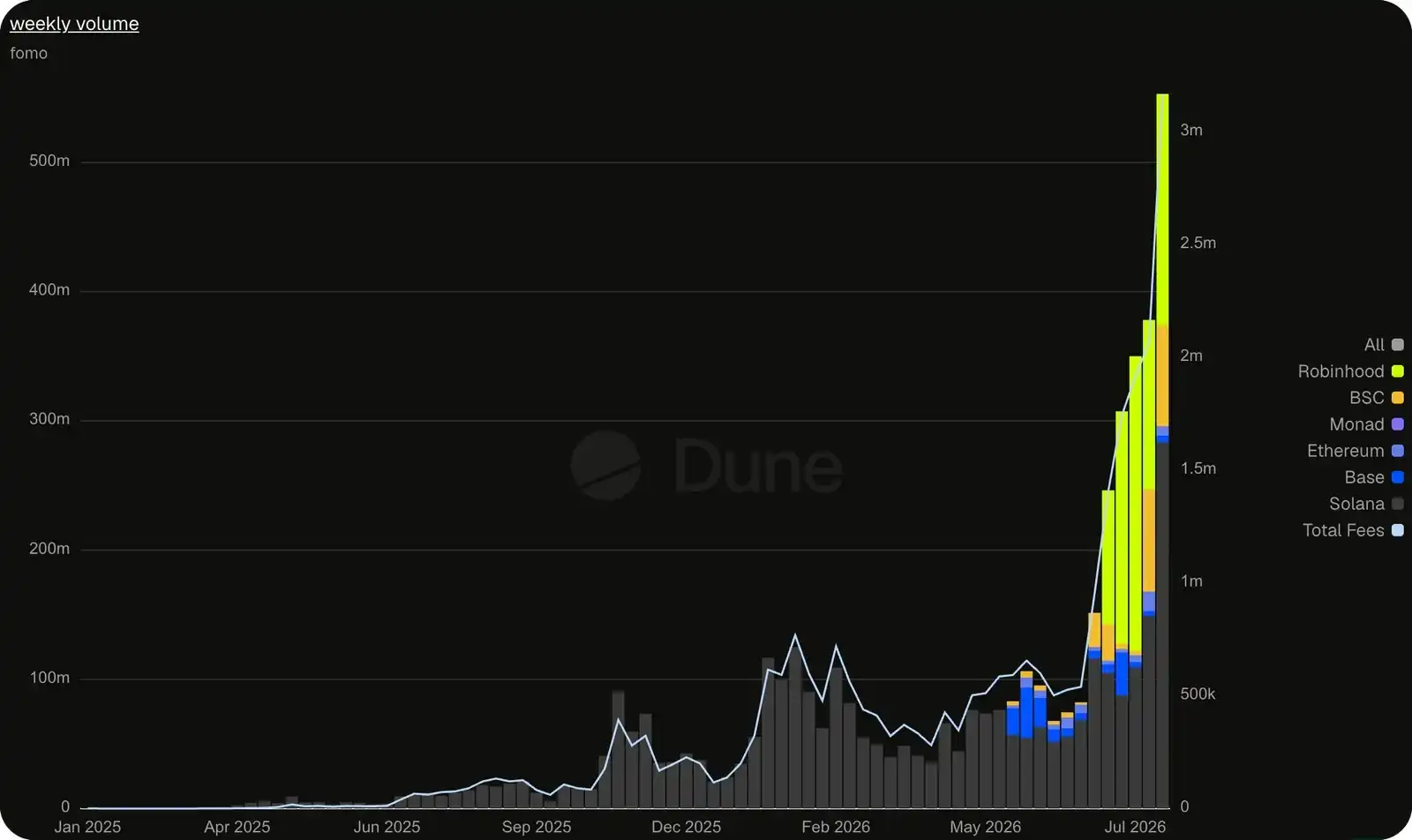
This Dune chart shows Fomo's weekly trading volume: starting with slow growth in early 2025, experiencing an explosive surge after May 2026, with Robinhood Chain being the core driver of volume growth, while total platform fees simultaneously hit record highs.

However, Solana remains the stronghold of speculative trading in the crypto market, and Pump.fun sits at the heart of this arena, unwilling to share the market pie.

Fomo relies on the underlying infrastructure from Pump.fun, achieving rapid growth with a superior front-end interface, essentially acting as a middleman between Solana's speculative infrastructure and the average speculative user. The term 'middleman' here is not derogatory. Fomo has built a product that meets user needs, and the platform's continuous generation of fees proves users are willing to pay for this experience.

But ultimately, most of the features built by Fomo could theoretically be replicated by Pump.fun. We are witnessing this now: Pump.fun is continuously adding numerous social features to its own application, striving to become the 'homepage' for speculative trading.

This creates a delicate dynamic between the two platforms: partners at the underlying infrastructure layer, yet direct competitors in the user-facing market. Fomo holds user traffic, while the infrastructure supporting trade execution mostly belongs to Pump.fun.

Now, Pump.fun wants to capture both the infrastructure and the consumer-facing market layers.

To achieve this goal, Pump.fun is going all out. It is reportedly offering conditions, with contracts worth tens of thousands of dollars per month, to poach top traders from Fomo and attract them to move their trading activities to Pump.fun. This action is not illegal, nor even an industry scandal. Essentially, it's a well-funded platform spending money to attract core users who bring their own traffic.

Beyond this, Pump.fun has also introduced a zero-fee policy for its front-end. It can afford this subsidy because the platform already profits from mechanisms like its bonding curve and PumpSwap; this front-end subsidy model is something Fomo cannot replicate.

Many market participants criticize Fomo for charging fees as a result, but this view misses the core question: what exactly are users paying for?

Users pay for the entire accompanying trading experience: finding traders worth following, viewing their holdings, tracking trade profits, receiving market alerts, and completing all operations through an interface that significantly lowers the barrier to cryptocurrency actions.

Transaction fees are Fomo's core revenue source; the entire user experience is its main business. Pump.fun can offer similar features for free because its underlying business already provides stable income.

In my view, there are two key points worth considering in this matter.

First, this is yet another classic case: mature crypto infrastructure projects are beginning vertical integration upward, competing for end-user traffic. A similar drama is unfolding with Uniswap on Robinhood Chain. After becoming the core on-chain trading infrastructure, Uniswap is promoting its own launchpad, no longer merely serving as an underlying tool for other platforms. Pump.fun is employing the same strategy on Solana: having already captured the underlying infrastructure for speculative trading, it now wants to further control the consumer-facing layer for ordinary users.

Second, I believe the key to the ultimate outcome between Pump.fun and Fomo lies in trust.

Due to its central position in the meme speculation arena, regardless of objectivity, Pump.fun's reputation within the crypto community is mixed. And the rumors of the platform heavily incentivizing trader poaching further damage its image.

In contrast, Fomo launched later, carries less historical baggage, and its product was designed from the outset to make trading behavior more transparent and traceable, focusing on social trading.

But the value of social trading depends entirely on the credibility of the signals traders provide. A trader can publicly buy with one wallet and quietly sell with another; build a position in advance, promote it publicly, and then dump the holdings on followers. While blockchain enables on-chain data transparency, it cannot guarantee that traders themselves are trustworthy.

Ultimately, where users choose to trade depends on which platform can maximize the authenticity of the information displayed. Once traders collude, use multiple hidden wallets to obscure transactions, and harvest their followers, users will lose trust in trading signals. After trust collapses, the value of the social trading layer that both platforms are fiercely competing for will also vanish.

It remains to be seen what measures both platforms will take to maintain user trust going forward.


Crypto di tendenza

Domande pertinenti

QWhat are the main strategies that Pump.fun is using to compete with Fomo for trading traffic?

APump.fun is employing two main strategies to compete with Fomo. First, it is reportedly offering lucrative contracts, worth tens of thousands of dollars per month, to attract top traders from Fomo to migrate their trading activity to Pump.fun. Second, it has introduced a zero-fee policy for its front-end interface, a subsidy it can afford due to profits from its underlying infrastructure like bonding curves and PumpSwap, which Fomo cannot replicate as its core revenue comes from transaction fees.

QWhat is the fundamental difference in the business models of Pump.fun and Fomo that allows Pump.fun to offer a zero-fee front-end?

AThe fundamental difference lies in their primary revenue sources. Pump.fun's core business and profitability come from its underlying infrastructure, such as the bonding curve mechanism and PumpSwap, which facilitate token creation and trading. This allows it to subsidize its front-end by offering zero fees. In contrast, Fomo's main business and revenue stream is its user-facing platform and the associated trading experience; transaction fees are essential for its operation, as it does not have the same foundational infrastructure profits to offset such costs.

QAccording to the article, what broader trend in the crypto industry does the competition between Pump.fun and Fomo represent?

AThe competition represents a trend of vertical integration, where mature crypto infrastructure projects begin moving upstream to capture end-user traffic and control the consumer-facing layer. Similar dynamics are seen with Uniswap on Robinhood Chain, which, after becoming core on-chain trading infrastructure, started promoting its own launchpad instead of just serving as a backend tool for other platforms. Pump.fun is following the same playbook on Solana.

QWhat is identified as the ultimate deciding factor for which platform, Pump.fun or Fomo, will win in the long run?

AThe article identifies user trust as the ultimate deciding factor. The value of social trading, which Fomo emphasizes and Pump.fun is replicating, depends entirely on the credibility of the signals traders provide. If traders engage in manipulative practices (like wash trading or hidden wallets), user trust will erode. The platform that can best ensure the authenticity of the information and trading signals displayed will likely gain a decisive advantage.

QHow does Fomo's product design differentiate it in the meme coin trading space, and what is a potential vulnerability of this model?

AFomo differentiates itself by socializing, publicizing, and making trading trackable. Its product allows users to follow traders, view their portfolios, copy trades (or trade against them), and observe the entire trading process in real-time. This superior front-end experience drove its rapid growth. A potential vulnerability of this social trading model is its dependence on trader trustworthiness. The transparency of blockchain data does not prevent traders from acting dishonestly (e.g., using multiple wallets to hide true positions), which could lead to a collapse in user trust and devalue the platform's core offering.

Letture associate

Wall Street Morning Report: CPI Lands Mildly, U.S. Stocks Stage Deep V-Shaped Reversal, AI Cloud, Storage, and Optical Communications Collectively Surge

Wall Street Morning Report: US stocks staged a deep V-shaped recovery following a mild CPI report, with AI cloud, storage, and optical communication sectors leading the rally. Major indexes were mixed: the Dow dipped slightly, while the S&P 500 and Nasdaq gained, nearing record highs. The July CPI data met expectations, with core inflation hitting its slowest pace since March 2021, further reducing expectations for a September Fed rate hike. Market focus shifted decisively towards AI infrastructure. The Philadelphia Semiconductor Index jumped 2.49%. AI cloud providers NEBIUS and CoreWeave surged 34% and 19% respectively on strong earnings and massive order backlogs. Optical communication stocks like Lumentum and Coherent also posted significant gains. The storage sector rallied broadly, with SK Hynix and Micron among the advancers. Meanwhile, major tech giants saw divergence. Nvidia rose over 3%, while Apple, Microsoft, Amazon, and Meta closed lower. In commodities, gold and silver remained strong, while oil prices retreated as markets awaited developments in the Strait of Hormuz. The US federal budget deficit widened significantly in July, raising long-term concerns. Key upcoming events include US PPI data, Sandisk's investor day, and the SEC's 13F filings deadline, which will reveal institutional holdings.

marsbit11 min fa

Wall Street Morning Report: CPI Lands Mildly, U.S. Stocks Stage Deep V-Shaped Reversal, AI Cloud, Storage, and Optical Communications Collectively Surge

marsbit11 min fa

A 22-Year-Old Mathematical Puzzle, Solved by a Union Hospital Intern?

In an astonishing development, a longstanding mathematical problem known as the Crouzeix conjecture, which had challenged experts in numerical linear algebra for 22 years, appears to have been solved by Shanmu Jin, a neurosurgery resident and postdoctoral researcher at Peking Union Medical College Hospital. With no formal advanced mathematical training—his background is in geology and medicine—Jin relied on self-study and, crucially, the AI model GPT-5.6. The conjecture, proposed by mathematician Michel Crouzeix in 2004, concerns a fundamental constant (speculated to be 2) bounding the relationship between matrix norms and polynomial values over numerical ranges. It is critical for applications in matrix function analysis and numerical methods. Despite dedicated efforts by leading mathematicians, the best proven constant had only been reduced to 2.414. Jin approached the problem using sophisticated prompt engineering with GPT-5.6. He adapted a known prompting strategy, isolating the AI from external resources to force original reasoning, employing multiple divergent "sub-agents" to explore different paths, and enforcing rigorous adversarial review of proposed proof steps. After about 16 hours of autonomous, unsupervised operation, the AI produced a novel and elegant proof. The key insight involved a clever "sampling strategy" that reduced the problem to a simple positivity condition—a solution described as elegant and unexpected by experts. The proof was verified by the conjecture's originator, Michel Crouzeix, and other specialists like Alex Townsend and Anne Greenbaum, who expressed astonishment at its validity. Jin has made the entire process open-source, including the prompt, drafts, and formal verification code. Remarkably, just eight days after Jin's preprint appeared, mathematicians Emiel Lorist and Felix Schwenninger published an independent, concise 5-page proof using a different approach, also developed with the aid of ChatGPT 5.6. Jin welcomed this complementary work. This event marks a potential turning point, demonstrating how AI can enable experts from non-traditional backgrounds to solve deep theoretical problems and dramatically accelerate scientific discovery, heralding what some are calling a new "golden age" for interdisciplinary research.

marsbit25 min fa

A 22-Year-Old Mathematical Puzzle, Solved by a Union Hospital Intern?

marsbit25 min fa

Trading

Spot

Articoli Popolari

Cosa è MEME 2.0

Memecoin 2.0: L'Ascesa di $MEME 2.0 nel Mondo delle Criptovalute Introduzione Nel panorama in continua evoluzione delle criptovalute, è emerso un nuovo contendente. Memecoin 2.0, simboleggiato come $MEME 2.0, porta il concetto di meme coin a un livello emozionante. Come prodotto derivato dal Memecoin originale, questo progetto ha catturato l'attenzione della comunità crypto spostando il focus da incentivi finanziari tipici a un'esperienza coinvolgente e divertente. Operando sulla blockchain di Ethereum, Memecoin 2.0 ridefinisce audacemente l'impegno della comunità nella sfera crypto. Che cos'è Memecoin 2.0, $MEME 2.0? Alla base, Memecoin 2.0 è un progetto di criptovaluta che dà priorità allo spirito di comunità e al divertimento associato alla cultura meme. A differenza delle criptovalute convenzionali, che si concentrano su casi d'uso pratici e benefici tangibili, Memecoin 2.0 si distingue abbracciando il lato più leggero della moneta digitale. Il progetto esiste senza promesse di utilità, una roadmap strutturata o ritorni finanziari, concentrandosi invece sulla creazione di una comunità vibrante incentrata sui meme e sul divertimento condiviso. Facendo così, attinge alla crescente tendenza della cultura meme nello spazio online, rendendola un giocatore unico nel mondo degli asset digitali. Creatore di Memecoin 2.0, $MEME 2.0 Nonostante ricerche approfondite sulle origini di Memecoin 2.0, l'identità esplicita del suo creatore rimane sconosciuta. Questa anonimità non è rara nella comunità crypto, dove molti progetti sono guidati da individui o gruppi che preferiscono rimanere dietro le quinte. La mancanza di informazioni pubblicamente disponibili sul creatore potrebbe essere vista come una mossa strategica, mettendo in evidenza l'impegno della comunità piuttosto che la notorietà individuale all'interno dello spazio. Investitori di Memecoin 2.0, $MEME 2.0 Le informazioni riguardanti gli investitori o il supporto finanziario per Memecoin 2.0 sono scarse. Questa assenza di dettagli potrebbe suggerire che il progetto sia autofinanziato o che il suo focus sulla comunità piuttosto che sulle strutture d'investimento tradizionali abbia attratto un tipo diverso di sostenitore. Poiché il mondo delle meme coin coinvolge tipicamente un maggior coinvolgimento di base piuttosto che investimenti istituzionali, questo approccio si allinea con l'etica dei progetti guidati dalla comunità. Come funziona Memecoin 2.0, $MEME 2.0? Memecoin 2.0 opera interamente sulla blockchain di Ethereum, capitalizzando le sue robuste caratteristiche di sicurezza e scalabilità. Sfruttando i punti di forza di Ethereum, Memecoin 2.0 può offrire un ambiente sicuro per le interazioni degli utenti garantendo che le transazioni siano sia efficienti che convenienti. Uno degli attributi unici di Memecoin 2.0 risiede nella sua struttura guidata dalla comunità. Il valore e la popolarità del token $MEME 2.0 derivano dalla partecipazione attiva dei suoi utenti, piuttosto che dalla utilità intrinseca. Questo design rinforza il focus del progetto sull'aspetto dell'intrattenimento delle criptovalute, implicando che la risata e l'impegno della comunità siano le vere monete che guidano il suo successo. Inoltre, il progetto si inserisce all'interno dell'ecosistema più ampio delle meme coin, dove il valore di ciascuna meme coin oscilla in base alla cultura, alle tendenze e all'impegno della comunità piuttosto che ai principi economici tradizionali. Cronologia di Memecoin 2.0, $MEME 2.0 Per comprendere meglio l'evoluzione e le pietre miliari di Memecoin 2.0, ecco una cronologia che evidenzia eventi significativi nella sua storia: 2024: L'inizio di Memecoin 2.0 è riconosciuto come un ramo del Memecoin originale, affermandosi all'interno del contesto fiorente delle meme coin mentre opera sulla blockchain di Ethereum. 13 luglio 2024: Memecoin 2.0 si posiziona ufficialmente come una meme coin incentrata sulla comunità sulla rete Ethereum, enfatizzando il suo approccio centrato sull'intrattenimento che invita gli utenti a impegnarsi e partecipare alla sua crescita. Punti Chiave su Memecoin 2.0, $MEME 2.0 Diverse caratteristiche critiche definiscono Memecoin 2.0: Approccio Centrico alla Comunità: La missione principale di Memecoin 2.0 è creare un'esperienza comunitaria divertente e coinvolgente, capitalizzando il piacere collettivo derivante dalla cultura memetica. Costruita su Ethereum: Operare sulla blockchain di Ethereum fornisce al progetto un'infrastruttura essenziale che garantisce sicurezza e scalabilità. Mancanza di Utilità o Roadmap: In una marcata deviazione dalle criptovalute tradizionali, Memecoin 2.0 non promette alcuna caratteristica utilitaria o ritorni finanziari, riaffermando il suo impegno per il coinvolgimento della comunità e l'impegno sociale. Focus sulla Cultura Memetica: Abbracciando gli aspetti umoristici e culturali del fenomeno meme, Memecoin 2.0 offre una piattaforma per gli utenti per interagire con la crypto offline e online. Ulteriore Contesto: L'Importanza delle Meme Coin Le meme coin sono emerse come una classe distinta di criptovaluta, spesso guidata dall'umorismo e da un approccio spensierato al trading. Queste monete generalmente mancano di significative utilità o roadmap di sviluppo, attirando gli utenti con la promessa di divertimento, interazione comunitaria e rilevanza culturale. Nel panorama del più ampio ecosistema crypto, le meme coin rianimano l'importanza dell'impegno della comunità, opponendosi ad approcci esclusivamente orientati al profitto. Progetti come Memecoin 2.0 danno il via a un'era in cui l'intrattenimento può armonizzarsi con le aspirazioni finanziarie, trasformando la blockchain in un parco giochi per la creatività e l'interazione sociale. Conclusione Memecoin 2.0, o $MEME 2.0, incarna una nuova ondata di criptovaluta che dà priorità all'impegno della comunità rispetto a rigidi strutture finanziarie. Con un focus sull'umorismo e l'interazione sociale, capitalizza sulla fascinazione circondante la cultura meme. Operando sulla blockchain di Ethereum, Memecoin 2.0 sfrutta le capacità della tecnologia mantenendo fermo il suo impegno per il valore ricreativo della valuta digitale. Mentre lo spazio delle criptovalute continua a evolversi, Memecoin 2.0 serve come testimonianza della nozione che il futuro degli asset digitali potrebbe ben dipendere da esperienze condivise, risate e solidi legami comunitari. Nel mondo imprevedibile delle crypto, forse la gioia può essere altrettanto preziosa quanto il guadagno finanziario tradizionale.

182 Totale visualizzazioniPubblicato il 2024.04.04Aggiornato il 2024.12.03

Cosa è MEME 2.0

Come comprare MEME

Benvenuto in HTX.com! Abbiamo reso l'acquisto di Memeland (MEME) semplice e conveniente. Segui la nostra guida passo passo per intraprendere il tuo viaggio nel mondo delle criptovalute.Step 1: Crea il tuo Account HTXUsa la tua email o numero di telefono per registrarti il tuo account gratuito su HTX. Vivi un'esperienza facile e sblocca tutte le funzionalità,Crea il mio accountStep 2: Vai in Acquista crypto e seleziona il tuo metodo di pagamentoCarta di credito/debito: utilizza la tua Visa o Mastercard per acquistare immediatamente MemelandMEME.Bilancio: Usa i fondi dal bilancio del tuo account HTX per fare trading senza problemi.Terze parti: abbiamo aggiunto metodi di pagamento molto utilizzati come Google Pay e Apple Pay per maggiore comodità.P2P: Fai trading direttamente con altri utenti HTX.Over-the-Counter (OTC): Offriamo servizi su misura e tassi di cambio competitivi per i trader.Step 3: Conserva Memeland (MEME)Dopo aver acquistato Memeland (MEME), conserva nel tuo account HTX. In alternativa, puoi inviare tramite trasferimento blockchain o scambiare per altre criptovalute.Step 4: Scambia Memeland (MEME)Scambia facilmente Memeland (MEME) nel mercato spot di HTX. Accedi al tuo account, seleziona la tua coppia di trading, esegui le tue operazioni e monitora in tempo reale. Offriamo un'esperienza user-friendly sia per chi ha appena iniziato che per i trader più esperti.

432 Totale visualizzazioniPubblicato il 2024.12.12Aggiornato il 2026.06.02

Come comprare MEME

Discussioni

Benvenuto nella Community HTX. Qui puoi rimanere informato sugli ultimi sviluppi della piattaforma e accedere ad approfondimenti esperti sul mercato. Le opinioni degli utenti sul prezzo di MEME MEME sono presentate come di seguito.

活动图片