Tornado Cash Suffers Another Governance Attack: A Fake Proposal Targets $23 Million Community Treasury

Foresight NewsPubblicato 2026-06-26Pubblicato ultima volta 2026-06-26

Introduzione

On June 25, 2026, a deceptive governance proposal (#67) appeared in the Tornado Cash DAO, masquerading as an upgrade to implement fee adjustments and token burns. Security researchers, including Sergey Shemyakov and Pascal Caversaccio, quickly identified it as malicious. The proposal's unverified code contained a hidden function designed to stealthily replace the protocol's legitimate governance address (0x5efda50f22d34F262c29268506C5Fa42cB56A1Ce) with an attacker-controlled address (0x5efda50f22d34f272c7077689d6abc42f15e285f). If passed, this would have granted the attacker control over the DAO's treasury, containing approximately $23 million in TORN tokens, and the ability to drain all relayers. The attacker's wallet (0xd4eca8c9242b9f9faa3cf19a78defc21dc97a925) was funded via the privacy protocol Railgun four days prior, obscuring the source. The community response was swift, with the proposal receiving 27,163 TORN votes against (100%) and 0 for, far below the 100,000 TORN quorum required for validity. It is set to expire on June 30. This incident marks the second major governance attack on Tornado Cash, following a May 2023 exploit that stole $2.17 million. It highlights persistent vulnerabilities in DAO structures where power derives from token ownership. The article advises users to follow security researchers, vote against unverified proposals, and delegate voting power. For developers, implementing timelocks—a delay between proposal approval and execution—is presente...


Author: angelilu, Foresight News


At 6:18 AM on June 25, 2026, a governance proposal numbered 67 appeared on the voting page of the Tornado Cash DAO.
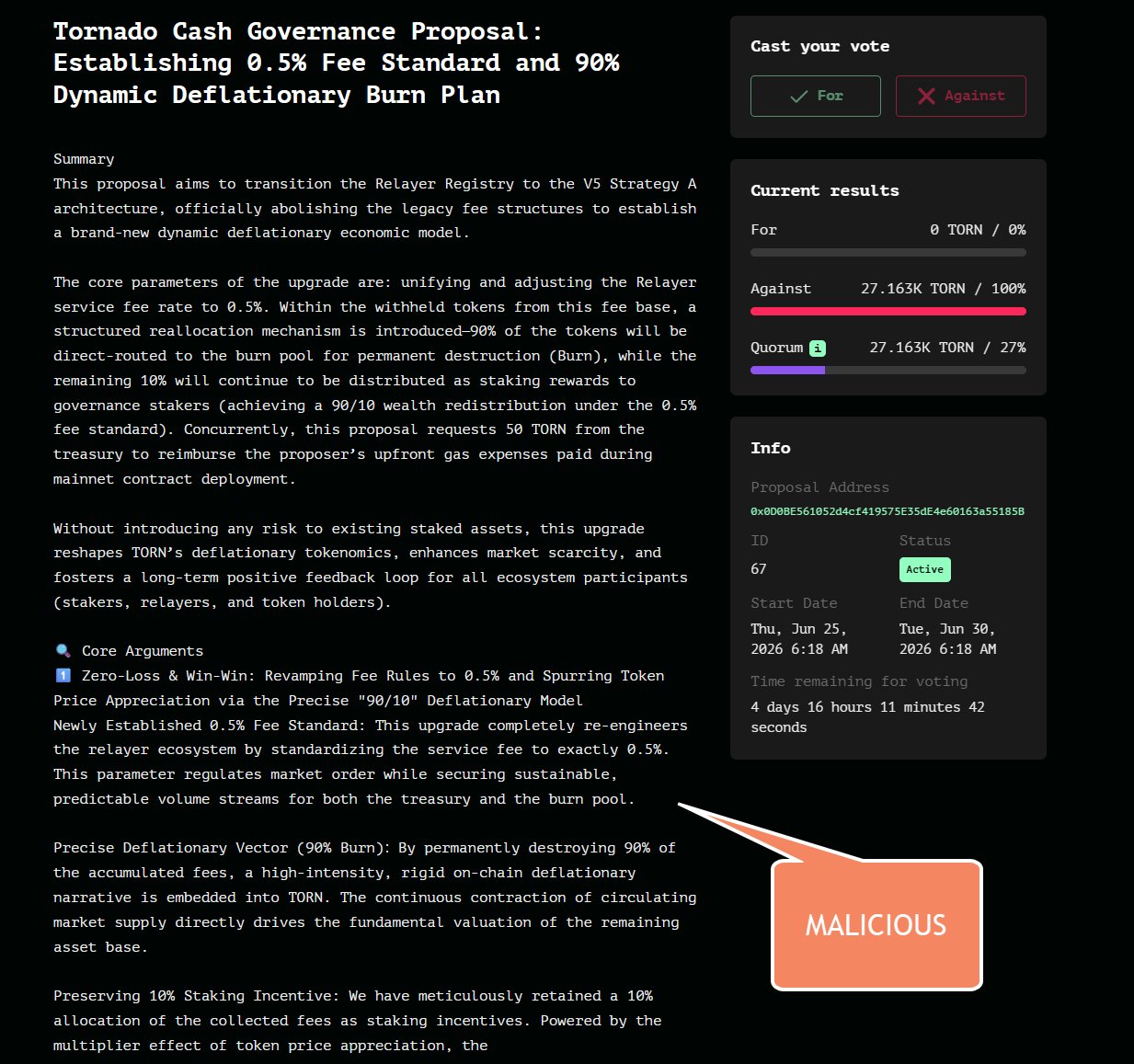


The title was written formally: "Establishing a 0.5% Fee Standard and 90% Dynamic Deflationary Burn Scheme." The main text was lengthy and elaborate, claiming to upgrade the relayer registry to the "V5 Strategy A" architecture, permanently burning 90% of the protocol fees, distributing 10% to stakers, and including a set of economic model projections for a "positive wealth cycle."


The proposer also requested 50 TORN tokens from the treasury to compensate for the Gas fees prepaid when deploying the contract—this detail made the entire proposal appear to be written by a responsible, out-of-pocket community contributor.


However, the contract code for this proposal was not verified at all. That is, the execution logic (Calldata) of the proposal was not source code verified on a block explorer (like Etherscan). Without verification, the community saw only machine code and could not directly review it. Historical normal proposals for Tornado Cash always included this step; this proposal skipped it.


L2BEAT researcher Sergey Shemyakov was the first to notice this. About 8 hours after the proposal went live, he tagged security researcher Pascal Caversaccio, saying: "The logic of this proposal is abnormally complex, please help with an independent review."
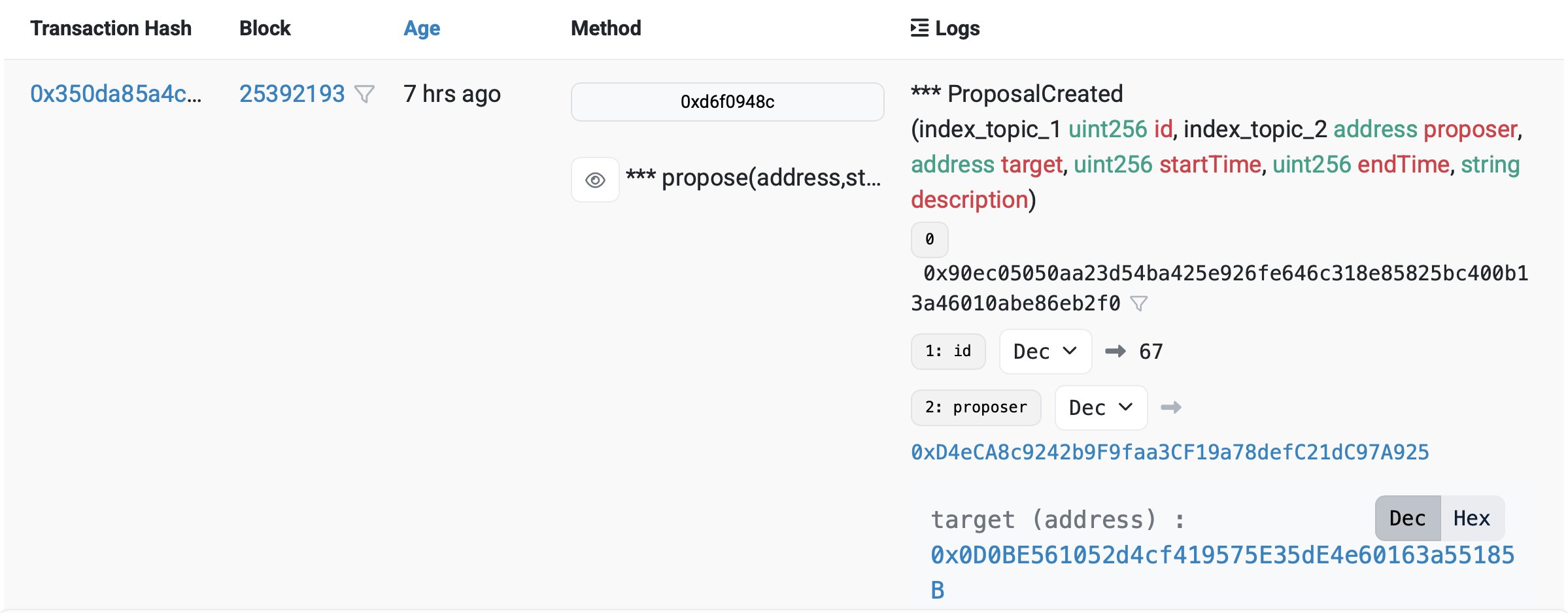


Security Alliance researcher Pascal Caversaccio quickly delivered a conclusion.


The Proposal's True Purpose: Stealthily Changing the Protocol's Admin Address


Caversaccio used a decompilation tool to revert the proposal contract's bytecode and determined the proposal was malicious.


The code contained a function named "governance," with only one function: to return an address, telling the protocol "who the admin is." The address hardcoded within this function was the attacker's own wallet.
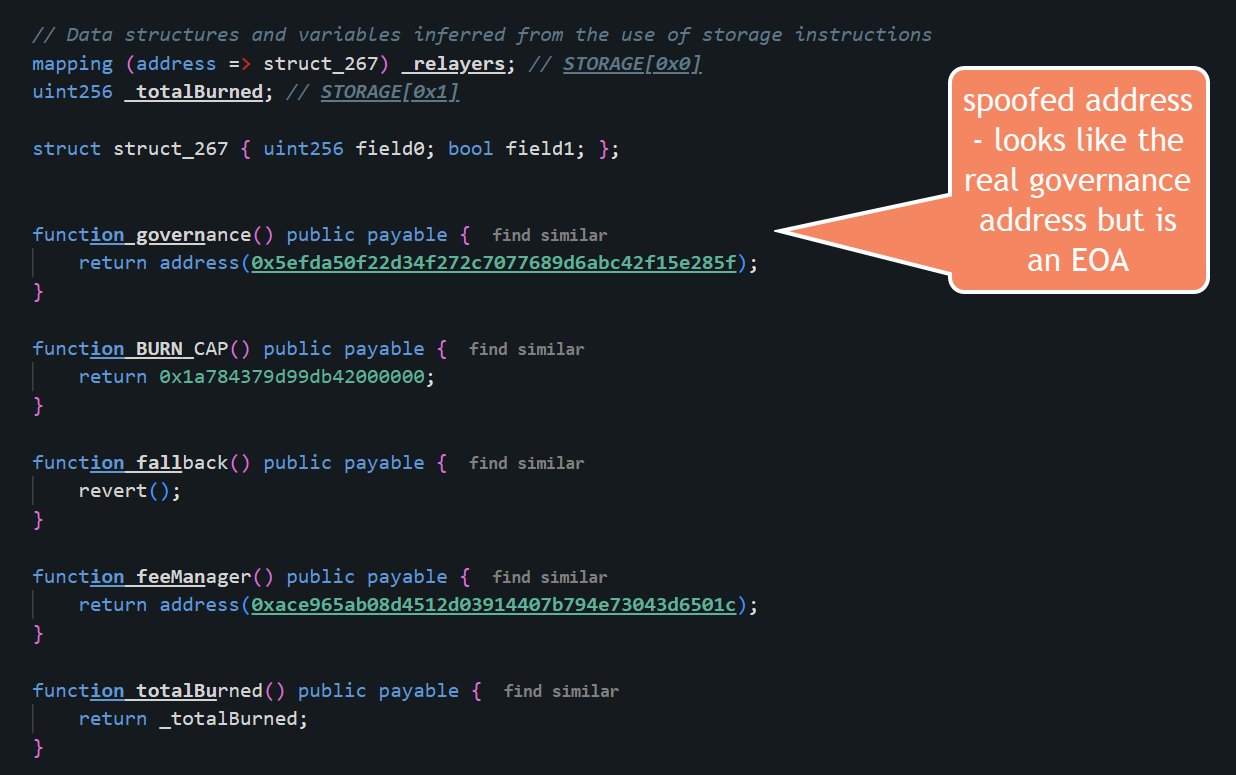


In Tornado Cash's architecture, various parts of the protocol call this function to confirm the highest authority. Once the proposal passed and executed, the address originally pointing to the community governance contract would be silently replaced with this attacker address.


The real governance address is 0x5efda50f22d34F262c29268506C5Fa42cB56A1Ce;

The forged attacker address is 0x5efda50f22d34f272c7077689d6abc42f15e285f.


The first 15 characters of the two addresses are identical, with differences starting only from the 16th character. It's very difficult for the average person to spot the difference by eye.


If this proposal passed, the consequence would be: the protocol's recognized "highest admin" address would be silently switched to the attacker's address. At that point, the attacker could use this identity to withdraw approximately $23 million worth of TORN tokens currently locked in the governance contract—this money is staked by community members for voting participation. Additionally, the attacker could forcibly zero out the balances of all relayers (service providers that forward transactions for users) within the protocol, paralyzing the entire system.


Who is the Attacker? Where Did the Money Come From?


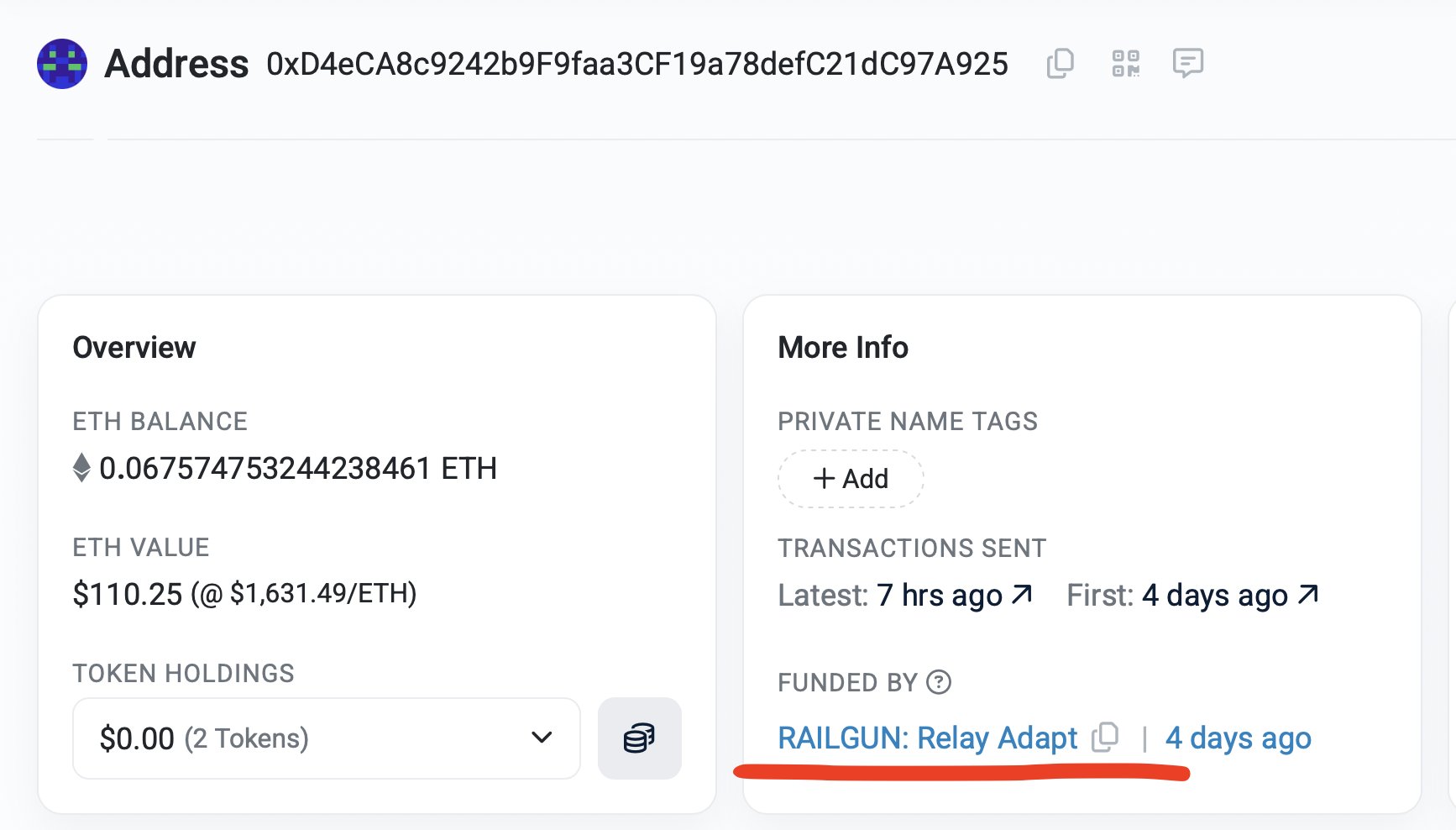
The wallet address of the proposal creator is 0xd4eca8c9242b9f9faa3cf19a78defc21dc97a925.


Caversaccio traced the funding source of this address and found it had received a transfer just 4 days before the proposal submission. The sender was Railgun—another on-chain privacy mixing protocol and a direct competitor of Tornado Cash. Using Railgun for the transfer means the fund source is obfuscated, untraceable to real identity.


Current Voting Status After Community Discovery


As of now, the voting results for this proposal are: 0 votes in favor, 27,163 TORN against, accounting for 100%. Voting closes on June 30.


Tornado Cash's governance rules require at least 100,000 TORN participating in the vote to reach quorum; currently, only 27% has been reached. Unless a large-scale abnormal wave of votes in favor appears within the next 4 days, pushing the quorum up and flipping the result. Otherwise, the proposal will expire and the result of being rejected is non-execution. However, the greater impact of this incident is the warning it provides.


This is already the second time Tornado Cash has faced this type of attack. In May 2023, an attacker gained governance control with 1.2 million votes through a proposal containing a hidden self-destruct function, while the entire DAO's legitimate votes at the time were only 70,000. In that attack, the attacker withdrew approximately $2.17 million worth of TORN, using Tornado Cash itself to launder the money, then submitted a "restore governance" proposal, netting about $900,000 before making a clean exit. Since then, no one has fundamentally repaired this governance structure.


DAO Governance Attacks: How Can Ordinary Users Defend Themselves?


Governance attacks are now a regular risk in Web3, not specific to any one protocol. In April 2022, Beanstalk was attacked by a perpetrator who borrowed $1 billion in temporary voting power via a flash loan, passed a proposal, transferred $182 million, and repaid the loan all within a single transaction, taking less than a minute. In February of the same year, Build Finance DAO was taken over by an attacker using counterfeit governance tokens, emptying its $11 million treasury.


The forms of attack are evolving: from flash loan vote snatching, to hidden self-destruct functions, to this time's address character substitution. But the underlying logic remains the same—a DAO's power comes from tokens, and tokens can be borrowed, forged, and obfuscated. Any governance mechanism that can be controlled by code can be attacked.


For ordinary users holding governance tokens, there are several practical paths. First, pay attention to real-time alerts from security researchers; this attack was first flagged by an L2BEAT researcher. Second, proposals pointing to unverified contracts should most likely be voted against directly. Third, if you hold a protocol's governance tokens but don't plan to actively participate, delegating your voting power to active community members is safer than letting the tokens lie dormant in your wallet. Silent tokens only make it harder to reach quorum.


For protocol developers, a more fundamental line of defense is introducing a timelock at the governance layer—proposals, once passed, do not execute immediately but have a 48 to 72-hour window, giving the community and security researchers a chance to review and trigger an emergency pause. Protocols like Compound and Aave have long made this mechanism standard; Tornado Cash still does not have it, which is also part of its extreme choice regarding compliance and censorship resistance.


Domande pertinenti

QWhat was the main deceptive tactic used in the fake Tornado Cash proposal to try and gain control of the protocol?

AThe fake proposal contained hidden code that, if executed, would have changed the protocol's 'governance' function to return the attacker's wallet address. This would have stealthily replaced the legitimate admin address, granting the attacker control over the DAO treasury and other protocol functions.

QWho first raised the alarm about the suspicious Proposal #67, and what was the key red flag they identified?

AL2BEAT researcher Sergey Shemyakov first raised the alarm about the suspicious proposal. The key red flag he identified was that the proposal's contract code was not verified on a block explorer like Etherscan, meaning its execution logic was hidden as unreadable bytecode, unlike normal proposals.

QWhat were the potential consequences if the malicious Tornado Cash proposal had passed?

AIf passed, the attacker would have gained control of the protocol's governance. They could have drained the approximately $23 million worth of TORN tokens from the community treasury and forced the balances of all protocol relayers to zero, effectively paralyzing the entire Tornado Cash service.

QHow does this 2026 attack on Tornado Cash relate to a previous incident involving the same protocol?

AThis was the second major governance attack on Tornado Cash. In May 2023, an attacker used a proposal with a hidden self-destruct function to gain voting control, drain roughly $2.17 million from the treasury, and profit by approximately $900,000. The article notes that the fundamental governance structure was not fixed after that first attack.

QAccording to the article, what is a fundamental defensive measure that protocols like Tornado Cash lack, which could help prevent such governance attacks?

AThe article states that Tornado Cash lacks a timelock mechanism in its governance layer. A timelock would impose a 48 to 72-hour delay between a proposal passing and its execution, giving the community and security researchers a window to review the code and trigger an emergency shutdown if necessary, a feature already standard in protocols like Compound and Aave.

Letture associate

South Korean Institutions' Crypto Race: Dual Explosion of Stablecoins and RWA

**Summary: South Korea's Institutional Crypto Race: Stablecoins and RWA Take Off** South Korea is undergoing a structural shift in its crypto ecosystem, moving beyond its historical role as a major retail trading hub. Major financial institutions and internet platforms are now building institutional-grade blockchain infrastructure, with stablecoins and Real-World Asset (RWA) tokenization as the primary drivers. The push for a regulated Korean won stablecoin market is a major policy and corporate focus. This is driven partly by an estimated $115 billion outflow into dollar stablecoins like USDC, threatening the domestic financial system. Banks (e.g., KB Financial, Hana), payment giants (e.g., Shinhan Card, BC Card), and internet super-apps (KakaoPay, NAVER Pay) are all conducting pilots. The goal is to anchor future digital finance to the Korean won and local regulations. In RWA, South Korea is advancing rapidly within regulatory sandboxes, focusing on unique domestic assets beyond typical global templates like US Treasuries. Projects involve tokenizing ships (with Hyundai Heavy Industries), defense supply chain assets, and K-pop intellectual property, alongside more conventional assets. A legal framework is set for 2027, and platforms like NXT are preparing for regulated trading. Key opportunities for crypto-native projects lie in providing the underlying technology these traditional institutions lack: global distribution channels for tokenized assets, cross-chain liquidity solutions, and enabling infrastructure tools (e.g., for asset packaging and management). Partnerships, such as Solana with Shinhan Card or LayerZero with the Korea Gold Exchange, exemplify this proactive approach. Crucially, user access is being shaped by consumer platforms. NAVER's planned acquisition of Upbit's operator Dunamu and Kakao's development of a unified wallet aim to seamlessly integrate crypto with everyday payments for tens of millions of users. The race is now about which protocols and projects will become the foundational standards as regulation solidifies and institutional adoption accelerates.

Foresight News38 min fa

South Korean Institutions' Crypto Race: Dual Explosion of Stablecoins and RWA

Foresight News38 min fa

How to Detect AI-Generated Videos? A Review of Dynamic, Traceable, and Explainable Detection Systems

**How to Detect AI-Generated Videos: A Survey on Dynamic, Traceable, and Explainable Detection Systems** With rapid advances in AI video generation (e.g., Sora, Veo), creating highly realistic, multi-minute videos is now possible, widening the gap with detection research. Current AI video detection, often limited to unreliable binary classifications, is insufficient. This survey, accepted at ACL 2026, reframes the goal as **"factual fidelity verification"**—checking if a video's content (who, when, where, what) aligns with the real world perceptually and cognitively. It categorizes AI-generated videos into three paradigms: **Local Manipulation Videos (LMV**, e.g., face swaps), **Audio-Visual Editing (AVE**, e.g., lip-syncing), and **Generative Video Synthesis (GVS**, fully synthetic videos like Sora's). Detection challenges evolve from visual artifacts in LMV to multi-modal inconsistencies in AVE and higher-level world knowledge violations in GVS. The core proposal is a **Vision-Language Dual-View framework** with four hierarchical layers: 1. **Layer 1 (Intrinsic Visual Cues):** Analyzes low-level signal statistics, noise patterns, and physiological signals. 2. **Layer 2 (Spatiotemporal Consistency):** Checks for temporal coherence in object motion and scene dynamics. 3. **Layer 3 (Cross-Modal Consistency):** Verifies alignment between video, audio, and text within the video. 4. **Layer 4 (Language-Guided World-Level Reasoning):** Uses external knowledge, facts, and physical laws to judge semantic plausibility and factual correctness. The survey traces a shift in detection focus from lower layers (1 & 2) toward higher, language-involved layers (3 & 4). It also reviews evolving evaluation metrics and datasets tailored for each video paradigm. The conclusion advocates for a **dynamic, evidence-first detection system** that moves beyond simple classification. Future trustworthy detection requires combining visual evidence (from CV) with semantic reasoning and explanation (from NLP & multimodal AI), ultimately creating traceable and explainable judgments about a video's adherence to real-world constraints.

marsbit1 h fa

How to Detect AI-Generated Videos? A Review of Dynamic, Traceable, and Explainable Detection Systems

marsbit1 h fa

It Turns Out the First Real-World Application of AI x Crypto is in Security Auditing

The article explores the surprising trend where AI's first major impact on crypto has been in security auditing, not in areas like trading or analytics. It details how AI-powered tools are dramatically lowering the barrier to finding smart contract vulnerabilities, enabling attackers to scan thousands of contracts and execute exploits within minutes. This has rendered traditional, manually-produced audit reports with their month-long validity periods increasingly obsolete, creating a critical "structural crack" in the old security model. Cases like Drift Protocol and KelpDAO show that even extensively audited protocols can be hacked through social engineering, operational flaws, or infrastructure misconfigurations beyond pure code review. Attackers are also using AI to find and exploit vulnerabilities in years-old, deployed contracts. Notably, OpenZeppelin's co-founder has expressed a grim view that "all DeFi is insecure" due to AI's asymmetric advantage. In response, the audit industry is undergoing a fundamental shift. While there's a short-term spike in defensive re-audits, the long-term business model is changing. Firms are developing AI-assisted systems and moving from one-time report deliveries towards embedded, continuous services like real-time monitoring and formal verification. Examples include AI tools uncovering critical, previously missed vulnerabilities in heavily audited protocols like Curve Finance and Zcash. The conclusion is that security must become a continuous investment, not a one-time checkbox, and audit firms must rapidly evolve their tools and service models to survive.

marsbit1 h fa

It Turns Out the First Real-World Application of AI x Crypto is in Security Auditing

marsbit1 h fa

Trading

Spot
活动图片