Stock Price Hits New High! Corning Targets CPO Optical Interconnect Market

marsbitPubblicato 2026-06-25Pubblicato ultima volta 2026-06-25

Introduzione

TL;DR Corning's stock recently hit a new high, driven partly by investor interest in its role within AI data center optical interconnects. At a recent conference, Corning showcased its GlassBridge technology, a glass-based optical bridge designed to connect fibers to photonic integrated chips (PICs). This component targets challenges in Co-Packaged Optics (CPO) architectures by aiming to reduce coupling loss and simplify the precise alignment needed between optical fibers and nanoscale chip waveguides. The core issue GlassBridge addresses is the significant dimensional mismatch between fibers and PICs, which causes signal loss and assembly complexity. Corning leverages its glass and fiber expertise to create a platform it claims offers low coupling loss (demonstrating 1.5dB) and supports passive alignment. The broader vision extends to glass-based substrates with through-glass vias for advanced CPO packaging. While positioning itself as a solutions provider from cables to chip-level interconnects, Corning's GlassBridge is currently a technological showcase. Its path to widespread adoption in AI servers depends on overcoming hurdles in mass production yield, cost, thermal management, and crucially, validation and integration into future customer platforms from major cloud and chip companies competing with alternative solutions like silicon photonics.

TL;DR

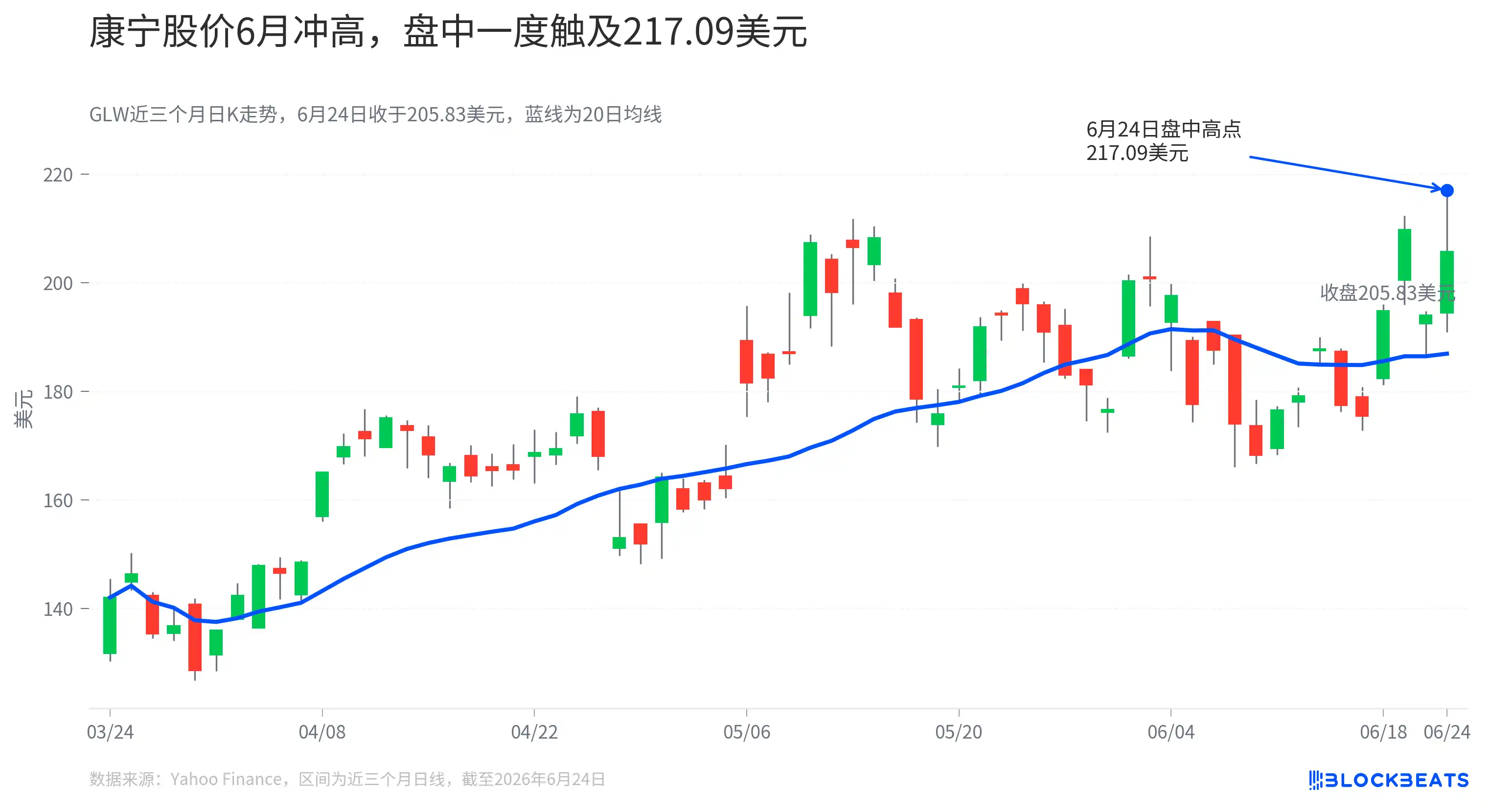
Corning's stock price is already at a high level. As of the close of U.S. trading on June 24, Corning (GLW) closed at $205.83, up about 6.1% for the day, with an intraday high of $217.09. The demand for AI data center optical interconnect is one of the core reasons the market is reassessing this established glass and fiber optics company.
According to materials from the Seoul AI Data Center Optical Communication Conference on June 24, Corning showcased the GlassBridge glass-based optical bridge, attempting to advance fiber connections to near the photonic integrated circuit. Corning's official product page positions it as a "fiber-to-PIC connector platform" for scenarios like NPO, CPO, and high-density photonic modules.

It belongs to optical interconnect components that are closer to the chip, positioned deeper than traditional pluggable optical modules. As AI data center GPU clusters grow larger, the pressure of data movement between chips, servers, and racks increases. Electrical connections and traditional optical connections face bottlenecks in density, power consumption, latency, and assembly complexity. CPO, or Co-Packaged Optics, aims to address precisely this issue of pushing optical connections closer to the chip.

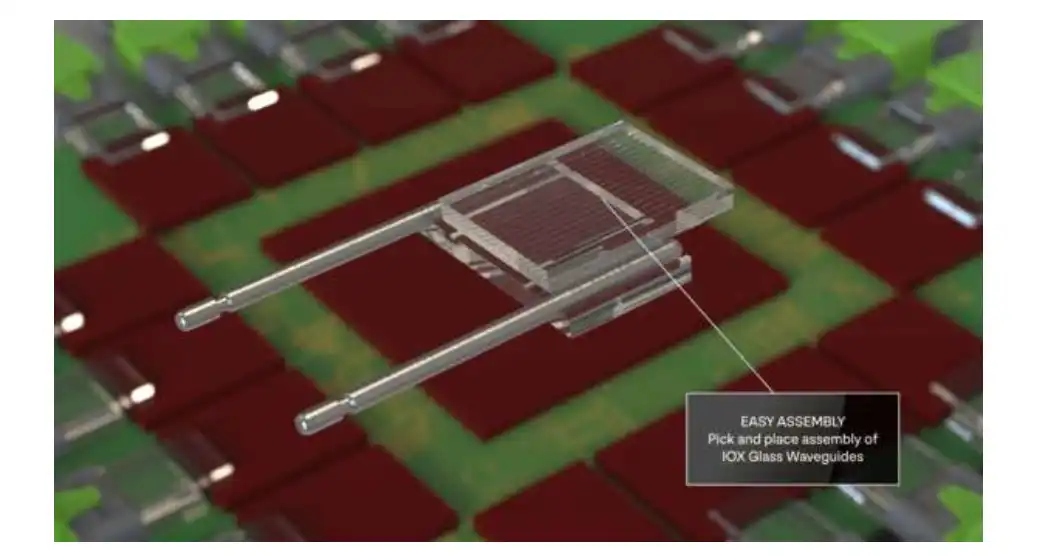
A key aspect of Corning's recent highlighting of GlassBridge is advancing the company's long-accumulated expertise in glass and fiber optics into the chip-level packaging and interconnect domain. Public documentation states that this platform, based on glass and wafer-level IOX ion-exchange waveguides, has demonstrated O-band fiber-to-photonic chip coupling performance of 1.5 dB, and supports passive alignment, detachability, and high-density connections.
The Glass Bridge Aims to Solve the "Misalignment" Between Fiber and Chip

Optical interconnect might sound like simply attaching an optical fiber to a chip, but the real challenge lies in the scale difference.

Waveguides on a photonic chip are typically only a few hundred nanometers wide, while the core diameter of an optical fiber is on the order of several micrometers. When signals travel from the fiber into the photonic chip, any deviation in the optical path, angle, or position introduces coupling loss. For high-density AI servers, this simultaneously impacts link efficiency, assembly, testing, and packaging difficulty.

GlassBridge's approach involves pre-forming optical pathways in glass to guide fiber signals to the photonic chip interface. Public documentation lists customizable PIC pitches including 40μm, 80μm, 127μm, and 165μm diameters. Compared to directly aligning a fiber array to the chip, this type of glass bridge aims to reduce assembly difficulty and eliminate some intermediate connection stages.

The 1.5 dB figure is the most notable performance metric highlighted this time, but it should still be understood as a demonstration figure from public documentation, not equivalent to having passed large-scale mass production validation. Before entering real data centers, this component must still undergo validation for packaging yield, long-term reliability, thermal stability, and ease of maintenance.

The Closer CPO Gets to the Chip, the Higher the Packaging Difficulty

CPO is valued by AI data centers because it has the potential to reduce the power consumption and latency of high-bandwidth interconnects. In traditional network connections, optical modules are typically plugged into switch or server panels, requiring electrical signals to travel a distance between the chip and the module. As the bandwidth demands of AI clusters continue to rise, this electrical connection becomes more costly and power-hungry.

Integrating optical devices into the package or near the chip can theoretically shorten the signal path and increase bandwidth density. However, the closer to the chip, the less the technical difficulty resembles that of ordinary optical modules and the more it resembles advanced packaging engineering. Photoelectric conversion, fiber coupling, thermal management, packaging materials, assembly precision, and manufacturability all have to be addressed within the same system.

Corning's showcased next-generation CPO glass-based architecture integrates glass substrates, optical waveguides, and through-glass vias (TGV) into a single concept and supports flip-chip mounting of photonic devices. The key change is that Corning is attempting to advance glass from a transmission material to a packaging platform position.

This also explains why GlassBridge appears alongside glass-core packaging. Glass materials offer advantages in dimensional stability, optical properties, and processability, making them suitable for carrying high-density optical pathways. However, the ultimate adoption of advanced packaging still depends on mass production yield, cost curves, supply chain equipment, and customer validation cycles.

Corning Wants to Sell an Optical Interconnect Solution

GlassBridge sits within Corning's broader AI data center optical communication strategy. In its OFC 2026 press release, Corning already showcased optical fibers, cables, connectors, and CPO-related solutions for AI data centers. The GlassWorks AI platform integrates optical fibers, cables, connectors, Fiber Array Units (FAU), and alignment components into a comprehensive AI data center optical communication solution, covering inter-rack and campus-wide connections.

This reflects Corning's evolving position within AI infrastructure from a "fiber and cable supplier" to an optical interconnect supplier moving closer to the system's interior. AI data center construction is driving up demand for optical fibers, connectors, and high-speed interconnects, while CPO and glass-core packaging are pushing demand even closer to the chip.

Customer and capacity plans are the foundation for Corning's advancement on this path. Corning is collaborating with GlobalFoundries on the GF Fotonix platform to develop detachable fiber connectivity solutions targeting high-bandwidth, low-power optical connections for AI data centers. The company has also signed a multi-year agreement with Meta worth up to $6 billion and announced a long-term commercial and technical collaboration with NVIDIA, involving the expansion of U.S. AI infrastructure manufacturing capacity.

However, this context cannot be directly equated with GlassBridge having secured large-scale deployment orders. The current materials do not disclose the component's mass production timeline, final yield, customer list, revenue contribution, or a clear timeline for integration into which generation of switch chips, AI servers, or packaging platforms.

For the Glass Route to Move Forward, It Still Awaits Customer Platform Validation

Corning is now presenting the intersection of glass materials, fiber connectivity, and advanced packaging to the AI data center market. If GlassBridge can achieve low loss, easy assembly, and manufacturability simultaneously in high-density interconnects, it could become a key component within CPO packaging.

The limitations are clear. Current public information points more towards a product platform and technology demonstration; the mass production timeline, yield, cost competitiveness, and major customer deployment cadence have not been disclosed. Route competition is also not over, with AI data center optical interconnects still seeing parallel advancement of multiple schemes including silicon photonics, glass-based packaging, and hybrid interconnect architectures.

The final choice of route by cloud providers and chipmakers will depend simultaneously on individual coupling loss metrics, overall system design, power budgets, supply chain stability, and maintainability. GlassBridge appears more like a step by Corning into AI chip-level optical interconnect; glass-based CPO still requires more customer validation before it can be considered a winning solution.


Domande pertinenti

QWhat is the key product Corning introduced targeting the CPO market for AI data centers?

ACorning introduced the GlassBridge, a glass-based optical bridge connector platform positioned as a 'fiber-to-PIC connector platform' for NPO, CPO, and high-density photonic modules.

QWhat performance metric for the GlassBridge platform is highlighted in the article as a key figure of merit?

AA key performance metric highlighted is a demonstrated O-band fiber-to-photonic chip coupling loss of 1.5 dB.

QWhat major technical challenge does the GlassBridge platform aim to address in CPO systems?

AIt aims to address the challenge of alignment between optical fibers and photonic chips, overcoming the scale difference where fiber cores are micrometers wide while chip waveguides are only hundreds of nanometers wide, which can cause coupling loss.

QWhich major companies has Corning formed partnerships with, as mentioned in the article, to support its AI infrastructure initiatives?

ACorning has partnerships with GlobalFoundries (on the GF Fotonix platform), Meta (a multi-year agreement worth up to $6 billion), and NVIDIA (a long-term commercial and technology collaboration).

QAccording to the article, what is the main factor that will determine the success of Corning's glass-based CPO approach?

AIts success will primarily depend on customer platform validation, which includes factors like mass production yield, cost competitiveness, supply chain stability, and meeting requirements for full system design, power budget, and maintainability.

Letture associate

Meta Follows the Trend into Prediction Markets: Can It Avoid Repeating the Failure of the Metaverse?

Meta, the tech giant behind Facebook, has reportedly formed a team to develop "Arena," a new application focused on prediction markets. Users would use platform points to place bets on outcomes in politics, sports, and global events. This move follows Meta's massive, nearly $900 billion, losses from its heavily-invested metaverse division, Reality Labs. The prediction market industry is already showing strong demand, with leading platforms like Kalshi and Polymarket facilitating hundreds of billions in annual volume. Meta, with its 3.56 billion daily active users across its apps, possesses the unprecedented scale to bring this niche activity to a mainstream audience, similar to its past success in cloning features like Stories and Reels. However, Arena faces significant hurdles. Meta plans to start with a points-based system to avoid strict financial regulations, but this may dilute the core incentive of accurate prediction that real-money markets provide. More critically, Meta enters the space with a major trust deficit stemming from its past regulatory battles, notably the failed Libra/Diem stablecoin project, and its controversial history with political content and misinformation. The prediction market sector itself is under increasing regulatory scrutiny, with recent CFTC actions including fines and the first-ever insider trading case. While Meta's vast user base offers a unique opportunity to expand the market, its success hinges on navigating complex regulations and rebuilding the credibility necessary for a platform dealing with sensitive topics like elections. The outcome could range from Meta dramatically growing the industry to Arena becoming a high-profile regulatory target before it can scale.

Foresight News17 min fa

Meta Follows the Trend into Prediction Markets: Can It Avoid Repeating the Failure of the Metaverse?

Foresight News17 min fa

Stock Soars 1200% on First Day, 80s Sales Engineer's Reversal: From Selling FRP to a Fortune of 29 Billion

On its first day of listing, Zhenbao Technology (stock code "N Zhenbao") surged by 1207%, marking itself as the second "ten-bagger" new stock of the year on the STAR Market. The closing price of 585 yuan propelled it into the top 20 of the A-share market by stock price. Dubbed the "first share of semiconductor consumables," the company is backed by a comprehensive shareholder list including National Integrated Circuit Industry Investment Fund Phase II, SMIC, BOE, and YMTC. Zhenbao's business model focuses on supplying critical consumable components like silicon rings and quartz parts to semiconductor fabs. Unlike expensive core equipment with low repurchase rates, these consumables require frequent replacement as long as production lines are running, generating stable recurring revenue—a key reason for its high market valuation. Founder Wang Bing, an 80s-born former sales engineer, built the company by identifying a supply chain vulnerability: foreign monopolies on high-purity materials led to high costs and unstable deliveries for domestic fabs. Zhenbao's strategy emphasized reliability and speed over absolute top-tier performance, offering products at about 50% of the price with 80% of the performance but 100% on delivery and responsiveness. To achieve this, the company vertically integrated its operations across "raw materials + components + surface treatment," ensuring supply chain control and cost reduction. Its clientele now spans major domestic fabs like BOE and Huahong, as well as international players like SK Hynix and Texas Instruments. However, risks accompany its rapid expansion. The IPO raised approximately 1.605 billion yuan primarily for capacity expansion, which will bring significant annual depreciation costs, potentially impacting future profitability. The company's growth is heavily reliant on sustained high levels of fab expansion, making it vulnerable to the semiconductor industry's cyclical downturns. Other concerns include high accounts receivable (70.83% of revenue at one point in 2025), heavy reliance on its top five customers (over 70% of sales), and questions about the stability and authenticity of its R&D investments, evidenced by volatile R&D headcount and unusual spikes in R&D energy consumption. While the "consumables story" commands a premium, long-term valuation will depend on maintaining high capacity utilization and healthy cash flow conversion.

marsbit23 min fa

Stock Soars 1200% on First Day, 80s Sales Engineer's Reversal: From Selling FRP to a Fortune of 29 Billion

marsbit23 min fa

Warsh Deals a Heavy Blow to the 'Dollar Devaluation Trade'! Gold Crashes, Bitcoin Slumps, How Long Can the Chip Frenzy Hold?

The "dollar devaluation trade" that dominated Wall Street this year is rapidly unraveling, driven by a hawkish pivot from Fed Chairman Kevin Warsh and a surging U.S. dollar. This double pressure has triggered a sharp sell-off in non-yielding assets. Gold broke below $4,000 an ounce, silver tumbled below $60, and Bitcoin fell under $60,000, with all retreating significantly from their earlier 2025 peaks. The dollar index hit a 14-month high. Warsh's emphasis on price stability has solidified market expectations for aggressive rate hikes, increasing the opportunity cost of holding assets like precious metals. Concurrently, massive fund flows are rotating out of metals and cryptocurrencies into the semiconductor sector, providing a temporary boost to stocks like Micron and SK Hynix. However, analysts warn this chip rally shows signs of a speculative top. Extreme volatility, with semiconductor stocks seeing trillion-dollar swings, is historically characteristic of major market turning points. Factors like month-end rebalancing, a flood of new equity issuance, and insider selling further signal potential exhaustion. While Micron's strong earnings briefly stemmed selling, it may offer a favorable exit point for remaining chip bulls. The sustainability of the semiconductor frenzy is now in serious doubt as the broader market reprices assets around a stronger dollar and tighter monetary policy.

华尔街日报31 min fa

Warsh Deals a Heavy Blow to the 'Dollar Devaluation Trade'! Gold Crashes, Bitcoin Slumps, How Long Can the Chip Frenzy Hold?

华尔街日报31 min fa

Micron Shuts Up the Bears, Makes India's 'Buffett' Regret: Sold Too Early, Missed Out on $2 Billion

Indian value investor Mohnish Pabrai, a disciple of Warren Buffett, revealed his costly mistake of selling shares in Micron Technology too early. He initially invested in 2017, holding it for six years and building a position as large as 77% of his portfolio, based on a thesis that the memory chip industry would consolidate into a stable oligopoly of Samsung, SK Hynix, and Micron. However, he sold his entire stake in September 2023, fearing oversupply after Samsung announced production expansion. Shortly after his exit, demand for high-bandwidth memory (HBM) surged with the rise of AI, and Micron's stock price skyrocketed over 15 times in two years. Pabrai estimates this premature sale cost him roughly $20 billion in potential gains. He expressed similar regret over selling his investment in SK Hynix too soon, stating he violated his own principle of holding companies forever. Reflecting on these errors, Pabrai emphasized his core investment checklist principles: avoiding leverage, focusing on the durability of a company's competitive moat, and assessing management's character. Despite these personal trading missteps, his long-term view on the remaining memory chip leaders remains bullish, advising current holders not to sell as "the party is just getting started." He concluded by sharing his philosophical outlook, prioritizing character over wealth, and his goal to donate his entire fortune before his passing.

marsbit1 h fa

Micron Shuts Up the Bears, Makes India's 'Buffett' Regret: Sold Too Early, Missed Out on $2 Billion

marsbit1 h fa

Mihoyo's Next Protagonist Is Her, Who Plays the Piano

Mihoyo, widely recognized for its hit game Genshin Impact, has long harbored a grander ambition: creating a virtual world where one billion people would want to live. While its character design is unparalleled, the company recognizes a fundamental limitation—these beloved virtual characters are not truly "alive." Their dialogue and actions are pre-scripted. This drive for authentic "living" characters has guided Mihoyo's strategic investments in cutting-edge fields like brain-computer interfaces, AI (including an early investment in MiniMax), and nuclear fusion. Following the release of ChatGPT in late 2022, co-founder Cai Haoyu stepped down from management to lead a new overseas AI venture, Anuttacon, focused on creating AI-driven virtual beings. Mihoyo's path has involved experimentation and iteration. Anuttacon's early project, *Whisper of the Stars*, showcased real-time AI conversation but revealed limitations in underlying language models. The team subsequently focused its resources on developing a sophisticated "emotional" large language model, distinct from purely utilitarian AI. Co-founder Liu Wei (Dawei) announced plans to invest up to 100 billion RMB in this AI pursuit. The first tangible product of this vision is *BSide: Olivia Lin*, a free Steam application featuring a piano-playing virtual companion. Unlike typical AI chatbots demanding constant interaction, Olivia Lin operates on a slower, more deliberate rhythm—responding to letters, playing user-submitted melodies, and serving as a desktop presence. This design emphasizes "lifelikeness" over exhaustive conversation, strategically working around current technological constraints while building a sense of authentic connection. The company's journey traces back to its name, "miHoYo," where "mi" pays homage to the virtual singer Hatsune Miku. For nearly two decades, fans have loved Miku, a character unaware of their devotion. Mihoyo's ultimate goal, now backed by massive investment and AI research, is to bridge that gap—to create virtual beings that can truly know they are loved.

marsbit2 h fa

Mihoyo's Next Protagonist Is Her, Who Plays the Piano

marsbit2 h fa

Trading

Spot
Futures
活动图片