Bitcoin firm Twenty One Capital drops 20% on first day of trading

cointelegraphPubblicato 2025-12-10Pubblicato ultima volta 2025-12-10

Introduzione

Twenty One Capital, a new Bitcoin-focused company, saw its shares drop 20% on its first day of trading after merging with a SPAC. The stock opened at $10.74 and closed at $11.42, later rising slightly after-hours. Backed by Tether, Bitfinex, and SoftBank, the company holds over 43,500 BTC worth around $4 billion. CEO Jack Mallers stated it is "not a treasury company" and plans to build a business around Bitcoin products in brokerage, exchange, and lending, though no specific plans were revealed. The debut reflects broader challenges for crypto-related stocks amid market declines.

Shares in Twenty One Capital (XXI), the newest crypto treasury company in the US, slid 20% on its trading debut after merging with the blank-check company Cantor Equity Partners.

Twenty One Capital opened trading on Tuesday at $10.74, below the closing price of $14.27 on Monday for Cantor’s special purpose acquisition company that it merged with.

The new Bitcoin (BTC)-focused company’s stock closed trading on Wednesday at $11.42, down 19.97% over 24 hours.

However, it later saw a slight 2.2% lift after-hours to $11.67, giving it a market capitalization of around $4 billion based on its outstanding shares.

Twenty One was among the most anticipated crypto public debuts this year, with the company backed by major stablecoin issuer Tether, crypto exchange Bitfinex Japan’s SoftBank Group. Jack Mallers, the founder and CEO of the Bitcoin platform Strike, was also named Twenty One’s CEO.

The company holds over 43,500 Bitcoin worth over $4 billion, boasting the third-largest holdings among public companies behind Bitcoin miner MARA Holdings, according to BitcoinTreasuries.NET.

Twenty One has no public plan, but it’s “not a treasury”

Twenty One has not publicly said what exactly its operating business will be or when it plans to launch one, but Mallers told CNBC that it’s “not a treasury company.”

“We don’t want the market to think of us and price us as just a treasury asset,” he added. “We do have a lot of Bitcoin, but we’re also building a business.”
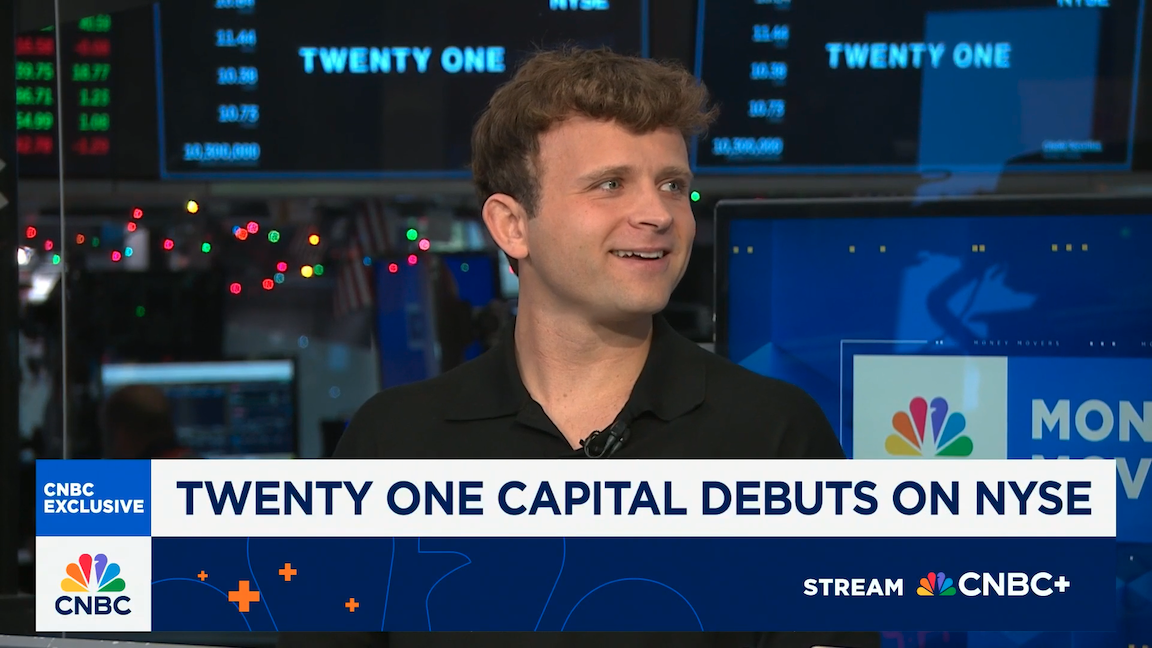
Jack Mallers appearing on CNBC’s “Money Movers” on Tuesday. Source: CNBC

“We’re building an operating company, we’re bringing a lot of Bitcoin products to market with the intent to have cash flow,” Mallers said, adding he sees “many opportunities in brokerage, exchange, credit and lending.”

Mallers deflected when pressed on what exactly Twenty One is planning, saying, “These things, we’ll come out with them sooner rather than later.”

Related: Vivek Ramaswamy's Strive to raise $500M to buy Bitcoin

The US has seen a deluge of so-called crypto treasury companies come to market this year, copying a model popularized by Strategy, where they buy and hold crypto and raise money to continue purchases.

Such crypto holding companies saw investor interest earlier this year as Bitcoin climbed to a high in October, but a decline in the crypto market since has dragged down shares in companies exposed to the sector.

Mallers is seemingly hoping his and Tether’s track record, and his conviction in Bitcoin, will buoy Twenty One in the meantime.

“We see Bitcoin as the forest through the trees,” he told CNBC. “It is the opportunity, and no one is seemingly focused on it. The story of this equity is to focus solely on Bitcoin and deliver value to shareholders primarily through Bitcoin.”

Magazine: Mysterious Mr Nakamoto author — Finding Satoshi would hurt Bitcoin

Letture associate

Axe Compute [NASDAQ: AGPU] Completes Corporate Restructuring (formerly POAI), Enterprise-Grade Decentralized GPU Computing Power Aethir Officially Enters Mainstream Market

Predictive Oncology has officially rebranded as Axe Compute and will trade on NASDAQ under the ticker AGPU. This rebranding signifies the company's shift to operating as an enterprise-level provider, commercializing Aethir's decentralized GPU network to deliver guaranteed computational power for global AI enterprises. Axe Compute's infrastructure is supported by the Aethir Strategic Compute Reserve (SCR), which offers predictable GPU reservations, dedicated computing clusters, and enterprise-grade SLAs to address computational bottlenecks in AI training, inference, and data-intensive workloads. This move marks the first time decentralized GPU infrastructure has entered mainstream capital markets via a U.S. publicly listed company. Axe Compute will serve as the enterprise-facing delivery and contracting entity, while Aethir continues to operate as the underlying decentralized GPU-as-a-Service infrastructure. This structure bridges Web3 decentralized networks with Web2 enterprise demand, allowing businesses to use distributed GPU resources within familiar compliance and procurement frameworks. Aethir's network currently spans 93 countries, over 200 regions, and deploys more than 435,000 GPU containers, supporting high-end hardware like NVIDIA H100, H200, B200, and B300. Axe Compute's model aims to provide guaranteed GPU reservations, dedicated clusters, bare-metal performance, multi-region deployment, and enterprise SLAs—addressing common industry challenges such as long procurement cycles, centralized cloud queues, and price volatility. This represents a significant step in scaling decentralized AI infrastructure for commercial use.

深潮5 min fa

Axe Compute [NASDAQ: AGPU] Completes Corporate Restructuring (formerly POAI), Enterprise-Grade Decentralized GPU Computing Power Aethir Officially Enters Mainstream Market

深潮5 min fa

Bitcoin's Creator Has Not Appeared Publicly for Exactly 15 Years. Where Did Satoshi Disappear To?

Bitcoin's creator, Satoshi Nakamoto, has been absent from the public eye for exactly 15 years, with his last known communication dating back to April 26, 2011. His final public forum post on December 12, 2010, addressed a DoS attack on the Bitcoin network. Shortly before disappearing, he privately corresponded with early developers, informing them he had "moved on to other things" and that Bitcoin was in good hands, specifically naming Gavin Andresen as the lead developer. His withdrawal is speculated to be linked to Andresen's planned talk about Bitcoin at the CIA headquarters. Satoshi's true identity remains one of cryptocurrency's greatest mysteries. Numerous theories exist, ranging from him being an individual to a group, or even a project by the CIA. Several individuals, including cryptographers Hal Finney and Nick Szabo, have been proposed as candidates, but all have either denied it or remained silent. Some speculate he may be deceased. The mystery is fueled further by the immense wealth potentially held by Satoshi. Research based on a unique mining pattern, dubbed "Patoshi," suggests he may have mined approximately 1.1 million BTC, worth over $100 billion at current prices. This was possible due to minimal mining competition and a high coin emission rate in Bitcoin's early days, when it could be mined on a regular laptop. The network's computational power has since grown by over 10 billion times.

RBK-crypto24 min fa

Bitcoin's Creator Has Not Appeared Publicly for Exactly 15 Years. Where Did Satoshi Disappear To?

RBK-crypto24 min fa

Trading

Spot
Futures
活动图片