Ripple's RLUSD Market Cap Exceeds $2 Billion, With Nearly $1 Billion on XRP Ledger

cryptonews.ruPubblicato 2026-08-26Pubblicato ultima volta 2026-08-26

Introduzione

Ripple USD's ($RLUSD) market capitalization has surpassed $2 billion, with nearly $1 billion issued on the XRP Ledger. Launched in December 2024, the stablecoin is backed by reserves of cash and cash equivalents, attested monthly by Deloitte. Data shows $RLUSD's market cap at approximately $2.02 billion, split almost evenly between the XRP Ledger ($962.8M) and Ethereum ($1.05B). This represents an eight-fold increase since April 2025. The stablecoin has provided significant dollar liquidity to the XRP Ledger, with over $2.5B processed through RLUSD trading pairs. Ripple is expanding RLUSD's utility through payments integrations (including Mastercard), exchange listings, regional distribution deals, and support for institutional lending initiatives on the XRP Ledger. A new platform, Ripple Mint, also allows qualified institutions to manage RLUSD issuance and redemptions.

Last week, the market capitalization of Ripple USD ($RLUSD) exceeded $2 billion. On August 25, Ripple announced this achievement in a post on X:

"Last week, the market cap of $RLUSD surpassed $2 billion, with nearly $1 billion issued on the $XRP Ledger. The system has been operational since December 2024, built for real-world utility and designed for enterprise use cases."

Each $RLUSD token is designed to maintain a value of $1 through reserves consisting of cash and permitted cash equivalents. Ripple's documentation for $RLUSD states that reserves are held in segregated accounts and include short-term U.S. Treasury bills, government money market funds, overnight reverse repurchase agreements, and bank deposits. According to Ripple, Deloitte performs monthly reserve attestations.

According to RWA.xyz, the market capitalization of $RLUSD was approximately $2.02 billion, having increased by 31.45% over 30 days, with about $962.8 million issued on the $XRP Ledger and $1.05 billion on the Ethereum network. According to the same data, over the previous 30 days, the transfer volume in $RLUSD amounted to $11.81 billion, distributed across 1.39 million transactions.
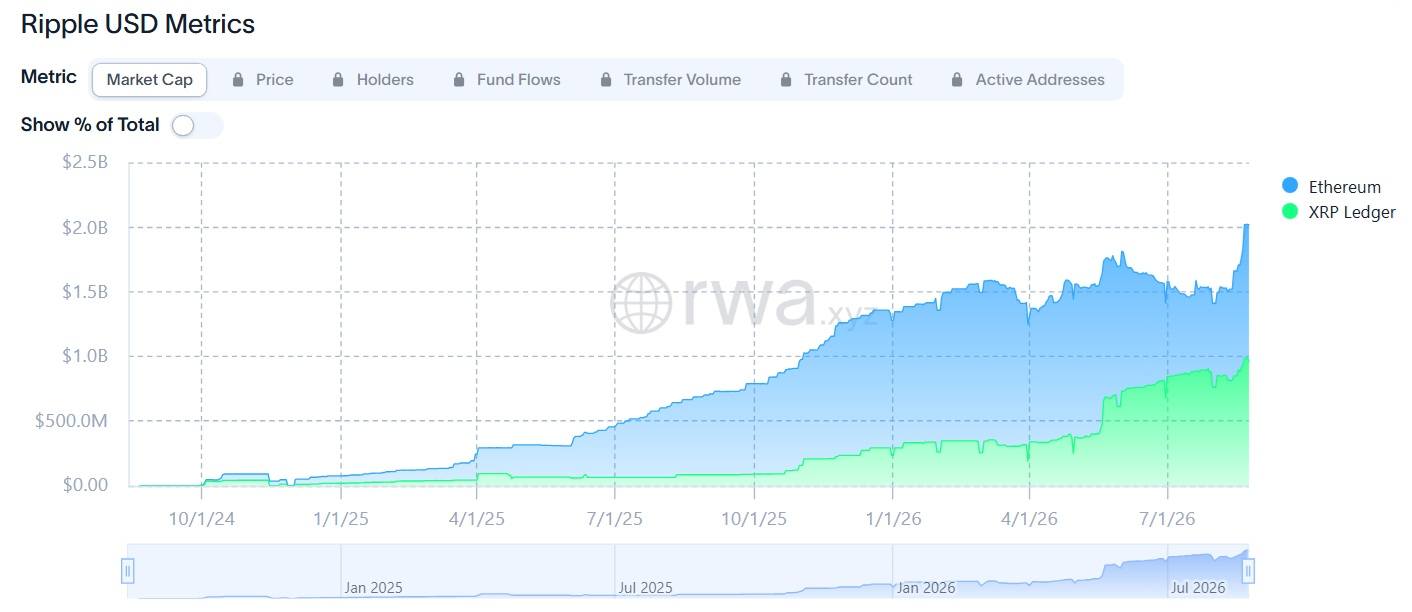
By August 25, the market capitalization of $RLUSD reached approximately $2.02 billion, with about $1.05 billion issued on Ethereum and $962.8 million on the $XRP Ledger. Source: RWA.xyz

Currently, these two networks account for nearly equal portions of the $RLUSD supply, with a difference of less than $90 million between them. Ripple mints the stablecoin directly on each chain rather than bridging them into a single pool, so these two balances comprise almost the entire $2.02 billion sum.

The stablecoin's current market cap is eight times the figure from its first four months post-launch. In April 2025, Ripple reported that the market capitalization of $RLUSD was approaching $250 million. At the time, the company had integrated the stablecoin into the Ripple Payments platform for cross-border transactions, treasury operations, and settlements with institutional investors.

Activity on $XRP Ledger Grows with $RLUSD Supply

The growing issuance of $RLUSD has provided additional dollar liquidity for the trading and payment infrastructure of the $XRP Ledger. According to an analysis by Evernorth, from the stablecoin's launch through the end of June, over $2.5 billion was processed through trading pairs with $RLUSD. The $RLUSD-$XRP pair accounted for approximately $900 million over the previous six months and constituted nearly 90% of $RLUSD trading volume on the network.

$RLUSD could also support institutional lending if two proposed amendments to the $XRP Ledger gain validator approval. Ripple supports an institutional lending initiative for $RLUSD involving Clearpool and Cicada Partners. The system remains in development on the Devnet and depends on the approval of amendments XLS-65 "Discreet Asset Vaults" and XLS-66 "Lending Protocol" before launching on the mainnet.

Institutional users gained another method of accessing the stablecoin when Ripple introduced a unified issuance and redemption platform in July. Ripple Mint allows eligible institutions to manage $RLUSD via a web interface or API. Its features include minting, redeeming, cross-chain bridging, balance monitoring, transaction tracking, and automated notifications, covering every step of the settlement process.

Payments and Multi-Chain Access Expand $RLUSD Utility

Ripple has expanded $RLUSD's utility through integrations with payment systems, exchange listings, regional distribution agreements, and support for additional blockchain networks. Among eight new $RLUSD introductions announced in July were: settlement support via Mastercard, availability in Japan and Turkey, integration with Bitso, and Flutterwave investments related to African payment corridors. Ripple also expanded the stablecoin's reach beyond its initial deployments on the $XRP Ledger and Ethereum.

Stablecoins are cryptocurrencies designed to be pegged to underlying assets, most commonly the U.S. dollar, through reserves, collateral, redemption mechanisms, or other structures. A stablecoin's collateral and redemption models determine how each token aims to maintain its peg to the underlying asset, as well as the risks faced by holders. The transfer volume metric measures on-chain movement, not payments, revenue, or net inflows, while market capitalization reflects the value of tokens in circulation.

end-content

Crypto di tendenza

Domande pertinenti

QWhat milestone did Ripple's RLUSD stablecoin achieve recently according to the article?

AThe market capitalization of Ripple USD (RLUSD) recently surpassed $2 billion, with nearly $1 billion of that amount issued on the XRP Ledger.

QHow is the value of each RLUSD token maintained, and how are the reserves audited?

AEach RLUSD token is designed to maintain a value of $1 through reserves consisting of cash and permitted cash equivalents. According to Ripple's documentation, the reserves are held in segregated accounts and include short-term U.S. Treasury bills, government money market funds, overnight reverse repurchase agreements, and bank deposits. The auditing firm Deloitte performs monthly attestations of these reserves.

QWhat is the current distribution of the $2.02 billion RLUSD market cap between the XRP Ledger and Ethereum networks?

AAccording to RWA.xyz, approximately $962.8 million of RLUSD was issued on the XRP Ledger, and $1.05 billion was issued on the Ethereum network. The difference between the two networks is less than $90 million.

QHow has RLUSD contributed to activity within the XRP Ledger ecosystem?

AThe growing issuance of RLUSD has provided additional dollar liquidity for the XRP Ledger's trading and payment infrastructure. Analysis from Evernorth shows that over $2.5 billion was processed through RLUSD trading pairs from its launch until the end of June. The RLUSD-XRP pair alone accounted for approximately $900 million in volume over the previous six months, representing nearly 90% of RLUSD's trading volume on the ledger.

QWhat were some of the key use case expansions for RLUSD announced by Ripple in July?

AIn July, Ripple announced eight expansions for RLUSD, including: enabling settlements via Mastercard, availability in Japan and Turkey, integration with Bitso, and Flutterwave's investment related to African payment corridors. Ripple also expanded the stablecoin's reach beyond its initial deployments on the XRP Ledger and Ethereum.

Letture associate

a16z Deep Dive: Stop Chasing the 'AI Smell', Here's a Practical Guide to Writing with AI

"Don't Obsess Over AI Detection: A Practical Guide to Writing Alongside AI" by Steph Zinn (a16z Crypto) This guide moves beyond the flawed premise that AI-generated text can be easily spotted by a set of "tells" and that these features automatically mean poor quality. Instead, it focuses on how writers and founders can use LLMs effectively by understanding, controlling, and editing the common stylistic tendencies of AI-assisted prose. The article breaks down AI writing "tells" into four key dimensions: **1. Rhetorical Features (Insight-Shaped Writing):** AI often produces semantically empty, "corporate-sounding" filler language—vague profundities, hedging phrases, excessive parallelism, and summary statements. The advice is to ruthlessly edit these out, using prompts to make language more specific and direct. **2. Voice Features (The Alexa Voice):** Default AI writing relies on a narrow, fungible vocabulary of low-friction, abstract words and cliché phrases that lack personality. While this generic voice is acceptable for support docs or mass communications, founders should preserve their unique voice for impactful writing. Use LLMs to identify and replace jargon, aiming for concrete, distinctive word choices. **3. Structural Features (Form Without Function):** AI tends towards over-structured text with excessive subheadings, lists, roadmaps, and the rigid "three-point" framework. While clear structure is good for readability and SEO, it shouldn't force ideas into unnatural containers. Choose a structure that serves the format and purpose, borrowing from effective examples. **4. Punctuation Features (Dash Panic):** The overuse of em dashes and colons has become a hallmark, but writers shouldn't avoid useful punctuation just to seem "human." The key is avoiding repetitive, distracting patterns. Use punctuation that is grammatically correct and supports the flow of your argument. The core argument is that many so-called AI flaws are just amplified versions of existing bad writing habits. The goal isn't to eliminate AI's role but to use it as a tool while maintaining editorial control. The final question shouldn't be "Can this be detected as AI?" but "Does this writing effectively do its job?"

marsbit50 min fa

a16z Deep Dive: Stop Chasing the 'AI Smell', Here's a Practical Guide to Writing with AI

marsbit50 min fa

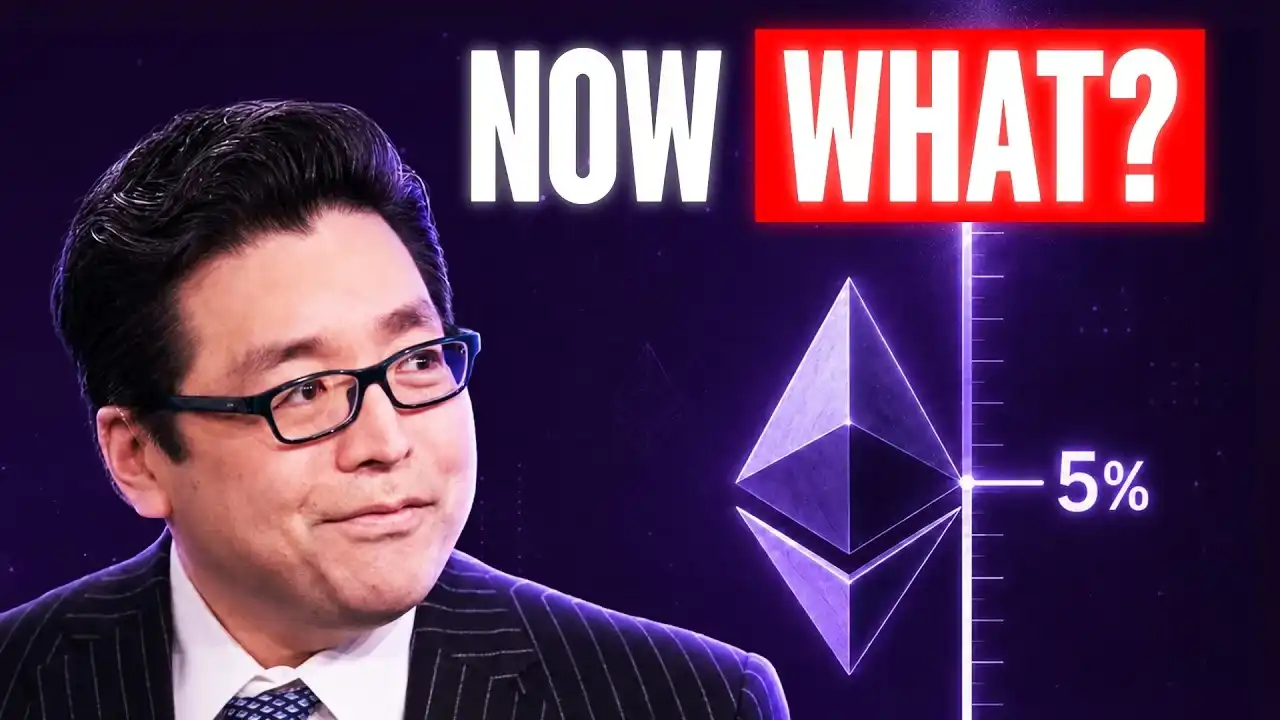
Podcast Notes | Conversation with Tom Lee: Bitmine Acquiring Nearly 5% of Total ETH Supply Is Not the End Goal, ETH Price Target Set at $10,000

In a podcast interview, Tom Lee, Chairman of BitMine Immersion Technologies, discusses the company's strategy to accumulate nearly 5% of the total Ethereum supply within 14 months, using equity financing and avoiding debt. BitMine has consistently purchased ETH for over 60 consecutive weeks, with recent weeks combining buybacks with purchases. The company's substantial ETH holdings generate approximately $300 million in annual staking rewards, covering operational costs like the dividends for its 9.5% perpetual preferred stock (BMNP). Lee positions ETH as a store-of-value asset, likening it to stocks or land, rather than a pure cash-flow instrument. Looking ahead, Lee suggests BitMine may continue buying beyond the 5% target if institutional adoption grows. He outlines a bullish price target for ETH: surpassing $5,000 in a new crypto bull cycle and potentially exceeding $10,000 within 1-2 years, driven by Wall Street tokenization and AI-related demand. The discussion also covers BitMine's evolution into an ecosystem player, funding Ethereum Foundation spin-offs and developing its Maven staking platform. Lee acknowledges his significant financial interests are tied to ETH's price and BitMine's performance. The interview provides a framework for evaluating ETH as a long-term asset, emphasizing staking yield sustainability and future institutional demand, while noting the uncertainties surrounding macro cycles and real-world adoption.

marsbit50 min fa

Podcast Notes | Conversation with Tom Lee: Bitmine Acquiring Nearly 5% of Total ETH Supply Is Not the End Goal, ETH Price Target Set at $10,000

marsbit50 min fa

Pricing Risk Assets in 8 Hours: Tonight's PCE to Set the Discount Rate, Nvidia to Test Earnings Tomorrow Morning

"Pricing Risk Assets in 8 Hours: PCE to Set the Discount Rate Tonight, NVIDIA to Test Profits Tomorrow Morning" Risk asset prices hinge on two variables: the numerator (earnings expectations) and the denominator (the discount rate). Both will be recalibrated within eight hours. First, at 20:30 Beijing time, the US Bureau of Economic Analysis releases July PCE inflation data and the second estimate of Q2 GDP. Consensus expects mild core PCE growth, but a surge in key PPI components poses an upside risk. A hotter-than-expected print could push Treasury yields and the dollar higher, threatening the recent rally in Bitcoin (BTC) above $80K, which was fueled by falling yields. A benign reading would support risk assets. Market sentiment is already "greedy" (Fear & Greed Index at 74), making it vulnerable to disappointment. Second, around 04:20, NVIDIA reports its Q2 FY27 earnings. While consensus revenue of ~$91.85B slightly exceeds company guidance, the market has priced in a beat. The key will be the magnitude of the beat and, crucially, the Q3 guidance. As a bellwether for tech and AI narratives, NVIDIA's results will significantly impact overall risk appetite and AI-related crypto tokens. The combination creates four scenarios: 1) Benign PCE & strong NVIDIA guidance confirms the bullish trend. 2) Hot PCE & strong NVIDIA leads to conflicted signals and likely volatility for BTC. 3) Benign PCE & weak NVIDIA guidance pressures tech but offers some macro support for BTC. 4) Hot PCE & weak NVIDIA guidance presents a "double whammy," risking a sharp pullback in BTC toward the $75K-$76K support zone. The outcomes will set the tone for markets ahead of the upcoming Jackson Hole symposium.

marsbit1 h fa

Pricing Risk Assets in 8 Hours: Tonight's PCE to Set the Discount Rate, Nvidia to Test Earnings Tomorrow Morning

marsbit1 h fa

Trading

Spot

Articoli Popolari

Cosa è XRP 2.0

XRP 2.0: Una Nuova Frontiera nel Paesaggio delle Criptovalute Introduzione a XRP 2.0 Nel mondo in continua evoluzione delle criptovalute, nuovi progetti emergono continuamente, cercando attenzione e adozione. Una tale iniziativa promettente è XRP 2.0, un nuovo progetto di criptovaluta progettato per sfruttare avanzate tecnologie blockchain e metodologie di crittografia robuste. Anche se il nome richiama alla mente l'XRP di Ripple, è fondamentale notare che XRP 2.0 opera in modo indipendente, concentrandosi sul miglioramento della sicurezza delle transazioni, della privacy e della scalabilità. Mentre il panorama finanziario digitale abbraccia sempre di più soluzioni decentralizzate, XRP 2.0 mira a contribuire in modo significativo al web3 e all'espansione generale dei progetti crypto. Cos'è XRP 2.0? Alla sua base, XRP 2.0 è un progetto di criptovaluta che mira a creare un ecosistema di valuta digitale sicuro e decentralizzato. La sua tecnologia fondamentale integra principi di blockchain sofisticati con tecniche di crittografia all'avanguardia. L'obiettivo principale di XRP 2.0 è quello di affermarsi come una piattaforma affidabile ed efficiente in grado di consentire un'esecuzione rapida delle transazioni, dando priorità a migliori protezioni della privacy per i suoi utenti. Il progetto è promosso come una soluzione a molte limitazioni affrontate dalle criptovalute esistenti, proponendo un sistema in grado di gestire un volume maggiore di transazioni con migliorata velocità e privacy. Questa versatilità pone XRP 2.0 come un significativo competitor in un mercato affollato di varie valute digitali. Chi è il Creatore di XRP 2.0? L'identità del creatore dietro XRP 2.0 è stata segnalata come 'Wilbur'. Tuttavia, i dettagli completi riguardanti Wilbur o l'entità associata rimangono sfuggenti. L'anonimato di molti creatori di criptovalute non è un fenomeno raro nel settore, spesso progettato per mantenere un certo grado di privacy e sicurezza. Chi sono gli Investitori di XRP 2.0? Al momento, informazioni specifiche relative alle fondazioni o organizzazioni di investimento a supporto di XRP 2.0 non sono disponibili pubblicamente. Nel settore delle criptovalute, il supporto di investitori rinomati può influenzare significativamente la credibilità e il successo di un progetto, tuttavia la trasparenza riguardo ai sostenitori finanziari di XRP 2.0 non è stata stabilita. Come Funziona XRP 2.0? XRP 2.0 si distingue per l'impiego di una combinazione di tecnologia blockchain e algoritmi di crittografia avanzati che garantiscono transazioni sicure e decentralizzate. La sua struttura innovativa include caratteristiche uniche progettate per promuovere il coinvolgimento degli utenti e ampliare le funzionalità oltre le transazioni convenzionali delle criptovalute. Tra queste caratteristiche, XRP 2.0 incorpora capacità alimentate da intelligenza artificiale, come funzionalità di testo in immagini e testo in voce. Queste aggiunte sono progettate per migliorare l'esperienza interattiva per gli utenti, promuovendo una maggiore applicabilità in vari settori. Unendo progressi tecnologici con design incentrati sugli utenti, XRP 2.0 mira a catturare l'attenzione di una vasta gamma di individui e aziende che cercano di integrare soluzioni di criptovaluta nei loro framework operativi. Cronologia di XRP 2.0 Comprendere XRP 2.0 richiede di esaminare i traguardi che hanno definito il suo percorso fino ad ora: 23 luglio 2023: XRP 2.0 viene introdotto come un nuovo progetto di criptovaluta, mirante a rivoluzionare le capacità di transazione sicura e decentralizzata nel dominio blockchain. 8 settembre 2023: Si verifica il lancio di un altro progetto, XRP20, marcando l'emergere di un token ERC-20 sulla blockchain di Ethereum che resta non correlato a XRP 2.0. 13 novembre 2023: Il ledger XRP subisce un significativo aggiornamento con il rilascio della versione 2.0.0 del software server rippled. È essenziale notare che questo sviluppo è scollegato dal progetto di criptovaluta XRP 2.0. Punti Chiave su XRP 2.0 Per distillare l'essenza di XRP 2.0, emergono diversi fattori critici: Caratteristiche Uniche: L'inclusione di funzionalità come il testo in immagini e testo in voce alimentato da intelligenza artificiale diversifica ulteriormente le potenziali applicazioni di XRP 2.0. Tecnologia Blockchain: Il framework utilizza meccanismi blockchain avanzati e protocolli di crittografia, garantendo un ambiente sicuro e decentralizzato per le transazioni. Scalabilità e Privacy: XRP 2.0 dà priorità a migliori protezioni della privacy nei processi di transazione e alla scalabilità necessaria per accogliere una base di utenti in crescita. Nessuna Affiliazione con Ripple: È importante notare che, nonostante il suo nome, XRP 2.0 non ha alcuna fedeltà o collaborazione con l'XRP di Ripple, distinguendo il proprio framework operativo e obiettivi all'interno dell'ecosistema delle criptovalute. Conclusione XRP 2.0 rappresenta un'ambiziosa venture nell'ambito delle criptovalute, mirante a offrire una combinazione di sicurezza, privacy ed efficienza nelle transazioni digitali. Integrando tecnologie sofisticate e caratteristiche user-friendly, il progetto si propone di ampliare gli orizzonti di ciò che le criptovalute possono realizzare nell'economia digitale odierna. Sebbene l'anonimato del suo creatore e la mancanza di investitori dichiarati possano sollevare domande per alcuni, il focus di XRP 2.0 su funzionalità avanzate e decentralizzazione ne amplifica l'appeal in un mercato crypto sempre più affollato. Man mano che il panorama delle criptovalute continua a evolversi, XRP 2.0 potrebbe emergere come un attore decisivo nell'espansione di soluzioni blockchain sicure e scalabili.

331 Totale visualizzazioniPubblicato il 2024.04.05Aggiornato il 2024.12.03

Cosa è XRP 2.0

Come comprare XRP

Benvenuto in HTX.com! Abbiamo reso l'acquisto di XRP (XRP) semplice e conveniente. Segui la nostra guida passo passo per intraprendere il tuo viaggio nel mondo delle criptovalute.Step 1: Crea il tuo Account HTXUsa la tua email o numero di telefono per registrarti il tuo account gratuito su HTX. Vivi un'esperienza facile e sblocca tutte le funzionalità,Crea il mio accountStep 2: Vai in Acquista crypto e seleziona il tuo metodo di pagamentoCarta di credito/debito: utilizza la tua Visa o Mastercard per acquistare immediatamente XRPXRP.Bilancio: Usa i fondi dal bilancio del tuo account HTX per fare trading senza problemi.Terze parti: abbiamo aggiunto metodi di pagamento molto utilizzati come Google Pay e Apple Pay per maggiore comodità.P2P: Fai trading direttamente con altri utenti HTX.Over-the-Counter (OTC): Offriamo servizi su misura e tassi di cambio competitivi per i trader.Step 3: Conserva XRP (XRP)Dopo aver acquistato XRP (XRP), conserva nel tuo account HTX. In alternativa, puoi inviare tramite trasferimento blockchain o scambiare per altre criptovalute.Step 4: Scambia XRP (XRP)Scambia facilmente XRP (XRP) nel mercato spot di HTX. Accedi al tuo account, seleziona la tua coppia di trading, esegui le tue operazioni e monitora in tempo reale. Offriamo un'esperienza user-friendly sia per chi ha appena iniziato che per i trader più esperti.

1.9k Totale visualizzazioniPubblicato il 2024.12.10Aggiornato il 2026.06.02

Come comprare XRP

Discussioni

Benvenuto nella Community HTX. Qui puoi rimanere informato sugli ultimi sviluppi della piattaforma e accedere ad approfondimenti esperti sul mercato. Le opinioni degli utenti sul prezzo di XRP XRP sono presentate come di seguito.

活动图片