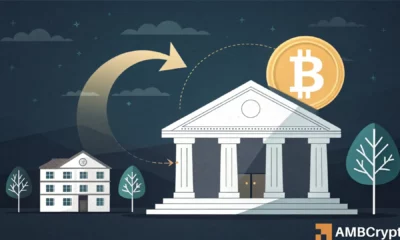
Why sell your coins when you can borrow money?
This mantra, once only circulated among crypto whales, has now become the official creed of Wall Street's big six banks.

According to MicroStrategy founder Michael Saylor, top financial institutions including JPMorgan, Citi, and Bank of America have quietly launched a revolutionary business: accepting Bitcoin as collateral to provide clients with fiat currency loans.
Don't underestimate this news that didn't make the headlines. If the approval of ETFs meant Bitcoin entered Wall Street's stock accounts, then "accepting collateral" means Bitcoin has entered the core of Wall Street's balance sheets.
This is a qualitative change in monetary nature: Bitcoin is no longer just a chip for trading; it has officially gained the status of "Pristine Collateral," on par with U.S. Treasury bonds and gold. From now on, Bitcoin holders can obtain liquidity without selling a single Satoshi.
A "buy, don't sell" credit flywheel is slowly turning.
Everyone is MicroStrategy
Over the past four years, Michael Saylor has stunned the world with an almost insane strategy: issue debt to buy coins, use coins as collateral to buy more coins, issue more debt, buy more coins.
This "stepping on your own feet to spiral upwards"玩法 had one huge barrier to entry—you had to be a publicly listed company or a billionaire with an extremely high credit rating to borrow money at low interest rates. Ordinary institutions and high-net-worth individuals who wanted to exchange Bitcoin for cash often had to turn to DeFi protocols (facing the risk of contract hacks) or second-tier lending platforms (facing the risk of misuse like FTX), with high interest rates and full of uncertainty.
Now, Wall Street has broken down this barrier.
When JPMorgan and Citi start accepting BTC as collateral, it means they have standardized, productized, and合规化 Saylor's strategy.
Imagine this scenario: a family office holding 1000 BTC, which previously needed $10 million for周转, had to sell part of its Bitcoin, not only paying high capital gains taxes but also losing future upside potential. Now, it only needs to抵押 its Bitcoin to the bank to get $10 million in cash.
- Tax-wise: A loan is not income, so it is not taxable.
- Asset-wise: Ownership of the Bitcoin remains in its hands, and it still enjoys the benefits of price appreciation.
This is the common strategy for the wealthy class: "Buy, Borrow, Die." When this strategy is普及 by Wall Street to the entire crypto market, the logic of Bitcoin selling pressure will be completely rewritten: In this market, true diamond hands will no longer need to sell coins.
Credit Expansion: Fiat Flows In Like Water
From a macro perspective, this is also the most critical step in Bitcoin's monetization process: Credit Creation.
In the modern financial system, money is not only printed by central banks but also loaned out by commercial banks. When banks accept real estate as collateral to loan out dollars, real estate participates in the credit expansion of the dollar; when banks accept Bitcoin as collateral to loan out dollars, Bitcoin effectively becomes the anchor for the issuance of "shadow dollars."
This means the flood barrier between the Bitcoin system and the fiat system has been blown open.
In the past, pushing up the Bitcoin price required real "net inflows" of capital. Now, through抵押借贷, Bitcoin itself can create new purchasing power. You抵押 BTC to borrow dollars, and then you can use those dollars to buy more BTC (or buy a house, buy stocks).
This forms a positive Credit Flywheel: Coin price rises ->抵押物 value increases -> Loanable amount increases -> Loan out more fiat -> Buy more assets -> Coin price continues to rise.
As long as Bitcoin's long-term volatility remains controllable within the banks' risk models, this flywheel will introduce astronomical levels of fiat liquidity. This is a more ferocious catalyst than ETF inflows because ETFs are linear capital accumulation, while credit is exponential expansion with leverage.
Regulatory Acquiescence and the Demise of SAB 121
The fact that the big six banks dare to do this is itself a huge political signal.
Remember, the SEC's SAB 121 (Staff Accounting Bulletin No. 121) was once a tight curse. It required banks that custody crypto assets to record those assets on their balance sheets as liabilities, which greatly increased the banks' capital pressure and effectively prohibited banks from engaging in crypto custody.
Now, the fact that Wall Street giants are collectively launching抵押借贷 businesses indicates that SAB 121 is practically dead in terms of implementation, or that banks have found ways to circumvent the regulation (or obtained regulatory exemptions).
This is not surprising. When Bitcoin ETF规模突破千亿美元, Bitcoin has become too big to ignore. Rather than letting these high-value assets flow to crypto-native companies like Coinbase, it's better for "Old Money" to firmly control them through custody and credit业务.
This is a transfer of power. The pricing power and liquidity control of Bitcoin are shifting from exchanges like Binance to the headquarters of JPMorgan in Manhattan.
Risk: The Cruelty of Deleveraging
Of course, the flywheel can spin forward, but it can also reverse.
When we incorporate Bitcoin into the traditional credit system, we also expose Bitcoin to the risks of traditional debt crises.
Although "never selling coins" sounds beautiful, borrowing comes with a清算线 (Margin Call). When the Bitcoin price experiences a sharp correction of 30% or more, the banks' risk control systems will be more冷酷无情 than any DeFi protocol. They will forcibly sell the抵押品 to recover the loan.
This kind of credit-driven rise is often accompanied by an even more brutal deleveraging process. The future Bitcoin market might see reduced volatility due to institutional involvement, but once a systemic crash occurs, its chain reaction will no longer be confined to the crypto circle but could spill over into traditional financial markets.
Investor Survival Guide
Facing this new "creditized" cycle, how should ordinary investors respond?
Learn "Debt Thinking":
- Your goal used to be "accumulate more coins," then sell them for U.S. dollars when the price rose.
- Your future goal should be "accumulate more high-quality assets (BTC)," establish a good credit history, learn to use low-interest loans like the wealthy to cover living expenses, and retain the appreciation rights of your assets.
Beware the "Leverage死神":
- Wall Street can play the "borrowing flywheel" because they have unlimited margin and hedging tools.
- If ordinary retail investors imitate Saylor's循环抵押 (using抵押 BTC to buy more BTC), be sure to control the Loan-to-Value ratio (LTV). Bitcoin is still a highly volatile asset. It is recommended that LTV never exceed 30%-40%, leaving yourself a safety cushion of more than 50% for price drops. Don't fall to forced liquidation just before dawn.
Pay Attention to the "Return of CeFi":
- As banks enter the game, centralized lending (CeFi) will experience a second spring, but the protagonists this time are not Celsius or BlockFi, but compliant licensed institutions. Pay attention to those crypto wealth management platforms that have打通 fiat on/off ramps and have deep cooperation with banks, as they might be the new红利入口.